 R112
R112Palada Payasam, Rebuilt
Rice ada in reduced milk, at a measured 100 millilitres
Recipes › Sweets and Payasam, Honestly
R114
Green gram payasam — the highest-protein and lowest-load payasam in the tradition
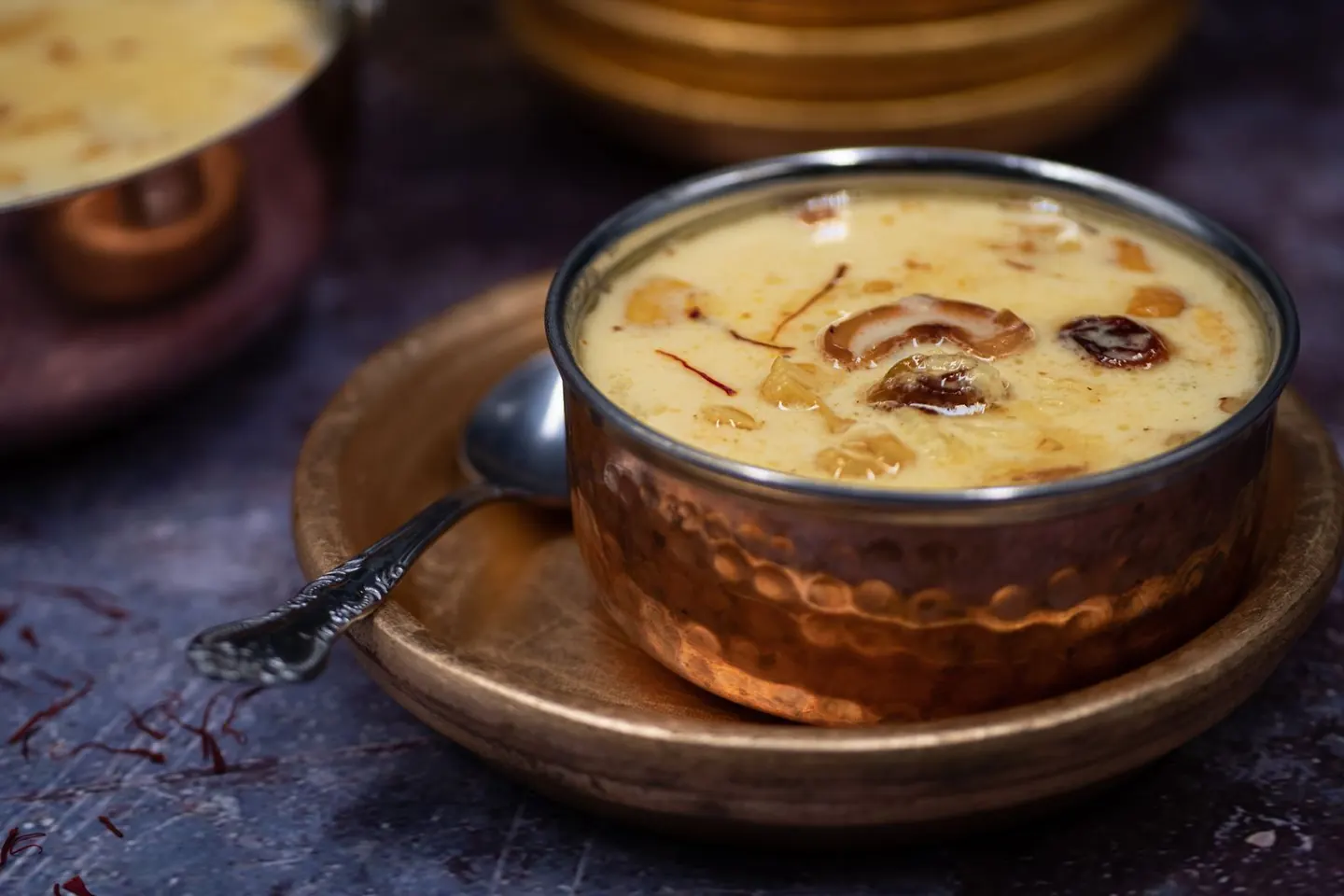
Photograph: Adobe Stock · representative of the dish
Of all the payasams, this is the one that carries actual food in it. A hundred and twenty grams of green gram dal delivers nearly 29 g of protein and 11 g of fibre into the pot, which is why a bowl of this reads as substantial in a way that ada pradhaman never does — 5 g of protein per serving against 2 g for the same volume of ada pradhaman, and 3 g of fibre against 1. It is also the payasam most improved by technique: dry-roast the dal until it smells of biscuit before you cook it, and the difference is not subtle.
Before you start: Melt and strain the jaggery before you start cooking, as in R113. And roast the dal properly — this is the step people skip, and it is the step the dish depends on.
Allergens: Milk.
Equipment: Heavy pan of at least 3 litres, or an uruli; a small frying pan for roasting the dal; a fine sieve for the jaggery. Substitute: a pressure cooker for the dal saves 15 minutes — three whistles, then let the pressure drop naturally. Roast the dal first regardless; the cooker cannot do that step for you.
Split skinned green gram dal — moong dal, cherupayar parippu — is in every Indian grocery and most supermarkets. Whole green gram with the skin on also works and gives a darker, earthier payasam with considerably more fibre (17.04 g per 100 g against 9.37 g for the split dal), at the cost of a longer cook and a less refined texture; several households in central Kerala make it that way and it is not a compromise. Do not use yellow split peas, which are a different legume and stay grainy. Jaggery and coconut milk as in R113.
Blood sugar: 24 g of net carbohydrate, but arriving with 5 g of protein and 3 g of fibre, which is the most favourable ratio of any payasam in this chapter. Made with whole green gram rather than split dal, the fibre goes to about 5 g a bowl.
Blood pressure: 40 mg sodium. Comfortable.
Cholesterol: 10 g of saturated fat, essentially all coconut milk. Using only second milk and skipping the first takes it to about 5 g, and this is the one payasam where that substitution works reasonably well, because the roasted dal supplies body the coconut fat would otherwise have to.
Split green gram dal → whole green gram with skin, same weight. Add 10–12 minutes to step 3. Earthier, coarser, and fibre roughly doubles.
Green gram → red gram dal (toor), which makes parippu pradhaman, a sadya dish in its own right. Heavier, sweeter, and the roasting matters even more.
Jaggery → cane jaggery or panela, 1:1, with the usual loss of smoke.
Ghee → coconut oil for a vegan version, 1:1. The dish is then entirely plant-based.
Skip the first milk entirely and use 400 ml of second → about 165 kcal and 5 g of saturated fat a bowl. Thinner, but this is the payasam that survives it.
Cook to the end of step 6 up to two days ahead — the dal-and-jaggery base keeps well and improves. Fridge 3 days finished, thickening considerably. Freeze 2 months, before the first milk goes in; this freezes better than any other payasam in the chapter because the pulse holds its texture. Reheat gently with a splash of water and finish with fresh first milk.
The thick base, without coconut milk, is very close to the sweet filling of an unnakkaya or a kadalaparippu ada. Use it in R115 Elayada, or thin it with hot water into a breakfast porridge with a spoon of curd, which is a genuinely good use for it and a better breakfast than most sweet things.
Tastes of raw pulse: under-roasted at step 1. Nothing later in the recipe corrects it.
Bitter, acrid: the dal scorched during roasting, or the jaggery caught. Start the roasting again with new dal; it costs seven minutes and saves the pot.
Grainy and slightly chalky: the dal was not fully soft before the jaggery went in. Sugar slows the softening of pulses considerably, so once the jaggery is in, what you have is what you get.
Split and oily: the first milk boiled. Off the heat, always.
Too thick to portion: it will thicken further off the heat. Hold back 50 ml of second milk and add it at the last moment.
Serve with
As one of the two payasams at a sadya, alongside R112 or R120 · R069 Avial and R015 Matta Rice, in the sadya sequence · R107 Sambharam to close · M08 coconut milk, three extractions
Tap a star to rate this recipe
The Kindle edition is on its way. Until it lands, the complete book — all 25 chapters and 137 recipes — is free to read here, and it stays free after.