 R089
R089Kerala Kitchen Salad
Raw vegetables the way a Kerala kitchen cuts them
Recipes › Salads, Pachadis, Chutneys, Podis and Pickles
R096
Naranga achar at a third of the salt, and a third of the shelf life
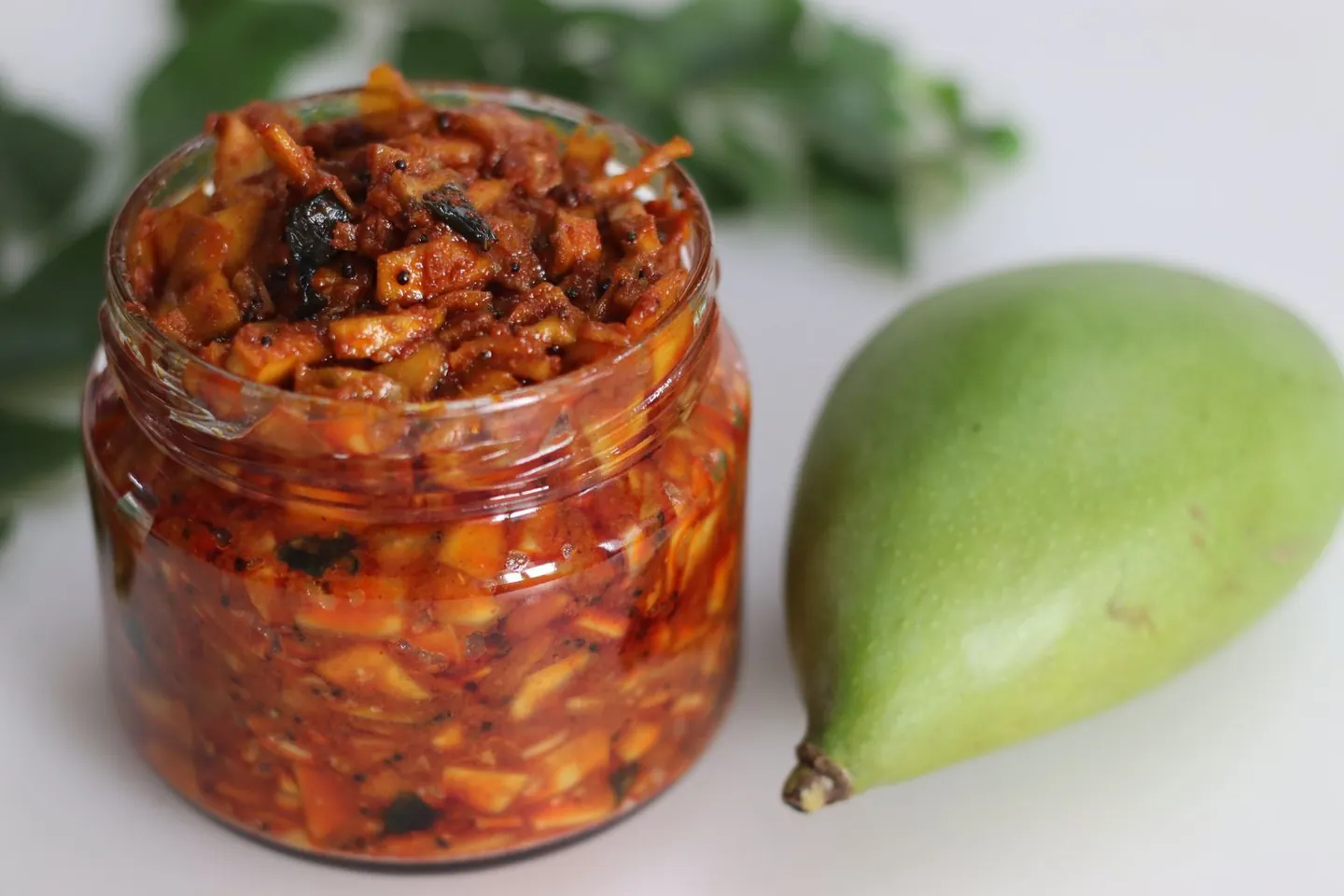
Photograph: Adobe Stock · representative of the dish
Plan ahead: plus 5–7 days maturing, and 4 hours salting.
> ## READ THIS BEFORE YOU MAKE IT > Salt is not a flavouring in a pickle. It is the preservative. Traditional Kerala achar carries salt at roughly a tenth to a seventh of the fruit's weight because that concentration draws water out of the fruit and denies spoilage organisms the free water they need to grow, which is why a bharani of mango pickle sits in a Kerala pantry for a year without refrigeration. Reduce the salt and you remove that protection. This recipe therefore is not a pantry pickle. It lives in the refrigerator, it has a short and specific life, and it must be handled with a dry spoon and a clean jar. Read the storage section before you start, not after. > > And here is the honest part. No food-safety authority specifies a minimum salt concentration for this style of pickle. The National Center for Home Food Preservation and the USDA Complete Guide to Home Canning between them govern fermented pickles, vinegar-acidified quick pickles and canned chutneys; a Kerala achar — not fermented, not heat-processed, preserved by acid, salt and a seal of oil — belongs to none of those classes, so there is no published percentage to point to. What the authorities do publish is a threshold that is not about salt at all: the National Center for Home Food Preservation states that "if the product is not acidified sufficiently (below pH 4.6), and not heat-processed adequately, pathogenic bacterial spores may survive", and that pH 4.6 is the line above which a food counts as low-acid and Clostridium botulinum can grow. Because this book cannot hand you a salt number backed by an authority, it errs the other way: refrigeration, a short dated shelf life, and a set of discard rules that assume the barrier is thinner than you would like.
Lime achar is the one pickle where a serious salt reduction is defensible, because lime juice is punishingly acidic on its own account and the fruit is preserved in its own juice as much as in salt. This is still a condiment for a teaspoon rather than a spoonful. What it gives back is enormous: a quarter-teaspoon of it will make an unsalted thoran taste finished.
Before you start: Sterilise the jar — wash in hot soapy water, rinse, then dry in a 110°C (230°F) oven for 20 minutes and cool without touching the inside. Every surface that meets this pickle must be dry. A single drop of water is a colony.
Allergens: Sesame, mustard. Gluten (wheat) — only if your asafoetida is compounded with wheat flour, as most brands are.
Equipment: Glass or glazed ceramic jar with a tight lid, 750 ml, sterilised and bone dry; dry glass or ceramic bowl; small pan for the oil. No metal spoons, no metal lids in contact with the pickle — lime juice will corrode them and the pickle will taste of tin. Substitute: two smaller jars, which is better, because you open one and leave the other sealed.
Use small thin-skinned limes — Indian cherunaranga, or Mexican/key limes abroad. Large thick-skinned Persian limes make a bitter pickle because the pith is thicker; if that is all you can find, peel away half the pith. Sesame oil here should be the plain Indian gingelly oil, not the dark East Asian toasted sesame oil, which will dominate everything. Kashmiri chilli powder gives the colour with modest heat; ordinary hot chilli powder at 20 g will make this ferocious.
Blood pressure: 190 mg a tablespoon, 60 mg a teaspoon. Against a 2,000 mg daily target, a teaspoon of this is a rounding error where a tablespoon of the traditional version is 27% of the day. The behavioural instruction matters more than the recipe: put the pickle jar in the fridge rather than on the table, and serve it with a teaspoon rather than a dessert spoon.
Blood sugar: negligible carbohydrate, and the acid alongside a rice meal is on the useful side of the evidence.
Cholesterol: 0.1 g of saturated fat a tablespoon. Sesame oil is 16% saturated where coconut oil is 91%, which is why it is specified here.
Coconut oil for the sesame → Consequence: more recognisably Kerala, and saturated fat per tablespoon rises from 0.1 g to about 1.6 g. Also note that coconut oil solidifies below about 24°C (75°F), so a refrigerated pickle made with it sets into a block; sesame stays liquid, which is the practical reason for the swap as much as the lipid one.
Salt back up to 12% (48 g) → Consequence: a genuine pantry pickle that keeps 6–12 months unrefrigerated, at roughly 550 mg of sodium a tablespoon. If you have a household that will only accept a traditional achar, make it traditional and serve it by the quarter-teaspoon; that is a better outcome than a low-salt pickle nobody trusts.
Potassium-enriched salt for part of the salt → this book does not recommend it in a pickle. Consequence: the preservation evidence and practice rest on sodium chloride specifically, and substituting potassium chloride changes the chemistry of the barrier you are relying on for safety. Separately, potassium-enriched salt is not for readers with chronic kidney disease, or on a RAAS inhibitor (an ACE inhibitor or an ARB) or a potassium-sparing diuretic, without a doctor's approval.
Add 20 g of slivered garlic → Consequence: much better flavour and a genuine safety caution, and this one has changed since the first draft of this book. Health Canada's guidance on vegetables and herbs in oil is that garlic, onions, sun-dried tomatoes, hot peppers and mushrooms are low-acid foods that "if they are not prepared, bottled or refrigerated properly … can cause foodborne illnesses like botulism"; that such mixtures must always be kept in the refrigerator; and — the figure that matters — "use your oil within one week of making it. Throw out any oil that is left over." Health Canada also notes that "there usually aren't any obvious signs that your oil is spoiled. You will not be able to tell if it is dangerous, because it will still look, smell, and taste the same." The lime juice here acidifies the garlic, which is the condition under which garlic in oil is defensible at all, but this book will not print a longer life than the national authority prints for the same hazard. If you add garlic, the pickle keeps one week in the refrigerator, not six. Make a small jar.
At 800 g of limes, split the pickle between three jars. A jar that is opened daily has a shorter life than one that is not.
Fridge 6 weeks, at 4°C (39°F) or below, in a sterilised jar with the solids under liquid and a film of oil on top. Cupboard: none. This pickle must not be stored at room temperature at any point beyond the 4-hour salting step and the time it takes to eat a meal. Freeze 6 months in 60 g portions in small sterilised jars, thawed in the fridge and used within 2 weeks. Always use a dry spoon, never a wet or previously licked one, and never return anything to the jar.
A jar that has gone soft rather than bad — the peel collapsing, the flavour flattening — is not finished. Blend 3 tablespoons with 100 ml of water into a pickle-based gravy for boiled tubers, or stir a tablespoon into a fish curry in place of the souring agent and the salt together.
Bitter: the pith, or burnt fenugreek at step 3. Thick-skinned limes are the usual culprit.
Went mouldy in a fortnight: water somewhere — a damp jar, damp fruit, or a wet spoon. There is no salvage.
Peel still tough after a week: the salting at step 2 was too short, or the limes were thick-skinned. Leave it another week; it will soften.
Tastes only of chilli: the chilli powder was added to hot oil and scorched. It should go in off the heat.
Serve with
R015 Perfect Matta Rice · R012 Kanji with a Pulse · R058 Parippu Curry · R120 the sadya leaf, by the quarter-teaspoon
Tap a star to rate this recipe
The Kindle edition is on its way. Until it lands, the complete book — all 25 chapters and 137 recipes — is free to read here, and it stays free after.