 R053
R053Vanpayar Thoran
Brown cowpea with grated coconut
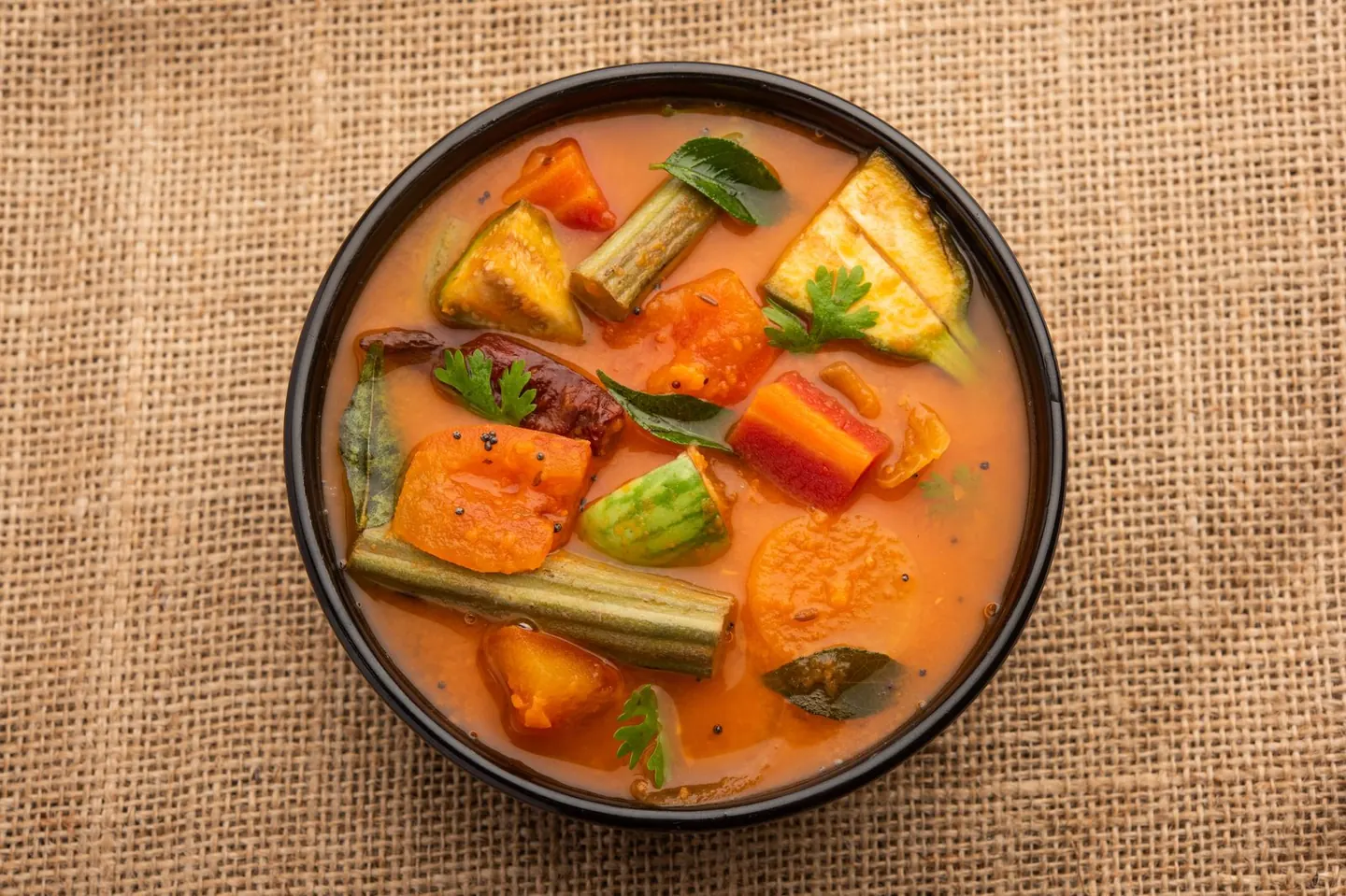
Photograph: Adobe Stock · representative of the dish
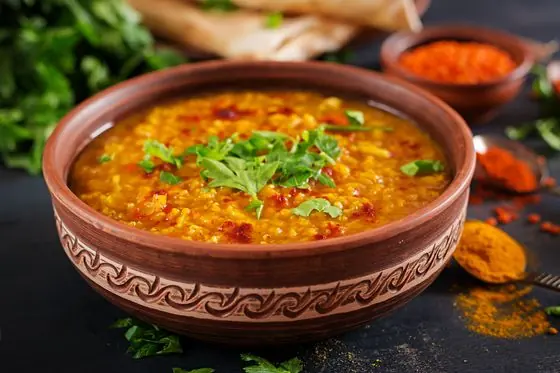
Parippu with a spoon of ghee is the first rice course of every sadya, served when agni — the digestive fire, in the tradition's own terms — is held to be at its strongest. It is also, read as nutrition, an unusually sensible way to open a feast: 24 g of protein per 100 g dry moong dal, arriving before any of the rich curries, at a low glycaemic load. This is a temple-register recipe, so there is no onion and no garlic in it. Do not add them; there are nine other recipes in this chapter where they belong.
Before you start: Dry-roast the moong dal before you cook it — 3–4 minutes in a dry pan, until it smells of biscuit. This is the step that separates a sadya parippu from a plain dal, and it takes almost no time.
Allergens: Milk, mustard.
Equipment: Pressure cooker or heavy pot; mixie or ammikkallu; small pan for the tempering. Substitute: a pot takes 20–25 minutes for moong dal against 4–5 minutes under pressure, and needs skimming.
| Energy | 194 kcal |
| Protein | 9 g |
| Fibre | 5 g |
| Net carbohydrate | 19 g |
| Total carbohydrate | 24 g |
| Sugars | 3 g |
| Fat | 9 g |
| Saturated fat | 7 g |
| Sodium | 150 mg |
From ICMR-NIN IFCT 2017 and USDA FoodData Central. Per-serving figures stay the same when you scale.
Moong dal — cherupayar parippu — is the correct pulse here and gives the pale gold, faintly sweet parippu of a Kerala feast; toor dal makes a heavier, more Tamil-inflected dal and is a different dish. Buy the dal that looks bright yellow rather than dull and grey, which indicates age. Ghee is not optional in this recipe, and a tablespoon between six people is not the thing to economise on.
Blood sugar: 19 g of net carbohydrate at a pulse glycaemic index, giving an estimated load near 7. Eaten as the first course of a rice meal, this is precisely the practice Mohan's finding supports — and it is what a sadya has always done.
Blood pressure: 150 mg per serving, the lowest figure in this chapter. There is 3 g of salt in the whole pot.
Cholesterol: 7 g of saturated fat, of which about 5.5 g is the coconut and 1.2 g the ghee. If you want the number lower, take it from the coconut paste — 50 g gives about 5 g — and keep the ghee.
Toor dal → 180 g, pressure-cooked 6–8 minutes. Heavier, earthier, and no longer a Kerala sadya parippu.
No ghee, for a vegan version → 8 g of coconut oil added off the heat instead. It works, and the dish is genuinely different; ghee's aroma is not reproducible.
Add 150 g of chopped amaranth or spinach at step 5 → see R060, which is that dish done properly.
Onion and garlic → for an everyday, non-temple version, cook 80 g of sliced shallots and 8 g of garlic into the tempering at step 6. Better on a weekday, wrong on a leaf.
Cook the dal up to two days ahead and finish with the paste and tempering on the day. Fridge 3 days. Freeze 2 months without the tempering or the ghee; both are added fresh on reheating. Reheat with a splash of water at a bare simmer — it thickens considerably in the fridge.
Thin it with water into a soup, or thicken it with a spoon of rice flour and use it as a filling. Cold parippu over hot rice with a squeeze of lime is a complete lunch.
Dal disintegrated to soup: cooked too long, or not roasted first. Both, next time.
Curry tastes of raw coconut: it needs the 5–6 minutes at step 5.
Ghee smells of nothing: it was stirred in and simmered. Last, off the heat, on top.
Serve with
R015 Matta Rice · R069 Avial · R063 Cabbage Thoran · R098 Inji Puli
Tap a star to rate this recipe
The Kindle edition is on its way. Until it lands, the complete book — all 25 chapters and 137 recipes — is free to read here, and it stays free after.