 R053
R053Vanpayar Thoran
Brown cowpea with grated coconut
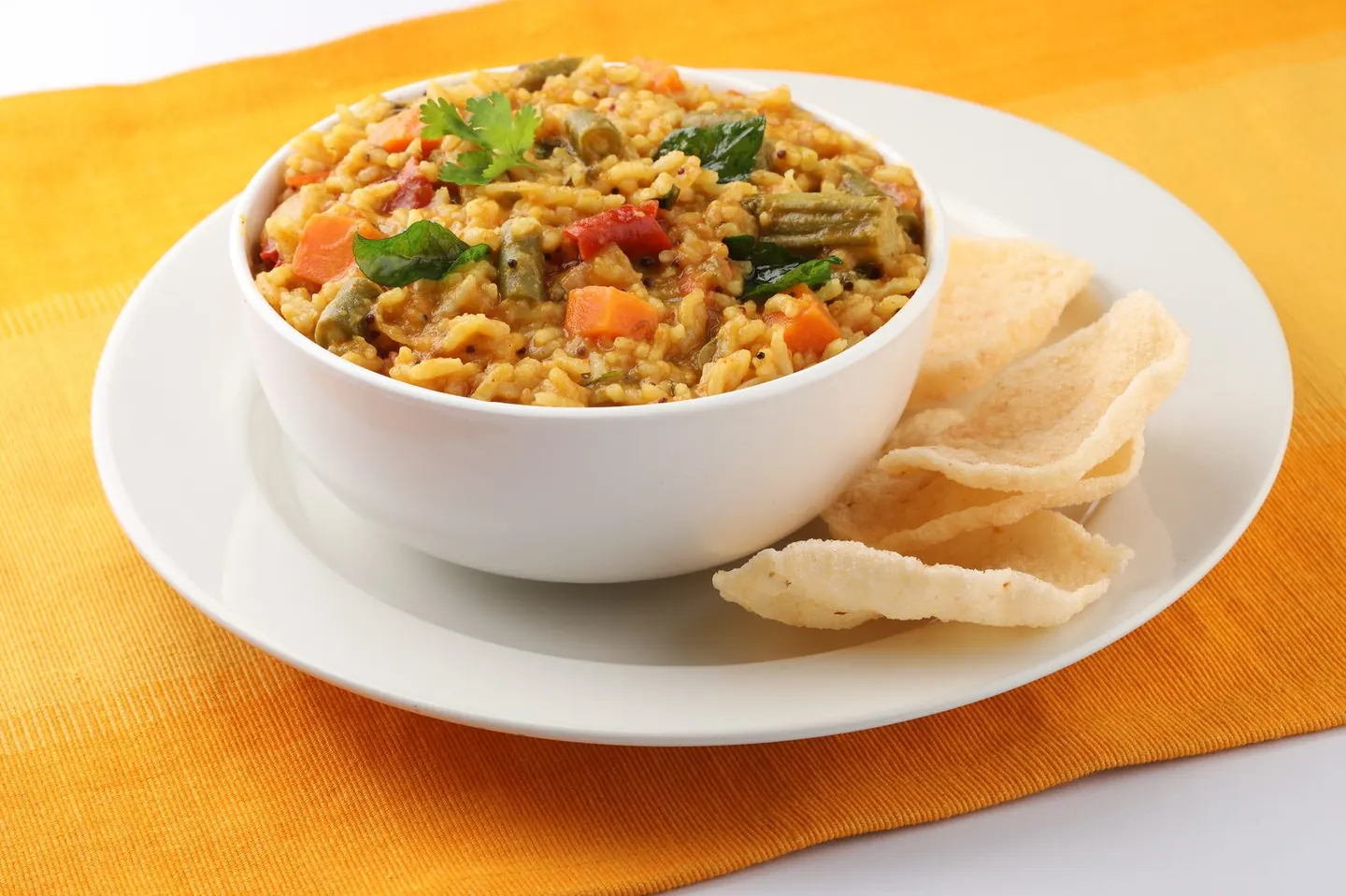
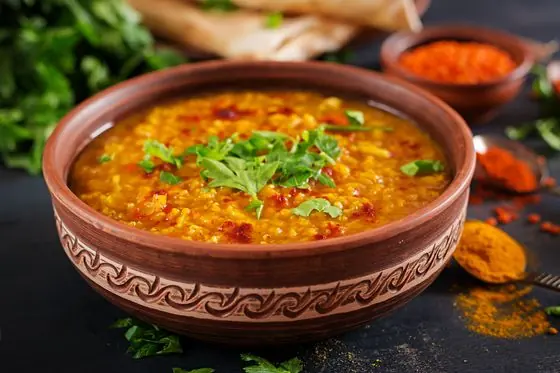
Photograph: Adobe Stock · representative of the dish
Greens and dal in the same pot is the plainest good idea in South Indian cooking, and cheera is the green Kerala grows most easily: amaranth, 3.29 g of protein and 4.41 g of fibre per 100 g at 31 kcal, in the ground everywhere from a March sowing. The dish takes twenty-five minutes, needs no soaking, and delivers 12 g of protein and 8 g of fibre a serving at 187 kcal with 2 g of saturated fat. If someone asks what a re-engineered Kerala dish looks like, show them this one.
Before you start: Wash the greens in three changes of water — amaranth grows low and carries grit — and chop the tender stalks along with the leaves; they have more fibre than the leaves and cook in the same time.
Allergens: Mustard.
Equipment: Pressure cooker or heavy pot; 26 cm pan. Substitute: one pot does both if you cook the dal first, tip it out, wilt the greens, and return the dal.
| Energy | 187 kcal |
| Protein | 12 g |
| Fibre | 8 g |
| Net carbohydrate | 25 g |
| Total carbohydrate | 33 g |
| Sugars | 5 g |
| Fat | 4 g |
| Saturated fat | 2 g |
| Sodium | 270 mg |
From ICMR-NIN IFCT 2017 and USDA FoodData Central. Per-serving figures stay the same when you scale.
Any tender green works: amaranth (green or red), spinach, colocasia leaf — which must be thoroughly cooked — drumstick leaf, water spinach, or beet tops. Frozen chopped spinach at 300 g, thawed and squeezed hard, is a good substitute; an unsqueezed block will flood the pan. Red amaranth gives a startling magenta dal that tastes identical to the green.
Blood sugar: 25 g of net carbohydrate at a pulse glycaemic index, an estimated load near 8, with 8 g of fibre and an acid in the pot. There is very little in this cuisine that does more per calorie.
Blood pressure: 270 mg per serving. Amaranth is also potassium-rich, which is the other half of the blood-pressure equation and the subject of Chapter 10.
Cholesterol: 2 g of saturated fat — the coconut-free version of a Kerala dal, and proof that the reduction can be total where coconut is not the flavour. Garlic is the one aromatic in this book whose effective dose overlaps ordinary cooking: pooled across 108 trials and 7,137 participants, garlic gave −3.7/−2.0 mmHg and LDL cholesterol −5.9 mg/dL (Behrouz et al., 2026). Twelve grams here is three cloves.
Toor dal → 130 g, pressure-cooked 6–8 minutes. Earthier, heavier, and it stands up to stronger greens.
Drumstick leaves (muringayila) → 200 g, added at step 4 for 2 minutes only. The highest-protein green in the Kerala list at 6.41 g per 100 g. Claim nothing therapeutic for it; a meta-analysis of nine trials of moringa supplementation found no consistent cardiometabolic effect at very low certainty (Crișan et al., 2025).
Add 30 g grated coconut at step 5 → the more usual Kerala version, with about 3 g more saturated fat per serving.
Add 2 eggs, beaten in at step 6 → protein to 17 g per serving, and the dish becomes a one-bowl meal. (Allergen: this swap introduces egg.)
Cook the dal up to three days ahead; the greens want to be done fresh, and take four minutes. Fridge 3 days finished, though the greens dull in colour. Freeze 2 months; texture is fine, colour is not. Reheat with a splash of water, 3–4 minutes, and add fresh lime after reheating.
Thin it into a soup, or thicken it and use it as a filling for pathiri. Cold, with rice and lime, it is a better packed lunch than most things.
Watery: step 5 was skipped. Cook the greens' water off before the dal goes in.
Bitter: the garlic browned, or colocasia leaves were undercooked. Colocasia needs a full 6–8 minutes.
Grey and dull: overcooked greens. Four minutes at high heat, not eight at low.
Serve with
R015 Matta Rice · R008 Ragi Dosa · R027 Ayala Varuthathu · R093 Coconut Chutney
Tap a star to rate this recipe
The Kindle edition is on its way. Until it lands, the complete book — all 25 chapters and 137 recipes — is free to read here, and it stays free after.