 R117
R117Sadya Parippu with Ghee
Green gram dal for the first rice course, with the ghee measured
Recipes › The Sadya, Re-engineered
R119
Inji puli, naranga achar and manga achar, in sadya proportions
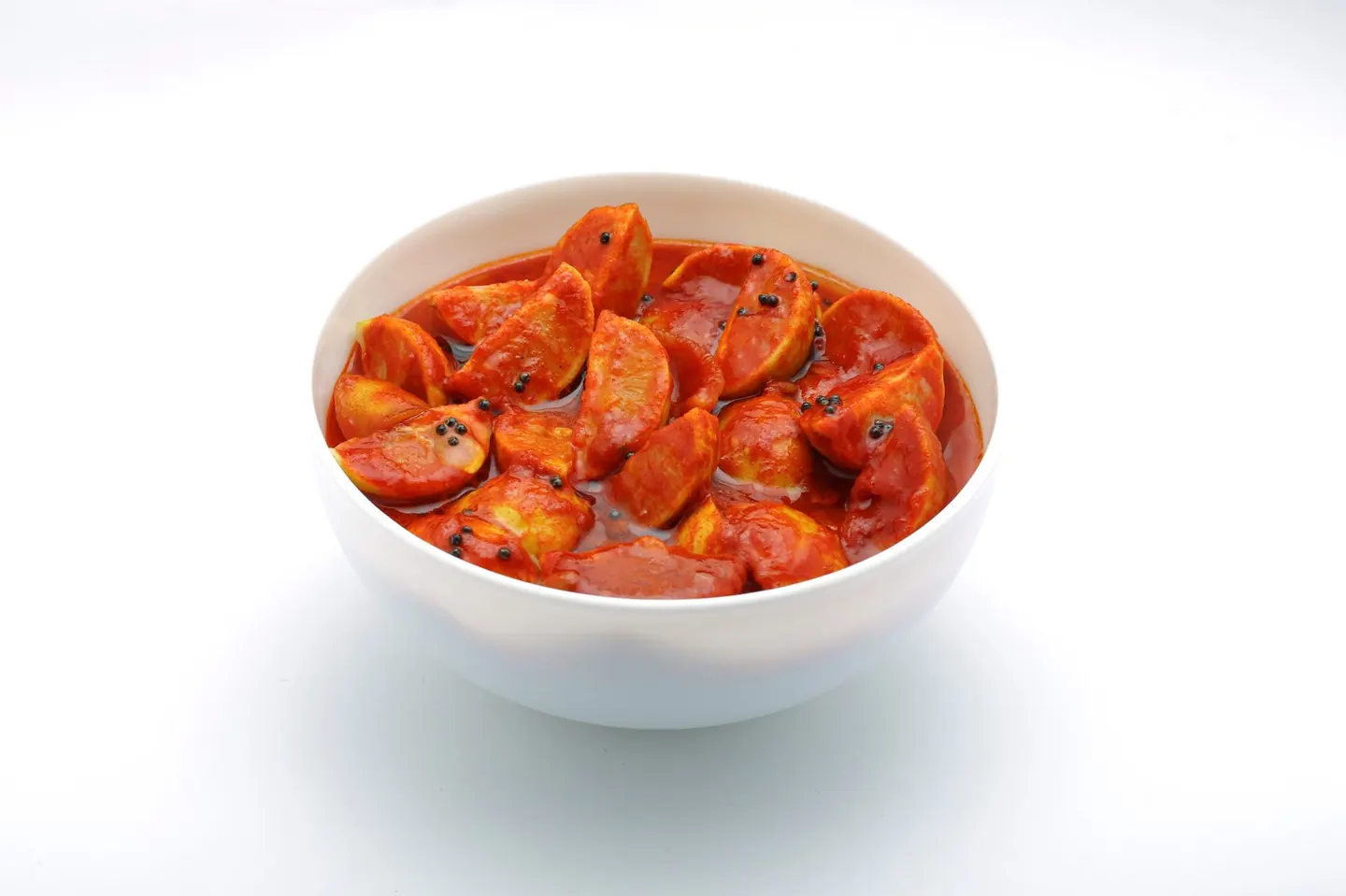
Photograph: Adobe Stock · representative of the dish
Plan ahead: plus 2 days maturing for the achars — required.
The condiment row sits at the top left of the leaf from the moment it is dressed, and it is the row a diner returns to most often. Its function is intensity in tiny quantities: pickles come first in the sequence because they start the salivary glands, and inji puli comes back at the very end, after the payasam, to cut the sweetness. A sadya without them is a sequence of soft mild dishes with nothing to strike against. Made properly and portioned properly, three relishes contribute about 18 kilocalories to a leaf — and about 380 mg of sodium, which is the number that matters.
> ### THE SODIUM, STATED PLAINLY > About 380 mg of sodium per leaf from the condiment row alone, at 8 g of each of the three. Against WHO's target of under 2,000 mg a day, that is roughly a fifth of a day in three teaspoons. The lime achar is the culprit — salt is the preservative in a lime pickle and there is no version of it that is low in sodium, because the salt is what stops it spoiling. Two things follow, and neither of them is "make a low-salt pickle", which does not work. Portion it as a condiment, not a side dish — one teaspoon of each, which is what the leaf's geometry already implies. And if you are working seriously on blood pressure, take the inji puli and skip the lime achar, which drops the row to about 140 mg. This book prints no sodium figure for shop-bought pickle, because the salt applied varies enormously between producers and no verified per-serving value exists in the sources behind it; the figures here are honest only because the salt was weighed into these batches.
Before you start: These are three separate preparations and they should be made in this order: mango first, because it needs the longest maturing; lime second; inji puli last, on the day before, because it is best fresh and it is the one that needs tasting and balancing. Sterilise the jars — 10 minutes in a 120°C (250°F) oven — and let them cool dry.
Allergens: Sesame, mustard. Gluten (wheat) — only if your asafoetida is compounded with wheat flour, as most brands are.
Equipment: Three heavy-based pans; three sterilised glass jars with non-metal lids; a digital scale reading to 1 g. Substitute: no substitute for the scale. Pickle salt is a preservative dose and guessing it either spoils the jar or doubles the sodium. Metal lids corrode against pickle acid — use glass or plastic.
Small thin-skinned Indian limes are what a naranga achar wants; large Persian limes have too much pith and go bitter, so if that is all you can get, use half the quantity of lime and make up the volume with lemon. Raw green mango for pickling must be genuinely unripe — hard, pale, sour, with a white stone — and the Indian and Latin American varieties sold for pickling and for chamoy are both right; a firm underripe supermarket mango is a poor substitute and a ripe one is useless. Gingelly (sesame) oil rather than coconut oil in the two achars is a deliberate choice, and it is traditional in South Indian pickling: sesame sits at 16.25% saturated fat against coconut oil's 90.86%, and it is the correct flavour for a pickle. Coconut oil is right for the inji puli, where it is the flavour. Note the standing fenugreek caution: the quantities here are culinary — under half a gram per leaf — and are not the exposure that matters, but if you take insulin or a sulfonylurea and are deliberately eating fenugreek at 10–25 g a day, that belongs in a conversation with your clinician (see R109).
Blood sugar: 2 g of net carbohydrate across the row. Irrelevant, and the acid may work slightly in your favour — pooled trial data on vinegar consumption show reductions in postprandial glucose and insulin response, which is the best evidence available for Kerala's souring habits generally.
Blood pressure: read the box above. This is the item on the leaf to manage, and the management is portion and selection rather than reformulation.
Cholesterol: 1 g of saturated fat across the row, and the choice of sesame oil over coconut oil for the two achars is why. Sesame is 16.25% saturated fat; coconut oil is 90.86%.
Gingelly oil → groundnut or rice bran oil, both at 19–24% saturated fat. Different flavour, similar profile; groundnut is sweeter and rice bran is neutral with a high smoke point. (Allergen: this swap introduces peanuts.)
Gingelly oil → coconut oil. Saturated fat across the row roughly triples to about 3 g and the pickles taste more Kerala and less South Indian. A legitimate choice made knowingly.
Raw mango → raw green papaya or firm gooseberry. Papaya is milder and needs more lime; gooseberry (nellikka) is sharper and traditional in its own right.
Jaggery in the inji puli → dates, 60 g, blitzed. Slightly less sweet, more fruity, and it holds the relish together well.
Working hard on sodium → make only the inji puli, at 25 mg per leaf, and put a wedge of fresh lime and a piece of raw mango on the leaf in place of the achars. The intensity is lower and the sodium is a tenth.
The salt fractions must scale exactly with the fruit, not with the number of leaves — a lime pickle with proportionally less salt will spoil, and this is the one recipe in the book where the salt is a preservative rather than a seasoning. Portion smaller if you want less sodium. Do not weaken the brine.
This is the make-ahead recipe of the whole chapter. Naranga achar and manga achar keep 6 months in a sterilised jar in a cool cupboard, submerged under their oil, provided a dry spoon is used every time — one wet spoon will start a mould. Inji puli keeps 3 weeks in the fridge and is best in the first week. Freeze inji puli 3 months in 100 g portions; the achars should not be frozen, since the salt and oil already preserve them and freezing softens the fruit.
There will be leftovers, because a sadya uses teaspoons. Inji puli is superb with curd rice, inside a dosa, or alongside cold meat. Chopped fine, a spoon of manga achar transforms a plain thoran. And a teaspoon of achar brine is one of the most efficient umami-and-acid seasonings in the kitchen — use it in place of salt in a curry and taste before adding any more.
Bitter pickle: the chilli powder went into hot oil. Off the heat, every time.
Mould on the surface within a fortnight: a wet spoon, an unsterilised jar, or the fruit not fully submerged in oil. Discard the jar; mould in a pickle is not something to scrape off.
Inji puli harsh and hot rather than rounded: the ginger was not browned long enough at step 10. Eight to ten minutes, to deep gold.
Inji puli too sweet: more tamarind water, reduced. Too sour: more jaggery, 10 g at a time. It should taste sour first.
Lime pickle unbearably bitter: large thick-skinned limes. Use small thin-skinned ones, or halve the lime and add lemon.
Serve with
At the top left of the leaf, in three small mounds, from the moment it is dressed · again after R113 Ada Pradhaman and R120, which is what inji puli is for · R096 low-sodium lime achar and R097 low-sodium mango achar are the everyday versions of these, for the days that are not a feast · M06 the low-sodium all-purpose podi, for the days you want intensity without the salt
Tap a star to rate this recipe
The Kindle edition is on its way. Until it lands, the complete book — all 25 chapters and 137 recipes — is free to read here, and it stays free after.