 R117
R117Sadya Parippu with Ghee
Green gram dal for the first rice course, with the ghee measured
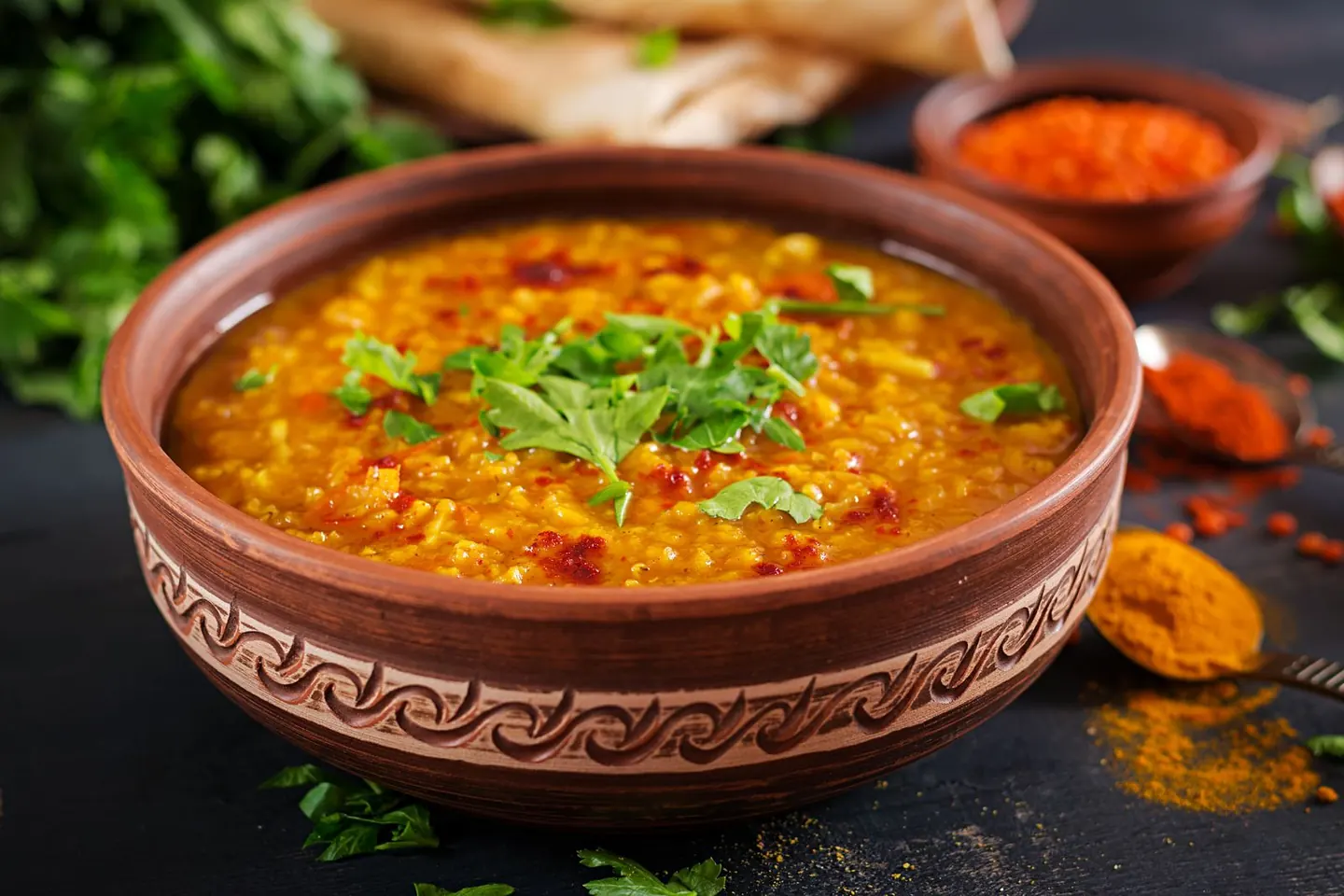
Photograph: Adobe Stock · representative of the dish
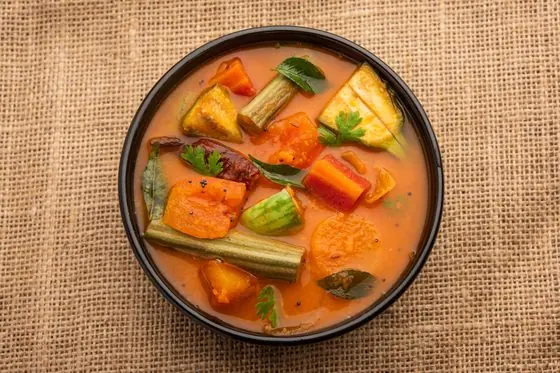
Sambar arrives in the sadya comparatively late — which is why the older four-curry scheme of erissery, kalan, olan and a madhura curry does not include it — and its origin story is a good case study in how food history goes wrong. The popular attribution places its invention in the Thanjavur kitchen of Shahaji I after 1676, improvised from dal and tamarind in the absence of kokum. No primary source is offered for that; Tamil literature refers to comparable tamarind-and-dal preparations earlier, and the Maratha analogue is amti rather than sambar. Treat the Thanjavur story as the popular attribution and not as documented history. What is certain is that a festival sambar is not a weekday sambar: more vegetables, more of them, cut larger, and no onion.
Before you start: Soak the tamarind first — it needs 20 minutes — and cut the vegetables into pieces large enough to survive: sadya vegetables are cut in 4 cm batons and chunks, not diced, because they are eaten with the fingers off a leaf.
Allergens: Mustard. Gluten (wheat) — only if your asafoetida is compounded with wheat flour, as most brands are.
Equipment: 4-litre pan or pressure cooker for the dal; a wide 4-litre pan for the sambar; small pan for the tempering. Substitute: one pan and a pressure cooker manage this comfortably. At 25 leaves you want a genuine 12-litre pot, which is what the bronze charakku of feast cooking exists for.
Drumstick is sold fresh in South Asian groceries and frozen in 400 g packets, which work well and save the peeling. Ash gourd is winter melon in Chinese groceries — buy a wedge, not a whole one, unless you are cooking for 25. Elephant foot yam is sold frozen in cubes and is the single most convenient item here; taro or ordinary yam substitutes almost exactly, since all five Kerala starchy tubers land within 17.5 to 17.9 g of available carbohydrate per 100 g and are effectively interchangeable by weight. Snake gourd substitutes with courgette, which is close in water content and much easier to find. Tamarind, not kudampuli: sambar is a tamarind dish, and kudampuli belongs in fish curry and never in a sadya vegetable dish. Buy tamarind as a block rather than as concentrate, which is flatter and often salted.
Blood sugar: 18 g of net carbohydrate with 7 g of fibre and 6 g of protein. This is a dish to take twice, and taking it twice instead of taking more rice is the single most effective move available at a sadya.
Blood pressure: 250 mg sodium a leaf, which is real and worth knowing in the context of a leaf that also carries pappadam, upperi and three pickles. Made with M07 the 70:30 salt it falls to about 175 mg — with the standing carve-out for chronic kidney disease, ACE inhibitors, angiotensin receptor blockers, potassium-sparing diuretics and potassium supplements. The vegetables here are also among the most potassium-dense items in the Kerala pantry, which is useful for most readers and a reason for that same carve-out for a few.
Cholesterol: 4 g of saturated fat, most of it from the roasted coconut rather than the oil. The coconut is doing flavour work that oil cannot do; leave it and cut elsewhere.
Drumstick → green beans and a piece of carrot. You lose the specific resinous flavour that makes a sambar taste of a sadya, and gain convenience.
Chena → taro, ordinary yam or potato. Metabolically near-identical by weight; potato is the least traditional and the most available.
Snake gourd → courgette, 1:1. Close in water content, slightly sweeter, cooks 2 minutes faster.
Roasted coconut → skip it and add 20 g more dal. About 25 kcal and 2.5 g of saturated fat less per leaf, and a noticeably thinner, brighter, less rounded sambar. A real trade rather than a free one.
M02 sambar podi → any good commercial sambar powder, 30 g. Check the label for added salt and cut the added salt accordingly.
Tamarind → 30 ml lime juice added off the heat. Sharper and more volatile; the sambar does not keep as well.
At 25 leaves, three things change. Cook the dal separately in a pressure cooker while the vegetables go in a 12-litre pot, or the pot will take an hour to come back to temperature each time you add something. Roast the 190 g of coconut in two batches — a crowded pan steams rather than roasts, and pale coconut paste is the commonest failure at scale. And add the salt at the very end, tasting, because a large pot reduces unpredictably and a 3.75-litre pot of over-salted sambar is 25 leaves ruined.
Sambar is better on day two and this is genuinely useful for a sadya. Cook it to the end of step 8 the day before, keep it fridge 3 days, and temper it fresh on the day — a re-tempered sambar tastes made that morning. Freeze 2 months; the okra suffers and the rest does not, so leave the okra out of a batch destined for the freezer and add it on reheating. Reheat to a gentle simmer, adding water, since it thickens considerably.
Sambar over rice is the best weekday lunch in South India and needs no apology. Thinned with water and a squeeze of lime it becomes a passable rasam. The vegetables can be fished out, drained and turned into a thoran with fresh grated coconut and a mustard tempering, which is what a Kerala kitchen has always done with the day after a feast.
Vegetables collapsed into mush: everything went in together. Hardest first, okra last, and cut sadya-sized.
Sambar tastes raw and dusty: the podi did not get its 8–10 minutes at step 7. Spice powders need time in liquid.
Slimy: the okra was cut too early and sat in water, or cooked too long. Cut it just before it goes in and give it four minutes.
Thin and sour rather than rounded: the tamarind did not get its own simmer at step 6, or the coconut was under-roasted.
Bitter: the mustard seeds burnt in the tempering, or the asafoetida sat too long in hot oil. Five seconds, then off.
Serve with
R015 Matta Rice as the second rice course · R117 Sadya Parippu as the first · R086 Rasam as the third · R069 Avial and R063 Cabbage Thoran alongside · M02 sambar podi · M07 the 70:30 salt
Tap a star to rate this recipe
The Kindle edition is on its way. Until it lands, the complete book — all 25 chapters and 137 recipes — is free to read here, and it stays free after.