 R024
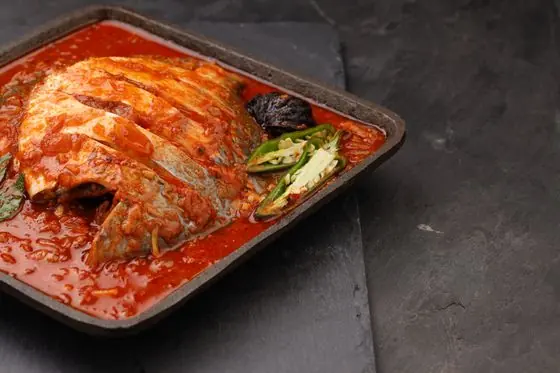
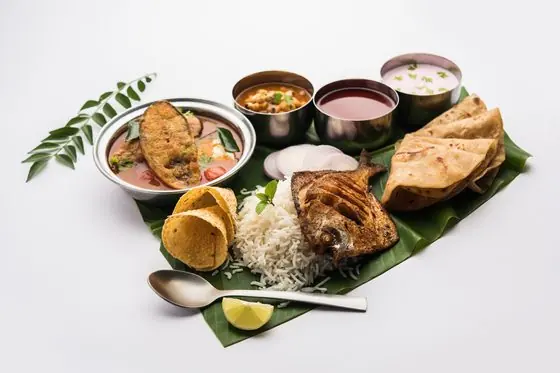
R024Meen Vevichathu
Kudampuli fish curry, the Kottayam Syrian Christian way
R029
Pearl spot in a banana leaf — the toddy shop's most famous dish
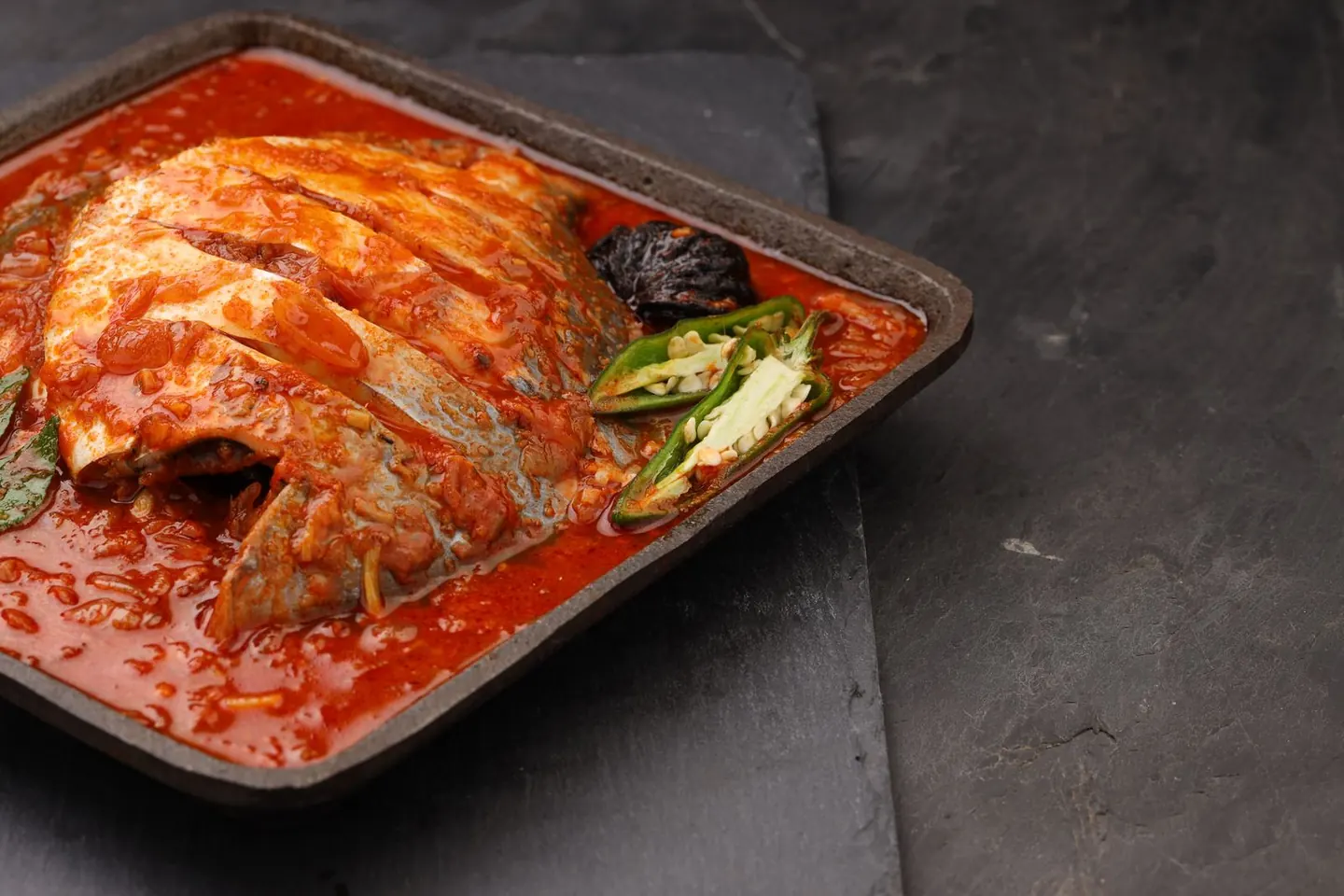
Photograph: Adobe Stock · representative of the dish
Plan ahead: including 20 minutes marinating.
Karimeen was declared Kerala's state fish in 2010, and 2011 was designated its year. It is a brackish-water cichlid of the backwaters, expensive because demand vastly outruns supply, and its signature dish is the single most recognisable Kerala preparation in the world. Pollichathu came out of the toddy shop rather than the palace — pollichathu means charred — and the char on the leaf is the flavour. Everything about the technique is designed to cook a delicate fish without touching it.
Before you start: Soften the banana leaves — hold each over a low flame or dip in boiling water for 10–15 seconds until it turns glossy and dark and goes pliable. A brittle leaf splits at the fold and the whole parcel leaks.
Allergens: Fish. Gluten (wheat) — only if your asafoetida is compounded with wheat flour, as most brands are (it arrives with M05).
Equipment: Heavy flat griddle or tawa, 26 cm or wider, with a lid; banana leaves; kitchen string or toothpicks. Substitute: baking parchment or foil in place of banana leaf, which loses the whole aromatic point and reduces the dish to a baked fish; a 200°C (390°F) oven for 18–22 minutes in place of the griddle, which works well and chars less.
| Energy | 199 kcal |
| Protein | 29 g |
| Fibre | 2 g |
| Net carbohydrate | 8 g |
| Total carbohydrate | 10 g |
| Sugars | 3 g |
| Fat | 6 g |
| Saturated fat | 4 g |
| Sodium | 300 mg |
From ICMR-NIN IFCT 2017 and USDA FoodData Central. Per-serving figures stay the same when you scale.
Karimeen has no true equivalent outside South Asia, and substituting it is a compromise you should make knowingly: it is a firm, sweet, faintly muddy fish with a lot of small bones. In the US: tilapia is the closest widely available cichlid and is the honest substitute, though blander; black crappie or freshwater drum are closer in flavour if you can get them. In the UK: sea bream or small sea bass, or tilapia from African and Caribbean fishmongers. In the Gulf: safi (rabbitfish) is the local answer and is very good this way. In Australia: silver perch, barramundi fillets or bream. Frozen banana leaf is sold in every Asian and Latin American freezer aisle and works perfectly — thaw and soften as above.
Blood sugar: 7 g of net carbohydrate, most of it shallot. A very low-load main dish at 29 g of protein.
Blood pressure: 300 mg. Two grams of salt instead of three gives about 230 mg, and the pepper and lime carry it easily.
Cholesterol: 4 g of saturated fat, essentially all of it the 15 g of coconut oil in the masala. Sesame oil takes it to about 2 g; the masala tastes slightly nuttier and no worse.
No karimeen → see SOURCING NOTE. Any firm whole fish of 200–300 g works, and fillets work if you must, at 130 g each and 9–11 minutes total.
No banana leaf → parchment. You lose the char and the aroma, which is most of the reason to make this. Do not use foil against an acidic masala.
Griddle → 200°C (390°F) oven, 18–22 minutes, turning once. Reliable, slightly less charred, and much easier with four parcels.
No M05 → 6 g Kashmiri chilli powder, 3 g coriander, 1 g turmeric.
The masala scales cleanly; the griddle does not. Above four parcels, use the oven.
The masala is the make-ahead. Fridge 3 days, or freeze 2 months in 100 g portions — one portion wraps one fish. Assembled parcels: fridge 12 hours before cooking. Cooked: fridge 2 days. Do not freeze cooked, because the leaf goes slimy on thawing. Reheat parcels in a 190°C (375°F) oven for 8–10 minutes.
Scrape the fish and masala together off the bones and fold through hot matta rice with a squeeze of lime — a pollichathu rice that is arguably better than the parent dish.
Leaf split and masala leaked onto the griddle: the leaf was not softened enough, or was folded against the grain. Soften properly and fold along the ribs.
Fish undercooked at the bone: the flame was too high, so the leaf charred before the inside cooked. Medium-low and covered is the whole technique.
Leaf burnt through: too high, too long, or a dry griddle. It should brown and blister, not incinerate.
Masala tastes raw: step 2 was rushed. Ten minutes of shallots is not negotiable in this dish.
Serve with
R015 Matta Rice · R020 Kanji · R068 Kumbalanga Olan · R107 Sambharam
Tap a star to rate this recipe
The Kindle edition is on its way. Until it lands, the complete book — all 25 chapters and 137 recipes — is free to read here, and it stays free after.