 R025
R025Meen Moilee
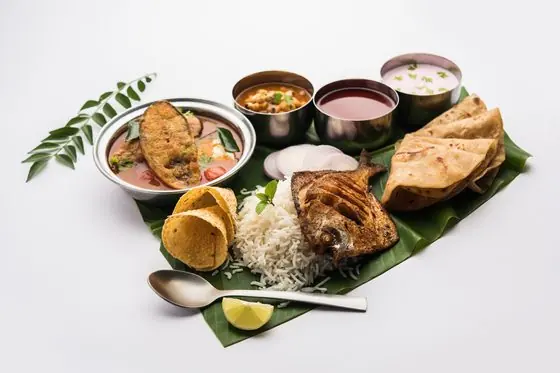
The pale coconut-milk fish curry, Cochin Latin Catholic and Anglo-Indian both
R024
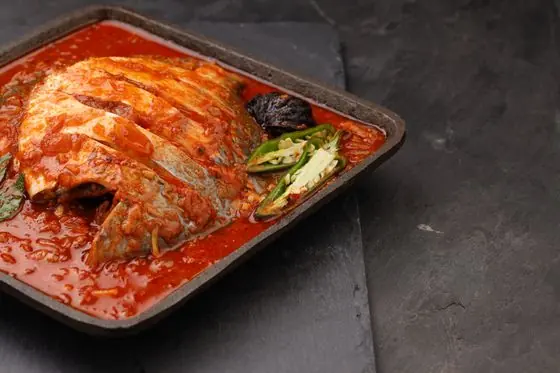
Kudampuli fish curry, the Kottayam Syrian Christian way
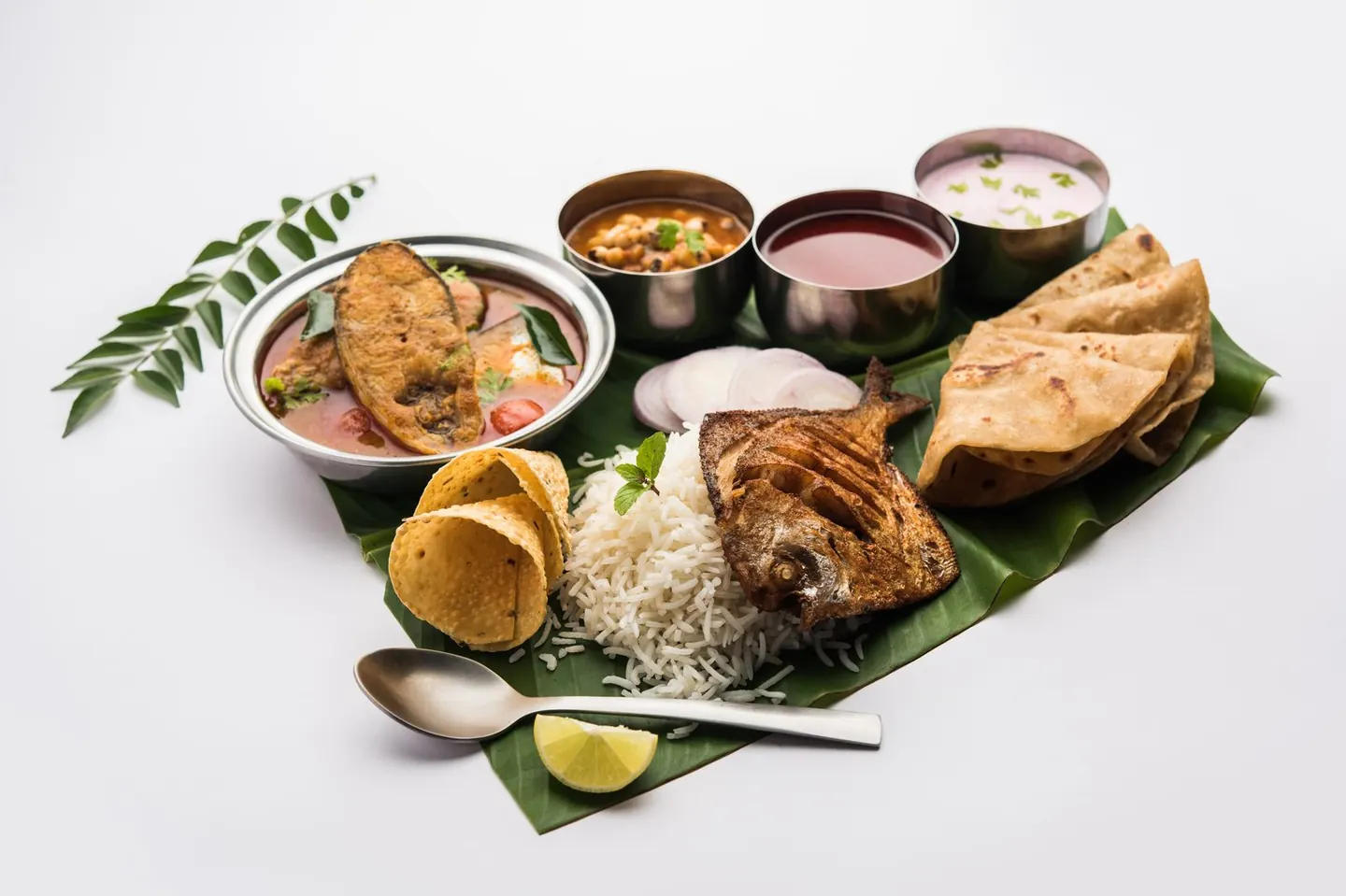
Photograph: Adobe Stock · representative of the dish
Plan ahead: plus at least 4 hours resting, and overnight is better.
This is the archetype of the Kerala red fish curry and the flagship of this chapter: fiery, thin, brick-dark, soured with kudampuli and cooked in an unglazed clay pot. It is a Central Travancore dish, Kottayam-style, and the households that own it cook it in the evening to eat at noon the next day. That is not thrift. Kudampuli is the one souring agent in Kerala that makes a curry improve overnight rather than flatten, and the mechanism is worth knowing before you cook it.
Before you start: Soak the kudampuli first — it needs 15–20 minutes and everything else takes less. Slice the shallots before you light the flame; 120 g takes five minutes and the pot will not wait.
Allergens: Fish. Gluten (wheat) — only if your asafoetida is compounded with wheat flour, as most brands are (it arrives with M05).
Equipment: Unglazed clay pot (meen chatti), 20–22 cm. Substitute: any heavy non-reactive pan — stainless steel, enamelled cast iron, a kalchatti. You lose the microporous wall that returns a little of yesterday's curry to today's, and you lose about five minutes of residual cooking, so take the fish off the heat slightly later. Do not use bare iron or aluminium: kudampuli will pick up a metallic edge from both.
| Energy | 232 kcal |
| Protein | 29 g |
| Fibre | 3 g |
| Net carbohydrate | 7 g |
| Total carbohydrate | 10 g |
| Sugars | 3 g |
| Fat | 10 g |
| Saturated fat | 4 g |
| Sodium | 300 mg |
From ICMR-NIN IFCT 2017 and USDA FoodData Central. Per-serving figures stay the same when you scale.
Kudampuli is sold as kodampuli, "Malabar tamarind" or "gambooge" in every Kerala-facing shop and online everywhere. Rinse it: the commercial product is often smoke-cured to speed drying, which is why one bag tastes of clean fruit acid and the next of a bonfire. In the US: kingfish steaks at Indian and Caribbean fishmongers, or Spanish mackerel, wahoo or mahi-mahi. In the UK: kingfish or coley at Asian counters; huss and monkfish tail both work and hold together beautifully. In the Gulf: ask for chanad — it is the same fish. In Australia: Spanish mackerel is the exact species, and school mackerel or blue-eye trevalla are good stand-ins. Any firm, thick, non-flaking fish will make this curry; a soft white fish will disintegrate.
Blood sugar: 7 g of net carbohydrate makes this one of the lowest-load main dishes in the book. What decides the meal is the rice: 150 g cooked matta (R015) adds about 45 g of net carbohydrate, and a 50 g serving of vanpayar (R053) alongside cuts the glycaemic response of that rice more than swapping the rice would.
Blood pressure: 300 mg is 15% of a 2,000 mg day. To go lower, drop the added salt to 2 g and lean harder on the kudampuli — sour and hot together mask a missing gram of salt better than anything else in this cuisine.
Cholesterol: 4 g of saturated fat, most of it from the 10 g of coconut oil. Sesame or groundnut oil takes it to about 2 g and the curry is still recognisably itself, though the raw finishing drizzle is where coconut oil earns its place.
No neymeen → ayala or mathi. Oilier, stronger, and better value; cut the coconut oil to 5 g in total because the fish brings its own. Omega-3 per serving goes up.
No kudampuli → 15 g tamarind pulp. The curry becomes rounder and brighter and does not improve overnight, so eat it the day you make it.
No M05 → 8 g Kashmiri chilli powder, 4 g ground coriander, 2 g turmeric and a pinch of fenugreek. Slightly flatter; you lose the pepper and the roasted depth. (The fenugreek here is under 1 g across four servings and nowhere near the 10–25 g a day at which fenugreek has real glycaemic effects — but anyone taking insulin or a sulfonylurea should read the caution at M05 and in Chapter 9.)
No clay pot → see EQUIPMENT. The curry works; it will not archive.
Better on day two, and this is not a figure of speech. Fridge 3 days in a covered non-metal container. Freeze 2 months; the fish loses texture, the gravy does not, so freeze gravy alone if you can and poach fresh fish in it. Reheat to a bare tremble only, never a rolling boil.
Flake the fish off the bone into a thoran with 40 g grated coconut and a curry-leaf tempering. Or spoon the cold gravy — it will have set slightly — over hot kanji (R020), which is what a Kottayam household does with the last of the pot.
Curry tastes of raw chilli powder: step 4 was cut short. Simmer another 8–10 minutes; it will come round.
Fish fell apart: it was stirred, it went in before the gravy had thickened, or the fish was tired. Shake the pot, never stir it.
Thin and watery: not enough shallot reduction at step 3, or the gravy was not simmered down at step 5. Lift the fish out and reduce the gravy 4–5 minutes, then return it off the heat.
Metallic, hard-edged sourness: an aluminium or bare-iron pan. This is the one dish where the vessel genuinely matters.
Serve with
R015 Matta Rice · R053 Vanpayar Thoran · R063 Cabbage Thoran · R107 Sambharam
Tap a star to rate this recipe
The Kindle edition is on its way. Until it lands, the complete book — all 25 chapters and 137 recipes — is free to read here, and it stays free after.