 R040
R040Nadan Kozhi Curry
The everyday country chicken curry
Recipes › Chicken, Egg and Meat
R048
Beef fry — the dry roast with coconut slivers, given twice
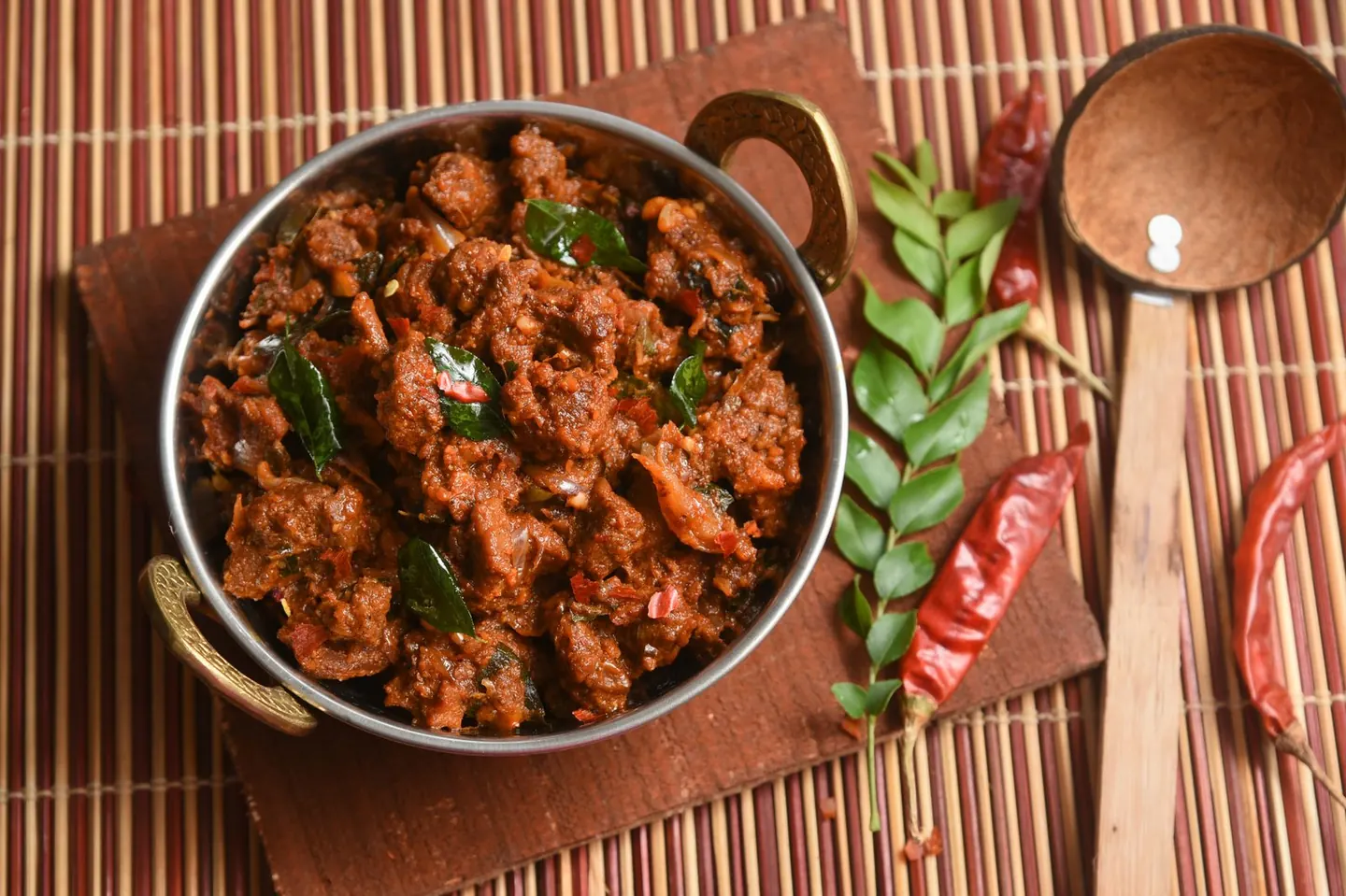
Photograph: Adobe Stock · representative of the dish
This is the most argued-about plate in Kerala and the one dish in this book that gets two nutrition panels. Beef ularthiyathu belongs to the Syrian Christian kitchens of central Kerala and the highland settler households of Idukki and Wayanad, and in its restaurant form, beside a maida parotta, it is the default evening meal for a generation of young Malayali men. It is also the honesty test for a book like this one. So: the traditional recipe is given properly, without apology and without dilution. The rebuilt one follows. The numbers for both sit side by side, and the decision is yours.
Before you start: Read both ingredient lists before you shop, because the cut is the decision. Sliver the coconut, slice the shallots and crush the pepper before the braise finishes; once the meat is dry the roast takes seven minutes and offers no pauses.
Allergens: None of the major allergens as the recipe is written. Sesame or peanuts — whichever of the two oils you use (it reaches the dish through M16).
Equipment: Pressure cooker, or heavy lidded pot; heavy 28 cm pan or cheena chatti for the roast; flat wooden turner. Substitute: one heavy pot does both jobs if you braise, drain and then roast in the same vessel — you lose a little browning to the residual moisture in the pot.
| Energy | 676 kcal |
| Protein | 42 g |
| Fibre | 7 g |
| Net carbohydrate | 11 g |
| Total carbohydrate | 18 g |
| Sugars | 5 g |
| Fat | 51 g |
| Saturated fat | 32 g |
| Sodium | 740 mg |
From ICMR-NIN IFCT 2017 and USDA FoodData Central. Per-serving figures stay the same when you scale.
In Kerala this is nadan beef, from an older animal, and the toughness is part of the identity — it wants long cooking and it rewards it. Outside India, ask for chuck, shoulder or blade for the traditional version and topside, round or thick flank for the rebuilt. Do not use a quick-cooking cut: sirloin or rump will be dry and grey long before the masala crusts. Buffalo meat (carabeef), which is what a good deal of Kerala "beef" actually is, works identically and is leaner still.
Blood sugar: both versions are low in carbohydrate. The glycaemic problem with this dish has never been the dish; it is the two maida parottas beside it. Eat it with matta rice at a measured 150 g, or with kappa portioned as a starch, and add a pulse.
Blood pressure: the traditional version's 740 mg is a third of a day's sodium in one serving, and most of it is the 6 g of plain salt. The rebuilt version's 380 mg comes from 4 g of M07. That swap alone — same recipe, different salt — takes about 190 mg out.
Cholesterol: the rebuilt version is the one to cook if a lipid panel is the reason you bought this book. If you want the traditional one anyway, halve the portion, double the vegetable beside it, and put it on the calendar rather than in the weekly rotation.
Buffalo meat (carabeef) → leaner than beef by roughly a third in the traditional cut, and it is what much Kerala beef actually is. Same timings.
Sesame or groundnut oil for the coconut oil → in the rebuilt version this takes saturated fat from 12 g to about 10.5 g per serving. It also changes the flavour, and here coconut oil genuinely is part of the taste, which is why the book keeps it in teaspoons rather than removing it.
Add 300 g of green plantain or 200 g of cooked kadala at step 5 → six servings instead of four, about 250 kcal and 12 g of fat per serving in the rebuilt version, and a plate that looks fuller rather than emptier. This is the single most effective change in the recipe and it is not a compromise on the meat.
Pressure cooker unavailable → the pot timings in step 2. Nothing is lost but ninety minutes.
The braise is the make-ahead. Do steps 1–3 up to two days ahead and refrigerate the meat in its reduced masala; the roast then takes twelve minutes. Fridge 4 days cooked — the longest keeper in the chapter. Freeze 3 months, braised or fully roasted; the texture is unharmed. Reheat in a dry pan over medium heat, 4–6 minutes, until it crackles again.
This is the best leftover in Kerala. Kappa biryani, layered with mashed tapioca — a modern Kottayam invention and worth knowing as such. Chopped fine into a pathiri or a wrap with raw onion and lime. Or folded through R061 chana masala, where the pulse does the stretching.
Meat tough after the full braise: it was a lean cut given the traditional timing, or the pressure never came up. Give it 10 minutes more and check again; collagen only converts with time.
Meat dry and stringy but tender: overcooked in the braise. Cut the roast to 6 minutes and accept less crust.
Masala pasty, never crusting: free liquid remained after step 3. Reduce properly before the roast; you cannot reduce and brown at the same time.
Burnt coconut, undercooked crust: the slivers went in with the shallots instead of before them, or the flame was too high at step 4.
Serve with
R015 Matta Rice · R055 Kadala Ularthiyathu · R065 Cheera Thoran · R089 Kerala-Idiom Salad
Tap a star to rate this recipe
The Kindle edition is on its way. Until it lands, the complete book — all 25 chapters and 137 recipes — is free to read here, and it stays free after.