 R063
R063Cabbage Thoran
The master thoran: shredded cabbage, crushed coconut, turmeric
Recipes › Vegetables: The Half of the Plate
R069
Mixed vegetables in coarse coconut-cumin paste, finished with raw coconut oil
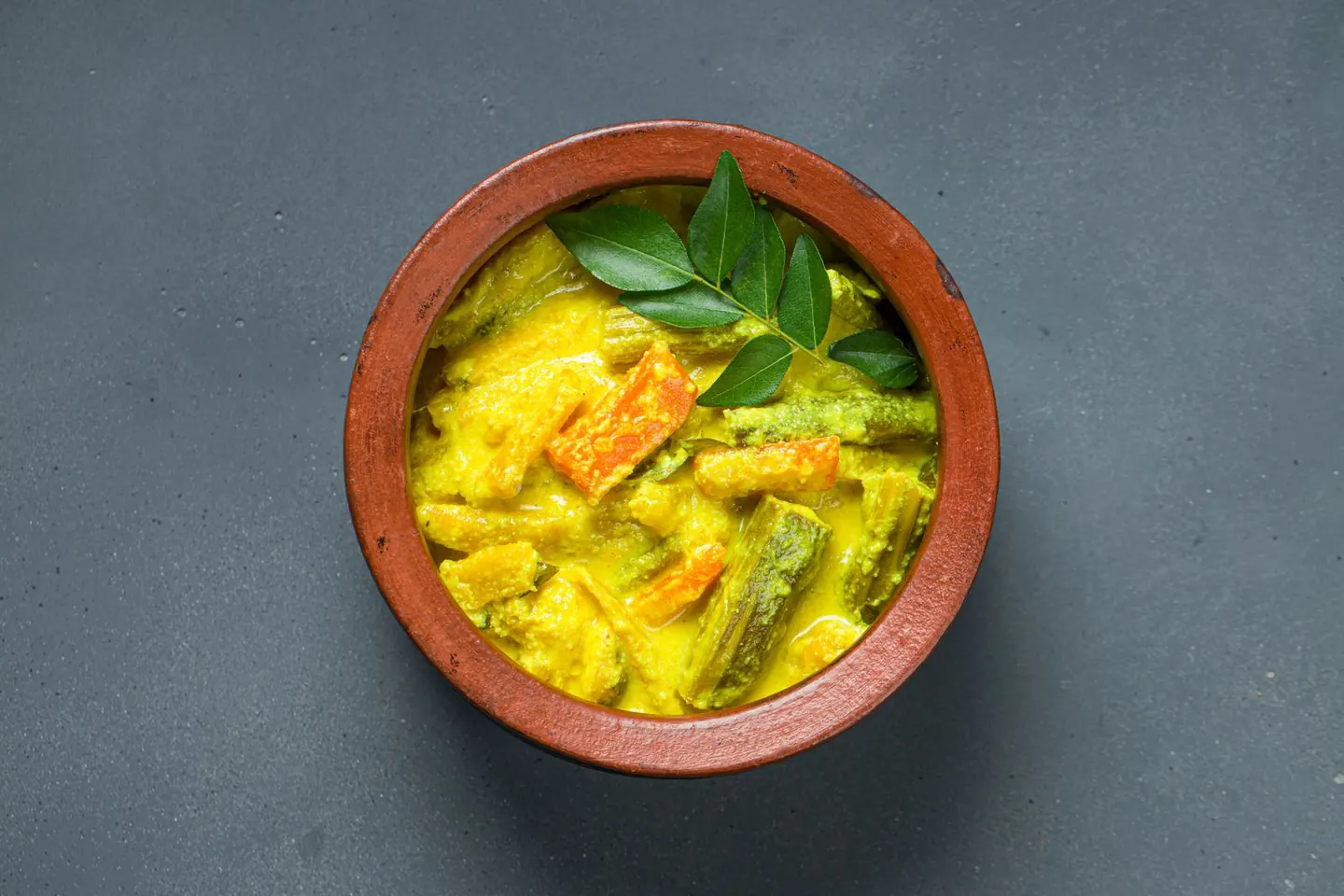
Photograph: Adobe Stock · representative of the dish
By legend, avial was invented by Bhima during the Pandavas' thirteenth year of exile, when he cooked in King Virata's kitchen under the name Vallala — in one telling to satisfy the sage Durvasa, in another after the Nagas revived him and he came back ravenous. Other stories credit Sakthan Thampuran of Cochin, or the Travancore Dewan Ramayyan Dalawa. This is legend, not history: avial has more origin stories than it has ingredients, which is usually a sign that nobody knows. What is genuinely notable is that mixing many vegetables in one pot ran against classical convention, which is probably why the dish needed a story at all.
Before you start: Avial is a dish of staggered timings, so cut every vegetable before you light the flame and keep them in three separate piles: slow (chena, plantain), medium (carrot, drumstick), fast (ash gourd, snake gourd). Grind the paste before you start cooking. Once the pan is on there is no time.
Allergens: Milk.
Equipment: Wide heavy pan or uruli, 26 cm, with a lid; mixie or ammikkallu for the paste; chattuvam. Substitute: a wide saucepan and a small food processor. The paste can be made in a mortar, which gives a better texture and takes ten minutes.
| Energy | 162 kcal |
| Protein | 3.7 g |
| Fibre | 7.7 g |
| Net carbohydrate | 15.3 g |
| Total carbohydrate | 23.0 g |
| Sugars | 4.9 g |
| Fat | 9.5 g |
| Saturated fat | 7.9 g |
| Sodium | 280 mg |
From ICMR-NIN IFCT 2017 and USDA FoodData Central. Per-serving figures stay the same when you scale.
The traditional list runs to nine or ten vegetables and no household has all of them; what matters is the shape — batons of roughly equal size, a mix of firm and soft, and something faintly bitter. Outside Kerala, build it from what exists: potato or sweet potato for chena, green banana for plantain, chayote or courgette for snake gourd, winter melon for ash gourd, French beans and carrot for structure, and skip the drumstick rather than substituting it, since nothing else behaves like it. Frozen cut drumstick is sold in Indian groceries and is entirely adequate. If you cannot get sour curd, use plain whole-milk yoghurt left out of the fridge for 4–6 hours, or add 15 g of raw mango, which is the older souring agent for this dish and arguably the better one.
Blood sugar: 15.3 g net carbohydrate per serving, and this is the one thing to understand about avial. The chena and the green plantain are starches, not vegetables — 17.5 g of available carbohydrate per 100 g each. So avial straddles two parts of the plate. Serve it as half your vegetables and count it towards a slightly smaller rice portion, or leave the plantain out entirely and net carbohydrate falls to about 11 g.
Blood pressure: 280 mg sodium, or about 210 mg with M07.
Cholesterol: 7.9 g saturated fat per serving, from 100 g of coconut across six people plus the finishing oil.
Sour curd → 15 g raw green mango, added at step 3. The older version, sharper and cleaner, and it takes the dish from vegetarian to vegan.
Drumstick → nothing. Leave it out rather than substituting; no other vegetable contributes that resinous note.
Chena and plantain → 300 g of ash gourd, snake gourd and beans instead. Net carbohydrate falls to about 8 g per serving and the dish loses its substance and its sadya character. Worth doing for a rice-heavy meal, not for a feast.
Fewer vegetables → four is a perfectly good avial. Three is a mixed vegetable curry with ambitions.
For twelve, cook in two pans. An avial for twelve in one vessel steams rather than simmers, and the bottom layer disintegrates before the top layer is done.
Cut the vegetables and grind the paste up to 1 day ahead, kept separately in the fridge. Fridge 3 days, and unusually for a curd dish it holds well. Freeze 1 month — safe, but the batons soften and the curd goes slightly grainy on thawing. Reheat on a low flame to just steaming, or eat it at room temperature, which is how it is eaten on a leaf.
Avial is the best leftover in the chapter. Mash it roughly with a fork, add a beaten egg and 20 g of rice flour, and shallow-fry as small cakes in 5 g of oil. Or thin it with 200 ml of second coconut milk into a vegetable curry for appam.
Mushy, indistinct, one texture: the vegetables went in together. The staggering in steps 2 to 4 is the entire craft of this dish.
Gluey: the paste was ground smooth. Pulse it next time and stop while it is still grainy.
Split and watery: the curd boiled. Off the heat, always.
Bland: not enough green chilli, or the raw oil and curry leaf were skipped, or it was served immediately instead of standing five minutes.
Serve with
R015 Matta Rice · R059 Sambar · R068 Kumbalanga Olan · R107 Sambharam
Tap a star to rate this recipe
The Kindle edition is on its way. Until it lands, the complete book — all 25 chapters and 137 recipes — is free to read here, and it stays free after.