 R081
R081Moru Curry
Tempered buttermilk curry with ground coconut
Recipes › Curries, Pulissery and the Sour Family
R082
Sweet-sour curd curry with pineapple
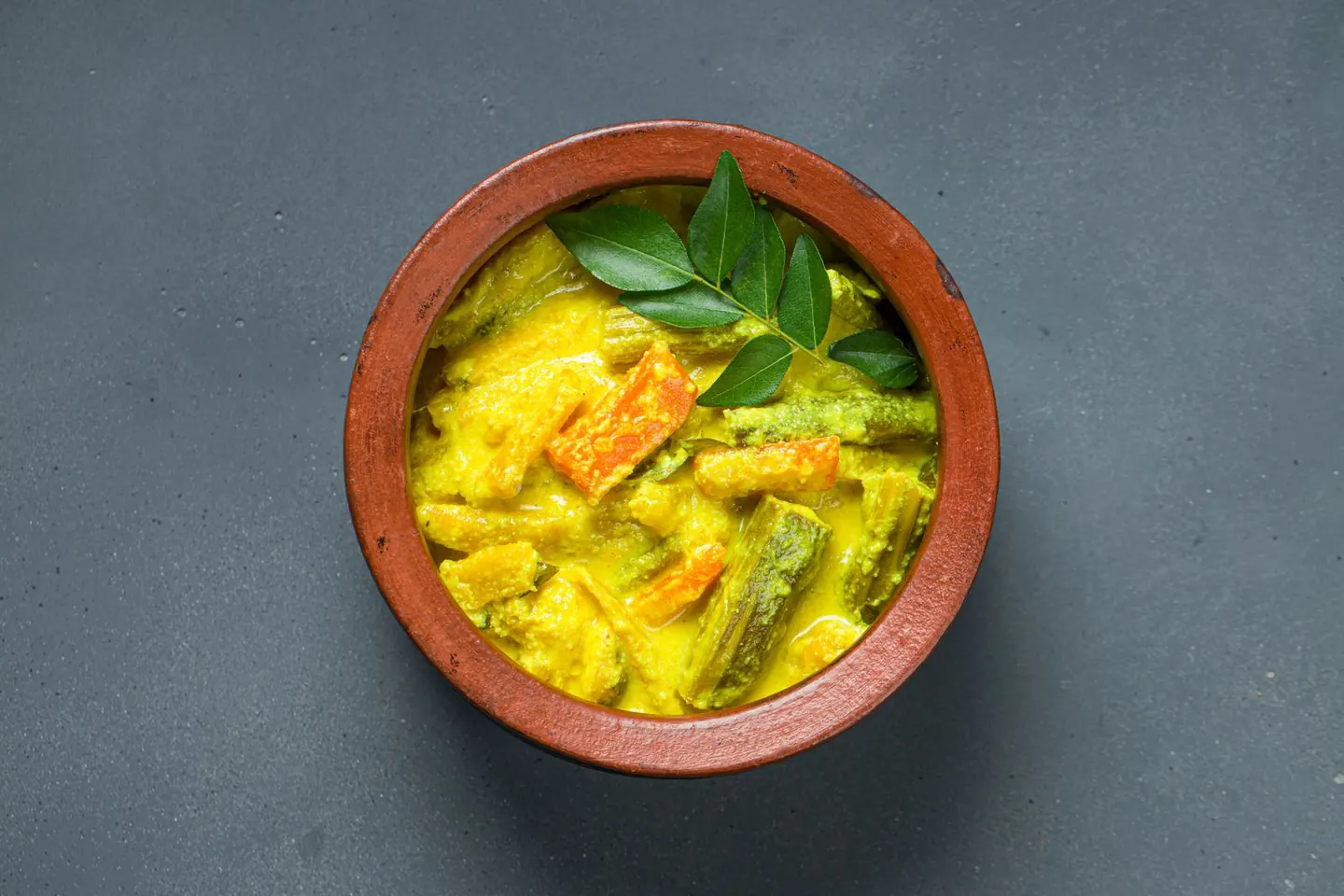
Photograph: Adobe Stock · representative of the dish
Pulissery is the curd family's showpiece, and the pineapple version is the one that converts people. It sits in the sweet-sour register the sadya reserves for the closing rice courses — a fruit cooked to softness, a curd-and-coconut body, mustard and curry leaf on top — and the tension between the acid of the curd and the acid of the fruit is the whole dish. Get the pineapple ripe. An underripe one gives sharpness without perfume, and no amount of jaggery corrects it.
Before you start: Cook the pineapple first and let it cool for a few minutes before the curd goes anywhere near it. Adding whisked curd to fruit still at a boil is the commonest way this dish is ruined.
Allergens: Milk, mustard.
Equipment: Heavy 2-litre pan; mixie; small pan for the tempering. Substitute: as R081.
| Energy | 164 kcal |
| Protein | 3.5 g |
| Fibre | 3.0 g |
| Net carbohydrate | 15.4 g |
| Total carbohydrate | 18.4 g |
| Sugars | 13.1 g |
| Fat | 9.9 g |
| Saturated fat | 7.9 g |
| Sodium | 170 mg |
From ICMR-NIN IFCT 2017 and USDA FoodData Central. Per-serving figures stay the same when you scale.
Kerala pineapple — the Vazhakulam variety from Ernakulam district — is smaller, sweeter and less fibrous than the tinned kind, and is a registered geographical indication. Outside Kerala, buy a fresh pineapple that smells of pineapple at the base and gives slightly under a thumb at the crown. Tinned pineapple in juice is an acceptable substitute at 300 g drained; tinned in syrup is not, and if it is all you have, rinse it and leave the jaggery out. Jaggery is in every South Asian shop; dark muscovado sugar at the same weight is the closest supermarket substitute.
Blood sugar: 15.4 g of net carbohydrate and 13.1 g of sugars a portion, and that is the highest sugar figure in this chapter. About 9 g of it is the pineapple's own fructose and glucose, about 2 g the jaggery, about 3 g the lactose. Leave the jaggery out — the dish survives it if the fruit is ripe — and you are at about 11 g of sugars. Eat it as one dish on a plate, not as a bowl on its own.
Blood pressure: 170 mg a portion, which is low, and the fruit acid is carrying most of the seasoning.
Cholesterol: 7.9 g of saturated fat a portion, from 60 g of grated coconut and a teaspoon of coconut oil for four. Cut the coconut to 40 g for about 6.3 g, at real cost to the body of the curry. This dish needs some of its coconut and it is not honest to pretend otherwise.
Pineapple → 300 g ripe mango, which gives R085. Sweeter, softer, less acidic, and no bromelain problem.
Pineapple → 300 g ripe nendran banana in thick coins, simmered 5–6 minutes only. Sugars rise to about 17 g a portion; a very traditional sadya version.
Jaggery → nothing. If the pineapple is genuinely ripe you will not miss it, and you lose 2 g of sugars a portion.
Curd → 250 g coconut yoghurt, for a dairy-free version. It behaves similarly, does not split as readily, and saturated fat rises by about 1.5 g a portion.
The cooked pineapple base with the coconut paste — everything up to the end of step 3 — keeps in the fridge for 2 days and the curd goes in on the day. Fridge 2 days for the finished curry, covered, in a non-metal container. Do not freeze; the curd splits and the pineapple goes woolly. Reheat to barely warm over the lowest flame, or serve at room temperature.
Spoon it cold over R015 as a kind of Kerala rice salad, or fold a few tablespoons through plain curd for a pachadi-style side.
Bitter and thin: the pineapple was not cooked long enough before the curd went in, and its bromelain has cleaved the milk protein. Eight minutes minimum, and take it off the heat before the curd.
Split: it boiled after the curd went in. Never above a fingertip's warmth.
Cloyingly sweet: the jaggery was measured by eye, or the pineapple was very ripe. Add a teaspoon of lime juice off the heat; acid is the corrective for sweetness, not salt.
Watery: the pineapple's liquid was not reduced at step 1. Boil it down before the coconut paste goes in.
Serve with
R015 Matta Rice, Properly Cooked · R086 Rasam · R084 Ulli Theeyal · a thoran from Chapter 21
Tap a star to rate this recipe
The Kindle edition is on its way. Until it lands, the complete book — all 25 chapters and 137 recipes — is free to read here, and it stays free after.