 R081
R081Moru Curry
Tempered buttermilk curry with ground coconut
Recipes › Curries, Pulissery and the Sour Family
R085
Mambazha pulissery — ripe mango in curd and coconut
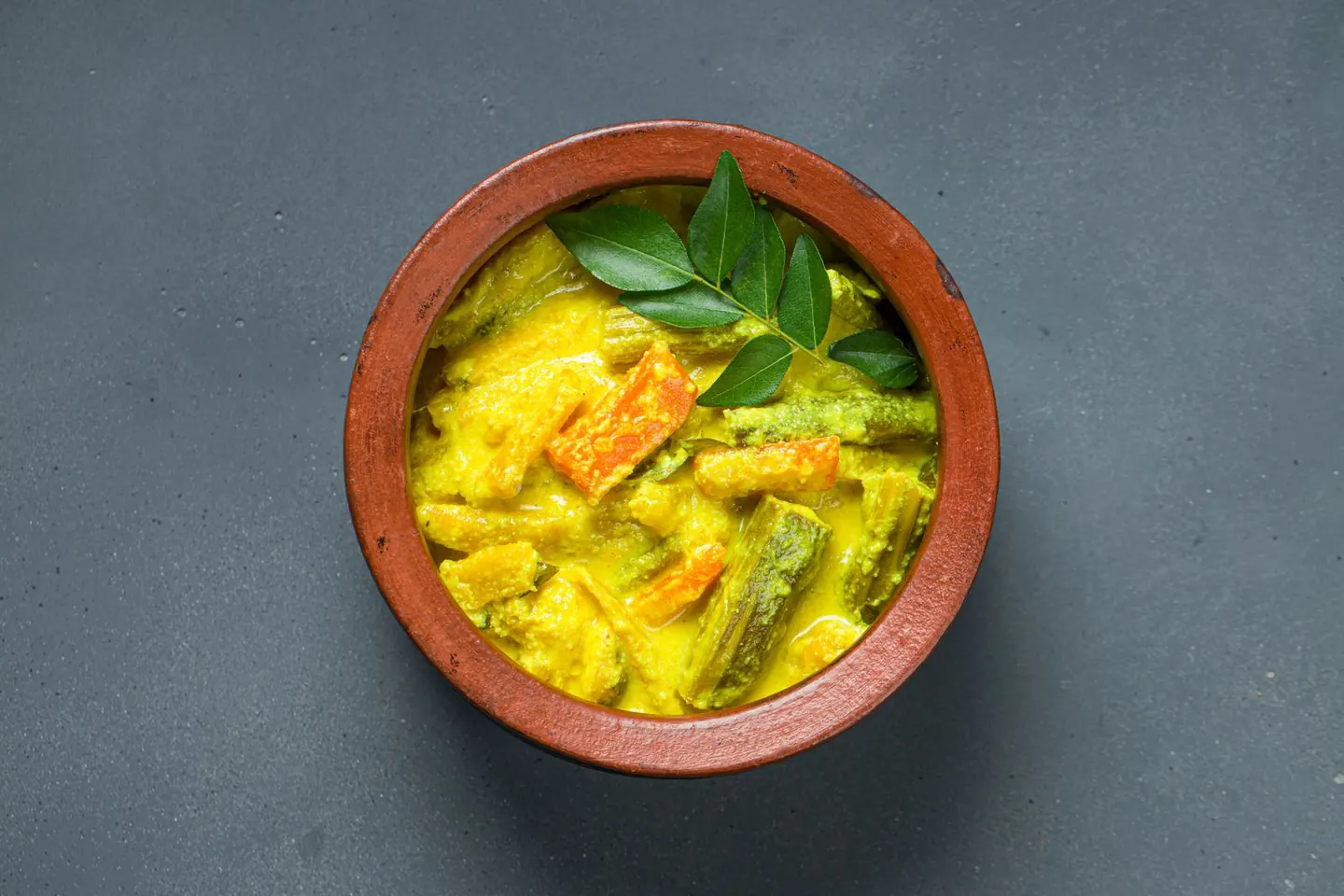
Photograph: Adobe Stock · representative of the dish
This is the sweet-sour register of the sadya at its clearest, and in Kerala it is the dish of the mango glut — the weeks in April and May when the trees drop more fruit than any household can eat and the curries turn yellow. Small, fibrous, intensely perfumed mangoes are the traditional choice, often cooked with the stone in and eaten with the fingers. It is a dish of a particular six weeks, and cooking it out of season with a shipped Kent mango is a pale imitation of a very good thing.
Before you start: Cook the mango and grind the paste before the curd is whisked. As with every dish in this family, once the curd is in the pan you have about three minutes and no room to hunt for anything.
Allergens: Milk, mustard.
Equipment: Heavy 2-litre pan; mixie; small pan for the tempering. Substitute: as R081.
| Energy | 168 kcal |
| Protein | 3.8 g |
| Fibre | 3.3 g |
| Net carbohydrate | 18.9 g |
| Total carbohydrate | 22.2 g |
| Sugars | 17.4 g |
| Fat | 9.1 g |
| Saturated fat | 7.0 g |
| Sodium | 170 mg |
From ICMR-NIN IFCT 2017 and USDA FoodData Central. Per-serving figures stay the same when you scale.
Look for small, fibrous, very fragrant mangoes — chandrakaran, moovandan, kilichundan in Kerala; Indian totapuri or Pakistani chaunsa seconds elsewhere; the Mexican ataulfo or champagne mango is a good and widely available stand-in. What you want is perfume and acidity, not the bland sweetness of a large Kent or Tommy Atkins. Do not use tinned mango pulp, which is heavily sweetened and turns this into a dessert. If only unripe mango is available, that is a different and also excellent dish — cook it 12–15 minutes, add 6 g of jaggery, and you have manga curry rather than mambazha pulissery.
Blood sugar: 17.4 g of sugars a portion is the highest figure in this chapter and you should know it before you cook. All but about 3 g of it is the mango's own fructose, glucose and sucrose. There is no honest way to make ripe-mango pulissery a low-sugar dish; what you can do is treat it as one item on a plate rather than a bowlful, keep the rice at the quarter-plate, and choose the unripe-mango version in the SWAP IT below when your numbers are running high. A whole ripe mango eaten out of hand is much the same arithmetic and nobody worries about it.
Blood pressure: 170 mg a portion, and this is a dish where the fruit acid genuinely replaces salt. It will taste fully seasoned with the M07 left out, at about 100 mg.
Cholesterol: 7.0 g of saturated fat a portion from 50 g of grated coconut and a teaspoon of oil for four. Cut the coconut to 30 g for about 5.2 g; the curry is thinner and the mango carries it well enough.
Ripe mango → 400 g unripe green mango, cooked 12–15 minutes with 6 g jaggery. Sugars drop from 17.4 g to about 7 g a portion and the dish becomes sharper and more assertive. This is the version to cook if glucose is the concern.
Ripe mango → 300 g pineapple, which gives R082. Sugars fall to about 13 g a portion.
Curd → 250 g coconut yoghurt for a dairy-free version. Splits less readily; saturated fat rises by about 1.5 g a portion.
Add 100 g cooked vanpayar at step 5 → protein up about 4 g, fibre up about 2 g, and the plate carries its pulse. Traditional in some Palakkad households and better than it sounds.
The cooked mango base with the coconut paste keeps 2 days in the fridge; add the curd on the day. Fridge 2 days for the finished curry, covered, non-metal. Do not freeze; the curd splits and the mango goes stringy. Reheat to barely warm over the lowest flame, or serve cold, which in a Kerala April is what most people do.
Blend it smooth, chill it hard, and drink it as a savoury mango sambharam. Or spoon it over R021 in place of the milk, which is a genuinely good breakfast.
Split: it boiled, and ripe mango makes the pan base run hot. Lowest flame, constant stirring, off early.
Purée rather than curry: the mango was overripe or overcooked. Six minutes, and crush only a third of it.
Cloying: add a teaspoon of lime juice off the heat, or three or four crushed black peppercorns. Acid and pungency are the correctives for sweetness; more salt is not.
Stringy and fibrous: the cultivar. Small Kerala mangoes are fibrous by nature and the fibres are traditionally sucked off the stone rather than strained out.
Serve with
R015 Matta Rice, Properly Cooked · R086 Rasam · R084 Ulli Theeyal · a thoran or mezhukkupuratti from Chapter 21
Tap a star to rate this recipe
The Kindle edition is on its way. Until it lands, the complete book — all 25 chapters and 137 recipes — is free to read here, and it stays free after.