 R089
R089Kerala Kitchen Salad
Raw vegetables the way a Kerala kitchen cuts them
Recipes › Salads, Pachadis, Chutneys, Podis and Pickles
R097
Kadumanga achar, refrigerated and honestly dated
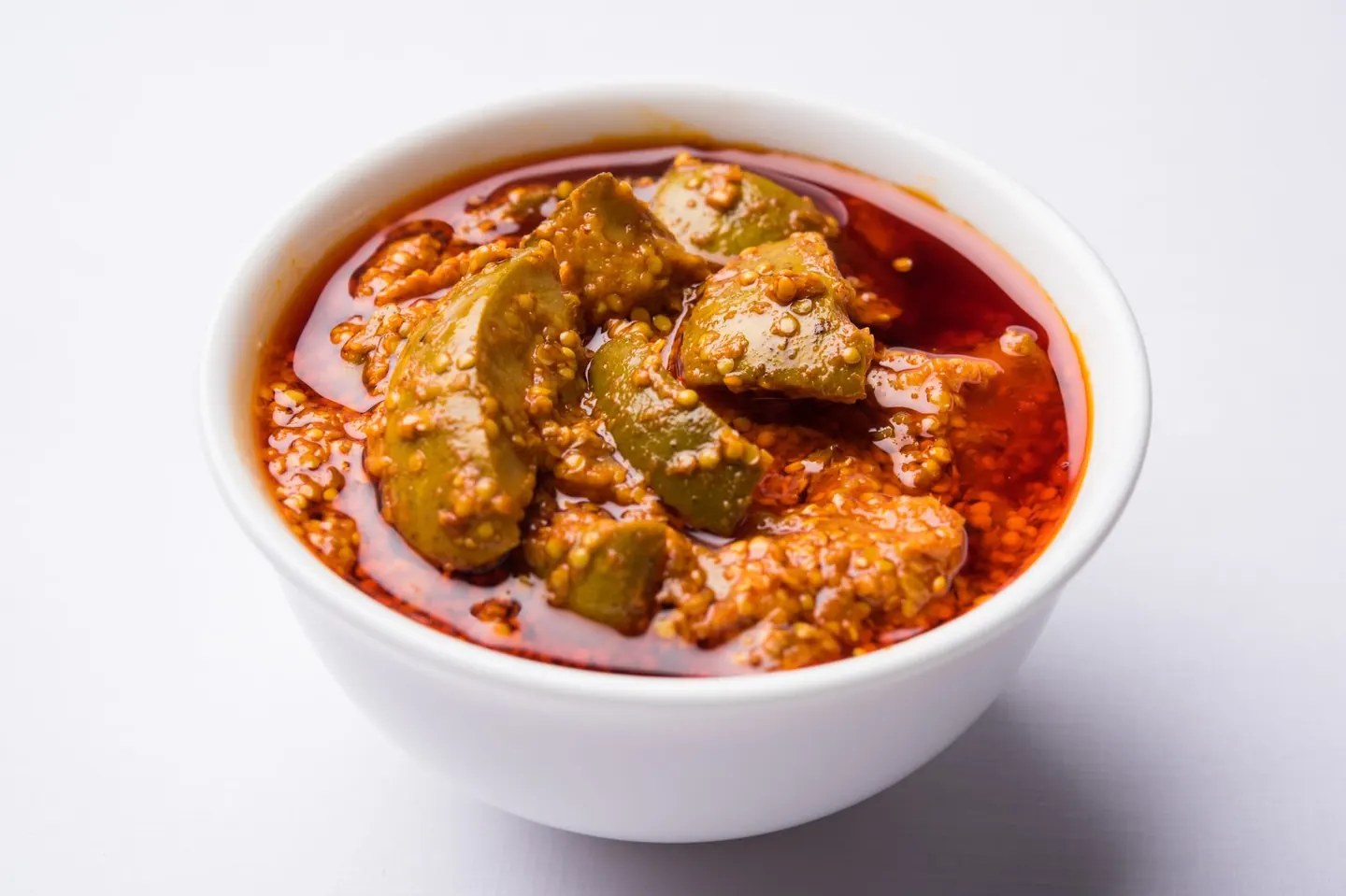
Photograph: Adobe Stock · representative of the dish
Plan ahead: plus 6 hours salting and 4–5 days maturing.
Mango achar is harder to make safely at low salt than lime achar, and the reason is simple: raw mango is sour but nowhere near as acid as lime juice, so cutting the salt removes a barrier with less to fall back on. Coconut vinegar — a Syrian Christian preserving ingredient, so this is not an imported idea — replaces it. Treat this as the more demanding of the two pickles and follow the hygiene exactly.
> ## READ THIS BEFORE YOU MAKE IT > The salt in a pickle is the preservative, not the seasoning. At 5% of the fruit's weight this pickle is not shelf-stable and must not be stored at room temperature. It requires a sterilised jar, completely dry fruit, a dry spoon every time, and a refrigerator at 4°C (39°F) or below. Its life is four weeks, not a year. If you want a pickle that lives in the pantry, make the traditional version at 12% salt and serve it by the quarter-teaspoon — that is a legitimate choice and it is safer than a low-salt pickle stored carelessly. > > Read the same honest paragraph that heads R096, because it applies here with more force. No food-safety authority specifies a minimum salt concentration for an achar, and none publishes a refrigerated shelf life for one. What the National Center for Home Food Preservation does specify is the acid threshold — a product acidified "below pH 4.6" resists the bacterial spores that matter, and above 4.6 it does not — and the vinegar in this recipe exists to put the jar on the right side of that line, because raw mango on its own does not. The NCHFP's other instruction bears repeating without softening: "do not alter vinegar, food, or water proportions in a recipe or use a vinegar with unknown acidity." The 60 ml of 5% vinegar is not a flavouring. Do not reduce it, and do not substitute a vinegar whose strength is not printed on the bottle. The four weeks below is this book's judgement, erring short; it is not a number an authority has published for this product.
Before you start: Sterilise the jar as for R096: hot soapy water, rinse, 20 minutes in a 110°C (230°F) oven, cool without touching the inside. Dry the mango on a cloth until there is no visible moisture. Water is the enemy of every low-salt preserve.
Allergens: Sesame, mustard. Gluten (wheat) — only if your asafoetida is compounded with wheat flour, as most brands are.
Equipment: Glass or glazed ceramic jar with a tight non-metal lid, 1 litre, sterilised and bone dry; dry ceramic or glass bowl; small pan. Substitute: two 500 ml jars, which is better — open one at a time.
You want hard, sour, fully unripe mango — Indian kadumanga, or the green mangoes sold for Thai salads, or unripe Kent or Tommy Atkins from a supermarket if that is the choice. A mango with any give in it will collapse. Coconut vinegar is sold in South Asian and Filipino groceries; cider vinegar or plain white vinegar at 5% acidity works identically for safety and slightly differently for flavour, and both are acceptable. Do not use a vinegar of unstated acidity, because acidity is the point.
Blood pressure: 220 mg a tablespoon, 70 mg a teaspoon. Pickle is one of the three items ICMR-NIN's 2024 dietary guidelines single out by name for Indian readers, alongside pappadam and salted snacks, and the reason is the arithmetic above rather than anything mysterious. A teaspoon on the side of a plate is a sensible daily habit. A heaped serving spoonful is a third of a day's sodium.
Blood sugar: negligible.
Cholesterol: 0.2 g of saturated fat a tablespoon.
Coconut oil for sesame → Consequence: the traditional Kerala flavour, saturated fat up from 0.2 g to about 2.2 g a tablespoon, and a jar that sets solid in the fridge.
No vinegar, salt raised to 12% (60 g) → Consequence: the traditional pantry pickle, 6–12 months unrefrigerated, roughly 570 mg of sodium a tablespoon. A legitimate choice, made knowingly.
Vinegar raised to 100 ml with salt held at 5% → Consequence: a sharper, more Anglo-Indian-tasting pickle with a better safety margin; shelf life extends to about 6 weeks in the fridge.
Lime juice for the vinegar → Consequence: better flavour, and a less certain acid concentration, because the acidity of a lime varies and that of a labelled 5% vinegar does not. For a low-salt preserve, use the vinegar.
Potassium-enriched salt for part of the salt → not recommended in a pickle, for the reason given in R096: the preservation is sodium chloride's doing. Consequence: an unquantified change to the safety barrier. And potassium-enriched salt is not for readers with chronic kidney disease, or on a RAAS inhibitor (ACE inhibitor or ARB) or a potassium-sparing diuretic, without a doctor's approval.
Salt, vinegar and oil must all scale exactly. These are the three safety ingredients and eyeballing them is how a jar spoils.
Fridge 4 weeks at 4°C (39°F) or below, solids under liquid, dry spoon only. Cupboard: none — this pickle is not shelf-stable and must not be left out. Freeze 4 months in 60 g portions, thawed in the fridge and used within 10 days. If a jar is opened daily, treat the four weeks as three.
Blend 3 tablespoons with 150 ml of water into an instant mango curry for rice, or chop the pieces finely and stir a tablespoon into a beef or chicken ularthiyathu at the end, where it does the work of both souring agent and salt.
Mushy within a week: the mango was not fully unripe, or step 2 was skipped.
Mould in the first fortnight: moisture. A damp jar, damp fruit, or a wet spoon.
Harsh and raw after a week: it needs longer. The fenugreek and mustard round out over two weeks.
Burnt taste throughout: the chilli powder went into hot oil.
Liquid does not cover the solids: add 20 ml more vinegar and 10 g more oil. Exposed fruit is where a jar fails.
Serve with
R015 Perfect Matta Rice · R004 Puttu · R012 Kanji with a Pulse · R055 Kadala Ularthiyathu · R120 the sadya leaf, by the quarter-teaspoon
Tap a star to rate this recipe
The Kindle edition is on its way. Until it lands, the complete book — all 25 chapters and 137 recipes — is free to read here, and it stays free after.