 R118
R118Sadya Sambar
The festival sambar, at full scale
Recipes › The Sadya, Re-engineered
R117
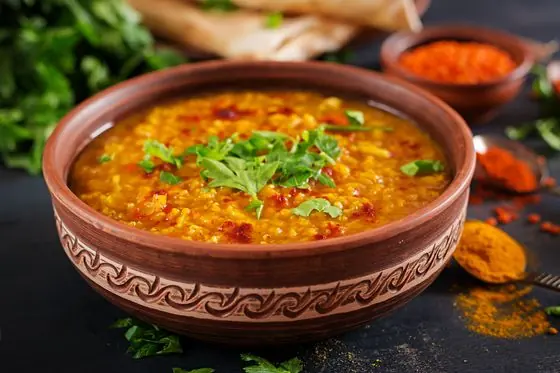
Green gram dal for the first rice course, with the ghee measured
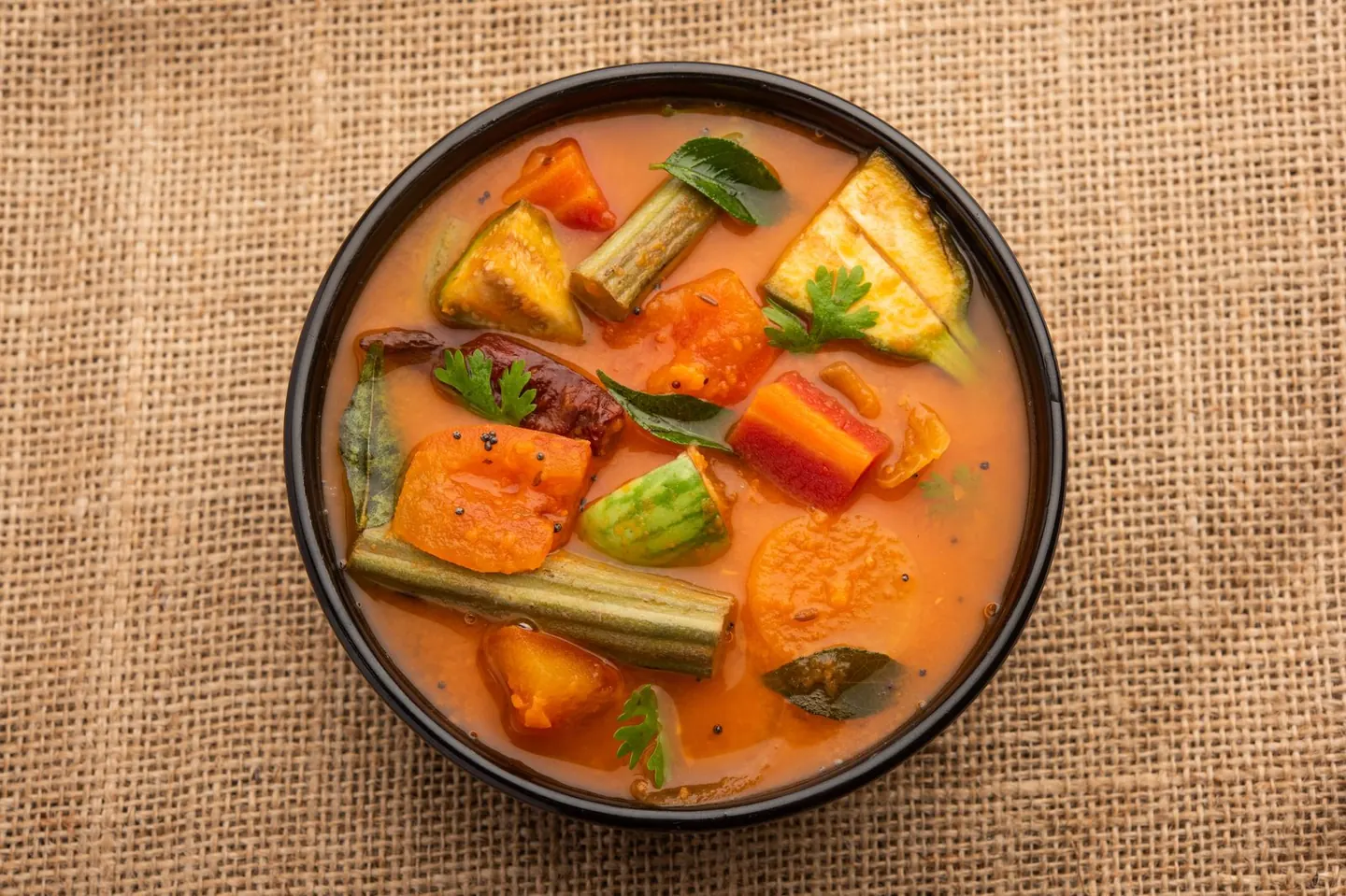
Photograph: Adobe Stock · representative of the dish
The sadya opens with a pulse, and that is not an accident of custom. In this tradition the heaviest, fattiest course goes first, when agni — the digestive fire — is held to be at its strongest, which is why hot rice, parippu and ghee are the first thing on the leaf and cooling moru is the last. The nutritional reading is different and arrives at the same place: a rice meal that begins with 50 g of legumes is a materially different meal from one that does not. Brown rice eaten with 50 g of legumes a day cut glycaemic response 22.9% below white rice in the one direct Indian trial, where switching the rice and stopping there reached 19.8% — the pulse is what took it past the grain swap. The sadya has been front-loading the pulse for centuries.
Before you start: Roast the dal before you wash it. Sadya parippu is made with dry-roasted green gram dal, and the roasting is the difference between this dish and any other dal on earth.
Allergens: Milk.
Equipment: 2-litre pan or a pressure cooker; mixie or a small blender for the coconut paste. Substitute: an ammikkallu or a mortar gives a coarser paste with better texture and takes 5 minutes longer. A pressure cooker takes the dal to soft in 3 whistles, about 8 minutes at pressure, against 25 in an open pan.
Split skinned green gram dal is in every Indian grocery and most large supermarkets as moong dal. Choose bright yellow, uniform dal; grey or dusty dal is old and will not roast to a clean aroma. Frozen grated coconut works completely here and is what most diaspora readers should use. On the ghee: buy real ghee rather than a vegetable-fat "ghee substitute", because the whole point of 2 g is that it must be worth tasting — a hydrogenated substitute at 2 g tastes of nothing and you will end up using 10 g of it. Note that formal sadya and temple cooking exclude onion and garlic, treated in this tradition as rajasic or tamasic; household Brahmin cooking varies, and shallots are widely used elsewhere in Kerala. There is neither here, and the dish does not miss them.
Blood sugar: this is the most useful dish on the leaf and it should be eaten in full. Thirteen grams of net carbohydrate, 6 g of protein and 3 g of fibre, arriving before the rice.
Blood pressure: 150 mg sodium a leaf. Made with M07 the 70:30 salt it drops to about 105 mg and brings roughly 60 mg of potassium — and the standing carve-out applies: do not use potassium-enriched salt if you have chronic kidney disease, or take an ACE inhibitor, an angiotensin receptor blocker, a potassium-sparing diuretic or a potassium supplement, without your doctor's approval.
Cholesterol: 3 g of saturated fat, roughly half from the ghee and half from the coconut. Using coconut oil instead of ghee changes the saturated figure very little and loses the aroma, which is the wrong trade.
Green gram dal → red gram dal (toor). Heavier, sweeter, slower to soften by 10 minutes; some households do it this way and it is not wrong, but green gram is the sadya standard and it is lighter.
Ghee → coconut oil, 2 g. Saturated fat is essentially unchanged; the aroma is completely different and the dish stops being upastharanam in any recognisable sense.
Fresh coconut → 25 g desiccated coconut soaked 15 minutes in 50 ml warm water. Slightly chalky, and you will want a squeeze more water in the grind.
Cannot have ghee at all → finish with 2 g of coconut oil and a scatter of fried curry leaves, which supplies aroma from a different direction and works better than nothing.
At 25 leaves this is about 1.75 litres of finished parippu — a 5-litre pan, or a pressure cooker in two batches. Grind the coconut paste in one go and add it in proportion.
Roast the dal up to a week ahead and keep it in a jar. Cook the parippu to the end of step 3 the day before — fridge 2 days — and add the coconut paste on the day, because ground coconut sours faster than anything else on the leaf. Freeze 2 months without the coconut paste. Reheat with hot water to bring it back to a pouring consistency, which it will need.
Thin it with water, add a tempering of mustard and curry leaves in 3 g of coconut oil, and it becomes a weekday parippu curry over rice. Or thicken it with a handful of rice flour and make dal vada. Leftover parippu also makes the best possible base for a parippu pradhaman if you have jaggery and coconut milk to hand.
Tastes of raw pulse: under-roasted at step 1, and nothing later fixes it.
Grainy, with hard centres: the dal was not fully soft before the coconut went in. Coconut fat slows further softening; get it right at step 3.
Too thick to pour on the leaf: the commonest fault in this dish. Hot water, generously, right before serving.
Sour by the time the sadya starts: the ground coconut went in too early on a hot day. Add it within the hour before serving.
Serve with
R015 Matta Rice as the first course · R118 Sadya Sambar as the second · R119 the pickle set at the top left of the leaf · M07 the 70:30 salt
Tap a star to rate this recipe
The Kindle edition is on its way. Until it lands, the complete book — all 25 chapters and 137 recipes — is free to read here, and it stays free after.