 R040
R040Nadan Kozhi Curry
The everyday country chicken curry
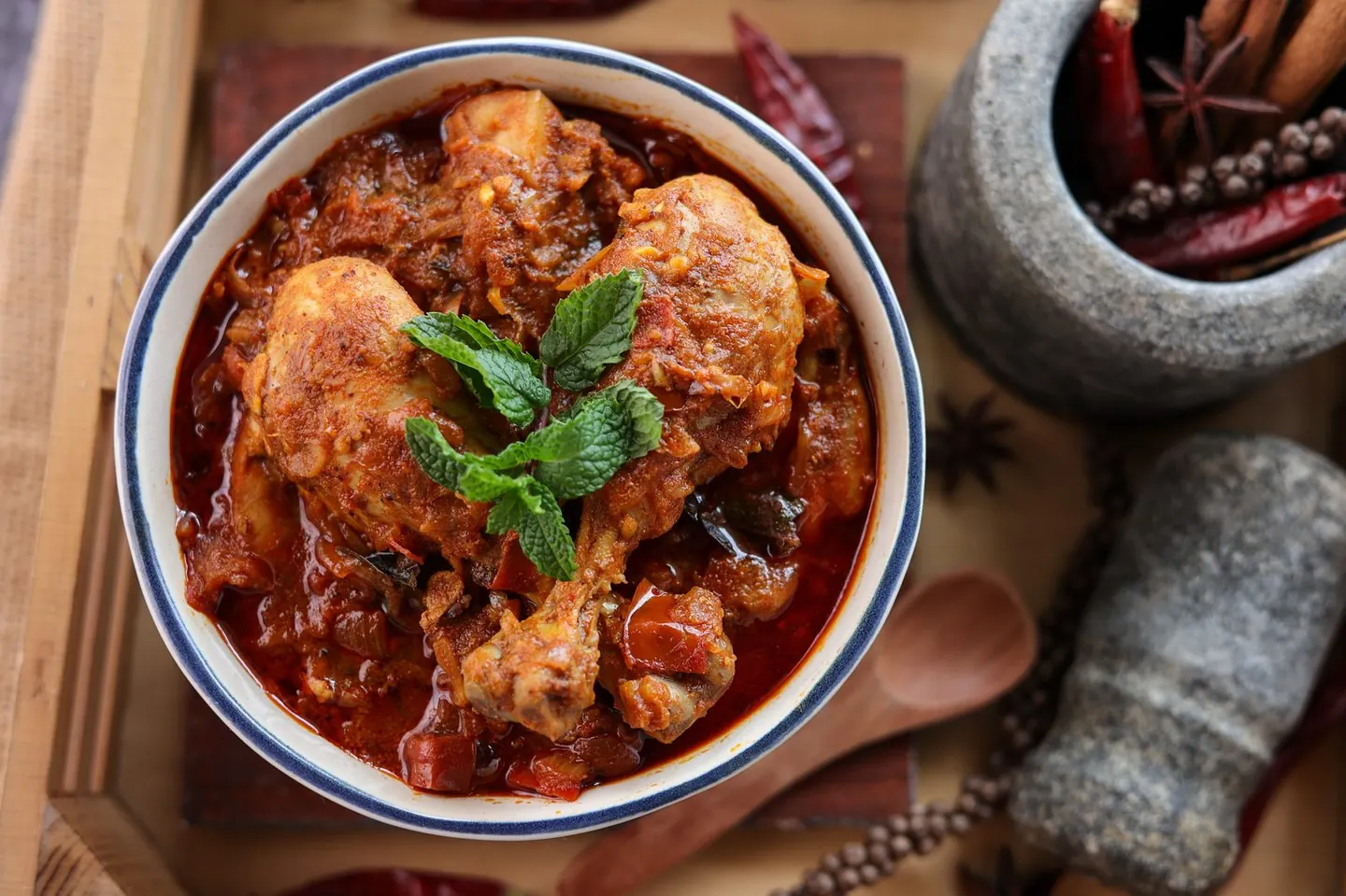
Photograph: Adobe Stock · representative of the dish
Plan ahead: plus 30 minutes marinating — recommended.
Kerala's pepper is the reason ships came. It is also, for a cook, the most useful ingredient in a low-fat kitchen, because piperine's heat is a trigeminal sensation rather than a taste — it raises the perceived intensity of everything else in the pan, which means less salt and less fat register as more flavour. This is a dry roast: the gravy reduces onto the meat until the pieces glisten and the pepper crusts. Sixteen grams of pepper for four people sounds like a mistake. It is not.
Before you start: Crush the pepper coarsely, not to powder — you want grit that sits on the surface of the meat. Open a window before step 5; 16 g of pepper hitting a hot pan will find your throat.
Allergens: None of the major allergens as the recipe is written. Sesame or peanuts — whichever of the two oils you use (it reaches the dish through M16).
Equipment: Heavy 26 cm pan or cheena chatti; mortar or spice grinder for the pepper. Substitute: pre-ground pepper works and loses perhaps a third of the aroma — pepper's volatiles go within days of grinding. If that is what you have, use 20 g rather than 16 g.
| Energy | 311 kcal |
| Protein | 27 g |
| Fibre | 4 g |
| Net carbohydrate | 9 g |
| Total carbohydrate | 13 g |
| Sugars | 3 g |
| Fat | 18 g |
| Saturated fat | 7 g |
| Sodium | 260 mg |
From ICMR-NIN IFCT 2017 and USDA FoodData Central. Per-serving figures stay the same when you scale.
Buy whole peppercorns and grind them yourself; the difference here is not marginal, because pepper is the dish. Malabar pepper is GI-registered and worth the premium if you can get it — larger berries, more resinous. Tellicherry is the export grade of the same pepper, graded for size. Wherever you are, buy small quantities often rather than a large tin once.
Blood sugar: 9 g of net carbohydrate. This is a free dish glycaemically; the meal is decided by the rice beside it.
Blood pressure: 260 mg per serving, the lowest of any meat dish in this chapter, and the reason is the pepper. If you are working down from a high-salt habit, this is the recipe to start with.
Cholesterol: 7 g of saturated fat, and there is no coconut in it at all — about 5 g comes from the chicken itself and 1 g from the tablespoon of coconut oil. Swap that tablespoon for sesame oil and saturated fat falls by about 0.2 g per serving while the dish tastes marginally nuttier.
Sesame or groundnut oil for the coconut oil → 16–19% saturated fat instead of 91%, and a cleaner, less sweet finish. Genuinely better here, where coconut is not the flavour.
Boneless thigh → 500 g, and cut the covered cooking to 10–12 minutes. Easier to eat, and the gravy has less body without the bone.
Add 60 g of coconut slivers at step 6 → this becomes something closer to R045, with about 5 g more fat and 4.5 g more saturated fat per serving.
Less heat → 10 g of pepper total, and add 4 g of chilli powder at step 3. Different heat, similar intensity, and you will need more salt.
Marinate up to 8 hours ahead. Fridge 3 days; it stays good because there is no emulsion to break. Freeze 2 months — the best freezer dish in the chapter. Reheat in a dry pan over medium heat with a tablespoon of water, 3–4 minutes, until it sizzles again.
Bitter, harsh finish: all the pepper went in early and scorched. Half at the start, half off the heat.
Chicken cooked but pale and wet: you skipped step 6, or the pan was crowded. Cook in two batches if your pan is under 26 cm.
Too hot to eat: the pepper was ground fine rather than crushed coarse. Fine pepper distributes into every mouthful; coarse pepper sits in patches you can eat around.
Serve with
R015 Matta Rice · R004 Puttu · R059 Sambar · R079 Cabbage-Carrot Upperi
Tap a star to rate this recipe
The Kindle edition is on its way. Until it lands, the complete book — all 25 chapters and 137 recipes — is free to read here, and it stays free after.