 R040
R040Nadan Kozhi Curry
The everyday country chicken curry
Recipes › Chicken, Egg and Meat
R044
The Syrian Christian coconut-milk curry, pale and pepper-warm
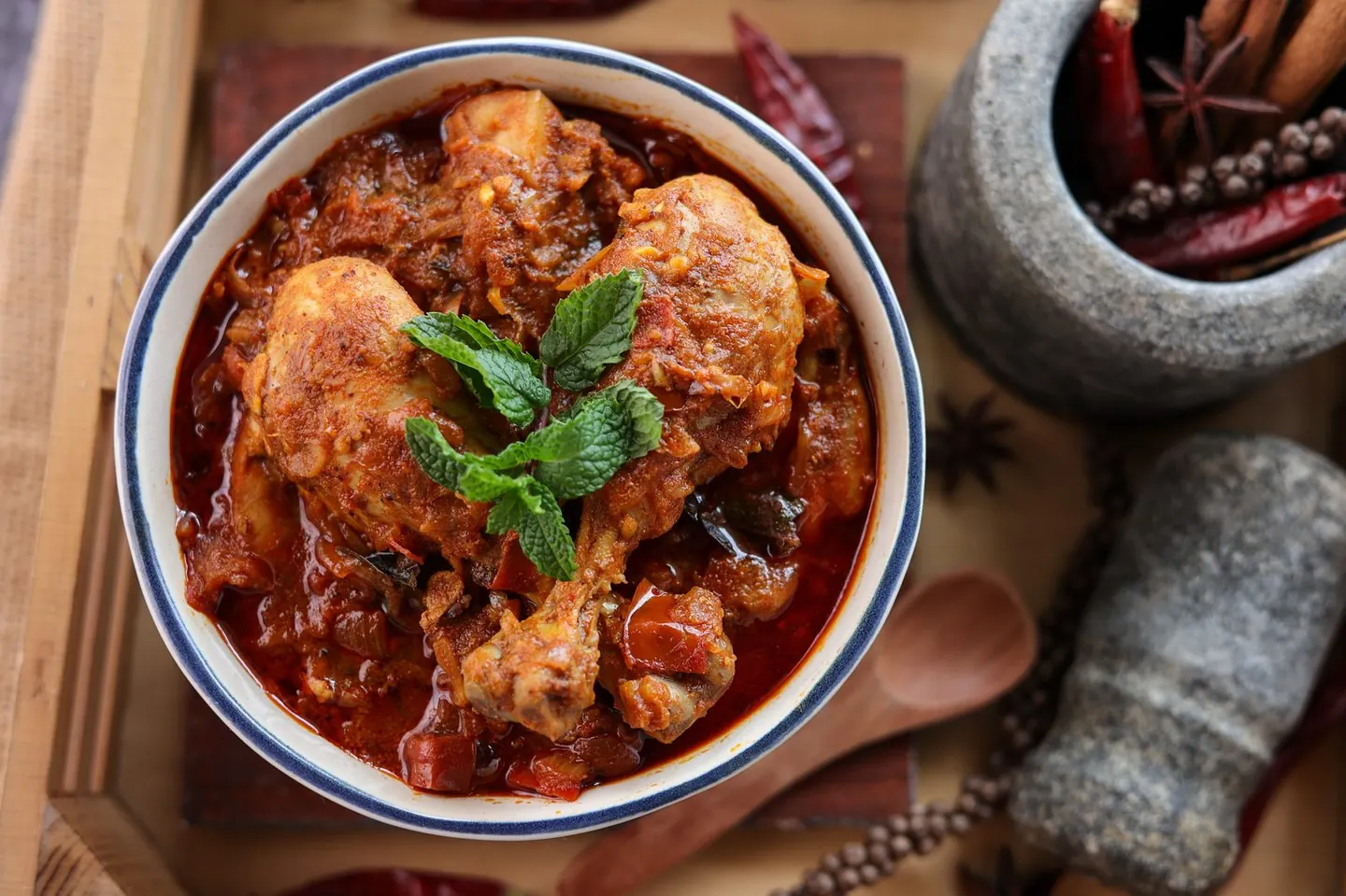
Photograph: Adobe Stock · representative of the dish
Mappas sits between a stew and a curry: paler and gentler than a nadan curry, more spiced and more sour than an ishtu. It belongs to the Kottayam and Alappuzha Christian kitchens, and its distinguishing move is the vinegar, which comes from the coconut-vinegar preserving tradition of the same households. The vinegar is not incidental. It cuts the coconut fat on the palate, and there is reasonable trial evidence that vinegar with a meal attenuates the glucose and insulin response — pooled reductions in glucose area under the curve of −0.60 standardised mean difference across clinical trials (Shishehbor et al., 2017).
Before you start: Have the thick milk measured and the pan lid within reach. The last two minutes of this dish are the only two that can ruin it.
Allergens: None of the major allergens.
Equipment: Heavy 26 cm pan with a lid, or a clay manchatti of 24 cm. Substitute: clay is genuinely better here because it is inert to the vinegar and simmers gently, but any non-reactive pan works; avoid bare iron or aluminium with this much acid.
| Energy | 413 kcal |
| Protein | 28 g |
| Fibre | 4 g |
| Net carbohydrate | 10 g |
| Total carbohydrate | 14 g |
| Sugars | 5 g |
| Fat | 29 g |
| Saturated fat | 16 g |
| Sodium | 380 mg |
From ICMR-NIN IFCT 2017 and USDA FoodData Central. Per-serving figures stay the same when you scale.
Coconut vinegar — cloudy, mild, faintly sweet — is sold by Kerala grocers and online as kaadi. Cider vinegar at the same volume is the closest substitute and is a little sharper. Do not use malt or distilled white vinegar, which are both too aggressive for the amount of coconut here.
Blood sugar: 10 g of net carbohydrate, and the vinegar is on your side. Pair with 150 g of cooked matta rice or two appam rather than four.
Blood pressure: 380 mg. The vinegar and pepper make this dish tolerant of less salt; 3 g of M07 brings it to about 320 mg with no real loss.
Cholesterol: 16 g of saturated fat, of which about 11 g is coconut milk. If you make one change, make it here: 60 ml of first extraction instead of 100 ml removes about 2.5 g per serving.
Fish instead of chicken → 600 g of firm white fish, added at step 5 and simmered 8–10 minutes only. This is fish mappas, and it is lighter by about 12 g of fat per serving. (Allergen: this swap introduces fish.)
Add 200 g of potato at step 5 → the Kuttanad habit. Adds about 10 g of net carbohydrate per serving and makes the dish stretch to five.
No vinegar → 15 g of tamarind pulp added at step 5. Rounder, fruitier, and the dish loses its clean finish.
Coconut milk → 40 g of roasted coconut paste (M09) plus 200 ml of second extraction. Deeper and darker, and no longer a mappas.
Cook to step 6 up to a day ahead. Fridge 2 days, covered, non-metal. Freeze 1 month at step 6 only. Reheat below a simmer and re-finish with 20 ml of fresh thick milk if it looks tired.
Reduce hard and use as a filling for chatti pathiri. Or add 200 g of cooked vanpayar (R053) and 100 ml of second milk to turn the remains into a full second meal.
Curdled, with visible curds: the thick milk boiled, or the vinegar went in while the pan was still on the flame. Both, next time, off the heat.
Flat and sweet: not enough vinegar or not enough pepper. A mappas that does not taste faintly sour is an ishtu with more spice in it.
Gravy too thin: skipped step 6. Reduce before the thick milk, not after — after, you cannot.
Serve with
R001 Appam · R007 Thattu Dosa · R053 Vanpayar Thoran · R065 Cheera Thoran
Tap a star to rate this recipe
The Kindle edition is on its way. Until it lands, the complete book — all 25 chapters and 137 recipes — is free to read here, and it stays free after.