 R063
R063Cabbage Thoran
The master thoran: shredded cabbage, crushed coconut, turmeric
Recipes › Vegetables: The Half of the Plate
R078
Vazhapindi in curd with ground coconut and mustard
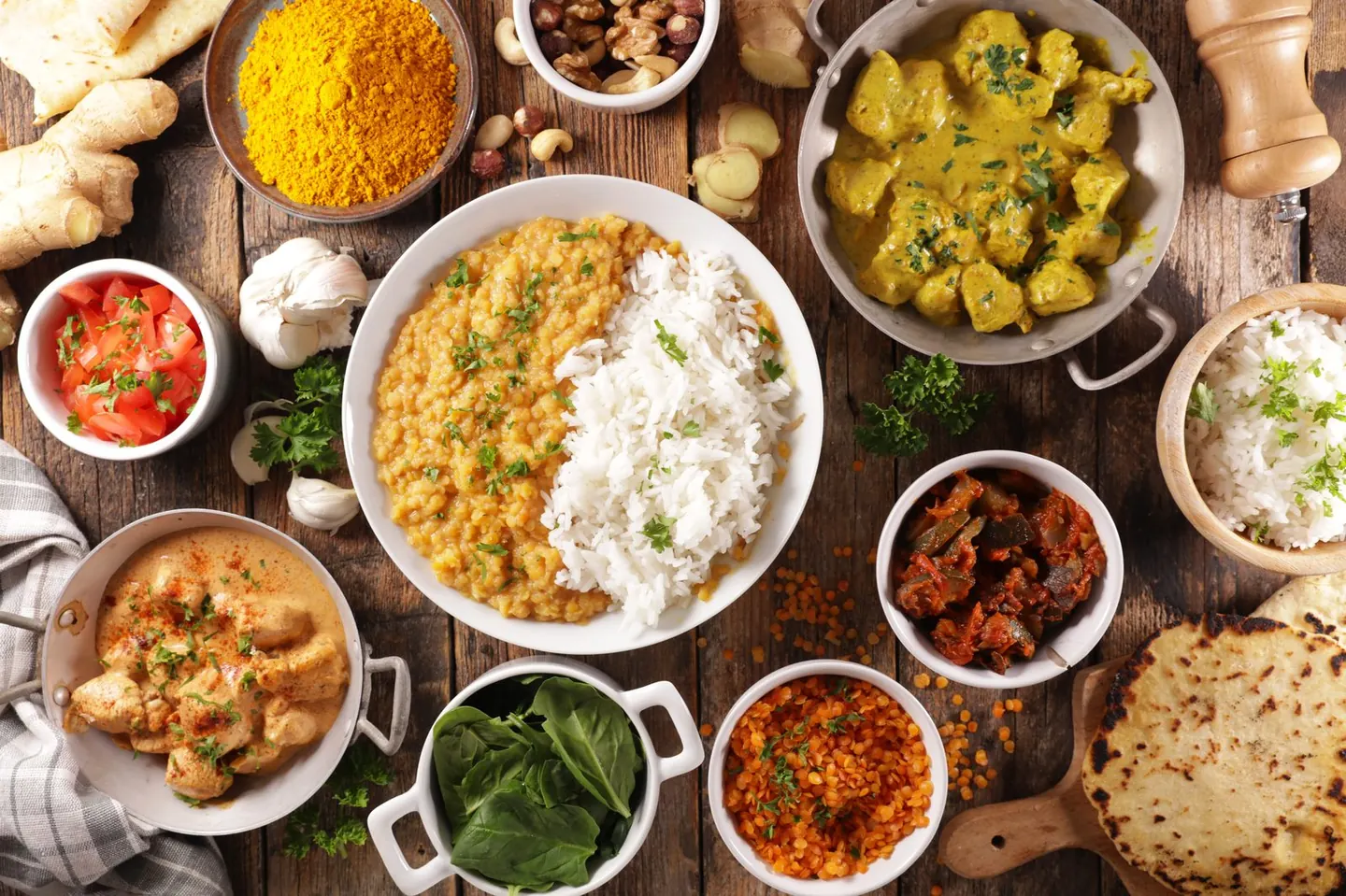
Photograph: Adobe Stock · representative of the dish
The banana plant gives Kerala four vegetables and a serving dish, and the stem is the one that gets thrown away outside Kerala. It is 39 kcal and 8.6 g of available carbohydrate per 100 g with the texture of a firm water chestnut, and it is unusually high in fibre for something so watery. Preparing it is the whole job: the stem has to be peeled down to its pale core, sliced, and de-stringed by winding the fibres round a finger as you go. Twenty minutes, once, and then you understand why Kerala keeps it.
Before you start: Cut the stem into the acidulated water as you go. Banana stem oxidises to a dull pink-brown within two or three minutes of being cut, and once it has, it stays that colour. Whisk the curd smooth and leave it out of the fridge.
Allergens: Milk, mustard.
Equipment: Bowl of water with a squeeze of lime or a spoon of buttermilk, for holding the cut stem; saucepan; mixie; small pan for tempering. Substitute: none required.
| Energy | 120 kcal |
| Protein | 2.7 g |
| Fibre | 3.0 g |
| Net carbohydrate | 10.5 g |
| Total carbohydrate | 13.5 g |
| Sugars | 3.9 g |
| Fat | 7.5 g |
| Saturated fat | 5.9 g |
| Sodium | 240 mg |
From ICMR-NIN IFCT 2017 and USDA FoodData Central. Per-serving figures stay the same when you scale.
Fresh banana stem is sold in Indian and Sri Lankan groceries in the Gulf, Singapore and parts of the UK, sometimes ready-sliced in water, which is worth paying for. In North America it is easiest found frozen, or tinned in brine — rinse tinned stem twice and skip step 2's cooking almost entirely, and know that its texture is softer and its flavour flatter. Where there is none: peeled and thinly sliced celery stalks and water chestnuts together, 250 g of each, give a surprisingly close approximation of the crunch, though not the faint bitterness. Cucumber pachadi (vellarikka pachadi) is the better fallback and is a genuine Kerala dish in its own right; use 500 g of peeled, seeded cucumber and cook it 3 minutes only.
Blood sugar: 10.5 g net carbohydrate per serving, and the curd contributes protein and lactic acid. Fermented dairy shows the most consistent inverse associations with weight, type 2 diabetes and blood pressure of any dairy category in the cohort literature, and those are observational associations rather than proof of effect.
Blood pressure: 240 mg sodium, or about 180 mg with M07. Curd itself carries about 46 mg per 100 g before any salt.
Cholesterol: 5.9 g saturated fat per serving, split between the coconut and the curd. Made with low-fat curd it falls to about 4.5 g.
Banana stem → cucumber (vellarikka), 500 g peeled and seeded, cooked 3 minutes. A real Kerala dish rather than a compromise.
Banana stem → 400 g grated white radish, or 400 g of ash gourd. Radish is sharper; ash gourd is closer in blandness.
Curd → 300 ml thin coconut milk with 10 g tamarind. Vegan, thinner, and no longer a pachadi in the strict sense.
Add 60 g of pineapple, finely chopped → the madhura pachadi of a sadya leaf. Sugars rise about 2 g per serving, and it is a different dish with a different job.
Prepare and cook the stem up to 2 days ahead and keep it refrigerated in its liquid; add the paste and curd on the day. Fridge 2 days finished, and the curd sharpens noticeably. Do not freeze. Do not reheat — serve at room temperature or cold. Warming a pachadi is how you split it.
Thin with water and a pinch of M06 and drink it as a sambharam-adjacent glass, or spoon it over rice as a cooling course, which is its traditional place in a sadya's sequence.
Grey-brown stem: it was not held in acidulated water. Flavour is unaffected; appearance is not recoverable.
Split and watery: the curd met a hot pan. Off the heat, and wait two minutes longer than you think you need.
Stringy in the mouth: the fibres were not pulled out at step 1. This is the step that takes practice and there is no shortcut.
Serve with
R015 Matta Rice · R069 Avial · R071 Chena Erissery · R059 Sambar
Tap a star to rate this recipe
The Kindle edition is on its way. Until it lands, the complete book — all 25 chapters and 137 recipes — is free to read here, and it stays free after.