 R081
R081Moru Curry
Tempered buttermilk curry with ground coconut
Recipes › Curries, Pulissery and the Sour Family
R083
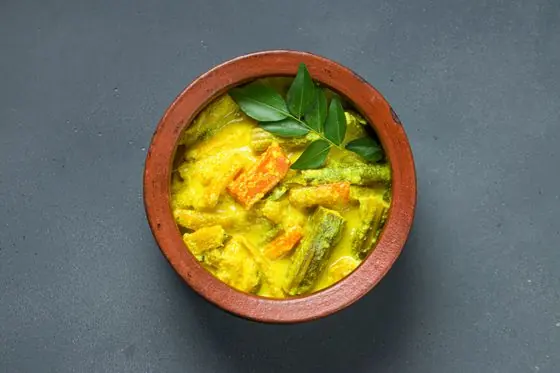
Ash gourd in curd and coconut
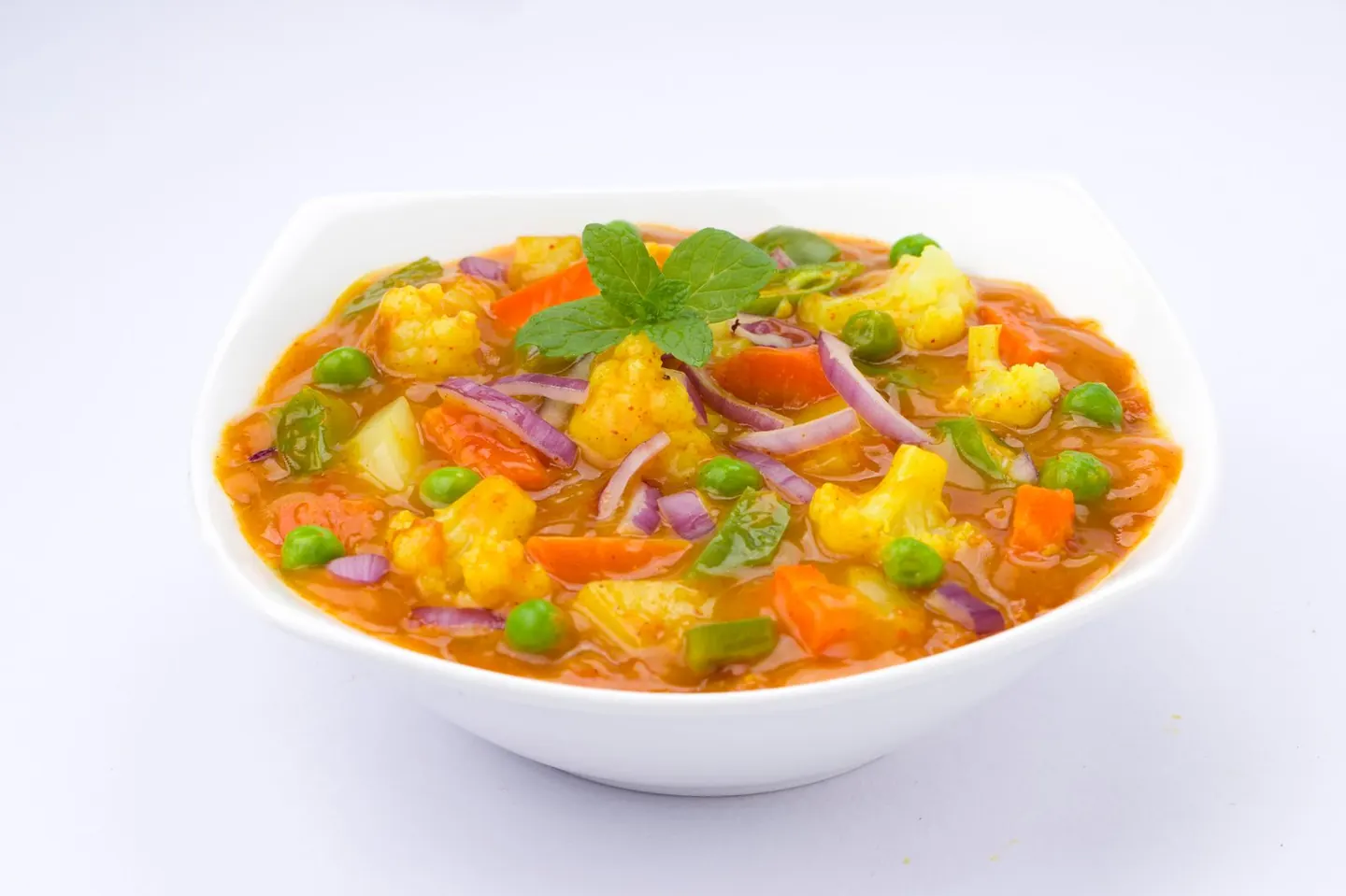
Photograph: Adobe Stock · representative of the dish
Ash gourd is the most useful vegetable in this chapter: 17 kcal, 2.84 g of available carbohydrate and 3.37 g of fibre per 100 g, and a texture that goes from squeaky to silken in about eight minutes. In a sadya it is the vegetable of olan and of the cooling closing curries, classified by tradition as calming and paired with coconut for exactly that reason. In a fat-loss kitchen it is the ingredient that lets you put 500 g of food on a plate for 85 kcal.
Before you start: Cook the gourd, grind the paste and whisk the curd before the two are brought together. Once the curd is in the pan the dish has about three minutes of life and it will not wait while you find the mustard seeds.
Allergens: Milk, mustard.
Equipment: Heavy 2-litre pan; mixie; small pan for the tempering. Substitute: as R081.
| Energy | 137 kcal |
| Protein | 4.5 g |
| Fibre | 5.9 g |
| Net carbohydrate | 8.6 g |
| Total carbohydrate | 14.5 g |
| Sugars | 6.8 g |
| Fat | 9.3 g |
| Saturated fat | 7.3 g |
| Sodium | 190 mg |
From ICMR-NIN IFCT 2017 and USDA FoodData Central. Per-serving figures stay the same when you scale.
Ash gourd is sold as winter melon or wax gourd in Chinese, Vietnamese and Thai grocers, usually cut by the wedge and usually fresher and cheaper than in Indian shops — buy it with the cut face still wet-looking and use it within two days. Bottle gourd (churakka, lauki, opo) is the closest substitute at the same weight, cooks in about the same time, and is slightly sweeter. Chayote works too and holds its shape more firmly. Do not use courgette here; it collapses into water.
Blood sugar: 8.6 g of net carbohydrate against 5.9 g of fibre in a 230 g portion. There is very little here for glucose to do. This is the dish to put on the plate when you want the plate full and the numbers small.
Blood pressure: 190 mg a portion, most of it the curd's own sodium plus the M07. Leave the salt out and it falls to about 120 mg, and the dish still tastes seasoned because the curd's acid is doing that job.
Cholesterol: 7.3 g of saturated fat a portion, essentially all of it coconut — 50 g grated plus a teaspoon of oil across four. Cut the coconut to 30 g for about 5.5 g and add a tablespoon of rice flour slaked in water to keep the body. That is a real and reasonable trade.
Ash gourd → 500 g bottle gourd, chayote or snake gourd. Snake gourd is the lowest-carbohydrate of the four at 1.27 g per 100 g and needs only 5–6 minutes.
Ash gourd → 400 g ripe nendran banana or 400 g cooked yam, for the sadya registers. Both take the net carbohydrate to about 20 g a portion; both are traditional; neither is a low-energy dish any more.
Curd → 300 g buttermilk plus 15 g rice flour for body. Saturated fat drops to about 5.8 g a portion and the curry is looser and sharper.
Add 80 g cooked vanpayar at step 4 → the dish becomes closer to an olan in spirit, gains about 4 g of protein and 2 g of fibre a portion, and now carries the plate's pulse.
Water scales sub-linearly because the gourd's own water is the main liquid. At eight servings cook the gourd in two pans or a very wide one; piled deep, the bottom layer collapses before the top is done.
The cooked gourd with the coconut paste keeps 2 days in the fridge and the curd goes in on the day — this is the sensible way to make it ahead. Fridge 2 days for the finished curry, covered, non-metal. Do not freeze: the curd splits and the gourd turns to water. Reheat to barely warm over the lowest flame, or eat it cold.
Blend it smooth with a little water for a cold soup that is better than the description suggests. Or drain the gourd out and fold it into a thoran with fresh coconut and a mustard tempering.
Gourd disintegrated into the sauce: overcooked at step 1, or boiled after the curd went in. Seven minutes, then check every 30 seconds.
Split, grainy sauce: it boiled. No repair.
Watery and bland: too much water at step 1. Ash gourd supplies most of its own; 150 ml for 500 g is the ceiling, not the target.
Squeaky, raw-tasting gourd: undercooked. It should be translucent all the way through, not just at the edges.
Serve with
R015 Matta Rice, Properly Cooked · R023 Kerala Khichdi · R086 Rasam · R084 Ulli Theeyal
Tap a star to rate this recipe
The Kindle edition is on its way. Until it lands, the complete book — all 25 chapters and 137 recipes — is free to read here, and it stays free after.