 R015
R015Matta Rice, Properly Cooked
Kerala's parboiled red rice, by absorption and by draining
Recipes › Rice, Grains and the Grain Question in Practice
R020
Rice gruel: plain, with a pulse, and tempered
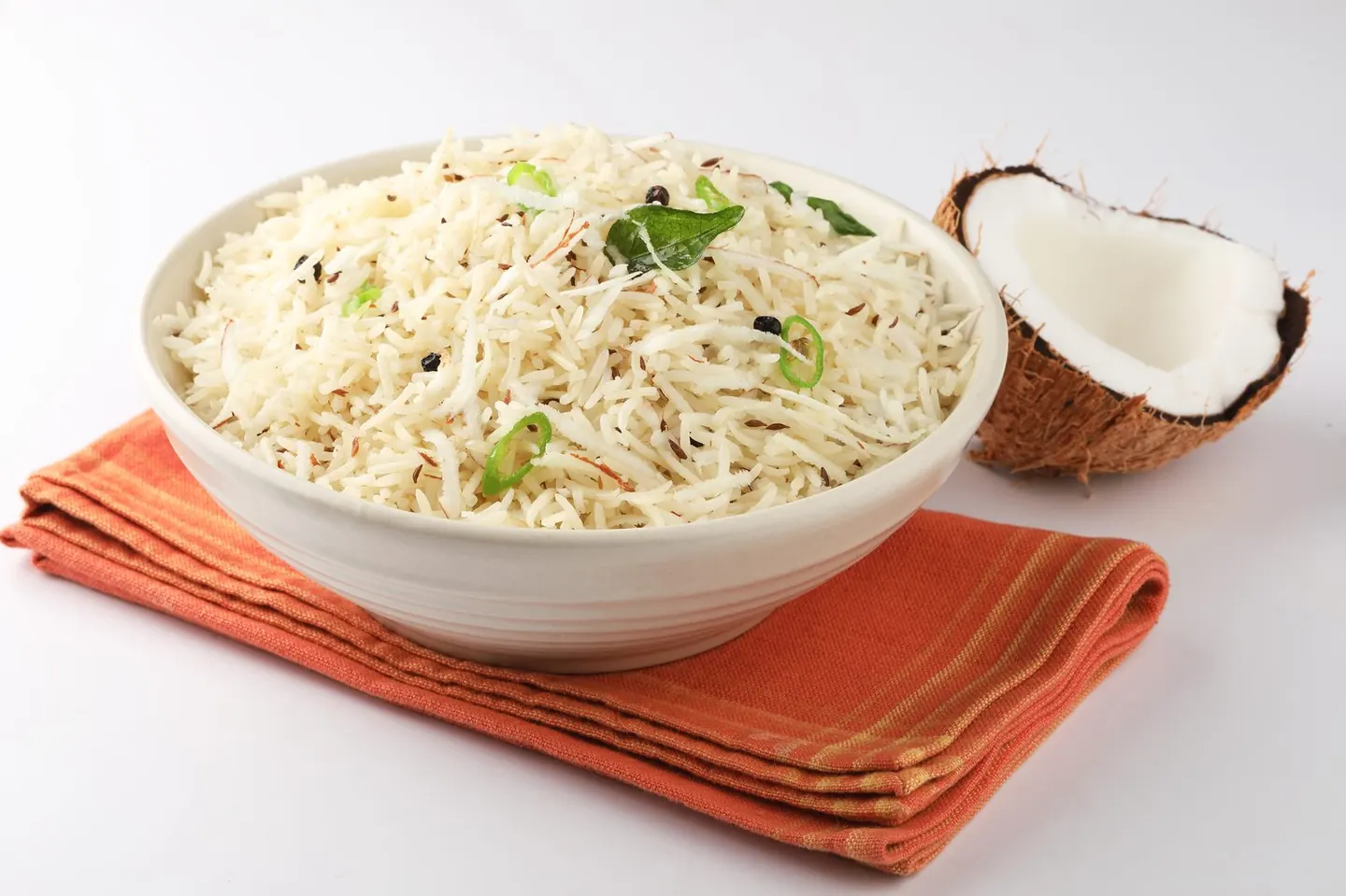
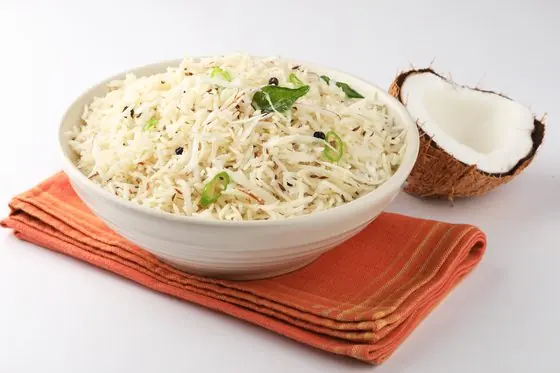
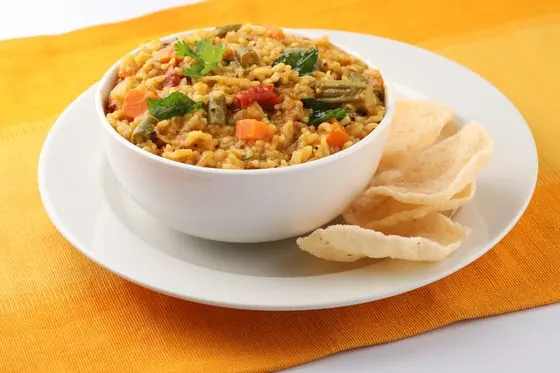
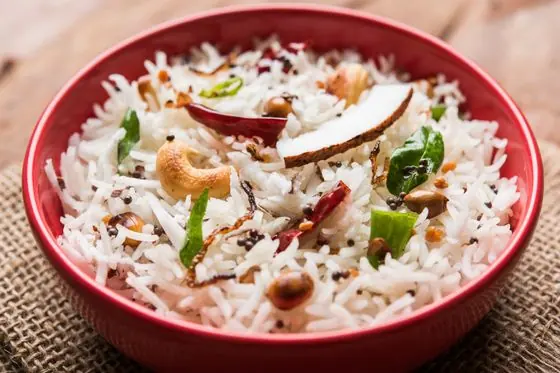
Photograph: Adobe Stock · representative of the dish
Plan ahead: plus overnight soaking for version two — required.
Kanji is what Kerala eats when it is ill, when it is fasting, when the monsoon has taken the appetite, and when there is nothing else. It is also, read coldly, one of the best-designed dishes in the state: a small quantity of grain, a large quantity of water, eaten hot and slowly with a spoon, which is a description of a low-energy-density meal that takes time to eat. Three finished versions follow from one pot. The first is what an ammachi would give a fevered child. The second is the one to cook on a weeknight. The third is dinner.
Before you start: For version two, the whole green gram goes into water the night before. For version three, have the tempering ingredients in one small bowl beside the hob; mustard seeds pop for about 15 seconds and everything else has to be ready to follow them.
Allergens: Mustard.
Equipment: Heavy 2-litre pan with a lid. A small cheena chatti or steel ladle for the tempering in version three. Substitute: any pan deep enough that a starchy liquid at a rolling boil will not climb out of it — allow twice the height of the finished gruel.
| Energy | 106 kcal |
| Protein | 2.3 g |
| Fibre | 1.1 g |
| Net carbohydrate | 23.1 g |
| Total carbohydrate | 24.2 g |
| Sugars | 0.1 g |
| Fat | 0.2 g |
| Saturated fat | 0.0 g |
| Sodium | 140 mg |
From ICMR-NIN IFCT 2017 and USDA FoodData Central. Per-serving figures stay the same when you scale.
Matta gives the best kanji because parboiled grain releases its starch slowly and holds a little bite even when the liquid has thickened; white raw rice turns to paste. Broken matta — sold cheaply as nurukku or "rice rava" — is traditional for kanji and cooks in about half the time. Whole green gram is in every South Asian shop as moong or mung; use split moong dal if you must, at 40 g and no soaking, and accept a softer, less nutty result with about 4 g less fibre per portion.
Blood sugar: version two is the one to choose, and the reason is 25 g of dry whole green gram a head — comfortably above the 50 g of cooked pulse that, added to brown rice, took the glycaemic area under the curve 22.9% below white rice in overweight Asian Indians, against 19.8% for the grain swap alone (Mohan et al., 2014). It also lifts protein from 2.3 g to 8.0 g and fibre from 1.1 g to 5.4 g for 73 kcal.
Blood pressure: 140 to 210 mg per portion, which is low, and kanji is a good place to practise eating with less salt because the coconut and the pickle carry the interest. If you use pickle alongside, count it: a teaspoon of commercial lime achar can carry 300 mg on its own.
Cholesterol: versions one and two are effectively fat-free. Version three's 4.6 g of saturated fat comes from 80 ml of second coconut milk and 4 g of coconut oil across two people. Use third-extraction milk instead for about 2.5 g.
Matta → broken matta (nurukku). Cooks in 15–18 minutes and gives a smoother, more porridge-like gruel. The pulse version still needs 30 minutes for the green gram.
Whole green gram → 50 g vanpayar (brown cowpea), soaked overnight. Earthier, needs 45–50 minutes, and fibre is similar. This is the version most Kerala households actually eat.
Second coconut milk → 80 ml cow's milk. Saturated fat drops to about 1.5 g a portion; the dish stops being kanji in the Kerala sense and becomes something closer to a milk porridge. (Allergen: this swap introduces milk.)
No coconut oil → temper in 4 g gingelly oil. Different aroma, much less saturated fat, and entirely defensible. (Allergen: this swap introduces sesame.)
Water scales sub-linearly because a larger pot loses proportionally less to evaporation. Check the consistency at 25 minutes and add boiling water as needed rather than trusting the table.
Kanji thickens as it stands and will set almost solid in the fridge; thin it with boiling water on reheating. Fridge 24 hours — the same limit as any cooked rice, chilled within 1 hour in a shallow container. Freeze 1 month for versions one and two; do not freeze version three, because the coconut milk separates and the tempering goes soft. Reheat once, with 60–100 ml of water per portion, to a full simmer.
Set, cold kanji can be beaten smooth with a little water and used as part of the liquid in a dosa batter, where the pre-gelatinised starch improves the ferment. Or eat it cold with buttermilk, which is what Kerala does in April.
Thick, gluey and pasty: stirred too often, or cooked too fast so the water went before the grain softened. Add boiling water, drop the flame, and stop stirring.
Thin and watery with hard grains: not long enough. Matta takes 28 minutes minimum and unsoaked broken matta about 15; there is no shortcut.
Coconut milk split into grains and oil: it boiled. Off the heat next time, or use third extraction, which has too little fat to split.
Boiled over: a starchy gruel foams. Use a pan twice the height of the finished liquid and leave it uncovered.
Serve with
R087 Moru Kachiyathu · R084 Ulli Theeyal for the tempered version · a chammanthi or podi from Chapter 23 · M08 Coconut Milk, Three Extractions
Tap a star to rate this recipe
The Kindle edition is on its way. Until it lands, the complete book — all 25 chapters and 137 recipes — is free to read here, and it stays free after.