 R053
R053Vanpayar Thoran
Brown cowpea with grated coconut
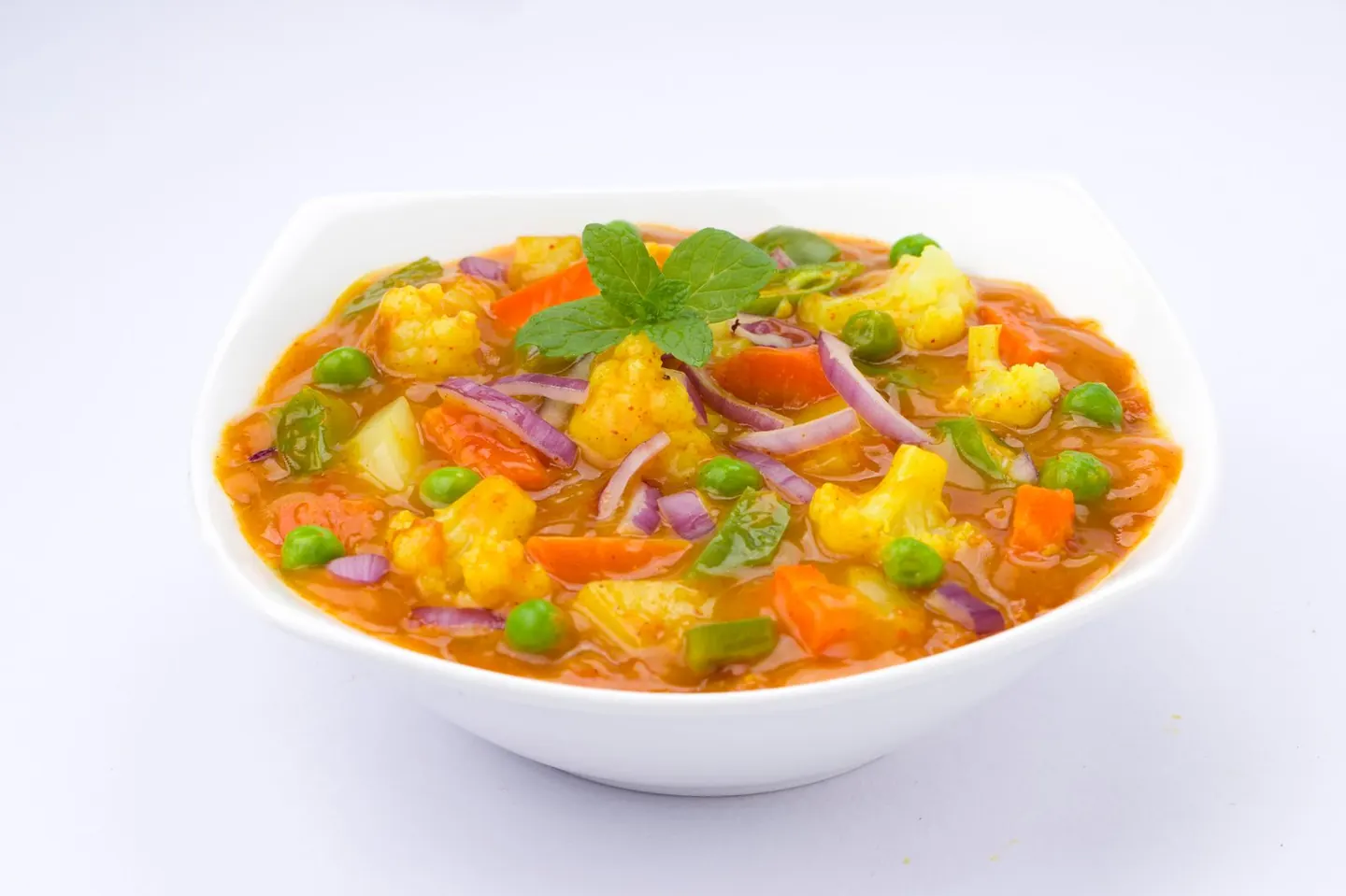
Photograph: Adobe Stock · representative of the dish
Plan ahead: plus 10–12 hours soaking and 25 minutes pressure-cooking — required.
The thoran in R056 is what a Kerala household does with muthira on a weekday. This is what it does on a Sunday: a dark, sour, varutharacha gravy — the roasted-coconut register that is the third grammar of Kerala cooking, neither ground raw coconut nor added milk. Tamarind, or kudampuli if you have it, cuts the earthiness. At 6 g of fat and 5 g of saturated fat a serving, it is also the leanest substantial dish in this chapter apart from the sambar.
Before you start: Take the M09 portion out of the freezer when you start the pressure cooker, or soak 10 g of tamarind in 80 ml of warm water at the same time. Both need twenty minutes and neither can be hurried.
Allergens: Mustard.
Equipment: Pressure cooker; heavy 24 cm pan or clay manchatti. Substitute: clay is better with this much acid and holds a gentler simmer; any non-reactive pan works. Avoid bare iron or aluminium with the tamarind.
| Energy | 240 kcal |
| Protein | 12 g |
| Fibre | 7 g |
| Net carbohydrate | 34 g |
| Total carbohydrate | 41 g |
| Sugars | 6 g |
| Fat | 6 g |
| Saturated fat | 5 g |
| Sodium | 260 mg |
From ICMR-NIN IFCT 2017 and USDA FoodData Central. Per-serving figures stay the same when you scale.
If you have no M09 in the freezer, make it fresh from 40 g of grated coconut, 10 g of sliced shallot, 5 g of coriander seed and 3 dried chillies, dry-roasted together to the colour of dark toast and ground with 40 ml of water — about twelve minutes of continuous stirring, which is exactly why M09 exists as a batch preparation. Kudampuli is the more interesting acid here and is sold by every Kerala grocer as Malabar tamarind or kodampuli; rinse it before use, because commercial smoke-curing leaves a bonfire note on the surface.
Blood sugar: 34 g of net carbohydrate, almost all of it from the pulse, plus an acid in the pot. This is a dish you can build a rice meal around rather than one you need to compensate for.
Blood pressure: 260 mg from 3.5 g of salt. The acid is doing part of the seasoning work, which is the whole craft argument of Chapter 10.
Cholesterol: 5 g of saturated fat, against 9 g for the thoran version and 10 g for the erissery. If a lipid panel is why you bought this book, this is the pulse recipe to start from.
Kudampuli for tamarind → smokier, rounder, and it deepens overnight rather than flattening. The better choice if you have it, and the reason is in Chapter 12's souring-agent map.
Vanpayar or kadala → 180 g dry, cooked to their own timings. Kadala makes the best version after muthira.
No M09 → 100 ml of second-extraction coconut milk added at step 7. Lighter, paler, less interesting, and about the same saturated fat.
Add 200 g of drumstick pods or ash gourd at step 6 → six servings, more volume, more fibre.
Better on day two, decidedly. Fridge 4 days in a covered non-metal container. Freeze 3 months — it freezes better than any coconut-milk curry, because there is no emulsion to break. Reheat at a simmer with a splash of water; this is one of the few curries in the book that can take a proper boil.
Mash it coarsely, reduce it, and it becomes a thick spread for pathiri or dosa. Or thin it with the pulse cooking water into a broth with more vegetables.
Gravy tastes raw and dusty: the M09 went in at the end without its 5 minutes. It needs to cook.
Thin and grey: the shallots were rushed at step 3, or there is too much water. Reduce uncovered 5 minutes.
Harshly sour: too much tamarind, or it went in unstrained with its fibre. Strain it, and remember 10 g of pulp is enough for four.
Serve with
R015 Matta Rice · R004 Puttu · R027 Ayala Varuthathu · R079 Cabbage-Carrot Upperi
Tap a star to rate this recipe
The Kindle edition is on its way. Until it lands, the complete book — all 25 chapters and 137 recipes — is free to read here, and it stays free after.