 R063
R063Cabbage Thoran
The master thoran: shredded cabbage, crushed coconut, turmeric
Recipes › Vegetables: The Half of the Plate
R075
Snake gourd and moong dal in coconut-cumin paste
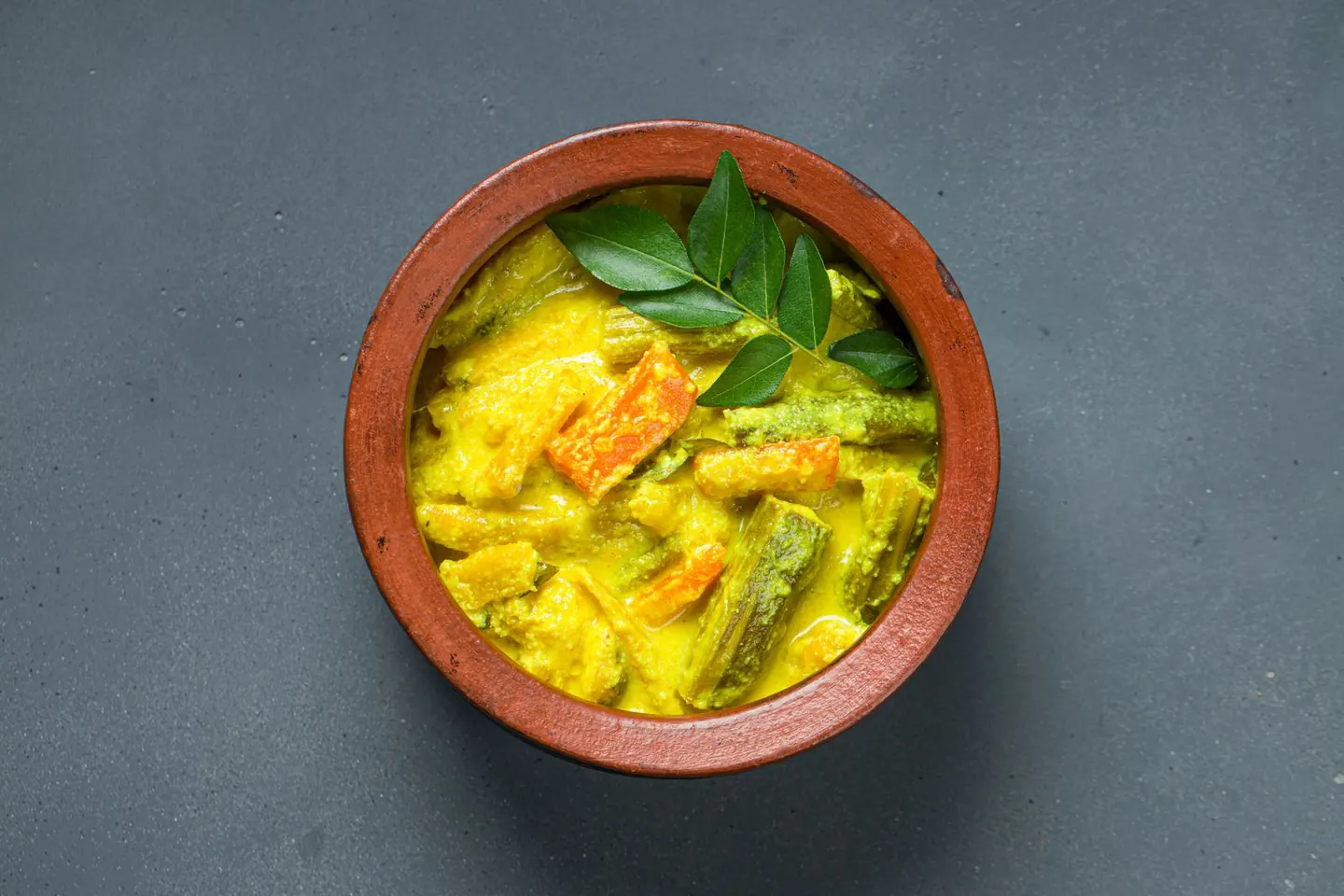
Photograph: Adobe Stock · representative of the dish
Snake gourd is the lowest-energy vegetable in the whole Kerala repertoire: 12 kcal and 1.3 g of available carbohydrate per 100 g. That is close to the theoretical floor for a food, and it means a large serving of this curry costs almost nothing. It is also a bland vegetable, which is why the traditional treatment gives it a coconut-cumin paste and a pulse rather than leaving it to fend for itself. The version below is the everyday thenga aracha one, not a sadya dish.
Before you start: Nothing here moves fast. This is a dish you can cook while doing something else, which is worth knowing on a Wednesday.
Allergens: Mustard.
Equipment: Heavy pan, 24 cm, with a lid; mixie. Substitute: any saucepan. The paste can be crushed in a mortar for a coarser, better texture.
| Energy | 154 kcal |
| Protein | 5.9 g |
| Fibre | 6.3 g |
| Net carbohydrate | 12.1 g |
| Total carbohydrate | 18.4 g |
| Sugars | 3.3 g |
| Fat | 9.1 g |
| Saturated fat | 7.3 g |
| Sodium | 260 mg |
From ICMR-NIN IFCT 2017 and USDA FoodData Central. Per-serving figures stay the same when you scale.
Snake gourd — padavalanga, pudalangai, chichinda — is in Indian and South East Asian groceries, usually a metre long and pale green, sold whole or in halves. It keeps four days in the fridge. Where there is none, the ladder is: chayote (nearest in texture, 2 minutes longer), courgette (easiest, watery, cut thicker and cook 4 minutes only), or a peeled and seeded cucumber, which sounds wrong and is what several Kerala households use out of season. Bottle gourd (lauki) is also close. Split moong dal is in every Indian grocery and most supermarkets as yellow moong or petite yellow lentils; red lentils will work and will disappear completely into the gravy.
Blood sugar: 12.1 g net carbohydrate per serving, of which about 8 g is the dal — which is the good kind of carbohydrate to be carrying, since it arrives with 5.9 g of protein and 6.3 g of fibre. This is one of the few dishes in the chapter that is a vegetable and a pulse, so it satisfies two lines of the plate at once.
Blood pressure: 260 mg sodium, or about 195 mg with M07.
Cholesterol: 7.3 g saturated fat per serving, essentially all coconut. Dropping the coconut to 40 g and adding 20 g more dal takes it to about 5 g with no loss of body, and is the swap to make if saturated fat is your main concern.
Snake gourd → chayote, courgette, bottle gourd or cucumber. See the sourcing note for timings.
Moong dal → toor dal, cooked 20–25 minutes instead of 12–15. Earthier, heavier, and it makes the dish closer to a koottukari.
Moong dal → 150 g cooked vanpayar, added at step 2. Chewier and more substantial; protein rises about 1 g.
Coconut paste → 200 ml second coconut milk. Now a thenga chertha dish: thinner, silkier, and it must not be boiled hard once the milk is in.
Cook the dal up to 3 days ahead. Fridge 3 days. Freeze 1 month — the gourd softens noticeably but the dish survives, unlike the coconut-milk version. Reheat on a low flame with a splash of water.
Blend it smooth, thin with 150 ml water, and it is a good soup. Or reduce it hard in a dry pan and it becomes a thick side dish for chapatti.
Watery: the gourd's water was not cooked off before the paste went in. Simmer uncovered 4–5 minutes longer.
Dal disappeared entirely: overcooked at step 1, or red lentils were used. Not a fault, exactly, but the texture is poorer.
Flat: snake gourd needs more salt and more green chilli than you expect, and a squeeze of lime off the heat lifts it without adding sodium.
Serve with
R015 Matta Rice · R024 Meen Vevichathu · R063 Cabbage Thoran · R074 Vendakka Mezhukkupuratti
Tap a star to rate this recipe
The Kindle edition is on its way. Until it lands, the complete book — all 25 chapters and 137 recipes — is free to read here, and it stays free after.