 R001
R001Palappam
The lace-edged fermented appam, the Syrian Christian breakfast bread
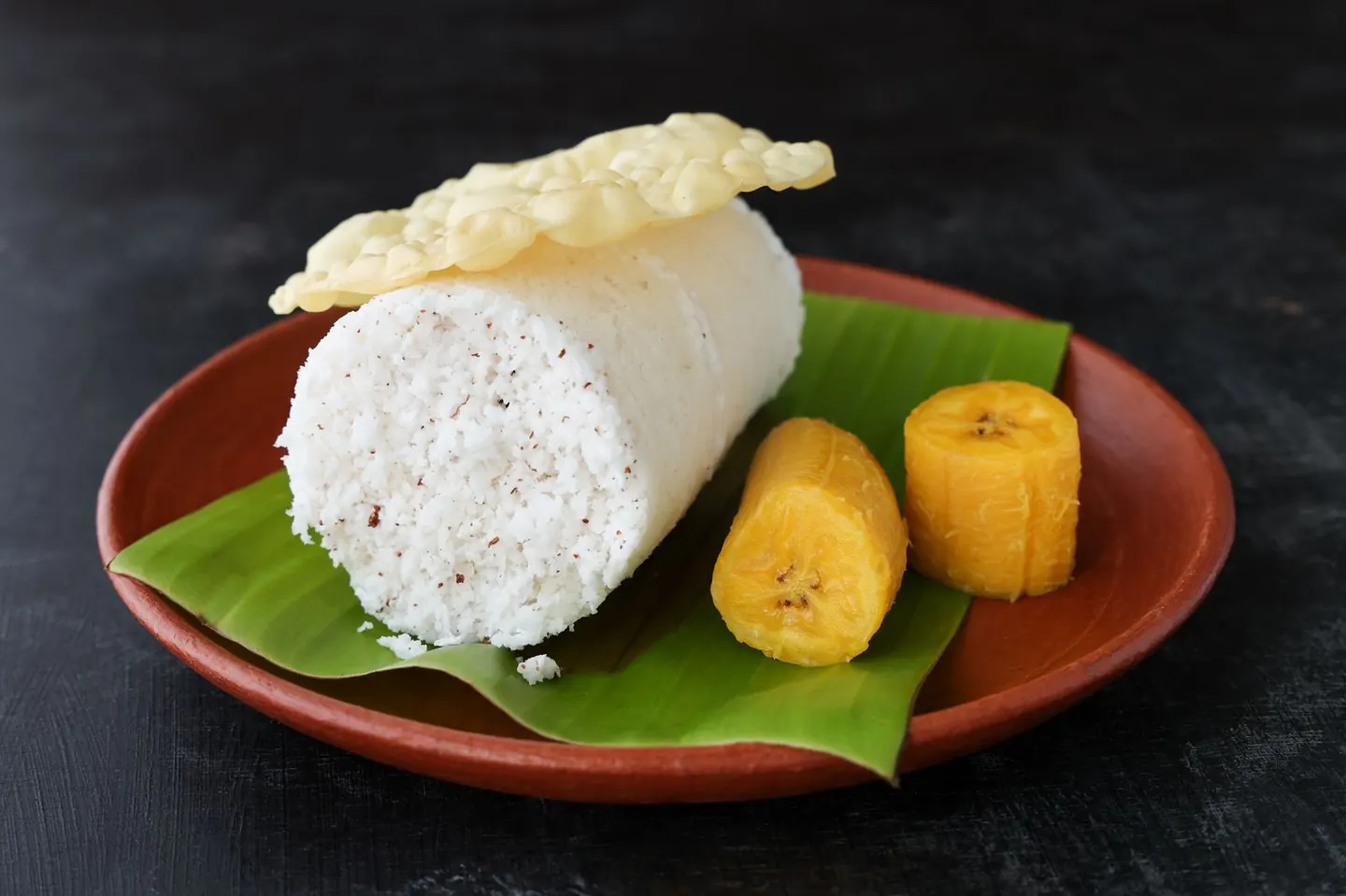
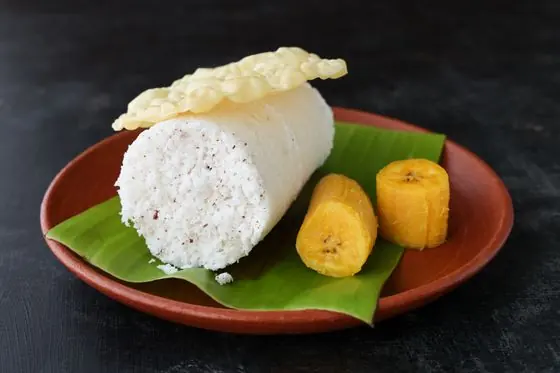
Photograph: Adobe Stock · representative of the dish
This is the flagship breakfast of this book, and the reason is a number measured in Kerala on Kerala food. In Pavithran and colleagues' 24-week randomised trial (2020), the recipes participants actually ate were tested for glycaemic index, and red rice puttu came out at GI 38, alongside Rose Matta rice at 38, against whole-wheat roti at 45 and oats puttu at 51–52. The low-glycaemic arm's HbA1c fell 0.93%. Treat 38 as a measured value for this preparation cooked this way, not as a property of every bag on every stove. Then steam it and eat it with chickpeas.
Before you start: Water and flour is the whole skill of this dish. Add the water in stages and stop when the crumb holds a shape in your fist and breaks apart cleanly when you push it with a thumb. Too wet and it steams into a solid plug; too dry and it falls out as powder.
Allergens: None of the major allergens.
Equipment: Puttu kutti — the cylindrical steamer, bamboo or steel. Substitute: a stacked steamer basket lined with muslin, filled 4 cm deep; you lose the cylinder shape and nothing else. A large idli steamer works the same way.
| Energy | 272 kcal |
| Protein | 6 g |
| Fibre | 4 g |
| Net carbohydrate | 44 g |
| Total carbohydrate | 48 g |
| Sugars | 1 g |
| Fat | 9 g |
| Saturated fat | 7 g |
| Sodium | 280 mg |
From ICMR-NIN IFCT 2017 and USDA FoodData Central. Per-serving figures stay the same when you scale.
Look for "red puttu podi", "matta puttu podi" or "roasted red rice flour" in any Kerala or Sri Lankan grocery, and check the colour through the bag — it should be dull pinkish-fawn, not white. Anything labelled matta that is bright white has been polished, and polish is the lever that matters: glycaemic index in one Indian parboiled variety rose from 57.6 unpolished to 79.6 at 9.7% polish. If only plain white puttu podi is available, use it and take the pulse pairing more seriously, not less. To roast your own flour, dry-toast plain matta rice flour over a low flame 4–6 minutes until it smells faintly of biscuit and no longer of raw starch.
Blood sugar: at the measured GI of 38 and 44 g of net carbohydrate, this portion is a glycaemic load of about 16 — moderate by the standard tables, and roughly half what the same weight of polished white rice would deliver. This is the lowest-glycaemic-load rice breakfast in the chapter; it is not a low-carbohydrate one. Two portions is not the same as one.
Blood pressure: 280 mg of sodium against a 2,000 mg daily target, and made with plain salt it is about 400 mg. The chutney beside it will usually carry more, so look there next.
Cholesterol: 7 g of saturated fat, all from the coconut. Halving the coconut halves it, at a cost in fibre and in the dish.
Plain white puttu podi for matta → the texture is softer and paler and the glycaemic advantage of the measured GI 38 does not transfer. Make the pulse non-negotiable.
40 g coconut instead of 80 g → saturated fat falls to about 3.7 g a serving and the puttu is drier and noticeably less good. A fair trade if LDL cholesterol is your working number.
Add 30 g grated jackfruit or 40 g mashed ripe nendran to the layers → the traditional sweet versions. Both add sugar; the nendran adds about 10 g of available carbohydrate a serving.
At eight servings, steam in two loads rather than packing the cylinder tighter.
The moistened crumb keeps 24 hours refrigerated in a covered box and steams straight from cold. Steamed puttu holds 2 days in the fridge. Freeze the steamed puttu 1 month in portioned bags. Reheat by re-steaming 4–5 minutes from chilled or 6–8 minutes from frozen; a microwave turns it rubbery.
Crumble cold puttu into a pan with a teaspoon of oil, mustard seed, curry leaf, sliced shallot and any leftover pulse, and fry it for 4–5 minutes for puttu upma. Or mash it with ripe banana and a pinch of cardamom as a child's breakfast.
Solid, heavy plug instead of a crumb: too much water, or the mix was packed into the cylinder. Both faults are invisible until it comes out.
Falls apart as dry powder: too little water. Sprinkle 2 tablespoons over the crumb, rake, and re-steam.
Steam never comes through the top: the cylinder is packed too tight, or the pot below is not at a hard boil.
Tastes of raw flour: the podi was unroasted. Dry-toast it next time.
Serve with
R010 Kadala Curry — the intended partner and the point of the recipe · R011 Cherupayar Curry · R107 Sambharam
Tap a star to rate this recipe
The Kindle edition is on its way. Until it lands, the complete book — all 25 chapters and 137 recipes — is free to read here, and it stays free after.