 R015
R015Matta Rice, Properly Cooked
Kerala's parboiled red rice, by absorption and by draining
Recipes › Rice, Grains and the Grain Question in Practice
R023
Matta rice and moong dal in one pot, with coconut and curry leaf
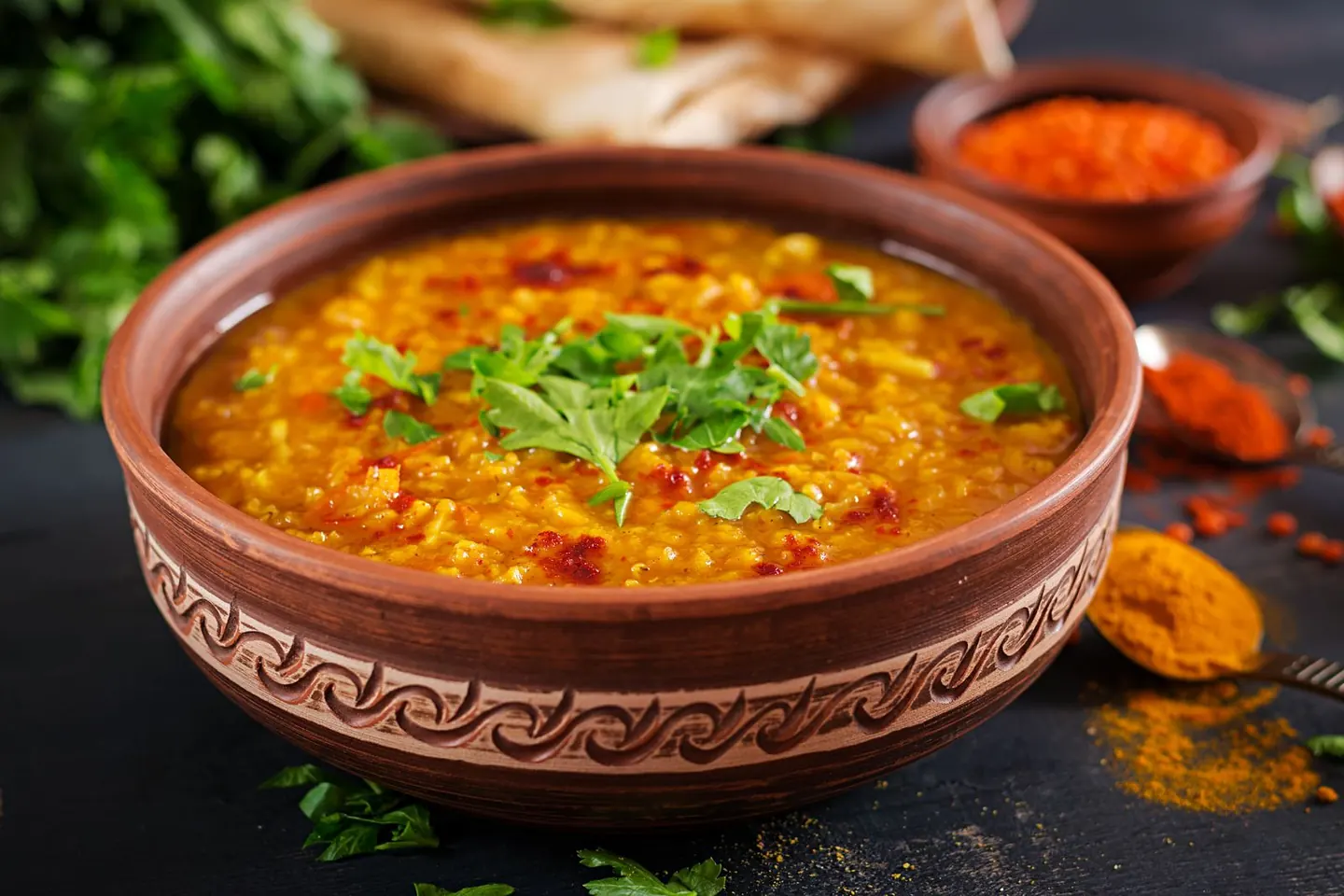
Photograph: Adobe Stock · representative of the dish
Kerala does not have a canonical khichdi; the north does, and Kerala has kanji, puzhukku and the rice-and-dal logic scattered across a dozen dishes without one name to gather them. This recipe gathers them. It is built to make the single best-evidenced instruction in this book — put a pulse on every rice plate — impossible to forget, because the pulse is in the pot. Adding 50 g of legumes a day to a rice diet lowered 24-hour glycaemic area under the curve by 22.9% against white rice, more than swapping to brown rice alone achieved at 19.8% (Mohan et al., 2014). One pot, one flame, thirty-five minutes.
Before you start: Rinse and drain the rice and dal together and leave them to sit while you cut the vegetables. Twenty minutes of standing damp does most of the work a soak would.
Allergens: None of the major allergens.
Equipment: Heavy 4-litre pan with a lid, or a 3-litre pressure cooker. Substitute: a pressure cooker at 3 whistles then 5 minutes on the lowest flame, which saves about 12 minutes and gives a softer, more integrated result — the traditional texture, in fact.
| Energy | 322 kcal |
| Protein | 11.1 g |
| Fibre | 7.9 g |
| Net carbohydrate | 52.4 g |
| Total carbohydrate | 60.3 g |
| Sugars | 5.5 g |
| Fat | 6.5 g |
| Saturated fat | 5.0 g |
| Sodium | 240 mg |
From ICMR-NIN IFCT 2017 and USDA FoodData Central. Per-serving figures stay the same when you scale.
Moong dal is in every shop that sells lentils, often as "yellow split mung" or "moong dal (split, skinless)". Dry-roasting it for 3–4 minutes before rinsing improves the dish considerably and is worth the trouble; some Indian shops sell it pre-roasted for exactly this purpose. Ash gourd is winter melon or wax gourd in Chinese and Southeast Asian grocers, where it is usually cheaper and fresher than in Indian ones, and is sold cut by the wedge — buy 150 g and use it the same day. If there is none, use 150 g of courgette, added 5 minutes later than the ash gourd would be, or 150 g of bottle gourd.
Blood sugar: this is the dish in the chapter built for you. Each portion carries 25 g of dry moong dal, which is about 65 g cooked — above the 50 g of legumes that, eaten with brown rice, produced the 22.9% reduction in glycaemic area under the curve against white rice in overweight Asian Indians — 19.8% of which the brown rice managed on its own (Mohan et al., 2014) — plus 7.9 g of fibre and 11.1 g of protein. The rice is still 40 g dry a head, which is the quarter-plate. Nothing here is a claim about disease; it is a plate assembled the way the trial assembled it.
Blood pressure: 240 mg per portion. Because the dish is soft and soupy it reads as under-seasoned at low salt, so lean on the pepper, the lime and the ginger rather than the salt cellar — this is exactly the substitution Chapter 10 is about.
Cholesterol: 5.0 g of saturated fat per portion, from 12 g of coconut oil and 25 g of grated coconut for four. Swap the oil for gingelly and it drops to about 3.9 g; drop the grated coconut too and you are at about 1.5 g, and you have lost 1 g of fibre and most of the dish's character. The coconut is worth keeping.
Moong dal → 100 g toor dal. Needs 30–35 minutes rather than 22–25, and gives an earthier, heavier pot. Or 100 g vanpayar, soaked overnight, for the most Kerala version of all, and 45 minutes.
Matta → white raw rice. Cooks in 15 minutes, so add the dal 8 minutes ahead of it, and you give up the thiamine and the bite.
Ash gourd → 150 g courgette, bottle gourd, chayote or snake gourd. All are 12–20 kcal per 100 g and all behave similarly; snake gourd is the lowest at 12 kcal and 1.27 g of available carbohydrate.
Add 100 g chopped cheera or spinach at step 11 → 30 kcal a portion, another 1 g of fibre, and iron. This is the easiest genuine upgrade in the recipe.
Water scales sub-linearly. Check consistency at 20 minutes and add boiling water rather than trusting the table, because ash gourd's own water content varies a great deal.
This is the most batch-friendly dish in the chapter. Fridge 3 days, chilled within 1 hour in shallow containers. Freeze 2 months in 290 g portions — it freezes better than plain rice because the dal holds the moisture. Reheat once, with 60–80 ml of water per portion, to a full simmer, 4–5 minutes; it thickens hard in the fridge and needs the water.
Thin cold khichdi with water and buttermilk into a kanji, or press it into patties, dust them with rice flour and pan-fry in a teaspoon of oil for a very good tea-time cutlet.
Dry and stodgy: not enough water, or cooked too long uncovered. This dish should be loose enough to fall off a spoon; add boiling water freely.
Dal cooked, rice still hard: matta needs more time than moong. If it happens repeatedly, soak the rice 30 minutes and add the dal 8 minutes into the cooking.
Bitter, dull colour: the turmeric cooked too long at step 5. Twenty to thirty seconds, then the tomato goes in.
Tastes flat despite the salt: it needs acid, not more salt. The lime at the end is doing real seasoning work — add the other half.
Serve with
R087 Moru Kachiyathu · R084 Ulli Theeyal · a lime pickle from Chapter 23 · M07 the 70:30 salt
Tap a star to rate this recipe
The Kindle edition is on its way. Until it lands, the complete book — all 25 chapters and 137 recipes — is free to read here, and it stays free after.