 R024
R024Meen Vevichathu
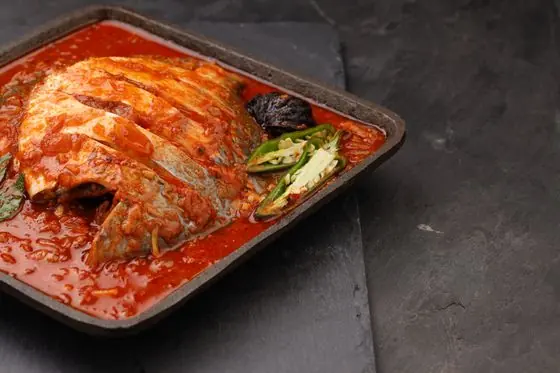
Kudampuli fish curry, the Kottayam Syrian Christian way
R025
The pale coconut-milk fish curry, Cochin Latin Catholic and Anglo-Indian both
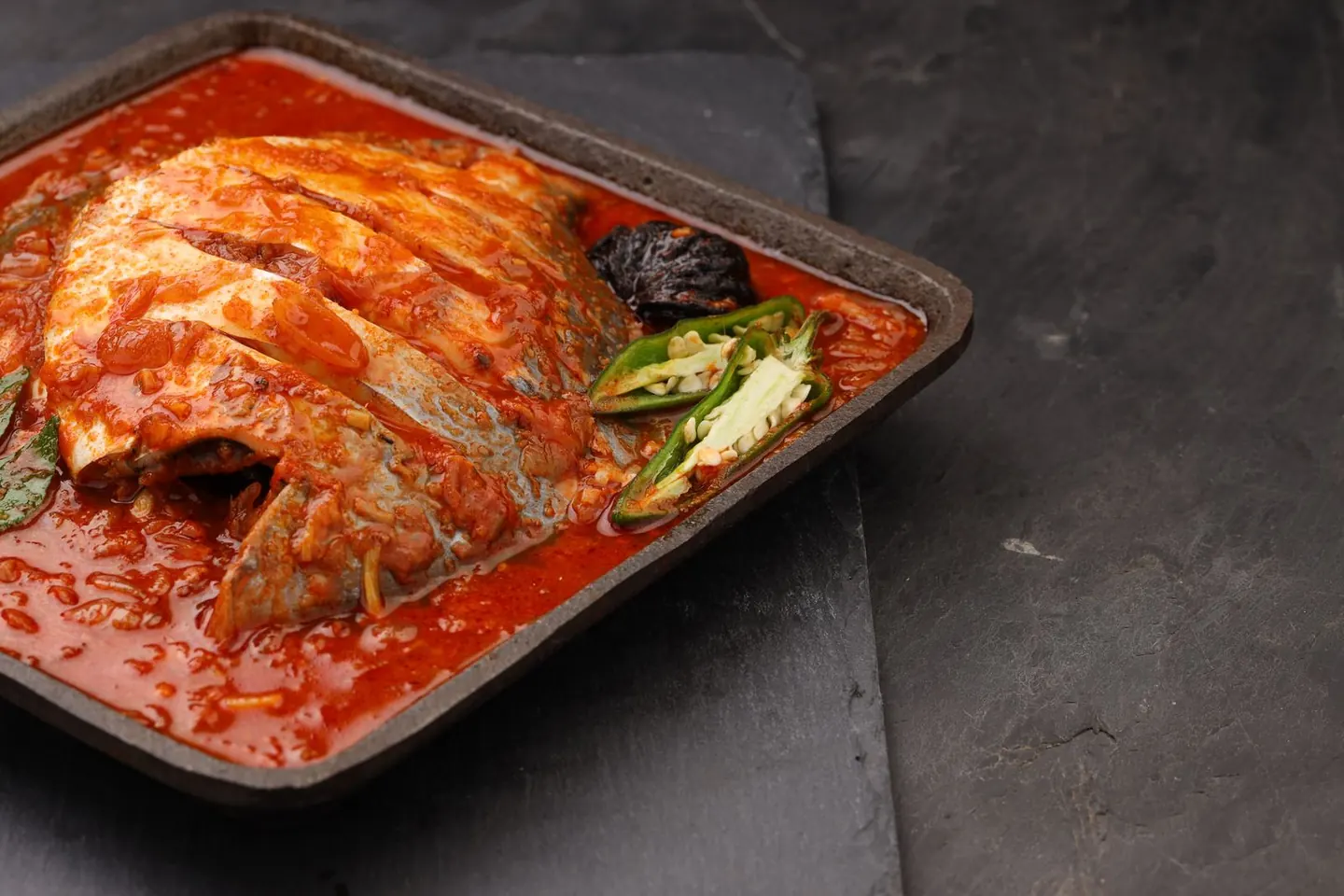
Photograph: Adobe Stock · representative of the dish
Moilee — also spelled molee, molly and moily depending on whose grandmother wrote it down — is the mild, pale, sour-sweet counterpart to the red kudampuli curry, and it comes out of the most Portuguese-inflected kitchens in Kerala. Turmeric and green chilli do the work of chilli powder; lime or vinegar does the work of kudampuli. It is the dish that teaches the coconut-milk rule, because there is nowhere for a broken emulsion to hide in a curry this pale.
Before you start: Have the first milk measured and standing away from the hob. The last 60 seconds of this recipe decide whether it is a moilee or a broken curry, and you will not have time to go looking for a jug.
Allergens: Fish.
Equipment: Wide shallow pan, 26–28 cm, non-reactive. Substitute: a clay pot works and holds heat beautifully, but a wide pan lets you see the surface, which is how you catch the milk before it splits.
| Energy | 318 kcal |
| Protein | 27 g |
| Fibre | 3 g |
| Net carbohydrate | 10 g |
| Total carbohydrate | 13 g |
| Sugars | 6 g |
| Fat | 19 g |
| Saturated fat | 13 g |
| Sodium | 340 mg |
From ICMR-NIN IFCT 2017 and USDA FoodData Central. Per-serving figures stay the same when you scale.
This curry wants a firm white fish that holds its shape. In the US: pompano is the same family as pomfret and is widely available in the South; otherwise red snapper, black sea bass or halibut cheeks. In the UK: pollack, gurnard, hake or a farmed sea bream. In the Gulf: hamour (grouper) or safi (rabbitfish) both work; zubaidi is pomfret. In Australia: snapper, barramundi or blue-eye trevalla. Tinned coconut milk is the honest fallback if you are not making M08 — use it undiluted as the first milk and at 1:1.5 with water as the second, and expect a slightly flatter, more cooked flavour.
Blood sugar: 10 g of net carbohydrate, and the fat slows gastric emptying further. This is a low-load main dish; the rice portion is the whole decision.
Blood pressure: 340 mg. Drop the added salt to 2 g and add a second slit chilli — 260 mg, and nobody notices.
Cholesterol: 13 g of saturated fat is the highest figure in this chapter and all of it is coconut. Coconut oil raises LDL-C relative to unsaturated oils by about 10.5 mg/dL across 16 trials (Neelakantan et al., 2020), and thick coconut milk is the same fat in a whole-food matrix. Two levers: swap the 10 g of coconut oil for sesame, and take the first milk down to 60 ml with 40 ml more stock. That lands at about 9 g and the curry survives it.
No M08 → tinned coconut milk as in the sourcing note. Flatter, slightly cooked, and you lose the graded texture.
No fish stock → water plus 100 ml third coconut milk. Thinner-bodied; add 2–3 minutes to step 4.
Lime → 10 ml coconut vinegar, which is the older Latin Catholic choice. Sharper, more fermented, less floral.
No coconut at all → 40 g cashews blended with 200 ml water in place of the second and first milk together. Comparable body, different flavour, roughly a third of the saturated fat, more monounsaturated. (Allergen: this swap introduces tree nuts (cashew).)
Best within an hour of cooking, and this is the opposite of R024. Fridge 2 days. Do not freeze — the emulsion breaks on thawing and there is no repair. Reheat in a wide pan over the lowest possible flame, or better, over a pan of hot water.
Oil on the surface with grainy curds beneath: the first milk boiled. There is no repair. Next time, off the heat.
Gravy split even off the heat: the pan was too hot when the milk went in, or the milk was stirred rather than swirled. Let the pan sit 60 seconds before adding it.
Tastes flat and milky: not enough acid. Another 5 ml of lime, and check the salt after the acid, not before.
Fish tough and dry: it cooked while the milk was going in. Add the milk with the pan already off the heat and the fish only just set.
Serve with
R001 Appam · R015 Matta Rice · R068 Kumbalanga Olan · R089 Kerala Salad
Tap a star to rate this recipe
The Kindle edition is on its way. Until it lands, the complete book — all 25 chapters and 137 recipes — is free to read here, and it stays free after.