 R040
R040Nadan Kozhi Curry
The everyday country chicken curry
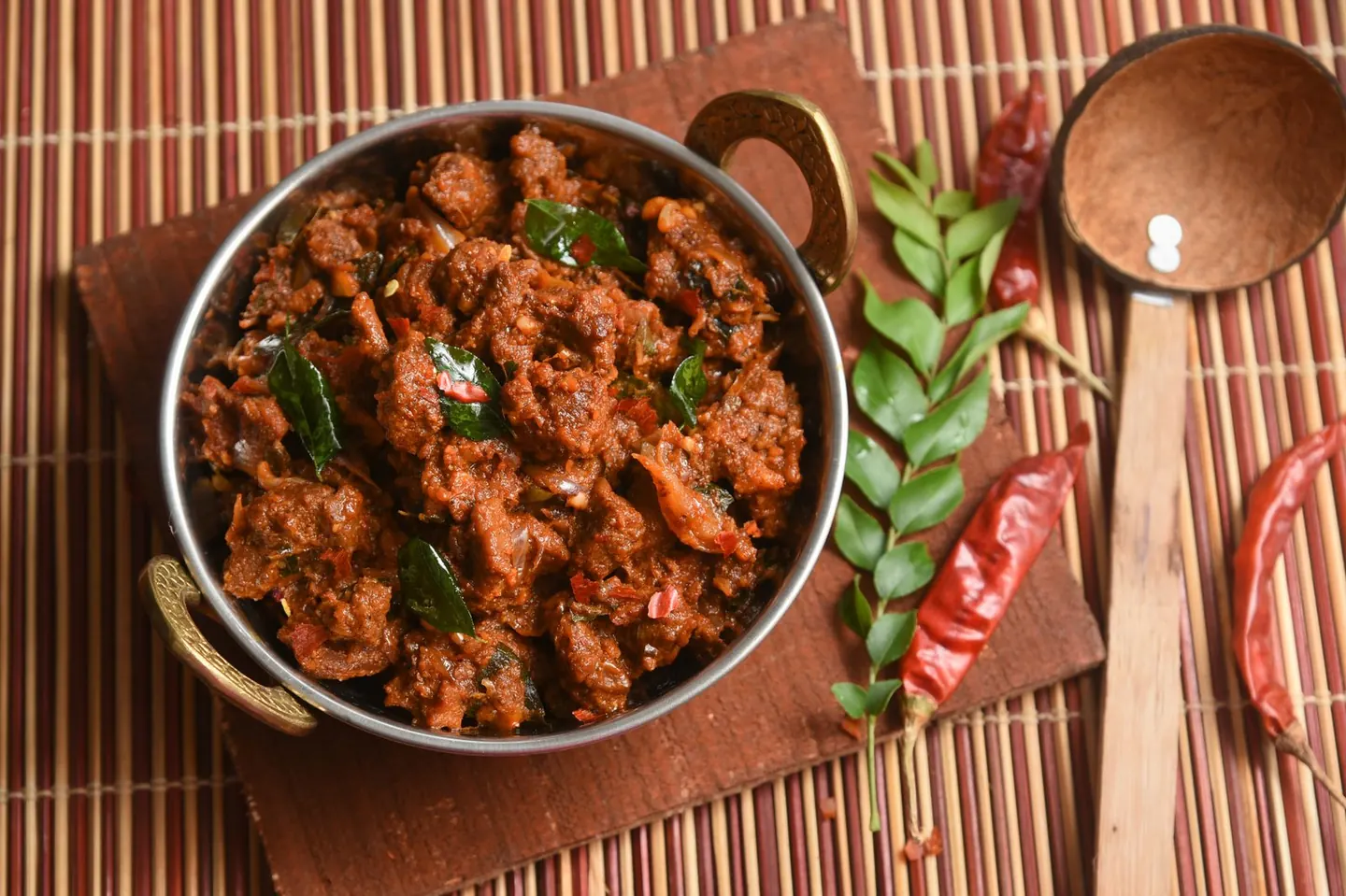
Photograph: Adobe Stock · representative of the dish
Plan ahead: plus 20 minutes soaking — recommended.
Liver is the most nutrient-dense meat in the Kerala repertoire and the one this book has to write about carefully. Per 100 g raw it carries about 20 g of protein at 135 kcal with only 3.6 g of fat, and it is exceptionally rich in iron, vitamin B12 and preformed vitamin A — which matters in a country where B12 deficiency was found in 26.1% of 835 hospitalised adults in one eastern Indian series, and where anaemia is common (Priyadarshi et al., 2026). It is also, precisely because of the vitamin A, the one food in this chapter that carries a genuine upper-limit caution. Read the box before you cook it.
> A caution about vitamin A, and it matters most in pregnancy. Liver is unusually concentrated in preformed vitamin A (retinol), and unlike the carotenoids in vegetables, preformed vitamin A has an upper intake level above which excess is a real concern. Two bodies have set that level independently and arrived at the same number. The European Food Safety Authority's 2024 opinion gives a tolerable upper intake level of 3,000 µg retinol equivalents a day for adults, applying to men, to women of child-bearing age, and to pregnant and lactating women, and states that "teratogenicity was selected as the critical effect on which to base the UL for preformed vitamin A". The US Food and Nutrition Board of the Institute of Medicine — now the National Academies — set the same figure, 3,000 µg RAE a day for adults aged 19 and over. > > The everyday advisory is a different and lower number, and it is worth having both. The NHS states that "liver is a very rich source of vitamin A. Do not eat liver or liver products, such as pâté, more than once a week", and that "having an average of 1.5mg a day or less of vitamin A from diet and supplements combined is unlikely to cause any harm". That 1.5 mg — 1,500 µg — is a precautionary figure aimed at bone health rather than the toxicological ceiling: "women who have been through the menopause and older men, who are more at risk of osteoporosis, should avoid having more than 1.5mg of vitamin A a day from food and supplements." For reference, the NHS puts adult requirements at 700 µg a day for men and 600 µg for women. > > In pregnancy the advice is not a limit but an exclusion. The NHS: "if you're pregnant you should avoid eating liver or liver products." The US National Institutes of Health note that intakes of preformed vitamin A above the upper level "can cause congenital birth defects", and that experts advise women who are or might be pregnant not to take more than 3,000 µg RAE daily from supplements. > > This book's position, which follows those sources rather than departing from them: liver once a week or less, in a portion of about 100 g, for anyone who is not pregnant; and for anyone who is pregnant, planning a pregnancy, or taking a vitamin A or multivitamin supplement, ask your doctor or midwife before eating it at all. This book does not tell anyone to start or stop a supplement or a medicine.
Before you start: Everything must be within reach before the liver goes in. Have the pepper crushed, the lime cut and the curry leaves picked. This is a five-minute dish at the pan and there is no pausing in it.
Allergens: None of the major allergens as the recipe is written. Sesame or peanuts — whichever of the two oils you use (it reaches the dish through M16).
Equipment: Heavy 26 cm pan or cheena chatti; flat wooden turner. Substitute: a non-stick pan is genuinely useful here, because liver sticks and 12 g of oil is not much.
| Energy | 211 kcal |
| Protein | 22 g |
| Fibre | 3 g |
| Net carbohydrate | 14 g |
| Total carbohydrate | 17 g |
| Sugars | 4 g |
| Fat | 7 g |
| Saturated fat | 4 g |
| Sodium | 280 mg |
From ICMR-NIN IFCT 2017 and USDA FoodData Central. Per-serving figures stay the same when you scale.
Buy liver the day you cook it and ask for it in a single piece rather than sliced, so you can see the colour — it should be glossy and deep red-brown, not grey or dull, and it should smell clean and faintly metallic, never sour. Goat liver is milder and more tender than beef liver; chicken liver is milder still and needs half the cooking time. Soaking the cubes in cold water or thin buttermilk for 20 minutes and patting them dry draws out some of the blood and softens the mineral edge that puts people off.
Blood sugar: 14 g of net carbohydrate, almost all of it from 200 g of shallots. Negligible in a meal.
Blood pressure: 280 mg. There is 3 g of salt in the whole dish and the pepper carries it.
Cholesterol: 4 g of saturated fat and 7 g of fat in total — the lowest of any meat dish here. Note honestly that liver is high in dietary cholesterol; the evidence base this book works from is about saturated fat and about dietary patterns, and it does not support a specific numeric limit on dietary cholesterol from a food eaten weekly.
Iron and B12: this is the most efficient food in the chapter for both, which is the reason it is in the book. It is also the reason for the caution box above.
Chicken liver → 400 g, and halve the cooking at steps 5 and 6. Milder, softer, and it overcooks even faster.
Add 150 g of sliced green pepper or onion at step 3 → stretches to five and adds volume, in the style of the thattukada version.
No lime → coconut vinegar, 10 ml. Similar job, less bright.
Sesame or groundnut oil for the coconut oil → saturated fat to about 3 g per serving. Worth doing; coconut is not the flavour here, pepper is.
Soak, trim and marinate up to 4 hours ahead; that is all the make-ahead this dish permits. Fridge 1 day only, and it will not be as good. Freeze: no — cooked liver thaws grainy and dry. Reheat: no. Cook liver when you intend to eat it.
There should not be any, but if there are: chop them fine, fold them into R047 egg thoran, and eat that cold rather than reheating the liver on its own.
Grainy, dry, metallic: overcooked. There is no recovery. Ninety seconds shorter next time.
Liver stuck and tore: the pan was not hot enough at step 5, or the cubes were wet. Dry them and let the pan get properly hot.
Bitter: a bile duct or gall residue was left in the trim. Cut away any green-tinged tissue before cooking.
Serve with
R015 Matta Rice · R004 Puttu · R089 Kerala-Idiom Salad · R107 Sambharam
Tap a star to rate this recipe
The Kindle edition is on its way. Until it lands, the complete book — all 25 chapters and 137 recipes — is free to read here, and it stays free after.