 R053
R053Vanpayar Thoran
Brown cowpea with grated coconut
R055
Black chickpea, roasted dry with coconut slivers
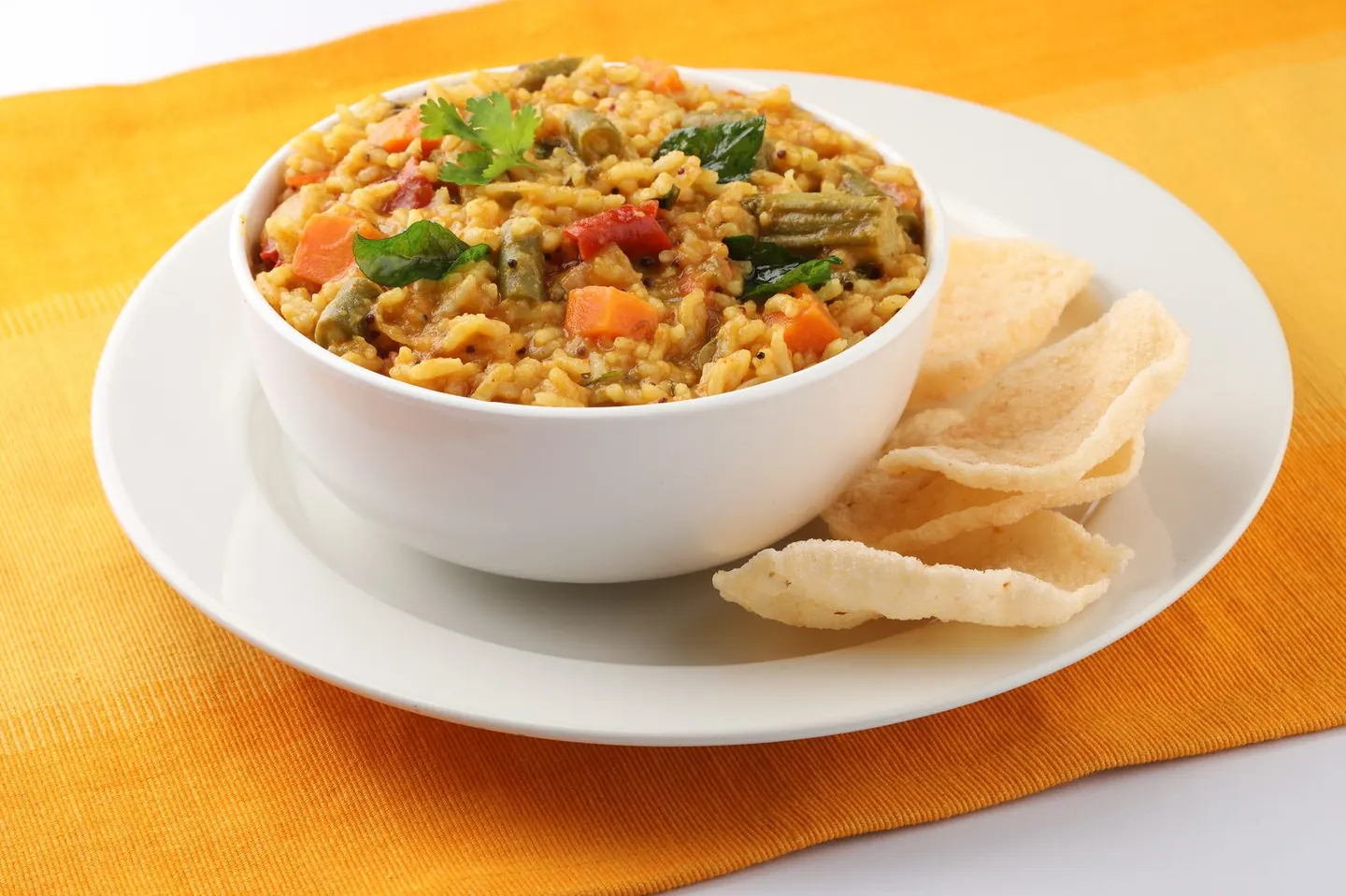
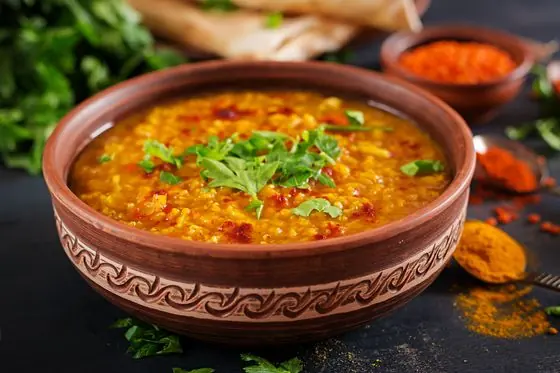
Photograph: Adobe Stock · representative of the dish
Plan ahead: plus 8–12 hours soaking and 20 minutes pressure-cooking — required.
Kadala — the small dark Bengal gram, the whole black chickpea — carries 25.2 g of fibre per 100 g dry, which is the highest of any pulse in the Kerala pantry by a wide margin, and more than four times the fibre of a comparable weight of oats. It is usually met in kadala curry with morning puttu. This is the other thing to do with it: a dry roast, dark and nutty, that eats like a snack and sits on a plate like a main dish. If R048 is this chapter's argument about meat, this is its answer.
Before you start: Sliver the coconut — thin pieces about 2 cm long, thenga kothu — rather than grating it. Grated coconut disappears; slivers stay as texture, and texture is the dish.
Allergens: Mustard. Sesame or peanuts — whichever of the two oils you use (it reaches the dish through M16).
Equipment: Pressure cooker; heavy 26 cm pan or cheena chatti; flat wooden turner. Substitute: an open pot for the chickpeas, 1¼–1½ hours. A thin pan will burn the coconut slivers before the chickpeas dry.
| Energy | 260 kcal |
| Protein | 11 g |
| Fibre | 16 g |
| Net carbohydrate | 26 g |
| Total carbohydrate | 42 g |
| Sugars | 8 g |
| Fat | 12 g |
| Saturated fat | 8 g |
| Sodium | 260 mg |
From ICMR-NIN IFCT 2017 and USDA FoodData Central. Per-serving figures stay the same when you scale.
Black chickpea is sold as kala chana, desi chana, Bengal gram whole or brown chickpea, and it is a different, smaller, tougher, far higher-fibre bean than the pale kabuli chickpea used in hummus. Buy the black one for this dish; kabuli will work but goes floury and the skins slip off in the roast. Tinned chickpeas are usually kabuli and are too soft for this technique. Do not skip the overnight soak — an unsoaked kadala takes 45 minutes under pressure and cooks unevenly.
Blood sugar: 16 g of fibre in a single serving is more than most people manage in a day, and 26 g of net carbohydrate at a category glycaemic index of 34 gives an estimated glycaemic load near 9. This is the single most useful dish in the chapter to put beside rice.
Blood pressure: 260 mg, from 3.5 g of salt across four servings.
Cholesterol: 8 g of saturated fat, of which about 5.5 g is the coconut slivers and 1.8 g the coconut oil. Cutting the slivers to 40 g takes it to about 6 g. Set against that, pulses at around 130 g a day lowered LDL cholesterol by about 6.6 mg/dL in 26 randomised trials (Ha et al., 2014).
Sesame or groundnut oil for the coconut oil → saturated fat to about 6.5 g per serving. Worth doing here; the slivers, not the oil, are the coconut flavour.
Cashews for the slivers → 40 g, chopped. Less saturated fat, more monounsaturated. (Allergen: this swap introduces tree nuts (cashew).)
Vanpayar or cherupayar → 200 g dry, cooked to their own timings. Both roast well; neither has kadala's fibre.
Add 200 g of diced green plantain at step 4 → six servings and a fuller plate, in the manner of a koottukari.
Cook and drain the chickpeas up to four days ahead — this is the whole make-ahead. Fridge 4 days finished. Freeze 3 months, cooked chickpeas plain or the finished dish; both survive well, because there is no emulsion. Reheat in a dry pan, 3–4 minutes, until it sizzles.
Eat it cold, by the handful, instead of a packet of anything. Or fold it into R062 sprouted moong salad, or stir it through leftover rice with lime and raw onion.
Skins everywhere and floury insides: those were kabuli chickpeas, or the kadala was cooked 5 minutes too long.
Chickpeas still hard after full pressure: the soak was short, or the pulses are old. Another 8 minutes; if still hard, they are too old.
Masala pasty rather than crusted: the chickpeas went in wet, or the flame was too low at step 6. Steam-dry them in the colander first.
Serve with
R004 Puttu · R015 Matta Rice · R040 Nadan Kozhi Curry · R048 Beef Ularthiyathu
Tap a star to rate this recipe
The Kindle edition is on its way. Until it lands, the complete book — all 25 chapters and 137 recipes — is free to read here, and it stays free after.