 R081
R081Moru Curry
Tempered buttermilk curry with ground coconut
Recipes › Curries, Pulissery and the Sour Family
R086
Tamarind and pepper broth, the third rice course
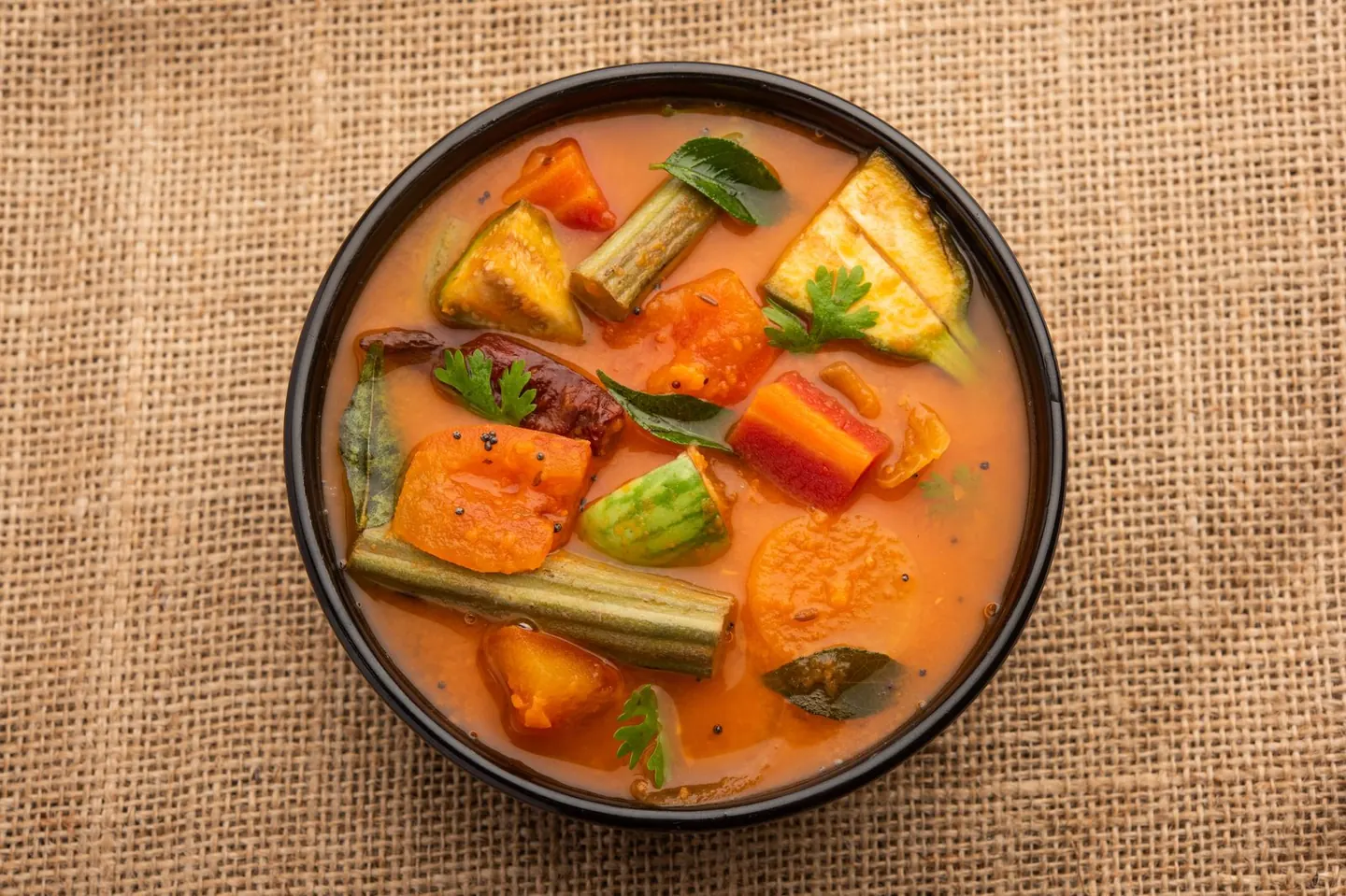
Photograph: Adobe Stock · representative of the dish
Rasam — from Sanskrit rasa, juice or essence — is the third rice course of a sadya, explicitly digestive, and often the last savoury thing before the buttermilk. Its character is thin, sharp and pungent, and its job is to cut what came before. The Anglo-Indian calque is worth knowing: mulligatawny, from Tamil milagu thanni, "pepper water", which is exactly what this is. At 78 kcal a bowl it is also the cheapest thing on this plate.
Before you start: Cook the dal ahead or use leftover parippu. Everything else takes fifteen minutes, and the tempering happens in the last thirty seconds.
Allergens: Mustard. Gluten (wheat) — only if your asafoetida is compounded with wheat flour, as most brands are (it arrives with M03).
Equipment: Heavy 2-litre pan, non-reactive. Small pan or steel ladle for the tempering. Substitute: a clay pot is traditional and genuinely better here — the slow, even heat keeps the rasam below a hard boil, which is where the pepper's aroma survives.
| Energy | 78 kcal |
| Protein | 3.5 g |
| Fibre | 2.9 g |
| Net carbohydrate | 10.5 g |
| Total carbohydrate | 13.4 g |
| Sugars | 3.2 g |
| Fat | 2.1 g |
| Saturated fat | 1.2 g |
| Sodium | 150 mg |
From ICMR-NIN IFCT 2017 and USDA FoodData Central. Per-serving figures stay the same when you scale.
M03 is the recipe's flavour and it takes twenty minutes to make; commercial rasam powder is a reasonable substitute at 12 g but almost all of it is salted, so if you use one, leave the M07 out altogether and taste before adding anything. Tamarind: seedless block, not concentrate. Buy pepper whole and recently — Malabar pepper is a registered geographical indication and it is worth the premium in this dish specifically, because pre-ground pepper has lost the aroma and kept only the burn.
Blood sugar: 10.5 g of net carbohydrate a bowl, with 2.9 g of fibre and 3.5 g of protein, most of it the toor dal. As a starter before a rice meal it slows the meal down for almost nothing, and the tamarind's acid is the same lever discussed in this chapter's introduction.
Blood pressure: 150 mg a portion, and this is the point of the recipe. A commercial rasam powder plus a normal hand with the salt cellar would put the same bowl near 600 mg, and because rasam is drunk it goes down without registering as salty food. Leave the M07 out entirely and you are at about 80 mg, and with M03 in the pot you will not miss it. Garlic is also worth noting here as the one aromatic whose trial doses overlap ordinary cooking: across 108 trials in 7,137 participants, garlic gave −3.7/−2.0 mmHg (Behrouz et al., 2026).
Cholesterol: 1.2 g of saturated fat a portion. Swap the coconut oil for gingelly and it falls to about 0.3 g, and gingelly oil suits a rasam rather well.
M03 → 12 g commercial rasam powder. Convenient, and almost certainly salted; omit the M07 and taste first.
Tamarind → 3 pieces of kudampuli, soaked. Smokier and rounder, and no longer really a rasam — this is the Kottayam dialect intruding on a Tamil-inflected dish, and it is worth trying once to hear the difference.
Toor dal → 40 g moong dal. Lighter, cooks in half the time, slightly less body.
Add 100 g cooked chena or 100 g drumstick pods at step 3, simmered 6–8 minutes → the rasam becomes a light vegetable soup at about 100 kcal, and drumstick brings 6.83 g of fibre per 100 g with it.
The podi scales sub-linearly: a larger volume of liquid extracts more from the same weight of pepper, and 24 g in a big pot tastes harsh.
Rasam is at its best within ten minutes of the tempering and declines noticeably after an hour, because everything good about it is volatile. Fridge 2 days in a covered non-metal container. Freeze 1 month — freeze the base from the end of step 3 and temper it fresh on the day, which is the only way freezing makes sense here. Reheat to just below a boil, never hard, and add a fresh tempering if you can be bothered; it is four minutes and it is the difference between a rasam and a sour soup.
Cold rasam over rice is a legitimate lunch and needs no apology. Or use it as the poaching liquid for a piece of white fish, which takes six minutes and is very good.
Harsh, raw, puckering: the tamarind and podi were not simmered long enough at step 2. Eight minutes minimum.
Flat and dull despite the tamarind: it was boiled hard, and the pepper's aroma has gone. Add 2 g more M03, warm briefly, and cover.
Bitter: the podi's fenugreek was over-roasted when M03 was made, or the tempering's garlic burnt.
Muddy rather than clear-tasting: too much dal. Forty grams for four is the ceiling; a rasam is a broth, not a sambar.
Serve with
R015 Matta Rice, Properly Cooked · R081 Moru Curry to follow it, as a sadya does · R023 Kerala Khichdi · M03 Rasam Podi
Tap a star to rate this recipe
The Kindle edition is on its way. Until it lands, the complete book — all 25 chapters and 137 recipes — is free to read here, and it stays free after.