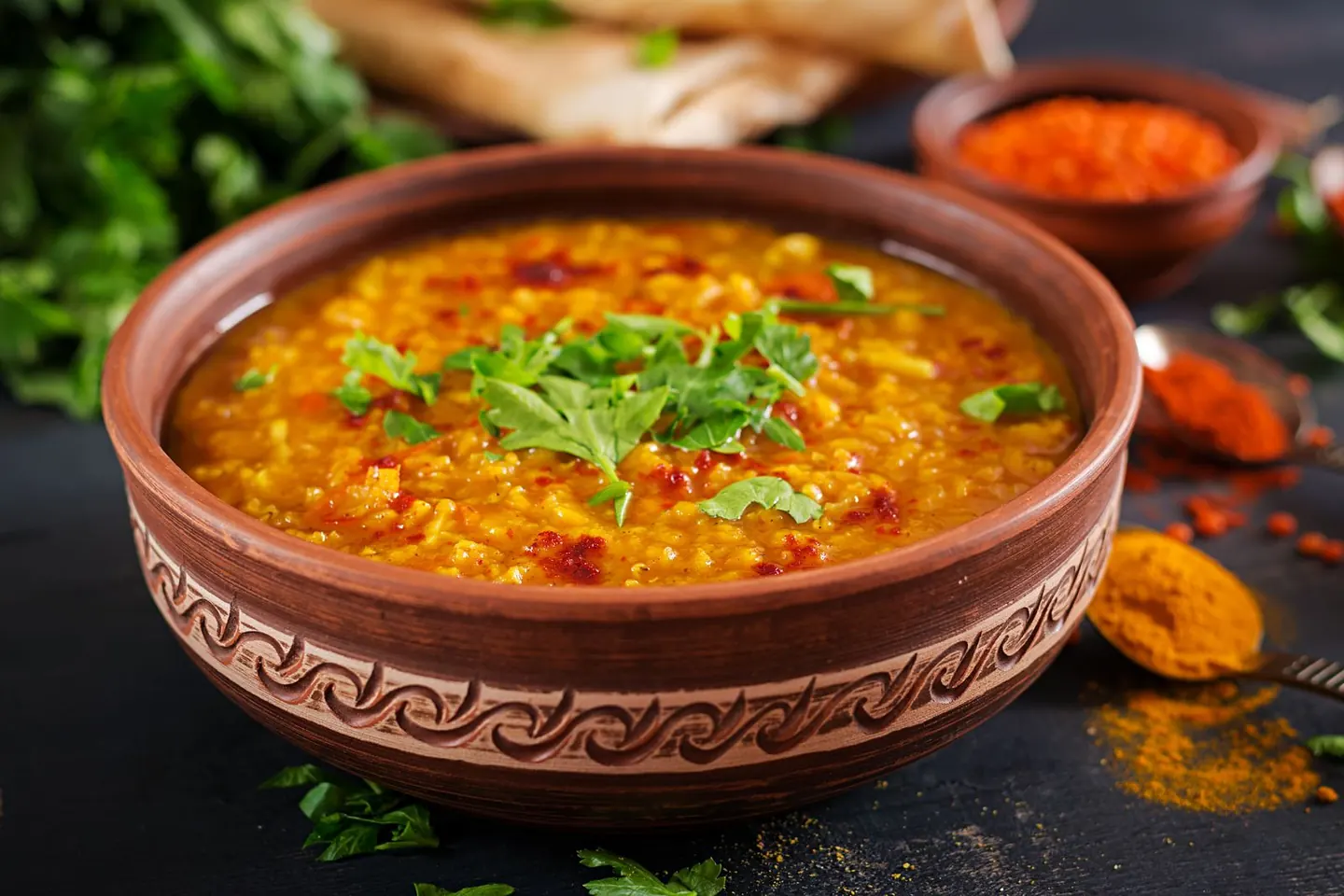
Chapter 10 — Salt, Pressure and Flavour
Half of this chapter is evidence and half is craft, and the craft half is the half that will change your cooking. It is arranged that way deliberately: the numbers tell you how much is at stake, and the technique tells you how to collect it without eating dull food. A low-salt Kerala kitchen that tastes flat has failed, and it has failed for a reason that is entirely fixable.
What the pattern does before you touch the salt cellar
The most instructive blood-pressure trial ever run on food did not reduce salt at all.
DASH fed 459 adults for eight weeks under controlled conditions with sodium intake and body weight deliberately held constant (Appel et al., N Engl J Med 1997). The combination arm — abundant fruit, vegetables and low-fat dairy, with reduced saturated and total fat — lowered blood pressure by 11.4/5.5 mmHg in participants with hypertension and 3.5/2.1 mmHg in those without, both at P<0.01.
Sit with the size of that. Eleven millimetres of systolic pressure, from the composition of the plate alone, with no salt reduction and no weight loss. Nobody counted a gram of sodium. What changed was potassium, magnesium, calcium and fibre up, saturated fat down, and the sheer proportion of the plate given over to plants. This is the single strongest argument for building a blood-pressure strategy around vegetables, fruit and pulses rather than around the salt shaker — and it is why Chapter 11 draws a plate rather than issuing a sodium budget.
Then the sodium, which is additive and not linear
DASH-Sodium took 412 participants and fed each of them the control diet and the DASH diet at high, intermediate and low sodium — roughly 3.5, 2.3 and 1.2 g of sodium a day — for thirty days each, in random order (Sacks et al., N Engl J Med 2001).
Two findings matter. The first is that sodium reduction and dietary pattern add together: the DASH diet at low sodium sat 11.5 mmHg systolic below the control diet at high sodium in participants with hypertension, and 7.1 mmHg below it in participants without. That is the DASH effect plus the sodium effect, not one substituting for the other.
The second is that the sodium effect is not linear. On the control diet, moving from high to intermediate sodium bought 2.1 mmHg. Moving from intermediate to low bought a further 4.6 mmHg — more than twice as much for a smaller absolute reduction. The gains are concentrated in the step below about 2.3 g of sodium a day, which is precisely the step almost no Indian household ever takes. Most sodium-reduction efforts stall in the flat part of the curve and conclude that cutting salt does nothing.
Pooled evidence agrees on the direction and size. Across 34 randomised trials in 3,230 people, a mean reduction of about 4.4 g of salt a day lowered pressure by 5.39/2.82 mmHg in people with hypertension and 2.42/1.00 mmHg in those without (He et al., Cochrane Database Syst Rev 2013). Across 37 trials, reduced sodium gave 3.39 mmHg systolic, with higher intake associated with a stroke risk of RR 1.24 in cohort studies (Aburto et al., BMJ 2013).
Potassium runs the same argument in reverse. Across 22 trials, increased potassium lowered pressure by 3.49/1.96 mmHg — and only in people who already had hypertension, not in those who did not. At intakes of 90–120 mmol a day the systolic effect reached 7.16 mmHg, and higher potassium was associated with 24% lower stroke risk (RR 0.76) with no adverse effect on renal function, lipids or catecholamines in the adults studied (Aburto et al., BMJ 2013). WHO conditionally recommends at least 90 mmol — 3,510 mg — of potassium a day from food.
The targets, for reference: WHO advises under 2,000 mg of sodium a day, which is under 5 g of salt, about one level teaspoon. The American Heart Association's ideal limit is stricter at 1,500 mg, with 2,300 mg as an upper bound. ICMR-NIN's 2024 dietary guidelines for Indians restate the 5 g salt limit and single out pickles, pappadams, salted snacks and processed foods by name.
The one-ingredient swap that moved mortality
Then there is SSaSS, which is the most consequential finding in this chapter and possibly in the book.
The Salt Substitute and Stroke Study enrolled 20,995 people across 600 villages in rural China — everyone either had a prior stroke or was aged 60 and over with poorly controlled hypertension — and randomised the villages, open-label, to a salt substitute of 70% sodium chloride and 30% potassium chloride or to ordinary salt. Mean follow-up was 4.74 years (Neal et al., N Engl J Med 2021). Results: stroke fell 14% (29.14 against 33.65 per 1,000 person-years), fatal stroke gave RR 0.77, major adverse cardiovascular events fell 13%, non-fatal acute coronary syndrome gave RR 0.70, and all-cause mortality fell 12% (RR 0.88, 95% CI 0.82–0.95). Hyperkalaemia events did not differ significantly between arms (3.35 against 3.30 per 1,000 person-years, P=0.76).
No cooking classes. No education. No behaviour change at all. One jar on the shelf replaced by a different jar, in households where nearly all the salt was added during home cooking — which describes a Kerala kitchen almost exactly.
The carve-out, stated in full, and it is not optional Potassium-enriched salt is not for everyone. Do not use a potassium salt substitute — and do not deliberately load potassium — if you have chronic kidney disease, or if you take a RAAS inhibitor (an ACE inhibitor such as enalapril or ramipril, or an ARB such as losartan or telmisartan), a potassium-sparing diuretic (spironolactone, eplerenone, amiloride), or a potassium supplement, without your doctor's explicit sign-off. All of these raise the risk of hyperkalaemia, which can be dangerous and is often silent. SSaSS screened its population and ran in a setting with normal renal function; you are not automatically inside its eligibility criteria. Take the jar to your next appointment and ask. This warning appears more than once in this chapter because it is the only genuine safety hazard in the entire book.
One practical note for a recipe writer: 30% potassium chloride is the ceiling for a reason. Above that the blend reads metallic and faintly bitter, particularly in a dish finished with coconut milk. The 70:30 blend in Chapter 15 is built to that limit, and it carries the same carve-out on the page.
Where the sodium in a Kerala meal actually comes from
Kerala's own NCD risk-factor survey of 12,012 adults across all 14 districts measured estimated daily salt intake at 6.7 g — above the WHO target of 5 g, though below what the wider Indian picture suggests (Sarma et al., BMJ Open 2019). Twenty-four-hour urine studies elsewhere in India found intakes of 8.59 g/day in Delhi and Haryana and 9.46 g/day in Andhra Pradesh, inflating to estimated intakes of 9.45 and 10.41 g when non-urinary losses were accounted for (Johnson et al., J Am Heart Assoc 2017). That study did not sample Kerala, and no Kerala-specific 24-hour urine data were identified for this book. Given the state's consumption of dried fish, pickle and parcel food, there is no reason to expect Kerala to sit below the national picture.
Now the part that matters for cooking, and it is genuinely good news. A Kerala meal's sodium usually arrives from a handful of high-density items rather than from the salt you put in the pot. The cooking salt in a thoran, a sambar or a fish curry is a modest fraction of the day's total. What carries the load is:
- Achar — lime and mango pickle are preserved in salt; that is the technology. Salt is not seasoning here, it is the reason the jar keeps.
- Unakka meen, dried fish. Salt is applied as a preservative at high and highly variable levels depending on the producer, which is why no single figure would be honest.
- Pappadam, which contains added salt and alkali before it ever meets oil, and is eaten in twos and threes.
- Coconut chutney and podi, salted to carry against plain rice or kanji, then eaten in quantity.
- Restaurant and thattukada food — the curry that tastes better than yours frequently tastes better partly because it has more salt, more oil and more sugar in it. Parcel food is the single largest uncontrolled sodium source in a modern Malayali week.
- Packaged masala mixes, kondattam and bakery items, which arrive pre-salted before you make a single decision.
The practical consequence is a change of target. You are not being asked to cook bland food. You are being asked to demote about six items from daily fixtures to occasional condiments — pickle by the teaspoon rather than by the spoonful, pappadam on Sundays, dried fish used as a seasoning rather than as a portion, and one fewer parcel meal a week. That is where the grams are.
Rinse and soak dried fish before cooking, and add no further salt to the dish. That instruction alone, applied consistently, will do more than a month of restraint at the table.
The potassium half, which Kerala already wins
Kerala cooking is built on potassium-dense ingredients, which is a considerable inherited advantage: kappa (tapioca), plantain and raw banana, banana stem and banana flower, chena (elephant foot yam), chembu (colocasia), drumstick and drumstick leaves, all the thoran greens — cheera, ponnanganni, thakara — coconut water, jackfruit, papaya, tomato, and every pulse: parippu, cherupayar, kadala, muthira, vanpayar.
Vanpayar and kadala deserve particular mention because they deliver potassium, fibre and protein in the same spoonful, which no other single ingredient in this cuisine does as efficiently.
The framing is swap, not supplement: raise potassium by eating more of these foods, never by taking potassium tablets. And the same carve-out applies to deliberate potassium loading as to the salt substitute — if you have chronic kidney disease, or take an ACE inhibitor, an ARB, or a potassium-sparing diuretic, a deliberate increase in dietary potassium is a decision to make with your doctor, not on your own. For most readers this is a non-issue; for a minority it matters a great deal.
The craft: five things that do salt's work
Salt does four jobs at once. It makes food taste salty; it suppresses bitterness; it amplifies aroma; and it makes everything read as more intense. Remove it without replacing those functions and the food collapses. Replace them and most people cannot tell.
Acid is the most powerful substitute, and Kerala already owns the best examples. Acidity amplifies perceived saltiness and lifts the whole dish forward. Kudampuli, soaked and added with its dark soaking water, gives a deep, resinous, almost smoky sourness that holds up in a fish curry and improves overnight. Tamarind is flatter and brighter and works where you want the acid to announce itself, as in sambar and rasam. Lime, squeezed at the table over the rice and the thoran, does more for a low-salt meal in two seconds than anything you can do in the pan. Raw mango — in a curry, a pachadi, a chutney — contributes acid and fruit together. And curd, moru and sambharam supply a rounder lactic sourness that reads as richness rather than sharpness. If a low-salt dish tastes empty, the first thing to reach for is not the salt. It is the lime.
Aroma is the second lever, and it is free. A large fraction of what we call taste arrives through the nose, and a fragrant dish tastes more seasoned than a bland one at identical sodium. Three techniques: add curry leaves twice — once in the tempering, where they fry and give up their oil-soluble aromatics, and once at the very end, a small handful thrown in off the heat, where they stay green and volatile. Finish with raw coconut oil, half a teaspoon stirred in after the pan leaves the flame; uncooked, it reads several times more strongly than the same amount cooked in from the start, which makes it the highest-leverage move in the whole book for cutting fat and salt at once. And crack pepper fresh, at the end. Pre-ground pepper has lost the volatiles that do the work and kept only the heat.
Umami is the third, and it needs discipline. Dried fish is the obvious Kerala source, and the rule is to use it as a seasoning rather than as bulk — a small piece, rinsed, soaked, then dry-roasted and crushed fine, stirred through a thoran or a chutney, with no additional salt in the dish. A teaspoon of powdered unakka meen will season an entire pan. Slow-browned shallots are the second source: fifteen to twenty minutes over a low flame until they are genuinely brown and sweet, not the four minutes most recipes allow. Mushrooms, tomato reduced until it darkens, and coconut roasted to the colour of a coffee bean — the varutharacha technique — all deliver the same savoury depth. Trained-panel work on Singaporean hawker dishes found that a 40% reduction in salt could be made without loss of perceived saltiness when umami was added back, while sour and bitter perception actually fell (Leong et al., Food Sci Nutr 2016 — noting that one author is affiliated with a manufacturer of monosodium glutamate, so read the direction rather than the precise figure).
Heat is the fourth. Capsaicin does not taste of anything; it stimulates the trigeminal nerve, and that stimulation raises perceived flavour intensity and palatability across the whole dish. This is chilli's real role in a health cookbook — not thermogenesis, which amounts to about 34 kcal a day and is trivial, but the fact that a properly hot pavakka theeyal needs less salt than a mild one. Fresh green chilli slit and added late, dried red chilli broken into the tempering, and coarsely crushed pepper each do this differently.
Texture is the fifth and the most overlooked. Uniformly soft food reads as bland regardless of its sodium. A coarse grind rather than a smooth paste, a raw element alongside a cooked one, a crisp curry leaf on top, a few crystals of salt scattered on the surface at the end rather than dissolved into the mass — all of these deliver more perceived seasoning per gram. Surface salt hits the tongue directly and undiluted, and it is the cheapest trick available.
Four weeks to a lower-salt palate, and why it works
Salt preference is learned, and it can be unlearned. Reduce sodium gradually and the receptors and the expectation adjust: food that tasted under-seasoned in week one tastes correct by week eight, and the old level then tastes aggressively salty. That is the physiological reason for staging the reduction rather than making it all at once — a steep cut is detected, resented and reversed, while a series of small ones is not noticed at all. The full adaptation takes longer than a month; the four weeks below start it, and week five onward is where it consolidates.
Week 1 — remove, do not reduce. Take the salt shaker off the table. Change nothing about your cooking. This is the single largest cut most households can make and the least noticed, because table salt sits on the surface where it is most detectable and is therefore where the palate adjusts fastest.
Week 2 — demote the six. Pickle becomes a teaspoon on the side of the plate rather than a serving. Pappadam becomes a weekend item. Dried fish becomes a seasoning, rinsed and soaked, with no salt added to its dish. Podi and chutney are made in smaller batches so they are eaten fresher and in smaller quantity. And one parcel or thattukada meal comes out of the week. Cooking salt is still untouched.
Week 3 — build the replacements before you cut the salt. This week you practise the craft above and nothing else: lime at the table, curry leaves added twice, coconut oil finished raw, pepper cracked fresh, shallots browned properly, salt scattered on the surface at the end. Cook the dishes you already know, with these six habits added. Notice that several of them taste better, not merely acceptable.
Week 4 — now cut the cooking salt, by about 15%. Not a third, not a half. Roughly one-sixth, which in most Kerala dishes is a quarter-teaspoon per pan, and which with week three's replacements in place is genuinely undetectable. Then hold there for a month before cutting again by the same fraction. Two or three such steps, spread across a season, will take a household from 6.7 g of salt a day into the range where DASH-Sodium says the real millimetres live.
If you and your doctor have agreed that a potassium blend is appropriate for you — and remember the carve-out: not with chronic kidney disease, not on an ACE inhibitor, ARB or potassium-sparing diuretic, without medical sign-off — introduce it at week four in place of the reduction, mixed initially at half strength with ordinary salt so the palate does not notice the change in edge.
Chapter 11 — The Kerala Plate
This is the framework the book is named for, and it is deliberately unglamorous. It has six parts, none of which requires an ingredient your grandmother would not recognise, and all of which are drawn from the evidence set out in the preceding chapters rather than from a philosophy of eating.
The plate itself
Take a standard 23 cm (nine-inch) dinner plate. Not a serving dish, not a thali with compartments sized by tradition, and emphatically not a sadya leaf — a leaf has no edges, which is the entire point of a leaf and the entire problem with one. The plate is the instrument. Its rim is the portion control.
Divide it:
- Half the plate: vegetables, cooked and raw. Thoran, mezhukkupuratti, avial, olan, upperi, kichadi and pachadi, greens of every kind, a raw salad or a raita alongside. Not vegetables in a curry with rice — vegetables occupying half the visible surface.
- A quarter: protein. Fish first, because that is Kerala's inherited advantage and the diaspora's most frequent loss. Then egg, chicken, mussel, prawn, and the beef and mutton where the household eats them.
- A quarter: the grain or the tuber. Rice — unpolished, parboiled, matta, red — or puttu, kappa, idiyappam, appam, pathiri. Not banned. Bounded.
- A pulse on every plate, non-negotiable. Vanpayar, muthira, kadala, cherupayar, thuvara parippu. A minimum of 50 g cooked, which is about three tablespoons, sitting either inside the protein quarter or scattered through the vegetable half.
- Acid and aroma, present at every meal. Kudampuli, tamarind, lime, raw mango, curd, sambharam; curry leaves, fresh pepper, a finish of raw coconut oil.
- The fat, measured. Coconut for its flesh and its milk. Oil in levelled teaspoons, not poured — coconut oil kept for the dishes where it is the flavour, sesame, groundnut or rice bran for anything involving volume.
Six parts. Every one of them has a citation behind it.
Why half the plate is vegetables
Because of Rolls's finding, set out in Chapter 5: people eat a roughly constant weight of food, so when the energy density of what is available falls, energy intake falls with it (Rolls, Physiol Behav 2009). Half a plate of thoran and olan and salad weighs as much as half a plate of anything else and carries a fraction of the energy. You are not eating less; you are eating the same mass at a lower density. That is why the plate is drawn in area rather than in calories, and it is why the instruction can be followed without arithmetic.
And because of DASH: 11.4/5.5 mmHg in people with hypertension, achieved with no change in salt and no weight loss, from a plate dominated by plants (Appel et al., N Engl J Med 1997). The vegetable half is doing two jobs at once, and the second one shows up on a blood-pressure cuff.
Why a quarter is protein, and why fish is first
Because the target is 1.2–1.6 g of protein per kilogram of body weight per day, at roughly 25–30 g per meal, and a rice-and-coconut day lands at 0.6–0.8 g/kg without effort (Leidy et al., Am J Clin Nutr 2015). A quarter of a 23 cm plate holds about 25–30 g of protein from fish or chicken, which is the per-meal figure, and three such plates a day is the daily one. The arithmetic is the reason for the fraction.
Fish first for three reasons: it is the protein Kerala has the deepest technique for, it is the one the diaspora most often replaces with chicken and mutton on arriving abroad, and it comes with fat that the rest of the plate does not supply. Ayala, mathi, kozhuva, neymeen, karimeen, kallummakkaya — sixteen recipes in Chapter 18 exist because this quarter is the quarter most Malayali plates have quietly emptied.
Why the grain is a quarter and not a villain
Because the evidence points at quantity and polish, not identity. PURE measured rice in cooked grams — the only study to do it properly — and found that eating 450 g or more a day against under 150 g gave a hazard ratio of 1.20 overall but 1.61 (95% CI 1.13–2.30) in South Asia, with no association at all in China (Bhavadharini et al., Diabetes Care 2020). The same grain, the same disease, opposite answers in two populations, and the variable that separates them is how much arrives on the plate and in what state.
That is what a quarter-plate does. It is not a rice ban; it is 125 to 150 g of cooked rice, the figure Chapter 7 derives, which puts two rice meals a day at 250 to 300 g and lands in PURE's middle bands rather than its highest. Chapter 7 deals with polish, parboiling and the rest. Here the rule is simply: rice occupies a quarter, and what is on the other three quarters decides what it does to you.
Why a pulse goes on every plate
Because this is the single best-supported small addition in the whole book. In Chennai, brown rice with 50 g of legumes a day cut the glycaemic incremental area under the curve by 22.9% against white rice, where the straight brown-rice swap managed 19.8% (Mohan et al., Diabetes Technol Ther 2014). That 22.9% is the grain and the pulse together — the pulse is the addition, not the substitute. And across 26 randomised trials, pulses at a median 130 g/day lowered LDL cholesterol by 0.17 mmol/L (Ha et al., CMAJ 2014).
Fifty grams cooked. Every plate. It costs almost nothing, it is already in the cuisine in a dozen forms, and it does more measurable metabolic work than any spice in Chapter 9.
Why a plate and not a calorie count Every division above is a proxy for a number, and the proxy is deliberate. Half by area stands in for energy density; a quarter stands in for 25–30 g of protein; a quarter stands in for a cooked-rice portion at the safe end of PURE's range; three tablespoons of pulse stands in for Mohan's 50 g. You could count all four instead, and some readers should. But you can see a plate from across a kitchen, you can serve one to somebody else without explaining yourself, and you will still be able to do it in five years — which, on the evidence of Chapter 5, is the only property that reliably predicts an outcome.
Why the acid, the aroma and the measured fat
The acid and the aroma are in the framework for the reason Chapter 10 sets out: they are how a Kerala kitchen cuts sodium without cutting flavour. Kudampuli, tamarind, lime, raw mango and curd amplify perceived saltiness; curry leaves added twice and coconut oil finished raw off the heat amplify perceived seasoning through the nose. A plate that has an acid and an aroma on it can carry 15% less salt and nobody at the table will remark on it. There is a second, softer reason: sour and aromatic food is eaten more slowly, and a meal that takes longer is a meal with more opportunity to stop.
The fat is measured because it is the one item on a Kerala plate where a small physical difference produces a large energy difference. A levelled teaspoon of oil is about 5 g and 45 kcal; the pour most cooks make from the bottle is three or four times that, in a movement that takes the same second and looks identical in the pan. Nothing else in this cuisine multiplies by four so invisibly. Measure it — properly, with a spoon or a scale — and the single most common source of drift in a Malayali kitchen closes. Coconut stays in the diet as flesh and milk, which carry fibre and protein that the extracted oil does not; it is the oil that gets counted.
Cooking from scratch is itself the intervention
Here is the finding that makes this a cookbook rather than a pamphlet, and it deserves to be understood precisely.
Hall's team admitted 20 weight-stable adults to a metabolic ward and fed them, in randomised order, two weeks of ultra-processed food and two weeks of unprocessed food, eating as much as they liked. The two diets were matched for presented calories, energy density, macronutrients, sugar, sodium and fibre — every variable nutrition normally blames. Participants ate 508 kcal a day more on the ultra-processed diet (P=0.0001), the excess coming from carbohydrate and fat rather than protein. They gained 0.9 kg on the ultra-processed weeks and lost 0.9 kg on the unprocessed ones (Hall et al., Cell Metab 2019).
Twenty people is a small trial. It is also the cleanest causal demonstration available that processing itself drives overeating, independently of the nutrients — and it means that the act of cooking from whole ingredients is not a virtuous preliminary to the intervention. It is the intervention. Every recipe in Part Three is therefore doing metabolic work before you have made a single substitution, simply because it starts from a coconut, a fish and a bag of rice rather than from a packet.
For a Malayali reader the targets follow directly: packaged snacks, bakery items, instant and ready mixes, sweetened beverages, and parcel food. Not traditional home cooking, which is on the other side of that line entirely.
The icon strip
Every recipe in this book carries up to six letters on its title block, so you can build a plate from the page without reading the whole page:
- V — Vegetable-forward. Half the plate or more is vegetables. These are the recipes that fill the largest division.
- P — Pulse included, or pairs with one. Either the pulse is in the dish, or the entry names the pulse dish that completes the plate.
- Q — Quick. Thirty minutes or less, start to table, with no soaking, marinating, resting, fermenting or chilling on top of that. The weeknight set.
- B — Batch-friendly. Doubles cleanly and keeps, which is what makes Sunday's three hours in Chapter 30 possible.
- F — Freezer-friendly. Freezes and comes back without collapsing.
- L — Low sodium. Under 300 mg per serving.
A plate assembled from a V, a P and an L, with a quarter of matta rice, is the Kerala Plate. That is the whole system, and it fits on a title line.
The plate in the real world
At a sadya. The leaf has no edges, so impose them mentally: decide before you sit that you will take one rice course, not three. Load the upper half of the leaf heavily — thoran, avial, kichadi, pachadi, the vegetables that are already half your plate by design — and take the ceremonial curries in tablespoons rather than ladles. Parippu with ghee is the first course and the richest; have it, in a small quantity, because refusing it is refusing the point of the meal. Then let the sambar and rasam courses pass without fresh rice. Take one payasam, not three, and eat the inji puli at the end as tradition intends. Then, and this is the part that actually matters: sadya is one meal. DiRECT's gradient tracks sustained average weight loss, not perfection. The surrounding days are the intervention, not the feast.
At a wedding. The default is biryani, parotta, a fry and a payasam, and the plate is handed to you already assembled. The workable move is to eat the meat and leave a substantial part of the rice or the parotta — which is socially invisible in a way that declining a dish is not — and to find the salad, the raita or the pickle table and use it.
At a thattukada at midnight. Parotta and beef fry is the highest-energy-density combination in the state, and the hour makes it worse because it is rarely accounted for. Two structural fixes rather than a prohibition: order one parotta instead of two and ask for extra of whatever vegetable is on the board, and if there is a fish option, take the fish. If the choice is between going and not going, go. The social meal is not the problem; the second parotta is.
In a Gulf work canteen. The reliable levers are the rice ladle and the salad tray. Ask for half rice — canteens comply without comment — take the dal or the chana every single day, and take the salad even when it is indifferent, because it is the only thing on the counter with the energy density you need. Shift work makes the day's largest meal a late one; where you have any choice, move the volume earlier.
On a plane. Airline food is engineered for shelf life, which is to say it is ultra-processed almost by definition, and Hall's 508 kcal applies. Order the vegetarian Indian meal in advance if the airline offers one; it usually arrives with a dal and a vegetable rather than a sauce and a roll. Skip the bread and the dessert, drink water rather than juice, and eat properly before you board so the tray is not the day's only food.
In a diaspora Indian restaurant. The portions are inflated, the cream and the oil are load-bearing, and the "Kerala" section is often three dishes long. Order one curry between two people, with rice and a vegetable side each rather than a curry each. Ask for it without cream where cream is not traditional, which is most places. And accept that this is a restaurant meal, priced accordingly in every sense — the answer is frequency, not a modified order.
A note on shadrasa, and what it is doing here
Kerala inherits a formal system for organising a meal, and it belongs in this chapter as a piece of culinary architecture. It does not belong here as evidence, and nothing in this section supports any health claim.
The system is shadrasa, the six tastes: madhura (sweet), amla (sour), lavana (salty), katu (pungent), tikta (bitter) and kashaya (astringent). In this framework a complete meal contains all six in appropriate proportion, and the sadya is the most literal expression of the idea anywhere in Indian food. On the leaf, sweet arrives as payasam, ripe nendran and sharkara upperi; sour as inji puli, lime and mango achar, kalan and pulissery; salty as pappadam and upperi; pungent as the ginger in inji puli and the pepper in rasam; bitter as pavakka, in a thoran or a kichadi; astringent as koottukari, raw banana and unripe jackfruit.
What is worth noticing — and worth noticing carefully, without overclaiming — is that a plate constructed to satisfy all six tastes ends up structurally diverse. It has to include a bitter vegetable, which means a vegetable. It has to include an acid, which is the salt-reduction lever from Chapter 10. It has to include an astringent item, which in practice means a pulse or an unripe fruit. It cannot be four versions of the same thing. A rule written to balance taste happens to produce a plate that is also balanced in composition.
That is an observation about culinary structure, not a validation. This is inherited culinary wisdom, developed over centuries by cooks with no access to a blood test, and it should be honoured as exactly that: a sophisticated organising principle that makes food more interesting to eat, arrived at for reasons that have nothing to do with the trials cited in this chapter. The evidence for the Kerala Plate comes from Rolls, Appel, Mohan, Bhavadharini, Leidy and Hall. The shadrasa framework comes from somewhere else entirely, and it is included because it is beautiful, because it is true to the cuisine, and because a cook who thinks in six tastes will build a better plate than a cook who thinks in four fractions. Both are useful. They are not the same kind of thing, and this book will not pretend they are.