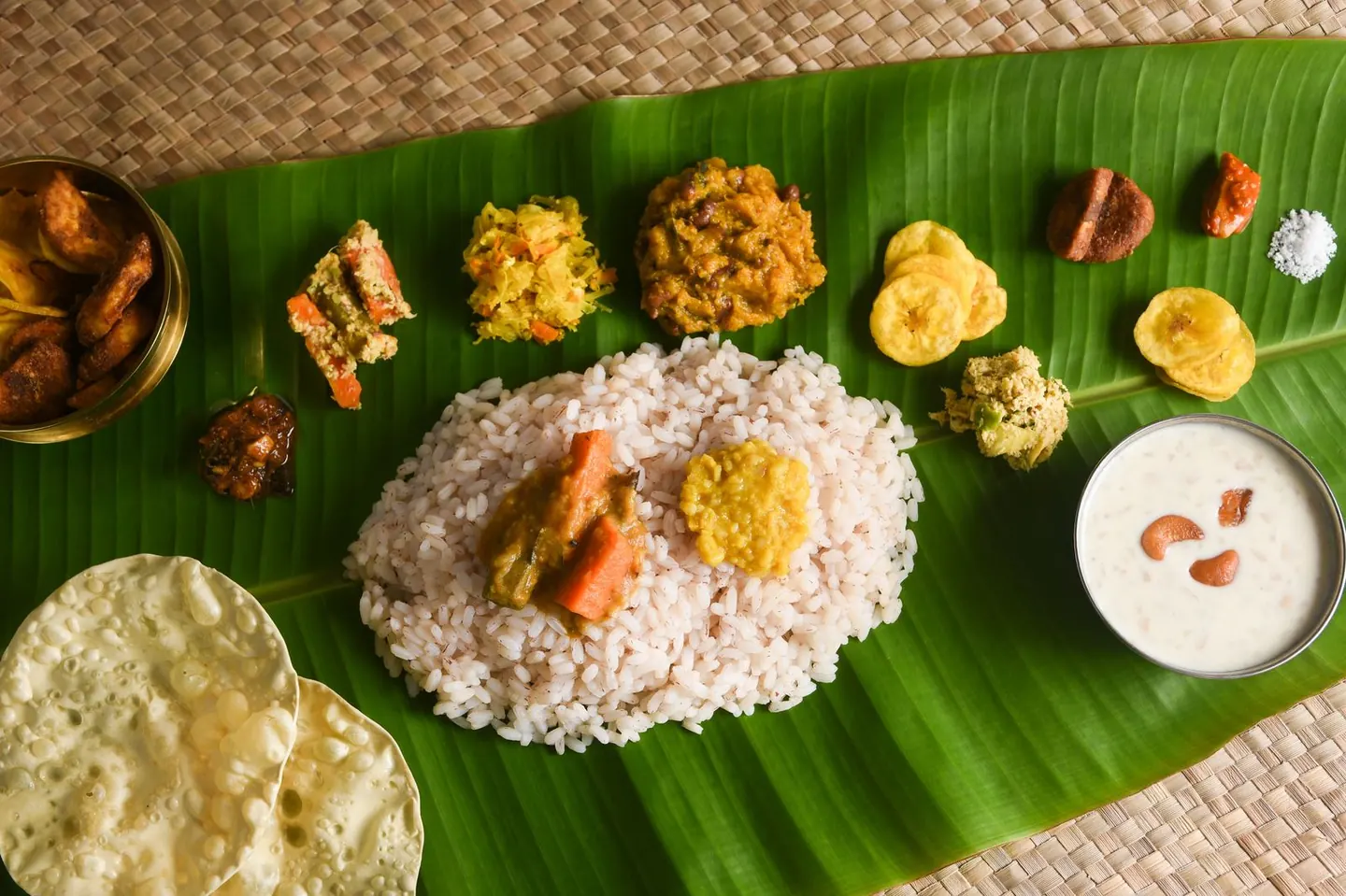
THE KERALA PLATE
Traditional Malayali Cooking, Re-engineered for Fat Loss and Metabolic Health
Reshmi R Nair
Copyright
THE KERALA PLATE Traditional Malayali Cooking, Re-engineered for Fat Loss and Metabolic Health
Copyright © 2026 by Reshmi R Nair
All rights reserved. No part of this publication may be reproduced, distributed or transmitted in any form or by any means, including photocopying, recording, scanning or other electronic or mechanical methods, or stored in a retrieval system, without the prior written permission of the author, except in the case of brief quotations embodied in critical reviews and certain other non-commercial uses permitted by copyright law. For permission requests, write to the author.
First edition, 2026
Independently published.
The author has made every reasonable effort to ensure that the information in this book is accurate at the time of publication, and that all research findings are correctly attributed to their original sources. Nutritional values are estimates; see An Important Note on Your Health, below, and the explanation of the nutrition panel in How to Use This Book.
Malayalam food names appear in roman transliteration throughout. Choices of spelling are explained in A Note on Names, Measurements and Spellings.
Printed in the United States of America / United Kingdom / India, depending on point of sale.
An Important Note on Your Health
This is a cookbook, and it is a book about evidence. It is not a medical text, and reading it does not put you under anyone's care.
Everything in these pages is offered for education. It describes what has been measured in published research about food, body composition, blood pressure, blood glucose and blood lipids, and it translates that research into cooking. It does not diagnose anything, it does not treat anything, and it cannot know your history, your medication list, your kidney function or your family's. Nothing written here is a substitute for the judgement of a doctor, a registered dietitian or a nurse who has examined you, read your notes and seen your test results. If this book and your clinician disagree, your clinician is looking at you and this book is not. Follow your clinician.
Some readers must have a conversation with their doctor before they change how they eat, not after. If you take insulin or a sulfonylurea, or any other medicine that lowers blood glucose; if you take medication for blood pressure; if you take an anticoagulant or antiplatelet drug; if you have kidney disease of any stage; if you are pregnant or breastfeeding; if you have an eating disorder now or have had one in the past; or if you are being treated for any serious illness, then a change in diet is a change in your treatment. It can alter how much medicine you need. Adjusting medication is your clinician's work, not yours and not mine. This book will never tell you to reduce, delay or stop a prescribed drug, and if you ever read it that way, you have misread it.
Two specific hazards in this book deserve to be named in plain words, because they are real and because a reader could stumble into either of them while trying to do the right thing.
The first is fenugreek. Fenugreek — uluva, and the leaves sold as methi — appears in Kerala cooking in small, seasoning quantities, and at those quantities it is simply an ingredient. The published trials that found an effect on blood glucose used far larger amounts, of the order of 10 to 25 g a day, which is reachable through soaked seeds, generous quantities of methi leaves and fenugreek-heavy batters. If you take insulin or a sulfonylurea, adding fenugreek in that therapeutic range alongside your medication can push your blood glucose too low. Hypoglycaemia is dangerous. Do not add fenugreek in quantity to your diet without telling the clinician who manages your glucose-lowering medication, and if they agree to it, agree also on how you will monitor.
The second is potassium-based salt substitute. This book explains, because the evidence is strong and the flavour consequences are manageable, how a potassium-enriched salt blend can be used in place of ordinary salt. For most people that swap is one of the most useful single changes available. For some people it is not safe. If you have chronic kidney disease, or take an ACE inhibitor or angiotensin receptor blocker, or a potassium-sparing diuretic such as spironolactone or amiloride, or any other drug that raises serum potassium, then potassium-based salt substitutes are not for you unless your clinician has specifically said otherwise and has arranged to check your bloods. Raised serum potassium can affect the heart's rhythm. Every chapter of this book that uses potassium salt repeats this warning at its opening, and every back-matter table that names the blend carries it too; that repetition is deliberate, and it is not padding.
Two further points of honesty. First, the nutrition panel printed beneath each recipe is an estimate. It is calculated from published food-composition tables — principally the Indian Food Composition Tables of the ICMR-National Institute of Nutrition, supplemented by USDA data for items those tables do not cover — applied to the weights of the ingredients as written. Real food varies. Two coconuts of the same size do not hold the same fat. A fish fillet's oil content changes with season and with what the fish had been eating. How much oil actually stays in a pan and how much remains on the plate is not fully predictable. Treat the panels as a reliable guide to the relative differences between dishes and to the rough order of magnitude, and do not treat them as laboratory values for your own portion. Where a number matters clinically — a sodium restriction, a potassium restriction, a carbohydrate count for insulin dosing — verify it with the person who set the restriction.
Second, this book makes no claim that any food, spice, dish or plan cures, treats or prevents any disease. Foods contribute to dietary patterns. Patterns shift risk, on average, across populations, over years. That is a genuine and useful thing, and it is a smaller and more careful claim than the one this genre usually makes. The whole of Part One explains why the smaller claim is the true one.
The author and publisher accept no liability for any loss, injury or damage alleged to arise from the use or misuse of the information in this book. By continuing to read, you accept that the decisions you make about your health are made with your clinician, and that the responsibility for them is yours.
Dedication
For the women who ran Kerala's kitchens without a scale, a timer or a thermometer, and got it right anyway.
For my grandmother, who scraped a coconut every morning of her adult life and never once measured it.
And for everyone who has been handed a blood report and told, without further explanation, to eat less rice.
How to Use This Book
This is a long book, and you do not have to read it in order. But you do have to read some of it, because the recipes in Part Three will not do what they are designed to do if you treat them as a collection of dishes rather than as a system. Ten minutes spent here will save you a great deal of guessing later.
The four parts
Part One — Why Your Plate Changed is the argument. It sets out what has happened to metabolic health in Kerala and in the Malayali diaspora, what the numbers actually are, what changed in the food between roughly 1950 and 2000, how your own measurements work and what fat loss physically involves. It is the part that explains why a cookbook is a reasonable response to a blood test. If you want to know whether to trust this book, read Part One.
Part Two — The Kerala Kitchen is the reference. The pantry, the equipment, the ten techniques that decide whether a dish works, and the mother preparations — masalas, batters, pastes, stocks and podis — that the recipes in Part Three refer back to. Part Two is meant to be consulted, not read straight through, although the techniques chapter rewards a single continuous reading.
Part Three — The Recipes is the book's centre of gravity: 120 recipes, each of them a real Kerala dish, each of them re-engineered where re-engineering was needed and left alone where it was not.
Part Four — The Programme is the scaffolding: a seven-day reset to establish the habits, a 28-day plan, a batch-cooking chapter for people who work, a chapter on the social world of weddings, sadya, tea shops and family pressure, and a chapter on special situations from PCOS to fatty liver to protein needs in older adults.
Three readers, three starting points
If you have just had a bad blood test, start with Chapter 3, "Your Numbers, Not Theirs", and measure your waist today. Then read Chapter 4 and Chapter 6, which tell you what is and is not reversible and how much change the evidence suggests it takes. Then go to Part Four and start the seven-day reset. Come back to Chapters 1, 2 and 5 in the weeks that follow, when you want to understand what you are doing rather than simply do it.
If you just want to cook Kerala food well, and you are not carrying a health worry, start with Part Two. Learn the difference between thenga aracha and thenga chertha, learn the three coconut milk extractions and why the first one must never boil, then cook from Part Three. You may ignore every nutrition panel in the book and you will still be cooking well: nothing has been made bland, thin or apologetic. Read Chapter 11 at some point anyway, because the plate framework is a genuinely good way to build a meal, and Chapter 8 and Chapter 9 if you have ever wondered whether the things people say about coconut oil and turmeric are true.
If you already cook this food, possibly better than I do, and what you want is to change it, go straight to the line marked THE RE-ENGINEERING at the top of every recipe. It states in one sentence exactly what has been altered from the version you know and why. Then read Chapter 7 on rice, Chapter 8 on coconut and Chapter 10 on salt, which contain the three highest-value changes available in this cuisine. You will disagree with me somewhere. Please do; the disagreement is where the useful thinking happens.
The recipe template, field by field
Every recipe in Part Three carries the same fields, in the same order, for a reason.
The number (R041, R078) is how the whole book cross-references itself. The title carries the Malayalam name; the italic line beneath it says in English what the dish is.
ICONS is the six-letter Kerala Plate strip, explained below.
THE RE-ENGINEERING is one sentence naming what changed from the traditional dish and why. It exists so that you are never left wondering whether you are being handed an heirloom or an edit. Where nothing changed, it says so.
The headnote does exactly one job: history, or the technique that matters, or the reason this dish belongs in a book about metabolic health. Never all three, because a headnote that tries to do three things teaches none of them.
Serves and the portion weight in grams are there because "serves 4" means nothing without a portion size, and portion size is most of what this book is about.
Active and Total times are given as ranges, and where a dish needs resting or soaking it is stated separately, so you can plan backwards from when you want to eat.
EQUIPMENT names what the dish genuinely needs and what to substitute, with the consequence of substituting stated. BEFORE YOU START appears on any dish that moves too fast to improvise, which in this cuisine mostly means anything involving a tempering.
INGREDIENTS are listed strictly in the order they are used, by weight first. SOURCING NOTE tells a reader outside Kerala where to find the difficult item and what to do if they cannot.
METHOD steps each open with a bolded imperative verb. Every step that depends on judgement gives you a sensory cue paired with a time range — how it should look, smell or feel, and roughly how long that takes — because a clock cannot see your pan.
WHY THIS WORKS is the short box that explains the mechanism, culinary or chemical or metabolic. It is the field that makes this a book you can cook from for twenty years rather than one you follow for a fortnight.
PER SERVING (estimated) is the nutrition panel. IF YOU ARE WATCHING… translates that panel into practical action for blood sugar, blood pressure or cholesterol, where relevant.
SWAP IT gives substitutions and, every time, the consequence. SCALE IT gives a table for base recipes. MAKE AHEAD · STORE · FREEZE and LEFTOVERS exist because the single strongest predictor of whether you keep eating this way is whether the food is already cooked when you are hungry. SERVE WITH builds the plate for you. TROUBLESHOOTING addresses what actually goes wrong. NOTES is ruled space for your own hand, because your kitchen is not mine.
The icon strip and the attribute tags
Six letters, on every recipe, showing at a glance how a dish fits the Kerala Plate:
- V — Vegetable-forward: half the plate or more is vegetables
- P — Pulse included, or pairs with one to complete the plate
- Q — Quick: 30 minutes or less, start to table, with no unattended time on top
- B — Batch-friendly: doubles cleanly and keeps
- F — Freezer-friendly
- L — Low sodium: under 300 mg per serving
Only the letters that apply are printed, and the Q icon is withheld from any dish that needs unattended soaking, marinating, resting, fermenting, sprouting, cooling or chilling on top of its stated total time, however short the hands-on work is. In addition, each recipe carries one to three attribute tags on its title line, and each tag has a number behind it: [HIGH PROTEIN] is 25 g or more of protein a serving, the figure Chapter 5 sets as the per-meal target; [HIGH FIBRE] is 6 g or more of fibre; [LOW SODIUM] is under 300 mg of sodium, the same threshold as the L icon; [UNDER 250 KCAL] is under 250 kcal; [LOW SAT FAT] is under 5 g of saturated fat, which is under a quarter of the 22 g a day that WHO's 10%-of-energy figure works out to on a 2,000 kcal intake; [VEGETARIAN] and [VEGAN] are read from the ingredient list; and [LOW GL] marks the dishes whose glycaemic load is low for the portion served, which is a judgement about the whole plate rather than a single measured number, so no threshold is claimed for it. These feed the condition-and-attribute index at the back, so that a reader who needs to eat 12 low-sodium dinners can find them in one place.
The nutrition panel, and what it cannot tell you
The panel gives energy in kcal and kJ, total carbohydrate, fibre, net carbohydrate, sugars, protein, fat, saturated fat and sodium, per serving. It is calculated by summing published per-100 g values for each ingredient and dividing by the stated number of servings. Net carbohydrate is total carbohydrate minus fibre.
The panel is labelled estimated on every single recipe, and the label is meant literally. Food composition varies by variety, season, soil, ripeness and cut. Cooking loss and oil retention are approximations. Where an ingredient does not appear in the published tables at all, the closest documented food has been substituted and the substitution noted. If you require accurate carbohydrate counts for insulin dosing, or accurate sodium or potassium figures for a clinical restriction, work from these panels as a starting point and confirm with your clinician or dietitian.
Cross-references, indexes and plans
This book cross-references by recipe number, never by page number. R041 will find the same dish in the paperback, the ebook and any future edition, and it will find it in the alphabetical index too.
There are three indexes. The first is alphabetical, by dish name in both Malayalam and English. The second is by ingredient, so that half a cabbage and a handful of vanpayar can be turned into dinner. The third is by condition and attribute, keyed to the tags above, for a reader who has been told to reduce sodium or raise protein and wants a list rather than a lecture.
There are two plans, and they are for different people. The 7-Day Reset is short, structured and mainly about installing four habits: half the plate vegetables, a pulse at every meal, oil that is measured rather than poured, and a weekly measurement routine. Use it if you are starting from nothing, if you have just had a blood test, or if you have fallen off a longer plan and need a way back in. The 28-Day Kerala Plate Plan is the fuller programme, with a theme each week, full daily menus, shopping lists and a batch-cooking Sunday. Use it if you have a specific target — a waist measurement, an HbA1c, a weight — and you want four weeks of decisions already made for you. You can run the reset first and the 28 days after. You should not run both at once.
What this book will not do
It will not cleanse you of anything. Your liver and your kidneys clear metabolic waste continuously and competently, and no juice, gruel, fast, tea or seven-day plan improves on that machinery. Nothing in this book removes a substance from your body that was not already on its way out.
It will not name a food that fixes anything. There is no single ingredient in this cuisine, or any cuisine, whose addition changes the course of a metabolic condition. Chapter 9 goes through the most-hyped candidates one by one, including several that Kerala is proud of, and tells you honestly what the trials found — which in most cases is very little at quantities you would ever cook with.
It will not sell you a spice as a medicine. Where a spice does have a measurable effect, the dose in the trial is compared with the dose in the pan, in a table, so you can see the gap for yourself.
It will not promise you a fixed number of kilograms in a fixed number of weeks. That promise is the standard currency of this genre and it is not supported by the evidence. What the trials show is a range of outcomes, wide variation between individuals, and a strong dependence on whether people keep going. Chapter 5 gives you the honest numbers, including the disappointing ones, and Chapter 6 tells you what amount of change has actually been associated with what result.
What this book will do is give you back a way of eating that was, before it was displaced, a good one — and make it precise enough to work in a body that is now carrying more risk than that plate was ever designed for.
A Note on Names, Measurements and Spellings
The names
Kerala dishes are called by their Malayalam names in this book. Thoran is not "a Kerala-style stir-fried vegetable dish with grated coconut"; thoran is what it is called, by everyone who cooks it, and a book that renames it in English every time would be both longer and less accurate. On first use in each chapter, a name appears in italics with a short gloss. After that it is set in roman type, unitalicised, like any other English noun that has been fully adopted — because within these pages it has been.
This is not a language book. There is no Malayalam script here, no pronunciation drill, no vocabulary exercise and no box inviting you to learn a phrase. If you do not speak Malayalam you will lose nothing; the glossary at the back is a reference list of dishes and ingredients, arranged for looking things up rather than for study. If you do speak Malayalam, you will notice that I have not attempted to teach you your own kitchen.
Romanisation, and why the spellings vary in the world
Malayalam does not map cleanly onto the roman alphabet, and no single system of transliteration has won. The same fish curry souring fruit is written kudampuli, kodampuli and kudam puli on three different packets in the same shop. This book picks one spelling for each word and holds to it, without diacritical marks, choosing the form that is most widely used in Kerala English-language publishing rather than the form that is most linguistically precise. Where a second spelling is common enough that a reader might search for it, it is given once in the glossary.
Regional variants are a different matter, and they are real rather than orthographic. A dish can carry the same name and different content across 150 km of a state that is only 35 to 120 km wide: what a Kottayam household calls a fish curry and what a Kozhikode household calls a fish curry are not the same dish, and neither is wrong. Where a recipe follows one community's or one district's version, the headnote says so. Where a name genuinely covers several distinct preparations, the book says that too, rather than quietly promoting one to the status of "authentic".
Measurements
Weights come first, and volumes come second, in parentheses. A recipe asks for 200 g (1 cup) matta rice, in that order, and where the two disagree the gram figure is the one to follow.
This is not fussiness. In an ordinary cookbook, a cup of rice that is 15% heavier than the one the author used produces a dish that is slightly different. In a book whose central subject is portion and quantity, the same error moves the carbohydrate load of the meal by 15%, which over a week is the difference between a plan working and a plan not working. Coconut is worse: grated coconut can be packed loosely or firmly into the same cup with a difference of nearly half its weight, and coconut carries most of the fat in this cuisine. Oil measured by pouring is routinely two or three times oil measured by spoon. A digital kitchen scale that weighs to 1 g costs very little and is the single highest-return purchase in a kitchen where portions matter. Use it for rice, coconut, oil, jaggery and protein at minimum; you can be casual about the vegetables, and this book actively wants you to be.
Temperatures are given in °C first, with °F in parentheses: 180°C (350°F).
Times are given as ranges, never as single figures. A recipe says 6–8 minutes, because your pan, your hob, your altitude and the water content of your onions are not mine. Every step where the outcome depends on judgement pairs its time range with something you can see, smell or hear. When the two disagree, believe your senses and not the clock.
British spelling is used throughout: flavour, colour, litre, metre, fibre, programme, organise, analyse. Energy is given in kcal with kJ in parentheses, weight change in kg, waist in cm, and sodium in mg.
Salt, sodium, and the arithmetic you need
Food labels and dietary guidelines are inconsistent about whether they discuss salt or sodium, and the confusion causes real errors. This book gives sodium, in milligrams, throughout, because that is the figure that public health targets and clinical restrictions are written in.
The conversion is simple arithmetic and worth committing to memory:
- 1 g of salt contains 400 mg of sodium.
- 1 level teaspoon of salt is about 6 g, which is about 2,400 mg of sodium.
So a single level teaspoon of salt divided between four servings of a curry contributes 600 mg of sodium per serving before anything else on the plate is counted. Set that against a daily target in the region of 2,000 mg, note that a Kerala meal typically carries a pickle, a pappadam and a chutney alongside the curry, and the shape of the problem becomes clear without anyone needing to be scolded. Chapter 10 deals with it properly, and with the craft of building flavour from acid, aroma, heat and texture rather than from the salt tin.