PART TWO — THE KERALA KITCHEN
Part One argued that the problem is not the cuisine. This part hands the cuisine back, item by item. A Kerala kitchen is not a long shopping list; it is a short one used with unusual intelligence. Coconut, rice, a souring fruit, a handful of whole spices, curry leaf, shallot, a pulse, whatever the boat brought in. From that narrow store the coast built several hundred dishes, and it did so by varying technique — how the coconut is cut, when the acid goes in, whether the tempering leads or finishes — rather than by buying more things. That is the good news for a reader in Houston or Manchester with one Indian grocery within driving distance. You do not need forty ingredients. You need about twenty-five, bought well and stored properly, and you need to know what each of them is doing. The three chapters that follow are the reference heart of this book: what to keep, what to cook it in, and the ten techniques that decide whether any of it tastes right.
Chapter 12 — The Pantry
Every entry follows the same shape so you can scan rather than read: what it is, what it does, how to buy it, how to store it, what to substitute and what that costs, and where to find it abroad. Per-100 g values are for the raw edible portion and come from the ICMR-NIN Indian Food Composition Tables 2017 unless marked USDA; those tables report available carbohydrate, which is not the same basis as USDA's carbohydrate-by-difference, and report energy in kilojoules, converted here.
One warning. A pantry chapter is where cookbooks start making claims. This one does not. Several of the most-praised items here — bitter gourd, okra, moringa, curry leaf — have been tested in humans and did not deliver what folklore promises. They are still excellent food, and the reasons are given where they arise.
The rices
Three things move rice's glycaemic behaviour more than colour does: amylose content, the intensity of parboiling, and how much the grain has been polished. Boers and colleagues' systematic review (2015) found amylose the most consistent source of variation, and — the line to remember — pressure parboiling reduced glycaemic index by nearly 30% in some cases, while traditional mild parboiling had minimal effect. Kerala matta is traditionally parboiled; whether your bag was pressure-parboiled is not printed on it. Polish is where the loss happens: Shobana and colleagues (2017) milled one parboiled indica variety three ways and measured brown at GI 57.6, under-milled at 2.3% polish at 73, and white at 9.7% polish at 79.6. Parboiling also drives vitamins inward before milling, which is why parboiled milled rice carries 0.17 mg thiamine per 100 g against 0.05 mg in raw milled rice, with brown rice higher again at 0.27 mg.
Matta · Palakkadan Matta · rosematta
Kerala's everyday rice: a short plump grain steeped and steamed in the husk before milling, which drives the bran's pigment inward and leaves it yellowish-pink. Palakkadan Matta is GI-registered; "rosematta" is the same family under a trade name. Assertive and faintly nutty, firm enough for a fierce fish curry, and it will bully a delicate ishtu. Buy even unbroken grains with red streaking, no chalky centres, no musty smell through the bag. Store airtight, cool and dark, 8–12 months, with two dried chillies in the container against weevils. Substitute any parboiled red or brown short-grain rice, or brown basmati; you lose the earthy bite and gain a longer, more separate grain — fine under a stew, wrong under a kudampuli curry. Abroad: "Kerala Matta", "Rosematta" or "red parboiled rice" in 5 kg and 10 kg bags, or Sri Lankan red parboiled rice. Anything labelled matta that is white and long is polished rice with a heritage word on the packet.
The Indian tables carry no entry for matta or red rice, so no panel in this book is attributed to it. For glycaemic index there is one directly relevant Kerala measurement: Pavithran and colleagues' 24-week randomised trial (2020) measured the recipes participants actually ate and reported Rose Matta rice at GI 38 and red rice puttu at 38, against whole-wheat roti 45 and oats puttu 51–52, with HbA1c falling 0.93% in the low-glycaemic arm. Treat 38 as a measured value for those preparations cooked that way, not a property of every bag on every stove.
Pokkali
The saline-tolerant coastal rice — about 5,000 hectares across Alappuzha, Kottayam, Thrissur and Ernakulam, grown to two metres so it survives flooding, and rotated with prawns: rice from June to early November while salinity is low, prawns from mid-November to mid-April, their waste fertilising the next crop. GI-registered, and organic by construction. Coarser and more mineral than matta, traditionally eaten as kanji. Buy from a named producer society, store as matta, substitute matta and lose nothing but the story. Rarely exported.
Njavara (navara)
The heirloom rice of Kerala's Ayurvedic tradition, GI-registered, used in karkidaka kanji and in medicated kizhi poultices: sticky, quick-cooking, mild. Buy 500 g at a time, often through Ayurvedic pharmacies, and use within 3–4 months, since it stales faster than matta; substitute matta in a kanji. Sold online abroad as "Navara rice". In this tradition njavara is understood to be strengthening; the book reports what the system says and makes no clinical claim.
Jeerakasala and gandhakasala
Two short, thin, intensely aromatic Wayanad rices, both GI-registered — the same grain grown in Adivasi and smallholder highland fields that ends up in a coastal Muslim wedding feast. Jeerakasala, kaima in Malabar, is the rice of Thalassery biryani and needs no pre-soaking; gandhakasala is its more perfumed relative. They give aroma and short grain, not length, which is why a Thalassery biryani made with basmati is a longer, blander dish. Buy small translucent grains that smell of themselves through the bag. Store airtight and dark, 6 months — aromatic rices lose perfume fastest. Swap in seeraga samba, or basmati in less water, losing the aroma the dish is named for. Abroad: ask for "kaima" or "seeraga samba".
Unpolished parboiled, polished parboiled and brown — what to actually buy
Per 100 g raw: milled raw rice 356 kcal, 7.94 g protein, 2.81 g fibre; milled parboiled 352 kcal, 7.81 g protein, 3.74 g fibre; brown raw 354 kcal, 9.16 g protein, 4.43 g fibre. Energy is effectively identical; fibre and B vitamins are not.
Buy an unpolished or lightly polished parboiled rice, in the largest bag you will finish in three months, and a scale to portion it. That is the whole recommendation. It is not "buy brown rice": a three-month trial swapping brown for white in two meals a day moved neither HbA1c nor lipids overall, while quantity moved everything — 450 g or more of cooked rice a day against under 150 g carried a hazard ratio of 1.61 for incident diabetes in South Asia (Chapter 7 sets both out). Buy the better rice if you like it. Weigh it either way, and put a pulse beside it.
Parboiled idli rice. A short, fat, heavily parboiled grain sold as idli rice, idli rava's parent grain or simply parboiled rice, and the grain M11 and M06 are built on. It is not matta and not interchangeable with it: idli rice is milled paler, swells further and grinds to a smoother batter, which is what gives an idli its crumb. Buy it in 1 kg bags from any South Indian shop, or online; the label will say puzhungal ari or idli rice. Store as for matta — airtight, dark, three months. Substitute any short-grain parboiled rice; long-grain parboiled will ferment but gives a coarser, flatter idli. Abroad: every Indian grocery in the UK, US, Gulf and Australia carries it, usually beside the sona masoori. No verified per-100 g composition for it sits in this book's sources; see Section 1.13 of the reference tables.
On brown rice and cooking time At identical cooking times brown rice always produced lower glucose and insulin responses than white — but at the longer times brown rice actually needs, that advantage narrowed or disappeared (Boers et al., 2015). Cook it to mush because the family complains it is hard and you have bought texture nobody likes and kept the glycaemic load.
Coconut in its five forms
Coconut is not an ingredient in Kerala cooking; it is the medium — the fat, the thickener, the sweetener, the acid-buffer and half the texture. The argument about it resolves once you separate the fruit from the oil. Fresh grated coconut carries about 10 g of fibre and 3.8 g of protein per 100 g. Coconut oil carries none of either. That contrast governs how this book uses coconut: generously as flesh and milk, in measured teaspoons as oil.
Fresh mature coconut (thenga)
The brown-husked nut, 10–12 months old: 409 kcal, 3.84 g protein, 41.38 g fat, 10.42 g fibre, 6.30 g available carbohydrate per 100 g. Ground raw with shallot, cumin and green chilli it is the body of avial, erissery and kalan; dry-roasted dark before grinding it is a different register entirely; scraped in at the end it is a thoran. Buy by shaking it — you should hear plenty of water, and silence means it has dried; the three eyes must be dry and firm, never damp or smelling fermented. Store whole 2–3 weeks cool, opened 2 days refrigerated, or grate and freeze at once. Swap in frozen grated. Abroad: supermarket coconuts have travelled far, so buy two and expect to reject one.
Fresh grated, and frozen grated — the diaspora's best friend
Kernel shredded into fine long flakes on a chirava; frozen grated coconut is that, flash-frozen, — the one processed Kerala ingredient this book recommends without hedging. A thoran is grated coconut with a vegetable attached. Buy bags that rattle loose rather than frozen bricks, which have thawed and refrozen; flakes white, labelled unsweetened. Store fresh 2 days refrigerated, 3 months frozen in flat portioned bags, breaking off what you need, since twice-frozen coconut tastes of the freezer. Substitute desiccated rehydrated in 2–3 tablespoons of warm water per 100 g for 10–15 minutes: you get bulk and sweetness but not the fresh milky note, and it will never grind to a glossy paste. Abroad: the frozen aisle of any South Asian, Sri Lankan, Filipino, Thai or Caribbean grocery. Buy four.
Desiccated coconut
Kernel dried to about 4% moisture: 624 kcal, 7.27 g protein, 63.26 g fat, 15.88 g fibre per 100 g — the same food concentrated, energy included. Acceptable in a ground paste for a long-simmered curry and in sweets; poor in a thoran. Buy unsweetened, fine or medium, pale cream not yellow. Store airtight and cool, 6 months — the high fat means rancidity, so if it smells of crayons, bin it. Coconut flour is not a substitute. Every supermarket stocks it; read the ingredients for sugar.
Coconut milk — tinned and fresh-pressed
An emulsion: coconut fat suspended in water, stabilised by coconut proteins. Kerala distinguishes three extractions — onnaam, randaam, moonnaam paal: a first pressing with little or no water, then two further soakings and pressings. Raw coconut milk runs about 230 kcal, 2.29 g protein, 23.8 g fat, 2.2 g fibre per 100 g, coconut cream about 330 kcal and 34.7 g fat (USDA). Second and third milk are cooking liquid; first milk is a finish, and it must never boil — sustained boiling denatures the proteins holding the emulsion, the fat separates over grainy curds, and the dish is beyond rescue. Swirl the pan; do not stir. Buy by finding the fat percentage rather than reading the front of the label: 17–22% is a thick first-milk equivalent, 8–12% behaves like second milk, below about 6% is coconut drink that will not thicken a mappas. A separated tin is unstabilised, not spoiled. Store unopened 2 years; opened, 3 days refrigerated in a non-metal container, or 2 months frozen in cubes, which separate on thawing, so whisk them into a cooked dish. Fresh-pressed keeps 24 hours. Swap fresh for tinned 1:1 in the thick extraction, or thin full-fat tinned with water for the later milks; tinned milk is cooked, so it tastes faintly caramelised, which is audible in a finishing role. Abroad: tinned full-fat from a Thai or South Asian brand, never the chilled cartons sold as milk alternatives, which are thin, sweetened and will not make an olan.
Coconut oil (velichenna)
Pressed from copra, or from fresh kernel for virgin oil. The composition is settled: 90.86% saturated, lauric acid 49.57% of total fatty acids, and genuinely medium-chain C8 plus C10 only 7.94% together — so coconut oil is not, in any useful sense, an "MCT oil". Pooling 16 trials, it raised LDL cholesterol by 10.47 mg/dL against non-tropical vegetable oils, with no effect on glucose, weight or body fat; Chapter 8 gives the full argument, including the one four-week trial that found it comparable to olive oil. In some dishes coconut oil is the flavour — raw over an avial or kappa puzhukku, in a finishing tempering — and this book keeps it there, in teaspoons. Buy cold-pressed or wood-pressed (chekku); it should smell sweetly of coconut, solid below about 24°C (75°F) and clear above, both normal. Store cool and dark, 12 months. For flavour there is no substitute: use less rather than swapping. Virgin coconut oil carries no verified benefit for weight, waist, body fat, metabolic rate or blood pressure; buy it because it tastes better, which it does.
The oils
The standing recommendation: keep coconut oil for the dishes where it is the flavour, measured in teaspoons; use gingelly (sesame), groundnut or rice bran for anything involving volume. That moves a kitchen from about 91% saturated fat to 16–24%, the substitution WHO's 2023 guideline and the American Heart Association's 2017 advisory both recommend — noting that WHO's strong recommendation is replacement with polyunsaturated fat specifically, plant monounsaturated fat being conditional.
| Oil | SFA % | MUFA % | PUFA % | The job it is for |
|---|---|---|---|---|
| Coconut (velichenna) | 90.9 | 7.2 | 1.9 | Flavour, in teaspoons: tempering, raw finish, avial, kappa |
| Gingelly / sesame (nallenna) | 16.3 | 41.4 | 42.3 | The everyday cooking oil of this book; also pickles |
| Groundnut | 18.9 | 53.9 | 27.2 | Shallow frying, roasting, neutral heat |
| Rice bran | 23.8 | 44.1 | 32.1 | Deep frying, where a high smoke point matters |
| Mustard | 5.7 | 67.1 | 27.2 | Northern-style pickles only — see below |
| Palm | 45.0 | 43.5 | 11.5 | Avoid; it is what commercial fried snacks are made in |
Percentages are of total fatty acids. Smoke points deserve a warning rather than a table: published values vary widely, depend on refining level and free fatty acid content, change the moment an oil is used, and are a poor proxy for oxidative stability anyway. As a working order, refined rice bran and groundnut sit highest, sesame and coconut lower, unrefined versions lower again.
Gingelly / sesame (nallenna). Two products share the name: Indian nallenna is light golden, pressed from raw seed, mildly nutty; East Asian toasted sesame oil is dark, aggressive and wrong here. Ask for "gingelly", "til" or "nallenna" and check the colour through the bottle; 6–9 months opened, cool and dark. Abroad, "cold-pressed sesame oil" from a health aisle is correct and "sesame oil" from the Asian aisle usually is not.
Groundnut and rice bran. Groundnut is 53.9% oleic, stable, cheap and near-tasteless, the default for shallow frying, with the obvious allergen caution when cooking for guests; rice bran suits the reader who genuinely deep-fries. Both keep 9–12 months in a dark cupboard, and both should be discarded after frying rather than strained and reused: ICMR-NIN's 2024 guidance is explicit about not reheating or reusing frying oil.
Mustard. Pungent, only 5.7% saturated, 11.64% α-linolenic — and 51.30% erucic acid, subject to regulatory limits in several jurisdictions and a genuine caveat rather than a technicality. It is a North Indian and Bengali oil. This book uses mustard seed constantly and mustard oil never.
Ghee (neyy). Butter clarified until the water has gone and the milk solids have browned and been strained out, which is why it keeps without refrigeration and why it smells of toasted nuts rather than of butter. In this book it is a finishing fat, not a cooking one: 2 g over the parippu course, a teaspoon through neychoru, a smear on an ada. That is a deliberate restriction — ghee is almost pure fat and mostly saturated, and its whole value is aromatic, which means a small quantity placed where you will taste it does more than a large quantity cooked into something. Buy a plain cow ghee with one ingredient on the label; the granular texture of a well-made ghee is a good sign, not a fault. Store in an airtight jar away from light, 6–9 months at room temperature, longer refrigerated; it goes rancid slowly and unmistakably. Substitute coconut oil where the job is greasing or frying — you lose the milky top note and nothing else — and note that ghee is a dairy product for anyone avoiding milk. Abroad: universally available, including in supermarkets. This book has no verified per-100 g figure for ghee: the panels that use it are computed on a stated assumption of 99 g fat, about 890 kcal and roughly 62% saturated per 100 g, flagged as unverified wherever it is used.
The souring agents, and the community map they draw
The choice of acid is the most reliable community and regional marker in this cuisine. Not the spices — the acid. Choosing the souring agent is choosing the dialect you are cooking in. There is a modest metabolic bonus: pooled trials of vinegar consumption show reduced postprandial glucose and insulin area under the curve, standardised mean differences of −0.60 and −1.30 (Shishehbor et al., 2017). Acid also does something more immediately useful — it makes food taste more seasoned than it is, and is therefore the best salt-reduction tool in the kitchen.
Kudampuli · Malabar tamarind · gambooge (Garcinia gummi-gutta)
The sun-dried rind of a Western Ghats fruit, dried to wrinkled blackish-brown pieces like small leather cups. Smoky, rounded and deep rather than sharp, it integrates into a coconut gravy instead of sitting on top of it, and it is the one acid in Kerala that makes a curry improve overnight: the acid keeps penetrating the fish and softening connective tissue, soluble compounds migrate both ways between gravy and flesh, the emulsion settles, and the harsh volatiles of raw shallot and chilli dissipate. In Kottayam households the phrase is that the curry has "sat". Two or three pieces sour a whole pot. Buy by smell — good kudampuli smells of clean dark fruit acid, and pieces should be pliable rather than powdery; commercial smoke-curing speeds drying and masks poor fruit, so heavy smoke is a warning, not a feature. Store airtight and dry, 2 years or more, and soak in warm water 15–20 minutes before use, until it softens to the texture of a dried apricot, using the soaking water. Swap in 15 g tamarind pulp for three pieces; the consequence, stated every time it appears in this book, is that the curry becomes rounder and brighter and does not improve overnight. Abroad: ask for "kudampuli", "Malabar tamarind", "fish tamarind" or "gambooge"; it is dry and light, so it posts well.
The capsules sold as "Garcinia cambogia" are not this ingredient. Chapter 9 sets out why one plant produces opposite verdicts: concentrated hydroxycitric acid extracts produced a pooled weight difference of just −0.88 kg with a confidence interval touching zero and carry a documented signal for rare but severe liver injury, while the culinary rind is not implicated. Cook with the fruit.
Tamarind (puli, vaalanpuli)
The sticky pulp of the tamarind pod, sold as a compressed block or a concentrate: flat, bright, frankly acidic and fruity — the acid of sambar, rasam, chutneys and inji puli, and the Tamil-inflected and sadya acid. Its presence in a "traditional" Kerala recipe tells you which border that recipe crossed. Buy blocks that are dark and pliable, preferring seedless block to concentrate, which is harsher and often preserved. Store the block 12 months, extracted pulp 1 week refrigerated or 3 months frozen in tablespoon portions. Substitute kokum, lime or amchur — lime is a top note only and gives no body. Abroad: South Asian, Thai, Mexican and Middle Eastern shops all carry it.
Raw mango (pacha manga)
Hard, green, sour unripe mango: fresh and sharp with fruit body, a genuine pre-monsoon alternative to kudampuli in coastal fish curries, and the acid of kichadi, pachadi and manga curry. Buy rock-hard and heavy; any give at the stem end means it will sweeten. Store 1–2 weeks refrigerated, or freeze peeled slices 6 months for use in a cooked curry. Substitute tamarind with a little green apple for body, or amchur at about 1 teaspoon per 100 g replaced — you lose the flesh, which in a mango curry is half the dish. Abroad: Indian and Caribbean groceries in spring; frozen raw mango slices work.
Kokum
A close cousin of kudampuli — the dried rind of another Garcinia, deep purple-black, from the Konkan coast, milder and fruitier with a plum-like edge. This is the acid of the Konkani and Gowda Saraswat Brahmin kitchens of Kochi — sol kadhi, ambat, sasam — and it marks the boundary of a different culinary language sitting inside Kerala. Buy sticky-soft and near-black, not brittle; store 2 years airtight, still usable if it dries. Substitute kudampuli or tamarind, both more assertive. Abroad: ask for "kokum" or "amsul" in the Maharashtrian and Goan section.
Lime (cherunaranga)
Small thin-skinned Indian limes: a volatile top note for pickles, finishing, sulaimani tea and a squeeze over fried fish, added at the end because it evaporates. Buy heavy, glossy and thin-skinned; keeps 2 weeks refrigerated, or freeze the juice in cubes for 6 months. Substitute lemon at about three-quarters the quantity, for a rounder, less floral acidity. Abroad, Mexican groceries' Key limes are closer to Kerala limes than large Persian ones.
Curd and buttermilk (thairu, moru)
Set yoghurt, and the thin sour liquid left after churning — or, in modern practice, curd whisked with water. This is the Brahmin and sadya acid, the one that closes a feast: lactic, soft and cooling where kudampuli is smoky and tamarind sharp, and the body of pulissery, kalan, kichadi, moru curry and sambharam. Plain whole-milk yoghurt runs 61 kcal, 3.47 g protein and 121 mg calcium per 100 g; cultured low-fat buttermilk 40 kcal, 3.31 g protein — and 148 mg sodium, the figure to notice before you add salt (USDA; the Indian tables carry no curd entry). The rule shares its physics with coconut milk and is absolute: curd-based dishes must never boil, or the proteins coagulate and the dish goes grainy. Warm through, then temper. Buy plain and unsweetened with live cultures and no starch; full-fat sets better and splits less. Store 5–7 days refrigerated, souring daily, which is often an advantage. Swap in Greek yoghurt thinned to pouring consistency, for a thicker, milder result. Abroad: look for "dahi" or "curd" in South Asian shops, soured closer to home than Western plain yoghurt.
The map, stated plainly Kudampuli belongs to Syrian Christian fish curry — Kottayam-style meen vevichathu, prawn curry, the whole red fish curry family — and never to sadya vegetables. Tamarind belongs to the sadya and to Tamil-inflected cooking: sambar, rasam, inji puli. Curd and buttermilk belong to Brahmin kitchens and to the close of a feast. Kokum belongs to the Konkani and Gowda Saraswat Brahmin houses of Kochi. Raw mango belongs to the season. Toddy vinegar belongs to Latin Catholic and Anglo-Indian vindaloo-family dishes and to kallappam batter. Swap one for another and the dish does not become worse; it becomes a dish from a different street.
Spices, whole and ground
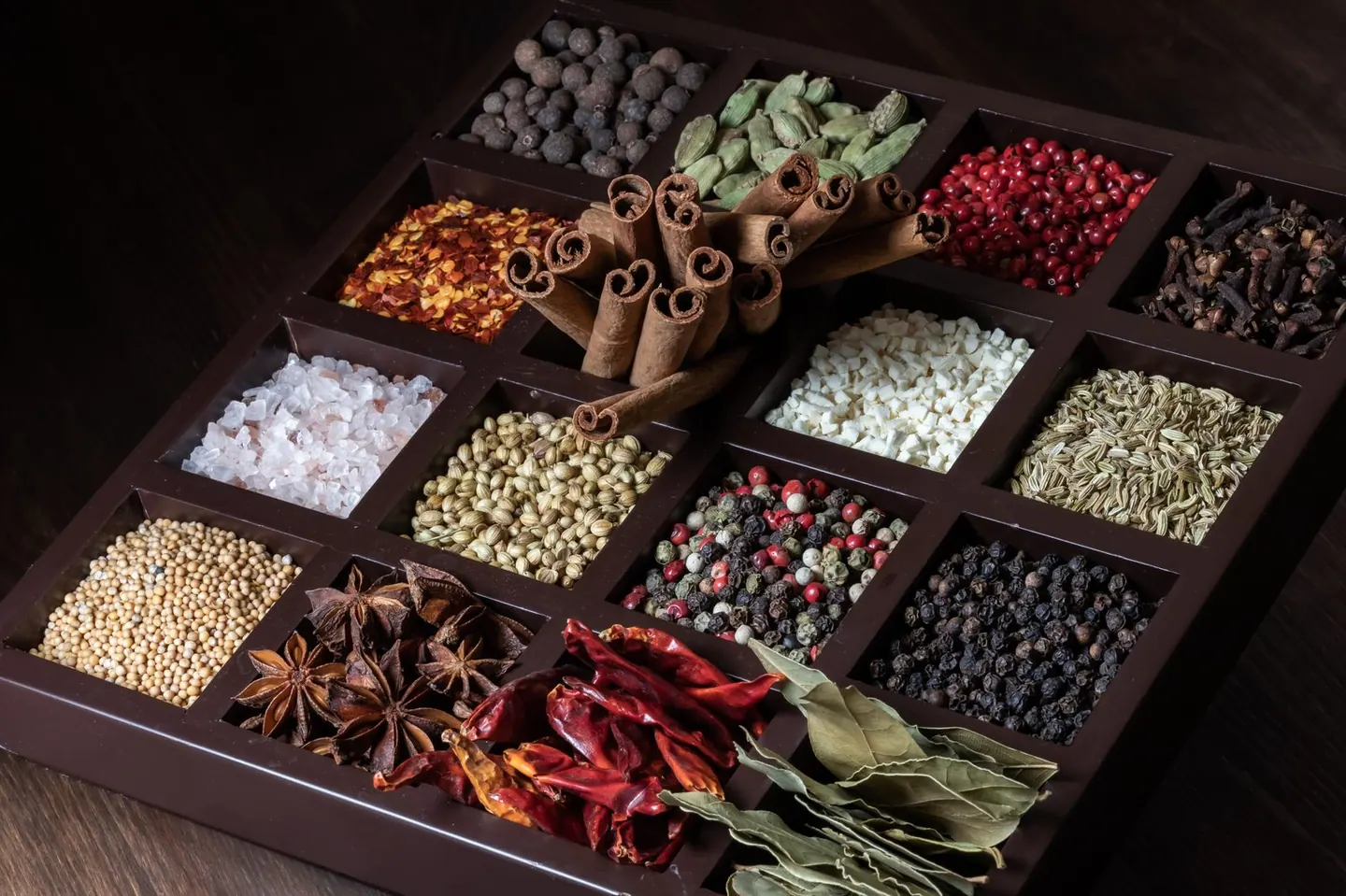
Buy whole, grind small, date the jar. Volatile aromatics live in intact cell structures and escape from ground powder within weeks; the spice cupboard is where most households work with dead stock and blame the recipe. To test whether a spice is alive, crush a pinch between finger and thumb, warm it and smell — if you have to decide whether you can smell it, it is finished. A cardamom pod should have sticky black seeds, not dry brown ones; a peppercorn should crack rather than crumble; turmeric that smells only dusty, with no bitter-fresh edge, will colour a dish and season nothing. Store everything in glass, airtight, away from the cooker and out of the light. The shelf above the hob is the worst place in the kitchen and where almost everyone keeps spices.
| Spice | Whole, in the dark | Ground | Note |
|---|---|---|---|
| Black pepper | 3–4 years | 3–4 months | Grind to order; the aroma is the point |
| Cardamom | 2 years | 2–3 months | Keep in the pod until the moment of use |
| Cinnamon (quills) | 2–3 years | 6 months | Species matters — see below |
| Cloves | 2–3 years | 6 months | Should still be oily and flexible |
| Star anise | 2–3 years | 6 months | Chinese star anise only |
| Nutmeg | 3–4 years | 2 months | Buy whole, grate to order |
| Fennel, cumin, coriander seed | 2 years | 3–4 months | Dry-roast before grinding |
| Mustard seed | 2 years | — | Freshness shows in the pop |
| Fenugreek | 2–3 years | 4–6 months | Bitter when stale as well as when burnt |
| Dried red chillies | 12 months | 6 months | Colour fades before heat does |
| Turmeric | 2 years (dried root) | 9–12 months | The most-abused jar in most kitchens |
| Asafoetida | — | 12 months | Airtight, or it flavours the whole cupboard |
Black pepper (kurumulaku)
The dried unripe berry of Piper nigrum, native to these hills; Malabar Pepper is GI-registered. This is the commodity that brought Rome, Arabia, China and Portugal to the coast: a single ship of the Antonine period, reconstructed from the Muziris papyrus, carried roughly 552 tonnes of pepper to Egypt. Kerala cooked with pepper for centuries before chilli arrived with the Portuguese in the 16th century. It gives heat with aroma — pepper chicken, kalan, rasam, anything where chilli would be blunt — and cracked at the end it perfumes where ground in early it merely warms. Buy heavy wrinkled berries that crack rather than dust, preferring Malabar or Tellicherry. Store whole 3–4 years, ground 3–4 months. No substitute is worth having. No claim: pepper does not raise energy expenditure meaningfully, and the famous "+2000% turmeric absorption" line comes from one small 1998 pharmacokinetic study co-authored by the founder of a company selling piperine supplements.
Cardamom (elakka)
Elettaria cardamomum, from the Cardamom Hills — a reserve created by royal proclamation of Travancore in April 1822, about 1,072 km², today producing roughly 70% of India's cardamom; Alleppey Green Cardamom is GI-registered. Biryani, payasam, chai, garam masala. Buy plump, pale green, unsplit pods by weight from a South Asian shop, since brown or bleached pods have lost their oil and supermarket jars are absurd per gram. Store in the pod, airtight, 2 years. No substitute. No claim: cardamom trials use around 3 g/day, six to fifteen times culinary use, and most outcomes were null.
Cinnamon (karuvapatta) — and why the species matters
Kerala and Sri Lanka are home to Cinnamomum verum, true or Ceylon cinnamon: pale, thin, brittle, multi-layered quills that shatter. Most supermarket "cinnamon" is C. cassia or C. burmannii — thick, hard, single-curl, redder. Why it matters: cassia is high in coumarin, hepatotoxic in susceptible individuals, and Ceylon is very low. Germany's BfR sets a coumarin tolerable daily intake of 0.1 mg per kg body weight, reached by a 60 kg adult at roughly 2 g of cassia a day — about three-quarters of a teaspoon — and by a 15 kg child at about 0.5 g. Since blood sugar trials use 1–6 g/day, mostly cassia, "a teaspoon of cinnamon daily for your blood sugar" means exceeding that limit chronically in pursuit of an effect Cochrane found insufficient evidence for. Use Ceylon, for flavour. Buy thin layered quills that crumble in the hand, tan rather than red; Ceylon commands a premium and is a common target for adulteration, so the label is not a guarantee. Store quills 2–3 years. Abroad: Sri Lankan groceries are the most reliable source.
Cloves, star anise, nutmeg and mace
Cloves (grambu) should be plump and oily enough to mark paper; dry pale cloves are spent. Star anise: buy Illicium verum, the Chinese culinary species — Japanese star anise (I. anisatum) is neurotoxic and has caused seizures in infants through contaminated "star anise tea", so never give star anise infusions to infants. Nutmeg and mace (jathikka, jathipathri) are the seed and its lacy red aril, both grown in Kerala's midland gardens: buy nutmeg whole and grate to order, since ground nutmeg is finished within two months, and use mace, finer and more floral, in Malabar biryani and meat masalas. No human trial evidence supports metabolic claims for any of the four. They are flavour.
Fennel, cumin, coriander seed and mustard seed
Fennel (perumjeerakam) is sweet and aniseed-like, the signature of Malabar meat cooking. Cumin (jeerakam) is earthy and essential in the coconut–green chilli paste under avial and erissery. Coriander seed (mallii) gives body rather than punch — a fish masala is mostly coriander by weight. Dry-roast these three over a low flame until they darken by a shade and smell nutty, 3–5 minutes, then grind; buy whole seed with no dust at the bottom of the bag, in 200–400 g quantities rather than 30 g supermarket jars. Mustard seed (kaduku) is where Kerala's tempering begins, and the seeds must actually pop in properly hot oil, since a lukewarm pan gives raw mustard grit instead. Brown swaps for black 1:1, never yellow, which is milder and wrong.
Fenugreek (uluva)
Hard angular ochre seeds, bitter and maple-scented: a pinch in a fish masala, a spoon in a dosa batter, whole in some pickles, always added last and briefly, because burnt fenugreek is irretrievably bitter. Whole seed keeps 2–3 years; sold everywhere as "methi seeds". Fenugreek has the strongest glycaemic evidence of any spice here — pooled trials show fasting glucose −0.96 mmol/L and HbA1c −0.85% — but only at medium-to-high doses of 5–25 g a day, roughly twenty to a hundred times what seasoning delivers. That dose is reachable through soaked seeds, methi leaves and batters, not through a curry; Chapter 9 gives the full picture. Standing caution: because fenugreek genuinely lowers glucose at those doses, any reader on insulin or a sulfonylurea who deliberately eats 10–25 g a day should monitor for hypoglycaemia and tell their clinician first.
Dried red chillies (vattal mulaku)
The most consequential arrival in this cuisine, brought by the Portuguese in the 16th century, which displaced nothing and reorganised everything. Kerala uses long, mild, deep-red chillies for colour and short hot ones for heat; Edayur chilli, from Malappuram, is GI-registered. Those are two jobs most cooks conflate: a red curry takes its colour from a mild chilli used generously and its heat from a hot one used sparingly, and knowing which bag is which stops the same recipe being unpredictable. Buy deep even red with a slight sheen and pliable flesh — pale, brittle or grey-blotched chillies have lost colour, and white bloom means mould. Store whole 12 months airtight, longer frozen; powder loses colour before heat, so dull-brown powder makes a hot, drab curry. Swap in Kashmiri chilli powder for colour and cayenne for heat, roughly 3:1. Abroad: Mexican guajillo is a surprisingly good colour chilli.
Turmeric (manjal)
Dried, boiled and polished rhizome, ground: colour, a faint bitter-earthy floor note, and the thing you rub on fish before frying. Buy from a shop with fast turnover — it should smell bitter and slightly medicinal rather than dusty, and adulteration with colourants is a documented problem in cheap bulk turmeric. Store ground 9–12 months, whole dried root 2 years; grating it yourself is a revelation. Nothing substitutes for the colour. No claim, and one caution. Culinary use sits 30–70 times below trial doses, and turmeric supplements — particularly bioavailability-enhanced formulations, including piperine-containing ones — are a documented cause of liver injury: the US Drug-Induced Liver Injury Network adjudicated ten cases, five hospitalised and one death, with seven of ten patients carrying HLA-B*35:01. Cook with turmeric freely; do not take capsules of it.
Asafoetida (kayam)
Dried resin from a Ferula root, sold as a hard lump or as compounded powder cut with rice or wheat flour — check the label if you avoid gluten. It supplies savoury depth in the absence of onion and garlic, which is why it is central to temple and sadya cooking where those are excluded, and a pinch bloomed in hot oil goes from foul to fragrant in seconds. Buy small tins only and double-contain them, or it will scent the cupboard. Sold everywhere as "hing".
The fresh aromatics
Curry leaves (kariveppila)
The glossy pinnate leaves of Murraya koenigii, and the most recognisable aroma in Kerala cooking: bloomed in hot oil at the start or crackled over the top at the end, and either way volatile and short-lived, which is why dried curry leaf is a duller ingredient. Buy deep green glossy leaves on the stem, no yellowing or black spots; good leaves smell citrus-resinous through the bag. Store wrapped in kitchen paper in a box, 7–10 days refrigerated. To freeze, strip from the stems, spread on a tray until firm, then bag: they keep 6 months and go straight into hot oil from frozen, behaving almost like fresh. Do not thaw them. Substitute: none — omit rather than replace, and accept that the dish is now a different dish. Abroad: fresh and frozen in South Asian groceries, and increasingly grown as a houseplant by determined readers. No claim. The most-cited human trial gave 30 people with diabetes 12 g of curry leaf powder daily for a month and found a transient glucose reduction at 15 days and no appreciable change in glycated proteins or lipids at 15 or 30 days; a realistic serving of 5–15 leaves is roughly a tenth of that dose. Eat them rather than picking them out — they are delicious and mineral-dense — and expect nothing more.
Shallots (cheriya ulli) versus onions
Kerala's small pink-purple shallots, sold by the kilogram and peeled by the household. They are sweeter, denser and lower in water than a large onion, so they brown faster, hold their shape in a curry instead of dissolving, and give the sweet-sharp body of a Kerala fish curry, a theeyal or an ulli sambar — substituting a big onion changes the dish more than substituting the fish does. They are also why "no onion" Brahmin cooking is less absolute than it sounds: shallots appear widely in Kerala Brahmin household dishes even where temple and formal sadya cooking exclude onion and garlic entirely. Buy firm, dry, papery bulbs with no green shoots or soft spots. Store cool, dark and airy — a basket, not a bag — 3–4 weeks; peeled, 5 days refrigerated or 3 months frozen sliced. Substitute banana shallots or small red onions at about three-quarters the weight, for a wetter, milder base that needs longer to reduce. Abroad: "Madras onions", "sambar onions", "pearl onions" or "small red onions"; French shallots are a good second.
Ginger (inchi) and garlic (velluthulli)
Buy ginger plump, taut and thin-skinned so it snaps cleanly, since wrinkled skin means it has dried: 3 weeks refrigerated in paper, 3 months frozen whole and grated from frozen. Buy garlic in heavy tight heads with no give: 1–2 months in an airy basket. One mechanistically sound habit is to crush or chop garlic and let it stand 10 minutes before it meets heat, which lets the enzyme reaction proceed before it is denatured. Garlic is the one aromatic here whose effective dose overlaps ordinary cooking: across 108 trials and 7,137 participants it lowered blood pressure by about 3.7/2.0 mmHg and LDL cholesterol by about 5.9 mg/dL. That is worth having, and it is not a substitute for medication. Both garlic and ginger have antiplatelet activity, a precaution at supplement doses and before surgery rather than at culinary ones. Ginger's glycaemic signal sits at 1.6–4 g of dried powder daily, which — fresh ginger being about 80% water — means 15–20 g fresh a day: achievable, but only just.
Green chillies, coriander leaf, pandan
Green chillies (pacha mulaku) are long, slim and moderately hot, slit rather than chopped in coconut-milk dishes so the heat stays gentle: buy firm and glossy, keep 10 days refrigerated or 6 months frozen whole, and swap in serrano or a mild long green chilli, since jalapeño is too thick-walled and too mild. Coriander leaf (mallii ela) is used far less here than in North Indian cooking — a garnish, not a foundation; stems in water, leaves bagged, 5–7 days. Pandan (rampe) appears in some Malabar rice and biryani preparations and in the Sri Lankan cooking that borders this cuisine, where one knotted leaf perfumes a pot of rice: buy fresh or frozen from Thai and Sri Lankan groceries, accept that there is no substitute, and note that its absence is not fatal.
Pulses and legumes
The strongest evidence base in the book, and the least glamorous shelf in the kitchen. A pulse on every plate is non-negotiable here, and the reason is arithmetic, not tradition. Brown rice with 50 g of legumes a day cut glycaemic area under the curve by 22.9% against white rice, where brown rice on its own managed 19.8% — the pulse added to the grain change rather than replacing it. A median 130 g a day lowered LDL cholesterol by about 6.6 mg/dL across 26 trials, and 132 g a day produced 0.34 kg of weight loss across 21 trials even with no calorie restriction; as part of a low-glycaemic diet, a cup a day lowered HbA1c by 0.5% and systolic pressure by 4.5 mmHg over three months. Legumes as a category average GI 34. Buy in 1 kg bags, keep airtight in the dark, use within 12 months — old pulses do not spoil, they simply refuse to soften.
| Pulse | Malayalam | Protein g | Fibre g | Fat g | kcal |
|---|---|---|---|---|---|
| Red gram dal | thuvara parippu | 21.70 | 9.06 | 1.56 | 331 |
| Green gram dal | cherupayar parippu | 23.88 | 9.37 | 1.35 | 326 |
| Green gram, whole | cherupayar | 22.53 | 17.04 | 1.14 | 294 |
| Bengal gram dal | kadala parippu | 21.55 | 15.15 | 5.31 | 329 |
| Bengal gram, whole | kadala | 18.77 | 25.22 | 5.11 | 287 |
| Cowpea, brown | vanpayar | 20.36 | 11.54 | 1.15 | 320 |
| Horse gram, whole | muthira | 21.73 | 7.88 | 0.62 | 330 |
Toor dal cooks to a purée and thickens a dish — the sambar and parippu pulse; Attappady Thuvara, an heirloom red gram maintained by Adivasi cultivators, is GI-registered. Moong is fastest-cooking and most digestible: whole for a breakfast curry with grated coconut, split for a soft parippu, sprouted in 2–3 days on a damp cloth. Chana is nuttier and firmer and wants a longer soak. Vanpayar is the Kerala pulse — thoran, erissery, olan: soak 6–8 hours, cook 25–35 minutes, and keep the skins on, because that is where the fibre is. Muthira is the leanest pulse here at 0.62 g fat, hard as gravel, needs an overnight soak, and carries a smoky-bitter edge people either love or need converting to. Kadala is the fibre champion at 25.22 g per 100 g and the partner of puttu at breakfast: soak overnight, pressure-cook, and keep the dark cooking liquid, where the colour and much of the flavour live. Urad (uzhunnu) appears here as a batter component and a tempering crackle — split skinless for batters, whole black for tempering. Abroad: all are in any South Asian grocery and most in Middle Eastern and African shops under other names — cowpea as black-eyed bean, horse gram as kollu, black chickpea as kala chana. Tinned chickpeas and black-eyed beans are a legitimate Tuesday shortcut; rinse them, since the brine is where the sodium is.
Tubers and starchy vegetables
Kerala's tubers are interchangeable by weight. Per 100 g: kappa 80 kcal and 17.81 g available carbohydrate; chena 84 kcal and 17.46 g; chembu 89 kcal and 17.85 g; ordinary yam 83 kcal and 17.65 g; green plantain 80 kcal and 17.58 g. All five land within a whisker of each other, so choosing chena over kappa is a flavour decision, not a metabolic one — except that chena and chembu carry 2.5–3.3 g protein against kappa's 1.03 g. Portion all of them as a starch, not as a free vegetable.
Kappa (tapioca, cassava)
A Brazilian root that became a Malayali identity: it probably arrived with the Portuguese and stayed marginal, was systematically promoted as a famine crop by the Travancore royals in the 1860s–1880s, and became a staple when the Japanese occupation of Burma cut off Travancore's rice imports in the Second World War. Boiled and crushed with a coconut–green chilli–turmeric–shallot paste it is kappa puzhukku; in logs, chenda kappa; sun-dried, unakka kappa; layered with beef, the modern Kottayam kappa biryani. Buy firm roots with no soft or grey patches, snapping to clean white flesh, since blue-grey streaking means deterioration; frozen peeled cassava is genuinely good and far less work. Store fresh 2–3 days, since it deteriorates fast once out of the ground, or peeled and frozen 6 months. Abroad: frozen cassava chunks in Caribbean, Latin American, West African and South Asian freezers, labelled "cassava" or "yuca".
Safety, and it is not optional. Cassava contains cyanogenic glycosides, bitter varieties more than sweet. Food Standards Australia New Zealand sets out the mechanism in its risk assessment of cyanogenic glycosides in cassava: "peeling and slicing disrupts the cell structure of the plant, with subsequent liberation of hydrogen cyanide. Hydrogen cyanide can be removed by further processing such as cooking (baking, boiling, or roasting) or fermentation." Its warning about the shortcut is equally plain: "if either cassava or bamboo shoots are eaten either raw or after inadequate processing, evidence of toxicity may be observed." The Codex standard for edible cassava flour describes the same protocol for bitter varieties — "detoxification is carried out by soaking the tubers in water for a few days, before they undergo drying". The regulatory ceiling of 10 mg total hydrocyanic acid per kg in ready-to-eat cassava products is FSANZ's, in Schedule 19 of the Australia New Zealand Food Standards Code, not Codex's; raw roots average about 61 mg/kg. Boiling for 30 minutes removes 96.3%, whereas soaking alone removes about 20% and sun-drying alone about 30% — neither sufficient by itself. So the Kerala practice is a detoxification protocol as well as a culinary one: peel thoroughly, cut, boil in plenty of water, discard that water, cook through. Never eat cassava raw or undercooked.
What under-processing does, over years. FSANZ describes acute cyanide effects as "rapid respiration, drop in blood pressure, rapid pulse, dizziness, headache, stomach pains, vomiting, diarrhoea, mental confusion, twitching and convulsions", and puts a lethal dose for an adult man at "approximately 50-60 mg of free cyanide from cassava and its processed products". The chronic effects are the ones that matter to a population rather than a meal: konzo, an irreversible but non-progressive symmetric spastic paraparesis documented where poorly processed bitter cassava is a staple; and the thyroid, where FSANZ notes that "goitre and cretinism, which are caused by iodine deficiency, can be considerably aggravated by a continuous dietary cyanide exposure". None of this is a reason to stop eating kappa. FSANZ's own conclusion is that "the likelihood of cyanide intoxication from consumption of cassava or bamboo shoots is low, but due care in preparation remains necessary" — which is exactly what the Kerala method has always supplied. It is worth adding that the European Food Safety Authority set an acute reference dose of 20 µg of cyanide per kg of body weight in 2019 but concluded that the available data "do not allow the derivation of a chronic health-based guidance value", so no daily figure for long-term intake exists to print. And kappa alone is a near-protein-free meal at 1.03 g per 100 g, which is why the pairing with fish curry is not decoration: the 1945 Famine Inquiry Commission warned that tapioca's low protein content meant it had to be supplemented, and explicitly recommended fish. Kerala's most beloved plate was, in the most literal sense, a nutritional prescription.
Chena, chembu, koorka and sweet potato
Chena (elephant foot yam) is big, brown and warty, cubed for mezhukkupuratti and erissery, at 2.56 g protein; some varieties are acrid and itch the throat, and the traditional remedy is tamarind or curd in the cooking water. Keeps 2–3 weeks whole in a cool dark place. Chembu (colocasia, taro) is smaller, hairier, higher in protein at 3.31 g, slippery when cooked, the star of Thiruvathira puzhukku, and must be cooked through, since raw colocasia irritates the mouth: 2 weeks. Koorka (Chinese potato) is small, knobbly and intensely aromatic, tedious to clean and worth every minute; mezhukkupuratti is its proper form, it keeps 1–2 weeks, and frozen peeled koorka is widely sold to the diaspora. Sweet potato (madhura kizhangu) is sweeter and softer, used in puzhukku and roasted for ettangadi. All four appear frozen in South Asian groceries; taro and sweet potato are mainstream everywhere.
The plantain and banana family
Kerala grows different cultivars for different jobs, and treating them as interchangeable is the commonest error a non-Malayali cook makes. Nendran is the large plantain: chips (upperi), pazham pori, unnakkaya, puzhukku, and the ripe pazham at the tip of the sadya leaf. Ethakka is the everyday name for the cooking plantain. Palayamkodan is the small tart-sweet eating banana. Chengalikodan Nendran was GI-registered in 2015 to a growers' association in Erumapetty, Thrissur — grown along the Bharathapuzha, planted in October, raised on green leaf manure, ash and cow dung, the bunches wrapped in old banana leaves to develop the deep yellow that makes it the kaazhchakula, the ceremonial bunch offered at Guruvayur. A banana bred to be looked at as much as eaten.
The green-versus-ripe difference. Green plantain: 80 kcal, 17.58 g available carbohydrate, 3.60 g fibre. Ripe nendran: 111 kcal, 24.95 g available carbohydrate, 2.21 g fibre. So green carries roughly 30% less available carbohydrate and 60% more fibre. In the USDA plantain pair total carbohydrate barely falls on ripening, which is the real point: the shift is in the form of the carbohydrate — starch, much of it resistant, converting to free sugars — not in the total. That is why green plantain thoran and steamed green plantain are useful everyday food while ethakka appam deep-fried in a coconut-oil batter is not; there is no version of the evidence in which the fried one is a diabetes-friendly item, and Chapter 24 rebuilds it rather than pretending. Two parts of the plant are excellent and routinely thrown away: plantain stem (vazhapindi) at 39 kcal, 8.64 g carbohydrate and 2.12 g fibre, and plantain flower (vazhakkoombu) at 21 kcal with 2.15 g carbohydrate and 5.25 g fibre. Both discolour fast, so hold cut pieces in water with buttermilk or lime while you work.
Buy green plantains hard, matte and unblemished, and buy for the week you have, since they will ripen whether you want them to or not: 1–2 weeks at room temperature. Frozen sliced green plantain is fine for a thoran. Abroad: Caribbean, Latin American and African groceries have far better plantains than Indian shops in most Western cities — ask for "green plantain" or "plátano verde".
Greens and vegetables
Half the plate — and it works through volume and displacement, not through anything herbal. Per 100 g the Kerala vegetables cluster at 12–40 kcal with 2–8 g of fibre, so you can eat a large weight of food for very little energy; and people eat a fairly consistent weight of food, which is the mechanism by which this book substitutes recipe design for willpower.
| Vegetable | Malayalam | Avail. CHO g | Fibre g | kcal |
|---|---|---|---|---|
| Snake gourd, long | padavalanga | 1.27 | 2.27 | 12 |
| Plantain flower | vazhakkoombu | 2.15 | 5.25 | 21 |
| Amaranth leaves, green | cheera | 2.28 | 4.41 | 31 |
| Bitter gourd | pavakka | 2.82 | 3.78 | 21 |
| Ash gourd | kumbalanga | 2.84 | 3.37 | 17 |
| Jackfruit, tender | chakka | 3.48 | 7.69 | 26 |
| Okra | vendakka | 3.62 | 4.08 | 27 |
| Drumstick pods | muringakka | 3.76 | 6.83 | 29 |
| Papaya, raw green | — | 4.40 | 2.28 | 24 |
| Cluster beans | kothavara | 4.91 | 4.83 | 40 |
| Moringa leaves | muringayila | 5.62 | 8.21 | 67 |
Cheera (amaranth). Green and red varieties, the red bleeding spectacularly into a thoran, at 3.29 g protein and 4.41 g fibre. Buy turgid stems with no yellowing and wash in three changes of water, because amaranth grows low and holds grit; 2–3 days refrigerated in paper. Swap in spinach, chard or callaloo, with less added water because spinach is wetter. Abroad: sold as "callaloo", "yin choy" or "Chinese spinach".
Muringayila and muringakka (moringa leaves and drumstick). The leaves are the highest-protein green in the Kerala list at 6.41 g protein and 8.21 g fibre; strip them from the fibrous bitter stems and cook briefly. The pods carry 2.62 g protein and 6.83 g fibre — buy slim pods that snap, reject any that bend, cut into 5 cm lengths. Both keep 3–4 days refrigerated; leaves freeze stripped for 3 months, pods cut for 6 months, and frozen drumstick is one of the genuinely good frozen vegetables. Honest verdict: moringa is an outstanding food and a weak supplement. A 2025 meta-analysis of nine randomised trials found no significant effects on most outcomes, a modest diastolic blood pressure reduction that did not survive sensitivity analysis, and GRADE certainty rated very low throughout. Use it generously and claim nothing.
Kumbalanga (ash gourd) at 17 kcal is the body of olan and pulissery: buy heavy for its size with the waxy bloom intact, and a cut piece keeps 4–5 days wrapped. Abroad it is often sold as "winter melon" in wedges. Padavalanga (snake gourd), at 1.27 g available carbohydrate and 12 kcal, is the lightest vegetable in this book: buy slim, firm and pale green, scrape the seeds from older ones, use within 3–4 days. Courgette swaps for either, wetter and blander.
Pavakka (bitter gourd). 2.82 g available carbohydrate, 3.78 g fibre, 21 kcal — a superb low-energy-density vegetable that belongs here in quantity. Buy firm, deep green and tightly ridged, since yellowing means over-mature and harshly bitter, and smaller is milder; salting slices for 20–30 minutes and squeezing removes some bitterness and much of the character. 3–5 days refrigerated. The honest line, which folklore will not give you: the two best syntheses of the human evidence — a Cochrane review of four randomised trials in 479 participants, and a 2014 meta-analysis — both found no statistically significant effect on HbA1c or fasting glucose. A vegetable at 21 kcal per 100 g that displaces rice on the plate is doing real metabolic work through volume alone, and needs no herbal claim.
Vendakka (okra). 2.08 g protein, 3.62 g available carbohydrate, 4.08 g fibre — 1.28 g of it soluble — at 27 kcal. Buy small bright pods that snap; keep dry 3–4 days, and dry them thoroughly before cutting or they turn ropey. The same honesty applies: the practice of soaking okra overnight and drinking the water rests on rodent studies — a systematic review of 11 studies in 388 rodents — and no human randomised trial of okra water has been verified. The soluble mucilage is the plausible mechanism, and eating the vegetable delivers far more of it than steeping does. Eat the okra.
Chakka (jackfruit), tender and ripe. Indigenous to the Western Ghats and ancient here, whatever some sources claim about Portuguese introduction. The two states are effectively two foods: tender green jackfruit carries 3.48 g available carbohydrate and 7.69 g fibre per 100 g at 26 kcal; ripe carries 14.01 g and 3.62 g at 72 kcal — a quarter of the available carbohydrate and twice the fibre. So tender chakka behaves like a vegetable and belongs in thoran, erissery and cutlets, while ripe chakka is a sugary fruit to be portioned as one. Jackfruit seeds are the item nobody eats: 5.79 g protein and 8.63 g fibre at 77 kcal — dry them, boil them, put them in a thoran. Buy pre-cut tender jackfruit or tinned "green jackfruit in brine", rinsed; beware the labelling trap, since a tin or database entry marked simply "jackfruit" is usually the ripe fruit at 23 g carbohydrate. Cut tender jackfruit keeps 2 days refrigerated, 6 months frozen, and tinned green jackfruit is now mainstream through the vegan aisle.
Raw papaya at 4.40 g carbohydrate and 24 kcal is firm and neutral, excellent in thoran and pachadi: buy rock-hard and fully green, 1 week refrigerated once cut. Cluster beans (kothavara) at 3.55 g protein and 4.83 g fibre are slightly bitter and best in a coconut thoran: slim and snappable, 4 days. Banana stem and flower are as described above — the two most underused vegetables in the cuisine.
The market vegetables that came later. Six vegetables and one fruit in this book are not on the ICMR-NIN Kerala list above, because none of them is a Kerala native and none has a verified per-100 g entry in this book's sources. They are in the recipes anyway, because they are in Kerala kitchens: see Section 1.13 of the reference tables for the honest statement that their composition is not established here, and treat any figure you meet elsewhere as somebody else's table, not this one's.
Cabbage (muttakoos). The vegetable of R063, the thoran this book teaches the whole grammar on, and of R079. Buy heavy for its size with tight, squeaky leaves and a cut stem that is pale rather than browned. Store whole and unwrapped in the fridge, two weeks; once cut, wrap the face and use it within four days. Shred it by hand, 2–3 mm, not in a processor, which bruises it and makes a wet thoran. Substitute white cabbage for green, or the tender inner leaves of a savoy. Abroad: everywhere.
Carrot. Grated into R079, R099, R069 and the pulao. Buy firm with no rubbery flex and, if the tops are on, green rather than wilted tops. Store loose in the fridge drawer, tops removed, two to three weeks. Substitute nothing, really; the sweetness is the point. Abroad: everywhere.
Beetroot. The sweetest thoran in the book (R067) and a pachadi (R090). Buy small and firm — large ones go woody at the core — and keep the leaves if they are fresh, because they cook like cheera. Store unwashed in the fridge, two weeks. Handle it last and on a board you do not mind staining. Substitute nothing. Abroad: everywhere; pre-cooked vacuum-packed beetroot is not a substitute, since it is already vinegared.
Cucumber (vellarikka). Kerala grows a pale, fat, thin-skinned cucumber for pachadi; the long dark salad cucumber of a Western supermarket does the same job with more water in it. Buy firm along its whole length. Store in the fridge, five days. Seed it for anything that must not weep — the seed jelly is where the water is. Abroad: the fat pale ones appear in South Asian and Middle Eastern shops as dosakai or vellarikka.
Green peas. Frozen, in R013 and R019, and frozen is genuinely better than the fresh peas beside it unless you are shelling them yourself the same day. Buy loose-frozen. Store in the freezer and take out what you need. Add them late — three minutes is enough, and longer greys them. Abroad: everywhere.
Tomato (thakkali). In M15, R088, R018, R014 and a dozen others, doing an acid-and-body job that pre-Columbian Kerala did with tamarind and kudampuli. Buy them heavy, deep red and slightly soft at the stem; a pale supermarket tomato has almost no acid in it and will need lime to compensate. Store at room temperature, never in the fridge, which kills the aroma; four to five days. Substitute tinned chopped tomato at about 200 g per 250 g of fresh, or, where the tomato is doing an acid job rather than a body job, a little more tamarind. Abroad: everywhere.
Pineapple. A pachadi (R092) and a pulissery (R082), both of them sadya dishes in the Central Travancore idiom. Buy by smell at the base rather than by the leaf test; it should smell of pineapple through the skin. Store whole at room temperature two to three days, cut and refrigerated three days. Substitute tinned pineapple in juice, drained and rinsed, with the jaggery in the recipe cut by half; tinned in syrup is a different dish. Abroad: everywhere, and the tinned option is honest here.
Fish and seafood, as a pantry
Kerala's inherited advantage: 13–24 g of protein per 100 g at 58–136 kcal, and no better satiety-per-calorie food in the repertoire. On omega-3s this book promotes eating fish, not taking capsules, and promises no cardiovascular event reduction from either — the two large 1 g/day supplement trials in broad populations were null, and the high-dose trials disagree depending on which placebo oil was used. Triglyceride lowering is the one omega-3 effect not in dispute, and it belongs to 4 g/day of prescription product, not to food.
| Fish | Malayalam | Protein g | Fat g | kcal | EPA+DHA mg |
|---|---|---|---|---|---|
| Seer / kingfish | neymeen | 22.28 | 5.18 | 136 | ≈1,048 |
| Sardine | mathi | 17.91 | 8.99 | 152 | ≈614 |
| Mackerel | ayala | 21.51 | 1.53 | 101 | ≈332 |
| Anchovy | kozhuva | 19.88 | 0.78 | 88 | ≈247 |
| Green mussel | kallummakkaya | 12.14 | 0.98 | 58 | ≈189 |
| Pearl spot | karimeen | 19.68 | 1.38 | 92 | ≈127 |
| Tiger prawn | chemmeen | 14.85 | 0.56 | 65 | lean, low |
Two caveats the tables themselves demand. Several entries rest on a single sample, and the sardine entry is internally inconsistent between its fat figure and its fatty-acid totals, so read it as indicative; for a robust sardine figure, USDA's canned Atlantic sardine in oil, drained, with bone gives 24.6 g protein, roughly 982 mg EPA plus DHA, 382 mg calcium and 307 mg sodium per 100 g — an excellent tinned pantry item. Atlantic mackerel is far fattier than Indian ayala, so do not transfer its higher omega-3 figure to Kerala mackerel.
Karimeen (pearl spot) is Kerala's state fish, declared in 2010: a brackish-water cichlid of the backwaters, expensive because demand outruns supply, and the subject of the most recognisable Kerala dish in the world — karimeen pollichathu, which came out of the toddy shop, not the palace. Ayala, mathi and kozhuva are the everyday fish, cheap, oily and excellent, and the ones this book leans on hardest. Neymeen is the special-occasion steak fish and the best omega-3 source in these waters. Kallummakkaya (Asian green mussel) is a Malabar specialism — porichathu, arikkadukka, ularthiyathu. Prawns are lean and high-protein rather than oily.
Buy fresh fish by the eyes, gills and smell: clear domed wet eyes, bright red gills, firm flesh that springs back, tight scales, and a smell of clean sea, never of ammonia. Whole fish tells you more than fillets, which is why Kerala buys whole fish. Frozen is genuinely fine for prawns — almost always better than "fresh" thawed — and for mussels, squid and firm fillets in a curry where the gravy carries the texture; frozen is a real compromise for anything fried whole or wrapped in a leaf, because thawed flesh sheds water and will not crisp. Store fresh fish the same day, or 24 hours on ice in the coldest part of the fridge; frozen, 3 months for oily fish and 6 months for lean, since it is the fat that goes rancid. Thaw in the fridge overnight, never in water.
Mercury, stated rather than glossed. US FDA and EPA advice places sardines, anchovies, shrimp and Atlantic mackerel among "Best Choices" and king mackerel among "Choices to Avoid", recommending 2–3 servings a week from Best Choices in pregnancy and breastfeeding. King mackerel is a large Atlantic Scomberomorus — the same genus as neymeen — and large predatory fish of that genus are among the higher-mercury species, so the caution most plausibly applies to neymeen too, particularly in pregnancy. This book prints no mercury figure for neymeen, because none has been verified for the Indian species, and does not extend the FDA's classification to karimeen, kozhuva or mussels, which the advice does not name.
Unakka meen (dried fish)
Sun-dried salted fish — mostly small mackerel, anchovy, sardine and prawn — and one of the oldest flavour concentrates in the cuisine. Use it as seasoning, not as bulk: a small quantity, finely powdered or flaked, gives a whole thoran or chammanthi a savoury depth nothing else provides. Buy firm and dry, pale rather than dark, with no caked salt crust and no rancid smell, since dried fish that smells sharply of old oil is oxidised. Store airtight in the freezer, 6 months — it is high in fat, will go rancid at room temperature, and will perfume the entire kitchen if left in a cupboard. The sodium reality. Salt is applied as a preservative at high and wildly variable levels, so a single sodium figure would mislead, which is why this book gives none; the instruction is procedural instead — rinse and soak dried fish before cooking, and add no further salt to the dish. Two safety notes from the FDA's seafood guidance. First, what keeps dried salted fish stable is water activity "0.85 or below by drying" or salt at "20% water phase salt (wps) or more"; soaking removes that barrier, so soaked fish is perishable and should be cooked the same day and refrigerated until it is. Second, mackerel, sardine and anchovy are histamine-forming species, and "once histamine is produced, it cannot be eliminated by heat (including retorting) or freezing" — so the only control a cook has is buying from a supplier who kept the fish cold before drying it. Reject anything with a sharp, oxidised or ammoniacal smell. Abroad: Kerala- and Sri Lanka-facing shops; the Filipino aisle (tuyo, dilis) is a good substitute source, and Italian salted anchovies work surprisingly well, rinsed hard.
Jaggery, palm sugar and sweeteners
Cane juice or palm sap boiled down to a solid. Kerala's two GI-registered jaggeries are cane, not palm: Marayoor jaggery, registered on 6 March 2019 and distinctive because Marayoor's unusually low rainfall at around 990 m produces exceptionally sweet cane, and Central Travancore jaggery. Palm jaggery (karuppatti), from coconut or palmyra sap tapped at dawn, is darker, more mineral and less cloying than cane. It goes into payasam, ada pradhaman, sharkara upperi, chakka varatti and the sweet-salt balance of inji puli, contributing caramel, faint smoke and a mineral bitterness refined sugar cannot — a flavour argument, and the only argument this book makes for it.
Buy jaggery dry-firm, breaking cleanly rather than sticky-wet, which indicates high moisture and short life; colour runs from pale gold to near-black, and darker is not automatically better, since very dark cane jaggery is often just more heavily boiled. Reject anything gritty or smelling of chemical bleach-sweetness. Store airtight and dry, 6–9 months — it absorbs moisture and will weep in a humid kitchen, so a piece of muslin in the jar helps, and grated jaggery freezes indefinitely and is far easier to measure. Substitute dark muscovado or panela at about 1:1 by weight, or coconut sugar: muscovado is more molasses-forward, and coconut sugar sits closer to karuppatti than to cane. Abroad: blocks and "jaggery powder" in every South Asian grocery, and Latin American panela or piloncillo is essentially the same product.
And now the honest paragraph. Jaggery is not a health food. It is unrefined sugar, and it behaves like sugar: it raises blood glucose, it carries about the same energy per gram as white sugar, and the trace minerals cited in its defence are present in quantities that would require eating absurd amounts of jaggery to matter — at which point the sugar is the dominant fact by an enormous margin. Nothing in the evidence base behind this book supports treating jaggery as different from sugar for a reader watching blood glucose or waist. What it is is better-tasting sugar, which is a genuine advantage, because better-tasting sugar lets you use less. Chapter 26 does the arithmetic on a payasam rather than pretending, and its conclusion is about frequency, not substitution. Coconut sap sugar behaves like palm jaggery; refined white sugar is what most Kerala tea now contains, and the arithmetic of four sweet cups a day is the easiest saving most readers of this book will ever make.
The fermented and the preserved
Batters
Fermented rice-and-urad batters for appam, idli and dosa, and the toddy-leavened batters of kallappam. Fermentation is not a modern refinement: these are pre-colonial South Indian preparations, with Sangam-era references to appam and idiyappam sold by street vendors, and the Portuguese and Dutch had neither coconut nor bamboo in their own kitchens. Fermentation gives lift, sourness and digestibility. It does not, on current evidence, give a low glycaemic index — the grain matters far more, and polishing alone moved GI from 57.6 to 79.6 in one Indian parboiled variety — so this book promises no number for idli or appam. What it does say is defensible: use minimally polished parboiled rice where texture allows, ferment fully for 8–12 hours rather than using soda-leavened shortcuts, raise the dal fraction, include fenugreek, never eat idli or appam naked, and count them, because three appams is three servings of rice. Store fresh batter 3–4 days refrigerated, souring as it goes, which suits dosa and eventually ruins appam, or 1 month frozen in portions. Ready-made idli and dosa batter is sold chilled in South Asian groceries in most Western cities and is a legitimate weeknight shortcut — check for added soda.
Achar, pappadam, and their sodium reality
Preserved condiments — kadumanga, naranga achar, inji puli — and the fried or roasted lentil pappadams of the sadya leaf. Note the ritual precision this cuisine applies to them: in the Namboothiri tradition pappadam is taboo for brahmachaaris and for the death-anniversary and eleventh-day feasts. A cuisine in which a pappadam is a theological statement. Their job is intensity in tiny quantities, returned to repeatedly — exactly how the sadya leaf positions them, at the top left, in spoonfuls.
The sodium reality. This book prints no sodium figure for pickle, pappadam or dried fish, because no verified per-serving values for these items exist in the food-composition sources behind it, and the salt applied varies enormously between producers and households; a plausible-looking invented number would be worse than none. What is established is the context: Kerala's own state survey measured 6.7 g of salt a day against WHO's target of under 5 g of salt — 2,000 mg of sodium — and the American Heart Association's ideal of 1,500 mg for most adults, and ICMR-NIN's 2024 guidance names pickles, pappadams and salted snacks explicitly. So the guidance here is portion-based rather than numeric, which is how the sadya leaf treats them anyway: a teaspoon of achar as a condiment, not a side dish; pappadam as an occasional item rather than a daily fixture; the shaker off the table. For this book's own recipes, where salt is measured into a batch, the arithmetic is printed on the page — 1 g of salt is 400 mg of sodium, and a level teaspoon is about 6 g, or 2,400 mg. Chapter 10 handles the craft of replacing that salt with acid, aroma, umami, heat and texture.
Buy homemade, or from a small producer with a short ingredients list, since commercial pickles carry acetic acid, preservative and often far more oil and salt than a household version. Store unopened 12 months, opened and refrigerated 3 months, always with a dry spoon and always with the oil layer covering the surface, which is what keeps mould out. Pappadams keep 6 months airtight and go leathery as they absorb humidity — and roasting them over a flame or in a dry pan rather than frying saves the whole fat load for no loss worth mourning.
The rest of the shelf
Five things this book uses that belong to no category above, and one of them carries a safety instruction.
Eggs. In R014, R046, R047 and, in small quantities, in two tea-time recipes. Kerala's egg is a small one; where a recipe here says "8 eggs, medium" it means about 50 g of shelled egg each, so weigh rather than count if your eggs are large. Buy them as fresh as you can and test a doubtful one in water — a fresh egg lies flat on the bottom, a stale one stands on end. Store in the fridge, pointed end down, and bring them to room temperature before boiling if you want the shells to behave. Substitute nothing in R046, where the egg is the dish; in R047 a firm crumbled paneer or 400 g of mushrooms does the textural job. Abroad: everywhere.
Cashew nuts (kasuvandi). In R017, R018 and R019, and, in the SWAP IT lines throughout, as the substitute that replaces coconut milk with something lighter in saturated fat. Kerala grows and processes an enormous quantity of them, mostly around Kollam. Buy whole plain kernels, not roasted and not salted, in the largest grade you can afford; broken pieces are cheaper and fine where they are going to be ground. Store airtight in the freezer, six months — they are 46% fat and go rancid at room temperature faster than people expect. Substitute blanched almonds where the job is body, roasted peanuts where the job is crunch; both change the flavour and neither is a tree-nut-free option except the peanut, which is its own allergen. Abroad: everywhere. No verified per-100 g composition sits in this book's sources; see Section 1.13.
Raisins and sultanas. A garnish in R018 and a sweetener in R102 and R103, in quantities of 10–15 g. Buy plump and still slightly tacky; a hard raisin has been on the shelf too long and will not soften in the time these recipes allow. Store airtight, six months. Substitute chopped stoned dates at about the same weight, which are stickier and less sharp. Abroad: everywhere. Commercially dried pale fruit is usually treated with sulphur dioxide as a preservative, which is why the recipes that use it carry a sulphites line; unsulphured raisins are dark brown and sold as such.
Instant yeast. M10 offers it as the modern alternative to toddy in the appam batter, at 2 g. Buy instant or "easy-blend" dried yeast in sachets rather than a large tin unless you bake often, since an opened tin loses activity over a few months. Store the unopened sachets in a cupboard and an opened tin in the freezer. Substitute 6 g of fresh yeast, or the toddy the batter was built on, or a spoon of a live batter you already have going. Abroad: everywhere, including supermarkets.
Food-grade potassium chloride. The 30% of M07, and the only item in this pantry with a medical carve-out attached. It is sold as a salt substitute, sometimes under a brand name, sometimes as "potassium salt" or "low-sodium salt", and food-grade is the only grade to buy — not a laboratory or agricultural product. Buy a plain one with potassium chloride as the sole ingredient, or a 70:30 blend already made up, which is what most commercial low-sodium salts are. Store airtight; it takes up moisture faster than sodium chloride and cakes. Taste it before you commit: above about 30% of the blend it reads metallic to most people, which is the reason M07 stops there. Do not use it without your doctor's approval if you have chronic kidney disease, or if you take a RAAS inhibitor — an ACE inhibitor ending -pril or an angiotensin receptor blocker ending -sartan — a potassium-sparing diuretic, or a potassium supplement. The full safety box is at M07 and the evidence behind the blend is in Chapter 10. Abroad: pharmacies and supermarkets in the UK, US, Gulf and Australia; ask for low-sodium or potassium salt.
Allergens, and what this book can and cannot tell you
Every recipe in this book carries an ALLERGENS line, printed immediately after its sourcing note. It names the classes present in the recipe as written — fish, crustaceans, molluscs, egg, milk, tree nuts, peanuts, sesame, mustard, soya, gluten and sulphites — and, separately, the ones that depend on a choice the recipe offers you, such as sesame oil against coconut oil, or ghee against coconut oil. Where a SWAP IT line brings in something the dish did not have, that line says so where it stands. Section 6.3 of the finding aids turns all of it into lists: every preparation free of each class, and the ones whose status depends on which option you take.
Two features of this cuisine are worth naming before you use those lists. Mustard is nearly universal. Almost every tempering in Kerala begins with mustard seed cracking in hot oil, and 48 of this book's 136 preparations contain it. Mustard is a declarable allergen in the United Kingdom and the European Union and is not one in the United States, which means a British reader will find it on labels and an American reader often will not. Where a recipe's whole character does not depend on it, cumin seed or urad dal will start the tempering instead; you lose the specific pungency and nothing else. Sesame is the default frying oil in several chapters — gingelly oil is what a Kerala kitchen reaches for when the dish is not a coconut-oil dish — and it appears in this book both as a cooking fat and as a swap offered to lower saturated fat. Every one of those uses can be met with coconut, groundnut or rice bran oil instead, and the recipe says what changes when you do.
Coconut is the harder case. United States labelling classifies coconut as a tree nut; the United Kingdom and the European Union do not, and botanically it is a drupe rather than a nut. True coconut allergy is uncommon and is not predicted by an allergy to cashew, almond or walnut. This book does not tag coconut as a tree nut on every recipe, because it is in almost all of them and a tag on 120 dishes would carry no information — so the standing statement is here instead: assume coconut in some form is present unless a recipe's ingredient list shows otherwise.
Finally, the limit. These lines describe recipes, not products. Asafoetida is usually compounded with wheat flour and sometimes is not. Commercial masalas, jaggery, dried fruit, vinegar and dried fish vary by producer, and formulations change without notice. Shared fryers, shared grinders, shared shop scoops and shared kitchen surfaces are outside anything a book can see. If someone in your household has a diagnosed allergy, read every label yourself, every time, and treat this book's lines as a starting point rather than a clearance.
The starter pantry — 25 items to cook 80% of this book
Quantities are for a household of two to four starting from nothing.
The base — 1. Matta or unpolished parboiled red rice, 5 kg · 2. Frozen grated coconut, 4 × 400 g · 3. Tinned full-fat coconut milk at 17–22% fat, 4 tins · 4. Gingelly (sesame) oil, 1 litre · 5. Cold-pressed coconut oil, 500 ml
The acids — 6. Kudampuli, 100 g · 7. Seedless tamarind block, 250 g · 8. Limes, 6 · 9. Plain full-fat curd, 500 g
The pulses — 10. Vanpayar, 1 kg · 11. Kadala, 1 kg · 12. Thuvara parippu, 1 kg · 13. Whole cherupayar, 500 g
The whole spices — 14. Black pepper, 200 g · 15. Mustard seed, 200 g · 16. Coriander seed, 400 g · 17. Cumin, 200 g · 18. Fenugreek seed, 100 g · 19. Mild colour chillies, 200 g · 20. Hot chillies, 100 g · 21. Cardamom pods, 50 g · 22. Turmeric powder, 200 g
The fresh — 23. Shallots, 1 kg · 24. Curry leaves, 2 large bunches with half frozen on arrival · 25. Ginger and garlic, 200 g each
The next five, when you are ready: Ceylon cinnamon, cloves, fennel seed, asafoetida, and a bag of unakka meen for the freezer. Everything else in this chapter is a refinement of these thirty items, not a prerequisite.