 R001
R001Palappam
The lace-edged fermented appam, the Syrian Christian breakfast bread
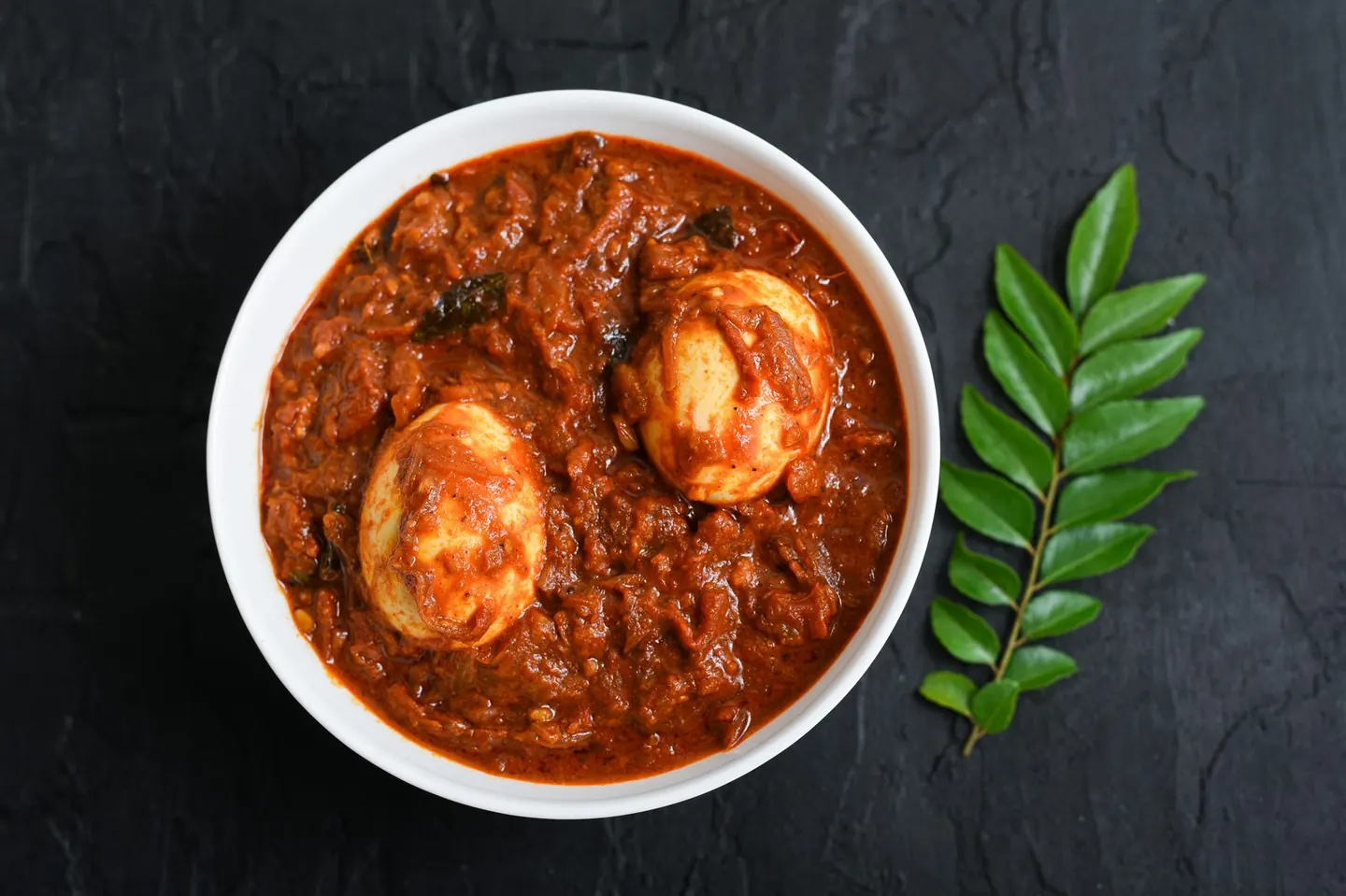
Photograph: Adobe Stock · representative of the dish
Egg roast is the dish that shows what onion reduction can do. A restaurant version is glossy because it is swimming in oil; a good household version is glossy because 500 g of shallots have been cooked down to a fraction of their volume and their sugars have caramelised. The second is better food and better cooking. It is also the fastest protein in this chapter — 16 g a serving, on the table in half an hour — and the natural partner for appam, idiyappam and wheat puttu across Kerala, from Syrian Christian Easter breakfasts to Malabar tea shops.
Before you start: Slice all the shallots before the flame goes on. Five hundred grams takes 12–15 minutes to slice and the pan will not wait. If you have M15 in the freezer, 6 cubes replace steps 1 to 4 and the dish takes 15 minutes.
Allergens: Egg.
Equipment: Wide heavy pan, 26 cm, with a lid. Substitute: any deep frying pan with a lid; a narrow pan steams the shallots instead of reducing them and adds 10 minutes.
| Energy | 240 kcal |
| Protein | 16 g |
| Fibre | 4 g |
| Net carbohydrate | 13 g |
| Total carbohydrate | 17 g |
| Sugars | 13 g |
| Fat | 14 g |
| Saturated fat | 6 g |
| Sodium | 280 mg |
From ICMR-NIN IFCT 2017 and USDA FoodData Central. Per-serving figures stay the same when you scale.
Shallots are not interchangeable with onions here, and this is the dish that proves it: they are sweeter, denser and lower in water, so they reduce to a jam rather than a purée. Look for "Madras onions", "sambar onions", "pearl onions" or small red onions; French shallots are a good second. Where shallots are expensive, use 350 g shallots and 200 g red onion rather than going all-onion, and expect a wetter base that needs 5 minutes longer. Frozen pre-peeled shallots save half the active time and are a legitimate shortcut.
Blood sugar: 13 g of net carbohydrate and 16 g of protein makes this the lowest-glycaemic-load dish in the chapter and the best thing to put beside a large grain portion. Pairing protein and fat with a starch slows the meal; the specific effect for rice has not been measured in a trial this book can cite, so it is offered as a principle rather than a number.
Blood pressure: 280 mg a serving with M07 and about 400 mg with plain salt.
Cholesterol: 6 g of saturated fat a serving, of which about 3.5 g is the eggs and 2 g the coconut oil. Sesame or groundnut oil instead of coconut takes the oil's contribution to about 0.3 g, at some loss of Kerala character in a dish where the oil is genuinely tasteable. Dietary cholesterol from eggs is a separate question from saturated fat and one for your doctor, not for this page.
6 cubes of M15 for steps 1 to 4 → 15 minutes instead of 40, at the cost of the fresher shallot note you get from cooking them down today. The best weeknight version.
Sesame or groundnut oil for coconut oil → saturated fat falls from 6 g to about 4.2 g a serving, and the dish loses a distinctly Kerala aroma. This is one of the dishes where coconut oil genuinely is the flavour, so make the swap deliberately rather than by default. (Allergen: this swap introduces peanuts, sesame.)
Boiled egg whites only, 12 of them → protein rises to about 18 g a serving, fat falls to about 4 g, and the dish loses the yolk's richness, which was carrying the masala. A real trade, not a free one.
400 g mushrooms or 300 g cubed paneer for the eggs → a vegetarian roast on the same base. Mushrooms need the water cooked off hard before the masala goes on. (Allergen: this swap introduces milk.)
At 1 kg of shallots use two pans, or add 10 minutes to steps 2 and 3. Oil does not scale linearly; a wider pan needs proportionally less.
The masala base is better made ahead and keeps fridge 4 days or freezes 3 months without the eggs. Assembled egg roast keeps fridge 2 days. Do not freeze it with the eggs in — boiled egg white turns rubbery and weeps on thawing. Reheat gently with a splash of water, 4–5 minutes, turning the eggs rather than stirring.
Chop the eggs and masala together coarsely and use them as a filling for a rolled dosa or between two pathiris. Cold egg roast on toast is not traditional and is very good.
Sharp and oniony rather than sweet: step 2 was rushed on too high a flame. Nothing fixes it afterwards but longer cooking.
Watery masala that will not coat the eggs: the tomatoes were not cooked down to the oil-rim stage at step 6.
Eggs torn and ragged: stirred rather than turned, or scored too deeply.
Burnt, bitter edge: the powders caught at step 5. Add a splash of water with them next time.
Serve with
R001 Palappam — the Syrian Christian pairing · R005 Idiyappam · R004 Wheat and Coconut Puttu · R011 Cherupayar Curry to complete the plate with a pulse
Tap a star to rate this recipe
The Kindle edition is on its way. Until it lands, the complete book — all 25 chapters and 137 recipes — is free to read here, and it stays free after.