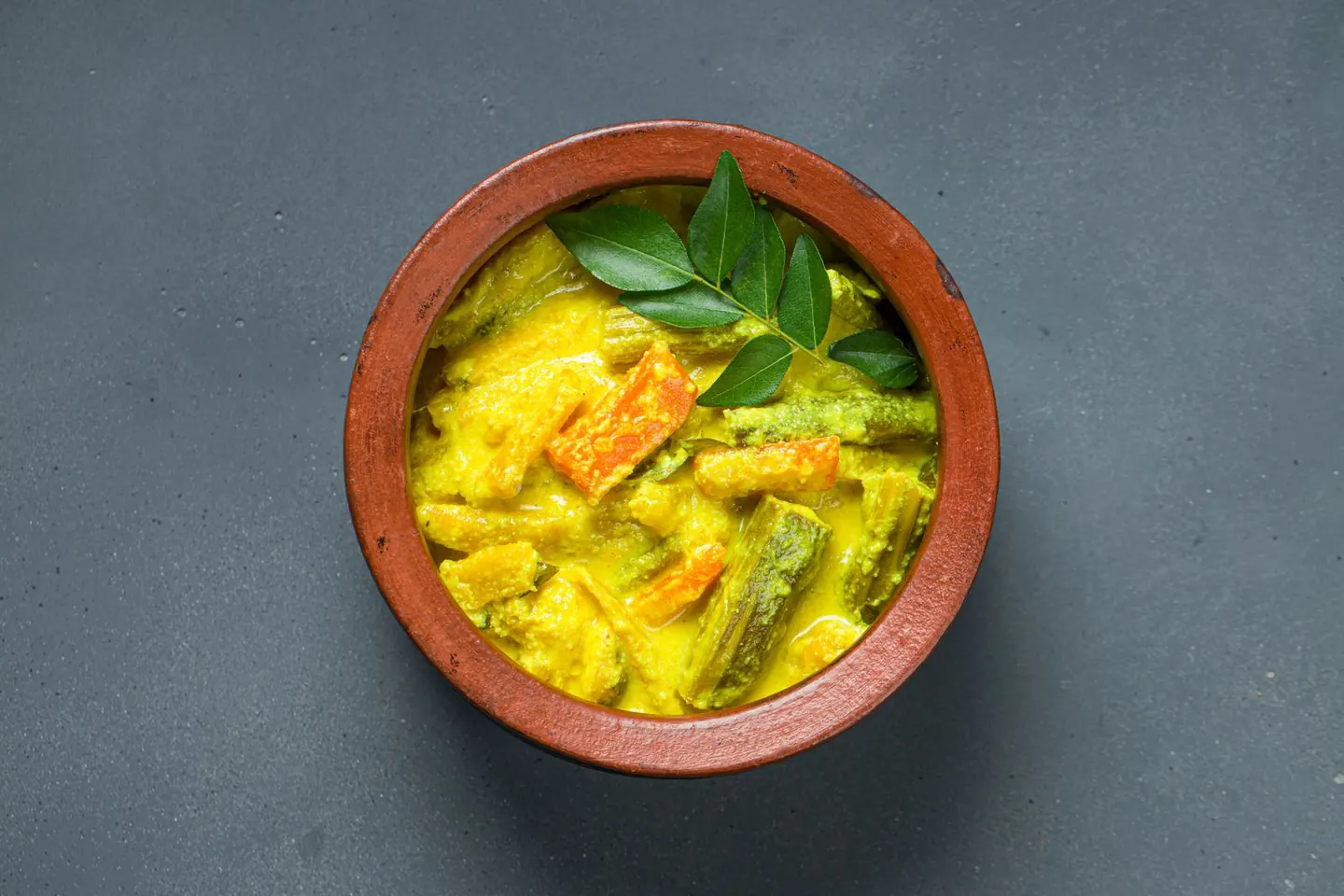
Chapter 21 — Vegetables: The Half of the Plate
Half the plate is the largest single instruction in this book, and it is also the least demanding. It asks you to change proportions, not identity. Nothing in this chapter is a diet dish. Every one of the eighteen recipes here is something a Kerala household already cooks, in the form it already cooks it, with the oil weighed.
The reason half the plate works is a finding about how people eat rather than about what they eat. Across a long series of controlled studies, Barbara Rolls and her colleagues established that people consume a roughly constant weight of food from day to day, and that when the energy density of what is available falls, energy intake falls with it — without anyone being told to eat less. Her summary sentence is worth reading twice: "Since people tend to eat a consistent weight of food, when the ED of the available foods is reduced, energy intake is reduced" (Rolls, 2009). The effect held across weight status, sex and behavioural type, and it held in three-to-five-year-olds. Trials that lowered energy density by adding water-rich foods produced substantial weight loss in people who had never been asked to restrict calories. In Ello-Martin's twelve-month trial, the group told to add fruit and vegetables lost more weight than the group told to restrict portions, while eating about 25% more food and reporting less hunger.
Read that as a design brief and the whole chapter follows. If the eater's stomach is going to be filled by a fixed weight of something, the cook's only real decision is what that weight is made of. Snake gourd is 12 kcal per 100 g. Ash gourd is 17. A cup of white rice is roughly ten times as dense as either. Displacement is the mechanism, and volume is the tool.
Kerala is unusually well equipped for this, and not by accident. A backyard here — a coconut palm, a jackfruit tree, tapioca, a drumstick, koorka and yam in the corner, a curry-leaf bush by the tap — is a vegetable system, and it became close to universal after the 1969 land reforms gave a generation of labourers a house plot. The repertoire that grew on those plots is larger than any other in India, and, more usefully, it is built on cooking vegetables as the main event. A thoran is not a garnish. An avial is not a side salad. An olan is a whole dish whose entire content is ash gourd, cowpea and thin coconut milk. The cuisine already treats a vegetable as something you serve 150 g of, which is exactly the habit a fat-loss plate needs and exactly the habit that Western vegetable cookery, with its handful of steamed broccoli, never built.
Which is why almost nothing here needed rewriting. The traditional forms are already close to right. What has drifted is the fat: a thoran that a grandmother made with two teaspoons of coconut oil is now routinely made with two tablespoons, and an avial that was always finished with raw coconut oil is now cooked in it. Chapter 14's oil table sets out the arithmetic dish by dish. In this chapter it appears as a number in every ingredient list, in grams as well as spoons, and where the traditional version uses substantially more, the recipe says what it usually gets, what this one uses, and what is lost. Sometimes something is lost. You will be told when.
Fibre is the other half of the argument, and here the evidence needs handling carefully. The claim that dietary fibre independently increases satiety is widely made and, at the level of a specific pooled effect size, is one this book will not assert:. What is firmly established is that fibre comes bundled with water and bulk, which is the energy-density mechanism above, and that pulses — the fibre source this book cares most about — do real measurable work. Brown rice with 50 g a day of legumes cut glycaemic response by 22.9% against white rice, where switching the rice and stopping there achieved 19.8% (Mohan et al., 2014). Pulses at about 130 g a day lower LDL cholesterol by 0.17 mmol/L (Ha et al., 2014) and reduce body weight by 0.34 kg even without calorie restriction (Kim et al., 2016). So the vegetables here carry fibre because vegetables do, and several of them carry a pulse on purpose.
Read the table below the way a cook reads a market. Everything above the line can be eaten in volume. Everything below it is a starch wearing a vegetable's clothes, and belongs in the quarter of the plate reserved for the grain.
ENERGY DENSITY OF THE MAIN KERALA VEGETABLES, per 100 g raw
| Vegetable | kcal per 100 g | Fibre g | Available carbohydrate g |
|---|---|---|---|
| Snake gourd / padavalanga | 12 | 2.3 | 1.3 |
| Ash gourd / kumbalanga | 17 | 3.4 | 2.8 |
| Bitter gourd / pavakka | 21 | 3.8 | 2.8 |
| Plantain flower / vazhakkoombu | 21 | 5.3 | 2.2 |
| Raw green papaya | 24 | 2.3 | 4.4 |
| Cabbage (unverified) | 25 | 2.5 | 3.3 |
| Tender green jackfruit / chakka | 26 | 7.7 | 3.5 |
| Okra / vendakka | 27 | 4.1 | 3.6 |
| Drumstick pods / muringakka | 29 | 6.8 | 3.8 |
| Amaranth leaves / cheera | 31 | 4.4 | 2.3 |
| French beans (unverified) | 31 | 2.7 | 4.3 |
| Banana stem / vazhapindi | 39 | 2.1 | 8.6 |
| Cluster beans | 40 | 4.8 | 4.9 |
| Carrot (unverified) | 41 | 2.8 | 6.8 |
| Colocasia leaves | 43 | 5.6 | 3.7 |
| Beetroot (unverified) | 43 | 2.8 | 6.8 |
| Moringa leaves / muringayila | 67 | 8.2 | 5.6 |
| — below this line, portion as starch — | |||
| Green plantain | 80 | 3.6 | 17.6 |
| Tapioca / kappa | 80 | 4.6 | 17.8 |
| Yam, ordinary (and koorka) | 83 | 4.1 | 17.7 |
| Elephant foot yam / chena | 84 | 4.2 | 17.5 |
| Colocasia / chembu | 89 | 3.2 | 17.9 |
Values from ICMR-NIN Indian Food Composition Tables 2017 except where marked. Note the striking flatness of the bottom five: every Kerala starchy tuber lands within 17.5–17.9 g of available carbohydrate and 80–89 kcal per 100 g. Choosing chena over kappa is a flavour decision, not a metabolic one.
The grammar: four ways Kerala cooks a vegetable
Learn these four and you will not need to memorise eighteen recipes. You will be able to look at whatever the shop had and know what to do with it.
Thoran is the dry one, with grated coconut. The vegetable is cut fine, cooked barely — in its own water, under a lid, with no added liquid — and tossed with raw grated coconut crushed with green chilli, shallot and turmeric. It is finished dry, so that the coconut looks like coconut again rather than a wet paste, and the vegetable still has bite. The tempering goes on last, poured over, because the point of it is aroma. R063 is the master pattern; R064 to R067, R076 and R079 are variations on it.
Mezhukkupuratti is the dry one without coconut, and its name is the recipe: mezhukku, oil or wax, plus puratti, smeared. It is the best example in Malayalam of a dish named for its technique rather than its contents, and it is where the oil discipline of this book matters most, because the smear is the whole dish. The vegetable is firm — chena, koorka, okra, raw plantain — usually par-cooked, then finished in a wide pan until it glistens and catches at the edges. The tempering goes first, and the dish is built on top of it.
Upperi is the broadest of the four terms, and the most confusing in English. In everyday household speech it means a dry-cooked vegetable side, roughly interchangeable with mezhukkupuratti and sometimes with thoran; on a sadya leaf it means something else entirely — the deep-fried salted banana chip, with sharkara upperi as its jaggery-glazed cousin. Both meanings are correct. R079 is the household sense. The chips are in Chapter 24, where their oil is stated honestly and not apologised for.
The coconut-gravy family is where a vegetable sits in liquid, and it splits along the single most important technical line in Kerala cooking. Thenga chertha — "with coconut added" — means coconut milk, added as a liquid, giving a pale, silky, fragile gravy: olan (R068), stew (R080). Thenga aracha — "with ground coconut" — means a paste of grated kernel and aromatics cooked in, giving a thick, opaque, clinging one: avial (R069), kalan (R070), erissery (R071), padavalanga curry (R075). And varutharacha, where the coconut is dry-roasted dark before grinding, is a third register rather than a variant: theeyal (R072). Chapter 14 sets out all three, along with the rule that governs the first of them. Thick coconut milk must never boil. Curd must never boil. Learn those two sentences and this chapter will not break on you.
On the numbers in this chapter. Per-serving panels are computed from the per-100 g values in this book's nutrition tables (ICMR-NIN IFCT 2017), divided by the stated servings, and labelled estimated. Energy is 4 kcal per gram of available carbohydrate and of protein and 9 kcal per gram of fat, with dietary fibre excluded, which is the ICMR-NIN convention; net carbohydrate therefore equals available carbohydrate, and the carbohydrate column is available carbohydrate plus fibre. Sodium is to the nearest 10 mg and is computed on plain salt at 400 mg sodium per gram; every recipe made with M07 instead carries roughly 30% less. Saturated fat in coconut is taken as 88.6% of total fat, after USDA FDC 170169.
None of these is tabulated in this book's nutrition tables. Values used here are USDA FoodData Central SR Legacy for the closest documented food; koorka (Chinese potato) is not in either database and is computed throughout as ordinary yam, IFCT F018, which is the closest documented tuber. Sugar figures for all vegetables are USDA stand-ins and should be checked against IFCT 2017 before print:.
On the 70:30 salt. Recipes in this chapter offer M07, the 70% sodium chloride / 30% potassium chloride blend, in place of some or all of the salt, and the Blood pressure notes give the lower sodium figure it produces. Potassium-enriched salt is not for everyone: do not use M07, or any potassium-based salt substitute, without your doctor's approval if you have chronic kidney disease, or if you take a RAAS inhibitor (an ACE inhibitor, names ending -pril, or an angiotensin receptor blocker, names ending -sartan), a potassium-sparing diuretic (spironolactone, eplerenone, amiloride), or a potassium supplement. Read the safety box at M07 in full before you make the jar. Where M07 is not suitable, use ordinary salt at the same weight and take the higher, plain-salt sodium figure, or work with M06 and the acid-and-aroma techniques of Chapter 10 instead. This book does not tell anyone to change or stop a medicine.
R063 · Cabbage Thoran [LOW GL] [VEGAN]
The master thoran: shredded cabbage, crushed coconut, turmeric
ICONS: V · Q · B · L
THE RE-ENGINEERING: Coconut oil cut from 25–30 g to 10 g and moved to the end, where the nose finds it; grated coconut from the usual 100–125 g to 50 g. Nothing else changes, because nothing else needed to.
Learn this one properly and you have learned six. A thoran is not a stir-fry: nothing is fried and no water is added. The cabbage cooks in the moisture it already contains, under a lid, while a coarse crush of coconut, green chilli and shallot waits to go in at the end. Every other thoran in this chapter changes the vegetable and the cutting, and leaves this method alone. Get the two cues right — dry pan at the finish, cabbage still with bite — and it is a ten-minute dish you will make weekly.
Serves 4 · about 120 g per portion Active 15 minutes · Total 25 minutes Difficulty: Easy
EQUIPMENT: Wide heavy pan or cheena chatti, 26 cm, with a lid; chattuvam or flat wooden turner. Substitute: any wide pan and a wooden spatula. Avoid a metal spatula, which bruises and breaks the vegetable and turns a thoran to mush.
BEFORE YOU START: The tempering and the crush both need to be ready before the pan goes on. Crush the coconut mixture first, shred the cabbage second, and keep them in separate bowls within reach.
INGREDIENTS
- 50 g (⅔ cup) freshly grated coconut
- 40 g (about 4) shallots, roughly chopped
- 10 g (2) green chillies, roughly chopped
- 2 g (⅓ tsp) ground turmeric
- 500 g (about 1 small head) cabbage, shredded 3–4 mm
- 2.5 g (scant ½ tsp) salt, or M07
- 10 g (2 tsp) coconut oil
- 2 g (½ tsp) mustard seed
- 2 g (1 sprig) curry leaves
SOURCING NOTE: Any tight green cabbage works, and a Western supermarket white or Savoy cabbage is closer to Kerala cabbage than you would expect. Avoid red cabbage, which bleeds and turns the coconut grey. Frozen grated coconut, thawed, is the right choice outside Kerala and is used in this book without apology; desiccated coconut is not a substitute here, because the dish depends on the coconut still holding water. If desiccated is all you have, use 25 g soaked in 25 ml warm water for 10 minutes, and accept a drier, sweeter result.
ALLERGENS: Mustard.
METHOD
- Crush the coconut, shallots, green chilli and turmeric together — a few pulses in a mixie, or thirty seconds in a mortar. You want a coarse, streaky crumble in which the coconut is still recognisable, not a paste. Over-grinding is the commonest fault in a thoran and it makes the finished dish gluey.
- Heat the dry pan for 1–2 minutes, add the oil, and swirl it to a film. Add the mustard seed and let it finish popping — vigorous, then subsiding, 20–30 seconds. Add the curry leaves and let them crackle 5–10 seconds, until the leaf goes glossy and slightly translucent.
- Add the cabbage all at once with the salt, and toss to coat. It will look like too much for the pan and will collapse by half within two minutes.
- Cover and cook on a medium flame, stirring twice, until the cabbage has wilted and turned a shade deeper green but still resists a fingernail, 5–7 minutes. Do not add water. If nothing is steaming after two minutes, the flame is too low.
- Uncover and check the pan by tilting it. If water runs to the low side, cook uncovered until it has gone, 2–3 minutes.
- Fold in the coconut crush off the direct heat, lifting rather than stirring, and return to a low flame for 2–3 minutes — just long enough for the raw shallot smell to lift and the coconut to warm through and look dry and separate again. The finished thoran should mound on a spoon and leave no liquid on the plate.
WHY THIS WORKS
Cabbage is about 92% water, so a covered pan is a steamer and needs no added liquid. Adding the coconut at the end keeps its fat and its aroma on the surface of the vegetable rather than dissolved into the pan, and the same is true of the oil in the tempering. Two teaspoons met directly by the tongue read as more than four cooked in from the start.
PER SERVING (estimated)
| kcal | kJ | Carb | Fibre | Net carb | Sugars | Protein | Fat | Sat fat | Sodium |
|---|---|---|---|---|---|---|---|---|---|
| 110 | 460 | 11.8 g | 5.0 g | 6.8 g | 5.7 g | 2.6 g | 8.0 g | 6.7 g | 280 mg |
IF YOU ARE WATCHING… Blood sugar: 6.8 g of net carbohydrate for a 120 g serving. This is the dish that makes a smaller rice portion tolerable, because it fills the same volume at a tenth of the density. Serve 150 g of it, not 80 g. Blood pressure: 280 mg of sodium against a 2,000 mg daily target. Made with M07 it falls to about 210 mg, and dropping the salt to 1.5 g takes it near 180 mg without the dish tasting under-seasoned, because the shallot and chilli are doing seasoning work. Cholesterol: 6.7 g of saturated fat is the honest cost of coconut in a thoran, and most of it is the coconut rather than the oil. Halving the coconut to 25 g and making up the volume with an extra 100 g of cabbage brings it to about 3.6 g, at a real cost in mouthfeel.
SWAP IT
- No fresh coconut → 25 g desiccated, soaked as above. The dish becomes drier and sweeter and loses the fresh-coconut aroma that is most of its character.
- Coconut oil → groundnut or sesame oil. Saturated fat per serving drops from 6.7 g to about 4.7 g, and the dish stops tasting like a thoran. This is the one place in the book where coconut oil is the flavour rather than the medium, so make this swap for a weekday and not for a guest. (Allergen: this swap introduces peanuts, sesame.)
- Cabbage → 500 g shredded white or Chinese cabbage, or 400 g grated chayote. Both work; chayote gives more water, so expect an extra 2–3 minutes uncovered.
- Add 100 g cooked vanpayar at step 6 → protein rises about 2 g per serving and the plate gains its pulse. The best single addition to any thoran in this chapter.
SCALE IT
| Serves | Cabbage | Coconut | Shallots | Green chilli | Oil | Salt |
|---|---|---|---|---|---|---|
| 2 | 250 g | 25 g | 20 g | 5 g | 5 g | 1.5 g |
| 4 | 500 g | 50 g | 40 g | 10 g | 10 g | 2.5 g |
| 8 | 1 kg | 100 g | 80 g | 20 g | 18 g | 4 g |
At eight servings, cook in two pans rather than one. A single deep pan steams the cabbage into a wet heap, and no amount of uncovered cooking gets a thoran back once it has stewed.
MAKE AHEAD · STORE · FREEZE Best within an hour of cooking. Fridge 3 days in a covered container. Freeze 1 month — it is safe and it thaws watery, so this is a last resort rather than a plan. Reheat dry in a pan for 3–4 minutes, never in a microwave with a lid on, which steams the coconut back into a paste.
LEFTOVERS Fold cold thoran into a dosa as it sets, or into scrambled egg. Two hundred grams of it turned through 100 g of cooked matta rice with a squeeze of lime is a lunch that needs nothing else except a pulse.
SERVE WITH R015 Matta Rice · R058 Parippu Curry · R024 Meen Vevichathu · R107 Sambharam
TROUBLESHOOTING Wet and heavy: too small a pan, the lid left on too long, or water added. Uncover and cook it dry over a higher flame; you will recover most of it. Gluey, pasty coconut: the crush was ground to a paste. Nothing rescues this batch. Pulse, do not grind, next time. Cabbage grey and sulphurous: overcooked. Cabbage's sulphur compounds develop with time on heat, so the fix is a shorter cook and a higher flame, not a lower one.
NOTES
R064 · Beans Thoran [LOW GL] [VEGAN]
French beans cut fine, with coconut and cumin
ICONS: V · Q · B · L
THE RE-ENGINEERING: Oil at 10 g rather than the usual 25–30 g, coconut at 50 g rather than 100 g, and the beans steamed in their own water instead of being fried soft in oil.
The one thing that decides this dish is the knife. Beans cut into 1 cm lengths take twice as long to cook and never take up the coconut; cut into 3–4 mm rounds, almost a mince, they cook in six minutes and every fragment carries coconut. This is tedious for ten minutes and then it is done, and it is why a good beans thoran tastes different from a bad one made with identical ingredients. Cumin belongs in the crush here, where it does not in a cabbage thoran.
Serves 4 · about 115 g per portion Active 20 minutes · Total 30 minutes Difficulty: Easy
EQUIPMENT: Wide heavy pan, 26 cm, with a lid; chattuvam or wooden turner; a sharp knife you trust. Substitute for the knife work: the pulse button on a food processor, in two batches, which gives an uneven cut and a slightly bruised bean. Acceptable on a weeknight.
BEFORE YOU START: Cut the beans before anything else; everything after that step takes under ten minutes and the pan will not wait for you.
INGREDIENTS
- 450 g (about 3½ cups, cut) French beans, topped, tailed and cut into 3–4 mm rounds
- 50 g (⅔ cup) freshly grated coconut
- 40 g (about 4) shallots, roughly chopped
- 8 g (1–2) green chillies, roughly chopped
- 2 g (½ tsp) cumin seed
- 2 g (⅓ tsp) ground turmeric
- 2.5 g (scant ½ tsp) salt, or M07
- 10 g (2 tsp) coconut oil
- 2 g (½ tsp) mustard seed
- 2 g (1 sprig) curry leaves
SOURCING NOTE: Ordinary supermarket French beans, green beans or haricots verts are all correct for this and need no adjustment. Kerala cooks would often use achinga payar (yard-long beans), which are stringier and cook a minute or two longer; if you find them in an Asian grocer, use them, cut the same way. Frozen sliced green beans work but arrive already soft, so skip step 4's covered cooking entirely and go straight to the coconut. Avoid tinned beans.
ALLERGENS: Mustard.
METHOD
- Crush the coconut, shallots, green chilli, cumin and turmeric to a coarse streaky crumble, not a paste. Four or five pulses.
- Heat the dry pan 1–2 minutes, add the oil, swirl to a film, and pop the mustard seed, 20–30 seconds, until the sound subsides. Add the curry leaves for 5–10 seconds.
- Add the beans and salt and toss for 1 minute, until every piece is coated and glossy.
- Cover and cook on a medium flame, stirring every 2 minutes, until the beans have turned a deeper, brighter green and are tender with a distinct snap left in them, 6–8 minutes. Add 2 tablespoons of water only if the pan sounds dry and the beans are still hard. Beans hold less water than cabbage and this is the one thoran that occasionally needs a splash.
- Uncover and cook off any liquid, 1–2 minutes.
- Fold in the crush, lifting rather than stirring, and cook on a low flame 2–3 minutes, until the raw shallot smell has lifted and the coconut looks dry and separate. Take it off while the beans are still bright.
WHY THIS WORKS
Beans lose their green to two different faults: acid and time. There is no acid in a thoran, so time is the whole game, and a fine cut buys it. Chlorophyll degrades to dull olive pheophytin with prolonged heating, which is why a six-minute bean is emerald and a fifteen-minute bean is khaki. Cumin's earthiness suits the bean's grassiness in a way it does not suit cabbage.
PER SERVING (estimated)
| kcal | kJ | Carb | Fibre | Net carb | Sugars | Protein | Fat | Sat fat | Sodium |
|---|---|---|---|---|---|---|---|---|---|
| 117 | 491 | 12.5 g | 4.9 g | 7.6 g | 5.4 g | 3.1 g | 8.3 g | 6.7 g | 260 mg |
IF YOU ARE WATCHING… Blood sugar: 7.6 g net carbohydrate per serving, and beans bring more protein than most vegetables in this chapter. A generous serving alongside a measured 150 g of cooked rice is the shape of plate this book is built on. Blood pressure: 260 mg sodium, or about 195 mg made with M07. Cholesterol: 6.7 g saturated fat per serving, again mostly from the coconut. The swap that costs least here is to keep the coconut and drop the oil to 5 g, since beans need less help sticking than cabbage does.
SWAP IT
- French beans → cluster beans (kothavara). Firmer, faintly bitter, better; add 3–4 minutes to step 4 and a pinch more salt.
- French beans → 450 g finely diced carrot and beans together, half and half. Sweeter, brighter, sugars rise about 2 g per serving.
- Cumin → fennel seed, 2 g. Sweeter and more aromatic, and it stops tasting like a beans thoran and starts tasting like a Malabar one.
- Add 100 g cooked muthira at step 6 → protein up about 3 g per serving, and the dish becomes a one-bowl half-and-quarter of the plate.
SCALE IT
| Serves | Beans | Coconut | Shallots | Green chilli | Oil | Salt |
|---|---|---|---|---|---|---|
| 2 | 225 g | 25 g | 20 g | 4 g | 5 g | 1.5 g |
| 4 | 450 g | 50 g | 40 g | 8 g | 10 g | 2.5 g |
| 8 | 900 g | 100 g | 80 g | 16 g | 18 g | 4 g |
MAKE AHEAD · STORE · FREEZE The cut beans keep raw in a bag for 2 days, which is the useful make-ahead here. Fridge 3 days cooked. Freeze 1 month, with the same watery-thaw caveat as R063. Reheat dry, 3–4 minutes.
LEFTOVERS Beans thoran is the best of all these for a lunchbox, because it does not weep. Stir it through cooked matta rice with a spoon of M06 and a squeeze of lime, or spread it over an idiyappam and roll it.
SERVE WITH R015 Matta Rice · R059 Sambar · R070 Kalan · R080 Mixed Vegetable Stew
TROUBLESHOOTING Beans khaki and limp: cooked too long, or too low a flame for too long under a lid. Cut finer and cook faster. Beans still squeaky after 10 minutes: they were cut too coarse, or they were old. Add 3 tablespoons of water, cover, and give them 4 more minutes. Coconut browning in the pan: the flame was too high at step 6. The crush wants warming, not toasting.
NOTES
R065 · Cheera Thoran [LOW SODIUM] [HIGH FIBRE] [VEGAN]
Amaranth greens with coconut and crushed garlic
ICONS: V · Q · L
THE RE-ENGINEERING: Oil at 8 g instead of the usual 20–25 g, and the greens cooked uncovered from the start rather than stewed under a lid, which is what turns a bright cheera thoran into a dark wet one.
Cheera is the everyday green of Kerala backyards, and it behaves like no other vegetable in this chapter: 600 g of it becomes about 400 g in four minutes and gives up an alarming amount of water. That water is the whole difficulty. Cook it uncovered, over a flame higher than feels right, and stop while the stems still have some resistance. Garlic goes into this crush where it does not into the others, because amaranth's mineral, slightly metallic note wants it.
Serves 4 · about 100 g per portion Active 20 minutes · Total 25 minutes Difficulty: Easy, with one moment of nerve at step 4
EQUIPMENT: The widest pan you own, 28 cm if possible, no lid needed; chattuvam. Substitute: a wok, which is better than a narrow saucepan. The dish fails in a small pan.
BEFORE YOU START: Wash and dry the greens well ahead — at least 20 minutes in a colander, or spun in a salad spinner. Wet leaves add water the dish cannot afford, and this is the single biggest cause of a soggy cheera thoran.
INGREDIENTS
- 600 g (about 2 large bunches) green amaranth, leaves and tender stems, washed, dried and chopped 1 cm
- 50 g (⅔ cup) freshly grated coconut
- 40 g (about 4) shallots, roughly chopped
- 8 g (1–2) green chillies, roughly chopped
- 5 g (2 cloves) garlic
- 1.5 g (¼ tsp) ground turmeric
- 2 g (½ tsp) salt, or M07
- 8 g (1½ tsp) coconut oil
- 2 g (½ tsp) mustard seed
- 2 g (1 sprig) curry leaves
SOURCING NOTE: Amaranth greens are sold as cheera, thotakura, callaloo, Chinese spinach or simply amaranth in Indian, Caribbean, Chinese and African groceries, and they are one of the easiest Kerala greens to find abroad. Red amaranth works and stains everything pink. Where there is none: 600 g of spinach is the closest common substitute in texture and cooking time, though it is blander and gives even more water, so cook it 2 minutes less; 500 g of chard leaves with the stems chopped separately and started 2 minutes earlier is closer in flavour. Frozen chopped spinach works at 400 g, thawed and squeezed hard.
ALLERGENS: Mustard.
METHOD
- Crush the coconut, shallots, chilli, garlic and turmeric coarsely. Five or six pulses; the garlic should be broken, not puréed.
- Heat the dry pan 1–2 minutes, add the oil, pop the mustard seed 20–30 seconds, then the curry leaves 5–10 seconds.
- Add the greens in two or three handfuls, letting each collapse before the next goes in, with the salt. This takes 2–3 minutes and looks impossible until it suddenly is not.
- Cook uncovered on a flame higher than you would use for any other thoran, stirring and lifting constantly, until the water the leaves release has boiled away and the pan is dry, 4–6 minutes. Do not put a lid on. If the pan floods, tip the liquid off rather than waiting for it to evaporate — it will overcook the leaf.
- Fold in the crush and cook 2 minutes on a low flame, until the garlic smell has turned sweet. The greens should still be a clear deep green and the stems should give a faint resistance.
WHY THIS WORKS
Amaranth carries 4.4 g of fibre and 2.3 g of available carbohydrate per 100 g at 31 kcal, so 150 g of it fills a third of the plate for under 50 kcal before the coconut. Cooking uncovered matters because leaf cells rupture and dump water within the first two minutes; a lid returns that water as condensate and the leaf then simmers in it, which is what makes cheera thoran taste dull.
PER SERVING (estimated)
| kcal | kJ | Carb | Fibre | Net carb | Sugars | Protein | Fat | Sat fat | Sodium |
|---|---|---|---|---|---|---|---|---|---|
| 125 | 522 | 14.9 g | 8.5 g | 6.4 g | 2.5 g | 6.0 g | 8.4 g | 6.5 g | 230 mg |
IF YOU ARE WATCHING… Blood sugar: 6.4 g net carbohydrate and 8.5 g fibre per serving, which is the best fibre-to-carbohydrate ratio of any thoran here. Blood pressure: 230 mg sodium, or about 175 mg with M07. Amaranth is naturally potassium-rich, though this book does not publish a figure for it:. Cholesterol: 6.5 g saturated fat, essentially all of it coconut. At 25 g of coconut instead of 50 g the dish is still good — greens carry coconut better than any other vegetable — and saturated fat halves.
SWAP IT
- Amaranth → spinach, chard, colocasia leaves or moringa leaves. See the sourcing note for timings. Colocasia leaves must be cooked through, never briefly, and are not a beginner's green.
- Garlic → 20 g extra shallot. Milder and more sadya-appropriate, since temple and formal cooking excludes garlic; household cooking often does not.
- Add 100 g cooked cherupayar at step 5 → the classic cheera payar thoran. Protein rises about 2.5 g per serving and it becomes a meal rather than a side.
- Add 40 g grated carrot with the greens → colour and sweetness, sugars up about 1 g.
SCALE IT
| Serves | Amaranth | Coconut | Shallots | Garlic | Oil | Salt |
|---|---|---|---|---|---|---|
| 2 | 300 g | 25 g | 20 g | 3 g | 4 g | 1 g |
| 4 | 600 g | 50 g | 40 g | 5 g | 8 g | 2 g |
| 8 | 1.2 kg | 100 g | 80 g | 10 g | 15 g | 3.5 g |
Above four servings, cook in two batches without exception. Greens cannot be cooked dry in a crowded pan.
MAKE AHEAD · STORE · FREEZE Eat the day it is made. Fridge 2 days, and it darkens visibly by the second. Do not freeze — thawed amaranth is a wet grey purée. Reheat in a dry pan 2–3 minutes.
LEFTOVERS Cold cheera thoran folded into dosa batter makes an excellent green dosa. Or blend a cupful into a dal (R060) as body and colour.
SERVE WITH R015 Matta Rice · R055 Kadala Ularthiyathu · R081 Moru Curry · R024 Meen Vevichathu
TROUBLESHOOTING Dark, wet and sour: a lid was used, or the pan was too small. Neither is recoverable; the flavour has already gone. Bitter or astringent: the stems were too thick and woody. Use the top third of the stem only, and compost the rest. Gritty: amaranth grows low and holds soil in the leaf axils. Wash in three changes of water, lifting the leaves out rather than pouring the water off.
NOTES
R066 · Muringayila Thoran [LOW SODIUM] [HIGH FIBRE] [VEGAN]
Moringa leaves, stripped from the stalk, with coconut
ICONS: V · Q · L
THE RE-ENGINEERING: Oil at 8 g rather than the usual 20 g. The recipe is otherwise the traditional one, because a leaf that cooks in four minutes has never needed much fat.
Moringa leaves are the most nutrient-dense green in the Kerala repertoire on a per-100 g basis: 6.4 g of protein, 8.2 g of fibre and 5.6 g of available carbohydrate at 67 kcal (ICMR-NIN, 2017), which makes them the highest-protein green in the tables. That is a compositional fact and this book makes no health claim of any kind for them; the meta-analysis of moringa supplementation found no consistent cardiometabolic effect at very low certainty (Crișan et al., 2025). Eat them because they are excellent and because stripping them is a quiet job worth doing.
Serves 4 · about 85 g per portion Active 25 minutes (20 of it stripping leaves) · Total 30 minutes Difficulty: Easy, but the stripping is the whole task
EQUIPMENT: Wide pan, 26 cm, with a lid; chattuvam; a large bowl for stripping. Substitute: none needed. This dish requires nothing you do not own.
BEFORE YOU START: Strip the leaves from the stalks before you do anything else, and do it sitting down with a bowl in your lap, which is how it is done at home. Three hundred grams of stripped leaf takes about twenty minutes and is roughly two large bunches with the stalks on.
INGREDIENTS
- 300 g (about 6 packed cups) moringa leaves, stripped from the stalks
- 50 g (⅔ cup) freshly grated coconut
- 30 g (about 3) shallots, roughly chopped
- 8 g (1–2) green chillies, roughly chopped
- 1.5 g (¼ tsp) ground turmeric
- 2 g (½ tsp) salt, or M07
- 8 g (1½ tsp) coconut oil
- 2 g (½ tsp) mustard seed
- 2 g (1 sprig) curry leaves
SOURCING NOTE: Fresh moringa leaves are the hard one for a diaspora reader. Indian and Sri Lankan groceries in the UK, Gulf and Singapore stock them in bunches seasonally; in North America they are rarer and are most often found frozen, in 340 g bags, which work well here and need no thawing beyond breaking the block up in the pan. Do not use moringa powder, which is a different product entirely and tastes of hay in a cooked dish. Where there is nothing: 300 g of watercress gives a comparable faint bitterness and cooks in the same time; 400 g of spinach is blander but structurally right. Say which you used, if you are the kind of cook who writes in the margins.
ALLERGENS: Mustard.
METHOD
- Strip the leaves, discarding stalk and any thick petiole. A leaflet that bends is fine; a stem that snaps is woody and stays woody.
- Crush the coconut, shallots, chilli and turmeric to a coarse crumble.
- Heat the dry pan 1–2 minutes, add the oil, pop the mustard 20–30 seconds, then the curry leaves 5–10 seconds.
- Add the leaves with the salt and toss for 1 minute. They collapse much less than amaranth and give up much less water.
- Cover and cook on a medium flame, stirring twice, until the leaves are tender and have turned a deep, slightly grey-green and lost their raw pea-pod smell, 4–6 minutes. Uncover for the last minute if there is liquid.
- Fold in the crush and cook 2 minutes on a low flame, until the shallot has lost its rawness. Moringa is mildly bitter and that bitterness is the point of the dish; do not try to cook it away.
WHY THIS WORKS
Moringa leaves cook fast because they are small and thin, and they carry enough of their own protein and fibre that the coconut is flavour rather than structure. The mild bitterness comes largely from glucosinolates, the same family that gives mustard and cabbage their character, and heat plus fat both mute it, which is exactly what the tempering and the coconut are for.
PER SERVING (estimated)
| kcal | kJ | Carb | Fibre | Net carb | Sugars | Protein | Fat | Sat fat | Sodium |
|---|---|---|---|---|---|---|---|---|---|
| 126 | 528 | 14.4 g | 7.9 g | 6.5 g | 2.3 g | 5.7 g | 8.6 g | 6.5 g | 210 mg |
IF YOU ARE WATCHING… Blood sugar: 6.5 g net carbohydrate and 7.9 g fibre. Moringa leaves are a genuinely useful food for a plate that has to be low in carbohydrate and high in volume, and no claim beyond that is supportable. Blood pressure: 210 mg sodium, or about 160 mg with M07. Cholesterol: 6.5 g saturated fat, from the coconut. This dish tolerates a coconut reduction well because the leaf has its own body: at 25 g of coconut it is still recognisable.
SWAP IT
- Fresh leaves → frozen, 340 g, straight from the freezer. Add 2 minutes at step 5. The only loss is a little of the fresh green aroma.
- Moringa → drumstick pods (muringakka), 400 g cut into 5 cm lengths. A completely different dish, cooked 10–12 minutes, and the pods are eaten by drawing the flesh out with your teeth.
- Add 2 g crushed garlic to the crush → rounder and less bitter.
- Add 100 g cooked vanpayar → protein to about 8 g per serving, which is unusual for a vegetable dish and makes this a plate-completing side.
SCALE IT
| Serves | Moringa leaves | Coconut | Shallots | Oil | Salt |
|---|---|---|---|---|---|
| 2 | 150 g | 25 g | 15 g | 4 g | 1 g |
| 4 | 300 g | 50 g | 30 g | 8 g | 2 g |
| 8 | 600 g | 100 g | 60 g | 15 g | 3.5 g |
MAKE AHEAD · STORE · FREEZE Strip the leaves up to 2 days ahead and keep them in a bag in the fridge; this is the make-ahead that matters. Fridge 3 days cooked, and it holds better than cheera. Freeze 1 month, acceptably. Reheat dry, 2–3 minutes.
LEFTOVERS Stir into a kanji in the last two minutes, or into an omelette. Moringa thoran and a boiled egg is a breakfast this book endorses.
SERVE WITH R015 Matta Rice · R058 Parippu Curry · R073 Chena Mezhukkupuratti · R107 Sambharam
TROUBLESHOOTING Stalky and unpleasant to eat: petioles got in. Strip more carefully; there is no fix in the pan. Very bitter: older leaves, or leaves from a tree in dry season. Add 5 g of grated coconut more and 1 g of jaggery, which will round it without sweetening the dish. Dry and dusty: overcooked, or too little coconut for the volume of leaf. Moringa needs slightly more coconut per gram than cabbage does.
NOTES
R067 · Beetroot Thoran [VEGAN] [UNDER 250 KCAL]
Grated beetroot, coconut, and the sweetest of the thorans
ICONS: V · Q · B · F · L
THE RE-ENGINEERING: Oil at 10 g rather than 25 g, and no sugar. Beetroot thoran is often sweetened; at 6.8 g of natural sugar per 100 g the vegetable has already done that work, and added jaggery pushes a mild side dish towards a dessert.
Beetroot is not an old Kerala vegetable, and a beetroot thoran carries none of the sadya's authority. It is a twentieth-century household dish, and it is included here for two practical reasons: children eat it, and it is the one thoran that is genuinely good cold the next day. It is also the sweetest thing in this chapter, which matters — it has roughly one and a half times the available carbohydrate of cabbage, so it is a vegetable to enjoy rather than one to eat in unlimited volume.
Serves 4 · about 115 g per portion Active 20 minutes · Total 30 minutes Difficulty: Easy
EQUIPMENT: Wide pan, 26 cm, with a lid; coarse grater or the grating disc of a food processor. Substitute: dice by hand at 5 mm, which takes longer and gives a firmer, less cohesive dish that some households prefer.
BEFORE YOU START: Beetroot stains. Grate it onto a plate rather than a wooden board, and rub your hands with a cut lime afterwards.
INGREDIENTS
- 450 g (about 3 medium) beetroot, peeled and coarsely grated
- 50 g (⅔ cup) freshly grated coconut
- 40 g (about 4) shallots, roughly chopped
- 8 g (1–2) green chillies, roughly chopped
- 1.5 g (¼ tsp) ground turmeric
- 2 g (½ tsp) salt, or M07
- 10 g (2 tsp) coconut oil
- 2 g (½ tsp) mustard seed
- 2 g (1 sprig) curry leaves
SOURCING NOTE: Beetroot is one Kerala vegetable a Western supermarket stocks better than a Kerala market does. Buy raw beetroot, not the cooked vacuum-packed kind and never the kind in vinegar, which is unusable here. Pre-grated raw beetroot in a bag is fine and saves ten minutes. Golden beetroot works and looks entirely wrong, which is not a reason to avoid it.
ALLERGENS: Mustard.
METHOD
- Crush the coconut, shallots, chilli and turmeric to a coarse crumble.
- Heat the dry pan 1–2 minutes, add the oil, pop the mustard 20–30 seconds, then the curry leaves 5–10 seconds.
- Add the grated beetroot and salt, and toss for 1–2 minutes until it darkens and glistens.
- Cover and cook on a low to medium flame, stirring every 3 minutes, until the beetroot is tender to the bite with no chalkiness at the centre of a shred, 10–14 minutes. It gives up little water, so add 3 tablespoons and re-cover if the pan sounds dry before it is done. Beetroot is the one thoran in this chapter that genuinely needs a little water.
- Uncover and cook off any remaining liquid, 2–3 minutes.
- Fold in the crush and cook 2 minutes on a low flame. The colour will go from crimson to a deeper purple-red as the coconut takes up the juice, which is correct.
WHY THIS WORKS
Beetroot's sweetness is sucrose in a dense root, and dense roots need conducted heat and time rather than steam. Grating solves this by shortening the distance heat has to travel, which is why a grated beetroot thoran takes twelve minutes and a diced one takes twenty-five. The coconut absorbs the pigment and the sugar, which is why this dish tastes better after an hour.
PER SERVING (estimated)
| kcal | kJ | Carb | Fibre | Net carb | Sugars | Protein | Fat | Sat fat | Sodium |
|---|---|---|---|---|---|---|---|---|---|
| 125 | 521 | 15.2 g | 5.0 g | 10.2 g | 9.4 g | 2.8 g | 8.1 g | 6.7 g | 290 mg |
IF YOU ARE WATCHING… Blood sugar: 10.2 g net carbohydrate and 9.4 g of it sugars — the highest in this chapter's vegetable dishes, and worth knowing. This is not a reason to avoid beetroot; it is a reason to serve 100 g of it rather than 200 g, and to put a cabbage or okra dish next to it rather than another sweet root. Blood pressure: 290 mg sodium, of which about 90 mg is the beetroot's own. With M07 it falls to about 215 mg. Cholesterol: 6.7 g saturated fat per serving from the coconut and oil.
SWAP IT
- Beetroot → 450 g grated carrot. Slightly lower in sugar, much lighter in colour, cooks 4 minutes faster.
- Beetroot → half beetroot, half cabbage. Sugars fall to about 6 g per serving and the dish keeps most of its colour. The best version if you are watching carbohydrate closely.
- Add 30 g roasted peanuts, crushed, at the end → texture, 1.5 g protein and about 20 kcal per serving. A Tamil-inflected addition rather than a Kerala one, and good. (Allergen: this swap introduces peanuts.)
SCALE IT
| Serves | Beetroot | Coconut | Shallots | Oil | Salt |
|---|---|---|---|---|---|
| 2 | 225 g | 25 g | 20 g | 5 g | 1 g |
| 4 | 450 g | 50 g | 40 g | 10 g | 2 g |
| 8 | 900 g | 100 g | 80 g | 18 g | 3.5 g |
MAKE AHEAD · STORE · FREEZE The best make-ahead thoran in the chapter, and better on day two. Fridge 4 days. Freeze 2 months, and it thaws better than any other thoran here because beetroot's cell structure holds up. Reheat dry 3–4 minutes, or eat it cold.
LEFTOVERS Cold beetroot thoran with curd and a pinch of M06 is essentially a pachadi. It also goes into a wrap or a sandwich better than any other dish in this book.
SERVE WITH R015 Matta Rice · R059 Sambar · R074 Vendakka Mezhukkupuratti · R081 Moru Curry
TROUBLESHOOTING Still chalky after 15 minutes: old beetroot, or grated too coarse. Add 4 tablespoons water, cover, 5 more minutes. Tastes flat and earthy: beetroot needs more acid than other thorans. A teaspoon of lime juice off the heat fixes it, and geosmin, the earthy compound, is the reason. Everything is pink: expected. The chopping board will recover; the wooden spoon may not.
NOTES
R068 · Kumbalanga Olan [LOW GL] [LOW SODIUM] [VEGAN]
Ash gourd and cowpea in thin coconut milk, finished with raw oil
ICONS: V · P · L
THE RE-ENGINEERING: Nothing is taken out. The coconut milk is graded rather than tinned, so that most of the liquid is second milk and only 100 ml is first milk, added off the heat; and the finishing coconut oil is 5 g, measured, poured raw at the table end of the cooking rather than stirred in hot.
This is the quiet star of the whole book. Olan has no spice beyond green chilli, no acid, no onion, no garlic, no tempering and no browning of anything: ash gourd at 17 kcal per 100 g, cowpea, thin coconut milk and a few curry leaves. The Namboothiri scheme calls it the neutral curry of the four, and one source calls it the sadya's soul. It is also, at 163 kcal for a 190 g serving with a pulse in it, close to the ideal shape of a dish for the reader of this book. Restraint is the technique.
Serves 4 · about 190 g per portion Active 20 minutes · Total 45 minutes (plus overnight soaking for the cowpea — required) Difficulty: Easy, with one rule that cannot be broken
EQUIPMENT: Wide shallow pan or uruli, 24 cm, with a lid. Substitute: any wide pan. A deep saucepan works less well because olan should be a single layer of vegetable in a little liquid, not a stew.
BEFORE YOU START: The cowpea must be soaked overnight and cooked before the ash gourd goes anywhere near the pan, because ash gourd takes eight minutes and cowpea takes forty. Cook it the day before if that suits you better; it keeps three days.
INGREDIENTS
- 40 g (3 tbsp) brown cowpea (vanpayar), soaked overnight, then simmered until tender — about 100 g cooked
- 500 g (about ½ small gourd) ash gourd, peeled, seeded and cut into 4 cm × 1 cm slices
- 12 g (2–3) green chillies, slit lengthwise
- 2 g (1 sprig) curry leaves
- 2.5 g (scant ½ tsp) salt, or M07
- 200 ml second coconut milk (randaam paal, M08)
- 100 ml first coconut milk (onnaam paal, M08)
- 5 g (1 tsp) coconut oil, raw, to finish
SOURCING NOTE: Ash gourd — winter melon, white gourd, petha, dong gua — is stocked by every Chinese and most Indian groceries, usually sold as a wedge cut from a very large gourd, and it keeps a week wrapped in the fridge. It is the single most useful vegetable in this chapter for a diaspora reader to learn to buy. Where there is none: a wedge of chayote is the closest in texture and needs 2 minutes longer; courgette is the easiest substitute and the weakest, since it collapses and gives up too much water, so cut it thicker and cook it 3 minutes only; and a peeled, seeded wedge of honeydew-firm cucumber is a genuine emergency version used in some Kerala households in the dry months. Cowpea is sold as vanpayar, red cowpea or black-eyed-pea's brown cousin; a tin of drained black-eyed peas, 150 g, is an honest substitute and costs you the cooking liquid's flavour.
ALLERGENS: None of the major allergens.
METHOD
- Cook the soaked cowpea in unsalted water until it is tender but the skins are unbroken, 30–40 minutes, and drain it, keeping 100 ml of the cooking water. Salt at this stage toughens the skins.
- Put the ash gourd, green chilli, salt and the reserved 100 ml of cowpea water in the pan with the 200 ml of second milk. The liquid should come about halfway up the vegetable, no more.
- Simmer covered on a medium flame until the ash gourd has turned from opaque white to faintly translucent and a piece yields to the edge of a spoon without falling apart, 8–12 minutes. Test at 8 minutes and keep testing. Overcooked ash gourd goes to threads and there is no way back.
- Add the cooked cowpea and warm through, 2 minutes.
- Take the pan off the heat. Pour in the first milk, add the curry leaves, and swirl the pan — do not stir. Let it stand 1–2 minutes, until warmed through. The first milk must not boil. If a single bubble breaks the surface you have gone too far.
- Finish with the 5 g of raw coconut oil, poured over, and swirl once more. Serve within twenty minutes; olan is not a dish that improves on waiting.
WHY THIS WORKS
Coconut milk is an oil-in-water emulsion held together by coconut proteins at the surface of each fat droplet. Boiling denatures those proteins and the fat separates irreversibly into oil and grainy curds. Adding the first milk off the heat keeps the emulsion whole, and an intact emulsion coats the tongue: 100 ml added properly reads richer than 200 ml boiled.
PER SERVING (estimated)
| kcal | kJ | Carb | Fibre | Net carb | Sugars | Protein | Fat | Sat fat | Sodium |
|---|---|---|---|---|---|---|---|---|---|
| 163 | 681 | 17.1 g | 6.4 g | 10.7 g | 4.2 g | 4.1 g | 11.5 g | 9.9 g | 270 mg |
IF YOU ARE WATCHING… Blood sugar: 10.7 g net carbohydrate, most of it from the cowpea rather than the gourd, and the cowpea is the reason to eat it. This is the dish that puts a pulse on the plate without anyone noticing it is there. Blood pressure: 270 mg sodium, or about 200 mg with M07. Olan takes very little salt well, because there is nothing competing with it. Cholesterol: 9.9 g saturated fat per serving is the highest-but-one in this chapter, and it is all coconut. Two honest options: drop the first milk to 60 ml and add 40 ml more second milk, which takes saturated fat to about 7 g and thins the finish slightly; or keep it as written and treat olan as the coconut dish of that meal rather than one of two.
SWAP IT
- Ash gourd → pumpkin (mathanga), 500 g. Traditional, sweeter, and a different dish; sugars rise about 2 g per serving and it cooks 2 minutes longer.
- Cowpea → 150 g cooked butter beans or 150 g drained tinned black-eyed peas. Softer, milder, and the skins do not hold their shape as well.
- Fresh coconut milk → tinned, 100 ml undiluted as first milk and 200 ml at 1:1.5 with water as second. The flavour is flatter and faintly cooked, and you lose the thengaappu.
- No coconut at all → 40 g cashews blended with 250 ml water. Less saturated fat, more monounsaturated, and a sweeter, nuttier dish that is no longer an olan. (Allergen: this swap introduces tree nuts (cashew).)
SCALE IT
| Serves | Ash gourd | Cowpea (dry) | Second milk | First milk | Oil | Salt |
|---|---|---|---|---|---|---|
| 2 | 250 g | 20 g | 100 ml | 50 ml | 3 g | 1.5 g |
| 4 | 500 g | 40 g | 200 ml | 100 ml | 5 g | 2.5 g |
| 8 | 1 kg | 80 g | 400 ml | 180 ml | 8 g | 4 g |
Note that the first milk does not scale linearly. A larger pan holds heat longer, so eight servings need proportionally less and want the pan off the heat a full minute before the milk goes in.
MAKE AHEAD · STORE · FREEZE Cook the cowpea up to 3 days ahead; that is the only useful make-ahead. Fridge 2 days, and it will look slightly separated cold, which stirs back. Do not freeze — the emulsion breaks on thawing and cannot be brought back. Reheat on the lowest flame to just steaming, never at a simmer.
LEFTOVERS Blend cold olan smooth with 100 ml of water and warm it gently: it becomes a soup that would not embarrass a restaurant. Or spoon it over kanji.
SERVE WITH R015 Matta Rice · R063 Cabbage Thoran · R069 Avial · R024 Meen Vevichathu
TROUBLESHOOTING Oily film on top with grainy white curds beneath: the first milk boiled. There is no repair. Next time, off the heat, swirl not stir. Ash gourd in threads: overcooked by three or four minutes. Cut thicker next time and start testing at 8 minutes. Tastes of nothing: olan is meant to be quiet, but not silent. It needs the green chilli slit rather than whole, the salt correct, and the raw oil at the end. Skipping that final teaspoon is what makes people think they dislike olan.
NOTES
R069 · Avial [HIGH FIBRE] [VEGETARIAN] [UNDER 250 KCAL]
Mixed vegetables in coarse coconut-cumin paste, finished with raw coconut oil
ICONS: V · B · L
THE RE-ENGINEERING: The coconut oil goes in raw at the end, all 10 g of it, which is how avial was always finished before the habit of cooking in 25–30 g crept in. The coconut paste stays as it is, because the paste is the dish.
By legend, avial was invented by Bhima during the Pandavas' thirteenth year of exile, when he cooked in King Virata's kitchen under the name Vallala — in one telling to satisfy the sage Durvasa, in another after the Nagas revived him and he came back ravenous. Other stories credit Sakthan Thampuran of Cochin, or the Travancore Dewan Ramayyan Dalawa. This is legend, not history: avial has more origin stories than it has ingredients, which is usually a sign that nobody knows. What is genuinely notable is that mixing many vegetables in one pot ran against classical convention, which is probably why the dish needed a story at all.
Serves 6 · about 170 g per portion Active 30 minutes · Total 45 minutes Difficulty: Moderate — not for the technique but for the cutting and the staggered timings
EQUIPMENT: Wide heavy pan or uruli, 26 cm, with a lid; mixie or ammikkallu for the paste; chattuvam. Substitute: a wide saucepan and a small food processor. The paste can be made in a mortar, which gives a better texture and takes ten minutes.
BEFORE YOU START: Avial is a dish of staggered timings, so cut every vegetable before you light the flame and keep them in three separate piles: slow (chena, plantain), medium (carrot, drumstick), fast (ash gourd, snake gourd). Grind the paste before you start cooking. Once the pan is on there is no time.
INGREDIENTS
- 150 g (about ½ medium) elephant foot yam (chena), peeled and cut into 5 cm × 1 cm batons
- 150 g (about 1) green plantain, peeled and cut into 5 cm × 1 cm batons
- 130 g (about 2) carrots, cut into 5 cm × 1 cm batons
- 120 g (about 2) drumstick pods, cut into 6 cm lengths
- 150 g (a 15 cm length) snake gourd, seeded and cut into 5 cm × 1 cm batons
- 200 g (about 1½ cups, cut) ash gourd, peeled, seeded and cut into 5 cm × 1 cm batons
- 3.5 g (⅔ tsp) salt, or M07
- 2 g (⅓ tsp) ground turmeric
- 100 g (1⅓ cups) freshly grated coconut
- 15 g (3) green chillies
- 3 g (¾ tsp) cumin seed
- 30 g (about 3) shallots
- 100 g (about 6 tbsp) thick sour curd, whisked smooth
- 10 g (2 tsp) coconut oil, raw, to finish
- 3 g (2 sprigs) curry leaves
SOURCING NOTE: The traditional list runs to nine or ten vegetables and no household has all of them; what matters is the shape — batons of roughly equal size, a mix of firm and soft, and something faintly bitter. Outside Kerala, build it from what exists: potato or sweet potato for chena, green banana for plantain, chayote or courgette for snake gourd, winter melon for ash gourd, French beans and carrot for structure, and skip the drumstick rather than substituting it, since nothing else behaves like it. Frozen cut drumstick is sold in Indian groceries and is entirely adequate. If you cannot get sour curd, use plain whole-milk yoghurt left out of the fridge for 4–6 hours, or add 15 g of raw mango, which is the older souring agent for this dish and arguably the better one.
ALLERGENS: Milk.
METHOD
- Grind the coconut, green chilli, cumin and shallots to a coarse paste with 3 tablespoons of water, in short pulses. It must stay grainy — you should feel individual coconut particles between finger and thumb. A smooth paste makes a gluey avial and is the fault that ruins this dish most often.
- Put the chena and plantain in the pan with the turmeric, salt and 150 ml water. Cover and simmer 6–8 minutes, until a baton yields at the edge but is still firm at the centre.
- Add the carrot and drumstick and cook covered 4–5 minutes.
- Add the snake gourd and ash gourd and cook covered until everything is tender but every piece still holds its shape as a baton, 4–6 minutes. The pan should be almost dry: tilt it, and no more than a spoonful of liquid should run.
- Fold in the coconut paste, lifting with the chattuvam rather than stirring, and cook on a low flame 3–4 minutes, until the raw shallot smell lifts and the paste coats the vegetables in a thick opaque layer.
- Take the pan off the heat. Fold in the whisked curd. It must not boil or it will split.
- Finish with the raw coconut oil and the curry leaves, crushed between your palms as they go in. Cover and let it stand 5 minutes before serving. That five minutes is not optional: it is when the raw oil and the curry leaf perfume the whole dish.
WHY THIS WORKS
Avial is thenga aracha at its purest: the body comes from ground coconut, a suspension of insoluble particles that hold water, not from an emulsion. That is why avial reheats without splitting where olan does not, and why the paste must stay coarse — smooth particles pack together and turn a coating into a paste. The raw oil at the end delivers aroma the tongue meets directly, which is why 10 g reads like 25 g.
PER SERVING (estimated)
| kcal | kJ | Carb | Fibre | Net carb | Sugars | Protein | Fat | Sat fat | Sodium |
|---|---|---|---|---|---|---|---|---|---|
| 162 | 677 | 23.0 g | 7.7 g | 15.3 g | 4.9 g | 3.7 g | 9.5 g | 7.9 g | 280 mg |
IF YOU ARE WATCHING… Blood sugar: 15.3 g net carbohydrate per serving, and this is the one thing to understand about avial. The chena and the green plantain are starches, not vegetables — 17.5 g of available carbohydrate per 100 g each. So avial straddles two parts of the plate. Serve it as half your vegetables and count it towards a slightly smaller rice portion, or leave the plantain out entirely and net carbohydrate falls to about 11 g. Blood pressure: 280 mg sodium, or about 210 mg with M07. Cholesterol: 7.9 g saturated fat per serving, from 100 g of coconut across six people plus the finishing oil.
SWAP IT
- Sour curd → 15 g raw green mango, added at step 3. The older version, sharper and cleaner, and it takes the dish from vegetarian to vegan.
- Drumstick → nothing. Leave it out rather than substituting; no other vegetable contributes that resinous note.
- Chena and plantain → 300 g of ash gourd, snake gourd and beans instead. Net carbohydrate falls to about 8 g per serving and the dish loses its substance and its sadya character. Worth doing for a rice-heavy meal, not for a feast.
- Fewer vegetables → four is a perfectly good avial. Three is a mixed vegetable curry with ambitions.
SCALE IT
| Serves | Total vegetables | Coconut | Green chilli | Cumin | Curd | Oil | Salt |
|---|---|---|---|---|---|---|---|
| 4 | 600 g | 70 g | 10 g | 2 g | 70 g | 7 g | 2.5 g |
| 6 | 900 g | 100 g | 15 g | 3 g | 100 g | 10 g | 3.5 g |
| 12 | 1.8 kg | 200 g | 30 g | 6 g | 200 g | 18 g | 6 g |
For twelve, cook in two pans. An avial for twelve in one vessel steams rather than simmers, and the bottom layer disintegrates before the top layer is done.
MAKE AHEAD · STORE · FREEZE Cut the vegetables and grind the paste up to 1 day ahead, kept separately in the fridge. Fridge 3 days, and unusually for a curd dish it holds well. Freeze 1 month — safe, but the batons soften and the curd goes slightly grainy on thawing. Reheat on a low flame to just steaming, or eat it at room temperature, which is how it is eaten on a leaf.
LEFTOVERS Avial is the best leftover in the chapter. Mash it roughly with a fork, add a beaten egg and 20 g of rice flour, and shallow-fry as small cakes in 5 g of oil. Or thin it with 200 ml of second coconut milk into a vegetable curry for appam.
SERVE WITH R015 Matta Rice · R059 Sambar · R068 Kumbalanga Olan · R107 Sambharam
TROUBLESHOOTING Mushy, indistinct, one texture: the vegetables went in together. The staggering in steps 2 to 4 is the entire craft of this dish. Gluey: the paste was ground smooth. Pulse it next time and stop while it is still grainy. Split and watery: the curd boiled. Off the heat, always. Bland: not enough green chilli, or the raw oil and curry leaf were skipped, or it was served immediately instead of standing five minutes.
NOTES
R070 · Kalan [LOW SODIUM] [VEGETARIAN]
Yam and green plantain in thick soured curd with coconut and a great deal of pepper
ICONS: V · B · L
THE RE-ENGINEERING: Coconut oil at 8 g rather than the 25 g a traditional kalan is often built with, and the coconut paste at 90 g for six. The pepper is left at full strength, because pepper is what a kalan is, and because heat and aroma are how a dish with less fat still tastes finished.
Kalan is the sour one of the sadya's four ceremonial curries, and the one designed to keep: cooked down until it is thick enough to hold the mark of a spoon, it will sit for days without a fridge, which is why it was made in quantity before a feast. It carries more black pepper than any other vegetable dish in Kerala. The rule that governs it is the same one that governs olan, with a different protein: curd splits at a lower temperature than coconut milk does, and it must never boil.
Serves 6 · about 150 g per portion Active 30 minutes · Total 55 minutes Difficulty: Moderate — the reduction at step 5 needs judgement
EQUIPMENT: Kalchatti (soft-stone pot) or heavy non-reactive pan, 24 cm; mixie. Substitute: any heavy stainless or enamelled pan. Do not use aluminium or bare cast iron — kalan is acidic enough to pick up a metallic edge from both.
BEFORE YOU START: Whisk the curd smooth and leave it out of the fridge while you cook. Cold curd added to a hot pan is the commonest way a kalan splits.
INGREDIENTS
- 300 g (about 2 cups, cubed) elephant foot yam (chena), peeled and cut into 2 cm cubes
- 250 g (about 1½) green plantain, peeled and cut into 2 cm cubes
- 2 g (⅓ tsp) ground turmeric
- 4 g (1½ tsp) coarsely crushed black pepper
- 3 g (½ tsp) salt, or M07
- 90 g (1¼ cups) freshly grated coconut
- 12 g (2–3) green chillies
- 2 g (½ tsp) cumin seed
- 300 g (1¼ cups) thick sour curd, whisked smooth
- 8 g (1½ tsp) coconut oil
- 2 g (½ tsp) mustard seed
- 1 g (¼ tsp) ground fenugreek
- 2 g (1) dried red chilli, broken
- 3 g (2 sprigs) curry leaves
SOURCING NOTE: Chena is sold in Indian groceries as elephant foot yam or suran, fresh in large brown pieces or frozen in cubes, and the frozen is perfectly good here. Where there is none, taro (chembu) is the closest at 17.9 g available carbohydrate per 100 g, and a waxy potato is the honest last resort — it will break down more and the dish will be softer. Green plantain is stocked by every Caribbean, African and Latin American grocer as plátano verde. Handle chena with a little oil on your hands or wear gloves: the raw tuber contains calcium oxalate crystals that irritate skin, and the itch lasts an hour. Cooking destroys them completely.
ALLERGENS: Milk, mustard.
METHOD
- Simmer the chena, plantain, turmeric, half the crushed pepper and the salt in 300 ml water, covered, until the pieces are tender and a knife enters without resistance but they have not begun to break, 12–16 minutes.
- Grind the coconut, green chilli and cumin to a smooth paste with 4 tablespoons of water. Kalan is the exception to the coarse-paste rule: here you want it smooth, because the dish is meant to be thick and homogeneous rather than a coating.
- Add the paste to the pan and simmer uncovered, stirring often, until the raw coconut smell has lifted and the mixture has thickened noticeably, 5–7 minutes.
- Reduce the heat to its lowest setting and let the pan cool for 2 minutes, so that what goes into the curd is warm rather than hot.
- Pour in the whisked curd, stirring continuously in one direction, and cook on the lowest flame — never allowing a bubble to break the surface — until the kalan has thickened to the point where a spoon drawn across the base leaves a track that closes slowly, 8–12 minutes. This is the step that decides the dish. If you see steam rising in a column rather than a haze, the flame is too high.
- Stir in the remaining crushed pepper and take the pan off the heat.
- Temper in a separate small pan: heat the coconut oil, pop the mustard 20–30 seconds, add the dried chilli and fenugreek for 10 seconds, then the curry leaves for 5–10 seconds, and pour the whole thing over the kalan. Do not stir it in for a minute; let it sit on the surface first.
WHY THIS WORKS
Curd is stabilised by casein micelles that are already partly destabilised by their own acidity, so they aggregate at a lower temperature than coconut proteins do. Hold the pan below a simmer and the proteins stay dispersed; let it boil and you get whey and curds. The long slow reduction is also what makes kalan keep: less water and more acid mean less for spoilage organisms to work with.
PER SERVING (estimated)
| kcal | kJ | Carb | Fibre | Net carb | Sugars | Protein | Fat | Sat fat | Sodium |
|---|---|---|---|---|---|---|---|---|---|
| 186 | 776 | 25.9 g | 5.7 g | 20.2 g | 4.1 g | 4.5 g | 9.6 g | 7.7 g | 230 mg |
IF YOU ARE WATCHING… Blood sugar: 20.2 g net carbohydrate per serving. Kalan is a starch dish, not a vegetable dish, and it should be counted against the quarter of the plate that holds the grain and not against the half that holds vegetables. Serve it with 100 g of cooked rice rather than 200 g, and put a cabbage or okra thoran beside it. Blood pressure: 230 mg sodium, or about 175 mg with M07. Kalan needs little salt because the pepper and the acid are carrying the seasoning. Cholesterol: 7.7 g saturated fat per serving, from the coconut paste and the curd.
SWAP IT
- Chena → taro or waxy potato. Softer, and the dish holds together less well.
- Green plantain → all chena, 550 g. Slightly higher in protein, less sweet, and the traditional Namboothiri version in many households.
- Sour curd → plain whole-milk yoghurt with a teaspoon of lime juice, whisked in off the heat. Acceptable, and slightly less rounded.
- Curd → 300 ml second coconut milk plus 20 g tamarind pulp. This is no longer a kalan; it is a passable vegan approximation, and it must be reduced longer to reach the same thickness.
SCALE IT
| Serves | Chena | Plantain | Coconut | Curd | Pepper | Oil | Salt |
|---|---|---|---|---|---|---|---|
| 4 | 200 g | 170 g | 60 g | 200 g | 3 g | 5 g | 2 g |
| 6 | 300 g | 250 g | 90 g | 300 g | 4 g | 8 g | 3 g |
| 12 | 600 g | 500 g | 180 g | 600 g | 8 g | 15 g | 5.5 g |
MAKE AHEAD · STORE · FREEZE Kalan is the make-ahead dish of the sadya and is better on day two. Fridge 5 days in a covered non-metal container, which is longer than anything else in this chapter and is the entire reason the dish exists. Freeze 1 month — the curd goes grainy on thawing and stirs back only partly. Reheat on the lowest flame to just steaming, with a tablespoon of water if it has set too stiff.
LEFTOVERS Thin cold kalan with 100 ml of water and it becomes a pulissery-adjacent curry for rice. It is also very good spooned over puttu, which is not traditional and is worth trying.
SERVE WITH R015 Matta Rice · R064 Beans Thoran · R071 Chena Erissery · R079 Cabbage and Carrot Upperi
TROUBLESHOOTING Split, with visible whey: the curd boiled, or went in cold, or was stirred too little. Blending the finished dish smooth will disguise it, and it will taste fine. Thin and pourable: under-reduced at step 5. Keep going on the lowest flame; it will thicken. Harsh and raw-tasting: the coconut paste was not cooked long enough at step 3, or the pepper was added at the start rather than in two stages.
NOTES
R071 · Chena Erissery [HIGH FIBRE] [VEGAN] [UNDER 250 KCAL]
Elephant foot yam and cowpea in coconut paste, crowned with dark roasted coconut
ICONS: V · P · B · F · L
THE RE-ENGINEERING: The roasted-coconut crown is made with 5 g of oil rather than the 15–20 g it usually swims in, and the total coconut is 100 g across six servings rather than the 150–200 g a festival erissery would carry. The roast itself is not shortened, because the roast is the dish.
Erissery is the roasted one of the sadya's four curries: a body of raw coconut paste, and on top of it a separate handful of coconut fried dark until it smells nutty with an edge of smoke. Skip that crown and you have a decent vegetable curry with no reason to be called an erissery. It is also the best-designed dish in this chapter for a fat-loss plate, because it pairs a starchy tuber with a pulse in the same pot, which is the arrangement with the strongest evidence behind it in this whole book.
Serves 6 · about 150 g per portion Active 35 minutes · Total 1 hour 10 minutes (plus overnight soaking for the cowpea — required) Difficulty: Moderate — the roast at step 5 is the only unforgiving part
EQUIPMENT: Heavy pan, 24 cm, with a lid; small heavy pan for the roast; mixie. Substitute: for the roast, a cast-iron or thick steel pan, or skip it entirely and use a frozen portion of M09. A thin pan scorches the coconut before it dries, and there is no recovery from burnt coconut.
BEFORE YOU START: Soak the cowpea overnight. Weigh out the roast ingredients before you start roasting: once the coconut reaches pale gold you have about four minutes of decisions and no time to measure.
INGREDIENTS
- 80 g (½ cup) brown cowpea (vanpayar), soaked overnight
- 400 g (about 2¾ cups, cubed) elephant foot yam (chena), peeled and cut into 2 cm cubes
- 2 g (⅓ tsp) ground turmeric
- 3 g (½ tsp) salt, or M07
- 70 g (1 cup) freshly grated coconut, for the paste
- 10 g (2) green chillies
- 2 g (½ tsp) cumin seed
- 30 g (scant ½ cup) freshly grated coconut, for the crown
- 10 g (2 tsp) coconut oil, divided: 5 g for the crown, 5 g for the tempering
- 2 g (½ tsp) mustard seed
- 2 g (1) dried red chilli, broken
- 3 g (2 sprigs) curry leaves
SOURCING NOTE: See R070 for chena, including the oxalate warning, and R068 for cowpea. Erissery is traditionally made with pumpkin (mathanga) as often as with chena, and pumpkin is far easier to buy abroad: 500 g of peeled butternut or crown prince pumpkin needs 8–10 minutes rather than 16, gives a sweeter dish at about 3 g more sugar per serving, and is entirely authentic. Frozen cubed chena and frozen grated coconut both work here without compromise.
ALLERGENS: Mustard.
METHOD
- Cook the soaked cowpea in unsalted water until tender with the skins intact, 30–40 minutes. Drain, keeping the liquid.
- Simmer the chena with the turmeric, salt and 250 ml of the cowpea liquid, covered, until tender and beginning to break at the edges, 12–16 minutes. A little breakdown is wanted here; unlike avial, erissery is meant to be partly mashed.
- Grind the 70 g of coconut with the green chilli and cumin to a coarse paste with 3 tablespoons water.
- Add the paste and the cooked cowpea to the pan and simmer uncovered, mashing about a third of the yam against the side of the pan with the back of the spoon, until the raw coconut smell lifts and the mixture is thick but still spoonable, 6–8 minutes.
- Roast the crown while that simmers. M09 Varutharacha Thenga is the same roast made in batches and frozen, and one 30 g portion, thawed and dried briefly in a pan, will stand in here — though a crown ground to a paste is a different texture from a crown left loose, so scatter it knowing that. Heat the small pan dry, add 5 g of the oil and the 30 g of coconut, and stir constantly over a medium-low flame through three stages: white to ivory smelling of hot milk, 2–3 minutes; pale gold smelling of biscuit, 2 minutes; then the colour of dark toast, visibly releasing oil and smelling nutty with a distinct edge of smoke, 2–3 minutes more. Stop there. Past that point it turns ashy and bitter and no amount of jaggery or acid will bury it. Tip it onto a cold plate immediately.
- Temper in the same small pan: 5 g oil, mustard popped 20–30 seconds, dried chilli 10 seconds, curry leaves 5–10 seconds.
- Assemble. Spoon the tempering over the erissery, then scatter the roasted coconut on top. Do not stir the crown in; it is meant to be met in the first mouthful and to keep some of its crispness.
WHY THIS WORKS
Roasting the coconut runs Maillard reactions between its own sugars and amino acids and generates aroma compounds no spice imitates, while rupturing cell walls so a little of the coconut's fat renders out and carries them. That is why a crown made with 5 g of oil tastes of far more, and why erissery reads as a rich dish at 185 kcal. Mashing part of the yam thickens the body with starch instead of fat.
PER SERVING (estimated)
| kcal | kJ | Carb | Fibre | Net carb | Sugars | Protein | Fat | Sat fat | Sodium |
|---|---|---|---|---|---|---|---|---|---|
| 185 | 775 | 26.9 g | 6.4 g | 20.5 g | 1.8 g | 5.3 g | 9.1 g | 7.6 g | 210 mg |
IF YOU ARE WATCHING… Blood sugar: 20.5 g net carbohydrate, and as with kalan this is a starch dish. But it is a starch dish with 13 g of cowpea per serving in it, and a pulse eaten with a better grain took glycaemic response 22.9% below white rice in Mohan's trial, against 19.8% for the grain change alone. Treat erissery as your rice for that meal, not as your vegetable. Blood pressure: 210 mg sodium, the lowest in this chapter alongside R066, or about 160 mg with M07. Cholesterol: 7.6 g saturated fat per serving. Chapter 14's alternative applies here: replace half the paste coconut with 30 g of roasted chana dal for about 40% less fat and much the same thickening, at real cost in aroma.
SWAP IT
- Chena → 500 g pumpkin. See the sourcing note. Sweeter, faster, equally traditional.
- Cowpea → 200 g cooked chickpeas or butter beans. Coarser and less characteristic; fibre stays high.
- Roasted coconut crown → 20 g roasted cashew pieces. Pleasant, and not an erissery. Do not make this swap and keep the name. (Allergen: this swap introduces tree nuts (cashew).)
- Vegan already, and stays so with every swap above.
SCALE IT
| Serves | Chena | Cowpea (dry) | Paste coconut | Crown coconut | Oil | Salt |
|---|---|---|---|---|---|---|
| 4 | 270 g | 55 g | 45 g | 20 g | 7 g | 2 g |
| 6 | 400 g | 80 g | 70 g | 30 g | 10 g | 3 g |
| 12 | 800 g | 160 g | 140 g | 60 g | 18 g | 5.5 g |
Roast the crown in two batches above 40 g. One large batch steams rather than roasts and will not reach the third stage.
MAKE AHEAD · STORE · FREEZE Cook the cowpea and roast the crown up to 3 days ahead, the crown kept in a sealed jar at room temperature. Fridge 4 days. Freeze 2 months — the body freezes well because it is a suspension rather than an emulsion; freeze the crown separately or add it fresh. Reheat on a low flame with a splash of water.
LEFTOVERS Erissery mashed smooth with a little water is a good filling for a pathiri or a wrap. It also thickens a thin sambar usefully.
SERVE WITH R015 Matta Rice · R063 Cabbage Thoran · R065 Cheera Thoran · R081 Moru Curry
TROUBLESHOOTING Bitter, ashy crown: it went past dark toast into burnt. There is no correction. Roast another 30 g; it takes seven minutes. Body too thin: not enough yam was mashed at step 4, or too much cooking liquid. Simmer uncovered a further 4–5 minutes. Crown gone soggy by the table: it was stirred in, or added too early. Scatter it as the dish leaves the kitchen.
NOTES
R072 · Pavakka Theeyal [LOW GL] [HIGH FIBRE] [VEGAN]
Bitter gourd and shallots in dark roasted coconut, soured with tamarind
ICONS: V · B · F · L
THE RE-ENGINEERING: Oil at 10 g rather than the 30–40 g a theeyal is often built with, because the roasted coconut supplies the body that the oil was being asked to supply. The gourd is salted and squeezed rather than deep-fried first, which is how most restaurant versions start.
One honest paragraph before the pleasure. Bitter gourd is widely believed to lower blood sugar, and the human trial evidence does not support it: the Cochrane review of four randomised trials in 479 participants found no statistically significant difference in glycaemic control against placebo, and a separate meta-analysis found HbA1c −0.13% with a confidence interval crossing zero. Chapter 9 sets this out in full. What is true is better. Pavakka is 21 kcal and 2.8 g of available carbohydrate per 100 g with 3.8 g of fibre, and in a varutharacha gravy it is one of the most delicious things in this book.
Serves 4 · about 160 g per portion Active 35 minutes · Total 50 minutes (plus 20 minutes salting the gourd — recommended) Difficulty: Moderate — the coconut roast is the only step that will not wait
EQUIPMENT: Heavy pan, 24 cm; separate heavy pan for the roast; mixie. Substitute: a cast-iron pan for the roast. Thin pans scorch coconut.
BEFORE YOU START: Weigh the whole spices before the coconut goes in the pan. The roast moves from correct to ruined in ninety seconds, and you cannot be measuring coriander seed while it does.
INGREDIENTS
- 400 g (about 3 medium) bitter gourd, halved lengthwise, seeded and sliced 5 mm
- 2 g (½ tsp) salt, for salting the gourd
- 80 g (1 cup) freshly grated coconut
- 100 g (about 10) shallots, thinly sliced, divided: 30 g for the roast, 70 g for the pan
- 6 g (2 tsp) coriander seed
- 4 g (2) dried red chillies
- 2 g (⅓ tsp) ground turmeric
- 15 g (1 tbsp) tamarind pulp, soaked in 100 ml warm water
- 5 g (1 tsp) jaggery, grated
- 2.5 g (scant ½ tsp) salt, or M07
- 10 g (2 tsp) coconut oil, divided: 5 g for the roast, 5 g for the tempering
- 2 g (½ tsp) mustard seed
- 3 g (2 sprigs) curry leaves
SOURCING NOTE: Bitter gourd is sold as bitter melon, karela, ampalaya or ku gua in Indian, Filipino, Chinese and Caribbean groceries, and the long pale Chinese type is milder than the short knobbly Indian type — start with the pale one if bitterness worries you. Frozen sliced bitter gourd is widely available and works, though it holds more water, so skip the salting and add 2 minutes uncovered. If there is genuinely none: this recipe works beautifully with 400 g of aubergine or 350 g of shallots alone, and the shallot version, ulli theeyal, is R084 and is arguably the better dish. Tamarind: buy the block, not the concentrate, and soak and strain 30 g of block to get about 15 g of usable pulp.
ALLERGENS: Mustard.
METHOD
- Salt the sliced gourd with 2 g of salt in a colander and leave 20 minutes. Squeeze it firmly in your fist and discard the dark liquid. This removes perhaps a third of the bitterness, which is the amount most people want gone.
- Roast the coconut with 30 g of the shallots and 5 g of the oil in the small pan over a medium-low flame, stirring constantly, through three stages: white to ivory smelling of hot milk, 4–5 minutes; pale gold smelling of biscuit, 3–4 minutes; then the colour of dark toast, glossy with rendered oil, smelling nutty with an edge of smoke, 3–4 minutes more.
- Add the coriander seed and dried chilli for the last 2 minutes only, stirring hard — they burn while the coconut is still pale, which is why they go in late. Tip everything onto a cold plate the moment it is right.
- Grind while still warm, with the turmeric and 100 ml water, to a smooth dark paste. Warm coconut grinds smooth; cold roasted coconut grinds gritty. Shortcut: 90 g of M09 Varutharacha Thenga, from frozen, replaces steps 2 to 4 entirely.
- Temper in the large pan: 5 g oil, mustard popped 20–30 seconds, then the curry leaves 5–10 seconds. Add the remaining 70 g of shallots and cook until they are soft and the edges have turned golden, 5–7 minutes. Shortcut: two 50 g cubes of M15 Base Shallot Masala, from frozen, replace the shallots and the ground spice here. The consequence is that M15 carries tomato, which is not traditional in a theeyal and makes the gravy fruitier and a shade brighter.
- Add the squeezed gourd and cook, stirring, until it has darkened and lost its raw squeak and the slices bend rather than snap, 6–8 minutes.
- Pour in the strained tamarind water, the ground paste, the jaggery, the salt and 150 ml more water. Simmer uncovered, stirring occasionally, until the gravy has darkened to the colour of strong tea and thickened enough to coat the gourd, and a thin rim of oil shows at the edge of the pan, 10–14 minutes.
- Rest off the heat for 10 minutes before serving. Theeyal, like most roasted-coconut dishes, tastes better ten minutes after it is finished than at the moment it is.
WHY THIS WORKS
A varutharacha gravy is thickened by a suspension of roasted coconut particles rather than by an emulsion, which is why it will not split, reheats without incident and freezes well. Roasting also generates the bitter-adjacent Maillard compounds that make bitter gourd taste intentional rather than accidental: the dish works by matching the gourd's bitterness with a roasted one, and then softening both with tamarind and a gram of jaggery.
PER SERVING (estimated)
| kcal | kJ | Carb | Fibre | Net carb | Sugars | Protein | Fat | Sat fat | Sodium |
|---|---|---|---|---|---|---|---|---|---|
| 165 | 691 | 19.5 g | 8.0 g | 11.5 g | 6.9 g | 3.5 g | 11.7 g | 9.5 g | 260 mg |
IF YOU ARE WATCHING… Blood sugar: 11.5 g net carbohydrate per serving, most of it from the shallots and the tamarind rather than the gourd. The metabolic value of this dish is displacement and volume, not a herbal effect, and that is worth more than the folklore claims for it: a 160 g serving at 165 kcal alongside a smaller rice portion is doing real work. Chapter 9 has the trial data. Blood pressure: 260 mg sodium, or about 195 mg with M07. Note that 2 g of salt is used on the gourd and then discarded with the squeezed liquid; the panel counts only the 2.5 g that stays. Cholesterol: 9.5 g saturated fat per serving, the second highest in this chapter. Using 60 g of coconut instead of 80 g brings it to about 7.4 g and the dish is still convincingly dark.
SWAP IT
- Bitter gourd → shallots alone, 350 g. This is ulli theeyal (R084), sweeter and rounder, and it is the version most Kerala households make more often.
- Bitter gourd → aubergine, 400 g cut into 3 cm pieces. Softer and sweeter; add it at step 6 and cook 4 minutes only.
- Tamarind → 3 pieces kudampuli, soaked. Smokier and deeper, and it breaks a convention: kudampuli belongs to fish curries and is not traditional in a sadya vegetable dish. It tastes very good, and you should know you are doing it.
- Jaggery → nothing. The dish becomes sharper and more austere, which some households prefer. Sugars fall about 1 g per serving.
SCALE IT
| Serves | Bitter gourd | Coconut | Shallots | Tamarind pulp | Oil | Salt |
|---|---|---|---|---|---|---|
| 2 | 200 g | 40 g | 50 g | 8 g | 5 g | 1.5 g |
| 4 | 400 g | 80 g | 100 g | 15 g | 10 g | 2.5 g |
| 8 | 800 g | 160 g | 200 g | 30 g | 18 g | 4 g |
Roast the coconut in two batches above 100 g.
MAKE AHEAD · STORE · FREEZE Genuinely better on day two, like all roasted-coconut dishes. Fridge 4 days. Freeze 2 months with almost no loss, which makes this the best freezer dish in the chapter. Reheat on a low flame with a splash of water; it thickens in the fridge.
LEFTOVERS Cold theeyal is excellent with kanji. Reduced further in a dry pan it becomes a thick relish that keeps a week and goes on anything.
SERVE WITH R015 Matta Rice · R058 Parippu Curry · R063 Cabbage Thoran · R107 Sambharam
TROUBLESHOOTING Harsh, ashy bitterness through the whole dish: the coconut burnt. Nothing buries it. Start the paste again. Aggressively bitter: the gourd was not salted and squeezed, or the seeds and white pith were left in. Both matter. Thin, pale gravy: the roast stopped at stage two. Return the paste to a dry pan for 4–5 minutes and you will recover some of it. Gritty: the paste was ground cold. Add 20 ml water and grind 2 minutes more.
NOTES
R073 · Chena Mezhukkupuratti [HIGH FIBRE] [LOW SAT FAT] [VEGAN]
Elephant foot yam, parboiled then smeared with oil until it catches
ICONS: B · L
THE RE-ENGINEERING: Fifteen grams of oil where this dish is usually made with 40–45 g, and the reduction is bought entirely by technique: the yam is parboiled first, so the oil is doing three minutes of glazing rather than fifteen minutes of frying. Say plainly what is lost — a deep-fried chena has crisp edges that this version does not reach. What it keeps is the glaze, the pepper and the shallot, which is most of the pleasure.
Mezhukku means oil or wax; puratti means smeared. The name is the recipe, and it is the best example in Malayalam of a dish named for its technique rather than its contents. That makes it the most exposed dish in this book: there is nowhere for a heavy hand with the oil to hide, and nowhere for a light hand either. Fifteen grams across four servings is under a teaspoon each, and the way you spend it is the whole craft.
Serves 4 · about 130 g per portion Active 20 minutes · Total 40 minutes Difficulty: Easy
EQUIPMENT: Saucepan for parboiling; the widest heavy pan you own, 28 cm if possible. Substitute: a non-stick pan is legitimate here and saves 5 g of oil. This is one of the few places in the book where non-stick earns its keep.
BEFORE YOU START: Rub a little oil on your hands or wear gloves before peeling chena. The raw tuber carries calcium oxalate crystals that irritate skin for an hour; cooking destroys them entirely.
INGREDIENTS
- 550 g (about 3¾ cups, cut) elephant foot yam (chena), peeled and cut into 2 cm × 1 cm batons
- 2 g (⅓ tsp) ground turmeric
- 2.5 g (scant ½ tsp) salt, or M07
- 15 g (1 tbsp) coconut oil
- 60 g (about 6) shallots, thinly sliced
- 3 g (½ tsp) Kashmiri chilli powder
- 2 g (¾ tsp) coarsely crushed black pepper
- 3 g (2 sprigs) curry leaves
SOURCING NOTE: Chena is stocked by Indian groceries as elephant foot yam or suran, and by many Asian groceries simply as yam; frozen cubes are convenient and need no thawing, though they arrive softer, so cut the parboil to 4 minutes. In a Western supermarket with none of this, the substitution ladder runs: taro, then celeriac, then a waxy potato. Celeriac is the underrated answer — it holds its shape, browns well and is drier than potato, and nobody expects it to work. Sweet potato does not work: it is too sweet and too soft, and it will not glaze.
ALLERGENS: None of the major allergens.
METHOD
- Parboil the chena with the turmeric and salt in water to just cover, uncovered, until a piece can be pierced with a fingernail but holds firm at the centre, 6–8 minutes. Drain thoroughly and leave in the colander 5 minutes to steam dry. Wet yam will not glaze, and this five minutes is the difference between a good and a mediocre dish.
- Heat the wide pan for 1–2 minutes, add the oil, and swirl it to a film across the whole base. Add the shallots and cook until soft and the edges have coloured, 4–5 minutes.
- Add the chilli powder and pepper and stir for 20–30 seconds, until the powder darkens by a shade and the raw dusty smell goes.
- Add the drained chena in a single layer and leave it alone for 3–4 minutes. This is the step people ruin by stirring. It needs contact with the pan to colour.
- Turn the pieces and repeat, twice, until the batons are golden-brown in patches, glossy, and dry to the touch rather than wet, 8–12 minutes in total. Add the curry leaves for the last minute.
- Taste and correct the salt off the heat. Serve hot; a mezhukkupuratti loses its glaze as it cools.
WHY THIS WORKS
Parboiling gelatinises the yam's starch and drives off surface water, so the oil in the pan is available to conduct heat and brown the surface rather than being absorbed by a raw, thirsty vegetable. Food fried from raw at low temperature takes up several times more oil than the same food browned dry after par-cooking, which is why this version needs a third of the traditional quantity.
PER SERVING (estimated)
| kcal | kJ | Carb | Fibre | Net carb | Sugars | Protein | Fat | Sat fat | Sodium |
|---|---|---|---|---|---|---|---|---|---|
| 160 | 670 | 33.4 g | 6.8 g | 26.6 g | 2.0 g | 4.1 g | 4.1 g | 3.2 g | 270 mg |
IF YOU ARE WATCHING… Blood sugar: 26.6 g net carbohydrate per serving, which is the highest figure in this chapter and the most important thing to notice about this dish. Chena is a starch. A 130 g serving of this is roughly the carbohydrate of 100 g of cooked rice, so it belongs in the quarter of the plate that holds the grain — and if you serve it, serve less rice. It is not a vegetable side, whatever it looks like. Blood pressure: 270 mg sodium, or about 200 mg with M07. Cholesterol: 3.2 g saturated fat per serving, which is a third of what an olan carries and among the lowest in this chapter. Made with groundnut or sesame oil instead it falls to about 0.9 g, and it is still a good dish, because here the oil is a medium rather than a flavour.
SWAP IT
- Chena → taro, celeriac or waxy potato. See the sourcing note. Potato browns fastest and softens most.
- Chena → 550 g raw green plantain, cut the same way. This is ethakka mezhukkupuratti, equally traditional, faster to cook by 3 minutes, and slightly lower in protein.
- Coconut oil → groundnut, sesame or rice bran oil. Saturated fat falls to about 0.9 g per serving. Do make this swap here; the oil is not the flavour in a mezhukkupuratti the way it is in a thoran. (Allergen: this swap introduces peanuts, sesame.)
- Add 3 g crushed garlic with the shallots → rounder and more savoury, and no longer sadya-appropriate.
SCALE IT
| Serves | Chena | Shallots | Chilli powder | Pepper | Oil | Salt |
|---|---|---|---|---|---|---|
| 2 | 275 g | 30 g | 1.5 g | 1 g | 8 g | 1.5 g |
| 4 | 550 g | 60 g | 3 g | 2 g | 15 g | 2.5 g |
| 8 | 1.1 kg | 120 g | 6 g | 4 g | 25 g | 4 g |
Above four servings, use two pans. A crowded pan steams, and a steamed mezhukkupuratti is a boiled yam with pepper on it.
MAKE AHEAD · STORE · FREEZE Parboil up to 1 day ahead and refrigerate; the drier the yam, the better it glazes, so this is an improvement rather than a compromise. Fridge 3 days. Freeze 1 month after parboiling but before frying, which works well; freezing the finished dish does not. Reheat in a dry pan, 3–4 minutes, not a microwave.
LEFTOVERS Crush cold chena mezhukkupuratti roughly with a fork, bind with 1 beaten egg and 15 g of rice flour, and shallow-fry as cakes. Or fold it into a kappa puzhukku.
SERVE WITH R024 Meen Vevichathu · R063 Cabbage Thoran · R081 Moru Curry · R107 Sambharam
TROUBLESHOOTING Pieces broke into mash: parboiled too long. Six minutes, then test every minute. No colour after 12 minutes: the pan was too crowded or too cool, or the yam was still wet. Raise the flame and work in two batches. Itchy hands: raw chena oxalate. It passes within an hour; a rub with lime helps, and gloves next time help more.
NOTES
R074 · Vendakka Mezhukkupuratti [LOW GL] [LOW SAT FAT] [UNDER 250 KCAL]
Okra, cut on the diagonal and cooked dry until the slime is gone
ICONS: V · Q · L
THE RE-ENGINEERING: Twelve grams of oil where this is usually made with 40 g. The mucilage is dealt with by heat and dryness rather than by a pool of oil, which is what the extra 28 g was actually for.
A second honest paragraph, of the same kind as R072's. The claim that soaking okra in water overnight and drinking it lowers blood sugar rests on animal studies: a systematic review of 11 studies in 388 rodents found positive effects on glycaemic markers, and this book found no verified human randomised trial of okra water at all. So the drink is not established in people. The vegetable, meanwhile, is genuinely useful — 27 kcal per 100 g with 4.1 g of fibre, 1.3 g of it soluble — and eating it delivers far more of that soluble fibre than steeping it in water ever could.
Serves 4 · about 110 g per portion Active 20 minutes · Total 25 minutes Difficulty: Easy, with one rule: do not stir it early
EQUIPMENT: Widest heavy pan you own, 28 cm, no lid. Substitute: a wok. What you must not use is a small deep pan, which traps steam and guarantees slime.
BEFORE YOU START: Wash the okra and dry it completely — spread it on a cloth for 20 minutes, or the day before. Cutting wet okra releases mucilage before it ever reaches the pan, and no amount of technique afterwards fully recovers from it.
INGREDIENTS
- 450 g (about 30) okra, dried, topped and cut into 2 cm diagonal pieces
- 12 g (2½ tsp) coconut oil
- 50 g (about 5) shallots, thinly sliced
- 3 g (½ tsp) Kashmiri chilli powder
- 1.5 g (¼ tsp) ground turmeric
- 2.5 g (scant ½ tsp) salt, or M07
- 2 g (1 sprig) curry leaves
SOURCING NOTE: Okra is in every Indian, Middle Eastern, Caribbean and West African grocer and in most large supermarkets, and freshness is the only thing that matters: a pod should snap cleanly, and one that bends is old and will be stringy and slimy whatever you do. Choose pods under 10 cm. Frozen cut okra is the one frozen vegetable in this chapter that does not work for this dish — it thaws to mucilage — but it is fine in a sambar. Tinned okra is unusable.
ALLERGENS: None of the major allergens.
METHOD
- Cut the dried okra on the diagonal, wiping the knife on a cloth every twenty pieces. A diagonal cut exposes less of the seed cavity per piece than a straight round does.
- Heat the wide pan 1–2 minutes, add the oil, swirl to a film, and add the shallots. Cook until soft, 3–4 minutes.
- Add the okra in a single layer with the salt, and leave it completely alone for 4–5 minutes. Not one stir. This is the entire technique: undisturbed contact with a hot dry pan drives off surface moisture and sets the cut faces before the mucilage can be spread around.
- Turn the pieces once, gently, and cook a further 4–5 minutes, until the cut faces are browned in patches, the pieces have shrunk noticeably and the surface is dry rather than glossy-wet.
- Add the chilli powder and turmeric and toss for 30–60 seconds, until the powders darken by a shade.
- Add the curry leaves, toss once, and take the pan off the heat. Serve within ten minutes; okra tightens and dulls as it sits.
WHY THIS WORKS
Okra's mucilage is a soluble polysaccharide that becomes viscous in water and loses that viscosity when the water leaves. So the fix is dryness, not fat: a hot pan, a wide surface, no lid, and no stirring while the moisture is still coming out. Every stir in the first five minutes redistributes wet mucilage over dry surfaces and undoes the work.
PER SERVING (estimated)
| kcal | kJ | Carb | Fibre | Net carb | Sugars | Protein | Fat | Sat fat | Sodium |
|---|---|---|---|---|---|---|---|---|---|
| 66 | 277 | 11.5 g | 5.4 g | 6.1 g | 2.7 g | 2.8 g | 3.4 g | 2.5 g | 260 mg |
IF YOU ARE WATCHING… Blood sugar: 6.1 g net carbohydrate and 5.4 g fibre at 66 kcal for a 110 g serving. This is the lowest-energy dish in the chapter and one of the two or three most useful in the book for building volume onto a plate. Serve 200 g of it if you like. Blood pressure: 260 mg sodium, or about 195 mg with M07. Cholesterol: 2.5 g saturated fat, and about 0.6 g if you make it with groundnut or sesame oil, which works well here.
SWAP IT
- Coconut oil → groundnut, sesame or rice bran oil. Saturated fat falls to about 0.6 g per serving. Recommended for this dish. (Allergen: this swap introduces peanuts, sesame.)
- Add 100 g halved cherry tomatoes at step 5 → sweeter and wetter, and it becomes a different dish that wants eating with chapatti rather than rice.
- Okra → 450 g runner beans cut on the diagonal, or 450 g courgette batons. Neither is okra; both take the same treatment and the courgette needs a hotter pan.
- Add 60 g grated coconut at the end → this is now vendakka thoran, and it is very good. Energy rises to about 120 kcal per serving.
SCALE IT
| Serves | Okra | Shallots | Chilli powder | Oil | Salt |
|---|---|---|---|---|---|
| 2 | 225 g | 25 g | 1.5 g | 7 g | 1.5 g |
| 4 | 450 g | 50 g | 3 g | 12 g | 2.5 g |
| 8 | 900 g | 100 g | 6 g | 20 g | 4 g |
Cook eight servings as two separate batches without exception. Okra in a crowded pan steams, and steamed okra is slime.
MAKE AHEAD · STORE · FREEZE Not a make-ahead dish. Wash and dry the okra up to 1 day ahead, which genuinely helps. Fridge 2 days, and it softens. Do not freeze. Reheat in a dry pan over a high flame, 2–3 minutes.
LEFTOVERS Chop cold and fold into curd with a pinch of M06 for an improvised pachadi, or drop into a sambar in the last two minutes.
SERVE WITH R015 Matta Rice · R059 Sambar · R067 Beetroot Thoran · R070 Kalan
TROUBLESHOOTING Slimy: wet okra, a crowded pan, a lid, or stirring in the first five minutes. One of those four, always. Tough and stringy: the pods were old. There is no fix in the pan. Burnt outside, raw inside: flame too high with pieces cut too large. Two centimetres, medium-high.
NOTES
R075 · Padavalanga Curry [HIGH FIBRE] [VEGAN] [UNDER 250 KCAL]
Snake gourd and moong dal in coconut-cumin paste
ICONS: V · P · B · L
THE RE-ENGINEERING: Oil at 8 g, which is not much of a reduction because this dish never needed much; the real re-engineering is the moong dal, at 60 g, cooked in with the gourd. That is a deliberate addition of a pulse to a vegetable curry, and it is the pattern this book applies wherever a dish will take it.
Snake gourd is the lowest-energy vegetable in the whole Kerala repertoire: 12 kcal and 1.3 g of available carbohydrate per 100 g. That is close to the theoretical floor for a food, and it means a large serving of this curry costs almost nothing. It is also a bland vegetable, which is why the traditional treatment gives it a coconut-cumin paste and a pulse rather than leaving it to fend for itself. The version below is the everyday thenga aracha one, not a sadya dish.
Serves 4 · about 190 g per portion Active 20 minutes · Total 45 minutes Difficulty: Easy
EQUIPMENT: Heavy pan, 24 cm, with a lid; mixie. Substitute: any saucepan. The paste can be crushed in a mortar for a coarser, better texture.
BEFORE YOU START: Nothing here moves fast. This is a dish you can cook while doing something else, which is worth knowing on a Wednesday.
INGREDIENTS
- 60 g (⅓ cup) split moong dal (cherupayar parippu), rinsed
- 500 g (about 1 medium) snake gourd, halved lengthwise, seeded and sliced 1 cm
- 2 g (⅓ tsp) ground turmeric
- 2.5 g (scant ½ tsp) salt, or M07
- 60 g (¾ cup) freshly grated coconut
- 10 g (2) green chillies
- 2 g (½ tsp) cumin seed
- 30 g (about 3) shallots
- 8 g (1½ tsp) coconut oil
- 2 g (½ tsp) mustard seed
- 2 g (1 sprig) curry leaves
SOURCING NOTE: Snake gourd — padavalanga, pudalangai, chichinda — is in Indian and South East Asian groceries, usually a metre long and pale green, sold whole or in halves. It keeps four days in the fridge. Where there is none, the ladder is: chayote (nearest in texture, 2 minutes longer), courgette (easiest, watery, cut thicker and cook 4 minutes only), or a peeled and seeded cucumber, which sounds wrong and is what several Kerala households use out of season. Bottle gourd (lauki) is also close. Split moong dal is in every Indian grocery and most supermarkets as yellow moong or petite yellow lentils; red lentils will work and will disappear completely into the gravy.
ALLERGENS: Mustard.
METHOD
- Simmer the moong dal in 300 ml water with the turmeric, uncovered, skimming once, until the grains are soft but still distinguishable, 12–15 minutes. Do not cook it to a purée; the dal should keep some identity.
- Add the snake gourd and salt, cover, and simmer until the gourd is translucent at the edges and yields to a spoon without collapsing, 6–9 minutes. Snake gourd releases water, so the pan will get looser rather than drier.
- Grind the coconut, green chilli, cumin and shallots to a coarse paste with 3 tablespoons water, in pulses. Grainy, not smooth.
- Stir in the paste and simmer uncovered until the raw coconut smell has lifted and the gravy has thickened to a loose, opaque coating, 4–6 minutes. It should mound slightly on a spoon and not pour like soup.
- Temper separately: 8 g oil, mustard popped 20–30 seconds, curry leaves 5–10 seconds, and pour it over. Let it sit on the surface for a minute before stirring in.
WHY THIS WORKS
Snake gourd is 95% water and almost flavourless, so this dish is a study in borrowed body: the dal contributes starch and protein, the coconut paste contributes insoluble particles, and between them they give a gravy that clings to a vegetable that would otherwise sit in a puddle. Adding a pulse also does the metabolic work — 50 g a day of legumes eaten with brown rice took glycaemic response 22.9% below white rice in Mohan's trial, against 19.8% for the grain change alone.
PER SERVING (estimated)
| kcal | kJ | Carb | Fibre | Net carb | Sugars | Protein | Fat | Sat fat | Sodium |
|---|---|---|---|---|---|---|---|---|---|
| 154 | 644 | 18.4 g | 6.3 g | 12.1 g | 3.3 g | 5.9 g | 9.1 g | 7.3 g | 260 mg |
IF YOU ARE WATCHING… Blood sugar: 12.1 g net carbohydrate per serving, of which about 8 g is the dal — which is the good kind of carbohydrate to be carrying, since it arrives with 5.9 g of protein and 6.3 g of fibre. This is one of the few dishes in the chapter that is a vegetable and a pulse, so it satisfies two lines of the plate at once. Blood pressure: 260 mg sodium, or about 195 mg with M07. Cholesterol: 7.3 g saturated fat per serving, essentially all coconut. Dropping the coconut to 40 g and adding 20 g more dal takes it to about 5 g with no loss of body, and is the swap to make if saturated fat is your main concern.
SWAP IT
- Snake gourd → chayote, courgette, bottle gourd or cucumber. See the sourcing note for timings.
- Moong dal → toor dal, cooked 20–25 minutes instead of 12–15. Earthier, heavier, and it makes the dish closer to a koottukari.
- Moong dal → 150 g cooked vanpayar, added at step 2. Chewier and more substantial; protein rises about 1 g.
- Coconut paste → 200 ml second coconut milk. Now a thenga chertha dish: thinner, silkier, and it must not be boiled hard once the milk is in.
SCALE IT
| Serves | Snake gourd | Moong dal | Coconut | Green chilli | Oil | Salt |
|---|---|---|---|---|---|---|
| 2 | 250 g | 30 g | 30 g | 5 g | 4 g | 1.5 g |
| 4 | 500 g | 60 g | 60 g | 10 g | 8 g | 2.5 g |
| 8 | 1 kg | 120 g | 120 g | 20 g | 15 g | 4 g |
MAKE AHEAD · STORE · FREEZE Cook the dal up to 3 days ahead. Fridge 3 days. Freeze 1 month — the gourd softens noticeably but the dish survives, unlike the coconut-milk version. Reheat on a low flame with a splash of water.
LEFTOVERS Blend it smooth, thin with 150 ml water, and it is a good soup. Or reduce it hard in a dry pan and it becomes a thick side dish for chapatti.
SERVE WITH R015 Matta Rice · R024 Meen Vevichathu · R063 Cabbage Thoran · R074 Vendakka Mezhukkupuratti
TROUBLESHOOTING Watery: the gourd's water was not cooked off before the paste went in. Simmer uncovered 4–5 minutes longer. Dal disappeared entirely: overcooked at step 1, or red lentils were used. Not a fault, exactly, but the texture is poorer. Flat: snake gourd needs more salt and more green chilli than you expect, and a squeeze of lime off the heat lifts it without adding sodium.
NOTES
R076 · Raw Papaya Thoran [LOW GL] [VEGAN] [UNDER 250 KCAL]
Green papaya, grated, with coconut and cumin
ICONS: V · Q · B · L
THE RE-ENGINEERING: Oil at 10 g rather than 25 g, and the papaya grated rather than diced, so it cooks in six minutes in its own water instead of fifteen with added liquid.
Papaya came to Kerala with the Portuguese in the 16th century and stayed in the backyard rather than the orchard, which is why the unripe fruit is treated as a vegetable here and the ripe one as fruit. Green papaya is 24 kcal and 4.4 g of available carbohydrate per 100 g, and it has a quality no other vegetable in this chapter has: a mild, faintly milky sweetness that takes coconut better than cabbage does. If there is one thoran in this chapter to make for someone who thinks they do not like vegetables, this is it.
Serves 4 · about 120 g per portion Active 20 minutes · Total 30 minutes Difficulty: Easy
EQUIPMENT: Wide pan, 26 cm, with a lid; coarse grater. Substitute: the grating disc of a food processor, which is quicker and slightly wetter.
BEFORE YOU START: Green papaya leaks a sticky white latex when cut. Peel it under running water, or rinse the grated flesh once and drain it well; the latex is harmless but it makes everything tacky.
INGREDIENTS
- 500 g (about ½ medium) green papaya, peeled, seeded and coarsely grated
- 50 g (⅔ cup) freshly grated coconut
- 40 g (about 4) shallots, roughly chopped
- 8 g (1–2) green chillies, roughly chopped
- 1.5 g (¼ tsp) ground turmeric
- 1.5 g (⅓ tsp) cumin seed
- 2.5 g (scant ½ tsp) salt, or M07
- 10 g (2 tsp) coconut oil
- 2 g (½ tsp) mustard seed
- 2 g (1 sprig) curry leaves
SOURCING NOTE: Green papaya is easier to buy abroad than almost anything else in this chapter: every Caribbean, Latin American, Filipino, Vietnamese and Indian grocer sells it, often already shredded in bags for green papaya salad, which is exactly right for this dish and saves fifteen minutes. Choose one that is uniformly hard and dark green, with no yellow blush; a papaya that has begun to ripen turns sweet and slumps in the pan. Where there is genuinely none: 500 g of grated chayote, kohlrabi or white radish all work, kohlrabi being the closest in sweetness and radish being the sharpest.
ALLERGENS: Mustard.
METHOD
- Crush the coconut, shallots, chilli, cumin and turmeric to a coarse streaky crumble, four or five pulses.
- Heat the dry pan 1–2 minutes, add the oil, pop the mustard 20–30 seconds, then the curry leaves 5–10 seconds.
- Add the grated papaya with the salt and toss for 1 minute.
- Cover and cook on a medium flame, stirring twice, until the shreds have turned from opaque green-white to faintly translucent and are tender with the faintest bite left, 6–8 minutes. Green papaya cooks faster than it looks as though it should, and it goes from tender to mush in about two minutes, so test at six.
- Uncover and dry the pan off, 1–2 minutes.
- Fold in the crush and cook 2 minutes on a low flame, until the shallot smell has lifted.
WHY THIS WORKS
Unripe papaya's carbohydrate is largely still starch and its cell walls are intact, which is why it behaves like a vegetable rather than a fruit; the flesh also carries papain, a proteolytic enzyme, which is why raw green papaya is used as a meat tenderiser and why it softens abruptly rather than gradually once heat inactivates the cell structure. Grating shortens the heat path and keeps the cook inside that narrow window.
PER SERVING (estimated)
| kcal | kJ | Carb | Fibre | Net carb | Sugars | Protein | Fat | Sat fat | Sodium |
|---|---|---|---|---|---|---|---|---|---|
| 114 | 476 | 12.9 g | 4.7 g | 8.2 g | 4.2 g | 1.6 g | 8.3 g | 6.7 g | 260 mg |
IF YOU ARE WATCHING… Blood sugar: 8.2 g net carbohydrate per serving. Green papaya carries about a third of the available carbohydrate of ripe papaya's Kerala cousins on the fruit plate, and it is worth knowing which one you have bought. Blood pressure: 260 mg sodium, or about 195 mg with M07. Cholesterol: 6.7 g saturated fat per serving, from the coconut. At 25 g of coconut it falls to about 3.6 g, and papaya carries a reduced quantity of coconut better than beetroot does.
SWAP IT
- Green papaya → grated kohlrabi, chayote or white radish. Kohlrabi closest, radish sharpest, and radish needs an extra 2 minutes uncovered because it holds more water.
- Cumin → 1 g fenugreek seed, crushed. Bitter and aromatic and very good here. Note that fenugreek has real glycaemic effects at 10–25 g a day and can compound insulin and sulfonylureas; a gram in a dish for four does not approach that, and Chapter 9 sets out the detail.
- Add 100 g cooked cherupayar at step 6 → the pulse goes on the plate and protein rises about 2.5 g.
- Add 30 g grated carrot → colour, and about 0.5 g more sugar per serving.
SCALE IT
| Serves | Green papaya | Coconut | Shallots | Oil | Salt |
|---|---|---|---|---|---|
| 2 | 250 g | 25 g | 20 g | 5 g | 1.5 g |
| 4 | 500 g | 50 g | 40 g | 10 g | 2.5 g |
| 8 | 1 kg | 100 g | 80 g | 18 g | 4 g |
MAKE AHEAD · STORE · FREEZE Grate up to 1 day ahead, rinsed and kept in water in the fridge, then drained and squeezed. Fridge 3 days. Freeze 1 month, watery on thawing. Reheat dry, 2–3 minutes.
LEFTOVERS Very good cold, dressed with lime and a pinch of M06, as something between a thoran and a salad. It also goes into a dosa well.
SERVE WITH R015 Matta Rice · R055 Kadala Ularthiyathu · R024 Meen Vevichathu · R081 Moru Curry
TROUBLESHOOTING Mushy: the papaya was beginning to ripen, or it cooked two minutes too long. Both are common; test early. Sticky pan and sticky hands: latex. Rinse the grated flesh next time. Bland: green papaya needs salt and chilli at the top of the range given, and it wants the cumin.
NOTES
R077 · Koorka Mezhukkupuratti [HIGH FIBRE] [LOW SAT FAT] [VEGAN]
Chinese potato, scrubbed, boiled and glazed with pepper
ICONS: B · L
THE RE-ENGINEERING: Fifteen grams of oil where a koorka mezhukkupuratti is usually made with 40–45 g and often deep-fried outright. The tubers are boiled first and then glazed, which buys most of the texture back. What is lost is the crisp shell of a fried koorka, and there is no technique in this book that recovers it.
Koorka is the winter tuber of the Kerala backyard, and it belongs to the one day in the calendar when the tubers take the centre of the leaf: Thiruvathira, a rice-free women's festival whose main dish, puzhukku, is colocasia, yam, koorka, sweet potato and raw plantain bound in ground coconut. Koorka has a nutty, faintly earthy flavour that no other tuber has, and its reputation is entirely deserved. Its reputation for being maddening to peel is also deserved.
Serves 4 · about 120 g per portion Active 30 minutes (much of it cleaning) · Total 50 minutes Difficulty: Easy to cook, tedious to prepare
EQUIPMENT: Saucepan; wide heavy pan, 28 cm; a rough cloth or a clean coir scrubber for the tubers. Substitute for the traditional method of shaking koorka in a sack with coarse sand: put the tubers in a lidded container with 2 tablespoons of coarse salt and shake hard for 2 minutes, then rinse. It removes most of the skin and is the single most useful trick in this recipe.
BEFORE YOU START: Clean the koorka the night before if you can. It is twenty minutes of work and it is the reason people stop making this dish.
INGREDIENTS
- 500 g (about 30) koorka (Chinese potato), cleaned and larger ones halved
- 1.5 g (¼ tsp) ground turmeric
- 2.5 g (scant ½ tsp) salt, or M07
- 15 g (1 tbsp) coconut oil
- 50 g (about 5) shallots, thinly sliced
- 3 g (½ tsp) Kashmiri chilli powder
- 2 g (¾ tsp) coarsely crushed black pepper
- 3 g (2 sprigs) curry leaves
SOURCING NOTE: This is the hardest ingredient in the chapter to buy outside Kerala. Koorka (Plectranthus rotundifolius, Chinese potato, Hausa potato, coleus) turns up frozen in Kerala-focused Indian groceries in the Gulf, the UK and North America, usually already cleaned, which removes the only real obstacle to making it — buy it whenever you see it. Fresh, it appears in Indian shops from December to February. Where there is none: small new potatoes are the honest substitute and are not the same thing, since koorka is nuttier and drier; Jerusalem artichokes are closer in flavour and much less waxy; and arbi (taro corms) are closer in texture. Say which you used and adjust the boil by two or three minutes either way.
ALLERGENS: None of the major allergens.
A note on the numbers for this dish. Koorka is not in ICMR-NIN IFCT 2017 or in USDA FoodData Central. The panel below computes it as ordinary yam (IFCT F018: 2.18 g protein, 4.08 g fibre, 17.65 g available carbohydrate, 83 kcal per 100 g), which is the closest documented Kerala tuber, and note that all five Kerala tubers sit within 17.5–17.9 g available carbohydrate per 100 g, so the substitution is unlikely to be far out.
METHOD
- Clean the tubers by the salt-shaking method above, or scrub them with a rough cloth. Do not peel with a knife; you will lose half the vegetable. A little skin left on is correct and traditional.
- Boil in salted water with the turmeric until a tuber can be pierced with a skewer but still resists at the centre, 10–14 minutes depending on size. Drain and leave in the colander 5 minutes to steam dry.
- Heat the wide pan 1–2 minutes, add the oil, swirl to a film, add the shallots and cook until soft with coloured edges, 4–5 minutes.
- Add the chilli powder and pepper and stir 20–30 seconds until the powders darken by a shade.
- Add the drained koorka in a single layer and leave undisturbed 3–4 minutes, then turn and repeat until the tubers are patched with golden brown, glossy, and dry to the touch, 8–12 minutes in total. Press a few gently with the back of the spoon so they split slightly and take up more of the masala.
- Add the curry leaves for the last minute, correct the salt off the heat, and serve hot.
WHY THIS WORKS
Boiling first gelatinises the starch and drives off the surface water that would otherwise absorb oil, so the pan's job becomes browning rather than cooking. Splitting a few tubers at the end increases the surface the masala can cling to without adding fat, which is the cheapest flavour available in a dish made with a tablespoon of oil.
PER SERVING (estimated)
| kcal | kJ | Carb | Fibre | Net carb | Sugars | Protein | Fat | Sat fat | Sodium |
|---|---|---|---|---|---|---|---|---|---|
| 147 | 616 | 30.3 g | 6.0 g | 24.3 g | 1.7 g | 3.3 g | 4.1 g | 3.2 g | 260 mg |
IF YOU ARE WATCHING… Blood sugar: 24.3 g net carbohydrate per serving, computed as yam. Like chena mezhukkupuratti, this is a starch dish and belongs in the grain quarter of the plate. On Thiruvathira, when there is no rice at all, that is exactly the point of it. Blood pressure: 260 mg sodium, or about 195 mg with M07. Note that the boiling water is salted and discarded, and only the 2.5 g that seasons the finished dish is counted. Cholesterol: 3.2 g saturated fat per serving, and about 0.9 g made with groundnut or sesame oil.
SWAP IT
- Koorka → small new potatoes, Jerusalem artichokes or taro corms. See the sourcing note. Potatoes are waxier and blander; Jerusalem artichokes are closer in flavour and will not hold their shape as well.
- Coconut oil → groundnut, sesame or rice bran oil. Saturated fat falls to about 0.9 g per serving, and this dish loses little by it. (Allergen: this swap introduces peanuts, sesame.)
- Add 40 g grated coconut in the last minute → a hybrid koorka thoran, which many households make and which is very good.
- Deep-fried version → this exists, it is delicious, and it uses 250 ml of oil. Chapter 14's table is honest about which reductions are real; this is one of the two or three in the book that cannot be made honestly. Have it occasionally, as itself.
SCALE IT
| Serves | Koorka | Shallots | Chilli powder | Pepper | Oil | Salt |
|---|---|---|---|---|---|---|
| 2 | 250 g | 25 g | 1.5 g | 1 g | 8 g | 1.5 g |
| 4 | 500 g | 50 g | 3 g | 2 g | 15 g | 2.5 g |
| 8 | 1 kg | 100 g | 6 g | 4 g | 25 g | 4 g |
MAKE AHEAD · STORE · FREEZE Clean and boil up to 1 day ahead; drier tubers glaze better, so this improves the dish. Fridge 3 days. Freeze 2 months cleaned and boiled but not glazed. Reheat in a dry pan 3–4 minutes.
LEFTOVERS Crush cold koorka roughly and fold into a puzhukku with ground coconut, or mash with green chilli and shallot and fry as small cakes in 5 g of oil.
SERVE WITH R015 Matta Rice · R024 Meen Vevichathu · R065 Cheera Thoran · R081 Moru Curry
TROUBLESHOOTING Half the vegetable went in the bin: peeled with a knife. Use the salt-shake method. Falling apart in the pan: boiled too long. Ten minutes, then test every two. Gritty: koorka grows in sandy soil and holds it in the folds. Wash in three changes of water after scrubbing.
NOTES
R078 · Banana Stem Pachadi [LOW GL] [VEGETARIAN] [UNDER 250 KCAL]
Vazhapindi in curd with ground coconut and mustard
ICONS: V · L
THE RE-ENGINEERING: Eight grams of oil, all of it in a finishing tempering, and no sugar. A pachadi is often sweetened; here the curd's acidity and the coconut's own sweetness carry it, and the dish is better for the restraint.
The banana plant gives Kerala four vegetables and a serving dish, and the stem is the one that gets thrown away outside Kerala. It is 39 kcal and 8.6 g of available carbohydrate per 100 g with the texture of a firm water chestnut, and it is unusually high in fibre for something so watery. Preparing it is the whole job: the stem has to be peeled down to its pale core, sliced, and de-stringed by winding the fibres round a finger as you go. Twenty minutes, once, and then you understand why Kerala keeps it.
Serves 6 · about 130 g per portion Active 30 minutes · Total 40 minutes Difficulty: Easy to cook, and the preparation is a genuine skill
EQUIPMENT: Bowl of water with a squeeze of lime or a spoon of buttermilk, for holding the cut stem; saucepan; mixie; small pan for tempering. Substitute: none required.
BEFORE YOU START: Cut the stem into the acidulated water as you go. Banana stem oxidises to a dull pink-brown within two or three minutes of being cut, and once it has, it stays that colour. Whisk the curd smooth and leave it out of the fridge.
INGREDIENTS
- 500 g (about 1 stem, 30 cm) banana stem (vazhapindi), outer sheaths removed, sliced 5 mm and de-stringed, held in acidulated water
- 1.5 g (¼ tsp) ground turmeric
- 3 g (½ tsp) salt, or M07
- 60 g (¾ cup) freshly grated coconut
- 10 g (2) green chillies
- 2 g (½ tsp) cumin seed
- 2 g (½ tsp) mustard seed, for the paste
- 300 g (1¼ cups) thick curd, whisked smooth
- 8 g (1½ tsp) coconut oil
- 1 g (¼ tsp) mustard seed, for the tempering
- 2 g (1 sprig) curry leaves
SOURCING NOTE: Fresh banana stem is sold in Indian and Sri Lankan groceries in the Gulf, Singapore and parts of the UK, sometimes ready-sliced in water, which is worth paying for. In North America it is easiest found frozen, or tinned in brine — rinse tinned stem twice and skip step 2's cooking almost entirely, and know that its texture is softer and its flavour flatter. Where there is none: peeled and thinly sliced celery stalks and water chestnuts together, 250 g of each, give a surprisingly close approximation of the crunch, though not the faint bitterness. Cucumber pachadi (vellarikka pachadi) is the better fallback and is a genuine Kerala dish in its own right; use 500 g of peeled, seeded cucumber and cook it 3 minutes only.
ALLERGENS: Milk, mustard.
METHOD
- Prepare the stem: strip the fibrous outer sheaths until you reach the pale, tender core; slice 5 mm; and as you slice, wind the long fibres round a finger and pull them away. Drop each slice into the acidulated water. Then dice the slices to 1 cm.
- Simmer the drained stem with the turmeric, salt and 200 ml water, covered, until translucent and tender with a faint crunch remaining, 8–12 minutes. Drain off all but about 3 tablespoons of liquid.
- Grind the coconut, green chilli, cumin and the 2 g of mustard seed to a coarse paste with 3 tablespoons water. The mustard in the paste is what makes this a pachadi rather than a curd curry, and it should be perceptible.
- Stir in the paste and cook on a low flame until the raw coconut smell lifts, 3–4 minutes. Then take the pan off the heat and let it stand 2 minutes.
- Fold in the whisked curd off the heat. It must not boil. If the pan is too hot to hold a hand above comfortably, wait another minute.
- Temper: heat the oil in the small pan, pop the 1 g of mustard 20–30 seconds, add the curry leaves 5–10 seconds, and pour over. Serve at room temperature or lightly chilled, which is how a pachadi is eaten on a leaf.
WHY THIS WORKS
Ground raw mustard seed is the defining flavour of a pachadi: crushing it wets the seed's own myrosinase, which breaks glucosinolates down into pungent isothiocyanates, and because the paste is never properly cooked those compounds survive to the table. That is also why the curd must go in off the heat — heat would both split the curd and destroy the pungency in one move.
PER SERVING (estimated)
| kcal | kJ | Carb | Fibre | Net carb | Sugars | Protein | Fat | Sat fat | Sodium |
|---|---|---|---|---|---|---|---|---|---|
| 120 | 502 | 13.5 g | 3.0 g | 10.5 g | 3.9 g | 2.7 g | 7.5 g | 5.9 g | 240 mg |
IF YOU ARE WATCHING… Blood sugar: 10.5 g net carbohydrate per serving, and the curd contributes protein and lactic acid. Fermented dairy shows the most consistent inverse associations with weight, type 2 diabetes and blood pressure of any dairy category in the cohort literature, and those are observational associations rather than proof of effect. Blood pressure: 240 mg sodium, or about 180 mg with M07. Curd itself carries about 46 mg per 100 g before any salt. Cholesterol: 5.9 g saturated fat per serving, split between the coconut and the curd. Made with low-fat curd it falls to about 4.5 g.
SWAP IT
- Banana stem → cucumber (vellarikka), 500 g peeled and seeded, cooked 3 minutes. A real Kerala dish rather than a compromise.
- Banana stem → 400 g grated white radish, or 400 g of ash gourd. Radish is sharper; ash gourd is closer in blandness.
- Curd → 300 ml thin coconut milk with 10 g tamarind. Vegan, thinner, and no longer a pachadi in the strict sense.
- Add 60 g of pineapple, finely chopped → the madhura pachadi of a sadya leaf. Sugars rise about 2 g per serving, and it is a different dish with a different job.
SCALE IT
| Serves | Banana stem | Coconut | Curd | Green chilli | Oil | Salt |
|---|---|---|---|---|---|---|
| 4 | 330 g | 40 g | 200 g | 7 g | 5 g | 2 g |
| 6 | 500 g | 60 g | 300 g | 10 g | 8 g | 3 g |
| 12 | 1 kg | 120 g | 600 g | 20 g | 15 g | 5.5 g |
MAKE AHEAD · STORE · FREEZE Prepare and cook the stem up to 2 days ahead and keep it refrigerated in its liquid; add the paste and curd on the day. Fridge 2 days finished, and the curd sharpens noticeably. Do not freeze. Do not reheat — serve at room temperature or cold. Warming a pachadi is how you split it.
LEFTOVERS Thin with water and a pinch of M06 and drink it as a sambharam-adjacent glass, or spoon it over rice as a cooling course, which is its traditional place in a sadya's sequence.
SERVE WITH R015 Matta Rice · R069 Avial · R071 Chena Erissery · R059 Sambar
TROUBLESHOOTING Grey-brown stem: it was not held in acidulated water. Flavour is unaffected; appearance is not recoverable. Split and watery: the curd met a hot pan. Off the heat, and wait two minutes longer than you think you need. Stringy in the mouth: the fibres were not pulled out at step 1. This is the step that takes practice and there is no shortcut.
NOTES
R079 · Cabbage and Carrot Upperi [LOW GL] [VEGAN]
The everyday household upperi, with a little coconut and a urad dal tempering
ICONS: V · Q · B · L
THE RE-ENGINEERING: Ten grams of oil rather than 25 g, and 40 g of coconut rather than 100 g, which is what makes this the lightest coconut dish in the chapter at 111 kcal a serving.
A word about the name, because it confuses everybody. On a sadya leaf, upperi means the deep-fried salted banana chip. In everyday household speech it means a dry-cooked vegetable side, close to a mezhukkupuratti and sometimes close to a thoran. Both are correct, and this is the second sense: cabbage and carrot cut fine, a small quantity of coconut, and a tempering with urad dal in it, which gives the dish a nuttiness and a faint crunch that a plain thoran does not have. It is the most-cooked vegetable dish in Kerala kitchens after the cabbage thoran, and it deserves to be.
Serves 4 · about 130 g per portion Active 20 minutes · Total 30 minutes Difficulty: Easy
EQUIPMENT: Wide pan, 26 cm, with a lid; chattuvam. Substitute: any wide pan and a wooden spatula.
BEFORE YOU START: Cut the carrot finer than the cabbage — 3 mm matchsticks or coarse grating — because carrot takes about three minutes longer than shredded cabbage and the two need to finish together.
INGREDIENTS
- 10 g (2 tsp) coconut oil
- 2 g (½ tsp) mustard seed
- 3 g (¾ tsp) black gram dal (urad dal)
- 2 g (1 sprig) curry leaves
- 40 g (about 4) shallots, thinly sliced
- 8 g (1–2) green chillies, slit
- 200 g (about 2) carrots, cut into 3 mm matchsticks
- 350 g (about 5 cups, shredded) cabbage, shredded 3–4 mm
- 1.5 g (¼ tsp) ground turmeric
- 2 g (½ tsp) salt, or M07
- 40 g (½ cup) freshly grated coconut
SOURCING NOTE: Both vegetables are in every supermarket in the world, which makes this the recipe to give a reader who has just moved abroad and cannot find anything else. Bagged coleslaw mix — shredded cabbage and carrot, no dressing — is a legitimate shortcut at 550 g and saves fifteen minutes, and no one will know. Avoid anything with mayonnaise or vinegar in the bag.
ALLERGENS: Mustard.
METHOD
- Heat the pan 1–2 minutes, add the oil, and swirl to a film. Pop the mustard seed, 20–30 seconds, until the sound subsides.
- Add the urad dal and fry until it turns the colour of weak tea, 30–45 seconds. It goes from nutty to burnt quickly, so watch it rather than the clock.
- Add the curry leaves for 5–10 seconds, then the shallots and green chilli, and cook until the shallots soften, 2–3 minutes.
- Add the carrot, turmeric and salt, and cook uncovered 3 minutes.
- Add the cabbage, toss to combine, cover and cook on a medium flame, stirring twice, until both vegetables are tender with bite and the carrot has lost its raw snap, 5–7 minutes.
- Uncover, dry the pan off if there is liquid, 1–2 minutes, then fold in the coconut and cook 1–2 minutes more, just until warmed through.
WHY THIS WORKS
The urad dal is doing two jobs no other ingredient here does. Fried in oil it develops Maillard products that read as savoury and cooked, which is why this dish tastes better seasoned than its 2 g of salt should allow; and it stays firm, so the finished upperi has a textural contrast that a thoran does not. Texture is one of the five levers that let a dish carry less salt.
PER SERVING (estimated)
| kcal | kJ | Carb | Fibre | Net carb | Sugars | Protein | Fat | Sat fat | Sodium |
|---|---|---|---|---|---|---|---|---|---|
| 111 | 463 | 14.3 g | 5.2 g | 9.1 g | 6.7 g | 2.6 g | 7.1 g | 5.8 g | 250 mg |
IF YOU ARE WATCHING… Blood sugar: 9.1 g net carbohydrate per serving, of which 6.7 g is sugar, most of it the carrot's. Still low in absolute terms; a 130 g serving costs 111 kcal. Blood pressure: 250 mg sodium, or about 190 mg with M07. About 35 mg of it is the carrot's own sodium, which is unusually high for a vegetable. Cholesterol: 5.8 g saturated fat, the lowest of any coconut dish in this chapter, because there is only 40 g of coconut in it.
SWAP IT
- Carrot → 200 g French beans or 200 g finely diced capsicum. Sugars fall about 2 g per serving with beans.
- Urad dal → 5 g roasted peanuts, crushed, added at the end. Similar textural job, more fat, and it stops being a Kerala tempering. (Allergen: this swap introduces peanuts.)
- Cabbage → 350 g shredded Brussels sprouts. Unexpected, entirely successful, and slightly more bitter.
- Add 100 g cooked kadala at step 6 → protein up about 3 g and 6 g more fibre per serving, since black chickpea is the highest-fibre pulse in the Kerala repertoire at 25.2 g per 100 g.
SCALE IT
| Serves | Cabbage | Carrot | Coconut | Shallots | Urad dal | Oil | Salt |
|---|---|---|---|---|---|---|---|
| 2 | 175 g | 100 g | 20 g | 20 g | 1.5 g | 5 g | 1 g |
| 4 | 350 g | 200 g | 40 g | 40 g | 3 g | 10 g | 2 g |
| 8 | 700 g | 400 g | 80 g | 80 g | 6 g | 18 g | 3.5 g |
MAKE AHEAD · STORE · FREEZE Cut both vegetables up to 2 days ahead. Fridge 3 days cooked. Freeze 1 month, watery on thawing. Reheat dry, 3–4 minutes.
LEFTOVERS The best sandwich and wrap filling in this book, cold, with a spoon of curd. It also goes into an omelette or a dosa well, and it is the standard lunchbox vegetable in a great many Kerala households for good reason.
SERVE WITH R015 Matta Rice · R058 Parippu Curry · R070 Kalan · R107 Sambharam
TROUBLESHOOTING Carrot still hard, cabbage collapsed: the carrot was cut too thick or added at the same time. Three millimetres, three minutes' head start. Bitter tempering: the urad dal burnt. It takes forty seconds, not two minutes. Wet: the lid stayed on too long. Uncover and cook it dry over a higher flame.
NOTES
R080 · Mixed Vegetable Stew [LOW SODIUM] [HIGH FIBRE] [VEGAN]
Ishtu: vegetables poached in coconut milk with whole spices, for appam
ICONS: V · L
THE RE-ENGINEERING: The coconut milk is graded — 350 ml of second milk to cook in and 100 ml of first milk added off the heat — where a restaurant stew uses 400 ml of tinned milk boiled hard. Oil is 8 g rather than 25 g, and no flour or cashew paste thickens it. What the dish gives up is the very thick, pale, almost soupy body of a hotel stew; what it keeps is the fragrance, which is the point of a stew.
A Kerala stew is the mildest dish in the state and one of the most exacting, because there is nothing in it to hide behind: no chilli powder, no tomato, no roasted anything. Whole spices, shallots, ginger, green chilli, vegetables, coconut milk, and a discipline about heat. It is also the traditional partner to appam, and the pair of them together is the best argument in Kerala cooking for eating a fermented rice pancake at all — because the stew brings the vegetables and the fat that slow the meal down.
Serves 4 · about 250 g per portion Active 25 minutes · Total 45 minutes Difficulty: Easy, and the last step is the only one that matters
EQUIPMENT: Heavy pan or uruli, 26 cm, with a lid. Substitute: any heavy saucepan. A thin pan runs hot spots that will boil the first milk before you notice.
BEFORE YOU START: Have the first milk measured out in a jug beside the hob, so that when the pan comes off the heat you are not looking for it.
INGREDIENTS
- 8 g (1½ tsp) coconut oil
- 1 g (a 3 cm piece) cinnamon
- 1 g (3) green cardamom pods, bruised
- 0.5 g (3) cloves
- 2 g (¾ tsp) black peppercorns, lightly crushed
- 100 g (about 10) shallots, thinly sliced
- 15 g (a 3 cm piece) ginger, cut into fine matchsticks
- 15 g (3) green chillies, slit lengthwise
- 3 g (2 sprigs) curry leaves
- 150 g (about 2) carrots, cut into 2 cm pieces
- 150 g (about 1¼ cups, cut) French beans, cut into 3 cm lengths
- 150 g (about 1) green plantain, peeled and cut into 2 cm pieces
- 150 g (about 1 cup, cut) ash gourd, peeled, seeded and cut into 2 cm pieces
- 350 ml second coconut milk (randaam paal, M08)
- 2 g (½ tsp) salt, or M07
- 100 ml first coconut milk (onnaam paal, M08)
SOURCING NOTE: This is the most forgiving recipe in the chapter for a diaspora reader, because a stew accepts any firm vegetable: carrot, beans, peas, cauliflower, potato, courgette, sweet potato, leek. Potato is what most Kerala households actually use and it is entirely traditional in a stew even though it is a late arrival to the cuisine — swap it in for the plantain at 150 g if you like, and note that available carbohydrate barely moves. Fresh coconut milk is worth the twenty minutes here more than in almost any other dish, because the graded extractions are the technique; if you use tinned, take 100 ml undiluted for the first milk and dilute 130 ml with 220 ml water for the second. Do not use the sweetened coconut milk sold for cocktails.
ALLERGENS: None of the major allergens.
METHOD
- Heat the pan 1–2 minutes, add the oil, and add the cinnamon, cardamom, cloves and crushed pepper. Cook until they swell and smell fragrant, 30–60 seconds. They must not darken.
- Add the shallots, ginger, green chilli and curry leaves, and cook on a low flame until the shallots are soft and translucent but not coloured, 5–7 minutes. Colour in a stew is a fault: the dish should stay pale.
- Add the carrot, beans, plantain and ash gourd with the salt and 200 ml of the second milk. Cover and simmer gently until everything is tender and a piece of plantain gives to a spoon, 12–16 minutes. Add the remaining 150 ml of second milk if the pan looks dry.
- Check the seasoning now, while you still can. Once the first milk is in, the pan cannot go back on a real flame.
- Take the pan off the heat. Pour in the 100 ml of first milk and swirl the pan; do not stir. Let it stand 2 minutes until warmed through. It must not boil.
- Rest covered for 5 minutes before serving, which lets the whole spices finish giving up their aroma into the milk.
WHY THIS WORKS
Whole spices in a stew release their volatiles slowly into fat and then into the coconut milk's fat phase, which is why they are bloomed first and left in. And because the first milk goes in off the heat, its emulsion survives: intact emulsified fat coats the whole mouth, so 100 ml reads as richer than 200 ml boiled to a split. This is the clearest case in the book of technique substituting for quantity.
PER SERVING (estimated)
| kcal | kJ | Carb | Fibre | Net carb | Sugars | Protein | Fat | Sat fat | Sodium |
|---|---|---|---|---|---|---|---|---|---|
| 228 | 954 | 25.5 g | 7.2 g | 18.3 g | 8.2 g | 4.0 g | 15.4 g | 13.2 g | 250 mg |
IF YOU ARE WATCHING… Blood sugar: 18.3 g net carbohydrate for a 250 g serving, a third of it from the plantain. If you eat this with appam, count the appam as your grain and the stew as vegetables plus a little more starch, and stop at two appams rather than four. Three appams are three servings of rice, whatever the batter did overnight. Blood pressure: 250 mg sodium, or about 190 mg with M07. A stew needs very little salt because the whole spices, ginger and chilli are carrying the flavour. Cholesterol: 13.2 g saturated fat per serving is the highest figure in this chapter, and it is worth being straightforward about. Coconut milk is the largest saturated-fat source in Kerala home cooking, and coconut oil raises LDL cholesterol relative to seed and nut oils in pooled trials (Neelakantan et al., 2020). Two honest options: halve the first milk to 50 ml and add 50 ml of second, which takes saturated fat to about 9 g; or keep it as written and make this the coconut-milk dish of that week rather than that day. This book keeps coconut milk in the repertoire and asks you to place it deliberately.
SWAP IT
- Green plantain → 150 g potato. Entirely traditional, marginally more carbohydrate, softer.
- Add 150 g cubed chicken thigh at step 3 → this is kozhi ishtu, protein rises about 8 g per serving, and it stops being a vegetable dish.
- Add 120 g green peas at step 3 → a pulse on the plate, about 2 g more protein and 2 g more fibre per serving.
- First coconut milk → 30 g cashews blended with 100 ml water. Saturated fat falls to about 6 g per serving, monounsaturated rises, and the dish becomes sweeter and slightly gritty. A real option for a reader watching LDL closely. (Allergen: this swap introduces tree nuts (cashew).)
SCALE IT
| Serves | Vegetables total | Shallots | Second milk | First milk | Oil | Salt |
|---|---|---|---|---|---|---|
| 2 | 300 g | 50 g | 180 ml | 50 ml | 5 g | 1 g |
| 4 | 600 g | 100 g | 350 ml | 100 ml | 8 g | 2 g |
| 8 | 1.2 kg | 200 g | 650 ml | 180 ml | 15 g | 3.5 g |
As with olan, the first milk does not scale linearly: a bigger pan holds more heat, so use proportionally less and take the pan off the flame a full minute earlier.
MAKE AHEAD · STORE · FREEZE Make to step 4 up to 1 day ahead and refrigerate; add the first milk on reheating. Fridge 2 days. Do not freeze — the emulsion breaks and the vegetables go to pieces. Reheat on the lowest flame to just steaming, never at a simmer.
LEFTOVERS Blend cold stew smooth with 150 ml of water for a vegetable soup that is better than most. Or drain the vegetables, chop them, and fold them into a thoran with 30 g of grated coconut.
SERVE WITH R001 Appam · R015 Matta Rice · R007 Thattu Dosa · R064 Beans Thoran
TROUBLESHOOTING Oily surface with grainy curds beneath: the first milk boiled, or the finished stew was reheated too hard. There is no repair. Brown, not pale: the shallots or the whole spices coloured at steps 1 and 2. Still tasty, no longer a stew. Thin and watery: too much second milk for the quantity of vegetable, or the vegetables were watery ones. Lift the vegetables out, reduce the liquid uncovered for 4–5 minutes, and return them before the first milk goes in. Harsh and peppery: the peppercorns were crushed too fine. Bruise them, do not grind them.
NOTES
A standing note on this chapter. Eighteen recipes, four grammars. If you learn R063, R068, R069 and R073 you can cook any vegetable Kerala grows and most of what a Western supermarket sells, because you will know what a dry coconut dish, a coconut-milk dish, a ground-coconut dish and an oil-glazed dish each require. Everything else on these pages is a variation, and variations are what a cook invents on a Tuesday. The one thing not to vary is the measured oil: it is in grams in every list here for the reason set out in Chapter 14, which is that a poured tablespoon is anywhere between 12 and 20 g, three times a day, every day.