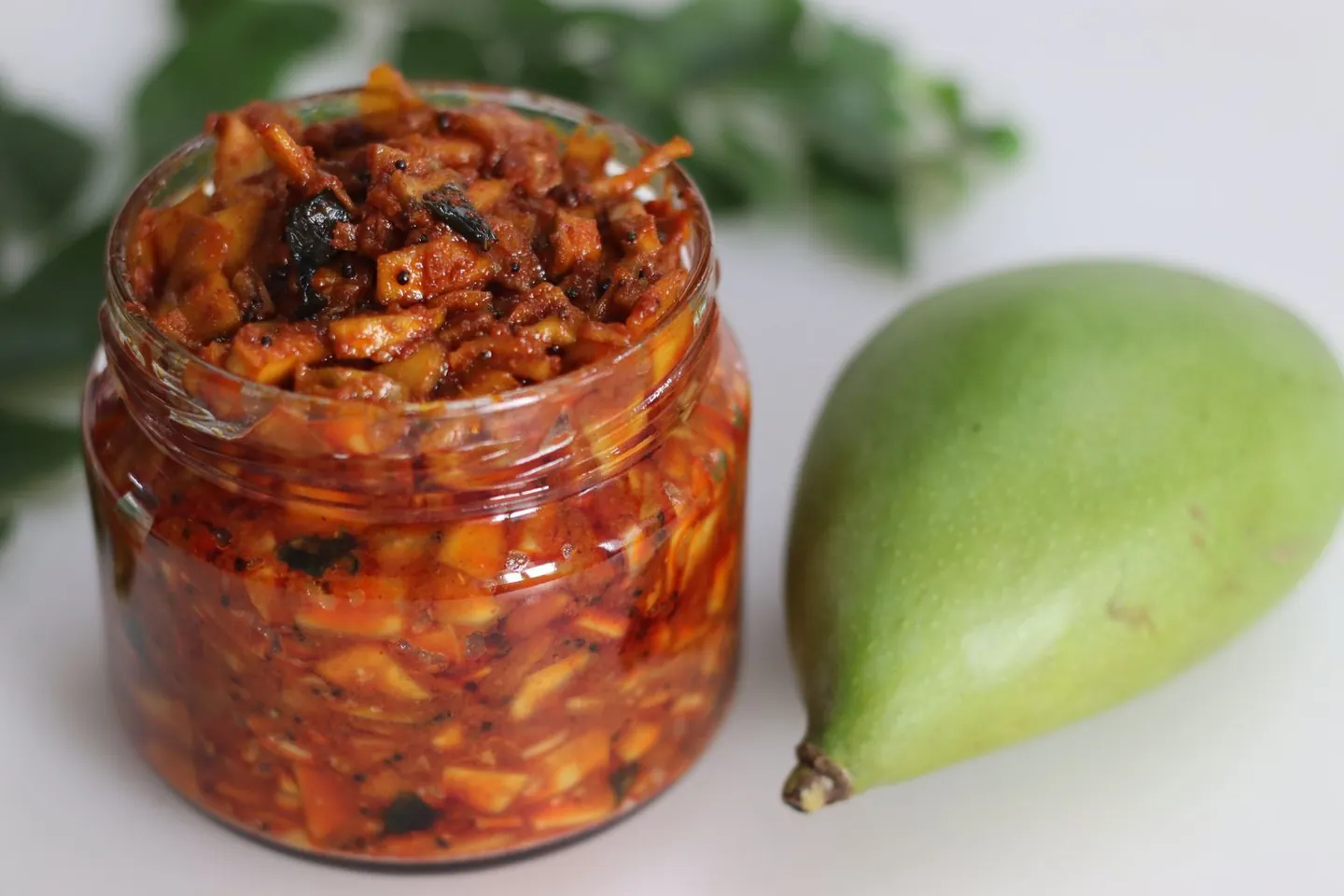
Chapter 23 — Salads, Pachadis, Chutneys, Podis and Pickles
The dishes in this chapter occupy the least space on a Kerala plate and decide more about it than anything else. A spoon of mango achar, a smear of coconut chutney, a pappadam broken over rice: none of them looks like a decision. Together they are where most of a Kerala meal's sodium lives, and — in the case of chutney — a surprising share of its fat. A daily coconut chutney made the way it is usually made carries about 18 g of fat per 60 g serving, roughly 16 g of it saturated. That is not a garnish. That is more saturated fat than the fish curry beside it.
They are also the cheapest place in the whole repertoire to buy flavour back. When you cut the salt in a thoran and the oil in a curry, something must replace the sensation you removed, and the levers that work are acid, aroma, umami, pungency and texture. This chapter is made almost entirely of those five things. A raw salad with lime and green chilli, a curd pachadi with ground mustard, a podi of roasted dal and curry leaf, a teaspoon of ginger-tamarind relish — each raises the perceived seasoning of everything around it without adding a milligram of sodium to the main dish. That is not a compromise. It is a trade that comes out ahead.
A Kerala salad is not a Western salad, and the distinction is practical rather than pedantic. There is no dressing, because there is no emulsion to make: the fat, when there is any, is a spoonful of fresh grated coconut, and the acid is lime juice or a little curd, applied directly. The vegetables are cut small rather than torn large, seasoned with slit green chilli and crushed curry leaf, and eaten with the rice rather than before it. Nothing is chilled, nothing is oiled, and the seasoning happens at the last minute because salt draws water out of cucumber within ten minutes. The result is high-volume, low-energy-density food that belongs to the half of the plate reserved for vegetables — and it arrives without the 100-plus kcal a vinaigrette adds.
The pachadi and raita family is Kerala's own answer to the same problem, arrived at independently and several centuries earlier. Take a vegetable or a fruit, cook it barely or not at all, bind it with curd and a paste of ground coconut and mustard seed, finish with a tempering. What you have is acid, live culture, a little fat and a vegetable — and on the sadya leaf it does exactly the job a raita does on a North Indian thali: it cools, it resets the palate, and it makes the rest of the meal taste more seasoned than it is.
Now the honest part, about pickles and pappadam. Kerala pickles are salt-preserved, and traditional recipes use salt at roughly a tenth to a seventh of the fruit's weight, because that is the concentration at which spoilage organisms stop. Pappadam is salted dough. So the direction of the problem is not in doubt, and neither is the instruction: treat these as condiments taken by the teaspoon, not side dishes taken by the spoonful.
What this book will not do is print per-serving sodium figures for traditional Kerala pickle, pappadam, dried fish or shop-bought chutney, because no peer-reviewed or official food-composition source gives them. Consumer websites give numbers with no provenance, and laundering those into a table with a citation would be dishonest. Dried fish in particular varies so much between producers that a single figure would mislead whichever way it fell. Where this chapter gives a sodium number, it is calculated from the salt this book tells you to add, divided by the portions it tells you to make. That is the only kind of sodium figure a recipe writer can vouch for, and it is why every panel below is labelled estimated.
A note on the panels in this chapter. Every figure is computed from this book's nutrition tables — ICMR-NIN Indian Food Composition Tables 2017 and USDA FoodData Central SR Legacy — divided by the stated portions. Several ingredients used here have no entry in those tables: beetroot, carrot, cucumber, tomato, shallot, pineapple, raw green mango, lime, ginger, garlic, tamarind, jaggery and whole spices. Where a value was needed, the closest documented food was substituted and the substitution is named under each panel. Sodium is calculated from added salt at 400 mg per gram and rounded to the nearest 10 mg. For pickles, podis and chutneys the unit is stated explicitly, because a per-tablespoon figure is the only one a reader can act on. IFCT reports available carbohydrate, so "net carbs" in these panels is the tabulated available carbohydrate and "carbohydrate" is available carbohydrate plus fibre. Sugars are estimated as the free-sugar fraction of available carbohydrate; IFCT does not report sugars separately.
R089 · Kerala Kitchen Salad [LOW SODIUM] [VEGAN] [UNDER 250 KCAL]
Raw vegetables the way a Kerala kitchen cuts them
ICONS: V · Q · L
THE RE-ENGINEERING: There is no dressing, because a Kerala salad never had one. Thirty grams of fresh grated coconut and the juice of two limes do the work that 40 g of oil-and-vinegar does in the Western version, at about a quarter of the energy and with 3 g of fibre attached.
Kerala has always eaten raw vegetables; what it has never had is a salad course. The cut vegetables came to the leaf beside the rice, dressed with nothing but lime, chilli, coconut and crushed curry leaf, and they were eaten in the same mouthfuls as everything else. That is a better idea than a starter salad, because it means the raw volume arrives when the rice does. Cut everything small, season at the last moment, and eat it within twenty minutes.
Serves 4 · about 135 g per portion Active 15 minutes · Total 15 minutes Difficulty: Easy
EQUIPMENT: A sharp knife and a wide bowl. Substitute: a mandoline or the coarse side of a box grater for the carrot, which saves five minutes and gives a softer texture.
BEFORE YOU START: Do not salt anything until the moment you serve. Salt pulls water out of cucumber within 8–10 minutes and the dish goes from crisp to slack with nothing to be done about it.
INGREDIENTS
- 200 g (1 medium) cucumber, seeded and cut into 5 mm dice
- 120 g (2 small) tomatoes, seeded and cut into 5 mm dice
- 80 g (1 medium) carrot, coarsely grated
- 60 g (about 6) shallots, very thinly sliced
- 15 g (about 3) green chillies, deseeded and finely chopped
- 5 g (about 15 leaves) curry leaves, torn
- 30 g (⅓ cup) fresh grated coconut
- 30 ml (2 tbsp) lime juice, from about 2 limes
- 5 g (1 tsp) coconut oil, raw, unheated
- 1.5 g (¼ tsp) salt
SOURCING NOTE: The one ingredient with no honest substitute is the curry leaf; jarred dried leaves have almost no aroma and coriander tastes of something else entirely. Fresh leaves freeze well on the stalk for six months. Where shallots are expensive, use 40 g of red onion plus 20 g of shallot rather than going all-onion: the shallot's sulphur compounds are what make the dish smell like Kerala. Frozen grated coconut, fully thawed, is fine.
ALLERGENS: None of the major allergens.
METHOD
- Seed the cucumber and the tomatoes with the tip of a spoon. The seed jelly is where the water is, and leaving it in is the difference between a salad and a puddle by the time it reaches the table.
- Cut everything to a roughly even 5 mm dice, with the carrot grated rather than diced so it releases sweetness. Uniform small pieces matter: this is a dish eaten with rice, and it must sit on a spoon.
- Bruise the curry leaves and green chilli briefly between your palms until you can smell the leaves clearly from an arm's length away, 10–15 seconds. This releases the terpenes that make lower-salt food taste seasoned.
- Combine the cucumber, tomato, carrot, shallots, coconut, chilli and curry leaf in the bowl and toss with your hand rather than a spoon, which mixes without crushing. The raw shallot is the note that makes this a Kerala salad rather than a chopped salad, so do not leave it on the board.
- Dress with the lime juice and the raw coconut oil, and add the salt only now. Toss again, taste, and add lime rather than salt if it needs lifting.
- Serve within 20 minutes, while the cucumber still snaps under the tooth.
WHY THIS WORKS
Acid raises perceived saltiness, so lime juice lets a quarter-teaspoon of salt read as more. The coconut supplies fat-soluble flavour and about 3 g of fibre, and raw unheated coconut oil delivers its aroma volatiles intact — heating drives them off. Meanwhile the dish is 137 g of food for 78 kcal, which is the energy-density lever working at its cleanest.
PER SERVING (estimated)
| kcal | kJ | Carb | Fibre | Net carb | Sugars | Protein | Fat | Sat fat | Sodium |
|---|---|---|---|---|---|---|---|---|---|
| 78 | 326 | 12 g | 4 g | 8 g | 5 g | 1 g | 5 g | 4 g | 150 mg |
*Substitutions: cucumber computed as ash gourd (IFCT D001); tomato and lime juice as raw green papaya (D059); carrot and shallot as plantain stem (D064); green chilli as bitter gourd (D004); curry leaf as Bengal gram dal (B001).
IF YOU ARE WATCHING… Blood pressure: 150 mg per serving against a 2,000 mg daily target, and it can go to under 40 mg by leaving the salt out altogether and adding a further 10 ml of lime — most people do not notice. Blood sugar: 7 g of net carbohydrate per portion. Eaten alongside rice this is one of the cheapest ways to raise the volume of a meal without raising its glycaemic load, and the vinegar and acid literature supports a sour dressing beside a rice meal. Cholesterol: 4 g of saturated fat per serving, almost all of it from the coconut and the teaspoon of coconut oil. Leave the oil out and it falls to about 3 g.
SWAP IT
- No cucumber → 200 g of ash gourd, peeled and diced raw. Consequence: milder and slightly softer; the dish loses its snap and needs 10 ml more lime.
- No coconut → 20 g of chopped roasted peanuts. Consequence: more protein and a better crunch, but a distinctly non-Kerala flavour and about 15 kcal more per serving. (Allergen: this swap introduces peanuts.)
- No lime → 60 g of grated raw green mango in season. Consequence: sharper and fruitier, and the salad now keeps 2 hours rather than 20 minutes because the acid is in the flesh rather than free in the bowl.
- Salt replaced with the 70:30 potassium blend (M07) → sodium falls to about 100 mg. Consequence: a faint metallic note in a raw dish, where there is no fat or heat to mask it, so this is one of the poorer places to use it. Potassium-enriched salt is not for readers with chronic kidney disease, or on a RAAS inhibitor (ACE inhibitor or ARB) or a potassium-sparing diuretic, without a doctor's approval.
SCALE IT
| Serves | Cucumber | Tomato | Carrot | Shallot | Coconut | Lime juice | Salt |
|---|---|---|---|---|---|---|---|
| 2 | 100 g | 60 g | 40 g | 30 g | 15 g | 15 ml | 0.75 g |
| 4 | 200 g | 120 g | 80 g | 60 g | 30 g | 30 ml | 1.5 g |
| 8 | 400 g | 240 g | 160 g | 120 g | 55 g | 55 ml | 3 g |
At eight servings the coconut and lime do not scale linearly; a larger bowl needs proportionally less of both.
MAKE AHEAD · STORE · FREEZE Cut the vegetables up to 6 hours ahead and keep them undressed and covered in the fridge 6 hours. Dressed, it is finished. Fridge 1 day dressed, at real cost to texture. Do not freeze — the cell walls rupture and it thaws to slush.
LEFTOVERS Drain off the liquid, chop the remains finer, and fold them through a curd raita, or press them into a dosa as it cooks. The drained liquid, with a little more lime, is a serviceable dressing for tomorrow's salad.
SERVE WITH R015 Perfect Matta Rice · R058 Parippu Curry · R024 Meen Vevichathu · R107 Sambharam
TROUBLESHOOTING Watery in the bowl: the seeds were left in, or it was salted early. Drain, and next time do neither. Tastes of nothing: under-acidified rather than under-salted. Add 10 ml of lime and taste again before you reach for the salt. Harsh and oniony: the shallots were sliced thickly. Slice them thin enough to be translucent, or soak the slices in cold water for 5 minutes and drain.
NOTES
R090 · Beetroot Pachadi [LOW SODIUM] [VEGETARIAN] [UNDER 250 KCAL]
Beetroot in curd with ground mustard and coconut
ICONS: V · L
THE RE-ENGINEERING: The coconut is cut from a full cup to 60 g across six servings, and the body comes from the curd rather than from the paste. Ground mustard seed and green chilli replace the depth the coconut used to carry, which is why this version tastes sharper rather than thinner.
Beetroot pachadi is the youngest dish on a sadya leaf and the one that makes non-Malayalis stare, because it comes to the table the colour of a hibiscus. The chemistry is simple and worth knowing: beetroot's betalain pigments are pH-sensitive, and the lactic acid in curd shifts them from earthy purple towards pink. Cook the beetroot in the barest water, let it cool before the curd goes in, and you get that colour and a clean, sweet-sour finish.
Serves 6 · about 115 g per portion Active 20 minutes · Total 40 minutes (plus 20 minutes cooling — required) Difficulty: Easy
EQUIPMENT: Small heavy pan with a lid; mixie or small blender for the paste; small tempering pan (cheena chatti). Substitute: an ammikkallu or mortar gives a coarser, better-textured paste and takes 5 minutes longer.
BEFORE YOU START: The curd must go in off the heat and into a mixture that is no warmer than blood heat, or it will split. Get the beetroot cooked and cooling before you whisk the curd.
INGREDIENTS
- 300 g (2 medium) beetroot, peeled and cut into 5 mm dice
- 60 ml water
- 60 g (⅔ cup) fresh grated coconut
- 12 g (about 2) green chillies
- 3 g (½ tsp) mustard seed, for the paste
- 250 g (1 cup) plain curd, whisked smooth
- 2.5 g (scant ½ tsp) salt
- For the tempering: 5 g (1 tsp) coconut oil · 4 g (¾ tsp) mustard seed · 3 g (about 2) dried red chillies, broken · 3 g (about 10 leaves) curry leaves
SOURCING NOTE: Any beetroot works, though the small dense ones sold loose have more sugar and less earth than the large ones sold in bunches. Outside India, use plain whole-milk yoghurt rather than Greek yoghurt: Greek yoghurt has been strained, so it is thicker, more acidic and about half again as energy-dense, and a pachadi made with it needs thinning with 40 ml of water. Frozen grated coconut is fine, fully thawed and patted dry.
ALLERGENS: Milk, mustard.
METHOD
- Cook the beetroot with the 60 ml water and a pinch of the salt, covered, over a low flame until a piece crushes against the side of the pan under light pressure but still holds its shape, 12–15 minutes. There should be almost no free liquid left.
- Grind the coconut, green chilli and the 3 g of mustard seed with 2 tablespoons of water into a thick paste, coarse enough that you can still feel grains of coconut on your fingertip, 60–90 seconds. Grinding it smoother makes the pachadi pasty.
- Stir the paste into the hot beetroot and cook 2–3 minutes, until the raw mustard smell has lifted and the mixture smells sweet and nutty.
- Cool to no more than blood heat, 15–20 minutes. Test with a fingertip on the side of the pan: if it feels warm rather than hot, the curd is safe to add.
- Whisk the curd smooth in a separate bowl and fold it in with the remaining salt, off the heat entirely.
- Temper: heat the coconut oil, add the mustard seed and wait until it pops steadily rather than sporadically, 30–45 seconds; add the dried chilli and curry leaf and pull the pan off the heat the moment the leaves go glassy and crackle, 5–10 seconds. Pour the whole tempering over the pachadi and fold it in once.
WHY THIS WORKS
Two things happen at once. Beetroot's betalain pigments shift towards pink in the curd's acid, which is where the colour comes from. And the mustard seed ground raw into the paste releases allyl isothiocyanate, a pungent volatile that stimulates the trigeminal nerve rather than the taste buds — pungency read as seasoning, delivered with no sodium at all.
PER SERVING (estimated)
| kcal | kJ | Carb | Fibre | Net carb | Sugars | Protein | Fat | Sat fat | Sodium |
|---|---|---|---|---|---|---|---|---|---|
| 99 | 415 | 10 g | 2 g | 8 g | 6 g | 2 g | 7 g | 5 g | 190 mg |
*Substitutions: beetroot computed as plantain stem (IFCT D064); green chilli as bitter gourd (D004); mustard seed, dried chilli and curry leaf as Bengal gram dal (B001); curd as USDA "Yogurt, plain, whole milk" (FDC 171284), since IFCT 2017 has no curd entry.
IF YOU ARE WATCHING… Blood pressure: 190 mg per serving. Curd itself carries about 46 mg of sodium per 100 g before any salt is added, so the floor here is around 120 mg even with no added salt at all — worth knowing before you try to cut it further. Blood sugar: beetroot is sweeter than most Kerala vegetables and this is a 6 g-of-sugars dish. It is still only 8 g of net carbohydrate per serving, and the curd's protein and fat slow the meal. Cholesterol: 5 g of saturated fat, from coconut and whole-milk curd. Low-fat curd takes it to about 3.5 g at some cost to body.
SWAP IT
- Low-fat curd for whole → saturated fat falls from about 5 g to 3.5 g. Consequence: thinner, and more likely to weep on standing; whisk in 10 g of extra ground coconut to compensate.
- No mustard seed in the paste → use 2 g of crushed black pepper. Consequence: the pungency becomes warm rather than sharp, and the dish loses the specific sadya character that mustard gives.
- Beetroot replaced with 300 g of grated raw beetroot, uncooked → Consequence: brighter, crunchier, more earthy, and it will not keep beyond a few hours.
SCALE IT
| Serves | Beetroot | Coconut | Green chilli | Curd | Salt | Tempering oil |
|---|---|---|---|---|---|---|
| 3 | 150 g | 30 g | 6 g | 125 g | 1.25 g | 3 g |
| 6 | 300 g | 60 g | 12 g | 250 g | 2.5 g | 5 g |
| 12 | 600 g | 110 g | 22 g | 500 g | 5 g | 8 g |
At 12 servings cook the beetroot in two batches or add 5 minutes to step 1; a crowded pan steams rather than reduces.
MAKE AHEAD · STORE · FREEZE Best on the day. Fridge 2 days in a covered non-metal container, after which the curd sours noticeably and the colour dulls. Freeze — do not. Curd emulsions break irreversibly on thawing. Make ahead by cooking the beetroot and grinding the paste up to 2 days in advance and adding the curd on the day.
LEFTOVERS Thin day-two pachadi with 100 ml of water and a pinch of cumin and drink it cold as a beetroot sambharam, or spoon it over hot matta rice as a one-bowl lunch with a pappadam broken over it.
SERVE WITH R015 Perfect Matta Rice · R059 Sambar · R069 Avial · R118 the lightened Onam sadya
TROUBLESHOOTING Split, grainy, watery: the curd went into a mixture that was too hot. There is no repair. Cool properly next time. Muddy brown rather than pink: not enough acid, or the beetroot was overcooked. Add 10 ml of lime juice and it will shift back some of the way. Bitter: the mustard seed in the tempering burned. It should pop and stop; a further 20 seconds turns it acrid.
NOTES
R091 · Cucumber Pachadi [LOW SODIUM] [VEGETARIAN] [UNDER 250 KCAL]
Vellarikka in curd, the sadya version
ICONS: V · Q · L
THE RE-ENGINEERING: The cucumber goes in raw rather than boiled, and the coconut drops to 50 g across six servings. Raw cucumber holds its water in its cells rather than releasing it into the dish, so less coconut is needed to give body and the pachadi is crisper for it.
On the sadya leaf this sits between the kichadi and the pulissery, and the difference between a good one and a dull one is entirely about water. Salt the cucumber and it weeps; boil it and it collapses; leave it raw, cut small, and fold it into a properly thick coconut-and-mustard paste, and every spoonful has a little snap in it. Kerala grows a pale, fat, thin-skinned cucumber for exactly this. Any cucumber will do the job.
Serves 6 · about 110 g per portion Active 20 minutes · Total 25 minutes Difficulty: Easy
EQUIPMENT: Mixie or small blender; small tempering pan. Substitute: a mortar, which gives a coarser paste that suits this dish better than a smooth one.
BEFORE YOU START: Dice the cucumber last, and do not salt it until the curd is already in. Salted cucumber loses noticeable water in 8–10 minutes.
INGREDIENTS
- 50 g (½ cup) fresh grated coconut
- 10 g (about 2) green chillies
- 3 g (½ tsp) mustard seed, for the paste
- 350 g (1 large) cucumber, peeled, seeded and cut into 5 mm dice
- 250 g (1 cup) plain curd, whisked smooth
- 2.5 g (scant ½ tsp) salt
- For the tempering: 5 g (1 tsp) coconut oil · 4 g (¾ tsp) mustard seed · 3 g (about 2) dried red chillies, broken · 3 g (about 10 leaves) curry leaves
SOURCING NOTE: The Kerala vellarikka is a large pale cucumber with soft seeds and a mild flesh; the closest thing abroad is a peeled and seeded English cucumber, or a peeled Armenian cucumber. Avoid the small pickling cucumbers, which are too dense and too bitter at the stem. Use plain whole-milk yoghurt rather than Greek, or thin Greek yoghurt with 40 ml of water.
ALLERGENS: Milk, mustard.
METHOD
- Grind the coconut, green chilli and the 3 g of mustard seed with 3 tablespoons of water to a thick, deliberately coarse paste, 60–90 seconds. Stop while you can still feel coconut grains between your fingers.
- Peel the cucumber, halve it lengthways, scrape out the seed core with a teaspoon, and dice the flesh to 5 mm.
- Whisk the curd with the coconut paste until it is a single pale-green cream with no streaks, 30–45 seconds.
- Fold in the cucumber and the salt, and taste at once. If it needs lifting, add 5 ml of lime juice rather than more salt.
- Temper: heat the coconut oil, add the mustard seed and wait for it to pop steadily, 30–45 seconds; add the dried chilli and curry leaf and take the pan off the heat as soon as the leaves crackle and go glassy, 5–10 seconds. Pour over and fold through once, no more.
- Rest 5 minutes and serve. Beyond about 40 minutes the cucumber begins to release water and the dish loosens.
WHY THIS WORKS
Raw cucumber is roughly 95% water held inside intact cells. Leave the cells intact and that water stays put, so the pachadi keeps its texture and needs less coconut to thicken it. The ground raw mustard supplies pungency without sodium, and the curd supplies both acid and live culture — the item with the most consistent inverse associations across weight, blood pressure and diabetes in the dairy cohorts.
PER SERVING (estimated)
| kcal | kJ | Carb | Fibre | Net carb | Sugars | Protein | Fat | Sat fat | Sodium |
|---|---|---|---|---|---|---|---|---|---|
| 83 | 346 | 8 g | 3 g | 5 g | 4 g | 3 g | 6 g | 5 g | 190 mg |
*Substitutions: cucumber computed as ash gourd (IFCT D001); green chilli as bitter gourd (D004); mustard seed, dried chilli and curry leaf as Bengal gram dal (B001); curd as USDA FDC 171284.
IF YOU ARE WATCHING… Blood pressure: 190 mg per serving, about 120 mg of which is the curd itself. This is one of the better dishes on the leaf for a reader counting sodium, and it can drop to about 130 mg by halving the added salt and adding lime. Blood sugar: 5 g of net carbohydrate for 110 g of food. Serve it in quantity beside rice; it is the cheapest volume on the plate. Cholesterol: 5 g of saturated fat per serving. Low-fat curd brings it to about 3.5 g.
SWAP IT
- Ash gourd (kumbalanga) for cucumber, lightly cooked → Consequence: this is a kichadi rather than a pachadi, softer and milder, and it keeps a day longer.
- Low-fat curd → saturated fat 5 g down to 3.5 g. Consequence: looser; add 10 g more ground coconut.
- No fresh coconut → 25 g desiccated coconut soaked in 50 ml warm water for 10 minutes. Consequence: noticeably chalkier and less sweet, and you lose about half the fibre.
SCALE IT
| Serves | Cucumber | Coconut | Green chilli | Curd | Salt | Tempering oil |
|---|---|---|---|---|---|---|
| 3 | 175 g | 25 g | 5 g | 125 g | 1.25 g | 3 g |
| 6 | 350 g | 50 g | 10 g | 250 g | 2.5 g | 5 g |
| 12 | 700 g | 90 g | 20 g | 500 g | 5 g | 8 g |
MAKE AHEAD · STORE · FREEZE Make the paste and whisk it into the curd up to 1 day ahead and keep it in the fridge; add the cucumber and temper within 40 minutes of serving. Finished, fridge 1 day only. Do not freeze.
LEFTOVERS Drain, blend with 150 ml of cold water and a little cumin, and drink it as a cucumber sambharam. Or drain and fold the solids into a cabbage thoran off the heat.
SERVE WITH R015 Perfect Matta Rice · R086 Rasam · R064 Beans Thoran · R040 Nadan Kozhi Curry
TROUBLESHOOTING Watery within the hour: the cucumber was salted early, or the seeds were left in. Bitter: the stem end of the cucumber. Cut 2 cm off it and taste before dicing the rest. Flat: not enough green chilli or mustard. Both are the seasoning here, and both are free of sodium.
NOTES
R092 · Pineapple Pachadi [LOW SODIUM] [VEGETARIAN] [UNDER 250 KCAL]
Sweet, sour and pungent all at once
ICONS: V · L
THE RE-ENGINEERING: Jaggery down from a traditional 40 g to 15 g across six servings, because the pineapple is already carrying 12 g of sugars per portion and does not need help. The sweetness that reads as sweetness in a pachadi is the fruit's; the jaggery was only ever rounding the sour edge, and 15 g rounds it perfectly.
The pineapple pachadi is the loudest dish on a sadya leaf and the one that teaches the sadya's logic best: sweet from the fruit, sour from the curd, pungent from ground mustard and green chilli, all in a single spoonful. Vazhakulam pineapple from Ernakulam is what a Kerala cook reaches for, low in acid and high in sugar. Use fruit that is ripe enough to smell from across the kitchen, cut small, and cooked only briefly.
Serves 6 · about 115 g per portion Active 20 minutes · Total 35 minutes (plus 15 minutes cooling — required) Difficulty: Easy
EQUIPMENT: Small heavy pan with a lid; mixie; small tempering pan.
BEFORE YOU START: Curd goes into a cooled mixture, never a hot one. And taste the pineapple before you weigh the jaggery: a very ripe fruit may need only 10 g, and a sour one 20 g.
INGREDIENTS
- 350 g (about 2½ cups) ripe pineapple, cored and cut into 1 cm dice
- 40 ml water
- 15 g (1 tbsp, packed) jaggery, grated
- 10 g (about 2) green chillies, slit
- 50 g (½ cup) fresh grated coconut
- 3 g (½ tsp) mustard seed, for the paste
- 200 g (¾ cup) plain curd, whisked smooth
- 2.5 g (scant ½ tsp) salt
- For the tempering: 5 g (1 tsp) coconut oil · 4 g (¾ tsp) mustard seed · 3 g (about 2) dried red chillies, broken · 3 g (about 10 leaves) curry leaves
SOURCING NOTE: Tinned pineapple in juice, drained hard, works at 350 g drained weight; tinned in syrup does not, because the syrup pushes the sugars up by several grams a serving and no jaggery is then needed at all. Frozen pineapple chunks are good and need 3–4 minutes less cooking. Where jaggery is unavailable, dark muscovado or Latin American panela is essentially the same product at about 1:1 by weight.
ALLERGENS: Milk, mustard.
METHOD
- Cook the pineapple with the water, jaggery, green chilli and a pinch of the salt, covered, over a low flame until the fruit is translucent at the edges and yields to a spoon but has not collapsed, 8–10 minutes.
- Uncover and reduce until almost no free liquid remains, 3–4 minutes. Any liquid left here thins the finished pachadi.
- Grind the coconut and the 3 g of mustard seed with 2 tablespoons of water to a thick, slightly coarse paste, 60–90 seconds.
- Stir the paste into the hot fruit and cook until the raw mustard smell lifts and the mixture smells of coconut and pineapple together, 2–3 minutes.
- Cool to blood heat, 12–15 minutes, then fold in the whisked curd and the remaining salt off the heat.
- Temper: heat the oil, pop the mustard seed 30–45 seconds, add the chilli and curry leaf for 5–10 seconds until the leaves crackle, and pour it over. Fold once.
WHY THIS WORKS
This is the six-taste principle in one dish, and it is also a genuine sodium-reduction device. Sweet, sour and pungent arriving together raise total flavour intensity, and food that reads as intensely flavoured reads as better seasoned. That is why a spoonful of this beside plain rice makes the rice taste salted when it is not.
PER SERVING (estimated)
| kcal | kJ | Carb | Fibre | Net carb | Sugars | Protein | Fat | Sat fat | Sodium |
|---|---|---|---|---|---|---|---|---|---|
| 120 | 501 | 17 g | 3 g | 14 g | 12 g | 4 g | 6 g | 5 g | 180 mg |
*Substitutions: pineapple computed as ripe jackfruit (IFCT E030), the closest documented sweet tropical fruit — it is more carbohydrate-dense than pineapple, so this panel is more likely to overstate than understate; jaggery costed as sucrose at 98 g of carbohydrate and about 390 kcal per 100 g, the working assumption this book states in its reference tables; green chilli as bitter gourd (D004); mustard seed, dried chilli and curry leaf as Bengal gram dal (B001); curd as USDA FDC 171284.
IF YOU ARE WATCHING… Blood sugar: this is the highest-sugar dish in the chapter at 12 g per serving, and 9 g of that is the fruit. It belongs beside a rice meal with a pulse on the plate rather than eaten alone, and a reader watching post-meal glucose should treat it as part of the meal's carbohydrate rather than as a free vegetable. Blood pressure: 180 mg per serving against a 2,000 mg target. Cholesterol: 5 g of saturated fat. Low-fat curd brings it to about 3.5 g.
SWAP IT
- Ripe mango for pineapple → Consequence: sweeter and less acidic, so drop the jaggery entirely and add 10 ml of lime juice at the end.
- No jaggery at all → Consequence: noticeably sharper and perfectly good with a properly ripe fruit; sugars fall from 12 g to about 9 g and energy to about 110 kcal.
- Ash gourd for half the pineapple → Consequence: the dish becomes a pulissery-leaning pachadi, 30 kcal lighter and much lower in sugars, at the cost of most of its character.
SCALE IT
| Serves | Pineapple | Jaggery | Coconut | Curd | Salt | Tempering oil |
|---|---|---|---|---|---|---|
| 3 | 175 g | 8 g | 25 g | 100 g | 1.25 g | 3 g |
| 6 | 350 g | 15 g | 50 g | 200 g | 2.5 g | 5 g |
| 12 | 700 g | 28 g | 90 g | 400 g | 5 g | 8 g |
MAKE AHEAD · STORE · FREEZE Cook the fruit and the paste up to 2 days ahead and keep it in the fridge, adding curd on the day. Finished, fridge 2 days. Do not freeze — the curd breaks and the pineapple turns fibrous.
LEFTOVERS Spoon it over hot rice with a pappadam, or thin it with 100 ml of water into a cold soup with a pinch of roasted cumin. Cooked pineapple with the paste, before the curd goes in, also freezes for 1 month on its own.
SERVE WITH R015 Perfect Matta Rice · R059 Sambar · R069 Avial · R119 the lightened sadya menu
TROUBLESHOOTING Split: the curd went in hot. Cloying: too much jaggery for the ripeness of the fruit. Add 10 ml of lime. Watery: step 2 was skipped. Reduce properly before the paste goes in.
NOTES
R093 · Coconut Chutney, Rebuilt [LOW GL] [VEGAN] [UNDER 250 KCAL]
The daily chammanthi, with the fat halved and the flavour kept
ICONS: P · Q · B · L
THE RE-ENGINEERING: Coconut down from 150 g to 60 g, with 45 g of roasted Bengal gram dal taking its place as the body. Saturated fat falls from about 16 g to 6 g a serving and energy from 182 kcal to 119 kcal, while protein doubles. This is the single most useful recipe in the chapter, because chutney is the one thing here that most readers eat every day.
Start with the honest numbers, because they are the argument. A conventional coconut chutney — 150 g of fresh grated coconut and 10 g of coconut oil, serving four — delivers 182 kcal, 18 g of fat and 16 g of saturated fat per 60 g serving. Eaten twice a day with breakfast and an evening dosa, that is more saturated fat than everything else on the plate combined. Roasted gram dal fixes it, because dal grinds to the same silk as coconut and carries the chilli and tamarind just as well.
Serves 4 · about 55 g per portion Active 15 minutes · Total 15 minutes Difficulty: Easy
EQUIPMENT: Mixie or small high-speed blender; small tempering pan. Substitute: an ammikkallu, which gives a better texture and takes 10 minutes; a food processor will not get roasted dal smooth and gives a gritty chutney.
BEFORE YOU START: Have the tamarind soaking and the tempering ingredients beside the hob. The tempering takes 60 seconds from cold and it will burn while you look for the curry leaves.
INGREDIENTS
- 12 g (2 tsp, packed) tamarind, soaked in 30 ml warm water for 10 minutes
- 60 g (⅔ cup) fresh grated coconut
- 45 g (5 tbsp) roasted Bengal gram dal (pottukadala)
- 15 g (about 2) shallots
- 10 g (about 2) green chillies
- 8 g (a 2 cm piece) ginger, roughly chopped
- 2 g (⅓ tsp) salt
- 60 ml water, for grinding
- For the tempering: 4 g (¾ tsp) coconut oil · 2 g (⅓ tsp) mustard seed · 2 g (1 small) dried red chilli, broken · 3 g (about 10 leaves) curry leaves
SOURCING NOTE: Roasted gram dal is sold as pottukadala, dalia or "roasted split chickpea" in every South Asian grocery and keeps six months in a jar. Do not substitute raw chana dal — it will not grind smooth and tastes of flour. Where you cannot find it, roast ordinary chana dal in a dry pan until it smells of biscuit and one grain snaps rather than bends, 6–8 minutes, and cool it fully before grinding. Frozen grated coconut works and should be thawed and drained.
ALLERGENS: Mustard.
METHOD
- Soak the tamarind in the warm water until it softens to the texture of a dried apricot, 8–10 minutes, then squeeze the pulp into the water and discard the fibre.
- Grind the roasted gram dal alone first, to a fine flour, 30–45 seconds. Dal ground with wet ingredients stays gritty; ground dry it goes to powder and then dissolves.
- Add the coconut, shallot, green chilli, ginger, tamarind water and salt. Grind in short bursts with 40 ml of the water, scraping down twice, until no grit remains on your fingertip, 60–90 seconds. Add the last 20 ml only if it is stiffer than thick cream.
- Taste and adjust with tamarind rather than salt. This chutney should be distinctly sour; the sourness is what lets the salt stay at 2 g.
- Temper: heat the coconut oil in the small pan until a mustard seed dropped in sizzles at once. Add the mustard and wait until it pops steadily rather than sporadically, 30–40 seconds. Add the dried chilli and curry leaf and pull the pan off the heat within 5–10 seconds, as soon as the leaves crackle and turn glassy.
- Pour the tempering over the chutney and fold it in once. Serve at room temperature.
WHY THIS WORKS
Roasted gram dal replaces coconut's job rather than imitating it. Both grind to a smooth paste, but the dal brings protein, fibre and Maillard-derived roasted aroma instead of 41 g of fat per 100 g. The tamarind matters too: acid raises perceived saltiness, which is why 2 g of salt across four servings tastes fully seasoned here and would not in a bland paste.
PER SERVING, about 55 g (estimated)
| kcal | kJ | Carb | Fibre | Net carb | Sugars | Protein | Fat | Sat fat | Sodium |
|---|---|---|---|---|---|---|---|---|---|
| 119 | 497 | 12 g | 4 g | 8 g | 2 g | 4 g | 8 g | 6 g | 200 mg |
AND THE TRADITIONAL VERSION, FOR COMPARISON — per 60 g serving (estimated)
| kcal | kJ | Carb | Fibre | Net carb | Sugars | Protein | Fat | Sat fat | Sodium |
|---|---|---|---|---|---|---|---|---|---|
| 182 | 761 | 8 g | 4 g | 4 g | 3 g | 2 g | 18 g | 16 g | 310 mg |
*Traditional version computed as 150 g fresh coconut, 10 g coconut oil, 15 g shallot, 10 g green chilli and 3 g salt for four. Substitutions in both panels: shallot as plantain stem (IFCT D064); green chilli as bitter gourd (D004); ginger as tapioca (F015); tamarind pulp as ripe jackfruit (E030); mustard, dried chilli and curry leaf as Bengal gram dal (B001).
IF YOU ARE WATCHING… Cholesterol: this is the chapter's headline. Two chutney servings a day, rebuilt rather than traditional, removes about 20 g of saturated fat a day. Coconut oil and coconut flesh are not the same thing and this recipe keeps the flesh, but 150 g of coconut in a condiment is still 62 g of fat, and pooled trial evidence puts coconut oil's LDL-cholesterol effect at about +10.5 mg/dL against non-tropical vegetable oils. Blood sugar: 8 g of net carbohydrate and 4 g of protein per serving, and the roasted dal is a pulse — the habit with the strongest evidence in this book. Blood pressure: 200 mg per serving. Cut the salt to 1 g and add a further 5 g of tamarind and it falls to about 100 mg without tasting under-seasoned.
SWAP IT
- Roasted peanuts for the gram dal → Consequence: richer and rounder, more monounsaturated fat, and about 30 kcal more per serving. A good chutney, a different one. (Allergen: this swap introduces peanuts.)
- Moong dal, dry-roasted, for the gram dal → Consequence: lighter and sweeter, less body, and it needs 20 ml more water.
- Coconut back up to 100 g with the dal at 20 g → Consequence: closer to the traditional flavour, with saturated fat back up to about 10 g a serving. Stated so you can choose knowingly.
- No tamarind → 15 ml lime juice added off the grinder at the end. Consequence: brighter and more volatile, and the chutney will not keep past a day.
SCALE IT
| Serves | Coconut | Gram dal | Shallot | Green chilli | Ginger | Tamarind | Salt | Water |
|---|---|---|---|---|---|---|---|---|
| 2 | 30 g | 22 g | 8 g | 5 g | 4 g | 6 g | 1 g | 30 ml |
| 4 | 60 g | 45 g | 15 g | 10 g | 8 g | 12 g | 2 g | 60 ml |
| 8 | 120 g | 90 g | 30 g | 20 g | 16 g | 24 g | 4 g | 110 ml |
Water does not scale linearly — a fuller grinder jar needs proportionally less. Add the last third by eye.
MAKE AHEAD · STORE · FREEZE Fridge 3 days in a covered non-metal container, with the tempering added fresh on the day if you want it at its best. Freeze 2 months in 60 g portions, untempered; texture holds well and the flavour dulls slightly. Do not leave it at room temperature above 25°C (77°F) for more than 4 hours — a wet, low-salt, low-acid paste of ground pulse and coconut is a good growth medium.
LEFTOVERS Loosen day-three chutney with 100 ml of water into a chutney-based gravy for boiled tubers, or spread it thinly inside a dosa before folding. Two tablespoons stirred into a vegetable stew thickens it and adds a pulse.
SERVE WITH R004 Puttu · R008 Ragi Dosa · R009 Oats and Matta Dosa · R012 Kanji with a Pulse · R001 Appam
TROUBLESHOOTING Gritty: the dal was ground wet. Grind it dry to a flour first. Bitter: the mustard seed burned, or the shallot was ground for too long and oxidised. Loose and watery: too much grinding water. Add 10 g more roasted dal, which absorbs it without changing the flavour. Grey by the next day: normal oxidation of the ground shallot and coconut. It affects colour more than flavour, but tempering on the day of serving hides it.
NOTES
R094 · Tomato Chutney [LOW SODIUM] [VEGAN] [UNDER 250 KCAL]
Thakkali chammanthi, cooked down until it is nearly a jam
ICONS: V · Q · B · L
THE RE-ENGINEERING: Coconut oil cut to 6 g for four servings, and the body built from 60 g of shallots reduced slowly plus 300 g of tomato cooked down hard. What used to come from oil now comes from water leaving the pan.
Tomato is a late arrival in Kerala — it is a reliable marker that a "traditional" recipe is younger than it claims — but it earned its place, because a tomato chutney does something coconut chutney cannot. It is savoury rather than rich, it carries glutamate, and glutamate is the reason a spoonful of it makes a low-salt meal taste finished. Cook it further than feels necessary. The moment to stop is when a spoon dragged across the pan leaves a track that fills in slowly.
Serves 4 · about 70 g per portion Active 25 minutes · Total 30 minutes Difficulty: Easy
EQUIPMENT: Heavy 20 cm pan; mixie or blender, optional. Substitute: leave it unblended for a coarse chutney closer to a thokku; the flavour is the same and the texture is rougher.
BEFORE YOU START: Slice the shallots before you light the flame; 60 g takes 4 minutes and the pan will not wait.
INGREDIENTS
- 6 g (1¼ tsp) coconut oil
- 2 g (⅓ tsp) mustard seed
- 6 g (about 4) dried red chillies, broken
- 60 g (about 6) shallots, thinly sliced
- 5 g (about 15 leaves) curry leaves
- 300 g (3 medium) tomatoes, roughly chopped
- 8 g (1½ tsp, packed) tamarind, soaked in 30 ml warm water
- 30 g (⅓ cup) fresh grated coconut
- 2 g (⅓ tsp) salt
SOURCING NOTE: Out of tomato season, 300 g of good tinned chopped tomatoes beats poor fresh ones and needs about 5 minutes less cooking; check the label for added salt, because some brands carry 200 mg of sodium per 100 g and that alone would double this recipe's figure. Kashmiri dried chillies give the colour without much heat; ordinary hot dried chillies at 6 g will make this fierce, so use 3 g of those plus 3 g of Kashmiri.
ALLERGENS: Mustard.
METHOD
- Heat the coconut oil in the pan until a mustard seed dropped in sizzles at once. Add the mustard and wait until it pops steadily, 30–40 seconds.
- Add the dried chilli and fry 20–30 seconds, until it darkens by a shade and smells toasted rather than raw.
- Add the shallots and curry leaves and cook over a low flame, stirring every minute, until the shallots have collapsed and turned the colour of weak tea, 8–10 minutes. This is where the body of the chutney comes from and it cannot be hurried on a higher flame.
- Add the tomatoes and the salt and cook uncovered, stirring occasionally and mashing with the back of the spoon, until the tomatoes have gone completely and the mass is glossy and dark with a thin rim of oil at the edge, 10–14 minutes. A spoon dragged through it should leave a track that fills in slowly.
- Add the tamarind water and the grated coconut and cook a further 2–3 minutes, until it smells sweet and no longer sharply of raw tamarind.
- Cool for 10 minutes and blend to a coarse purée, or leave it as it is. Taste, and correct with tamarind rather than salt.
WHY THIS WORKS
Slow shallot reduction and hard tomato reduction both concentrate glutamate, and glutamate at the levels a cooked-down tomato reaches will hold the perception of saltiness in a recipe with far less sodium than usual — the same effect trained panels found when umami enhancement maintained perceived saltiness in dishes with 40% of the salt removed. The tamarind then supplies acid, which raises it further.
PER SERVING, about 70 g (estimated)
| kcal | kJ | Carb | Fibre | Net carb | Sugars | Protein | Fat | Sat fat | Sodium |
|---|---|---|---|---|---|---|---|---|---|
| 78 | 328 | 10 g | 3 g | 7 g | 4 g | 1 g | 5 g | 4 g | 200 mg |
*The batch is 417 g of ingredients reducing to about 280 g of finished chutney; the panel is nutrients divided by four, which reduction does not change. Substitutions: tomato as raw green papaya (IFCT D059); shallot as plantain stem (D064); tamarind pulp as ripe jackfruit (E030); dried chilli, mustard and curry leaf as Bengal gram dal (B001).
IF YOU ARE WATCHING… Blood pressure: 200 mg per serving, entirely from the 2 g of added salt. This is the one chutney in the chapter that will taste properly seasoned at 1 g of salt — about 100 mg a serving — because the reduced tomato is doing the work. Blood sugar: 7 g of net carbohydrate. A negligible glycaemic contribution, and it makes plain rice more interesting, which is worth more than it sounds. Cholesterol: 4 g of saturated fat, three-quarters of it from the 30 g of fresh coconut. Halve the coconut and it falls to about 2.5 g.
SWAP IT
- Sesame (gingelly) oil for the coconut oil → saturated fat falls from about 4 g to about 3.3 g per serving. Consequence: nuttier and less recognisably Kerala; sesame is 16% saturated against coconut oil's 91%. (Allergen: this swap introduces sesame.)
- No coconut → Consequence: a sharper, cleaner chutney at about 65 kcal and 2 g of saturated fat, and it keeps two days longer.
- Add 15 g of roasted gram dal at step 6 → Consequence: thicker, more protein, less bright.
SCALE IT
| Serves | Tomato | Shallot | Dried chilli | Coconut | Tamarind | Oil | Salt |
|---|---|---|---|---|---|---|---|
| 2 | 150 g | 30 g | 3 g | 15 g | 4 g | 4 g | 1 g |
| 4 | 300 g | 60 g | 6 g | 30 g | 8 g | 6 g | 2 g |
| 8 | 600 g | 120 g | 12 g | 60 g | 16 g | 10 g | 4 g |
At eight servings use a 28 cm pan or the tomatoes will steam rather than reduce, and add 6–8 minutes to step 4.
MAKE AHEAD · STORE · FREEZE Better on day two, once the shallot sweetness has settled into the tomato. Fridge 5 days in a covered non-metal container with a film of oil on the surface. Freeze 3 months in 70 g portions. Reheat gently or serve at room temperature.
LEFTOVERS Two tablespoons make the base of a quick fish curry with a piece of kudampuli and 100 ml of water. It is also the best thing to spread inside a dosa, and stirred into hot rice with a teaspoon of M06 it becomes a meal on its own.
SERVE WITH R008 Ragi Dosa · R009 Oats and Matta Dosa · R004 Puttu · R012 Kanji with a Pulse · R022 Millet Upma
TROUBLESHOOTING Sharp and raw: step 4 was cut short. It needs to look darker than seems right. Bitter: the dried chilli or the mustard burned in the first minute. Watery: the tomatoes were very juicy. Keep reducing; there is no other fix.
NOTES
R095 · Kanji Podi [LOW SODIUM] [LOW SAT FAT] [VEGAN]
The dry podi that makes rice gruel a meal
ICONS: P · B · L
THE RE-ENGINEERING: No salt at all, and the savoury weight carried by roasted pulse and dried coconut instead. A tablespoon over kanji replaces the pinch of salt and the spoon of pickle the bowl usually gets, and brings 1.5 g of protein and a gram of fibre with it.
Kanji — rice cooked loose in its own water — is Kerala's convalescent food, monsoon food and late-night food, and it is almost always eaten with something salty on the side: pickle, pappadam, dried fish. That side dish is where the sodium is. A dry podi does the same job by a different route, and unlike pickle it keeps for months and costs nothing per spoonful. This is a close cousin of M06 and can be used interchangeably with it; this version is sweeter and coarser, because coconut belongs in a kanji bowl.
Makes about 165 g · Serves 23 at 1 level tablespoon, about 7 g each Active 25 minutes · Total 45 minutes (plus 20 minutes cooling — required) Difficulty: Easy
EQUIPMENT: Heavy dry pan, 24 cm; spice grinder or mixie with a small jar. Substitute: a mortar gives a coarser podi, which suits kanji better than a fine one.
BEFORE YOU START: Strip the curry leaves and check them for moisture. Damp leaves will not crisp, and a podi made with damp leaves cakes solid within a fortnight.
INGREDIENTS
- 60 g (⅓ cup) green gram dal (moong dal)
- 40 g (3½ tbsp) Bengal gram dal (chana dal)
- 30 g (⅓ cup) dried coconut (copra), grated or thinly sliced
- 20 g (about 12) dried red chillies
- 10 g (about 5 sprigs, stripped) curry leaves
- 6 g (¾ tbsp) black peppercorns
- 4 g (¾ tsp) cumin seed
- 3 g (½ tsp) asafoetida
- No salt. That is the point of the jar.
SOURCING NOTE: Use dried coconut (copra, sold as "coconut copra" or "dried coconut" in South Asian shops), not desiccated coconut, which has been defatted and shredded and burns before it toasts. Where only desiccated is available, use 25 g and add it in the last 90 seconds of roasting. Asafoetida sold in India is usually compounded with wheat flour; the resin lump is stronger and 2 g will do.
ALLERGENS: None of the major allergens as the recipe is written. Gluten (wheat) — only if your asafoetida is compounded with wheat flour, as most brands are.
METHOD
- Roast the chana dal over medium-low heat, stirring constantly, until it is pale honey-brown and one grain snaps rather than bends, 6–8 minutes. Tip onto a cold plate.
- Roast the moong dal the same way, 4–5 minutes, until it is the colour of weak tea and smells of biscuit. Moong colours faster than chana.
- Roast the dried coconut on a low flame, stirring without pause, until it is evenly the colour of dark toast and smells nutty with a distinct edge of smoke, 4–6 minutes. It goes from right to burnt in about 90 seconds, so tip it out the moment it is there.
- Roast the chillies until they blister and darken by a shade, 2–3 minutes, then the pepper and cumin together for 2 minutes, until the pepper starts to pop.
- Roast the curry leaves last, on the lowest flame, until they crumble to dust between finger and thumb, 1–2 minutes. If they bend rather than crumble they are still wet.
- Cool everything to room temperature, 15–20 minutes, then grind with the asafoetida to a coarse, sandy powder. Stop while it still feels gritty: texture is one of the levers that makes low-salt food read as seasoned, and a fine podi tastes flatter than a coarse one.
WHY THIS WORKS
Roasting the dals and the coconut generates Maillard products — pyrazines, furans, thiazoles — that the brain reads as savoury and cooked, the same reason browned onion tastes rich. Curry leaf adds terpene aroma and pepper adds trigeminal warmth. Aroma and pungency together let a bowl of kanji taste seasoned with no sodium at all, and the dal brings protein and fibre to a dish that has neither.
PER TABLESPOON, about 7 g (estimated)
| kcal | kJ | Carb | Fibre | Net carb | Sugars | Protein | Fat | Sat fat | Sodium |
|---|---|---|---|---|---|---|---|---|---|
| 28 | 116 | 4 g | 1 g | 3 g | 0.3 g | 1.5 g | 1 g | 0.7 g | under 10 mg |
*The unit is a tablespoon, because that is how a podi is used. Substitutions: dried chilli, curry leaf, peppercorn, cumin and asafoetida computed as Bengal gram dal (IFCT B001), the closest documented dry seed; together they are 43 g of a 173 g batch and the choice moves the panel by under 2 kcal per tablespoon.
IF YOU ARE WATCHING… Blood pressure: under 10 mg of sodium a tablespoon, replacing a spoon of pickle at roughly 200 mg or a pappadam at rather more. Used twice a day instead of a salted condiment, this jar is worth a few hundred milligrams a day against a 2,000 mg target. Blood sugar: a pulse-based podi over kanji is a small version of the best-evidenced habit in this book — adding legumes to a rice meal lowered glycaemic response more than changing the rice did. Cholesterol: 0.7 g of saturated fat a tablespoon, from the copra. Leave the coconut out and it falls to about 0.2 g.
SWAP IT
- Fresh coconut, dry-roasted, for copra → Consequence: better flavour, shorter life. Roast it until completely dry or the podi will keep two weeks rather than two months.
- Add 8 g of powdered dried prawn or dried fish → a large jump in savoury depth. Consequence stated plainly: dried fish is heavily salted, the podi is no longer low-sodium, and no further salt should go anywhere near the dish. (Allergen: this swap introduces fish, crustaceans.)
- No moong dal → all chana. Consequence: slightly less sweet, no other loss.
- Add 5 g of roasted fenugreek seed → Consequence: a pleasant bitterness that suits kanji. Note that this is a flavouring quantity, roughly 0.2 g a tablespoon, and about fifty times below the 10–25 g daily doses at which fenugreek trials found glycaemic effects. No claim is made for it here.
SCALE IT
| Makes | Moong dal | Chana dal | Copra | Chilli | Curry leaf | Pepper | Cumin | Asafoetida |
|---|---|---|---|---|---|---|---|---|
| 85 g | 30 g | 20 g | 15 g | 10 g | 5 g | 3 g | 2 g | 1.5 g |
| 165 g | 60 g | 40 g | 30 g | 20 g | 10 g | 6 g | 4 g | 3 g |
| 330 g | 120 g | 80 g | 60 g | 40 g | 20 g | 12 g | 8 g | 6 g |
At 330 g, roast in two batches. A crowded pan steams the dal instead of toasting it.
MAKE AHEAD · STORE · FREEZE Cupboard 6 weeks — shorter than a spice podi, because the roasted dal and copra carry fat that oxidises and curry-leaf aroma goes first. Fridge 4 months. Freeze 9 months in a small jar, decanting a fortnight at a time so the main jar is never warmed and cooled.
LEFTOVERS A podi does not generate leftovers, but an old jar that has lost its aroma is not waste: stir 3 tablespoons into a thoran off the heat, or into a dal, where the flatness disappears into the dish.
SERVE WITH R012 Kanji with a Pulse · R020 Kanji Three Ways · R008 Ragi Dosa · boiled tubers · R073 Chena Mezhukkupuratti
TROUBLESHOOTING Tastes of nothing: the curry leaves were damp or the dals under-roasted. Neither fault shows until you taste. Caked solid: moisture. Dry it on a tray at 60°C (140°F) for 15–20 minutes, cool completely, and re-grind. Bitter: the copra or the moong dal burned. Both go from right to wrong inside two minutes. Rancid after a month: the copra. Keep the jar in the fridge in a warm kitchen.
NOTES
R096 · Low-Sodium Lime Achar [LOW SAT FAT] [VEGAN] [UNDER 250 KCAL]
Naranga achar at a third of the salt, and a third of the shelf life
ICONS: B · L
THE RE-ENGINEERING: Salt cut from a traditional 12–15% of the fruit's weight to 4.5%, sesame oil in place of a heavier hand with coconut oil, and the preservation now resting on the lime's own extraordinary acidity plus the refrigerator. The sodium per tablespoon falls by roughly three-quarters. So does the shelf life, and that trade is stated here rather than buried.
READ THIS BEFORE YOU MAKE IT
Salt is not a flavouring in a pickle. It is the preservative. Traditional Kerala achar carries salt at roughly a tenth to a seventh of the fruit's weight because that concentration draws water out of the fruit and denies spoilage organisms the free water they need to grow, which is why a bharani of mango pickle sits in a Kerala pantry for a year without refrigeration. Reduce the salt and you remove that protection. This recipe therefore is not a pantry pickle. It lives in the refrigerator, it has a short and specific life, and it must be handled with a dry spoon and a clean jar. Read the storage section before you start, not after.
And here is the honest part. No food-safety authority specifies a minimum salt concentration for this style of pickle. The National Center for Home Food Preservation and the USDA Complete Guide to Home Canning between them govern fermented pickles, vinegar-acidified quick pickles and canned chutneys; a Kerala achar — not fermented, not heat-processed, preserved by acid, salt and a seal of oil — belongs to none of those classes, so there is no published percentage to point to. What the authorities do publish is a threshold that is not about salt at all: the National Center for Home Food Preservation states that "if the product is not acidified sufficiently (below pH 4.6), and not heat-processed adequately, pathogenic bacterial spores may survive", and that pH 4.6 is the line above which a food counts as low-acid and Clostridium botulinum can grow. Because this book cannot hand you a salt number backed by an authority, it errs the other way: refrigeration, a short dated shelf life, and a set of discard rules that assume the barrier is thinner than you would like.
Lime achar is the one pickle where a serious salt reduction is defensible, because lime juice is punishingly acidic on its own account and the fruit is preserved in its own juice as much as in salt. This is still a condiment for a teaspoon rather than a spoonful. What it gives back is enormous: a quarter-teaspoon of it will make an unsalted thoran taste finished.
Makes about 560 g · Serves 37 at 1 tablespoon, about 15 g each — or 110 at the teaspoon this pickle deserves Active 30 minutes · Total 30 minutes (plus 5–7 days maturing, and 4 hours salting) Difficulty: Moderate — the difficulty is entirely hygiene
EQUIPMENT: Glass or glazed ceramic jar with a tight lid, 750 ml, sterilised and bone dry; dry glass or ceramic bowl; small pan for the oil. No metal spoons, no metal lids in contact with the pickle — lime juice will corrode them and the pickle will taste of tin. Substitute: two smaller jars, which is better, because you open one and leave the other sealed.
BEFORE YOU START: Sterilise the jar — wash in hot soapy water, rinse, then dry in a 110°C (230°F) oven for 20 minutes and cool without touching the inside. Every surface that meets this pickle must be dry. A single drop of water is a colony.
INGREDIENTS
- 400 g (about 10 small) limes, washed, dried completely and quartered
- 18 g (3 tsp) salt
- 60 ml (4 tbsp) lime juice, from about 3 more limes
- 30 g (2 tbsp) sesame (gingelly) oil
- 15 g (2 tbsp) mustard seed, coarsely ground
- 10 g (1½ tbsp) fenugreek seed, dry-roasted and ground
- 20 g (3 tbsp) Kashmiri chilli powder
- 5 g (1 tsp) ground turmeric
- 8 g (1½ tsp) asafoetida
SOURCING NOTE: Use small thin-skinned limes — Indian cherunaranga, or Mexican/key limes abroad. Large thick-skinned Persian limes make a bitter pickle because the pith is thicker; if that is all you can find, peel away half the pith. Sesame oil here should be the plain Indian gingelly oil, not the dark East Asian toasted sesame oil, which will dominate everything. Kashmiri chilli powder gives the colour with modest heat; ordinary hot chilli powder at 20 g will make this ferocious.
ALLERGENS: Sesame, mustard. Gluten (wheat) — only if your asafoetida is compounded with wheat flour, as most brands are.
METHOD
- Wash and dry the limes completely — spread them on a cloth for 30–60 minutes until there is no moisture anywhere, including in the stem dimple. This is the step that decides whether the jar keeps.
- Quarter the limes and toss them with the salt and the 60 ml of lime juice in the dry bowl. Cover and leave at room temperature for 4 hours, until the peel has softened visibly and there is a pool of liquid in the bowl.
- Roast the fenugreek in a dry pan over a low flame until it darkens by a shade and smells nutty rather than green, 2–3 minutes, then cool and grind. Fenugreek burns from right to bitter in about 30 seconds.
- Heat the sesame oil in a small pan until it shimmers and a mustard seed dropped in sizzles at once, 2–3 minutes. Take it off the heat and stir in the ground mustard, fenugreek, chilli powder, turmeric and asafoetida. The residual heat is enough to bloom them; direct heat will burn the chilli powder in seconds.
- Cool the spiced oil completely, 15–20 minutes. Warm oil poured onto salted lime will part-cook the fruit and shorten the pickle's life.
- Combine the lime quarters with all their liquid and the cooled spiced oil, and mix until every piece is coated and the mass is uniformly brick-red.
- Pack into the sterilised jar, pressing down so the liquid rises above the solids. Everything must sit under liquid; anything above the surface is where mould starts.
- Mature in the refrigerator for 5–7 days before eating, shaking the closed jar once a day. It is edible on day one and correct on day six, when the peel has gone translucent and the raw chilli edge has gone.
WHY THIS WORKS
Two barriers replace one. Salt at 4.5% still lowers water activity, but not to the level that stops spoilage on its own; the lime's own juice supplies a pH low enough to make life very difficult for bacteria, and the oil layer excludes oxygen from the surface where moulds and yeasts would otherwise establish. Refrigeration then does the rest. Remove any one of the three and the pickle fails.
The acid is the barrier that is doing the load-bearing work, and it is the one an authority will vouch for. The National Center for Home Food Preservation's guidance on chutney names the threshold directly: acidification "below pH 4.6", because above it the food counts as low-acid and Clostridium botulinum spores may survive. Lime juice sits far below that line. It is also worth knowing that the USDA's own reduced-sodium pickle recipes — they exist, in the Complete Guide to Home Canning — work the same way: they are vinegar-acidified rather than salt-preserved. Lowering salt and leaning on acid is not an invention of this book.
PER TABLESPOON, about 15 g (estimated)
| kcal | kJ | Carb | Fibre | Net carb | Sugars | Protein | Fat | Sat fat | Sodium |
|---|---|---|---|---|---|---|---|---|---|
| 15 | 63 | 2 g | 0.5 g | 1.5 g | 0.4 g | 0.4 g | 1 g | 0.1 g | 190 mg |
Per teaspoon, about 5 g: about 5 kcal and 60 mg sodium — and a teaspoon is the honest serving. A traditional lime achar at 13% salt would carry roughly 550 mg of sodium per tablespoon on the same arithmetic. *Substitutions: lime computed as raw green papaya (IFCT D059); mustard, fenugreek, chilli powder, turmeric and asafoetida as Bengal gram dal (B001); sesame oil energy taken as 892 kcal per 100 g on the USDA oil figure, with saturated fat at 16.25% of fatty acids from IFCT 2017 Table 12.
IF YOU ARE WATCHING… Blood pressure: 190 mg a tablespoon, 60 mg a teaspoon. Against a 2,000 mg daily target, a teaspoon of this is a rounding error where a tablespoon of the traditional version is 27% of the day. The behavioural instruction matters more than the recipe: put the pickle jar in the fridge rather than on the table, and serve it with a teaspoon rather than a dessert spoon. Blood sugar: negligible carbohydrate, and the acid alongside a rice meal is on the useful side of the evidence. Cholesterol: 0.1 g of saturated fat a tablespoon. Sesame oil is 16% saturated where coconut oil is 91%, which is why it is specified here.
SWAP IT
- Coconut oil for the sesame → Consequence: more recognisably Kerala, and saturated fat per tablespoon rises from 0.1 g to about 1.6 g. Also note that coconut oil solidifies below about 24°C (75°F), so a refrigerated pickle made with it sets into a block; sesame stays liquid, which is the practical reason for the swap as much as the lipid one.
- Salt back up to 12% (48 g) → Consequence: a genuine pantry pickle that keeps 6–12 months unrefrigerated, at roughly 550 mg of sodium a tablespoon. If you have a household that will only accept a traditional achar, make it traditional and serve it by the quarter-teaspoon; that is a better outcome than a low-salt pickle nobody trusts.
- Potassium-enriched salt for part of the salt → this book does not recommend it in a pickle. Consequence: the preservation evidence and practice rest on sodium chloride specifically, and substituting potassium chloride changes the chemistry of the barrier you are relying on for safety. Separately, potassium-enriched salt is not for readers with chronic kidney disease, or on a RAAS inhibitor (an ACE inhibitor or an ARB) or a potassium-sparing diuretic, without a doctor's approval.
- Add 20 g of slivered garlic → Consequence: much better flavour and a genuine safety caution, and this one has changed since the first draft of this book. Health Canada's guidance on vegetables and herbs in oil is that garlic, onions, sun-dried tomatoes, hot peppers and mushrooms are low-acid foods that "if they are not prepared, bottled or refrigerated properly … can cause foodborne illnesses like botulism"; that such mixtures must always be kept in the refrigerator; and — the figure that matters — "use your oil within one week of making it. Throw out any oil that is left over." Health Canada also notes that "there usually aren't any obvious signs that your oil is spoiled. You will not be able to tell if it is dangerous, because it will still look, smell, and taste the same." The lime juice here acidifies the garlic, which is the condition under which garlic in oil is defensible at all, but this book will not print a longer life than the national authority prints for the same hazard. If you add garlic, the pickle keeps one week in the refrigerator, not six. Make a small jar.
SCALE IT
| Makes | Limes | Salt | Lime juice | Sesame oil | Mustard | Fenugreek | Chilli powder | Turmeric | Asafoetida |
|---|---|---|---|---|---|---|---|---|---|
| 280 g | 200 g | 9 g | 30 ml | 15 g | 8 g | 5 g | 10 g | 2.5 g | 4 g |
| 560 g | 400 g | 18 g | 60 ml | 30 g | 15 g | 10 g | 20 g | 5 g | 8 g |
| 1.1 kg | 800 g | 36 g | 120 ml | 55 g | 30 g | 20 g | 40 g | 10 g | 15 g |
At 800 g of limes, split the pickle between three jars. A jar that is opened daily has a shorter life than one that is not.
MAKE AHEAD · STORE · FREEZE Fridge 6 weeks, at 4°C (39°F) or below, in a sterilised jar with the solids under liquid and a film of oil on top. Cupboard: none. This pickle must not be stored at room temperature at any point beyond the 4-hour salting step and the time it takes to eat a meal. Freeze 6 months in 60 g portions in small sterilised jars, thawed in the fridge and used within 2 weeks. Always use a dry spoon, never a wet or previously licked one, and never return anything to the jar.
THE SIGNS THAT IT HAS GONE, AND WHAT TO DO Discard the entire jar, without tasting and without scraping, if you see or smell any of these: fuzzy or coloured growth — white, grey, green, pink or black — on the surface, on the fruit, or under the oil; a yeasty, fermenting, alcoholic or sour-beer smell in place of the sharp citrus-and-spice smell; gas bubbles rising through the oil, a hissing lid, or a lid that has domed upward; a slimy or ropy texture in the liquid; liquid that has gone cloudy and thin when it was clear and viscous. In a full-salt pickle a cook might scrape off a patch of surface mould. In a low-salt pickle you must not, and the authority on this is unambiguous. USDA's Food Safety and Inspection Service, in Molds on Food: Are They Dangerous?, says of soft high-moisture preserves that "the mold could be producing a mycotoxin" and that "microbiologists recommend against scooping out the mold and using the remaining condiment", because "when a food shows heavy mold growth, 'root' threads have invaded it deeply. In dangerous molds, poisonous substances are often contained in and around these threads." FSIS permits trimming only in hard cheese and firm produce, where "mold generally cannot penetrate deep into the product" — a low-salt achar is neither. Throw it away. That is the price of the lower sodium, and it is a fair one.
A note on shelf life, offered as this book's judgement rather than an authority's, because that is what it is. No authority publishes a refrigerated shelf life for a reduced-salt oil-and-acid pickle of this kind. The nearest published figures describe different products and span an unhelpfully wide range: the USDA allows a fully fermented, full-salt pickle four to six months in its own brine under refrigeration with the scum removed regularly; Health Canada allows vegetables in oil one week; the FDA Food Code allows refrigerated ready-to-eat food with no acid barrier seven days. The six weeks below sits inside that range and errs short. Treat it as a limit, not a target.
LEFTOVERS A jar that has gone soft rather than bad — the peel collapsing, the flavour flattening — is not finished. Blend 3 tablespoons with 100 ml of water into a pickle-based gravy for boiled tubers, or stir a tablespoon into a fish curry in place of the souring agent and the salt together.
SERVE WITH R015 Perfect Matta Rice · R012 Kanji with a Pulse · R058 Parippu Curry · R120 the sadya leaf, by the quarter-teaspoon
TROUBLESHOOTING Bitter: the pith, or burnt fenugreek at step 3. Thick-skinned limes are the usual culprit. Went mouldy in a fortnight: water somewhere — a damp jar, damp fruit, or a wet spoon. There is no salvage. Peel still tough after a week: the salting at step 2 was too short, or the limes were thick-skinned. Leave it another week; it will soften. Tastes only of chilli: the chilli powder was added to hot oil and scorched. It should go in off the heat.
NOTES
R097 · Low-Sodium Mango Achar [LOW SAT FAT] [VEGAN] [UNDER 250 KCAL]
Kadumanga achar, refrigerated and honestly dated
ICONS: B · L
THE RE-ENGINEERING: Salt down from a traditional 12–15% of the fruit's weight to 5%, with 60 ml of coconut vinegar added to supply the acidity that raw mango cannot supply on its own, and the whole jar moved into the refrigerator. Sodium per tablespoon falls by about 70%. The pickle now keeps four weeks instead of a year.
Mango achar is harder to make safely at low salt than lime achar, and the reason is simple: raw mango is sour but nowhere near as acid as lime juice, so cutting the salt removes a barrier with less to fall back on. Coconut vinegar — a Syrian Christian preserving ingredient, so this is not an imported idea — replaces it. Treat this as the more demanding of the two pickles and follow the hygiene exactly.
READ THIS BEFORE YOU MAKE IT
The salt in a pickle is the preservative, not the seasoning. At 5% of the fruit's weight this pickle is not shelf-stable and must not be stored at room temperature. It requires a sterilised jar, completely dry fruit, a dry spoon every time, and a refrigerator at 4°C (39°F) or below. Its life is four weeks, not a year. If you want a pickle that lives in the pantry, make the traditional version at 12% salt and serve it by the quarter-teaspoon — that is a legitimate choice and it is safer than a low-salt pickle stored carelessly.
Read the same honest paragraph that heads R096, because it applies here with more force. No food-safety authority specifies a minimum salt concentration for an achar, and none publishes a refrigerated shelf life for one. What the National Center for Home Food Preservation does specify is the acid threshold — a product acidified "below pH 4.6" resists the bacterial spores that matter, and above 4.6 it does not — and the vinegar in this recipe exists to put the jar on the right side of that line, because raw mango on its own does not. The NCHFP's other instruction bears repeating without softening: "do not alter vinegar, food, or water proportions in a recipe or use a vinegar with unknown acidity." The 60 ml of 5% vinegar is not a flavouring. Do not reduce it, and do not substitute a vinegar whose strength is not printed on the bottle. The four weeks below is this book's judgement, erring short; it is not a number an authority has published for this product.
Makes about 690 g · Serves 46 at 1 tablespoon, about 15 g each — or 138 at the teaspoon this pickle deserves Active 35 minutes · Total 35 minutes (plus 6 hours salting and 4–5 days maturing) Difficulty: Moderate
EQUIPMENT: Glass or glazed ceramic jar with a tight non-metal lid, 1 litre, sterilised and bone dry; dry ceramic or glass bowl; small pan. Substitute: two 500 ml jars, which is better — open one at a time.
BEFORE YOU START: Sterilise the jar as for R096: hot soapy water, rinse, 20 minutes in a 110°C (230°F) oven, cool without touching the inside. Dry the mango on a cloth until there is no visible moisture. Water is the enemy of every low-salt preserve.
INGREDIENTS
- 500 g (about 2 large) raw green mangoes, washed, dried and cut into 2 cm pieces with the skin on
- 25 g (4 tsp) salt
- 60 ml (4 tbsp) coconut vinegar, 5% acidity
- 40 g (3 tbsp) sesame (gingelly) oil
- 15 g (2 tbsp) mustard seed, coarsely ground
- 8 g (1 tbsp) fenugreek seed, dry-roasted and ground
- 30 g (4 tbsp) Kashmiri chilli powder
- 6 g (1 tsp) ground turmeric
- 8 g (1½ tsp) asafoetida
SOURCING NOTE: You want hard, sour, fully unripe mango — Indian kadumanga, or the green mangoes sold for Thai salads, or unripe Kent or Tommy Atkins from a supermarket if that is the choice. A mango with any give in it will collapse. Coconut vinegar is sold in South Asian and Filipino groceries; cider vinegar or plain white vinegar at 5% acidity works identically for safety and slightly differently for flavour, and both are acceptable. Do not use a vinegar of unstated acidity, because acidity is the point.
ALLERGENS: Sesame, mustard. Gluten (wheat) — only if your asafoetida is compounded with wheat flour, as most brands are.
METHOD
- Wash and dry the mangoes completely, then cut them into 2 cm pieces, skin on, discarding the stone. Spread the pieces on a dry cloth for 30–45 minutes until the cut faces are matt rather than wet.
- Salt the mango in the dry bowl with the 25 g of salt, cover, and leave 6 hours at room temperature. The pieces will firm up and give off a good deal of liquid. Keep that liquid — it is brine, and it goes into the jar.
- Roast the fenugreek in a dry pan over a low flame until it darkens by a shade and smells nutty rather than green, 2–3 minutes. Cool and grind.
- Heat the sesame oil until it shimmers and a mustard seed sizzles on contact, 2–3 minutes, then take it off the heat and stir in the ground mustard, fenugreek, chilli powder, turmeric and asafoetida. Off the heat, always — chilli powder scorches in hot oil in under 10 seconds and the whole jar tastes burnt.
- Cool the spiced oil completely, 15–20 minutes.
- Combine the mango and its brine, the vinegar and the spiced oil, and mix until every piece is coated.
- Pack into the sterilised jar, pressing down until the liquid covers the solids, and top with any remaining oil.
- Mature in the refrigerator 4–5 days, shaking the closed jar daily, until the mango has gone from opaque white-green to translucent at the edges and the raw chilli smell has gone.
WHY THIS WORKS
Raw mango has firm flesh and pectin-rich cell walls, which is why it stays crisp in brine where a ripe fruit would slump. The 6-hour salting draws out free water and firms the flesh further. The vinegar then supplies the acid barrier that the reduced salt gives up, the oil layer keeps oxygen off the surface, and refrigeration slows everything that is left. Four barriers, each individually insufficient.
PER TABLESPOON, about 15 g (estimated)
| kcal | kJ | Carb | Fibre | Net carb | Sugars | Protein | Fat | Sat fat | Sodium |
|---|---|---|---|---|---|---|---|---|---|
| 15 | 63 | 2 g | 0.5 g | 1.5 g | 0.4 g | 0.4 g | 1 g | 0.2 g | 220 mg |
Per teaspoon, about 5 g: about 5 kcal and 70 mg sodium. A traditional kadumanga achar at 13% salt works out at roughly 570 mg of sodium per tablespoon on the same arithmetic. *Substitutions: raw green mango computed as raw green papaya (IFCT D059), which is lower in carbohydrate than raw mango, so this panel probably understates energy by a few kcal a tablespoon; mustard, fenugreek, chilli powder, turmeric and asafoetida as Bengal gram dal (B001); sesame oil as in R096.
IF YOU ARE WATCHING… Blood pressure: 220 mg a tablespoon, 70 mg a teaspoon. Pickle is one of the three items ICMR-NIN's 2024 dietary guidelines single out by name for Indian readers, alongside pappadam and salted snacks, and the reason is the arithmetic above rather than anything mysterious. A teaspoon on the side of a plate is a sensible daily habit. A heaped serving spoonful is a third of a day's sodium. Blood sugar: negligible. Cholesterol: 0.2 g of saturated fat a tablespoon.
SWAP IT
- Coconut oil for sesame → Consequence: the traditional Kerala flavour, saturated fat up from 0.2 g to about 2.2 g a tablespoon, and a jar that sets solid in the fridge.
- No vinegar, salt raised to 12% (60 g) → Consequence: the traditional pantry pickle, 6–12 months unrefrigerated, roughly 570 mg of sodium a tablespoon. A legitimate choice, made knowingly.
- Vinegar raised to 100 ml with salt held at 5% → Consequence: a sharper, more Anglo-Indian-tasting pickle with a better safety margin; shelf life extends to about 6 weeks in the fridge.
- Lime juice for the vinegar → Consequence: better flavour, and a less certain acid concentration, because the acidity of a lime varies and that of a labelled 5% vinegar does not. For a low-salt preserve, use the vinegar.
- Potassium-enriched salt for part of the salt → not recommended in a pickle, for the reason given in R096: the preservation is sodium chloride's doing. Consequence: an unquantified change to the safety barrier. And potassium-enriched salt is not for readers with chronic kidney disease, or on a RAAS inhibitor (ACE inhibitor or ARB) or a potassium-sparing diuretic, without a doctor's approval.
SCALE IT
| Makes | Mango | Salt | Vinegar | Sesame oil | Mustard | Fenugreek | Chilli powder | Turmeric | Asafoetida |
|---|---|---|---|---|---|---|---|---|---|
| 345 g | 250 g | 12 g | 30 ml | 20 g | 8 g | 4 g | 15 g | 3 g | 4 g |
| 690 g | 500 g | 25 g | 60 ml | 40 g | 15 g | 8 g | 30 g | 6 g | 8 g |
| 1.4 kg | 1 kg | 50 g | 120 ml | 75 g | 30 g | 16 g | 60 g | 12 g | 15 g |
Salt, vinegar and oil must all scale exactly. These are the three safety ingredients and eyeballing them is how a jar spoils.
MAKE AHEAD · STORE · FREEZE Fridge 4 weeks at 4°C (39°F) or below, solids under liquid, dry spoon only. Cupboard: none — this pickle is not shelf-stable and must not be left out. Freeze 4 months in 60 g portions, thawed in the fridge and used within 10 days. If a jar is opened daily, treat the four weeks as three.
THE SIGNS THAT IT HAS GONE, AND WHAT TO DO The same list as R096, and the same instruction. Discard the whole jar without tasting if you find fuzzy or coloured growth of any colour, above or below the oil; a fermenting, yeasty or alcoholic smell; bubbles, a hiss, or a domed lid; sliminess or ropiness in the liquid; or liquid that has turned cloudy and thin. Mango pickle also tells you one thing lime pickle does not: if the pieces have gone soft and mushy rather than translucent-firm, fermentation is under way. The USDA's own wording on a spoiling brined pickle is the plainest version of this rule: "if the pickles become soft, slimy, or develop a disagreeable odor, discard them." Do not scrape and do not taste — USDA's Food Safety and Inspection Service advises against scooping mould out of a soft high-moisture preserve, because the mould's "root" threads run deeper than the visible patch and may carry mycotoxins with them. At 5% salt there is no reliable barrier confining growth to the surface.
LEFTOVERS Blend 3 tablespoons with 150 ml of water into an instant mango curry for rice, or chop the pieces finely and stir a tablespoon into a beef or chicken ularthiyathu at the end, where it does the work of both souring agent and salt.
SERVE WITH R015 Perfect Matta Rice · R004 Puttu · R012 Kanji with a Pulse · R055 Kadala Ularthiyathu · R120 the sadya leaf, by the quarter-teaspoon
TROUBLESHOOTING Mushy within a week: the mango was not fully unripe, or step 2 was skipped. Mould in the first fortnight: moisture. A damp jar, damp fruit, or a wet spoon. Harsh and raw after a week: it needs longer. The fenugreek and mustard round out over two weeks. Burnt taste throughout: the chilli powder went into hot oil. Liquid does not cover the solids: add 20 ml more vinegar and 10 g more oil. Exposed fruit is where a jar fails.
NOTES
R098 · Inji Puli, Reworked [LOW SODIUM] [VEGAN] [UNDER 250 KCAL]
The sadya's ginger, tamarind and jaggery relish, with the sugar shown
ICONS: B · F · L
THE RE-ENGINEERING: Jaggery down from 180 g to 60 g in a batch that yields about 25 tablespoons. Here is the arithmetic in full: at 180 g, a tablespoon of inji puli carries about 7.4 g of sugars and 39 kcal. At 60 g it carries 2.7 g and 20 kcal. The tamarind and ginger are untouched, and they are what the dish actually tastes of.
Inji puli — also called puli inji, and one of the two or three dishes on a sadya leaf that people remember for the rest of their lives — is eaten in Kerala after the payasam, specifically to cut the sweetness of what came before. There is something quietly absurd about a palate-cleanser containing 180 g of jaggery. Cut it to a third and the dish does its job better, not worse: sharper, hotter, more obviously gingery, and still recognisably itself.
Makes about 380 g · Serves 25 at 1 tablespoon, about 15 g each Active 30 minutes · Total 45 minutes Difficulty: Moderate — the reduction at the end needs watching
EQUIPMENT: Heavy 20 cm pan; fine sieve for the tamarind. Substitute: a non-stick pan is genuinely useful here, because a jaggery reduction catches easily at the end.
BEFORE YOU START: Chop the ginger before anything else; 120 g finely chopped takes 10 minutes and everything after step 3 moves fast.
INGREDIENTS
- 40 g (3 tbsp, packed) tamarind, soaked in 200 ml warm water for 20 minutes
- 10 g (2 tsp) sesame (gingelly) oil
- 3 g (½ tsp) mustard seed
- 2 g (1 small) dried red chilli, broken
- 2 g (⅓ tsp) fenugreek seed
- 3 g (about 10 leaves) curry leaves
- 120 g (a 12 cm piece) fresh ginger, peeled and very finely chopped
- 20 g (about 4) green chillies, finely chopped
- 3 g (½ tsp) Kashmiri chilli powder
- 1 g (¼ tsp) ground turmeric
- 60 g (4 tbsp, packed) jaggery, grated
- 4 g (⅔ tsp) salt
SOURCING NOTE: Old, fibrous ginger is better here than young ginger — it is more pungent and it holds its texture through the reduction. Peel it with a spoon rather than a peeler to save the flesh just under the skin, where much of the aroma sits. Where jaggery is unavailable, dark muscovado or panela at 1:1 by weight is essentially the same product; palm jaggery (karuppatti) is darker and more mineral and is the traditional choice in some households.
ALLERGENS: Sesame, mustard.
METHOD
- Soak the tamarind in the warm water until it softens to the texture of a dried apricot, 18–20 minutes, then squeeze it out and strain, discarding the fibre and seed. Keep all 200 ml.
- Heat the sesame oil in the pan until a mustard seed dropped in sizzles at once. Add the mustard and wait until it pops steadily rather than sporadically, 30–40 seconds.
- Add the dried chilli, fenugreek and curry leaf and fry 15–20 seconds, until the fenugreek darkens by a shade. Any longer and it turns bitter.
- Add the ginger and green chilli and fry over a medium-low flame, stirring often, until the ginger has lost its raw sharp smell, turned pale gold and begun to smell sweet, 8–10 minutes. This step is the whole dish; underdo it and the relish tastes raw for a week.
- Add the chilli powder and turmeric and stir 30 seconds, then pour in the tamarind water and the salt.
- Simmer uncovered until the liquid has reduced by about half and darkened, 10–12 minutes.
- Add the jaggery and continue to cook, stirring more often as it thickens, until the mixture is glossy and dark and a spoon dragged across the base leaves a track that fills in slowly, 6–8 minutes. It will thicken further on cooling, so stop while it still moves.
- Cool completely before jarring. Taste when cold, not hot — jaggery reads sweeter warm, and a relish that tastes right in the pan will taste flat the next day.
WHY THIS WORKS
Frying the ginger for a full 8–10 minutes drives off its raw pungency and develops sweetness, so less jaggery is needed to balance the tamarind. Tamarind is flat and frankly acidic rather than rounded, and its acid amplifies perceived saltiness — which is why 4 g of salt across 25 tablespoons tastes fully seasoned. Sugar was never the flavour here. It was only the brake on the acid.
PER TABLESPOON, about 15 g (estimated)
| kcal | kJ | Carb | Fibre | Net carb | Sugars | Protein | Fat | Sat fat | Sodium |
|---|---|---|---|---|---|---|---|---|---|
| 20 | 83 | 4 g | 0.4 g | 3.6 g | 2.7 g | 0.2 g | 0.4 g | 0.1 g | 60 mg |
AND THE TRADITIONAL VERSION AT 180 g JAGGERY — per tablespoon (estimated)
| kcal | kJ | Carb | Fibre | Net carb | Sugars | Protein | Fat | Sat fat | Sodium |
|---|---|---|---|---|---|---|---|---|---|
| 39 | 163 | 9 g | 0.4 g | 8.6 g | 7.4 g | 0.2 g | 0.4 g | 0.1 g | 60 mg |
*The difference is 120 g of jaggery across 25 tablespoons: 4.7 g of sugars and 19 kcal a spoon. Over a sadya where three or four spoonfuls are normal, that is 14–19 g of sugar removed from one small dish on the leaf. Substitutions: ginger computed as tapioca (IFCT F015), the closest documented root of similar carbohydrate density; tamarind pulp as ripe jackfruit (E030); green chilli as bitter gourd (D004); jaggery costed as sucrose at 98 g of carbohydrate and about 390 kcal per 100 g, the working assumption this book states in its reference tables; mustard, fenugreek, dried chilli and curry leaf as Bengal gram dal (B001); sesame oil as in R096.
IF YOU ARE WATCHING… Blood sugar: the point of this recipe. Four g of net carbohydrate a tablespoon rather than eight, in a dish eaten immediately after payasam — that is, at the moment in a sadya when blood glucose is already climbing hardest. Blood pressure: 60 mg a tablespoon, the lowest of any condiment in this chapter, because tamarind and ginger are doing the work that salt usually does. Cholesterol: 0.1 g of saturated fat a tablespoon, because this is made with sesame oil rather than coconut oil.
SWAP IT
- Coconut oil for sesame → Consequence: the traditional smell, and saturated fat rises from 0.1 g to about 0.4 g a tablespoon. A small change; this is a dish where sesame is arguably better anyway.
- Dates for the jaggery, 80 g stoned and chopped → Consequence: a fruitier, thicker relish with a little fibre; the sugars land at about 3.5 g a tablespoon, so this is a modest reduction rather than a large one.
- No jaggery at all → Consequence: aggressively sour and genuinely difficult to eat. Sixty grams is already close to the floor; do not go below 40 g.
- Add 20 g of slivered garlic at step 4 → Consequence: deeper and more savoury, further from the sadya version, and garlic is the one aromatic in this book with a blood-pressure effect at ordinary culinary doses.
SCALE IT
| Makes | Ginger | Tamarind | Water | Jaggery | Green chilli | Oil | Salt |
|---|---|---|---|---|---|---|---|
| 190 g | 60 g | 20 g | 100 ml | 30 g | 10 g | 5 g | 2 g |
| 380 g | 120 g | 40 g | 200 ml | 60 g | 20 g | 10 g | 4 g |
| 760 g | 240 g | 80 g | 400 ml | 120 g | 40 g | 18 g | 8 g |
At the largest quantity add 6–8 minutes to step 6 and stir continuously through step 7; a deep mass of jaggery reduction catches without warning.
MAKE AHEAD · STORE · FREEZE Better after 3 days and best after a week. Fridge 6 weeks in a sterilised jar with a dry spoon — the acid and the sugar together make this the most stable preparation in the chapter, but at 60 g of jaggery rather than 180 g there is less sugar doing preservative work, so refrigerate it rather than leaving it out. Freeze 6 months in 60 g portions. Cupboard: 1 week only, and only in a cool kitchen below 25°C (77°F).
LEFTOVERS A tablespoon stirred into a fish curry at the end gives it the sweet-sour-hot finish of a Malabar mango curry. It also makes an unexpectedly good glaze for baked fish, thinned with a little water and brushed on in the last five minutes.
SERVE WITH R120 the sadya leaf · R015 Perfect Matta Rice · R069 Avial · R112 Palada, immediately after
TROUBLESHOOTING Bitter: the fenugreek burned at step 3. It needs 15–20 seconds, not a minute. Raw and harsh, even after a week: step 4 was cut short. There is no way to fix this afterwards. Set hard in the jar: over-reduced at step 7. Stir in 20 ml of hot water and it will come back. Thin and watery: under-reduced. Return it to the pan and cook it down; it costs nothing but time.
NOTES
R099 · Carrot and Coconut Raita [LOW SODIUM] [VEGETARIAN] [UNDER 250 KCAL]
The raita family, with a Kerala tempering
ICONS: V · Q · L
THE RE-ENGINEERING: Grated raw carrot at 250 g for four servings, so the volume comes from vegetable rather than from curd, and the coconut held to 30 g. What arrives at the table is 155 g of food for 116 kcal, with a tempering that costs 1 g of oil a serving.
A raita is not a Kerala word, but the idea is thoroughly Kerala: the kichadi and the pachadi are the same construction, and a spiced curd side dish is how this cuisine has always finished a hot meal. This version is the one to know because it needs no cooking at all beyond a 60-second tempering, it takes ten minutes, and it turns any rice-and-curry plate into one where half the plate is vegetables. Grate the carrot coarsely; finely grated carrot goes limp in the curd within the hour.
Serves 4 · about 155 g per portion Active 12 minutes · Total 12 minutes Difficulty: Easy
EQUIPMENT: Box grater; small tempering pan. Substitute: a food processor's grating disc, which is faster and gives a slightly wetter shred.
BEFORE YOU START: Whisk the curd smooth before anything else goes in. Curd folded into vegetables while still lumpy will not come smooth afterwards.
INGREDIENTS
- 300 g (1¼ cups) plain curd, whisked smooth
- 250 g (3 medium) carrots, coarsely grated
- 30 g (⅓ cup) fresh grated coconut
- 10 g (about 2) green chillies, finely chopped
- 5 g (a 1 cm piece) ginger, finely grated
- 15 ml (1 tbsp) lime juice
- 1.5 g (¼ tsp) salt
- For the tempering: 4 g (¾ tsp) coconut oil · 2 g (⅓ tsp) mustard seed · 3 g (about 10 leaves) curry leaves
SOURCING NOTE: Plain whole-milk yoghurt is the right substitute for Kerala curd; Greek yoghurt is strained and about half again as energy-dense, so use 200 g of it plus 100 ml of water. Where the curd available is very sour, a teaspoon of grated coconut more and a pinch less lime will balance it. Frozen grated coconut is fine.
ALLERGENS: Milk, mustard.
METHOD
- Whisk the curd in a wide bowl until it is smooth and pourable, 30–45 seconds.
- Grate the carrots on the coarse holes of the box grater. Coarse shreds hold their bite in curd for an hour; fine shreds go soft in fifteen minutes.
- Fold in the carrot, coconut, green chilli, ginger, lime juice and salt. Taste, and correct with lime rather than salt.
- Temper: heat the coconut oil in the small pan until a mustard seed dropped in sizzles at once, 40–60 seconds. Add the mustard and wait until it pops steadily rather than sporadically, 30–40 seconds. Add the curry leaves and pull the pan off the heat within 5–10 seconds, as soon as they crackle and go glassy.
- Pour the tempering over the raita and fold it through once only. Folding repeatedly disperses the aroma into the mass, where it is wasted; a single fold leaves streaks of it to meet the tongue.
- Serve within the hour, cool but not fridge-cold. Cold blunts the aroma the tempering just supplied.
WHY THIS WORKS
Curd delivers acid, protein and live culture at 61 kcal per 100 g, and fermented dairy carries the most consistent inverse associations across weight, blood pressure and type 2 diabetes in the cohort evidence. The tempering added last is the aroma lever: mustard and curry-leaf volatiles sit on the surface, reach the nose first, and make the dish read as better seasoned than 1.5 g of salt should allow.
PER SERVING (estimated)
| kcal | kJ | Carb | Fibre | Net carb | Sugars | Protein | Fat | Sat fat | Sodium |
|---|---|---|---|---|---|---|---|---|---|
| 116 | 486 | 13 g | 3 g | 10 g | 8 g | 3 g | 7 g | 5 g | 190 mg |
*Substitutions: carrot computed as plantain stem (IFCT D064); ginger as tapioca (F015); green chilli as bitter gourd (D004); lime juice as raw green papaya (D059); mustard and curry leaf as Bengal gram dal (B001); curd as USDA "Yogurt, plain, whole milk" (FDC 171284).
IF YOU ARE WATCHING… Blood pressure: 190 mg per serving, of which about 140 mg is the curd itself at 46 mg per 100 g. Cutting the added salt out entirely takes it to about 140 mg and the lime covers the difference. Blood sugar: 10 g of net carbohydrate for 155 g of food. Served in quantity beside a rice meal this is the volume lever and the acid lever working together. Cholesterol: 5 g of saturated fat per serving, from whole-milk curd and coconut. Low-fat curd and half the coconut takes it to about 2.5 g and the energy to about 85 kcal, at real cost to the texture.
SWAP IT
- Grated cucumber for half the carrot → Consequence: fresher and lighter, about 15 kcal less, and it must be eaten within 30 minutes because cucumber weeps.
- Low-fat curd → saturated fat 5 g down to 3 g. Consequence: thinner; add 10 g more coconut or 20 g of whisked-in roasted gram dal.
- Beetroot for the carrot, grated raw → Consequence: sweeter, earthier and pink, and it stains everything it touches.
- Add 40 g of cooked and cooled vanpayar or chickpeas → Consequence: the dish now carries a pulse and about 3 g more protein, and becomes a light meal rather than a side.
- Salt replaced with the 70:30 potassium blend (M07) → added sodium falls from 150 mg to about 100 mg across the dish. Consequence: acceptable here, because the curd's fat and the lime's acid both mask potassium chloride's metallic edge well. Potassium-enriched salt is not for readers with chronic kidney disease, or on a RAAS inhibitor (an ACE inhibitor or an ARB) or a potassium-sparing diuretic, without a doctor's approval.
SCALE IT
| Serves | Curd | Carrot | Coconut | Green chilli | Ginger | Lime juice | Salt | Tempering oil |
|---|---|---|---|---|---|---|---|---|
| 2 | 150 g | 125 g | 15 g | 5 g | 3 g | 8 ml | 0.75 g | 2 g |
| 4 | 300 g | 250 g | 30 g | 10 g | 5 g | 15 ml | 1.5 g | 4 g |
| 8 | 600 g | 500 g | 55 g | 20 g | 10 g | 25 ml | 3 g | 7 g |
Lime and coconut do not scale linearly; add the last third of each by taste.
MAKE AHEAD · STORE · FREEZE Grate the carrot and whisk the curd up to 1 day ahead, separately, in the fridge. Assembled, it is at its best within the hour and acceptable for fridge 1 day, after which the carrot has softened and the curd has soured. Do not freeze — curd emulsions break irreversibly.
LEFTOVERS Blend day-two raita with 150 ml of cold water into a carrot sambharam, or use it as the souring liquid in a moru curry, where the softened carrot disappears usefully into the dish.
SERVE WITH R018 Thalassery Biryani, Rebuilt · R017 Ghee Rice, Reworked · R042 Pepper Chicken · R015 Perfect Matta Rice · R105 Roasted Kadala Mix
TROUBLESHOOTING Watery within the hour: the carrot was finely grated, or the curd was very loose. Drain and fold in 15 g of roasted gram dal. Sour: the curd. Add 10 g more coconut and a pinch of jaggery — no more than 2 g — rather than more salt. No aroma: the tempering was over-folded, or the curd was fridge-cold when it went in. Serve it cool, not cold. Bitter: the mustard seed burned. It should pop and come straight off the heat.
NOTES
The small end of the leaf, and the sharp one. Eleven preparations that between them occupy about a teaspoon each and change everything around them. A pachadi, a chammanthi, a podi and a spoon of achar are how a Kerala meal gets its contrast, and they are also, in a book about blood pressure, where the sodium hides. That is why the two pickles here are rebuilt at a third of the traditional salt and dated honestly rather than pretended to be shelf-stable, and why the podis are built to season rice without a salt cellar at all. Use them the way the leaf uses them: as condiments, not as side dishes, and never as the thing that makes a dull plate bearable. If a meal needs a spoon of achar to be worth eating, the problem is the meal. The next chapter is the one this book had to argue with hardest: tea time.