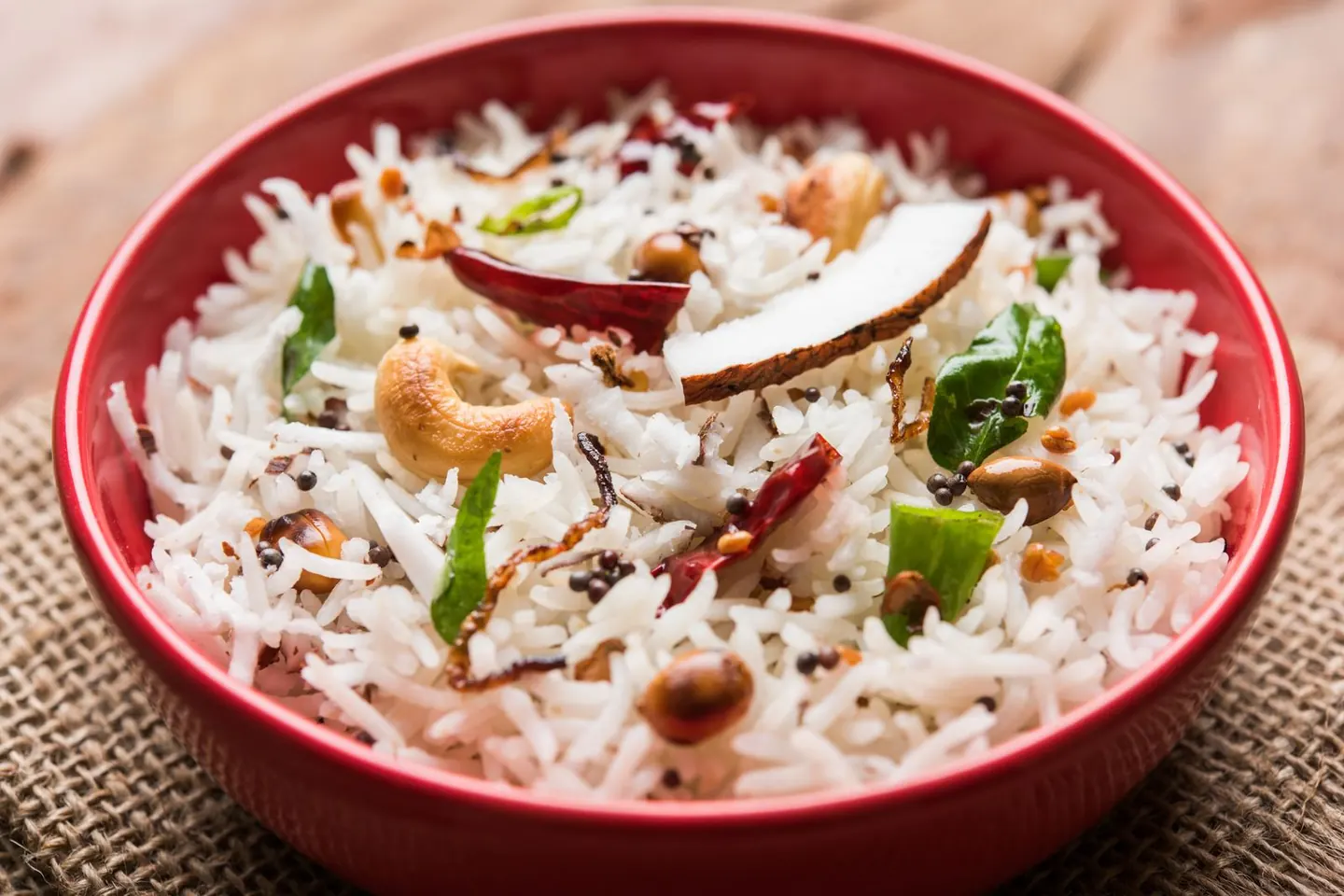
Chapter 17 — Rice, Grains and the Grain Question in Practice
Chapter 7 ended in four words and no prohibition. Portion, polish, pulse, plate. This chapter is those four words turned into pans, water ratios and weights, and the first thing to say is what it refuses to do. It does not tell you to stop eating rice, and it does not treat choru as a vice to be managed. A book that asked a Malayali household to give up rice would be asking it to give up the organising centre of every meal it knows how to cook, and it would fail — not for want of willpower, but because the instruction is unworkable. What follows is rice cooked properly, weighed once, and put on a plate that has other things on it.
Portion is the largest lever and it is the one that needs a number. The quarter of the plate this book gives to grain means 125 to 150 g of cooked rice, which is 48 to 58 g dry. Two rice meals a day at that size puts you at 250 to 300 g of cooked rice, inside the middle bands of the PURE cohort rather than its highest, where the South Asian hazard ratio was 1.61 (Bhavadharini et al., 2020). Here is what that weight looks like. A 200 ml cup of cooked rice is about 150 g, the conversion PURE itself used. On a 23 cm plate, 130 g of cooked matta occupies less than you expect: a mound about 9 cm across and 3 cm high, inside one quarter of the plate with a clear margin. In a serving spoon it is smaller still, and this is where readers get their surprise. A standard steel thavi holds 60 to 75 g of cooked rice, level. Two of those is your portion. Most people serve four to six without noticing, which is how a 130 g quarter-plate becomes a 400 g plate in four seconds of muscle memory.
So weigh it once. Serve yourself rice the way you always have, put the plate on the scale, and look at the number. Then weigh out 130 g and look at that. Fill your own serving spoon, weigh what it holds, and from that morning you can serve by eye for the rest of your life. That is the entire training, it takes four minutes, and it is worth more than every ingredient substitution in this chapter combined.
Polish is a purchasing decision, made once at the shop, that then asks nothing of you: unpolished or minimally milled parboiled matta or red rice, on the strength of 57.6 against 79.6 for the same Indica variety brown and at 9.7% polish (Shobana et al., 2017), and a measured glycaemic index of 38 for Rose Matta in Kerala (Pavithran et al., 2020). Accept the longer cooking and the firmer bite; both are what rice was before the mills got faster.
Pulse is the instruction with the cleanest evidence in this book: 50 g cooked, minimum, on every plate that carries rice (Mohan et al., 2014). It is why R023 exists as a whole recipe rather than a footnote, and why R020's second variation is the one to cook on a weeknight.
Plate is the frame. Rice eaten off a plate that is half vegetables behaves differently from the same rice eaten off a plate that is nine-tenths rice with a curry poured over it, and no varietal choice compensates for the second arrangement.
Two housekeeping notes before the recipes. The nutrition panels in this chapter use ICMR-NIN IFCT 2017 A014, parboiled milled rice, for all matta and red rice. IFCT 2017 contains no matta-specific entry and this book will not print one it cannot source; parboiled milled rice is the closest documented food, and matta's real fibre figure is probably a little higher than the 3.74 g per 100 g used here. And R016, the chilled-rice method, carries a safety warning that is not decorative. If you use insulin or a sulfonylurea, read the box before you read the method.
On the 70:30 salt. Recipes in this chapter offer M07, the 70% sodium chloride / 30% potassium chloride blend, in place of some or all of the salt, and the Blood pressure notes give the lower sodium figure it produces. Potassium-enriched salt is not for everyone: do not use M07, or any potassium-based salt substitute, without your doctor's approval if you have chronic kidney disease, or if you take a RAAS inhibitor (an ACE inhibitor, names ending -pril, or an angiotensin receptor blocker, names ending -sartan), a potassium-sparing diuretic (spironolactone, eplerenone, amiloride), or a potassium supplement. Read the safety box at M07 in full before you make the jar. Where M07 is not suitable, use ordinary salt at the same weight and take the higher, plain-salt sodium figure, or work with M06 and the acid-and-aroma techniques of Chapter 10 instead. This book does not tell anyone to change or stop a medicine.
R015 · Matta Rice, Properly Cooked [LOW SODIUM] [LOW SAT FAT] [VEGAN]
Kerala's parboiled red rice, by absorption and by draining
ICONS: P · B · F · L
THE RE-ENGINEERING: Nothing is taken out of the rice. What changes is that it is weighed — 50 g dry a head instead of an unmeasured scoop — and that the grain is unpolished parboiled rather than polished white.
This is the foundation recipe of the book, and the one most often got wrong in diaspora kitchens, where matta arrives in a 5 kg sack and is then cooked like basmati. It is not basmati. It is a hard, parboiled, pigmented grain that wants a soak and a long simmer, and it will stay stubbornly chalky at the centre if you rush it. Cooked properly it is faintly nutty, pinkish-fawn, and firm enough to stand under a fierce fish curry without dissolving into it. Get this right and forty recipes downstream get easier.
Serves 4 · about 130 g cooked rice per portion Active 10 minutes · Total 45 minutes (plus 30 minutes soaking — recommended) Difficulty: Easy
EQUIPMENT: Heavy 3-litre pan with a well-fitting lid, or a 3-litre uruli. Digital scale reading to 1 g. Substitute: a pressure cooker works for the absorption method at 2 whistles, then 8 minutes on the lowest flame; you lose the ability to see the grain and gain about 12 minutes.
INGREDIENTS
- 200 g (1 cup) unpolished parboiled matta or Kerala red rice
- water to rinse
- 500 ml water, for the absorption method or 2 litres water, for the drained method
- 2 g (⅓ tsp) M07 the 70:30 salt, optional
SOURCING NOTE: Ask for rosematta, Palakkadan matta, unda matta or "Kerala red parboiled rice". In the UK and Gulf, Indian and Sri Lankan grocers stock it in 5 and 10 kg bags; in the US and Canada, South Asian shops and online sellers do. The words to look for on the sack are parboiled and unpolished or single-polished; "extra polished" and "silky" are the ones to put back. Sri Lankan rathu kekulu is a very close substitute and often easier to find. If nothing red is available, brown parboiled long-grain is the next best thing — cook it as below, expect a blander grain, and keep the portion the same.
ALLERGENS: None of the major allergens.
METHOD
Both methods begin here.
- Rinse the rice in a bowl of cold water, rubbing it between your palms and pouring off the cloudy water, three or four changes, 1–2 minutes in all, until the water runs almost clear. It will never go completely clear with matta, because some of the colour is in the grain, not on it.
- Soak in fresh cold water to cover by 3 cm for 30 minutes. Drain. Soaking is not compulsory but it cuts 12–15 minutes off the simmer and gives a more evenly cooked grain; unsoaked matta needs 35–40 minutes rather than 20–25.
Absorption method — for everyday rice, and the method that keeps the most of the grain's minerals.
- Combine the drained rice with 500 ml water and the salt in the pan. Bring to a full rolling boil uncovered over a high flame, 4–6 minutes.
- Reduce to the lowest flame the hob will hold, cover, and leave undisturbed for 20–25 minutes if soaked, 35–40 if not. Do not lift the lid in the first 15 minutes. It is done when no free water shows if you tilt the pan, the surface is pocked with small craters, and a grain pressed against the roof of your mouth gives way completely with no chalky core.
- Rest off the heat, still covered, for 8–10 minutes. This is not optional: the outer layers are wetter than the centre at the moment the heat goes off, and resting equalises them. Fork through once, lightly, from the edge inwards.
Yield: about 260 g of cooked rice per 100 g of raw rice, so 200 g raw gives about 520 g cooked, which is four portions of 130 g.
Drained method — the traditional Kerala way, and the one to use if arsenic is on your mind.
- Bring 2 litres of water to a hard boil in the pan. Add the drained rice and the salt and keep it at an open, visible boil, uncovered, stirring once or twice so nothing sits on the base.
- Boil for 25–30 minutes if soaked, 35–40 if not, until a grain squashed between finger and thumb flattens into a smooth paste with no hard speck at the centre. Start testing at 22 minutes; matta goes from firm to soft over about four minutes and then keeps going.
- Drain through a colander, tilting the pan away from you. Keep the kanji vellam if you want it, in a jug, and let the rice steam dry in the colander for 3–4 minutes.
Yield: about 250 g of cooked rice per 100 g of raw rice, so 200 g raw gives about 500 g cooked, which is four portions of 125 g.
The blanch-and-finish variant, for the lowest arsenic. Boil the rinsed rice in 2 litres of pre-boiled water for 5 minutes, drain completely, then return it to the pan with 400 ml fresh boiling water and finish by absorption as in steps 4 and 5. This is the "parboiled and absorbed" sequence that removed 73% of inorganic arsenic from white rice and 54% from brown in Menon et al. (2021).
On rinsing, draining and arsenic, without the alarm. Rice takes up more inorganic arsenic from soil and water than other cereals, and the European Food Safety Authority, reviewing the evidence in 2024, set a reference point of 0.06 µg per kg of body weight per day and concluded that consumer exposure in food "raises a health concern" — margins of exposure of 2.0 to 0.4 for average consumers. That is a reason for a technique, not for anxiety, and Kerala already has the technique: rinse well, cook in generous water, pour the water off. What that costs is real and worth knowing. Draining white rice this way took 22% of its magnesium and 48% of its potassium in the same study, along with the water-soluble B vitamins that parboiling worked to drive inward. Which is the argument for unpolished parboiled rice as your base: it starts with more to lose. If you eat rice twice a day, drain. If you eat it four times a week, the absorption method is a reasonable choice and the minerals are worth more to you than the margin.
WHY THIS WORKS
Parboiling gelatinises the starch inside the intact husk and drives water-soluble B vitamins inward, which is why milled parboiled rice carries 0.17 mg of thiamine per 100 g against 0.05 mg in raw milled rice. That same pre-gelatinisation hardens the grain, so matta needs longer cooking and more water than white rice, and holds its shape in a gravy instead of collapsing.
PER SERVING (estimated)
| kcal | kJ | Carb | Fibre | Net carb | Sugars | Protein | Fat | Sat fat | Sodium |
|---|---|---|---|---|---|---|---|---|---|
| 176 | 736 | 40.5 g | 1.9 g | 38.6 g | 0.1 g | 3.9 g | 0.3 g | 0.1 g | 140 mg |
From ICMR-NIN IFCT 2017 A014, rice, parboiled, milled — IFCT 2017 has no matta or red-rice entry, so this is the closest documented food and the panel should be read as parboiled milled rice, not as matta specifically. Matta's fibre is probably somewhat higher than the 3.74 g per 100 g used here.
IF YOU ARE WATCHING… Blood sugar: the glycaemic load of this portion is where the argument lives. At 38.6 g of net carbohydrate and the glycaemic index of 38 measured for Rose Matta in Kerala (Pavithran et al., 2020), the load is about 15; at a published Indian value of 57.6 for unpolished parboiled rice (Shobana et al., 2017), about 22. Either is a moderate meal. Double the portion and you double the number, which is the whole point of weighing it. Blood pressure: 140 mg of sodium per portion, and you can cook it with none at all — the curry beside it carries the salt. Against a 2,000 mg daily target that leaves the day's budget essentially untouched. Cholesterol: 0.1 g of saturated fat. Rice is not where your saturated fat comes from; the coconut milk, the ghee and the oil are.
SWAP IT
- Matta → brown parboiled long-grain. Cooks in similar time, milder and less interesting, and it will not stand up to a Kottayam fish curry the way matta does.
- Matta → white raw rice (pachari). Faster and softer, and you give up the thiamine advantage and most of the glycaemic one. Keep the 50 g dry portion, which now matters more.
- Absorption → pressure cooker. Same yield, no visual control, and matta overcooks in a pressure cooker within about 90 seconds of the right point.
SCALE IT
| Serves | Raw rice | Absorption water | Drained water | Cooked yield | Per portion |
|---|---|---|---|---|---|
| 2 | 100 g | 250 ml | 1.5 litres | about 260 g | 130 g |
| 4 | 200 g | 500 ml | 2 litres | about 520 g | 130 g |
| 6 | 300 g | 720 ml | 3 litres | about 780 g | 130 g |
| 10 | 500 g | 1.15 litres | 4.5 litres | about 1.3 kg | 130 g |
Above 500 g the absorption ratio drops slightly because proportionally less water evaporates, which is why the 10-serving row is 2.3 rather than 2.5 parts water.
MAKE AHEAD · STORE · FREEZE Best within an hour of cooking. Fridge 24 hours only, and get it there fast: spread it in a shallow covered container and refrigerate within 1 hour of cooking. Freeze 1 month in 130 g portions, flat in bags. Reheat once and once only, with a tablespoon of water, covered, until steaming hot right through — 2–3 minutes in a pan, 90 seconds to 2 minutes in a microwave. Never reheat the same rice twice. These are the UK Food Standards Agency's limits for cooked rice, not this book's: chill ideally within one hour, keep no more than one day, and never reheat rice more than once.
LEFTOVERS Cold matta is the base of R016. Otherwise: fry a portion with a beaten egg and a handful of chopped greens for a fast breakfast, or drop it into R020 with extra water for an instant kanji.
SERVE WITH R023 Kerala Khichdi principles apply to any rice meal — put a pulse on the plate. R081 Moru Curry · R084 Ulli Theeyal · R086 Rasam · M07 the 70:30 salt
TROUBLESHOOTING Chalky white core after 30 minutes: not enough water, or the flame was too low to hold a simmer. Add 100 ml boiling water, cover, and give it 8–10 minutes more. Gluey, collapsed grains: overcooked by three or four minutes, or stirred during the simmer. Stirring rice releases surface starch; the absorption method wants no stirring at all. Rice tastes flat and smells of nothing: the sack is old. Matta's oils go stale within about six months of milling; buy smaller bags more often and keep them sealed away from heat.
NOTES
R016 · The Chilled-and-Reheated Rice Method [LOW SODIUM] [LOW SAT FAT] [VEGAN]
Cooked rice, chilled overnight, reheated once
ICONS: P · B · F · L
THE RE-ENGINEERING: The rice is unchanged. Twenty-four hours at 4°C (39°F) converts a little of its gelatinised starch into a crystalline form that digests more slowly, and reheating does not undo it.
READ THIS BEFORE YOU USE THIS METHOD
If you take insulin or a sulfonylurea, do not adopt this method as a routine without speaking to the clinician who set your dose.
In 32 adults with type 1 diabetes on pump therapy, long-grain white rice chilled for 24 hours at 4°C (39°F) and reheated produced a lower peak glucose (9.9 against 11.0 mmol/L, P = 0.0056), a smaller maximum rise (2.7 against 3.9 mmol/L, P < 0.0001), and 12 hypoglycaemic episodes against three (P = 0.0039) — because participants dosed insulin for the carbohydrate count they were used to (Strozyk et al., 2022). The technique worked exactly as intended, which is precisely why people went low. Sulfonylureas — glimepiride, gliclazide, glibenclamide — carry the same logic, because they raise insulin whether or not glucose is rising.
This book does not tell anyone to change or stop a medicine, and it does not tell you what your dose should be. It tells you that this method changes the glucose response of a food whose dose you have already calibrated, that the change is in the direction of lower, and that the person who set the dose needs to know.
The second warning is about bacteria, and it applies to everyone. Cooked rice carries Bacillus cereus spores that survive cooking; left to cool slowly at room temperature they germinate and produce a toxin that reheating does not reliably destroy. The UK Food Standards Agency's Home food fact checker is the authority for every number in this paragraph. Chill "as quickly as possible, ideally within one hour" — spread shallow in a covered container, and divide it into smaller portions, which is the FSA's own suggestion for getting the temperature down — to 4°C (39°F) or below. "Keep rice in the fridge for no more than one day until reheating." Reheat once, until — in the FSA's words — "it is steaming hot all the way through"; the FDA Food Code puts that at 74°C (165°F) throughout. "You should never reheat rice more than once." Never leave cooked rice out overnight to chill in the morning.
Do not expect much and you will not be disappointed. Resistant starch in freshly cooked white rice measured 0.64 g per 100 g; after 24 hours at 4°C (39°F) and reheating, 1.65 g (Sonia et al., 2015). That is a gain of about one gram of fibre-like material per 100 g of cooked rice. The glycaemic effect in the same study was larger than a gram of fibre would predict — area under the curve about 18% lower — but it came from 15 people over one sitting. This is a refinement to a portioned plate, not a way to make an unportioned one safe.
Serves 4 · about 130 g cooked rice per portion Active 15 minutes · Total 24 hours 45 minutes (of which 24 hours is chilling — required) Difficulty: Easy
EQUIPMENT: Everything for R015, plus a wide shallow container with a lid — a 20 × 20 cm box, not a deep bowl. A fridge thermometer, if you have never checked what your fridge actually runs at. Substitute: a metal tray covered with a plate chills faster than plastic and is the better choice in a hot kitchen.
BEFORE YOU START: Clear a shelf in the fridge and make space in the freezer for a tray or an ice pack. The single most important variable in this recipe is how fast the rice gets from 60°C (140°F) to 4°C (39°F), and a hot box in a crowded fridge does not manage it.
INGREDIENTS
- 200 g (1 cup) unpolished parboiled matta rice, cooked exactly as R015
- 2 g (⅓ tsp) M07 the 70:30 salt, optional
- 2–3 tbsp water, for reheating
SOURCING NOTE: Nothing to source. If you cannot verify that your fridge holds 4°C (39°F) or below — many domestic fridges in warm climates run at 8 to 10°C (46 to 50°F) on the door shelves — buy a fridge thermometer before you use this method at all. At 8°C (46°F) you get the bacteria and not the retrogradation.
ALLERGENS: None of the major allergens.
METHOD
- Cook the rice by either method in R015, and take it off the heat about 2 minutes earlier than you would for eating fresh. Chilled and reheated rice firms up, and rice cooked to perfect softness comes back the following day slightly past it.
- Spread it immediately in the shallow container, no more than 4 cm deep, and break up any clumps with a fork so heat can escape from the middle. A 500 g mound in a bowl takes over 3 hours to reach 4°C (39°F); the same rice spread 4 cm deep takes under 1 hour.
- Cool for 15–20 minutes at room temperature with the lid off, until the steam has stopped rising and the surface feels warm rather than hot to the back of your hand. Sit the container on a frozen tray or an ice pack if the kitchen is above 28°C (82°F).
- Cover and refrigerate at 4°C (39°F) or below for 24 hours. Longer gives no measured further benefit and takes you outside the storage limit. Label it with the time you put it in, not the date, because the limit is hours.
- Reheat in portions of 130 g with 2–3 tablespoons of water per portion: covered in a pan over a low flame, stirring once, 3–4 minutes; or covered in a microwave, 90 seconds to 2 minutes. It is ready when steam comes off the centre of the portion and the grains have loosened and separated — not merely when the outside is warm.
- Serve at once, and discard anything not eaten. This rice has now been reheated and does not get a second turn.
WHY THIS WORKS
Cooking gelatinises rice starch: the amylose helices unwind and hydrate. As the rice cools below about 10°C (50°F), amylose chains re-associate into tight crystalline double helices — retrogradation — and amylase cannot easily reach the bonds inside them. Those crystallites melt at a far higher temperature than a reheat reaches, which is why the effect survives the pan.
PER SERVING (estimated)
| kcal | kJ | Carb | Fibre | Net carb | Sugars | Protein | Fat | Sat fat | Sodium |
|---|---|---|---|---|---|---|---|---|---|
| 176 | 736 | 40.5 g | 1.9 g | 38.6 g | 0.1 g | 3.9 g | 0.3 g | 0.1 g | 140 mg |
This panel is deliberately identical to R015. Food composition tables do not distinguish retrograded starch from digestible starch, so the printed figures cannot show what changed. Roughly 1 g per 100 g of cooked rice moves from available carbohydrate into resistant starch (Sonia et al., 2015), which across a 130 g portion is about 1.3 g — real, small, and below the resolution of this table. Printing a lower carbohydrate figure here would be inventing precision.
IF YOU ARE WATCHING… Blood sugar: the measured effect was an 18% lower glucose area under the curve in 15 healthy adults, and a substantially lower peak in 32 adults with type 1 diabetes. Treat it as a useful addition to a portioned plate with a pulse on it, not as a replacement for either. Blood pressure: unchanged from R015 at 140 mg per portion. Cholesterol: unchanged. Nothing about chilling rice touches lipids. If you use insulin or a sulfonylurea: re-read the box at the top of this recipe.
SWAP IT
- Matta → any rice. Retrogradation is a property of starch, not of a variety, and the two studies behind this method both used ordinary long-grain white rice.
- Chilled 24 hours → chilled 10 hours at room temperature. Resistant starch measured 1.30 g per 100 g rather than 1.65 g, so you lose about half the gain — and you take on the Bacillus cereus risk that the whole point of rapid chilling is to avoid. This book does not recommend it.
- Reheated → eaten cold, as in a rice salad with lime, chopped shallot and coriander. Slightly more resistant starch retained; a texture some people dislike.
SCALE IT
| Serves | Raw rice | Cooked yield | Container depth | Chill time |
|---|---|---|---|---|
| 2 | 100 g | about 260 g | 3 cm | 24 hours |
| 4 | 200 g | about 520 g | 4 cm | 24 hours |
| 8 | 400 g | about 1.04 kg | two containers, 4 cm each | 24 hours |
Do not scale by using a deeper container. Depth is the variable that decides whether this is safe.
MAKE AHEAD · STORE · FREEZE The recipe is the make-ahead. Fridge 24 hours, no more. Freeze 1 month — freezing after the 24-hour chill preserves the retrograded starch and resets the safety clock, and this is the sensible way to batch it; thaw in the fridge overnight, then reheat once. Reheat once only, to steaming hot throughout.
LEFTOVERS There are no leftovers from this recipe. Rice that has been chilled and reheated is finished. Cook the amount you will eat.
SERVE WITH R023 Kerala Khichdi · R081 Moru Curry · R086 Rasam · R084 Ulli Theeyal
TROUBLESHOOTING Dry, separate, faintly hard grains after reheating: not enough water, or reheated uncovered. Two to three tablespoons per portion and a lid. Sour or faintly fermented smell: the rice cooled too slowly or has been in the fridge longer than 24 hours. Throw it away. This is the one place in the book where the answer is not a rescue. Rice reheated hot outside, cold in the middle: the portion was too large or too dense for the method. Break it up with a fork halfway through and give it another 45–60 seconds.
NOTES
R017 · Ghee Rice, Reworked [LOW SODIUM] [VEGETARIAN]
Neychoru, with the ghee measured
ICONS: P · B · L
THE RE-ENGINEERING: Ghee cut from about 60 g to 15 g across four portions, and the body it used to carry now comes from 120 g of shallots browned slowly and 24 g of cashews, so the aroma survives at under 4 g of ghee a head.
Neychoru — literally ghee rice — is Malabar's wedding rice, the plate that comes under the chicken at every Thalassery feast, and the traditional version is genuinely a ghee dish: a quarter of a cup of it, sometimes more, for four people. Most of that ghee is doing nothing but volume by the time the rice is on the plate. What the dish actually tastes of is browned shallot, whole spice bloomed in fat, and the specific milky nuttiness of ghee at the top of the nose. Fifteen grams gets you all of the third, and slow shallots get you the first two.
Serves 4 · about 190 g per portion Active 20 minutes · Total 45 minutes Difficulty: Easy
EQUIPMENT: Heavy 3-litre pan with a tight lid. Substitute: a pressure cooker, at 2 whistles then 4 minutes on the lowest flame — but the shallots must be browned in the open pan first, whatever you finish it in.
BEFORE YOU START: Slice the shallots and measure the ghee before you light the flame. Cashews go from pale to burnt in about 40 seconds in hot ghee, and there is no time to be looking for the scale.
INGREDIENTS
- 200 g (1 cup) jeerakasala rice, or basmati, rinsed and drained
- 15 g (1 tbsp) ghee
- 24 g (about 16) cashew nuts, halved
- 120 g (about 12) shallots, thinly sliced
- 1 g (½ tsp) black peppercorns
- 4 cm cinnamon, 3 cloves, 3 green cardamom pods, 1 star anise
- 3 g (½ tsp) M07 the 70:30 salt
- 380 ml water
- 10 g (2 tsp) lime juice
- 10 g (2 tbsp) coriander and mint leaves, chopped
SOURCING NOTE: Jeerakasala — sold as kaima — is a short, thin, intensely aromatic Wayanad rice and it needs no soaking, which is exactly why Malabar cooks use it. Look for it in Kerala grocers and online as "Kaima rice", "Jeerakasala" or "Jeeraka shala"; Wayanad Jeerakasala is a registered geographical indication and the bags that say so are usually the better grain. Basmati is the honest substitute and behaves differently: soak it 20 minutes, cut the water to 340 ml, and expect longer, drier grains and a less perfumed pot. Ghee is available everywhere Indian food is sold; use unsalted butter at the same weight if you must, and accept a slightly less nutty result.
ALLERGENS: Milk, tree nuts (cashew).
METHOD
- Melt the ghee in the pan over a medium flame. Add the cashews and stir constantly until they turn the colour of pale straw, 40–60 seconds. Lift them out with a slotted spoon straight away — they keep browning off the heat.
- Add the shallots to the same ghee, all at once, and spread them out. Cook on a medium-low flame, stirring every minute or so, until they have collapsed, given up their water and turned an even light brown with crisp edges, 10–13 minutes. This is where the dish's body comes from, so do not shorten it. If they begin to catch, add a tablespoon of water and carry on.
- Lift out about a third of the shallots for the top and set them on kitchen paper.
- Add the peppercorns, cinnamon, cloves, cardamom and star anise to the pan and stir for 30–45 seconds, until the cardamom smells sweet rather than green and the cinnamon has darkened a shade.
- Add the drained rice and stir gently for 2–3 minutes, until every grain is coated and glossy and the rice smells toasted. Move it with a flat turner, not a spoon, so you do not break the grains.
- Pour in the water, add the salt, and bring to a full boil. Taste the water: it should be very slightly saltier than you want the rice to be.
- Cover tightly, drop to the lowest flame, and cook undisturbed 12–14 minutes, until no free water remains and the surface is dimpled. Jeerakasala is a small grain and overcooks quickly; start checking at 11 minutes.
- Rest off the heat, covered, 8–10 minutes. Fork through with the lime juice, the herbs and the reserved shallots and cashews.
WHY THIS WORKS
Slowly browned shallots do two things fat cannot: their sugars caramelise into aroma compounds, and their collapsed cell walls leave a savoury pulp that coats each grain. Ghee's contribution is almost entirely volatile — short-chain fatty acids and lactones that reach the nose in the first second. Aroma is dose-insensitive where texture is not, so a little ghee, added where you smell it, reads as a lot.
PER SERVING (estimated)
| kcal | kJ | Carb | Fibre | Net carb | Sugars | Protein | Fat | Sat fat | Sodium |
|---|---|---|---|---|---|---|---|---|---|
| 268 | 1,123 | 47.8 g | 2.7 g | 45.1 g | 2.9 g | 5.9 g | 6.7 g | 2.9 g | 210 mg |
Rice from IFCT 2017 A015 (raw milled rice) — jeerakasala is a polished aromatic rice and IFCT has no entry for it. Ghee, shallot and cashew values from USDA FoodData Central generic entries, which this book's nutrition tables do not tabulate.
IF YOU ARE WATCHING… Blood sugar: this is polished aromatic rice and it is the highest-glycaemic grain in the chapter. The portion is 190 g of finished dish, of which about 130 g is cooked rice — the same quarter-plate as everywhere else. Put a pulse and a vegetable beside it, and treat it as a feast dish rather than a Tuesday. Blood pressure: 210 mg per portion, most of it from the M07. Leave the salt out of the cooking water and finish with a pinch at the table and you will be near 60 mg. Cholesterol: 2.9 g of saturated fat per portion, which is what 15 g of ghee across four people costs. The traditional 60 g version would be nearer 10 g each. If you are watching lipids closely, swap the ghee for sesame oil and lose the aroma honestly rather than pretending the ghee is free.
SWAP IT
- Ghee → 15 g gingelly (sesame) oil. Saturated fat per portion drops from 2.9 g to about 1.0 g. You lose the specific milky top note, and the dish becomes good rather than memorable. Say it plainly. (Allergen: this swap introduces sesame.)
- Jeerakasala → matta. It works, it is a better grain metabolically, and it is a different dish: earthier, chewier, less perfumed. Increase the water to 500 ml and the cooking time to 20–25 minutes.
- Cashews → 24 g roasted peanuts. Cheaper, more assertive, less traditional, and about the same fat. (Allergen: this swap introduces peanuts.)
- No star anise → leave it out. Nothing collapses; the pot is slightly less sweet at the back.
SCALE IT
| Serves | Rice | Ghee | Shallots | Cashews | Water | Salt (M07) |
|---|---|---|---|---|---|---|
| 2 | 100 g | 8 g | 60 g | 12 g | 200 ml | 1.5 g |
| 4 | 200 g | 15 g | 120 g | 24 g | 380 ml | 3 g |
| 8 | 400 g | 26 g | 240 g | 48 g | 720 ml | 6 g |
Ghee scales sub-linearly on purpose: a larger pot needs proportionally less to coat the same surface area of grain. Brown 240 g of shallots in two batches or they steam.
MAKE AHEAD · STORE · FREEZE The shallots and cashews can be browned a day ahead and kept in a covered jar at room temperature. Fridge 24 hours for the finished rice, chilled within 1 hour as in R016. Freeze 1 month in 190 g portions. Reheat once, covered, with a tablespoon of water, until steaming hot throughout.
LEFTOVERS Fry cold ghee rice with a beaten egg and a handful of chopped spinach for breakfast, or fold it through R087 for a soft, savoury kanji-adjacent bowl.
SERVE WITH R018 Thalassery Chicken Biryani principles do not apply here — this is the rice you serve with a curry. R081 Moru Curry · R088 Thakkali Curry · M04 Nadan Chicken Masala for a fast chicken to sit beside it
TROUBLESHOOTING Sticky, clumped rice: too much water, or the rice was stirred during the covered cooking. Jeerakasala at 1.9 parts water by weight is right; basmati wants 1.7. Shallots bitter: browned too fast on too high a flame. The line between brown and burnt for sliced shallots is about 45 seconds; a medium-low flame widens it. No aroma at the table: the whole spices went in too early, or the ghee went in at the start and cooked for 25 minutes. Volatiles leave. That is why the reserved shallots and cashews go on at the end.
NOTES
R018 · Thalassery Chicken Biryani, Rebuilt [HIGH PROTEIN]
Jeerakasala, dum-cooked, in a portion you can name
ICONS: P · B
THE RE-ENGINEERING: Fat cut from a typical 120 g of ghee and vanaspati to 18 g of ghee plus 15 g of coconut oil across six portions; skin off the chicken; rice fixed at 50 g dry a head instead of an open pot. The masala, the grain, the raw-chicken method and the sealed dum are untouched.
Thalassery biryani is not a lighter northern biryani. Its distinguishing feature is not technique but grain: it uses jeerakasala, also called kaima, a short, thin, intensely aromatic Wayanad rice that needs no soaking, and it is cooked pakki style, layered and sealed with live charcoal on the lid. The chicken goes into the masala raw, not pre-fried, which is why a properly made one is less oily than its reputation. The vanaspati that fills restaurant versions is an artefact of the Gulf-remittance decades, not of the dish. What follows respects the method and refuses the vanaspati.
Serves 6 · about 320 g per portion, of which about 130 g is cooked rice and about 125 g is chicken Active 55 minutes · Total 1 hour 40 minutes (plus 30 minutes marinating — required) Difficulty: Moderate — three components, one assembly, and a 20-minute window where nothing can be adjusted
EQUIPMENT: Wide heavy pan or uruli, 28–30 cm, with a lid that sits flat. A second pan for the rice. Aluminium foil or a strip of atta dough to seal. Substitute: a cast-iron casserole with a lid is ideal. For the charcoal on the lid, a baking tray of preheated 180°C (350°F) oven does the same job — set the sealed pot on the hob's lowest flame with a tawa underneath and put the whole thing in the oven for 20 minutes instead.
BEFORE YOU START: This dish has three streams and they must be ready together. Marinate the chicken first and let it sit while you slice 300 g of shallots — that is 20 minutes of knife work and the single largest job in the recipe. Have the fried garnish, the herbs and the seal ready before the rice goes on, because from the moment the rice is drained you have about four minutes to assemble.
INGREDIENTS
For the chicken and masala
- 450 g skinless chicken thigh, boneless, in 4 cm pieces
- 300 g skinless chicken breast, in 4 cm pieces
- 80 g (⅓ cup) thick curd, whisked smooth
- 25 g (a 5 cm piece) ginger, and 20 g (about 5 cloves) garlic, ground to a paste with 20 g (about 4) green chillies
- 2 g (1 tsp) ground turmeric
- 2 g (1 tsp) freshly ground black pepper
- 2 g (1 tsp) fennel-heavy Kerala garam masala (M01)
- 15 g (1 tbsp) coconut oil
- 300 g (about 30) shallots, thinly sliced
- 200 g (about 2) tomatoes, chopped
- 2 g (1 tsp) coriander seed, coarsely crushed
- 2 g (1 tsp) cumin seed
- 6 g (1 tsp) M07 the 70:30 salt
- 30 g (about ¾ cup, packed) coriander and mint leaves, chopped
- 15 g (1 tbsp) lime juice
For the rice
- 300 g (1½ cups) jeerakasala (kaima) rice, rinsed and drained, not soaked
- 4 cm cinnamon, 4 cloves, 4 green cardamom pods, 1 bay leaf
- 2 litres water
For the garnish and the seal
- 18 g (1 tbsp) ghee
- 24 g (about 16) cashew nuts, halved
- 15 g (2 tbsp) sultanas
- 10 g (¼ cup) coriander and mint leaves
- a pinch of saffron or 1 g ground turmeric steeped in 30 ml warm milk
SOURCING NOTE: Jeerakasala is the recipe, so try hard before substituting. Kerala grocers in the Gulf, London, Toronto and the New Jersey corridor stock it as "Kaima" or "Jeerakasala"; online sellers ship it everywhere. If you genuinely cannot get it, use basmati and change three things: soak it 20 minutes, boil it 4–5 minutes rather than 6–7, and accept that the finished dish will be longer-grained and less perfumed — recognisably a biryani, not recognisably a Thalassery one. Shallots are not optional either; onions make a sweeter, flatter masala. Where shallots are dear, use 220 g shallots and 100 g red onion.
ALLERGENS: Milk, tree nuts (cashew), sulphites.
METHOD
- Marinate the chicken with the curd, the ginger-garlic-chilli paste, the turmeric, the pepper and the garam masala. Cover and leave 30 minutes at room temperature, or up to 4 hours in the fridge. The chicken does not get fried at any stage, so this is where it takes on flavour.
- Heat the coconut oil in the wide pan and add the shallots all at once with a pinch of the salt. Cook on a medium-low flame, stirring every minute or two, until they have collapsed, lost their water and turned an even golden brown with darker edges, 14–18 minutes. They should smell sweet and faintly jammy, not sharp. Lift out a quarter of them for the garnish.
- Add the crushed coriander and the cumin and stir 30–45 seconds, until they smell toasted.
- Add the tomatoes and cook, stirring, until they have broken down completely and a thin rim of oil shows at the edge of the mass, 8–10 minutes. That rim is the cue that the water has gone.
- Tip in the marinated chicken with all its marinade and the rest of the salt. Raise the flame, stir once, then cover and cook 12–15 minutes, stirring twice, until the chicken is firm, opaque right through, and sitting in a thick masala rather than a liquid one. The thigh pieces should give no resistance to a fork; the breast should be just set. If the masala is loose, uncover and boil it down for 3–4 minutes — a wet masala makes a wet biryani.
- Stir in the chopped herbs and the lime juice, then take the pan off the heat and level the surface. Taste it now: this is the last chance to season anything.
- Boil the rice while the chicken finishes. Bring 2 litres of water with the cinnamon, cloves, cardamom and bay to a hard rolling boil. Add the rinsed rice and boil 6–7 minutes, uncovered, until a grain squeezed between finger and thumb is soft at the edges with a thread of firmness at the very centre — about seven-tenths cooked. It will finish in the dum. Drain immediately and completely; do not rinse.
- Fry the garnish in the ghee in a small pan: cashews first, 40–60 seconds to pale straw; then the sultanas, 20–30 seconds, until they puff. Lift both out. Keep any ghee left in the pan.
- Layer at once, while the rice is steaming. Spread all the drained rice over the chicken masala in an even blanket. Scatter the reserved fried shallots, the cashews, the sultanas and the last of the herbs over the top and trickle over the saffron milk and any remaining ghee. Do not stir.
- Seal the pan: press foil over the rim, or lay a rope of atta dough round it, and set the lid on hard. Put a tawa or heat-diffuser between pan and flame.
- Dum on the lowest possible flame for 20–25 minutes. If you are using charcoal, set three or four live coals on the lid at the start. Do not open it. The rice is finishing in trapped steam and every lift of the lid costs you a minute of it.
- Rest off the heat, still sealed, 10 minutes. Then open it, run a flat turner down the side of the pan to the base, and lift rather than stir — bring the masala up through the rice in sections so each plate gets both layers. Serve by weight the first few times: 320 g on a 23 cm plate, with a pachadi or raita and a pulse beside it.
WHY THIS WORKS
Sealing the pan turns it into a low-pressure steam chamber. The rice, drained at seven-tenths, finishes by absorbing steam and the masala's own volatiles rather than water, so the aroma compounds released by the chicken and shallots condense into the grain instead of leaving through the lid. Putting the chicken in raw means its juices are inside the dish rather than in a discarded frying pan.
PER SERVING (estimated)
| kcal | kJ | Carb | Fibre | Net carb | Sugars | Protein | Fat | Sat fat | Sodium |
|---|---|---|---|---|---|---|---|---|---|
| 549 | 2,299 | 55.2 g | 4.3 g | 50.9 g | 6.1 g | 31.9 g | 23.4 g | 9.1 g | 390 mg |
Chicken from IFCT 2017 N002 (thigh, skinless) and N003 (breast, skinless); rice from A015 (raw milled rice), IFCT having no jeerakasala entry; curd from USDA FoodData Central "Yogurt, plain, whole milk" (FDC 171284). Shallot, tomato, ghee and cashew values from USDA generic entries not tabulated in this book's nutrition tables.
What changed and what did not, exactly. Changed: the frying fat, from a typical 100–120 g of ghee and vanaspati to 18 g of ghee and 15 g of coconut oil across six people; the chicken, from skin-on bone-in pieces browned in fat to skinless thigh and breast going in raw; the rice, from an unmeasured pot to 300 g dry for six, which is the book's 50 g quarter-plate; and the tomato, kept, because Thalassery biryani is a dish of the Portuguese-contact era and no purist claim is being made for its absence. Not changed: jeerakasala as the grain; no pre-frying of the chicken; the curd-and-ginger-garlic marinade; the long shallot browning, which is the flavour engine and cannot be shortened; the whole-spice boiling water for the rice; the seven-tenths draining; the seal; the 20-minute dum on a diffuser; and the resting. Nothing was removed from the spice or the technique. The only culinary loss is the layer of free ghee that pools at the bottom of a restaurant pot, and that layer was never flavour.
IF YOU ARE WATCHING… Blood sugar: 50.9 g of net carbohydrate is the largest single figure in this chapter, and it is a whole main course rather than a side. It is built to be eaten as the meal, with a pachadi and a pulse, not with a parotta on the side. If your glucose runs high, cut the rice to 250 g dry for six — 42 g a head — and add a third more vegetable to the plate; the dish survives it. Blood pressure: 390 mg per portion is the highest sodium figure in this chapter and it does not earn the low-sodium icon. Two ways down: drop the M07 to 4 g and finish with lime rather than salt, which brings it to about 300 mg; or leave the salt out of the rice water entirely, which the drained rice barely notices, for about 340 mg. Against a 2,000 mg daily target this is a fifth of the day in one plate, so plan the rest of it. Cholesterol: 9.1 g of saturated fat per portion is honest and it is not small. Most of it is the chicken's own fat plus the ghee. Using all breast instead of half thigh takes it to about 7 g; dropping the ghee and using coconut oil for the garnish takes it to about 8 g and costs you the aroma. A traditional restaurant portion would be nearer 20 g. This dish needs some of its fat and the book is not going to pretend otherwise.
SWAP IT
- Chicken → 900 g bone-in skinless chicken. Better flavour, more work at the table, and the weights change: reckon 150 g bone-in as 100 g meat, and add 4–5 minutes at step 5.
- Chicken → 750 g firm white fish in 5 cm pieces, added at step 5 for 4–5 minutes only. Protein drops to about 26 g a portion and saturated fat to about 5 g; the dish becomes a meen biryani and is genuinely good. (Allergen: this swap introduces fish.)
- Jeerakasala → basmati. Longer grains, drier mouthfeel, less perfume; soak 20 minutes and boil 4–5.
- Ghee → coconut oil throughout. Saturated fat is barely different, because coconut oil is 90.9% saturated against ghee's roughly 62%. This is not the swap it looks like.
- Curd → thick coconut milk in the marinade. Dairy-free, sweeter, and the chicken tenderises less because you lose the lactic acid.
SCALE IT
| Serves | Chicken | Rice | Shallots | Curd | Ghee | Coconut oil | Dum time |
|---|---|---|---|---|---|---|---|
| 3 | 375 g | 150 g | 150 g | 40 g | 10 g | 8 g | 15–18 minutes |
| 6 | 750 g | 300 g | 300 g | 80 g | 18 g | 15 g | 20–25 minutes |
| 12 | 1.5 kg | 600 g | 600 g | 160 g | 30 g | 26 g | 30–35 minutes |
Brown 600 g of shallots in two batches. Above 12 servings, cook two pots rather than one deep one: a 10 cm layer of rice does not dum evenly.
MAKE AHEAD · STORE · FREEZE The chicken masala can be made a full day ahead and is arguably better for it — cool it fast, refrigerate, and bring it back to a simmer before you layer. Fridge 3 days, covered. Freeze 2 months, in portions, masala and rice together; the rice softens a little on thawing and the chicken does not suffer. Reheat covered with 2 tablespoons of water per portion, over a low flame or in a 160°C (325°F) oven for 20–25 minutes, until steaming hot right through. Chill within 1 hour of serving, as for any cooked rice.
LEFTOVERS Cold biryani reheats better than almost anything else in this chapter. Otherwise: pull the chicken out and fold it through R081, or fry the rice with a beaten egg and shredded cabbage for a very good and entirely inauthentic breakfast.
SERVE WITH R081 Moru Curry · R087 Moru Kachiyathu · R088 Thakkali Curry · a raita from Chapter 23 · M01 Kerala Garam Masala
TROUBLESHOOTING Rice mushy at the bottom, hard on top: the masala was too wet at step 6, or the flame was too high during the dum. Boil the masala down until a spoon drawn across the base leaves a clear track. Rice hard throughout after the dum: it was drained too early — under six minutes — or the seal leaked. Sprinkle 60 ml of hot water over the surface, reseal, and give it 8–10 minutes more. Bland, despite everything: the shallots were not browned far enough. Fourteen minutes is the floor and eighteen is better; pale shallots make a pale biryani no quantity of garam masala will rescue. Chicken breast dry and stringy: it cooked with the thigh for the full 15 minutes. Add the breast pieces 5 minutes after the thigh next time.
NOTES
R019 · Vegetable Pulao with Jeerakasala [LOW SODIUM] [HIGH FIBRE] [VEGETARIAN]
One pot, 360 g of vegetables, and the aromatic rice of Wayanad
ICONS: V · P · B · L
THE RE-ENGINEERING: The vegetable-to-rice ratio inverted — 360 g of vegetables against 200 g of dry rice, where a restaurant pulao runs the other way — and the fat held at 17 g for four, with green peas standing in as the plate's pulse.
A pulao is the easiest dish in this chapter to turn into a plate rather than a pile, because the vegetables cook in the same pot and no one thinks it strange. The trick is to cut them so they survive: batons and thick coins rather than dice, going in at the same time as the rice, so they are cooked through and still distinct when the lid comes off. Green peas do double duty here as vegetable and as the pulse the book asks for on every rice plate, at 120 g cooked for four.
Serves 4 · about 300 g per portion Active 20 minutes · Total 45 minutes Difficulty: Easy
EQUIPMENT: Heavy 3-litre pan with a tight lid. Substitute: a pressure cooker at 2 whistles then 3 minutes on the lowest flame; the vegetables come out softer than ideal.
BEFORE YOU START: Cut all the vegetables before you light the flame, and cut them the right size — carrots in 4 cm batons the thickness of a pencil, beans in 3 cm lengths. Diced vegetables disintegrate in a covered pot in 14 minutes.
INGREDIENTS
- 12 g (2½ tsp) coconut oil
- 5 g (1 tsp) ghee
- 16 g (about 11) cashew nuts, halved
- 4 cm cinnamon, 3 cloves, 3 green cardamom pods, 1 bay leaf
- 2 g (1 tsp) cumin seed
- 100 g (about 10) shallots, thinly sliced
- 12 g (a 2.5 cm piece) ginger, finely chopped
- 10 g (about 3 cloves) garlic, finely chopped
- 12 g (about 2) green chillies, slit
- 200 g (1 cup) jeerakasala (kaima) rice, rinsed and drained
- 120 g (about 1 large) carrot, in pencil-thick 4 cm batons
- 120 g (1 cup) green beans, in 3 cm lengths
- 120 g (¾ cup) green peas, fresh or frozen
- 1 g (½ tsp) black peppercorns, coarsely crushed
- 3 g (½ tsp) M07 the 70:30 salt
- 380 ml water
- 15 g (3 tbsp) coriander and mint leaves, chopped
SOURCING NOTE: See R017 for jeerakasala. Frozen green peas are entirely fine here and often sweeter than fresh ones that have travelled; add them in the last 5 minutes rather than at the start. Where fresh green beans are poor, use 120 g of frozen French beans, or 150 g of cauliflower in small florets, which holds up better than either.
ALLERGENS: Milk, tree nuts (cashew).
METHOD
- Heat the coconut oil and ghee in the pan over a medium flame. Fry the cashews to pale straw, 40–60 seconds, and lift them out.
- Add the cinnamon, cloves, cardamom, bay and cumin and stir 30–45 seconds, until the cumin darkens a shade and smells nutty.
- Add the shallots and cook on a medium-low flame, stirring, until soft, translucent and just beginning to colour at the edges, 6–8 minutes. You want them sweet, not browned — a pulao is not a neychoru.
- Add the ginger, garlic and green chilli and cook until the raw garlic smell has lifted, 90 seconds to 2 minutes.
- Add the drained rice and the crushed pepper. Stir gently with a flat turner for 2–3 minutes, until every grain is glossy and the rice smells toasted.
- Add the carrot and beans, the salt and the water. Bring to a full boil, then taste the water and adjust.
- Cover tightly, drop to the lowest flame, and cook undisturbed 12–14 minutes. At 9 minutes, lift the lid once and scatter the peas over the surface without stirring, then cover again.
- Rest off the heat, covered, 8–10 minutes. It is done when the rice is tender with no chalky core, the carrot batons still hold their shape under a fork, and no free water shows at the base of the pan. Fork through with the herbs and cashews.
WHY THIS WORKS
Vegetables cut in batons have less surface area per gram than dice, so they lose less water into the pot and less texture to the steam. They also raise the dish's mass without raising its available carbohydrate much: 360 g of carrot, beans and peas adds about 24 g of net carbohydrate and 11 g of fibre, so the same rice arrives on a plate of far lower energy density.
PER SERVING (estimated)
| kcal | kJ | Carb | Fibre | Net carb | Sugars | Protein | Fat | Sat fat | Sodium |
|---|---|---|---|---|---|---|---|---|---|
| 313 | 1,308 | 57.2 g | 6.1 g | 51.1 g | 6.7 g | 8.2 g | 6.7 g | 3.7 g | 240 mg |
Rice from IFCT 2017 A015. Carrot, green beans, green peas, shallot, cashew and ghee from USDA FoodData Central generic SR Legacy entries, which this book's nutrition tables do not tabulate.
IF YOU ARE WATCHING… Blood sugar: 51.1 g of net carbohydrate for a one-pot main is moderate, and 6.1 g of fibre and 8.2 g of protein alongside it slow the whole thing down. The peas are doing real work here: 120 g of green peas is more than the 50 g of cooked pulse this book asks for on a rice plate. Blood pressure: 240 mg per portion, and the carrots contribute a surprising 20 mg of it. Halve the M07 for about 170 mg. Cholesterol: 3.7 g of saturated fat, most of it from 12 g of coconut oil across four people. Swap to gingelly oil for about 1.6 g and a nuttier, less sweet pot.
SWAP IT
- Jeerakasala → matta. Increase water to 500 ml and cooking time to 20–25 minutes; add the vegetables at the 10-minute mark instead of the start, or they overcook.
- Green peas → 120 g cooked vanpayar or kadala, folded through at step 8. Fibre goes up by about 2 g a portion and the dish becomes noticeably more filling.
- Coconut oil → gingelly (sesame) oil. Saturated fat halves; the aroma turns nutty and slightly darker, which suits this dish well. (Allergen: this swap introduces sesame.)
- No cashews → 16 g roasted peanuts, or nothing at all. Without them the pulao is leaner and less festive. (Allergen: this swap introduces peanuts.)
SCALE IT
| Serves | Rice | Vegetables (total) | Shallots | Coconut oil | Ghee | Water | Salt (M07) |
|---|---|---|---|---|---|---|---|
| 2 | 100 g | 180 g | 50 g | 6 g | 3 g | 200 ml | 1.5 g |
| 4 | 200 g | 360 g | 100 g | 12 g | 5 g | 380 ml | 3 g |
| 8 | 400 g | 720 g | 200 g | 20 g | 8 g | 720 ml | 6 g |
MAKE AHEAD · STORE · FREEZE The vegetables can be cut a day ahead and kept in a closed box in the fridge. Fridge 24 hours, chilled within 1 hour of cooking. Freeze 1 month; the carrots come back a little softer and the peas are unaffected. Reheat once, covered, with a tablespoon of water per portion, until steaming hot throughout.
LEFTOVERS Cold pulao with a spoonful of curd and a squeeze of lime is a decent packed lunch. Or thin it with 200 ml water and a pinch of pepper into a rough vegetable kanji.
SERVE WITH R081 Moru Curry · R087 Moru Kachiyathu · R083 Kumbalanga Pulissery · a pachadi from Chapter 23
TROUBLESHOOTING Vegetables mushy, rice fine: they were diced rather than cut in batons, or the peas went in at the start. Batons, and peas at 9 minutes. Rice cooked, vegetables still hard: the carrot was cut too thick. Pencil thickness is the target; anything above 1 cm needs a 5-minute head start in the pan. Watery base: too much water for the vegetables' own moisture. Frozen vegetables release liquid, so cut the water to 340 ml when you use them.
NOTES
R020 · Kanji, Three Ways [LOW SODIUM] [VEGAN] [UNDER 250 KCAL]
Rice gruel: plain, with a pulse, and tempered
ICONS: P · B · L
THE RE-ENGINEERING: Nothing is removed, because kanji was never the problem. What changes is that the second version — rice cooked with whole green gram — becomes the default rather than the invalid's option, on the strength of the pulse evidence.
Kanji is what Kerala eats when it is ill, when it is fasting, when the monsoon has taken the appetite, and when there is nothing else. It is also, read coldly, one of the best-designed dishes in the state: a small quantity of grain, a large quantity of water, eaten hot and slowly with a spoon, which is a description of a low-energy-density meal that takes time to eat. Three finished versions follow from one pot. The first is what an ammachi would give a fevered child. The second is the one to cook on a weeknight. The third is dinner.
Serves 2 · about 380 g per portion in every version Active 10 minutes · Total 40 minutes (plus overnight soaking for version two — required) Difficulty: Easy
EQUIPMENT: Heavy 2-litre pan with a lid. A small cheena chatti or steel ladle for the tempering in version three. Substitute: any pan deep enough that a starchy liquid at a rolling boil will not climb out of it — allow twice the height of the finished gruel.
BEFORE YOU START: For version two, the whole green gram goes into water the night before. For version three, have the tempering ingredients in one small bowl beside the hob; mustard seeds pop for about 15 seconds and everything else has to be ready to follow them.
INGREDIENTS
The base, common to all three
- 60 g (⅓ cup) unpolished parboiled matta rice, rinsed
- 750 ml water
- 1 g (¼ tsp) M07 the 70:30 salt
Version two — with pulse
- 50 g (¼ cup) whole green gram (cherupayar), soaked overnight
- a further 0.5 g M07, and 200 ml more water
Version three — savoury and tempered
- 80 ml second-extraction coconut milk (M08)
- 4 g (1 tsp) coconut oil
- 1 g (¼ tsp) mustard seed
- 40 g (about 4) shallots, thinly sliced
- 1 dried red chilli, broken
- 2 g (1 sprig) curry leaves
- a further 0.5 g M07
SOURCING NOTE: Matta gives the best kanji because parboiled grain releases its starch slowly and holds a little bite even when the liquid has thickened; white raw rice turns to paste. Broken matta — sold cheaply as nurukku or "rice rava" — is traditional for kanji and cooks in about half the time. Whole green gram is in every South Asian shop as moong or mung; use split moong dal if you must, at 40 g and no soaking, and accept a softer, less nutty result with about 4 g less fibre per portion.
ALLERGENS: Mustard.
METHOD
- Combine the rinsed rice with 750 ml water and the salt in the pan, uncovered, over a high flame. For version two, add the drained soaked green gram at the same time along with the extra 200 ml water and 0.5 g salt — rice and pulse cook together from cold.
- Bring to a boil, then drop to a low flame so it holds a slow, lazy bubble. Stir once at the start and then leave it; stir a kanji constantly and you get glue.
- Simmer uncovered 28–35 minutes, until the grains have split open and softened completely and the liquid has thickened to the consistency of single cream — it should coat the back of a spoon and slide off it, not cling. Add 100 ml boiling water if it thickens faster than the grain softens. For version two, allow 35–40 minutes; the green gram should collapse under a spoon with no firmness at the skin.
Stop here for version one. Serve it hot, in a bowl, with a small dish of coarse salt, a spoonful of chammanthi or a piece of pickle, and — traditionally — 30 g of grated coconut on the side.
Stop here for version two. This is the one to cook most nights: the pulse arrives with the grain, which is the direct point of the fifty-gram rule.
For version three, continue.
- Stir in the second coconut milk off the heat, or at the barest tremble where a bubble breaks every few seconds. Second milk carries far less fat than first milk and will tolerate a little heat, but a rolling boil will still turn it grainy. Warm through 1–2 minutes.
- Heat the coconut oil in the small pan over a medium-high flame until a mustard seed dropped in circles and pops within 2 seconds. Add the mustard seed and cover for the 10–15 seconds it takes to finish popping.
- Add the shallots and the broken chilli and fry, stirring, until the shallots are deep golden and crisp at the edges, 2–3 minutes. Add the curry leaves and stand back — they will spit — and count 10–15 seconds until they go translucent and brittle.
- Pour the whole tempering over the kanji and do not stir it in. The point is that the first spoonful carries crisp shallot and the last carries none.
WHY THIS WORKS
A kanji is about 85% water by weight, so its energy density is around 0.3 kcal per gram against cooked rice's 1.3. Rolls' work on satiety shows people eat a fairly constant weight of food, which is precisely why 60 g of dry rice served as gruel fills two people and the same 60 g served drained does not. Adding a pulse then attacks the glucose response too.
PER SERVING — VERSION ONE, PLAIN (estimated)
| kcal | kJ | Carb | Fibre | Net carb | Sugars | Protein | Fat | Sat fat | Sodium |
|---|---|---|---|---|---|---|---|---|---|
| 106 | 442 | 24.2 g | 1.1 g | 23.1 g | 0.1 g | 2.3 g | 0.2 g | 0.0 g | 140 mg |
PER SERVING — VERSION TWO, WITH PULSE (estimated)
| kcal | kJ | Carb | Fibre | Net carb | Sugars | Protein | Fat | Sat fat | Sodium |
|---|---|---|---|---|---|---|---|---|---|
| 179 | 749 | 40.1 g | 5.4 g | 34.7 g | 0.7 g | 8.0 g | 0.4 g | 0.1 g | 210 mg |
PER SERVING — VERSION THREE, SAVOURY AND TEMPERED (estimated)
| kcal | kJ | Carb | Fibre | Net carb | Sugars | Protein | Fat | Sat fat | Sodium |
|---|---|---|---|---|---|---|---|---|---|
| 175 | 732 | 29.3 g | 2.3 g | 27.0 g | 2.2 g | 3.5 g | 5.6 g | 4.6 g | 210 mg |
Rice from IFCT 2017 A014 (parboiled milled rice), IFCT having no matta entry. Green gram whole from B011. Second-extraction coconut milk scaled from USDA FDC 170172 as in M08.
IF YOU ARE WATCHING… Blood sugar: version two is the one to choose, and the reason is 25 g of dry whole green gram a head — comfortably above the 50 g of cooked pulse that, added to brown rice, took the glycaemic area under the curve 22.9% below white rice in overweight Asian Indians, against 19.8% for the grain swap alone (Mohan et al., 2014). It also lifts protein from 2.3 g to 8.0 g and fibre from 1.1 g to 5.4 g for 73 kcal. Blood pressure: 140 to 210 mg per portion, which is low, and kanji is a good place to practise eating with less salt because the coconut and the pickle carry the interest. If you use pickle alongside, count it: a teaspoon of commercial lime achar can carry 300 mg on its own. Cholesterol: versions one and two are effectively fat-free. Version three's 4.6 g of saturated fat comes from 80 ml of second coconut milk and 4 g of coconut oil across two people. Use third-extraction milk instead for about 2.5 g.
SWAP IT
- Matta → broken matta (nurukku). Cooks in 15–18 minutes and gives a smoother, more porridge-like gruel. The pulse version still needs 30 minutes for the green gram.
- Whole green gram → 50 g vanpayar (brown cowpea), soaked overnight. Earthier, needs 45–50 minutes, and fibre is similar. This is the version most Kerala households actually eat.
- Second coconut milk → 80 ml cow's milk. Saturated fat drops to about 1.5 g a portion; the dish stops being kanji in the Kerala sense and becomes something closer to a milk porridge. (Allergen: this swap introduces milk.)
- No coconut oil → temper in 4 g gingelly oil. Different aroma, much less saturated fat, and entirely defensible. (Allergen: this swap introduces sesame.)
SCALE IT
| Serves | Rice | Water | Green gram (v2) | Coconut milk (v3) | Coconut oil (v3) |
|---|---|---|---|---|---|
| 2 | 60 g | 750 ml | 50 g | 80 ml | 4 g |
| 4 | 120 g | 1.4 litres | 100 g | 150 ml | 6 g |
| 8 | 240 g | 2.6 litres | 200 g | 280 ml | 10 g |
Water scales sub-linearly because a larger pot loses proportionally less to evaporation. Check the consistency at 25 minutes and add boiling water as needed rather than trusting the table.
MAKE AHEAD · STORE · FREEZE Kanji thickens as it stands and will set almost solid in the fridge; thin it with boiling water on reheating. Fridge 24 hours — the same limit as any cooked rice, chilled within 1 hour in a shallow container. Freeze 1 month for versions one and two; do not freeze version three, because the coconut milk separates and the tempering goes soft. Reheat once, with 60–100 ml of water per portion, to a full simmer.
LEFTOVERS Set, cold kanji can be beaten smooth with a little water and used as part of the liquid in a dosa batter, where the pre-gelatinised starch improves the ferment. Or eat it cold with buttermilk, which is what Kerala does in April.
SERVE WITH R087 Moru Kachiyathu · R084 Ulli Theeyal for the tempered version · a chammanthi or podi from Chapter 23 · M08 Coconut Milk, Three Extractions
TROUBLESHOOTING Thick, gluey and pasty: stirred too often, or cooked too fast so the water went before the grain softened. Add boiling water, drop the flame, and stop stirring. Thin and watery with hard grains: not long enough. Matta takes 28 minutes minimum and unsoaked broken matta about 15; there is no shortcut. Coconut milk split into grains and oil: it boiled. Off the heat next time, or use third extraction, which has too little fat to split. Boiled over: a starchy gruel foams. Use a pan twice the height of the finished liquid and leave it uncovered.
NOTES
R021 · Ragi Kanji [VEGAN] [UNDER 250 KCAL]
Finger millet porridge, with the enthusiasm removed
ICONS: Q · L
THE RE-ENGINEERING: Jaggery cut to 10 g across two portions — about 2 teaspoons total, where the usual bowl carries three or four each — and the millet cooked to a thick, slow-eating porridge rather than a thin drinkable one, because thinness is what costs a millet its glycaemic advantage.
Ragi deserves a place in this book and it does not deserve the claims made for it. Its real advantages are quantified and modest: 11.18 g of total fibre per 100 g against 2.81 g in raw milled rice, and a substantial calcium content. Its protein, at 7.16 g, is lower than rice's 7.94 g, and its energy, at 321 kcal per 100 g, is not much below rice's 356. The dish below is worth cooking because it is good, filling and quick. It is not medicine.
Serves 2 · about 320 g per portion Active 10 minutes · Total 20 minutes Difficulty: Easy
EQUIPMENT: Heavy 2-litre pan; a whisk or a fork. Substitute: nothing needed, but a whisk is the difference between a smooth porridge and one with lumps you cannot break up later.
BEFORE YOU START: Ragi flour must be slaked in cold water before it meets heat. Tip dry flour into hot liquid and you get permanent lumps within four seconds. Mix it cold, then heat it.
INGREDIENTS
- 60 g (½ cup) ragi (finger millet) flour
- 400 ml water, divided: 120 ml cold, 280 ml boiling
- 0.5 g (a pinch) M07 the 70:30 salt
- 150 ml whole milk, or second-extraction coconut milk (M08)
- 10 g (2 tsp) jaggery, grated, or none at all
- 2 green cardamom pods, seeds crushed
- 15 g (2 tbsp) toasted sesame seeds or chopped almonds, optional
SOURCING NOTE: Buy ragi flour in small bags and keep it in the fridge — it is high enough in fat to go rancid within about three months at room temperature, and stale ragi tastes distinctly of cardboard. Whole ragi grain, sprouted and milled at home, makes a noticeably better and coarser porridge; where you can buy sprouted ragi flour (sold as ragi malt or ragi sprouted flour), buy that. Health-food shops in the UK and US sell finger millet flour as "ragi" or "finger millet"; African grocers sell it as bulo or wimbi and it is the same grain.
ALLERGENS: None of the major allergens as the recipe is written. Milk — only if you use dairy milk rather than coconut milk. Tree nuts (cashew) — the ingredient is optional. Sesame — the ingredient is optional.
METHOD
- Whisk the ragi flour into the 120 ml of cold water with the salt until absolutely smooth, 30–45 seconds. Hold the bowl up to the light and look for lumps against the side; they will not disappear later.
- Pour the 280 ml boiling water into the pan and bring it back to a boil.
- Pour the cold slurry into the boiling water in a slow stream, whisking hard and continuously. It will thicken almost at once.
- Cook over a low flame, stirring with the whisk every 20–30 seconds, for 6–8 minutes. It is done when the colour has shifted from grey-mauve to a deeper reddish brown, the raw cereal smell has gone and been replaced by something nutty, and a spoon dragged through the pan leaves a track that closes slowly. Undercooked ragi tastes chalky and mealy, and six minutes is the minimum.
- Stir in the milk or second coconut milk off the heat, along with the jaggery and cardamom. If you are using coconut milk, keep it off the heat entirely.
- Rest 2–3 minutes, which lets it thicken to its final consistency, then scatter the sesame or almonds over and serve warm rather than hot.
WHY THIS WORKS
Ragi's fibre is 85% insoluble, which thickens by holding water rather than by forming a gel, so the porridge sets as it stands and eats slowly. That slowness is most of the benefit. The honest counterweight: in eight healthy adults, a decorticated finger-millet porridge measured a glycaemic index of 93.4, against 55.4 for a wheat formulation (Shobana et al., 2007). Fine milling and thin cooking destroy the advantage.
PER SERVING (estimated)
| kcal | kJ | Carb | Fibre | Net carb | Sugars | Protein | Fat | Sat fat | Sodium |
|---|---|---|---|---|---|---|---|---|---|
| 170 | 712 | 32.0 g | 3.4 g | 28.6 g | 8.4 g | 4.6 g | 3.9 g | 2.2 g | 110 mg |
Ragi from IFCT 2017 A010; milk from IFCT L002. Jaggery costed as sucrose at 98 g of carbohydrate and about 390 kcal per 100 g, the working assumption this book states in its reference tables. Values exclude the optional sesame or almonds, which add about 45 kcal and 4 g of fat per portion.
IF YOU ARE WATCHING… Blood sugar: be honest with yourself about this one. The pooled millet data give a mean glycaemic index of 52.7 against 71.7 for milled rice (Anitha et al., 2021) — a real difference, from a review funded by a millet-promotion endowment and built from before-and-after studies rather than randomised comparisons. Set against it, one careful measurement of a fine-milled finger millet porridge came out at 93.4. The resolution is processing: coarse and thick is where the benefit lives, fine and thin is where it dies. Cook this thick, add the sesame, and eat it with a spoon. Blood pressure: 110 mg per portion, nearly all of it from the milk and the pinch of salt. This is one of the lowest-sodium dishes in the book. Cholesterol: 2.2 g of saturated fat from 150 ml of whole milk between two. Semi-skimmed takes it to about 1.2 g; second coconut milk raises it to about 5.5 g, which is worth knowing before you assume the plant version is the leaner one.
SWAP IT
- Jaggery → nothing, and 15 g of chopped dates instead. Sugars fall by about 2 g a portion and you gain fibre; the sweetness arrives in pockets rather than throughout, which most people find more satisfying.
- Ragi flour → 60 g coarse ragi rava or sprouted ragi flour. Better texture, slower eating, and a plausibly lower glycaemic response for exactly the reason above.
- Milk → 150 ml second coconut milk. Dairy-free, richer, and saturated fat rises from 2.2 g to about 5.5 g a portion.
- Sweet → savoury. Leave out the jaggery and cardamom, use 1 g more salt, and finish with a mustard-and-shallot tempering as in R020 version three. This is the version to eat as a meal rather than a breakfast. (Allergen: this swap introduces mustard.)
SCALE IT
| Serves | Ragi flour | Cold water | Boiling water | Milk | Jaggery |
|---|---|---|---|---|---|
| 2 | 60 g | 120 ml | 280 ml | 150 ml | 10 g |
| 4 | 120 g | 240 ml | 550 ml | 300 ml | 20 g |
| 8 | 240 g | 450 ml | 1.05 litres | 600 ml | 40 g |
Above four servings, whisk in two additions rather than one; a large volume of slurry hitting boiling water at once will lump however hard you stir.
MAKE AHEAD · STORE · FREEZE Best within 20 minutes of cooking. Fridge 2 days in a covered container; it sets firm and needs 60–80 ml of water per portion to come back. Freeze 1 month without the milk, which separates. Reheat over a low flame with added water, whisking, 3–4 minutes, and add the milk off the heat.
LEFTOVERS Cold set ragi kanji can be cut into squares and pan-fried in a teaspoon of oil until crisp at the edges — a Kerala answer to polenta, and better than it sounds. Or thin it with buttermilk and drink it cold, which is what Karnataka does with ragi ambali.
SERVE WITH R087 Moru Kachiyathu for the savoury version · M12 Ragi-Matta Dosa Batter if you want to use the rest of the bag · a chammanthi from Chapter 23
TROUBLESHOOTING Lumps: the flour met hot water. There is no fix once they have formed; pass it through a sieve and start the slaking properly next time. Chalky, raw-cereal taste: under six minutes of cooking. Give it three or four more and watch for the colour to deepen. Bitter: the flour is rancid. Smell the bag; ragi flour older than about three months at room temperature is usually gone. Sets to a solid block in the bowl before you eat it: normal, and the reason to serve it warm rather than hot and to eat it promptly. Thin with a little hot water.
NOTES
R022 · Millet Upma [LOW SODIUM] [HIGH FIBRE] [VEGAN]
Little millet, dry-roasted, with 280 g of vegetables
ICONS: V · P · L
THE RE-ENGINEERING: Semolina replaced with whole little millet, which brings 7.72 g of fibre per 100 g against refined wheat's 2.76 g; the oil held at 12 g for four; and the vegetable weight raised to 280 g, which is more than the millet.
Upma is usually a way of eating refined semolina quickly, and swapping in a whole millet changes its character for the better — nuttier, chewier, and slower to eat. Little millet, samai, is the best of the small millets for this because its grains stay separate, and it carries 10.13 g of protein per 100 g, more than either ragi or rice. Dry-roasting it before the water goes in is not optional: it is what keeps the grains distinct instead of collapsing into porridge.
Serves 4 · about 230 g per portion Active 20 minutes · Total 35 minutes Difficulty: Easy
EQUIPMENT: Heavy 26 cm pan or cheena chatti with a lid; a dry pan for roasting. Substitute: roast the millet in the same pan you cook in, then tip it out and wipe the pan — you lose two minutes and a bowl.
BEFORE YOU START: Everything after the mustard seeds happens in sequence with no pauses. Have the millet roasted and in a bowl, the vegetables cut, the aromatics chopped, the coconut grated and 480 ml of water at a boil in a kettle before you light the flame under the oil.
INGREDIENTS
- 160 g (¾ cup) little millet (samai), rinsed and drained well
- 12 g (2½ tsp) coconut oil
- 2 g (½ tsp) mustard seed
- 15 g (1 tbsp) Bengal gram dal (chana dal)
- 4 g (2 sprigs) curry leaves
- 12 g (about 2) green chillies, slit
- 10 g (a 2 cm piece) ginger, finely chopped
- 80 g (about 8) shallots, thinly sliced
- 100 g (about 1) carrot, in small dice
- 100 g (¾ cup) green beans, in 1 cm lengths
- 80 g (½ cup) green peas, fresh or frozen
- 3 g (½ tsp) M07 the 70:30 salt
- 480 ml boiling water
- 30 g (about ⅓ cup) freshly grated coconut
- juice of half a lime
SOURCING NOTE: Little millet is samai in Tamil, saame in Kannada, kutki in Hindi, and is sold in Indian shops and health-food shops as "little millet". If you cannot find it, kodo millet (varagu) behaves almost identically at the same weight and water. Note the caution in the reference tables: IFCT 2017 labels its A017 "Varagu" entry inconsistently between kodo and foxtail millet, so a foxtail-millet figure from that table is not trustworthy — buy foxtail if you like it, but the panel below is computed for little millet. Frozen peas are fine, added in the last five minutes.
ALLERGENS: Mustard.
METHOD
- Dry-roast the rinsed and thoroughly drained millet in a dry pan over a medium flame, stirring constantly, until the grains are dry to the touch, have turned a shade darker and smell distinctly nutty rather than grassy, 4–6 minutes. Tip into a bowl. Wet millet will not roast; it steams, and you will be there ten minutes.
- Heat the coconut oil in the wide pan over a medium-high flame until a mustard seed dropped in pops within 2 seconds.
- Add the mustard seed and cover for the 10–15 seconds it takes to finish popping. Add the chana dal and stir until it turns pale gold, 45–60 seconds.
- Add the curry leaves, green chilli and ginger — the leaves will spit — and stir 15–20 seconds until the leaves go brittle.
- Add the shallots and cook, stirring, until soft and translucent with the first hint of gold, 4–5 minutes.
- Add the carrot and beans and cook 3–4 minutes, until the carrot has lost its raw edge but still snaps under a spoon.
- Pour in the boiling water with the salt and bring it back to a full boil. Using boiling water rather than cold is what keeps the grains separate.
- Add the roasted millet in a stream, stirring once to distribute it. Cover, drop to the lowest flame, and cook 10–12 minutes. At 8 minutes, scatter the peas over the top without stirring and cover again.
- Rest off the heat, covered, 5 minutes. It is done when the grains are tender and distinct, no free water shows at the base, and the upma comes away from the side of the pan in one mass. Fork through the grated coconut and the lime juice and serve warm.
WHY THIS WORKS
Dry-roasting drives off surface moisture and starts to dextrinise the outer starch, so each grain seals slightly and takes up water more slowly than its neighbours' starch can gelatinise and glue them together. Adding boiling rather than cold water does the same job from the other side: the grain hits gelatinisation temperature before it has time to swell and stick.
PER SERVING (estimated)
| kcal | kJ | Carb | Fibre | Net carb | Sugars | Protein | Fat | Sat fat | Sodium |
|---|---|---|---|---|---|---|---|---|---|
| 264 | 1,103 | 44.2 g | 7.8 g | 36.4 g | 5.6 g | 7.7 g | 8.3 g | 5.6 g | 230 mg |
Little millet from IFCT 2017 A016; chana dal from B001; fresh coconut from H007. Carrot, green beans, green peas and shallot from USDA generic SR Legacy entries not tabulated in this book's nutrition tables.
IF YOU ARE WATCHING… Blood sugar: 7.8 g of fibre per portion is the highest figure in this chapter, and 36.4 g of net carbohydrate is moderate for a full breakfast. The honest caveat from R021 applies here too and rather less severely: this millet is whole and coarse, cooked thick, which is the state in which millets keep their advantage. It is still a starch. Weigh it. Blood pressure: 230 mg per portion. Leave the M07 out and finish with lime and a pinch of plain salt at the table for about 160 mg. Cholesterol: 5.6 g of saturated fat, and almost all of it is the 30 g of grated coconut plus 12 g of coconut oil. Halve the coconut for about 3.8 g, or swap to gingelly oil and keep the coconut for about 4.5 g. The coconut is bringing 3 g of fibre with it, which the oil is not.
SWAP IT
- Little millet → kodo millet (varagu) at the same weight and water. Slightly softer, slightly earthier. Or 160 g broken matta, which makes a rice rava upma and is what most Kerala households cook.
- Little millet → 160 g coarse semolina (rava), for the conventional dish. Fibre drops from 7.8 g to about 3.5 g a portion; it cooks in 6 minutes rather than 12. (Allergen: this swap introduces gluten (wheat).)
- Coconut oil → gingelly oil. Saturated fat drops by about 1.1 g a portion, and the nuttiness suits millet better than it suits rice. (Allergen: this swap introduces sesame.)
- Add 60 g cooked kadala or sprouted green gram at step 9 → protein up about 2.5 g and fibre up about 2 g a portion, and the plate now carries its pulse without a second dish.
SCALE IT
| Serves | Millet | Water | Vegetables (total) | Shallots | Coconut oil | Coconut | Salt (M07) |
|---|---|---|---|---|---|---|---|
| 2 | 80 g | 240 ml | 140 g | 40 g | 6 g | 15 g | 1.5 g |
| 4 | 160 g | 480 ml | 280 g | 80 g | 12 g | 30 g | 3 g |
| 8 | 320 g | 900 ml | 560 g | 160 g | 20 g | 60 g | 6 g |
The 3:1 water ratio drops slightly at eight servings because less evaporates from a deeper pan.
MAKE AHEAD · STORE · FREEZE The millet can be dry-roasted a week ahead and kept in a jar; the vegetables can be cut the night before. Fridge 2 days covered. Freeze 1 month; millet freezes better than rice and comes back with less textural loss. Reheat covered with 2 tablespoons of water per portion until steaming hot throughout, 3–4 minutes.
LEFTOVERS Press cold upma into a flat cake, cut it into wedges and pan-fry in a teaspoon of oil until crisp on both sides — a genuinely good second dinner. Or crumble it into R087 with extra buttermilk.
SERVE WITH R087 Moru Kachiyathu · R086 Rasam · a coconut chammanthi from Chapter 23 · M06 the Low-Sodium All-Purpose Podi
TROUBLESHOOTING Sticky, porridge-like mass: the millet was not roasted, or cold water was used. Both matter; do both. Grains still hard after 12 minutes: not enough water, or the flame was too low to hold a simmer under the lid. Sprinkle 60 ml of boiling water over the surface, cover, and give it 5 minutes more. Bitter aftertaste: the chana dal or the curry leaves burnt. Chana dal turns from gold to brown in about 20 seconds at that heat. Vegetables mushy: they were diced too small or went in too early. Carrots in 6–8 mm dice, beans in 1 cm lengths, and the peas last.
NOTES
R023 · Kerala Khichdi [LOW SODIUM] [HIGH FIBRE] [VEGAN]
Matta rice and moong dal in one pot, with coconut and curry leaf
ICONS: V · P · B · F · L
THE RE-ENGINEERING: This dish is the re-engineering. Rice cooked with a pulse rather than beside one, at 25 g of dry dal a head — the direct kitchen expression of Mohan's brown-rice-plus-legumes arm — and the fat held to 12 g of coconut oil plus 25 g of grated coconut for four.
Kerala does not have a canonical khichdi; the north does, and Kerala has kanji, puzhukku and the rice-and-dal logic scattered across a dozen dishes without one name to gather them. This recipe gathers them. It is built to make the single best-evidenced instruction in this book — put a pulse on every rice plate — impossible to forget, because the pulse is in the pot. Adding 50 g of legumes a day to a rice diet lowered 24-hour glycaemic area under the curve by 22.9% against white rice, more than swapping to brown rice alone achieved at 19.8% (Mohan et al., 2014). One pot, one flame, thirty-five minutes.
Serves 4 · about 290 g per portion Active 20 minutes · Total 45 minutes Difficulty: Easy
EQUIPMENT: Heavy 4-litre pan with a lid, or a 3-litre pressure cooker. Substitute: a pressure cooker at 3 whistles then 5 minutes on the lowest flame, which saves about 12 minutes and gives a softer, more integrated result — the traditional texture, in fact.
BEFORE YOU START: Rinse and drain the rice and dal together and leave them to sit while you cut the vegetables. Twenty minutes of standing damp does most of the work a soak would.
INGREDIENTS
- 160 g (¾ cup) unpolished parboiled matta rice
- 100 g (½ cup) green gram dal (moong dal), preferably lightly dry-roasted
- 12 g (2½ tsp) coconut oil
- 2 g (1 tsp) cumin seed
- 3 g (1 sprig) curry leaves
- 10 g (about 2) green chillies, slit
- 12 g (a 2.5 cm piece) ginger, finely chopped
- 8 g (about 2 cloves) garlic, finely chopped
- 80 g (about 8) shallots, sliced
- 120 g (about 1) tomato, chopped
- 2 g (1 tsp) ground turmeric
- 1 g (½ tsp) freshly ground black pepper
- 100 g (about 1) carrot, in 1.5 cm dice
- 150 g (about ⅙ of one) ash gourd (kumbalanga), peeled and in 2 cm dice
- 3 g (½ tsp) M07 the 70:30 salt
- 1.1 litres water
- 25 g (¼ cup) freshly grated coconut
- juice of half a lime
SOURCING NOTE: Moong dal is in every shop that sells lentils, often as "yellow split mung" or "moong dal (split, skinless)". Dry-roasting it for 3–4 minutes before rinsing improves the dish considerably and is worth the trouble; some Indian shops sell it pre-roasted for exactly this purpose. Ash gourd is winter melon or wax gourd in Chinese and Southeast Asian grocers, where it is usually cheaper and fresher than in Indian ones, and is sold cut by the wedge — buy 150 g and use it the same day. If there is none, use 150 g of courgette, added 5 minutes later than the ash gourd would be, or 150 g of bottle gourd.
ALLERGENS: None of the major allergens.
METHOD
- Rinse the rice and dal together in two or three changes of water until the water runs almost clear, and leave them in the sieve to drain for 15–20 minutes.
- Heat the coconut oil in the pan over a medium flame. Add the cumin and let it sizzle until it darkens by a shade and smells toasted, 20–30 seconds.
- Add the curry leaves, green chilli, ginger and garlic. Cook, stirring, until the raw garlic smell has lifted and the mixture smells sweet, 90 seconds to 2 minutes.
- Add the shallots and cook until soft, translucent and just turning gold at the edges, 5–6 minutes.
- Add the turmeric and pepper and stir for 20–30 seconds only, until the dusty raw smell goes. Ground turmeric burns and turns bitter in under a minute at this heat.
- Add the tomato and cook until it collapses completely and the mass pulls together, 4–5 minutes.
- Add the drained rice and dal and stir for 1–2 minutes, until coated and glossy.
- Pour in the water with the salt, add the carrot, and bring to a full boil.
- Cover, drop to a low flame, and cook 22–25 minutes. At 15 minutes, add the ash gourd, stir once, and cover again — it needs about 10 minutes and turns to mush in 25.
- Check at 22 minutes. It is done when the matta grains have opened and softened with no chalky core, the dal has broken down and thickened the liquid, and the whole thing is loose and spoonable rather than dry — somewhere between a thick soup and a wet rice. Add 100 ml boiling water if it has tightened too far.
- Finish off the heat with the grated coconut and the lime juice, folded through with a flat turner. Rest 5 minutes and serve hot, in bowls, with a spoon.
WHY THIS WORKS
Cooking the pulse with the grain works twice over. Moong dal's soluble fibre and its own starch raise the viscosity of the whole pot, slowing gastric emptying for the rice as well as the dal; and the combination lifts the meal's protein from about 4 g to 11 g a portion, which is the second lever on the same glucose curve. Mohan's fifty grams, made unavoidable.
PER SERVING (estimated)
| kcal | kJ | Carb | Fibre | Net carb | Sugars | Protein | Fat | Sat fat | Sodium |
|---|---|---|---|---|---|---|---|---|---|
| 322 | 1,349 | 60.3 g | 7.9 g | 52.4 g | 5.5 g | 11.1 g | 6.5 g | 5.0 g | 240 mg |
Rice from IFCT 2017 A014 (parboiled milled rice), IFCT having no matta entry; moong dal from B010; ash gourd from D001; fresh coconut from H007. Shallot, tomato and carrot from USDA generic SR Legacy entries not tabulated in this book's nutrition tables.
IF YOU ARE WATCHING… Blood sugar: this is the dish in the chapter built for you. Each portion carries 25 g of dry moong dal, which is about 65 g cooked — above the 50 g of legumes that, eaten with brown rice, produced the 22.9% reduction in glycaemic area under the curve against white rice in overweight Asian Indians — 19.8% of which the brown rice managed on its own (Mohan et al., 2014) — plus 7.9 g of fibre and 11.1 g of protein. The rice is still 40 g dry a head, which is the quarter-plate. Nothing here is a claim about disease; it is a plate assembled the way the trial assembled it. Blood pressure: 240 mg per portion. Because the dish is soft and soupy it reads as under-seasoned at low salt, so lean on the pepper, the lime and the ginger rather than the salt cellar — this is exactly the substitution Chapter 10 is about. Cholesterol: 5.0 g of saturated fat per portion, from 12 g of coconut oil and 25 g of grated coconut for four. Swap the oil for gingelly and it drops to about 3.9 g; drop the grated coconut too and you are at about 1.5 g, and you have lost 1 g of fibre and most of the dish's character. The coconut is worth keeping.
SWAP IT
- Moong dal → 100 g toor dal. Needs 30–35 minutes rather than 22–25, and gives an earthier, heavier pot. Or 100 g vanpayar, soaked overnight, for the most Kerala version of all, and 45 minutes.
- Matta → white raw rice. Cooks in 15 minutes, so add the dal 8 minutes ahead of it, and you give up the thiamine and the bite.
- Ash gourd → 150 g courgette, bottle gourd, chayote or snake gourd. All are 12–20 kcal per 100 g and all behave similarly; snake gourd is the lowest at 12 kcal and 1.27 g of available carbohydrate.
- Add 100 g chopped cheera or spinach at step 11 → 30 kcal a portion, another 1 g of fibre, and iron. This is the easiest genuine upgrade in the recipe.
SCALE IT
| Serves | Rice | Dal | Water | Vegetables | Coconut oil | Coconut | Salt (M07) |
|---|---|---|---|---|---|---|---|
| 2 | 80 g | 50 g | 550 ml | 175 g | 6 g | 12 g | 1.5 g |
| 4 | 160 g | 100 g | 1.1 litres | 350 g | 12 g | 25 g | 3 g |
| 8 | 320 g | 200 g | 2 litres | 700 g | 20 g | 50 g | 6 g |
Water scales sub-linearly. Check consistency at 20 minutes and add boiling water rather than trusting the table, because ash gourd's own water content varies a great deal.
MAKE AHEAD · STORE · FREEZE This is the most batch-friendly dish in the chapter. Fridge 3 days, chilled within 1 hour in shallow containers. Freeze 2 months in 290 g portions — it freezes better than plain rice because the dal holds the moisture. Reheat once, with 60–80 ml of water per portion, to a full simmer, 4–5 minutes; it thickens hard in the fridge and needs the water.
LEFTOVERS Thin cold khichdi with water and buttermilk into a kanji, or press it into patties, dust them with rice flour and pan-fry in a teaspoon of oil for a very good tea-time cutlet.
SERVE WITH R087 Moru Kachiyathu · R084 Ulli Theeyal · a lime pickle from Chapter 23 · M07 the 70:30 salt
TROUBLESHOOTING Dry and stodgy: not enough water, or cooked too long uncovered. This dish should be loose enough to fall off a spoon; add boiling water freely. Dal cooked, rice still hard: matta needs more time than moong. If it happens repeatedly, soak the rice 30 minutes and add the dal 8 minutes into the cooking. Bitter, dull colour: the turmeric cooked too long at step 5. Twenty to thirty seconds, then the tomato goes in. Tastes flat despite the salt: it needs acid, not more salt. The lime at the end is doing real seasoning work — add the other half.
NOTES
Rice, honestly. Nine preparations, and the point of all of them is that rice is not the enemy and it is not a free food either. What decides its effect is the grain you buy, the polish it has had, how much of it lands on the plate, what goes beside it, and whether it has been cooked and cooled. Every one of those is a lever you control, and none of them requires you to stop eating rice — which matters, because a plan that asks a Malayali household to give up rice is a plan that will be abandoned by the second week. Matta cooked properly, weighed rather than heaped, with a pulse and half a plate of vegetables beside it, is a defensible meal at any of this book's targets. The chapter that follows is the one Kerala has the strongest hand in: fish, which is where the protein comes from and where the plate becomes worth the trouble.