 R024
R024Meen Vevichathu
Kudampuli fish curry, the Kottayam Syrian Christian way
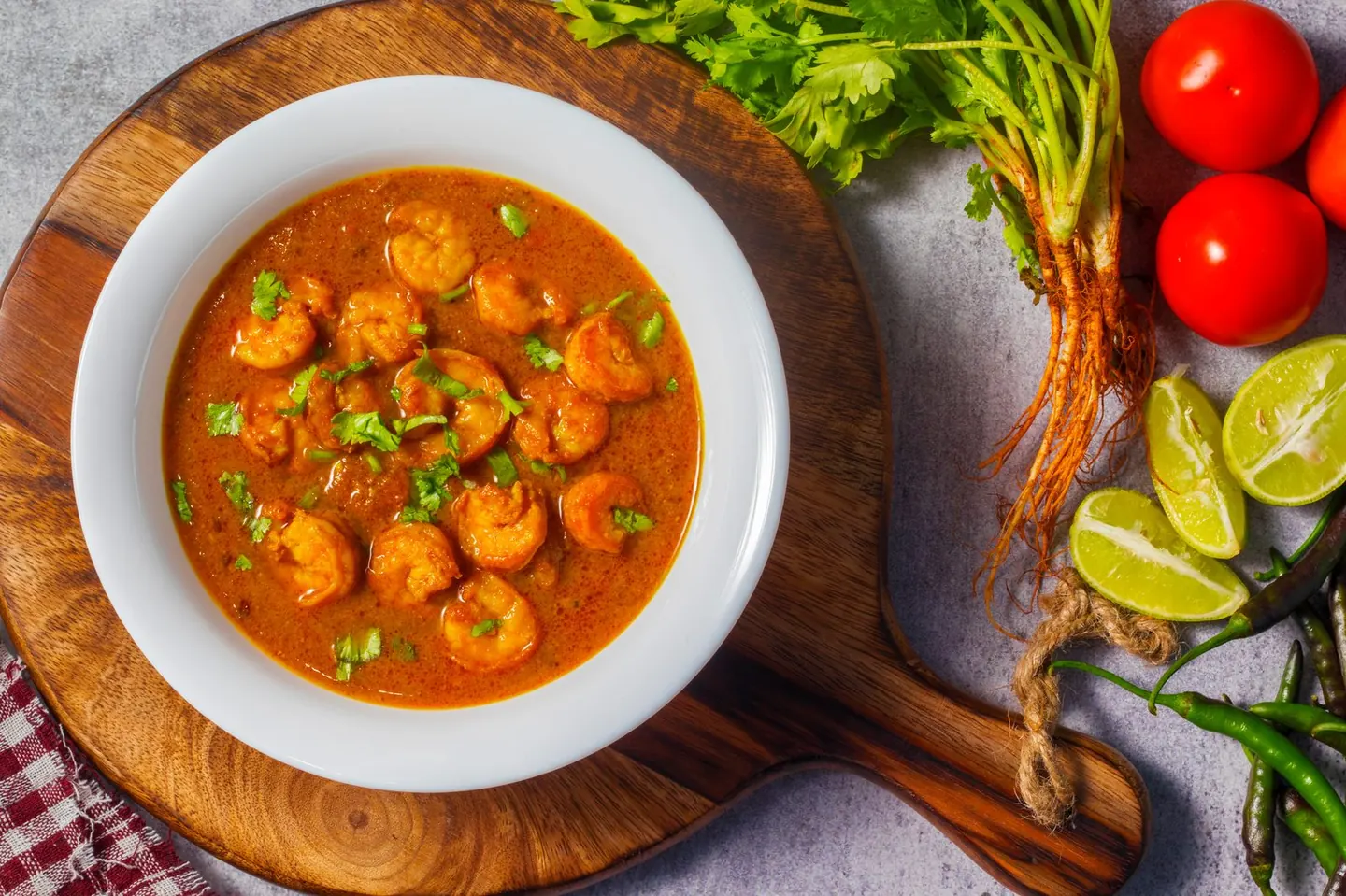
Photograph: Adobe Stock · representative of the dish
Ularthiyathu means dry-roasted down, and it is the technique behind Kerala's most famous meat dish. Applied to prawns it becomes a fifteen-minute pan dish: the gravy vanishes, the pieces darken, the coconut slivers go gold, and what is left clings to the prawns instead of pooling under them. It is a toddy-shop dish and it is meant to be eaten with your fingers off a banana leaf.
Before you start: This dish moves fast and there is no pause once the prawns go in. Have the coconut slivered, the aromatics chopped, the powders weighed, and the curry leaves stripped before you light the flame.
Allergens: Crustaceans. Gluten (wheat) — only if your asafoetida is compounded with wheat flour, as most brands are (it arrives with M05).
Equipment: Wide heavy pan or cheena chatti, 26–28 cm. Substitute: any wide pan. A narrow one steams the prawns instead of roasting them, which is the one way to fail at this.
| Energy | 182 kcal |
| Protein | 20 g |
| Fibre | 3 g |
| Net carbohydrate | 7 g |
| Total carbohydrate | 10 g |
| Sugars | 3 g |
| Fat | 8 g |
| Saturated fat | 6 g |
| Sodium | 300 mg |
From ICMR-NIN IFCT 2017 and USDA FoodData Central. Per-serving figures stay the same when you scale.
As R032 for prawns. On the coconut slivers: these are cut from the kernel with a knife rather than grated, into pieces about the size of a matchstick, and they are structural — they toast, they crunch, and they are half the reason this dish is worth making. Abroad: if you have a whole coconut, cut them yourself; frozen coconut chunks in South Asian and Caribbean freezers can be slivered from frozen. Frozen grated coconut will not do it — it burns before it toasts. Dried coconut chips, unsweetened, are the honest fallback and want to go in 2 minutes later than the recipe says.
Blood sugar: 6 g of net carbohydrate. A dry roast like this is a good protein anchor for a plate where the rice is the variable.
Blood pressure: 300 mg, and about half of it is the prawns themselves. With no added salt at all it lands near 210 mg, and the pepper and green chilli carry it.
Cholesterol: 6 g of saturated fat, split roughly evenly between the 12 g of coconut oil and the 40 g of coconut slivers. Sesame oil takes it to about 4.5 g; halving the slivers to 20 g takes it to about 4 g and costs the dish its texture, which is a poor trade.
Prawns → 500 g squid rings, 4–5 minutes at step 4 (see R037 for the timing rule), or 500 g diced firm fish, handled gently. Or 400 g mussel meat. (Allergen: this swap introduces fish, molluscs.)
No coconut slivers → 30 g desiccated coconut chips added at step 5. Less crunch, more even browning.
Add 100 g diced tomato at step 3 → wetter, more of a roast than an ularthiyathu, and 5 more minutes to dry out. A common household version.
Coconut oil → sesame or groundnut. Saturated fat falls about 1.5 g per serving; the finishing 3 g is where coconut oil is worth keeping. (Allergen: this swap introduces peanuts, sesame.)
Eight servings will not roast dry in one domestic pan. Cook in two batches and combine at step 5, or accept a wetter dish.
Best within ten minutes of cooking. Fridge 2 days. Freeze 1 month, though the prawns become noticeably firmer. Reheat dry in a hot pan for 2–3 minutes; a microwave turns prawns to rubber.
Fold cold into a cabbage thoran, or into rice with a squeeze of lime, or roll into a wrap with raw onion and yoghurt. It is also excellent stirred through R020 kanji.
Prawns rubbery: overcooked, and it happens between step 4 and step 5. Take them out after step 4 and return them for the last 90 seconds if you are unsure.
Watery and pale: pan too small, flame too low, or prawns still wet from thawing. Pat them dry and use a wider pan.
Coconut slivers black and bitter: they stayed in through the whole cook, or the flame was too high at step 2. Out after 3 minutes, back in at the end.
Masala tastes raw: the prawns went in before the shallots were properly cooked at step 3.
Serve with
R015 Matta Rice · R005 Idiyappam · R053 Vanpayar Thoran · R081 Moru Curry
Tap a star to rate this recipe
The Kindle edition is on its way. Until it lands, the complete book — all 25 chapters and 137 recipes — is free to read here, and it stays free after.