 R041
R041Kerala Chicken Stew
Ishtu — white pepper, coconut milk, and the appam's partner
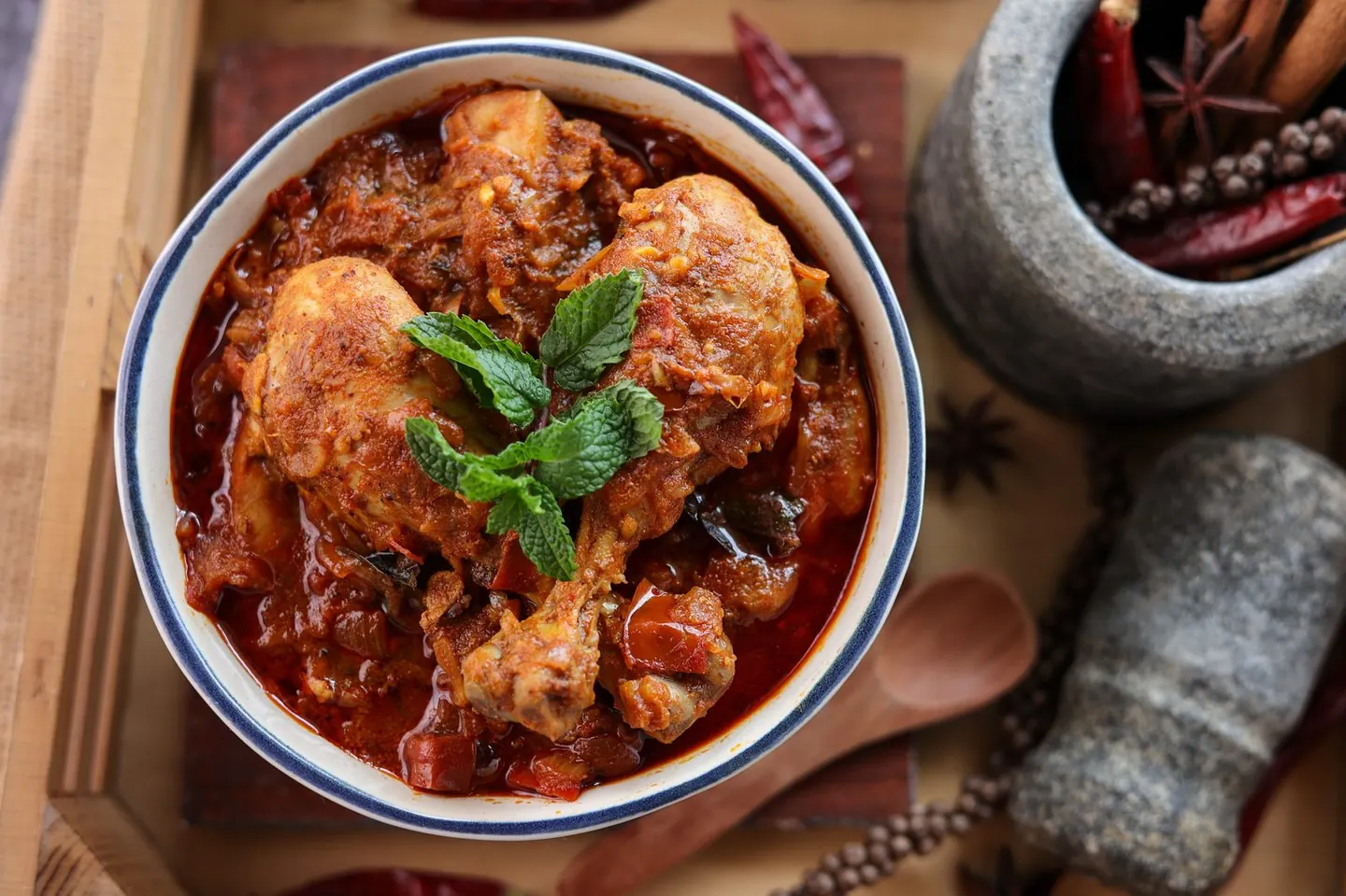
Photograph: Adobe Stock · representative of the dish
Plan ahead: plus 20 minutes resting — recommended, the curry tightens and deepens.
Nadan means "of the country" — the everyday register, not the feast one. This is the curry a Kottayam or Thrissur household makes on a Tuesday, and the thing that makes it recognisably Kerala rather than generically Indian is the fennel, the black pepper and the shallots. It is also the dish where oil creep is most invisible: nobody measures the oil in a weeknight chicken curry, and three tablespoons go in because three tablespoons always went in. Four teaspoons do the job if the shallots are given their twenty minutes.
Before you start: Slice the 200 g of shallots before you light the flame — it takes eight minutes and the pan will not wait. Have the coconut milk in two separate jugs, thick and thin, and keep the thick one away from the hob so you cannot tip it in by reflex.
Allergens: None of the major allergens as the recipe is written. Sesame or peanuts — whichever of the two oils you use (it reaches the dish through M16).
Equipment: Heavy 26 cm pan or uruli with a lid. Substitute: any wide pan with a well-fitting lid; a narrow deep pot steams the shallots instead of reducing them and you will taste the difference.
| Energy | 410 kcal |
| Protein | 29 g |
| Fibre | 5 g |
| Net carbohydrate | 13 g |
| Total carbohydrate | 18 g |
| Sugars | 6 g |
| Fat | 27 g |
| Saturated fat | 14 g |
| Sodium | 370 mg |
From ICMR-NIN IFCT 2017 and USDA FoodData Central. Per-serving figures stay the same when you scale.
Ask the butcher for a curry cut with the skin off and the bone in — the bone is what gives a nadan curry its body, and the skin is where most of the fat you are trying to leave out lives. Outside India, chicken thighs and drumsticks bone-in, skinned at home, are the closest thing to Kerala's nadan kozhi; whole chicken breast alone will go dry over 25 minutes of simmering. If shallots are expensive, use 150 g shallots plus 100 g red onion rather than going all-onion, which is noticeably flatter.
Blood sugar: at 13 g of net carbohydrate this dish contributes almost nothing to the meal's glycaemic load. What sits beside it decides everything — 150 g of cooked matta rice (R015) rather than 300 g, and a pulse on the plate (R053 or R059).
Blood pressure: 370 mg of sodium against a 2,000 mg daily target. Made with plain salt instead of M07 it would be about 490 mg. Dropping the salt to 3 g takes it to about 320 mg, and the pepper and fennel cover the difference.
Cholesterol: 14 g of saturated fat, of which roughly 9 g is the coconut — milk and oil together — and about 5 g the chicken. Halving the first-extraction milk to 30 ml removes about 2.5 g per serving and costs the curry a little silkiness, not its character.
No M04 → 15 g ground coriander, 6 g chilli powder, 3 g fennel and 2 g extra pepper. Close, and about 100 mg more sodium per serving is avoided compared with a packet masala, which is salted.
Coconut milk → 30 g roasted coconut paste (M09) stirred in at step 7. Deeper, smokier, thicker, and it brings 4 g of fibre; saturated fat lands in much the same place.
Chicken breast only → reduce the simmer to 10–12 minutes. Leaner by about 3 g of fat per serving, and noticeably drier if you overshoot.
No coconut at all → 40 g cashews blended with 150 ml water. Less saturated fat, more monounsaturated, and a sweeter, rounder curry that is not quite nadan any more. (Allergen: this swap introduces tree nuts (cashew).)
Better on day two, like most Kerala meat curries. Fridge 3 days in a covered non-metal container. Freeze 2 months, but freeze it before the thick milk goes in and add that on reheating — frozen-and-thawed coconut emulsion is grainy. Reheat at a bare tremble, never a rolling boil.
Strip the meat off the bones, reduce the gravy hard for 4–5 minutes and you have the filling for a pathiri or a wrap. Or thin it with second-extraction milk and pour it over R020 kanji.
Gravy split, with oil on top: the thick milk boiled. Add it off the heat and swirl rather than stir.
Thin, watery gravy: the shallots were rushed at step 2, or the tomato went in before the water had gone. Reduce uncovered for 5–6 minutes; it will not fully recover.
Chicken tough and stringy: breast pieces left in for the full simmer. Add them 8 minutes from the end.
Serve with
R015 Matta Rice · R001 Appam · R053 Vanpayar Thoran · R063 Cabbage Thoran
Tap a star to rate this recipe
The Kindle edition is on its way. Until it lands, the complete book — all 25 chapters and 137 recipes — is free to read here, and it stays free after.