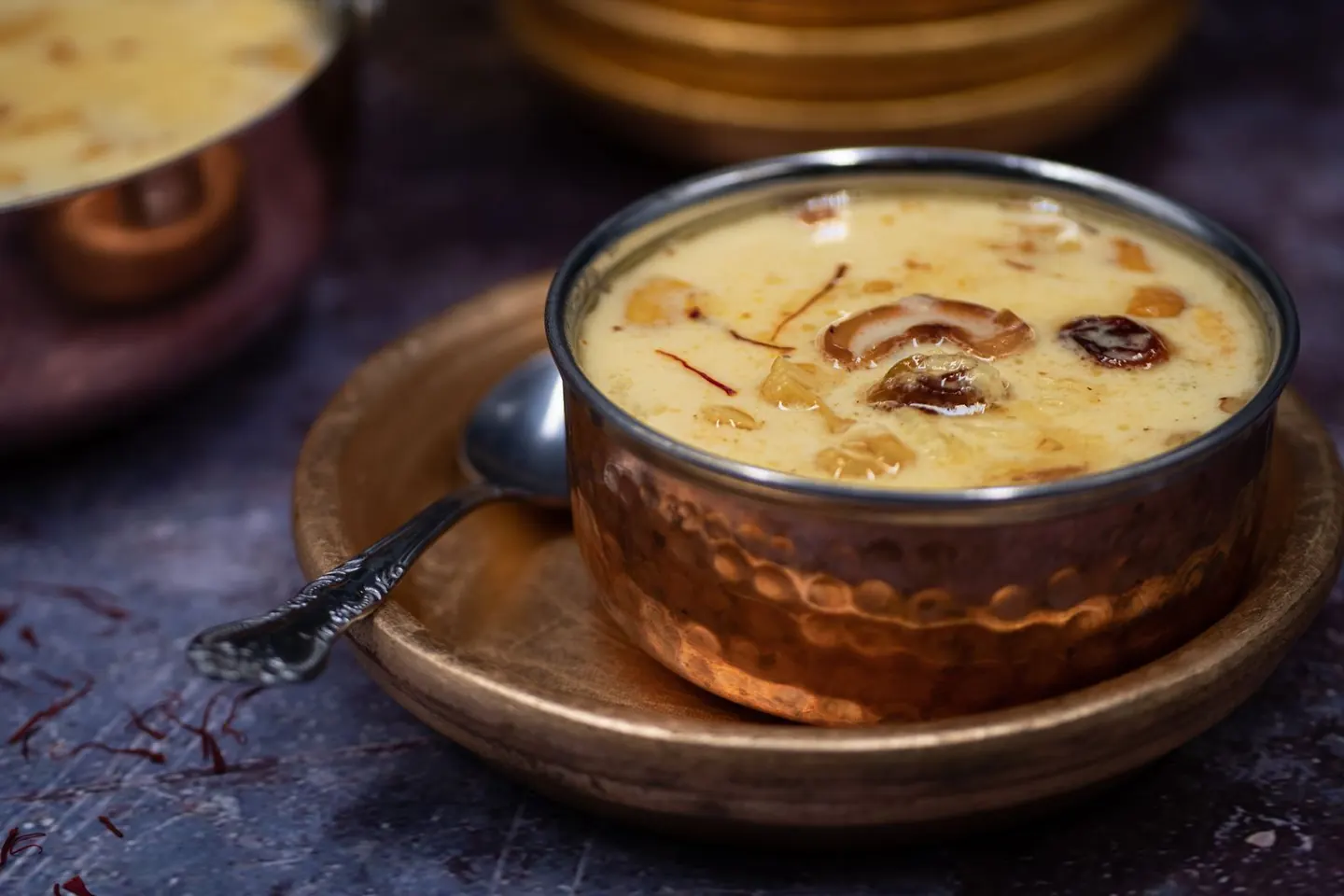
Chapter 26 — Sweets and Payasam, Honestly
A health cookbook that offers you a sugar-free payasam is insulting two things at once, and you should notice both. It is insulting your intelligence, because you know perfectly well that a payasam is a sugar reduction — that is what the dish physically is, jaggery or sugar cooked down with coconut milk or milk until the sweetness and the fat carry the starch. Take the sugar out and you have not made a lighter payasam. You have made a bowl of thin coconut milk with something floating in it, and an artificial sweetener that goes bitter over heat, and a family who politely finish one spoonful. And it is insulting the dish, which is four hundred years of Kerala kitchens and a bell-metal uruli and an hour of stirring, reduced to a delivery mechanism for a marketing claim.
This chapter does not do that. It does something harder and considerably more useful, which is to tell you exactly what these dishes cost and let you decide when to spend it.
Start with what payasam is for. Payasam and pradhaman are festival food, and the historical record on this is not ambiguous. They belong to Onam and Vishu, to weddings and temple feasts, to the eleventh-day and the naming and the housewarming. In the Namboothiri scheme they divide into payasam, the rice-based family — idichu pizhinja, sharkara, ney, paal, panchaara — and pradhaman, the non-rice family — ada, palada, pazha, chakka, parippu, kalakki — and a grand feast closes with two or more of them, at which point the ripe banana is mashed into the bowl and the pickle comes back out to cut the sweetness. This is a dish with a liturgical position. It was not a Tuesday.
What changed is not the recipe. It is the calendar. Jaggery and sugar became cheap and constant; the uruli was replaced by a pan and then by a tin of condensed milk; payasam moved from the festival leaf to the bakery counter, the wedding buffet that happens four times a season, the sweet box that arrives at the door, and the tub in the freezer. The dish that used to mark a day now marks nothing.
Which is why the real lever here is frequency and portion, not substitution. This is the argument the chapter is built on, and it is worth stating without hedging. If you eat 100 ml of genuine ada pradhaman four times a year, it contributes roughly 900 kilocalories to your year, which is a rounding error against the roughly 800,000 you will eat. If you eat 250 ml of a disappointing "healthy" payasam every Sunday because you have been told it is permitted, it contributes something on the order of 25,000. Substitution offers you the illusion of a solved problem and then quietly raises your frequency, because permitted food gets eaten more often. That is not a moral failing; it is how permission works. The honest architecture is the opposite: keep the dish exactly as good as it has always been, make the portion smaller than you are used to, and put it back on the days it belonged to.
And jaggery is not a health food. This book will show you the arithmetic rather than implying otherwise. Jaggery is unrefined sugar. It is sucrose with a trace mineral fraction and some molasses flavour, it carries about the same energy per gram as white sugar, and it raises blood glucose. There is nothing in the evidence base behind this book that supports treating it as different from sugar for a reader watching their waist or their blood glucose. The boxed section that follows sets out what is actually established, and — importantly — where the numbers are not established, which is more often than the internet suggests.
What jaggery does have is flavour: caramel, faint smoke, a mineral bitterness that refined sugar cannot supply, and in the palm form (karuppatti, from coconut or palmyra sap tapped at dawn) a darkness that is less cloying than cane. That is a real advantage, and it is a culinary one. Better-tasting sugar lets you use less of it. Every reduction in this chapter runs on that principle, and on no other.
So the offer is this: a small bowl of the real thing, four times a year, is a better answer than a weekly bowl of something disappointing. Not because the small bowl is virtuous — it is 225 kilocalories of sugar and saturated fat and it is meant to be — but because it is the version that actually works. It satisfies. You do not go back for a second helping of something that tasted right. You go back for a second helping of something that did not.
What the recipes in this chapter actually do
Three things, and none of them is a substitution.
They reduce the portion, and they state it in millilitres. Every recipe here gives a serving volume you can measure, alongside what a traditional festival serving contains, so you can see the difference rather than take it on faith. R113 gives 100 ml where a sadya gives 150 to 250. R112 gives 100 ml where a wedding gives 200. Nothing has been removed from the bowl. The bowl is smaller, and it is a specified size.
They reduce the coconut-milk richness where it can be reduced without collapse, and nowhere else. The three-extraction method in M08 is the tool: thick first milk goes in off the heat as a finish, thin second and third milk do the cooking. A pradhaman built that way tastes richer on less fat than one built by pouring tinned milk into a boiling pot, because the first milk arrives intact rather than split. Where the fat is the dish — the coconut in elayada's filling, the reduction in ada pradhaman — it stays. A collapsed payasam serves nobody.
And they use the sweetness of fruit where fruit belongs. R116 leans on ripe jackfruit, which brings 14.01 g of available carbohydrate per 100 g of its own and lets the added jaggery drop to 80 g across ten servings — a quarter of what a traditional chakka pradhaman carries. That is not a trick. Jackfruit was always the sweetener in that dish; the jaggery crept up as the fruit got cheaper to skip.
One dish in this chapter is included because of its shape rather than its arithmetic. R115 Elayada is steamed in a banana-leaf parcel, one parcel to a person, and you have to unwrap each one. Portion control that is built into the object rather than imposed on the eater is the most reliable kind there is.
THE JAGGERY QUESTION
What it is. Cane juice or palm sap boiled down until it sets. That is the whole process: no bleaching, no crystallisation and separation of molasses, no centrifuging. Cane jaggery is Kerala's common form — the state has two GI-registered jaggeries, Marayoor (registered 6 March 2019, and distinctive because Marayoor's unusually low rainfall at around 990 m produces exceptionally sweet cane) and Central Travancore, both cane rather than palm. Palm jaggery, karuppatti, comes from coconut or palmyra sap tapped at dawn and boiled down before it can ferment; it is darker, more mineral, less cloying, and it is what a traditional karkidaka kanji or a good ada pradhaman wants.
What it is chemically. Sucrose, with a small non-sucrose fraction that carries the colour, the flavour, and the minerals. This is not controversial and it is the single most important sentence in the box. Sucrose is a disaccharide of glucose and fructose; your small intestine cleaves it with sucrase and absorbs the two monosaccharides, and it makes no difference to that enzyme whether the sucrose arrived in a white crystal or a brown block. The molasses fraction that white sugar has removed and jaggery has kept is where the iron, the potassium, the calcium and the trace magnesium sit, and it is also where the flavour sits. Those are the same fraction. You cannot have the flavour without the sugar, and you cannot get a useful quantity of the minerals without an unuseful quantity of the sugar.
The mineral argument, taken seriously and then answered. It is true that jaggery contains iron and potassium and white sugar does not. It is also true that the quantities involved are the wrong order of magnitude to matter. Work it through with the shape of the numbers rather than a specific figure: to obtain a meaningful fraction of a day's iron requirement from jaggery you would need to eat jaggery in the tens of grams to over a hundred, at which point you have consumed something on the order of 40 to 100 g of sugar — several times the entire daily added-sugar allowance under any guideline in existence — in order to acquire a nutrient that a bowl of cheera thoran, a handful of kadala, or a piece of liver would have supplied for nothing. The mineral content is real. Its dietary relevance is not. A trace mineral delivered inside a sugar is not a reason to eat the sugar.
What the evidence supports. Added sugar is the part with real evidence, and it is not about jaggery specifically — it is about sugar. In the Nurses' Health Study II, women who increased sugar-sweetened drink intake to one a day or more gained 4.69 kg over four years, and those drinking one or more daily carried a relative risk of 1.83 for type 2 diabetes against fewer than one a month; homemade sweetened fruit punch came out at 2.00 (Schulze et al., 2004). WHO's carbohydrate guidance directs free sugars downward and whole-food carbohydrate upward. Low-glycaemic-index eating delivers roughly a 0.3 to 0.5 percentage-point HbA1c improvement across 54 randomised trials — larger than any spice in this book and achieved by changing the staple, not by adding anything (Zafar et al., 2019; Ojo et al., 2018). None of that literature distinguishes jaggery from sugar, because there is no reason on the biochemistry to expect it to.
What is not established, and where this book will not invent a number. There is no reliable glycaemic index for jaggery in the sources behind this book, and no reliable per-100 g composition either. The ICMR-NIN Indian Food Composition Tables 2017 and the University of Sydney glycaemic index database are the correct places to look, and neither value was retrieved during the research for this book. So no GI figure appears anywhere in these pages, and no per-100 g table entry for jaggery either. You will find both freely quoted online — "jaggery has a GI of 84", "GI 35", "jaggery is a low-GI sweetener" — and the range of those claims is itself the evidence that nobody quoting them has a source. If a number matters to you, it will vary by boiling method, by moisture content, by cane variety and by whether the block is cane or palm, which is a further reason to be suspicious of any single figure.
How this chapter handles that gap. The nutrition panels in this chapter cost jaggery as sucrose: 98 g of carbohydrate and about 390 kcal per 100 g. That is a stated assumption, not a measurement, and it is a deliberately conservative one — real jaggery carries some moisture and a small non-sucrose fraction, so its energy per gram is at or slightly below that of white sugar rather than above it. Costing it as sugar means the panels in this chapter never understate what you are eating, which is the direction of error a health cookbook should choose.
The practical position, in one line. Buy the best jaggery you can find, use it because it tastes better than sugar, use less of it because it tastes better than sugar, and do not tell yourself a story about minerals.
R112 · Palada Payasam, Rebuilt [VEGETARIAN] [UNDER 250 KCAL]
Rice ada in reduced milk, at a measured 100 millilitres
ICONS: B · L
THE RE-ENGINEERING: The condensed milk is gone and the sugar falls from around 300 g to 70 g; the reduction is done with time instead. The serving is fixed at 100 ml rather than left to whoever is holding the ladle. Result: about 180 kcal against about 410 for a traditional 200 ml wedding serving.
Palada is the aristocrat of the payasam family and it is made of almost nothing: rice ada, milk, sugar, cardamom, and patience. There is no coconut in it, which surprises people. Its whole character comes from milk reduced slowly until the lactose caramelises faintly and the liquid goes the colour of old ivory, and from ada soft enough to collapse on the tongue. Condensed milk, which now appears in most versions, is a shortcut that buys you thirty minutes and costs you the flavour of reduced milk, which is the flavour of the dish.
Serves 8 · exactly 100 ml per portion (about 800 ml total) Active 25 minutes · Total 1 hour 25 minutes Difficulty: Moderate
EQUIPMENT: Wide heavy pan of at least 3 litres, or a bell-metal uruli; a 100 ml ladle or measuring cup; a flat-ended wooden spoon that reaches the corners. Substitute: any wide pan with a thick base. Depth is the enemy here — a tall narrow pan gives you a small evaporating surface and doubles the reduction time. A non-stick wok is a better substitute than a tall saucepan.
BEFORE YOU START: Read the last two steps before you begin. Milk reduction fails in the final ten minutes, not the first fifty, and the failure is a scorched base you cannot taste your way out of.
INGREDIENTS
- 80 g dried rice ada
- 1.5 litres water, for boiling the ada
- 1.2 litres whole cow's milk
- 70 g (5½ tbsp) sugar, or the same weight of grated pale jaggery
- 2 g (½ tsp) cardamom, seeds only, crushed
- a pinch of salt
- 8 g (2 tsp) ghee — optional, for the pan
SOURCING NOTE: Rice ada is sold dried in packets by every Kerala grocer and by Indian groceries abroad, labelled "ada" or "palada"; it keeps a year in the cupboard and is worth stocking. If you cannot find it, the closest working substitute is broken rice or rice sev, which gives a similar collapse but a less silky mouthfeel; small pasta shapes do not work, because wheat gluten holds its shape and ada is meant to give way. Fresh homemade ada — rice batter spread on a banana leaf, steamed and cut — is better than any packet and takes an afternoon; it belongs in a household that has one to spare. Whole milk matters: skimmed milk will not reduce to the right body, and no amount of extra time fixes it.
ALLERGENS: Milk.
METHOD
- Boil the ada in the 1.5 litres of water until it is fully translucent and yields completely to a fingernail with no chalky core, 12–15 minutes for most packets. Undercooked ada stays chalky in the finished payasam and does not soften further in milk.
- Drain in a colander and rinse under cold running water for 20–30 seconds, tossing, until the pieces stop sticking to each other. Set aside.
- Rub the base of the dry pan with the ghee if you are using it, which reduces sticking through the long reduction.
- Bring the milk to a simmer over a medium heat, then drop the heat until the surface carries a slow tremble rather than a boil.
- Reduce the milk, stirring across the whole base every 3–4 minutes and scraping the sides down, until it has gone from white to a faint ivory and reduced by roughly a third — down to about 800 ml — 35–45 minutes. The smell shifts from milk to something nutty and faintly caramel; that shift is your cue, more reliable than the clock.
- Add the ada and the salt and cook a further 10–12 minutes, until the ada has swelled, gone slightly glassy at the edges and begun to thicken the milk around it so that a spoon drawn across the base leaves a track that closes slowly.
- Stir in the sugar and cook 5–6 minutes more, until it has entirely dissolved and the payasam coats the back of a spoon in a thin even film. Adding sugar earlier slows the reduction, because dissolved sucrose raises the boiling point and holds water.
- Take the pan off the heat, stir in the cardamom, and let it stand 10 minutes. It thickens noticeably as it cools, so stop while it still looks slightly too loose.
- Portion with the 100 ml ladle into eight bowls, at the pan, before it reaches the table. This is not a fussy instruction. It is the recipe.
WHY THIS WORKS
Reducing milk concentrates lactose and milk protein and drives the Maillard reaction between them at a low rate over a long time, which is where the ivory colour and the nutty flavour come from — condensed milk mimics that by boiling sugar into milk instead, which is why it tastes sweet where reduced milk tastes deep. The ada's starch, gelatinised twice, does the thickening, so the dish needs neither cream nor cornflour.
PER SERVING (estimated) — 100 ml
| kcal | kJ | Carb | Fibre | Net carb | Sugars | Protein | Fat | Sat fat | Sodium |
|---|---|---|---|---|---|---|---|---|---|
| 180 | 753 | 24 g | 0 g | 24 g | 16 g | 6 g | 7 g | 4 g | 90 mg |
THE TRADITIONAL VERSION, FOR COMPARISON. A wedding palada made to the usual proportions — 100 g ada, 1.5 litres whole milk, 300 g sugar and 200 g sweetened condensed milk, served at 200 ml — comes out at roughly 410 kcal and about 55 g of sugars per serving. Two of those, which is an ordinary thing to eat at a reception, is around 820 kcal and 110 g of sugar on top of a full meal.
Computed from ICMR-NIN IFCT 2017 "Rice, raw, milled" (A015) for the ada and "Milk, whole, cow" (L002) for the milk; sugar at 4 kcal/g.
IF YOU ARE WATCHING… Blood sugar: 24 g of net carbohydrate in a bowl, of which roughly 9 g is added sugar and the rest is ada starch and lactose. Eat it after a meal rather than between meals, and eat it after a meal that had a pulse in it. The protein and fat in the milk slow it considerably compared with the same sugar in a drink. Blood pressure: 90 mg sodium a bowl. Not a concern here. Cholesterol: 4 g of saturated fat a bowl, from milk fat rather than coconut. Made with semi-skimmed milk it drops to about 2 g and the payasam is noticeably thinner; this is the one substitution in the chapter that genuinely costs the dish something, and you should make it knowingly.
SWAP IT
- Sugar → pale cane jaggery, 1:1. The colour goes amber and the flavour gains caramel; palada purists object, and they have a point, because the clean milk flavour is the dish. Sugar is correct here and jaggery is correct in R113.
- Whole milk → half whole, half semi-skimmed. Saturated fat down to about 3 g; reduction takes 5–10 minutes longer and the body is slightly thinner.
- Rice ada → broken rice or rice sev, 60 g dry. Cooks faster, 6–8 minutes; less silky, more porridge-like.
- Cardamom → a scrape of nutmeg and a strip of dried ginger. Aromatic rather than floral, and a good variation for a cold evening. Never use nutmeg by the teaspoon in anything.
SCALE IT
| Serves | Ada | Whole milk | Sugar | Cardamom | Yield |
|---|---|---|---|---|---|
| 4 | 40 g | 600 ml | 35 g | ¼ tsp | 400 ml |
| 8 | 80 g | 1.2 litres | 70 g | ½ tsp | 800 ml |
| 25 | 250 g | 3.75 litres | 220 g | 1½ tsp | 2.5 litres |
| 50 | 500 g | 7.5 litres | 440 g | 1 tbsp | 5 litres |
MAKE AHEAD · STORE · FREEZE Best made the same day and served warm or at room temperature. Fridge 3 days in a covered non-metal container; it sets almost solid and needs 60–80 ml of hot milk per portion stirred in to bring it back. Freeze 1 month — the texture suffers, the ada goes slightly grainy, and it is drinkable rather than spoonable on thawing. Reheat gently and never at a boil, or the milk protein catches.
LEFTOVERS Cold palada set firm can be spread in a shallow tray, chilled until solid, and cut into squares — this is close to what some households do deliberately. Or thin it with milk into a drink and serve it in small glasses, which is a fair use of 60 ml of leftovers and no use at all of 600.
SERVE WITH As the milk payasam at a sadya alongside R113 Ada Pradhaman, at 100 ml each rather than 200 · R119 the sadya pickle set, which the tradition brings back specifically to cut this · R107 Sambharam to close · M08 coconut milk, for the pradhaman it is served beside
TROUBLESHOOTING Scorched, with brown flecks through it: the base caught in the last ten minutes. Do not stir it in — that distributes the burnt flavour through the whole pot. Pour the payasam off into a clean pan without scraping the base, and taste before you continue. Chalky bits in the finished dish: the ada was undercooked at step 1. It will not soften further once the milk has thickened. Boil it longer next time and test with a fingernail rather than a timer. Grainy, slightly separated: the milk boiled hard rather than trembled, and the protein coagulated. It still tastes right; the texture cannot be recovered. Too thin after cooling: under-reduced. Return it to the heat for 8–10 minutes. Judge by the spoon-coating test, not by the level in the pan.
NOTES
R113 · Ada Pradhaman, with the Arithmetic Shown [VEGETARIAN]
Rice ada, jaggery and coconut milk — the sadya's other payasam, costed in full
ICONS: B · F · L
THE RE-ENGINEERING: Jaggery down from around 500 g to 180 g and the coconut milk graded through M08's three extractions rather than poured in from a tin, with the thick first milk added off the heat as a finish. The portion is fixed at 100 ml. Result: about 225 kcal against about 350 for a 150 ml festival serving — and the smaller bowl of the rebuilt version tastes more strongly of coconut, not less, because the first milk has not split.
This is the centrepiece of the chapter, and the reason is that ada pradhaman is where a health cookbook usually starts lying. It is the richest thing on the Onam leaf, it is the item people go back for, and every claim you have read about making it lighter has been about substituting something. This recipe does not substitute anything. It reduces the jaggery to the point where the coconut can still be tasted through it, changes how the milk enters the pot, and then shows you the whole bill.
Serves 10 · exactly 100 ml per portion (about 1 litre total) Active 35 minutes · Total 1 hour 10 minutes Difficulty: Moderate
EQUIPMENT: Wide heavy pan of at least 4 litres, or a bell-metal uruli; a 100 ml ladle; a flat-ended wooden spoon. Substitute: any wide heavy pan. The uruli is not romanticism — its heat inertia is why you can stir a jaggery reduction for an hour without it catching, and a thin pan will scorch this dish while you answer the door.
BEFORE YOU START: Melt and strain the jaggery before anything else. Jaggery blocks carry grit, cane fibre and occasionally sand, and there is no way to remove it once the pradhaman is built. Have the three coconut milks measured into three separate jugs, labelled, in order.
INGREDIENTS
- 180 g jaggery, preferably dark palm jaggery (karuppatti), broken up
- 120 ml water, for melting the jaggery
- 10 g (2 tsp) ghee
- 20 g fresh coconut, cut into thin 5 mm slices
- 100 g dried rice ada
- 1.5 litres water, for boiling the ada
- 400 ml third coconut milk (moonnaam paal, M08)
- 400 ml second coconut milk (randaam paal, M08)
- 250 ml first coconut milk (onnaam paal, M08)
- 2 g (½ tsp) cardamom, seeds only, crushed
- 1 g (¼ tsp) dry ginger powder (chukku)
- a pinch of salt
SOURCING NOTE: For jaggery, buy the darkest palm jaggery you can find — karuppatti from Kerala or Tamil Nadu, or Marayoor cane jaggery if palm is unavailable — and buy it dry-firm so it breaks cleanly rather than sticky-wet, which indicates high moisture and short life. Abroad, Latin American panela or piloncillo is essentially the same product and is often easier to find than Indian jaggery; dark muscovado works at 1:1 and reads more molasses-forward. Rice ada as in R112. For the coconut milk, three extractions from one large coconut (M08) is the whole technique; if you must use tins, use one 400 ml tin undiluted as the first milk, one diluted 1:1.5 with water as the second, and 400 ml of water with a spoonful of tinned milk as the third — the dish will be flatter and slightly cooked-tasting, and you will lose the spent gratings that belong in a thoran.
ALLERGENS: Milk.
METHOD
- Melt the jaggery with the 120 ml water over a medium heat, stirring, until it is entirely liquid, 4–6 minutes. Do not let it boil down or start to thread — you are dissolving, not making syrup.
- Strain the melted jaggery through a fine sieve into a jug and rinse the pan. What stays behind in the sieve is why this step exists.
- Fry the coconut slices in the ghee in the clean pan over a medium heat until they are golden at the edges and smell toasted, 2–3 minutes. Lift them out with a slotted spoon and set aside; they go back at the end and they must stay crisp.
- Boil the ada in the 1.5 litres of water until fully translucent with no chalky core, 12–15 minutes. Drain and rinse under cold water for 20–30 seconds so the pieces separate.
- Simmer the ada in the 400 ml of third milk in the ghee pan, uncovered, until the ada has absorbed most of it and the pan looks nearly dry, 8–10 minutes. This is the step that gets coconut flavour into the ada rather than around it.
- Add the strained jaggery and cook, stirring across the base every minute or two, until the mixture darkens noticeably, thickens, and begins to leave a clean track behind the spoon that holds for a full second, 12–15 minutes. It will smell of caramel and coconut together. This is the flavour of the dish and it cannot be hurried.
- Pour in the 400 ml of second milk and bring back to a bare simmer for 5–6 minutes, until the pradhaman is uniform and just coats the spoon.
- Take the pan off the heat. Wait 30 seconds until the surface has stopped moving.
- Swirl in the 250 ml of first milk, the cardamom, the dry ginger and the salt — swirl the pan, do not stir hard — and do not return it to the heat. Thick coconut milk splits at a boil and it does not come back.
- Scatter the fried coconut slices over, and portion with the 100 ml ladle into ten bowls at the pan.
WHY THIS WORKS
Coconut milk is an oil-in-water emulsion stabilised by coconut globulins sitting at the surface of each fat droplet. Boiling denatures those proteins, the droplets coalesce, and you get oil above and curds below — irreversibly. Second and third milk survive heat because there is far less fat to separate; first milk does not. Adding the richest milk last and off the heat means every gram of fat you spend is tasted as richness rather than seen as an oil slick.
PER SERVING (estimated) — 100 ml
| kcal | kJ | Carb | Fibre | Net carb | Sugars | Protein | Fat | Sat fat | Sodium |
|---|---|---|---|---|---|---|---|---|---|
| 225 | 941 | 28 g | 1 g | 27 g | 19 g | 2 g | 12 g | 11 g | 40 mg |
Computed from ICMR-NIN IFCT 2017 "Rice, raw, milled" (A015) and "Coconut, kernel, fresh" (H007); coconut milk from USDA SR Legacy 170172 scaled by extraction as in M08; jaggery costed as sucrose at 98 g of carbohydrate and about 390 kcal per 100 g, the working assumption this book states in its reference tables, as the boxed section above sets out.
THE ARITHMETIC, WORKED IN FULL
This is the calculation the chapter exists to show. Nothing in it is hidden and you can check every line.
What a traditional festival serving contains. A sadya ada pradhaman built the usual way — 200 g ada, 500 g jaggery, the milk of two coconuts in three extractions plus a tin, 40 g ghee, 50 g coconut slices — yields roughly 2.2 litres and is ladled at 150 ml, which is about fifteen servings. Per serving:
| Per 150 ml traditional serving | |
|---|---|
| Energy | about 350 kcal (1,465 kJ) |
| Sugars | about 35 g |
| Fat | about 18 g |
| of which saturated | about 16 g |
| Protein | about 1 g |
Sixteen grams of saturated fat in one bowl is worth pausing on. WHO's recommendation is to hold saturated fat below 10% of total energy intake, which for a 2,000 kcal day is about 22 g. One traditional serving of ada pradhaman is roughly three-quarters of a day's entire saturated-fat allowance, and the leaf it sits on already carries olan, erissery, avial and a second payasam.
What it means across a sadya. At an Onam sadya, two payasams are served and both are usually taken, and few people stop at one ladle.
| Scenario | Payasam energy alone |
|---|---|
| One traditional ada pradhaman, 150 ml | about 350 kcal |
| Traditional ada pradhaman + traditional palada, 150 ml each | about 660 kcal |
| The same two, at the 250 ml a generous server actually pours | about 1,100 kcal |
| Rebuilt R113 + rebuilt R112, 100 ml each | about 405 kcal |
The full leaf comparison is in Chapter 27, where a complete traditional Onam sadya comes to roughly 2,923 kcal and the lightened architecture to roughly 1,898 kcal for the same twenty-two items. The two payasams account for 279 kcal of that 1,025-kcal gap — a little over a quarter of it, from two dishes — which is why they are the highest-leverage pair on the leaf.
And what it means across a year, which is the number that actually matters. Four festival occasions a year at 100 ml of the rebuilt version is about 900 kcal a year. Four occasions at 250 ml of the traditional version, twice over, is about 4,400 kcal a year. Both of those are trivial against an annual intake near 800,000 kcal, and that is the point of this whole chapter: the festival is not the problem. The problem is the payasam in the fridge on a Wednesday, the sweet box at the office, the four sadyas between Onam and the wedding season, and the bakery on the way home — because 250 ml of traditional pradhaman once a week — 583 kcal at the energy density in the table above — is about 30,300 kcal a year, and that is a number that moves a waist.
IF YOU ARE WATCHING… Blood sugar: 27 g of net carbohydrate a bowl, of which about 18 g is jaggery. Have it at the end of a meal, not alone, and specifically at the end of a meal containing a pulse — 50 g of legumes eaten with brown rice cut glycaemic response 22.9% below white rice in the one direct Indian trial, against 19.8% for the grain change alone, which is the closest thing this book has to a lever you can pull on the same day. If you take insulin or a sulfonylurea, a sadya is a day to monitor more closely than usual, and your clinician is the person to plan that with. Blood pressure: 40 mg sodium a bowl. Irrelevant here, unlike almost everything else on the leaf. Cholesterol: 11 g of saturated fat a bowl, and this is the honest headline of the recipe. That is half a day's allowance in 100 ml, and it is why the frequency argument matters more here than the portion argument. There is no version of this dish that is low in saturated fat, because coconut milk is 21 g of saturated fat per 100 ml and coconut milk is the dish. Anyone who tells you otherwise is selling you a thin pradhaman.
SWAP IT
- Palm jaggery → cane jaggery, 1:1. You lose the smoke and the mineral edge; the sweetness is more direct and slightly flatter.
- Jaggery → dark muscovado or panela, 1:1. Muscovado is more molasses-forward and slightly wetter, so reduce the melting water to 100 ml.
- Fresh coconut milk → tinned, as in the sourcing note. Flavour flatter and faintly cooked; you also lose the thengaappu that belongs in a thoran.
- Ghee → coconut oil, 1:1. Marginally higher saturated fat and a cleaner coconut note; the fried slices brown less evenly.
- Rice ada → aval (rice flakes), 80 g, added at step 5 without pre-boiling. This becomes a different and slightly quicker dish; it is thicker, less silky, and it will not hold overnight nearly as well.
- Want it genuinely lower in saturated fat → build it on whole cow's milk instead of coconut milk and you have made R112 or R120. That is not a lighter ada pradhaman. It is another dish, and a good one.
SCALE IT
| Serves | Ada | Jaggery | 3rd milk | 2nd milk | 1st milk | Ghee | Yield |
|---|---|---|---|---|---|---|---|
| 5 | 50 g | 90 g | 200 ml | 200 ml | 125 ml | 5 g | 500 ml |
| 10 | 100 g | 180 g | 400 ml | 400 ml | 250 ml | 10 g | 1 litre |
| 25 | 250 g | 450 g | 1 litre | 1 litre | 625 ml | 25 g | 2.5 litres |
| 50 | 500 g | 900 g | 2 litres | 2 litres | 1.25 litres | 50 g | 5 litres |
At 25 servings you will need the milk of about three large coconuts through M08, and a pan of at least 8 litres. Above 25, split it across two pans — a single deep pot has too little evaporating surface and the jaggery stage takes twice as long and scorches.
MAKE AHEAD · STORE · FREEZE Make it to the end of step 7 up to a day ahead and add the first milk on the day, which is genuinely better and is how large sadyas manage it. Fridge 3 days in a covered non-metal container; it thickens to a paste and needs 40–50 ml of warm second milk or water per portion stirred in. Freeze 2 months — freeze it before the first milk goes in, then thaw, warm gently and finish. Reheat to warm, never to a simmer, and stop as soon as it is hot to a fingertip.
LEFTOVERS Thick leftover pradhaman is very good spread thinly inside R115 Elayada in place of the coconut filling, or spooned over R102 steamed pazham nirachathu. Cold, it can be folded through thick curd at about one part pradhaman to three parts curd, which is a decent small dessert and stretches 100 ml across four people.
SERVE WITH R112 Palada Payasam, at 100 ml each · R119 the sadya pickle set, which the tradition brings back after the payasam specifically to break the sweetness · R107 Sambharam or R111 Sulaimani to close, both of which do more for a heavy mouth than a sweet coffee · M08 coconut milk, three extractions
TROUBLESHOOTING Split, with clear oil on top and grainy curds below: the first milk boiled, or went in while the pan was still on the heat. There is no repair. Off the heat, 30 seconds' wait, swirl not stir. Bitter or burnt-caramel taste: the jaggery reduction at step 6 went too far or the base caught. Pour off without scraping and taste; if the bitterness is through the whole pot, it is not salvageable. Grit between the teeth: the jaggery was not melted and strained. Step 2 is not optional. Thin and pale, tasting mostly of sugar: the jaggery stage was cut short. Those 12–15 minutes are where the colour, the caramel and the coconut-and-jaggery marriage happen, and there is no shortcut. Chalky ada: undercooked at step 4, and it will not soften afterwards.
NOTES
R114 · Cherupayar Payasam [VEGETARIAN] [UNDER 250 KCAL]
Green gram payasam — the highest-protein and lowest-load payasam in the tradition
ICONS: P · B · F · L
THE RE-ENGINEERING: Jaggery halved from about 250 g to 120 g, because roasted green gram brings a nutty sweetness of its own that the sugar was masking. The pulse is left at full strength, which is the entire reason this dish belongs in this book.
Of all the payasams, this is the one that carries actual food in it. A hundred and twenty grams of green gram dal delivers nearly 29 g of protein and 11 g of fibre into the pot, which is why a bowl of this reads as substantial in a way that ada pradhaman never does — 5 g of protein per serving against 2 g for the same volume of ada pradhaman, and 3 g of fibre against 1. It is also the payasam most improved by technique: dry-roast the dal until it smells of biscuit before you cook it, and the difference is not subtle.
Serves 8 · about 120 ml per portion (about 960 ml total) Active 30 minutes · Total 1 hour Difficulty: Moderate
EQUIPMENT: Heavy pan of at least 3 litres, or an uruli; a small frying pan for roasting the dal; a fine sieve for the jaggery. Substitute: a pressure cooker for the dal saves 15 minutes — three whistles, then let the pressure drop naturally. Roast the dal first regardless; the cooker cannot do that step for you.
BEFORE YOU START: Melt and strain the jaggery before you start cooking, as in R113. And roast the dal properly — this is the step people skip, and it is the step the dish depends on.
INGREDIENTS
- 120 g (⅔ cup) green gram dal (cherupayar parippu), split and skinned
- 500 ml water, for cooking the dal
- 120 g jaggery, preferably dark palm jaggery, broken up
- 80 ml water, for melting the jaggery
- 8 g (2 tsp) ghee
- 20 g fresh coconut, in thin 5 mm slices
- 300 ml second coconut milk (randaam paal, M08)
- 200 ml first coconut milk (onnaam paal, M08)
- 2 g (½ tsp) cardamom, seeds only, crushed
- 1 g (¼ tsp) dry ginger powder
- a pinch of cumin, ground — about 0.3 g
- a pinch of salt
SOURCING NOTE: Split skinned green gram dal — moong dal, cherupayar parippu — is in every Indian grocery and most supermarkets. Whole green gram with the skin on also works and gives a darker, earthier payasam with considerably more fibre (17.04 g per 100 g against 9.37 g for the split dal), at the cost of a longer cook and a less refined texture; several households in central Kerala make it that way and it is not a compromise. Do not use yellow split peas, which are a different legume and stay grainy. Jaggery and coconut milk as in R113.
ALLERGENS: Milk.
METHOD
- Dry-roast the dal in the frying pan over a medium heat, shaking and stirring constantly, until it is uniformly one shade darker, a few grains have gone properly golden, and the smell is unmistakably of biscuit rather than of raw pulse, 5–7 minutes. This is the flavour of the dish. Under-roast and it tastes of dal; over-roast and it tastes of burnt dal, and there is no middle repair.
- Rinse the roasted dal quickly in cold water — it will run cloudy — and drain.
- Simmer it in the 500 ml water, uncovered, until every grain is soft enough to crush against the side of the pan and the mixture has thickened but is not yet dry, 20–25 minutes. There should be a little loose liquid left.
- Mash about a third of the dal roughly against the base with the back of the spoon and leave the rest whole. That contrast — some collapsed, some intact — is what stops the payasam being a purée.
- Melt the jaggery with its 80 ml water, 4–6 minutes, and strain it into the dal.
- Cook the dal and jaggery together, stirring across the base, until the mixture darkens, thickens, and holds a spoon-track for a second, 10–12 minutes.
- Fry the coconut slices in the ghee in a separate small pan until golden at the edges, 2–3 minutes, and set them aside.
- Add the second coconut milk to the pan and bring to a bare simmer for 4–5 minutes, until uniform.
- Take the pan off the heat, wait 30 seconds, then swirl in the first coconut milk, the cardamom, the dry ginger, the cumin and the salt. Do not return it to the heat.
- Scatter the fried coconut over, and portion into eight bowls at the pan.
WHY THIS WORKS
Roasting the dal drives Maillard browning between its own protein and starch, which is where the biscuit note comes from and why the finished payasam needs half the jaggery of an unroasted one to taste equally sweet — browned flavours read as sweetness to the brain even when no sugar has been added. The pulse also brings 9.37 g of fibre and 23.88 g of protein per 100 g into a dish that would otherwise be starch, sugar and fat.
PER SERVING (estimated) — 120 ml
| kcal | kJ | Carb | Fibre | Net carb | Sugars | Protein | Fat | Sat fat | Sodium |
|---|---|---|---|---|---|---|---|---|---|
| 214 | 895 | 27 g | 3 g | 24 g | 16 g | 5 g | 11 g | 10 g | 40 mg |
Computed from ICMR-NIN IFCT 2017 "Green gram dal" (B010) and "Coconut, kernel, fresh" (H007); coconut milk from USDA SR Legacy 170172 scaled per M08; jaggery costed as sucrose at 98 g of carbohydrate and about 390 kcal per 100 g, the working assumption this book states in its reference tables, as the boxed section above sets out.
IF YOU ARE WATCHING… Blood sugar: 24 g of net carbohydrate, but arriving with 5 g of protein and 3 g of fibre, which is the most favourable ratio of any payasam in this chapter. Made with whole green gram rather than split dal, the fibre goes to about 5 g a bowl. Blood pressure: 40 mg sodium. Comfortable. Cholesterol: 10 g of saturated fat, essentially all coconut milk. Using only second milk and skipping the first takes it to about 5 g, and this is the one payasam where that substitution works reasonably well, because the roasted dal supplies body the coconut fat would otherwise have to.
SWAP IT
- Split green gram dal → whole green gram with skin, same weight. Add 10–12 minutes to step 3. Earthier, coarser, and fibre roughly doubles.
- Green gram → red gram dal (toor), which makes parippu pradhaman, a sadya dish in its own right. Heavier, sweeter, and the roasting matters even more.
- Jaggery → cane jaggery or panela, 1:1, with the usual loss of smoke.
- Ghee → coconut oil for a vegan version, 1:1. The dish is then entirely plant-based.
- Skip the first milk entirely and use 400 ml of second → about 165 kcal and 5 g of saturated fat a bowl. Thinner, but this is the payasam that survives it.
SCALE IT
| Serves | Green gram dal | Jaggery | 2nd milk | 1st milk | Ghee | Yield |
|---|---|---|---|---|---|---|
| 4 | 60 g | 60 g | 150 ml | 100 ml | 4 g | 480 ml |
| 8 | 120 g | 120 g | 300 ml | 200 ml | 8 g | 960 ml |
| 25 | 375 g | 375 g | 950 ml | 625 ml | 25 g | 3 litres |
| 50 | 750 g | 750 g | 1.9 litres | 1.25 litres | 50 g | 6 litres |
MAKE AHEAD · STORE · FREEZE Cook to the end of step 6 up to two days ahead — the dal-and-jaggery base keeps well and improves. Fridge 3 days finished, thickening considerably. Freeze 2 months, before the first milk goes in; this freezes better than any other payasam in the chapter because the pulse holds its texture. Reheat gently with a splash of water and finish with fresh first milk.
LEFTOVERS The thick base, without coconut milk, is very close to the sweet filling of an unnakkaya or a kadalaparippu ada. Use it in R115 Elayada, or thin it with hot water into a breakfast porridge with a spoon of curd, which is a genuinely good use for it and a better breakfast than most sweet things.
SERVE WITH As one of the two payasams at a sadya, alongside R112 or R120 · R069 Avial and R015 Matta Rice, in the sadya sequence · R107 Sambharam to close · M08 coconut milk, three extractions
TROUBLESHOOTING Tastes of raw pulse: under-roasted at step 1. Nothing later in the recipe corrects it. Bitter, acrid: the dal scorched during roasting, or the jaggery caught. Start the roasting again with new dal; it costs seven minutes and saves the pot. Grainy and slightly chalky: the dal was not fully soft before the jaggery went in. Sugar slows the softening of pulses considerably, so once the jaggery is in, what you have is what you get. Split and oily: the first milk boiled. Off the heat, always. Too thick to portion: it will thicken further off the heat. Hold back 50 ml of second milk and add it at the last moment.
NOTES
R115 · Elayada [VEGETARIAN] [UNDER 250 KCAL]
Rice parcels of coconut and jaggery, steamed in banana leaf
ICONS: B · F · L
THE RE-ENGINEERING: Almost nothing, and that is the argument. The jaggery drops from about 150 g to 90 g across twelve parcels. What makes this the most useful sweet in the chapter is not its composition but its shape: one parcel is one portion, it arrives sealed, and you have to unwrap the second one in front of everybody.
Rice flour dough spread thin on a piece of banana leaf, a spoonful of coconut and jaggery in the middle, the leaf folded over and steamed until the parcel goes dark and translucent and smells of hot leaf. It is a monsoon teatime food, an offering at Karkidaka Vavu, a thing made in quantity when there are children in the house. It is also the only sweet in this book where portion control is a property of the object rather than a demand made of the eater, and that is worth more than most nutritional engineering.
Serves 12 · one parcel per portion, about 65 g each Active 40 minutes · Total 1 hour Difficulty: Moderate
EQUIPMENT: Steamer with at least two tiers, or an idli pot; a heavy pan for the dough; scissors; a clean tea towel. Substitute: a large lidded pan with a trivet and 3 cm of water steams eight parcels at a time perfectly well. No steamer at all — bake the parcels at 180°C (350°F) for 18–22 minutes on a tray with a cup of water beside them; the leaf chars slightly at the edges, which some people prefer.
BEFORE YOU START: Soften the banana leaf before you touch the dough. A stiff leaf splits along its ribs the moment you fold it, and a split parcel leaks its filling into the steamer.
INGREDIENTS
For the parcels
- 12 pieces of banana leaf, each about 18 × 15 cm
- 200 g (1⅔ cups) fine rice flour, preferably roasted
- 250 ml water
- 2 g (½ tsp) salt
- 5 g (1 tsp) coconut oil or ghee, for your palms
For the filling
- 150 g (about 1½ cups) fresh grated coconut
- 90 g jaggery, grated fine, or palm jaggery
- 2 g (½ tsp) cardamom, seeds only, crushed
- a pinch of cumin, ground
- a pinch of salt
SOURCING NOTE: Frozen banana leaf is sold in 400 g packets in every Asian and Latin American grocery and thaws in 20 minutes; it is what most diaspora readers should use and it works as well as fresh. If you genuinely cannot get banana leaf, baking parchment steams the parcels perfectly and gives you none of the aroma, which is a real loss rather than a cosmetic one — the vegetal smell of hot leaf is half of what elayada tastes like. Fine rice flour labelled "roasted rice flour", "puttu podi" or "ada flour" is the correct product; plain rice flour works but wants a minute of dry-roasting in the pan first. Frozen grated coconut is fine; desiccated coconut is not, because it has been dried and defatted and gives a filling that is dry and slightly chalky — if it is all you have, soak 100 g in 80 ml of warm water for 15 minutes first.
ALLERGENS: None of the major allergens as the recipe is written. Milk — only if you use ghee rather than coconut oil.
METHOD
- Soften the banana leaf pieces: pass each one over a low gas flame for 3–5 seconds a side, or dip in boiling water for 10 seconds, until the leaf turns a deeper glossy green and goes visibly limp. Wipe dry and trim out the hard central rib if it runs through the piece.
- Mix the filling — coconut, jaggery, cardamom, cumin, salt — with your fingers until the jaggery is evenly distributed and the mixture just holds together when squeezed. Do not heat it; the jaggery melts in the steamer.
- Boil the 250 ml water with the salt in the heavy pan.
- Tip in the rice flour all at once, off the heat, and stir hard with a wooden spoon until there is no dry flour left, 30–40 seconds. It will look like a rough shaggy mass.
- Cover and rest 5 minutes so the flour hydrates fully. This rest is why the dough will roll without cracking.
- Knead the warm dough with oiled palms — as hot as you can bear, because it comes together far better warm than cool — until it is completely smooth and takes a fingerprint without cracking at the edges, 2–3 minutes. If it cracks, wet your palm and knead again; if it sticks, oil your palm.
- Divide into 12 balls of about 30 g each.
- Flatten each ball directly onto a leaf with oiled fingers into an oval about 12 cm long and 3 mm thick, working from the centre out. Thin is the whole point: a thick elayada is stodgy.
- Spoon about 25 g of filling along one half of the oval, leaving a 1 cm border.
- Fold the leaf over so the dough meets dough, press the edges together through the leaf to seal, and fold the open leaf edges under. The dough must seal to itself, not just be wrapped.
- Steam in a single layer, in batches if necessary, until the leaf has darkened to olive-brown, the dough has gone from opaque white to slightly translucent, and a parcel feels firm rather than yielding when pressed, 20–25 minutes.
- Rest 10 minutes before serving. Straight from the steamer the dough is gummy; ten minutes sets it. Serve in the leaf, and let people unwrap their own.
WHY THIS WORKS
Scalding the flour with boiling water gelatinises part of the starch before shaping, which is what makes a dough of pure rice flour — no gluten at all — pliable enough to fold. Inside the sealed leaf, the jaggery melts into the coconut and the whole parcel steams in its own moisture, so the filling never dries and never boils dry. And the leaf's own volatiles migrate into the dough, which is a flavour you cannot buy.
PER SERVING (estimated) — one parcel
| kcal | kJ | Carb | Fibre | Net carb | Sugars | Protein | Fat | Sat fat | Sodium |
|---|---|---|---|---|---|---|---|---|---|
| 140 | 586 | 23 g | 2 g | 21 g | 8 g | 2 g | 5 g | 5 g | 30 mg |
Computed from ICMR-NIN IFCT 2017 "Rice, raw, milled" (A015) for the flour and "Coconut, kernel, fresh" (H007) for the filling; jaggery costed as sucrose at 98 g of carbohydrate and about 390 kcal per 100 g, the working assumption this book states in its reference tables, as the boxed section above sets out.
IF YOU ARE WATCHING… Blood sugar: 21 g of net carbohydrate a parcel, and 8 g of that is sugars. One parcel with a black tea or a sulaimani is a defensible tea-time item; three parcels is a rice meal, and it is worth knowing which one you are having. Blood pressure: 30 mg sodium. Nothing to manage. Cholesterol: 5 g of saturated fat a parcel, all of it coconut flesh rather than coconut oil — which is a real distinction, because fresh grated coconut carries about 10 g of fibre and 3.8 g of protein per 100 g where the oil carries neither. That does not make the saturated fat disappear. It does mean this is the form of coconut the book keeps.
SWAP IT
- Rice flour → ragi (finger millet) flour, up to half the weight. Darker, nuttier, considerably more fibre at 11.18 g per 100 g against rice flour's 2.81; the dough is harder to roll thin and wants an extra 20 ml of water.
- Jaggery → cane jaggery or panela, 1:1.
- Fresh coconut → frozen grated coconut, thawed, same weight. No loss. Desiccated, only as in the sourcing note.
- Coconut-and-jaggery filling → the thick base of R114 Cherupayar Payasam, about 25 g a parcel. More protein, less sweet, excellent.
- Banana leaf → parchment. Works mechanically, and loses the aroma that is the reason to make elayada rather than anything else.
SCALE IT
| Makes | Rice flour | Water | Coconut | Jaggery | Steaming |
|---|---|---|---|---|---|
| 6 parcels | 100 g | 125 ml | 75 g | 45 g | 20–25 min, one tier |
| 12 parcels | 200 g | 250 ml | 150 g | 90 g | 20–25 min, two tiers |
| 25 parcels | 420 g | 525 ml | 315 g | 190 g | in batches; do not crowd |
| 50 parcels | 840 g | 1.05 litres | 630 g | 380 g | two steamers, or bake |
Do not crowd the steamer at scale. Parcels stacked without a gap steam unevenly and the ones in the middle stay gummy at the fold.
MAKE AHEAD · STORE · FREEZE Assemble the parcels up to 6 hours ahead and keep them covered with a damp cloth in the fridge, unsteamed — this is the best way to make them for a crowd. Fridge 3 days steamed, in their leaves; the dough firms and is better re-steamed than microwaved. Freeze 2 months, steamed and cooled, in their leaves in a bag; steam from frozen for 12–15 minutes. This is the best-freezing sweet in the chapter, and a bag of twelve in the freezer is a genuine defence against the bakery.
LEFTOVERS Day-old elayada, unwrapped, sliced 1 cm thick and warmed in a dry pan until the cut faces are golden, is arguably better than fresh — the filling caramelises against the pan. Two slices with a black coffee is a decent breakfast.
SERVE WITH R111 Sulaimani, which is the correct pairing and cuts the coconut fat · R106, the chai strategy · at Karkidaka Vavu, alongside R108 Karkidaka Kanji · M09 varutharacha thenga, if you want a roasted-coconut filling instead
TROUBLESHOOTING Dough cracks when you flatten it: too dry, or it cooled. Wet your palms and knead again while it is warm; if it has gone cold, add a tablespoon of boiling water and knead it back. Parcels leaked in the steamer: the dough was not sealed to itself, only wrapped, or the leaf split along a rib. Press the dough edges together firmly through the leaf, and trim ribs out at step 1. Gummy at the fold after 25 minutes: the dough was too thick, or the steamer was crowded. Thinner and fewer. Filling dry and gritty: desiccated coconut used without soaking, or the jaggery was in lumps rather than grated fine. Leaf tore while folding: not softened. Three seconds over a flame changes the leaf completely.
NOTES
R116 · Chakka Pradhaman [VEGETARIAN] [UNDER 250 KCAL]
Ripe jackfruit pradhaman, sweetened mostly by the fruit
ICONS: B · F · L
THE RE-ENGINEERING: The jaggery falls from around 300 g to 80 g, because 600 g of ripe jackfruit brings roughly 84 g of its own available carbohydrate into the pot. The fruit was always the sweetener here. The jaggery crept up as cooks began using less fruit.
Ripe jackfruit is Kerala's most extravagant fruit and its most seasonal — for six weeks a year it is everywhere and free, and for the rest of the year it exists as chakka varatti, the dark jaggery-set preserve that lets you make this dish in December. Cooked down with coconut milk it turns almost meaty in flavour, a deep resinous sweetness that no other fruit does. This is the pradhaman to make if you are going to make one, because the fruit does most of the work and you can taste it doing it.
Serves 10 · about 100 ml per portion (about 1 litre total) Active 35 minutes · Total 1 hour 15 minutes Difficulty: Moderate
EQUIPMENT: Heavy pan of at least 4 litres, or an uruli; a mixie or blender; a fine sieve for the jaggery; a 100 ml ladle. Substitute: mash the cooked jackfruit with a potato masher instead of blending, which gives a coarser, more fibrous pradhaman that several households prefer and which keeps more of the fruit's structure.
BEFORE YOU START: Oil your hands and your knife before you go near a jackfruit. The latex is genuinely difficult to remove and it will glue your fingers to the handle. Coconut oil takes it off; soap does not.
INGREDIENTS
- 600 g ripe jackfruit bulbs (about 1.1 kg whole fruit), seeds removed
- 300 ml water
- 80 g jaggery, preferably dark palm jaggery, broken up
- 60 ml water, for melting the jaggery
- 8 g (2 tsp) ghee
- 15 g fresh coconut, in thin 5 mm slices
- 300 ml second coconut milk (randaam paal, M08)
- 200 ml first coconut milk (onnaam paal, M08)
- 2 g (½ tsp) cardamom, seeds only, crushed
- 1 g (¼ tsp) dry ginger powder
- a pinch of salt
SOURCING NOTE: Ripe jackfruit is sold whole in season and, far more practically, as ready-cleaned bulbs in trays or frozen packets in Asian groceries year-round — frozen ripe jackfruit works completely and is what most readers should use, thawed and drained. Read the label on tins with real care. Tinned jackfruit in syrup is ripe fruit packed in added sugar, and if you use it you must drop the jaggery to about 30 g and rinse the fruit. Tinned jackfruit in brine is tender green jackfruit and it is a vegetable — it will not sweeten anything and it does not belong in this recipe. Chakka varatti, the jaggery-set jackfruit preserve, is the traditional out-of-season route: use 300 g of varatti in place of the fruit and all the jaggery, since the preserve already contains it. Jackfruit seeds are the best part of the fruit nutritionally and are almost always thrown away — 5.79 g protein and 8.63 g fibre per 100 g. Boil them, peel them, and put them in a thoran.
ALLERGENS: Milk.
METHOD
- Oil your hands and knife. Halve the bulbs, pull out the seeds, and reserve the seeds for another dish.
- Chop the bulbs roughly and simmer them in the 300 ml of water, covered, until completely soft and collapsing, 15–20 minutes. The kitchen will smell strongly of jackfruit, which some people love and some do not, and there is no middle ground.
- Blend the cooked fruit and its liquid to a coarse purée — not smooth. You want to see fibre. 15–20 seconds in a mixie is plenty.
- Melt the jaggery with the 60 ml water, 3–5 minutes, and strain it into the pan with the purée.
- Cook the purée and jaggery together over a medium heat, stirring across the base constantly in the last few minutes, until the mixture darkens to a deep amber-brown, thickens, and pulls away from the sides of the pan when you draw the spoon through it, 15–20 minutes. This stage is where the flavour is made and where the pan catches if you leave it. It should smell of caramel and resin.
- Fry the coconut slices in the ghee in a separate small pan until golden at the edges, 2–3 minutes, and set aside.
- Add the second coconut milk, stirring, and bring to a bare simmer for 4–5 minutes until uniform and glossy.
- Take the pan off the heat, wait 30 seconds, then swirl in the first coconut milk, the cardamom, the dry ginger and the salt. Do not return it to the heat.
- Scatter the fried coconut over and portion with the 100 ml ladle at the pan.
WHY THIS WORKS
Ripe jackfruit brings 14.01 g of available carbohydrate and 3.62 g of fibre per 100 g, most of that carbohydrate as free sugars, plus a set of resinous esters that read as intensely sweet even where sugar is absent. Reducing the purée before the coconut milk goes in concentrates those aromatics and drives some Maillard browning against the fruit's own protein, which is why the finished dish tastes of far more sugar than it contains.
THE RIPE-VERSUS-TENDER CONTRAST, WHICH IS THE MOST USEFUL FACT ABOUT JACKFRUIT
The same tree gives two completely different foods, and popular writing mixes them up constantly.
| Per 100 g (IFCT 2017) | Available carbohydrate | Fibre | Energy |
|---|---|---|---|
| Jackfruit, tender / green (D051) | 3.48 g | 7.69 g | 26 kcal |
| Jackfruit, ripe (E030) | 14.01 g | 3.62 g | 72 kcal |
| Jackfruit seed, mature (D052) | 11.81 g | 8.63 g | 77 kcal, and 5.79 g protein |
Green jackfruit carries roughly a quarter of the available carbohydrate of ripe jackfruit and twice the fibre. Tender chakka behaves like a vegetable and belongs in a thoran, an erissery or a curry, where it is one of the best low-carbohydrate items in the whole Kerala pantry. Ripe chakka behaves like a sugary fruit and belongs here, portioned as one. The USDA entry labelled "jackfruit, raw" is clearly the ripe fruit at 23.2 g of carbohydrate, and mixing the two is how "jackfruit is a low-carbohydrate wonder food" claims get made about a fruit that is 14 g of available carbohydrate per 100 g. The one randomised trial of green jackfruit flour — 40 patients, 12 weeks, 30 g/day replacing rice or wheat — found an HbA1c advantage of 0.25 percentage points, was industry-funded with the product's inventor among the authors, and worked by carbohydrate displacement rather than by anything intrinsic to jackfruit (Rao et al., 2021). Green jackfruit is a vegetable worth building recipes on. It is not a treatment, and neither is this pradhaman.
PER SERVING (estimated) — 100 ml
| kcal | kJ | Carb | Fibre | Net carb | Sugars | Protein | Fat | Sat fat | Sodium |
|---|---|---|---|---|---|---|---|---|---|
| 158 | 661 | 20 g | 3 g | 17 g | 16 g | 2 g | 9 g | 7 g | 30 mg |
Computed from ICMR-NIN IFCT 2017 "Jackfruit, ripe" (E030) and "Coconut, kernel, fresh" (H007); coconut milk from USDA SR Legacy 170172 scaled per M08; jaggery costed as sucrose at 98 g of carbohydrate and about 390 kcal per 100 g, the working assumption this book states in its reference tables, as the boxed section above sets out. This is the lowest-energy pradhaman in the chapter and the highest in fibre, and both of those are the fruit's doing.
IF YOU ARE WATCHING… Blood sugar: 17 g of net carbohydrate a bowl, of which about 8 g is added jaggery and the rest is fruit sugar arriving with 3 g of fibre. That is the best profile of any sweet in this chapter, and it is still 17 g of net carbohydrate. Blood pressure: 30 mg sodium. Note that jackfruit is a genuinely potassium-rich food, which for most readers is useful — but if you have chronic kidney disease, or take an ACE inhibitor, an angiotensin receptor blocker, a potassium-sparing diuretic or a potassium supplement, raising potassium intake is a conversation for your clinician rather than a general recommendation, and the same carve-out applies here as to M07. Cholesterol: 7 g of saturated fat a bowl, all coconut milk. Skipping the first milk and using 400 ml of second takes it to about 4 g, and this dish carries that reduction better than R113 does because the fruit purée supplies body.
SWAP IT
- Fresh ripe jackfruit → frozen ripe jackfruit, same weight, thawed and drained. Effectively no loss.
- Fresh fruit → 300 g chakka varatti and no jaggery at all. Darker, denser, more concentrated; this is the correct out-of-season version.
- Tinned in syrup → 600 g drained and rinsed, and cut the jaggery to 30 g. Sweeter and flatter, with less of the resinous note.
- Jaggery → cane jaggery or panela, 1:1.
- Ghee → coconut oil for a vegan version, 1:1.
- Ripe jackfruit → very ripe nendran banana, 600 g, which makes pazham pradhaman. Sweeter and softer, with a shorter reduction, 10–12 minutes; ripe nendran carries 24.95 g of available carbohydrate per 100 g against jackfruit's 14.01, so drop the jaggery to 50 g.
SCALE IT
| Serves | Ripe jackfruit | Jaggery | 2nd milk | 1st milk | Ghee | Yield |
|---|---|---|---|---|---|---|
| 5 | 300 g | 40 g | 150 ml | 100 ml | 4 g | 500 ml |
| 10 | 600 g | 80 g | 300 ml | 200 ml | 8 g | 1 litre |
| 25 | 1.5 kg | 200 g | 750 ml | 500 ml | 20 g | 2.5 litres |
| 50 | 3 kg | 400 g | 1.5 litres | 1 litre | 40 g | 5 litres |
At 25 servings and above, do the fruit reduction in two pans. A deep single pot of jackfruit purée spits, catches and takes nearly twice as long, because the evaporating surface is what limits it.
MAKE AHEAD · STORE · FREEZE The reduced fruit-and-jaggery base (end of step 5) keeps fridge 5 days and freezes 6 months — it is essentially chakka varatti, and making a large batch in season is the traditional and correct thing to do. Finished pradhaman keeps fridge 3 days. Freeze 2 months before the first milk goes in. Reheat gently, never at a simmer.
LEFTOVERS Thick leftover chakka pradhaman is the filling for R115 Elayada, for a chakka ada, or spread thinly on a dosa. It also does something very good stirred at one part to four into thick curd with a pinch of salt.
SERVE WITH As one of the two sadya payasams, alongside R112 or R120 · R119 the sadya pickle set afterwards · R111 Sulaimani · M08 coconut milk, three extractions
TROUBLESHOOTING Bitter, with a burnt edge: the purée caught at step 5. Pour off without scraping and taste. Jackfruit purée is thick and catches faster than a milk or dal base. Sticky, stringy, glue-like: over-blended. Fifteen seconds, coarse. The fibre is meant to be visible. Tastes of jaggery rather than of jackfruit: the fruit was underripe, or you used tinned fruit in syrup without cutting the jaggery. Underripe jackfruit brings little sweetness and no resin, and there is nothing to do but add fruit. Split and oily: the first milk boiled. Hands glued together: jackfruit latex. Rub with coconut oil, then wash. Oil the knife before the next fruit.
NOTES
On frequency
Here is the thing nobody selling you a healthy dessert will say: the substitute is usually the problem.
A weekly bowl of something disappointing does more damage than four annual bowls of the real thing, and it does it in three separate ways. It costs you more energy across the year, because weekly beats annual by a factor of thirteen no matter how thin the coconut milk. It costs you the dish, because a generation raised on jaggery-free payasam will not know what payasam tastes like and will not miss it. And it costs you something harder to name — the sense that food and occasion belong to each other, which is the thing a sadya is actually for and the thing a Tuesday dessert quietly dissolves.
The alternative is not restraint. It is architecture. Put the payasam back on the days that had a reason for it: Onam, Vishu, a wedding, a birthday, the day somebody comes home. That is four to six occasions in a year for most people, and at 100 ml of the real thing each time it amounts to about a thousand kilocalories across twelve months, which is nothing at all. Then make it properly. Dark palm jaggery, milk reduced by time rather than by tin, thick coconut milk swirled in off the heat, one hour and one wide pan and somebody in the kitchen with you. The version worth eating rarely is the version that is worth eating.
Planning a festival so that it costs you a day rather than a month takes less than people think. Eat normally on the days either side — the instinct to skip breakfast before a sadya and then eat nothing the day after is how one large meal turns into three disordered ones. Move, on the day: a walk before the leaf and a walk after is not a penance and it is not burning anything off, it is simply what a feast day used to involve when the feast was at somebody else's house and you got there on foot. Put the pulse in. The parippu that opens a sadya is not decoration; 50 g of legumes eaten with brown rice cut glycaemic response 22.9% below white rice in the one direct Indian trial, against 19.8% for the grain change alone, and that is a lever you can pull on the same day as the payasam. Portion the payasam at the pot, in the kitchen, before it reaches the table, which is the whole technique of R120 and the reason it is written as a recipe. And let the next day be ordinary, not compensatory. Remission in DiRECT tracked sustained average weight loss, not perfection; nobody's five-year trajectory was decided by a Thursday in August.
One more thing, and it matters more than the arithmetic. If you are the person cooking, you hold the ladle, which means you hold the portion. Serving 100 ml instead of 250 into somebody's bowl is not a restriction imposed on them. It is a decision you make on their behalf, invisibly, with love, and they will fold the leaf away from them at the end all the same.