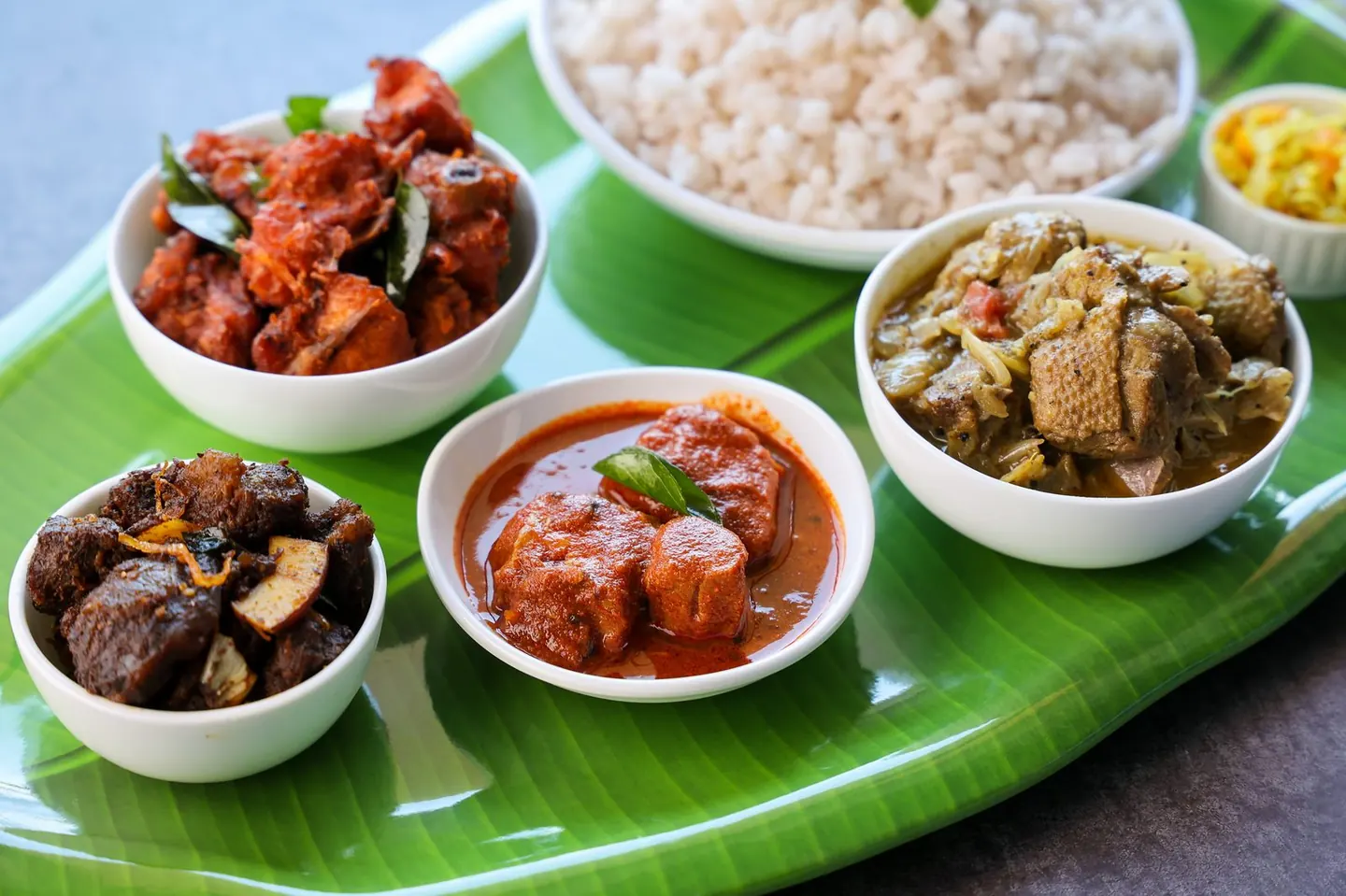
Chapter 27 — The Sadya, Re-engineered
A sadya is not a meal that got out of hand. It is one of the most carefully designed eating events anywhere in the world, and the design is legible in every detail if you know where to look. Before any of it can be lightened, it has to be understood, because most of what a health-conscious reader wants to remove is load-bearing.
Begin with the leaf. The banana leaf is laid with its pointed tip to the diner's left, narrow end left, cut spine away. The thooshanila, the tender tip portion, is the prized cut, and for grand feasts leaves were withered briefly over fire to make them supple; in shortage, banana stem sheath — pondi — stood in. Diners sit on the floor, traditionally in arthapadmasana and facing east, or on the avanappalaka and the long panthippalaka bench. Eating is with the right hand, in a calm room. And at the end, folding the leaf away from you signals satisfaction and thanks, and practically contains the liquids for the server; folding it toward yourself signals dissatisfaction and is associated with funeral meals. In Kerala even the way you finish a meal is a statement.
Then the geometry, which is not decorative. Reading the leaf left to right, tip to base: at the far left, pazham — ripe nendran — with upperi, sharkara upperi and salt, furthest from the rice, eaten with the fingers, the sweet and salt anchors pinned at the extremity. Left-centre, the pappadam, kept dry and away from the gravies. Upper left, the condiment row: inji puli, maanga achar, naranga achar — tiny quantities, enormous intensity, returned to repeatedly. Upper middle, the solids: thoran, avial, kichadi, pachadi. Upper right, the four ceremonial curries: olan, kalan, erissery, koottukari. The centre stays empty until the diner is seated, and then the rice arrives hot. The rice comes last onto the leaf and first into the mouth.
The single most quotable thing about that layout is that inji puli is placed first on the leaf and eaten last. It sits at the top left from the moment the leaf is dressed, and it is what you reach for at the very end, after the payasam, to cut the sweetness and settle the stomach. A dish positioned by protocol and consumed by physiology.
Then the sequence, and why rice arrives in courses. Before rice: banana, chips, pappadam, pickles, then the vegetable dishes — pickles first because they start the salivary glands, the chips and banana establishing textural and sweet-salt contrast. First rice course: hot matta rice with parippu and a spoon of ghee, the upastharanam, served when agni, the digestive fire, is held to be strongest. Second course: fresh rice with sambar, alongside avial, thoran, erissery and pappadam, the palate warmed and the complexity rising. Third: rasam, explicitly digestive, pepper and tamarind cutting the richness before it. Then payasam — and here is the instruction non-Malayali readers always miss, that the ripe banana is mashed into the payasam — more than one at a grand feast. Then the pickle again, specifically to break the sweetness. Then moru, spiced buttermilk with green chilli, ginger and curry leaf, described in the Namboothiri tradition as essential to a feast's end. Then inji puli, then betel leaf.
Rice comes in courses because each course is paired to a different liquid of a different viscosity and a different dominant taste: fatty-sweet, then sour-savoury, then sharp-pungent, then cooling-sour. Serve them together and a sequence collapses into a slurry. The sadya is a tasting menu that predates the phrase.
The count. A modest household sadya runs 20 to 26 items; a formal wedding sadya 26 to 30 or more. The named core is parippu, sambar, avial, two or three thorans, olan, kalan, erissery, koottukari, kichadi, pachadi, pulissery, rasam, moru, inji puli, mango and lime pickle, pazham, upperi, sharkara upperi, pappadam, rice, and two or more payasams. At the extreme, the Aranmula Vallasadya runs to 64 dishes and reportedly feeds around 200,000 people across a season.
Onam and Vishu. Onam, by tradition, commemorates the annual return of King Mahabali, whose reign is remembered as a golden age of equality — and the feast re-enacts that equality. That is myth, and it is also social argument: in a state with a documented history of severe caste exclusion, a meal where everyone sits at the same floor level and receives identical dishes in identical order carries real political weight. Vishu, on 14 or 15 April, opens the solar and agricultural year; the Vishukkani is arranged the night before and must be the first thing seen on waking — rice, coconut, golden konna flowers, fruit, gold, coins, a mirror so the viewer sees themselves among the abundance, and a lamp. Its menu deliberately covers sweet, salt, sour, bitter and astringent: a taste of everything the coming year will bring.
And the six tastes. The shadrasa scheme — madhura sweet, amla sour, lavana salty, katu pungent, tikta bitter, kashaya astringent — holds that a complete meal contains all six in appropriate proportion, and the sadya is the most literal expression of that idea anywhere in Indian food. Payasam and pazham carry the sweet; inji puli, pickle, kalan and pulissery the sour; pappadam and upperi the salt; ginger and pepper the pungent; bitter gourd the bitter; koottukari and unripe jackfruit the astringent. This book presents shadrasa as inherited culinary wisdom and nothing else. It is a coherent traditional system with a long textual history and a living institutional presence in Kerala, and describing what it says is not the same as validating it with clinical evidence, which nobody has done. What can be said is narrower and more interesting: a plate built to include all six tastes ends up containing acid, bitterness, aroma, heat and texture in quantity — and those happen to be the five levers Chapter 10 uses to cut salt. The tradition arrived at a well-balanced plate by its own reasoning. It does not need borrowed authority.
The book's position
A sadya is not a problem to be solved. It is a feast, and feasts are the point of having a calendar. Chapter 26 made the frequency argument for payasam and it applies with more force here: one leaf, four or five times a year, is a rounding error against a year of eating. What wrecks a reader's numbers is not Onam. It is the four sadyas between Onam and the wedding season, the sadya-style lunch served at every function, and the assumption that because the feast is permitted the fortnight around it is too.
So the strategy here is architecture rather than abstinence, and it has three parts.
What to reduce: the two payasams, from 200 or 250 ml each to 100 ml, portioned in the kitchen rather than at the leaf. The rice, from three generous courses to two moderate ones — this is the single largest item on the leaf and the easiest to cut without anyone noticing. The ghee on the parippu, from a tablespoon to a teaspoon. The frying oil in the upperi and the sharkara upperi, which is best handled by making fewer of them rather than making them differently. And the pappadam, roasted rather than deep-fried, which loses almost nothing.
What to leave completely untouched: everything vegetable. The thorans, the avial, the olan, the kalan, the two erisserys, the two pachadis, the pulissery, the rasam, the moru, the pickles, the sambar. These are the half of the leaf the whole book is built around — high-volume, high-fibre, low-energy-density dishes that Kerala cooking already does better than anywhere. Serve them generously. Serve them twice. The reduction happens in the rice, the ghee, the fried items and the payasam, and nowhere else, and a leaf lightened that way still carries twenty-two items.
And how to eat one as a guest, with no control over the menu: take everything once, take the vegetables generously, take one rice course rather than three, refuse nothing and finish nothing you did not want. The onnu koodi — the second helping pressed on you — is the real obstacle, because serving is done by the host and not by the eater, so portion is socially determined rather than individually. The workable answers are practical: leave a little rice on the leaf, because an empty space is an invitation and a half-inch of rice is not; accept the ladle and put the bowl down; and ask for the vegetable dishes by name, loudly and often, since a guest who wants three helpings of thoran is a guest the host is delighted with and nobody is counting. Feeding is love in this culture and refusing food refuses love, so the strategy has to be about what is offered, not about declining.
The four recipes that follow are the sadya set pieces where the re-engineering actually lives. Then a full lightened Onam menu in leaf order with the energy stated both ways, and a working back-schedule for cooking it.
R117 · Sadya Parippu with Ghee [LOW GL] [VEGETARIAN] [UNDER 250 KCAL]
Green gram dal for the first rice course, with the ghee measured
ICONS: P · B · F · L
THE RE-ENGINEERING: The ghee falls from about a tablespoon per leaf — 14 g, 125 kcal — to 2 g, and it is spooned on at the leaf rather than stirred into the pot, so every gram of it is tasted. Nothing else changes.
The sadya opens with a pulse, and that is not an accident of custom. In this tradition the heaviest, fattiest course goes first, when agni — the digestive fire — is held to be at its strongest, which is why hot rice, parippu and ghee are the first thing on the leaf and cooling moru is the last. The nutritional reading is different and arrives at the same place: a rice meal that begins with 50 g of legumes is a materially different meal from one that does not. Brown rice eaten with 50 g of legumes a day cut glycaemic response 22.9% below white rice in the one direct Indian trial, where switching the rice and stopping there reached 19.8% — the pulse is what took it past the grain swap. The sadya has been front-loading the pulse for centuries.
Serves 8 · about 70 ml per leaf, plus 2 g ghee Active 15 minutes · Total 40 minutes Difficulty: Easy
EQUIPMENT: 2-litre pan or a pressure cooker; mixie or a small blender for the coconut paste. Substitute: an ammikkallu or a mortar gives a coarser paste with better texture and takes 5 minutes longer. A pressure cooker takes the dal to soft in 3 whistles, about 8 minutes at pressure, against 25 in an open pan.
BEFORE YOU START: Roast the dal before you wash it. Sadya parippu is made with dry-roasted green gram dal, and the roasting is the difference between this dish and any other dal on earth.
INGREDIENTS
- 200 g (1 cup) green gram dal (cherupayar parippu), split and skinned
- 700 ml water
- 1 g (¼ tsp) turmeric
- 40 g (about ½ cup) fresh grated coconut
- 1 green chilli
- 2 g (½ tsp) cumin seeds
- 3 g (¾ tsp) salt, or M07 the 70:30 salt
- 16 g (4 tsp) ghee, for serving — 2 g per leaf
- 8 curry leaves — optional
SOURCING NOTE: Split skinned green gram dal is in every Indian grocery and most large supermarkets as moong dal. Choose bright yellow, uniform dal; grey or dusty dal is old and will not roast to a clean aroma. Frozen grated coconut works completely here and is what most diaspora readers should use. On the ghee: buy real ghee rather than a vegetable-fat "ghee substitute", because the whole point of 2 g is that it must be worth tasting — a hydrogenated substitute at 2 g tastes of nothing and you will end up using 10 g of it. Note that formal sadya and temple cooking exclude onion and garlic, treated in this tradition as rajasic or tamasic; household Brahmin cooking varies, and shallots are widely used elsewhere in Kerala. There is neither here, and the dish does not miss them.
ALLERGENS: Milk.
METHOD
- Dry-roast the dal in the pan over a medium heat, stirring constantly, until it is one shade darker, a few grains have gone golden, and the smell has turned from raw pulse to something toasted and faintly biscuit-like, 4–6 minutes.
- Rinse the roasted dal in two changes of cold water and drain.
- Simmer it in the 700 ml water with the turmeric, uncovered, skimming any foam in the first few minutes, until the grains crush completely against the side of the pan with no resistance in the centre, 22–28 minutes in an open pan. There should still be loose liquid; parippu is a pourable dish, not a thick dal.
- Grind the coconut, green chilli and cumin with 60 ml water to a smooth-ish paste, coarse enough that you can still feel a little grain on a fingertip, 20–30 seconds.
- Stir the paste into the dal and simmer 5–6 minutes more, until the raw coconut smell has lifted and the parippu has gone slightly opaque and thickened just enough to coat the back of a spoon thinly.
- Season with the salt, and add the curry leaves off the heat if you are using them.
- Adjust to a pouring consistency with hot water. It should run off a ladle in a stream rather than in dollops — on the leaf it has to mix into hot rice with one movement of the fingers.
- Serve the parippu over the first rice course, and put exactly 2 g of ghee — half a teaspoon — on top of each leaf, at the leaf. The aroma of ghee hitting hot rice is the whole sensory event, and it happens at the surface. Stirred into the pot, four times as much would deliver less of it.
WHY THIS WORKS
Two mechanisms, one culinary and one metabolic. Ghee's aroma compounds are volatile and are perceived at the nose rather than the tongue, so a small quantity applied hot to the surface of food delivers most of the sensory payload that a larger quantity stirred through would — this is the same principle as finishing with surface salt. And 200 g of green gram dal across eight leaves puts about 25 g of cooked pulse and 6 g of protein at the very start of the meal, before the rice, which is where the evidence says it does most good.
PER SERVING (estimated) — 70 ml plus 2 g ghee
| kcal | kJ | Carb | Fibre | Net carb | Sugars | Protein | Fat | Sat fat | Sodium |
|---|---|---|---|---|---|---|---|---|---|
| 120 | 502 | 16 g | 3 g | 13 g | 0 g | 6 g | 4 g | 3 g | 150 mg |
Computed from ICMR-NIN IFCT 2017 "Green gram dal" (B010) and "Coconut, kernel, fresh" (H007); salt at 400 mg sodium per gram. A traditional sadya parippu at the leaf serving in the table below — 80 ml with a full tablespoon of ghee, 14 g — comes to roughly 241 kcal and 16 g of fat, of which about 10 g saturated.
IF YOU ARE WATCHING… Blood sugar: this is the most useful dish on the leaf and it should be eaten in full. Thirteen grams of net carbohydrate, 6 g of protein and 3 g of fibre, arriving before the rice. Blood pressure: 150 mg sodium a leaf. Made with M07 the 70:30 salt it drops to about 105 mg and brings roughly 60 mg of potassium — and the standing carve-out applies: do not use potassium-enriched salt if you have chronic kidney disease, or take an ACE inhibitor, an angiotensin receptor blocker, a potassium-sparing diuretic or a potassium supplement, without your doctor's approval. Cholesterol: 3 g of saturated fat, roughly half from the ghee and half from the coconut. Using coconut oil instead of ghee changes the saturated figure very little and loses the aroma, which is the wrong trade.
SWAP IT
- Green gram dal → red gram dal (toor). Heavier, sweeter, slower to soften by 10 minutes; some households do it this way and it is not wrong, but green gram is the sadya standard and it is lighter.
- Ghee → coconut oil, 2 g. Saturated fat is essentially unchanged; the aroma is completely different and the dish stops being upastharanam in any recognisable sense.
- Fresh coconut → 25 g desiccated coconut soaked 15 minutes in 50 ml warm water. Slightly chalky, and you will want a squeeze more water in the grind.
- Cannot have ghee at all → finish with 2 g of coconut oil and a scatter of fried curry leaves, which supplies aroma from a different direction and works better than nothing.
SCALE IT
| Leaves | Green gram dal | Water | Coconut | Green chilli | Salt | Ghee (2 g/leaf) |
|---|---|---|---|---|---|---|
| 8 | 200 g | 700 ml | 40 g | 1 | 3 g | 16 g |
| 12 | 300 g | 1.05 litres | 60 g | 1–2 | 4.5 g | 24 g |
| 25 | 625 g | 2.2 litres | 125 g | 3 | 9 g | 50 g |
| 50 | 1.25 kg | 4.4 litres | 250 g | 5–6 | 18 g | 100 g |
At 25 leaves this is about 1.75 litres of finished parippu — a 5-litre pan, or a pressure cooker in two batches. Grind the coconut paste in one go and add it in proportion.
MAKE AHEAD · STORE · FREEZE Roast the dal up to a week ahead and keep it in a jar. Cook the parippu to the end of step 3 the day before — fridge 2 days — and add the coconut paste on the day, because ground coconut sours faster than anything else on the leaf. Freeze 2 months without the coconut paste. Reheat with hot water to bring it back to a pouring consistency, which it will need.
LEFTOVERS Thin it with water, add a tempering of mustard and curry leaves in 3 g of coconut oil, and it becomes a weekday parippu curry over rice. Or thicken it with a handful of rice flour and make dal vada. Leftover parippu also makes the best possible base for a parippu pradhaman if you have jaggery and coconut milk to hand.
SERVE WITH R015 Matta Rice as the first course · R118 Sadya Sambar as the second · R119 the pickle set at the top left of the leaf · M07 the 70:30 salt
TROUBLESHOOTING Tastes of raw pulse: under-roasted at step 1, and nothing later fixes it. Grainy, with hard centres: the dal was not fully soft before the coconut went in. Coconut fat slows further softening; get it right at step 3. Too thick to pour on the leaf: the commonest fault in this dish. Hot water, generously, right before serving. Sour by the time the sadya starts: the ground coconut went in too early on a hot day. Add it within the hour before serving.
NOTES
R118 · Sadya Sambar [HIGH FIBRE] [VEGAN] [UNDER 250 KCAL]
The festival sambar, at full scale
ICONS: V · P · B · F · L
THE RE-ENGINEERING: The vegetable weight is raised to more than four times the dal weight, and the coconut oil for the tempering falls from a poured glug to 10 g measured. The dal, the tamarind, the roasted coconut and the podi are all left at full strength, because they are the dish.
Sambar arrives in the sadya comparatively late — which is why the older four-curry scheme of erissery, kalan, olan and a madhura curry does not include it — and its origin story is a good case study in how food history goes wrong. The popular attribution places its invention in the Thanjavur kitchen of Shahaji I after 1676, improvised from dal and tamarind in the absence of kokum. No primary source is offered for that; Tamil literature refers to comparable tamarind-and-dal preparations earlier, and the Maratha analogue is amti rather than sambar. Treat the Thanjavur story as the popular attribution and not as documented history. What is certain is that a festival sambar is not a weekday sambar: more vegetables, more of them, cut larger, and no onion.
Serves 8 · about 150 ml per leaf (about 1.2 litres) Active 30 minutes · Total 1 hour 10 minutes Difficulty: Moderate
EQUIPMENT: 4-litre pan or pressure cooker for the dal; a wide 4-litre pan for the sambar; small pan for the tempering. Substitute: one pan and a pressure cooker manage this comfortably. At 25 leaves you want a genuine 12-litre pot, which is what the bronze charakku of feast cooking exists for.
BEFORE YOU START: Soak the tamarind first — it needs 20 minutes — and cut the vegetables into pieces large enough to survive: sadya vegetables are cut in 4 cm batons and chunks, not diced, because they are eaten with the fingers off a leaf.
INGREDIENTS
- 150 g (¾ cup) red gram dal (toor parippu)
- 900 ml water
- 1 g (¼ tsp) turmeric
- 25 g tamarind, soaked in 200 ml warm water for 20 minutes
- 150 g drumstick (muringakka), in 6 cm lengths, strings peeled
- 200 g ash gourd (kumbalanga), in 3 cm chunks
- 150 g elephant foot yam (chena), in 2.5 cm chunks
- 100 g snake gourd (padavalanga), in 2 cm rounds
- 100 g okra (vendakka), topped and cut in 3 cm lengths
- 60 g (about ¾ cup) fresh grated coconut
- 30 g (4 tbsp) M02 sambar podi
- 5 g (1¼ tsp) salt, or M07
- 10 g (2 tsp) coconut oil
- 2 g (½ tsp) mustard seeds
- 2 dried red chillies, broken
- 10 curry leaves
- a pinch of asafoetida
SOURCING NOTE: Drumstick is sold fresh in South Asian groceries and frozen in 400 g packets, which work well and save the peeling. Ash gourd is winter melon in Chinese groceries — buy a wedge, not a whole one, unless you are cooking for 25. Elephant foot yam is sold frozen in cubes and is the single most convenient item here; taro or ordinary yam substitutes almost exactly, since all five Kerala starchy tubers land within 17.5 to 17.9 g of available carbohydrate per 100 g and are effectively interchangeable by weight. Snake gourd substitutes with courgette, which is close in water content and much easier to find. Tamarind, not kudampuli: sambar is a tamarind dish, and kudampuli belongs in fish curry and never in a sadya vegetable dish. Buy tamarind as a block rather than as concentrate, which is flatter and often salted.
ALLERGENS: Mustard. Gluten (wheat) — only if your asafoetida is compounded with wheat flour, as most brands are.
METHOD
- Soak the tamarind in the 200 ml warm water. It should soften enough to break apart between your fingers, 15–20 minutes. Squeeze it out, strain, and keep the liquid.
- Cook the dal with the 900 ml water and the turmeric until it collapses entirely and can be whisked smooth — 30–35 minutes open, or 4 whistles in a pressure cooker. Whisk it smooth and set aside.
- Roast the grated coconut in a dry pan over a medium heat, stirring, until it is a uniform golden brown and smells strongly nutty, 6–8 minutes. Do not stop at pale — the varutharacha character comes from real colour. Grind with 80 ml water to a fine paste.
- Cook the harder vegetables first: chena and drumstick in 300 ml water with a pinch of salt, covered, 8–10 minutes, until the chena is just tender at the centre when pierced.
- Add the ash gourd and snake gourd and cook 4–5 minutes, then the okra for a final 3–4 minutes. The okra goes in last because it turns to slime if it is cooked as long as the yam. Every vegetable should be tender but still holding its shape — a sadya sambar with collapsed vegetables has failed, because the vegetables are eaten as vegetables.
- Pour in the strained tamarind water and simmer 5–6 minutes, until the raw sharpness of the tamarind has softened into something rounder.
- Stir in the whisked dal, the roasted coconut paste and the sambar podi, add water to bring the total to about 1.2 litres, and simmer gently 8–10 minutes, until the sambar has thickened enough to coat a spoon and no longer tastes of raw spice powder.
- Season with the salt.
- Temper: heat the 10 g of coconut oil in the small pan until a mustard seed dropped in cracks within 2 seconds, add the mustard and wait for it to finish popping, 20–30 seconds, then the dried chilli for 5 seconds, then the curry leaves and asafoetida for 5 seconds more. Pour it over the sambar and cover immediately for 2 minutes to trap the aroma.
WHY THIS WORKS
The re-engineering here is a ratio, not a subtraction: 700 g of vegetables against 150 g of dal means most of the volume on the leaf is water-rich, high-fibre and low in energy density, and Rolls's work is unambiguous that people eat a fairly consistent weight of food, so lowering the energy density of what is available lowers energy intake. Meanwhile the roasted coconut paste, the tamarind and the podi supply so much flavour that 10 g of tempering oil across eight leaves is genuinely enough.
PER SERVING (estimated) — 150 ml
| kcal | kJ | Carb | Fibre | Net carb | Sugars | Protein | Fat | Sat fat | Sodium |
|---|---|---|---|---|---|---|---|---|---|
| 149 | 623 | 25 g | 7 g | 18 g | 3 g | 6 g | 5 g | 4 g | 250 mg |
Computed from ICMR-NIN IFCT 2017: red gram dal (B021), drumstick pods (D046), ash gourd (D001), elephant foot yam (F017), snake gourd (D070), okra (D056), coconut kernel fresh (H007), coconut oil from USDA SR Legacy 171412; salt at 400 mg sodium per gram. Seven grams of fibre in one dish on the leaf is the highest of any item in this chapter.
IF YOU ARE WATCHING… Blood sugar: 18 g of net carbohydrate with 7 g of fibre and 6 g of protein. This is a dish to take twice, and taking it twice instead of taking more rice is the single most effective move available at a sadya. Blood pressure: 250 mg sodium a leaf, which is real and worth knowing in the context of a leaf that also carries pappadam, upperi and three pickles. Made with M07 the 70:30 salt it falls to about 175 mg — with the standing carve-out for chronic kidney disease, ACE inhibitors, angiotensin receptor blockers, potassium-sparing diuretics and potassium supplements. The vegetables here are also among the most potassium-dense items in the Kerala pantry, which is useful for most readers and a reason for that same carve-out for a few. Cholesterol: 4 g of saturated fat, most of it from the roasted coconut rather than the oil. The coconut is doing flavour work that oil cannot do; leave it and cut elsewhere.
SWAP IT
- Drumstick → green beans and a piece of carrot. You lose the specific resinous flavour that makes a sambar taste of a sadya, and gain convenience.
- Chena → taro, ordinary yam or potato. Metabolically near-identical by weight; potato is the least traditional and the most available.
- Snake gourd → courgette, 1:1. Close in water content, slightly sweeter, cooks 2 minutes faster.
- Roasted coconut → skip it and add 20 g more dal. About 25 kcal and 2.5 g of saturated fat less per leaf, and a noticeably thinner, brighter, less rounded sambar. A real trade rather than a free one.
- M02 sambar podi → any good commercial sambar powder, 30 g. Check the label for added salt and cut the added salt accordingly.
- Tamarind → 30 ml lime juice added off the heat. Sharper and more volatile; the sambar does not keep as well.
SCALE IT
| Leaves | Toor dal | Vegetables (total) | Tamarind | Coconut | Sambar podi | Salt | Coconut oil | Yield |
|---|---|---|---|---|---|---|---|---|
| 8 | 150 g | 700 g | 25 g | 60 g | 30 g | 5 g | 10 g | 1.2 litres |
| 12 | 225 g | 1.05 kg | 38 g | 90 g | 45 g | 7.5 g | 15 g | 1.8 litres |
| 25 | 475 g | 2.2 kg | 80 g | 190 g | 95 g | 16 g | 30 g | 3.75 litres |
| 50 | 950 g | 4.4 kg | 160 g | 375 g | 190 g | 32 g | 60 g | 7.5 litres |
At 25 leaves, three things change. Cook the dal separately in a pressure cooker while the vegetables go in a 12-litre pot, or the pot will take an hour to come back to temperature each time you add something. Roast the 190 g of coconut in two batches — a crowded pan steams rather than roasts, and pale coconut paste is the commonest failure at scale. And add the salt at the very end, tasting, because a large pot reduces unpredictably and a 3.75-litre pot of over-salted sambar is 25 leaves ruined.
MAKE AHEAD · STORE · FREEZE Sambar is better on day two and this is genuinely useful for a sadya. Cook it to the end of step 8 the day before, keep it fridge 3 days, and temper it fresh on the day — a re-tempered sambar tastes made that morning. Freeze 2 months; the okra suffers and the rest does not, so leave the okra out of a batch destined for the freezer and add it on reheating. Reheat to a gentle simmer, adding water, since it thickens considerably.
LEFTOVERS Sambar over rice is the best weekday lunch in South India and needs no apology. Thinned with water and a squeeze of lime it becomes a passable rasam. The vegetables can be fished out, drained and turned into a thoran with fresh grated coconut and a mustard tempering, which is what a Kerala kitchen has always done with the day after a feast.
SERVE WITH R015 Matta Rice as the second rice course · R117 Sadya Parippu as the first · R086 Rasam as the third · R069 Avial and R063 Cabbage Thoran alongside · M02 sambar podi · M07 the 70:30 salt
TROUBLESHOOTING Vegetables collapsed into mush: everything went in together. Hardest first, okra last, and cut sadya-sized. Sambar tastes raw and dusty: the podi did not get its 8–10 minutes at step 7. Spice powders need time in liquid. Slimy: the okra was cut too early and sat in water, or cooked too long. Cut it just before it goes in and give it four minutes. Thin and sour rather than rounded: the tamarind did not get its own simmer at step 6, or the coconut was under-roasted. Bitter: the mustard seeds burnt in the tempering, or the asafoetida sat too long in hot oil. Five seconds, then off.
NOTES
R119 · The Sadya Pickle and Relish Set [VEGAN] [UNDER 250 KCAL]
Inji puli, naranga achar and manga achar, in sadya proportions
ICONS: B
THE RE-ENGINEERING: Nothing is reduced in the jars, because a pickle diluted is a pickle spoiled. What changes is the portion and the honesty: the set is built to yield about 8 g of each per leaf, and the sodium is printed rather than hidden, because this is the corner of the leaf where a hypertensive reader's whole day can go.
The condiment row sits at the top left of the leaf from the moment it is dressed, and it is the row a diner returns to most often. Its function is intensity in tiny quantities: pickles come first in the sequence because they start the salivary glands, and inji puli comes back at the very end, after the payasam, to cut the sweetness. A sadya without them is a sequence of soft mild dishes with nothing to strike against. Made properly and portioned properly, three relishes contribute about 18 kilocalories to a leaf — and about 380 mg of sodium, which is the number that matters.
THE SODIUM, STATED PLAINLY
About 380 mg of sodium per leaf from the condiment row alone, at 8 g of each of the three. Against WHO's target of under 2,000 mg a day, that is roughly a fifth of a day in three teaspoons. The lime achar is the culprit — salt is the preservative in a lime pickle and there is no version of it that is low in sodium, because the salt is what stops it spoiling. Two things follow, and neither of them is "make a low-salt pickle", which does not work. Portion it as a condiment, not a side dish — one teaspoon of each, which is what the leaf's geometry already implies. And if you are working seriously on blood pressure, take the inji puli and skip the lime achar, which drops the row to about 140 mg. This book prints no sodium figure for shop-bought pickle, because the salt applied varies enormously between producers and no verified per-serving value exists in the sources behind it; the figures here are honest only because the salt was weighed into these batches.
Serves 25 · about 8 g of each relish per leaf, 24 g in total Active 1 hour · Total 1 hour (plus 2 days maturing for the achars — required) Difficulty: Moderate
EQUIPMENT: Three heavy-based pans; three sterilised glass jars with non-metal lids; a digital scale reading to 1 g. Substitute: no substitute for the scale. Pickle salt is a preservative dose and guessing it either spoils the jar or doubles the sodium. Metal lids corrode against pickle acid — use glass or plastic.
BEFORE YOU START: These are three separate preparations and they should be made in this order: mango first, because it needs the longest maturing; lime second; inji puli last, on the day before, because it is best fresh and it is the one that needs tasting and balancing. Sterilise the jars — 10 minutes in a 120°C (250°F) oven — and let them cool dry.
INGREDIENTS
Inji puli (puli inji) — yields about 380 g
- 120 g fresh ginger, peeled and very finely chopped
- 20 g green chilli, finely chopped
- 30 g tamarind, soaked in 200 ml warm water for 20 minutes
- 60 g jaggery, grated
- 10 g (2 tsp) coconut oil
- 3 g (¾ tsp) mustard seeds
- 5 g (about 2) dried red chillies, broken
- 2 g (½ tsp) fenugreek, dry-roasted and ground
- 2 g (½ tsp) chilli powder
- 3 g (¾ tsp) salt
- 12 curry leaves
- a pinch of asafoetida
Naranga achar (lime) — yields about 330 g
- 300 g small limes (about 10), quartered
- 25 g salt
- 15 g (2 tbsp) chilli powder
- 5 g (1 tsp) fenugreek, dry-roasted and ground
- 3 g (¾ tsp) asafoetida
- 15 g (1 tbsp) gingelly (sesame) oil
- 3 g (¾ tsp) mustard seeds
- 10 curry leaves
Manga achar (raw mango) — yields about 420 g
- 350 g raw green mango, in 1.5 cm dice with skin on
- 15 g salt
- 15 g (2 tbsp) chilli powder
- 5 g (1 tsp) fenugreek, dry-roasted and ground
- 2 g (½ tsp) turmeric
- 15 g (1 tbsp) gingelly (sesame) oil
- 3 g (¾ tsp) mustard seeds
- 100 ml water, boiled and cooled
- 12 curry leaves
- a pinch of asafoetida
SOURCING NOTE: Small thin-skinned Indian limes are what a naranga achar wants; large Persian limes have too much pith and go bitter, so if that is all you can get, use half the quantity of lime and make up the volume with lemon. Raw green mango for pickling must be genuinely unripe — hard, pale, sour, with a white stone — and the Indian and Latin American varieties sold for pickling and for chamoy are both right; a firm underripe supermarket mango is a poor substitute and a ripe one is useless. Gingelly (sesame) oil rather than coconut oil in the two achars is a deliberate choice, and it is traditional in South Indian pickling: sesame sits at 16.25% saturated fat against coconut oil's 90.86%, and it is the correct flavour for a pickle. Coconut oil is right for the inji puli, where it is the flavour. Note the standing fenugreek caution: the quantities here are culinary — under half a gram per leaf — and are not the exposure that matters, but if you take insulin or a sulfonylurea and are deliberately eating fenugreek at 10–25 g a day, that belongs in a conversation with your clinician (see R109).
ALLERGENS: Sesame, mustard. Gluten (wheat) — only if your asafoetida is compounded with wheat flour, as most brands are.
METHOD
Manga achar
- Salt the diced mango with the 15 g of salt in a bowl and leave 30 minutes, until it has released a pool of liquid and the pieces have gone slightly translucent at the edges. Do not drain it; that brine is the pickle.
- Temper: heat the sesame oil until a mustard seed cracks in 2 seconds, add the mustard and let it finish popping, 20–30 seconds, then the curry leaves and asafoetida for 5 seconds.
- Take the pan off the heat, stir in the chilli powder, turmeric and ground fenugreek — off the heat, or the chilli scorches within seconds and turns the whole jar bitter.
- Add the mango with its brine and the 100 ml of cooled boiled water, return to a low heat and cook 5–6 minutes, until the raw smell has gone and the oil has risen to the surface in a visible film.
- Cool completely and jar. Mature 2 days minimum before serving.
Naranga achar
- Salt the quartered limes with the 25 g of salt and leave 30 minutes to draw juice.
- Temper in the sesame oil exactly as above, adding the powders off the heat.
- Add the limes with all their juice and cook over a low heat 8–10 minutes, until the skins have softened enough to bite through easily and the colour has deepened to a dull orange-red.
- Cool and jar. Mature 2 days minimum; it improves for a fortnight.
Inji puli
- Fry the ginger and green chilli in the coconut oil over a medium heat until the ginger is deep golden, crisp at the edges and no longer smells raw, 8–10 minutes. This is the step that decides the dish; pale ginger gives a harsh, hot relish, and properly browned ginger gives the sweet-sour-pungent thing inji puli is famous for.
- Add the mustard seeds and let them pop, 20–30 seconds, then the dried chilli, curry leaves and asafoetida for 5 seconds.
- Stir in the chilli powder and ground fenugreek off the heat.
- Pour in the strained tamarind water, return to the heat and simmer 6–8 minutes, until it has reduced by about a third and thickened slightly.
- Add the jaggery and the salt and cook 5–7 minutes more, until the relish is glossy, dark and thick enough to hold a mound on a spoon without running. It should taste sour first, then sweet, then hot, then pungent, in that order — if any one of the four dominates, correct it with the missing one rather than by adding more of the loudest.
- Cool and jar. Ready the same day, better the next.
WHY THIS WORKS
Acid is the most powerful salt-reduction tool in this cuisine, and the condiment row is where it is most concentrated: tamarind, lime and raw mango all raise the perceived saltiness and brightness of everything else on the leaf, which is why a leaf with a proper pickle row needs less salt in its curries. The trade is visible in the numbers above — the row buys flavour intensity for the rest of the meal at a cost of about 380 mg of sodium, which is a bargain at a teaspoon each and a bad deal at a tablespoon.
PER SERVING (estimated) — 8 g of each of the three relishes, 24 g total
| kcal | kJ | Carb | Fibre | Net carb | Sugars | Protein | Fat | Sat fat | Sodium |
|---|---|---|---|---|---|---|---|---|---|
| 18 | 75 | 3 g | 1 g | 2 g | 2 g | 0 g | 1 g | 1 g | 380 mg |
Sodium computed directly from the weighed salt in each batch divided by yield: inji puli about 25 mg, naranga achar about 242 mg, manga achar about 114 mg per 8 g portion. Oils from USDA SR Legacy and IFCT 2017 Table 12; jaggery costed as sucrose at 98 g of carbohydrate and about 390 kcal per 100 g, the working assumption this book states in its reference tables.
IF YOU ARE WATCHING… Blood sugar: 2 g of net carbohydrate across the row. Irrelevant, and the acid may work slightly in your favour — pooled trial data on vinegar consumption show reductions in postprandial glucose and insulin response, which is the best evidence available for Kerala's souring habits generally. Blood pressure: read the box above. This is the item on the leaf to manage, and the management is portion and selection rather than reformulation. Cholesterol: 1 g of saturated fat across the row, and the choice of sesame oil over coconut oil for the two achars is why. Sesame is 16.25% saturated fat; coconut oil is 90.86%.
SWAP IT
- Gingelly oil → groundnut or rice bran oil, both at 19–24% saturated fat. Different flavour, similar profile; groundnut is sweeter and rice bran is neutral with a high smoke point. (Allergen: this swap introduces peanuts.)
- Gingelly oil → coconut oil. Saturated fat across the row roughly triples to about 3 g and the pickles taste more Kerala and less South Indian. A legitimate choice made knowingly.
- Raw mango → raw green papaya or firm gooseberry. Papaya is milder and needs more lime; gooseberry (nellikka) is sharper and traditional in its own right.
- Jaggery in the inji puli → dates, 60 g, blitzed. Slightly less sweet, more fruity, and it holds the relish together well.
- Working hard on sodium → make only the inji puli, at 25 mg per leaf, and put a wedge of fresh lime and a piece of raw mango on the leaf in place of the achars. The intensity is lower and the sodium is a tenth.
SCALE IT
| Leaves | Ginger (inji puli) | Jaggery | Limes | Salt (lime) | Raw mango | Salt (mango) | Total yield |
|---|---|---|---|---|---|---|---|
| 8 | 40 g | 20 g | 100 g | 8 g | 110 g | 5 g | about 360 g |
| 25 | 120 g | 60 g | 300 g | 25 g | 350 g | 15 g | about 1.13 kg |
| 50 | 240 g | 120 g | 600 g | 50 g | 700 g | 30 g | about 2.25 kg |
The salt fractions must scale exactly with the fruit, not with the number of leaves — a lime pickle with proportionally less salt will spoil, and this is the one recipe in the book where the salt is a preservative rather than a seasoning. Portion smaller if you want less sodium. Do not weaken the brine.
MAKE AHEAD · STORE · FREEZE This is the make-ahead recipe of the whole chapter. Naranga achar and manga achar keep 6 months in a sterilised jar in a cool cupboard, submerged under their oil, provided a dry spoon is used every time — one wet spoon will start a mould. Inji puli keeps 3 weeks in the fridge and is best in the first week. Freeze inji puli 3 months in 100 g portions; the achars should not be frozen, since the salt and oil already preserve them and freezing softens the fruit.
LEFTOVERS There will be leftovers, because a sadya uses teaspoons. Inji puli is superb with curd rice, inside a dosa, or alongside cold meat. Chopped fine, a spoon of manga achar transforms a plain thoran. And a teaspoon of achar brine is one of the most efficient umami-and-acid seasonings in the kitchen — use it in place of salt in a curry and taste before adding any more.
SERVE WITH At the top left of the leaf, in three small mounds, from the moment it is dressed · again after R113 Ada Pradhaman and R120, which is what inji puli is for · R096 low-sodium lime achar and R097 low-sodium mango achar are the everyday versions of these, for the days that are not a feast · M06 the low-sodium all-purpose podi, for the days you want intensity without the salt
TROUBLESHOOTING Bitter pickle: the chilli powder went into hot oil. Off the heat, every time. Mould on the surface within a fortnight: a wet spoon, an unsterilised jar, or the fruit not fully submerged in oil. Discard the jar; mould in a pickle is not something to scrape off. Inji puli harsh and hot rather than rounded: the ginger was not browned long enough at step 10. Eight to ten minutes, to deep gold. Inji puli too sweet: more tamarind water, reduced. Too sour: more jaggery, 10 g at a time. It should taste sour first. Lime pickle unbearably bitter: large thick-skinned limes. Use small thin-skinned ones, or halve the lime and add lemon.
NOTES
R120 · Sadya Payasam, Portioned [LOW SODIUM] [VEGETARIAN] [UNDER 250 KCAL]
Paal payasam for twenty-five leaves, at a measured ninety millilitres
ICONS: B · L
THE RE-ENGINEERING: The sugar falls from around 550 g to 250 g across twenty-five servings, and the reduction is done by time rather than by condensed milk. But the actual technique of this recipe is the portioning, and that is not a figure of speech: the payasam is measured into twenty-five vessels in the kitchen before the leaves are dressed, and the pot never reaches the dining room.
Paal payasam is the temple payasam — short-grain rice, milk, sugar, a scrape of cardamom, and nothing else. It is one of the two payasams a sadya closes with, alongside a jaggery-and-coconut pradhaman, and the ripe banana from the tip of the leaf is mashed into it, which is the instruction non-Malayali readers always get wrong. Its simplicity is why the portioning method belongs here: there is no ingredient to argue about, so the only lever left is the ladle, and the ladle is the lever that works.
Serves 25 · exactly 90 ml per leaf (about 2.25 litres) Active 40 minutes · Total 2 hours Difficulty: Moderate
EQUIPMENT: A genuinely wide heavy pot of at least 8 litres, or two 5-litre pans, or a bell-metal uruli; a 90 ml ladle or a 90 ml measure; twenty-five small steel tumblers, glasses or paper cups; a flat-ended wooden spoon that reaches the corners. Substitute for the 90 ml ladle: a standard 60 ml serving ladle plus a half — count "one and a half" for every portion and it works. What does not substitute is the ladle-by-eye, which is how 90 ml becomes 200.
BEFORE YOU START: Set out the twenty-five vessels before you begin cooking, on a tray, counted. This sounds trivial and it is the difference between the method working and not working. A cook who has to find and wash twenty-five tumblers while a hot pot of payasam sits on the stove will serve from the pot.
INGREDIENTS
- 200 g (1 cup) short-grain raw rice (unakkalari, or any short round grain), rinsed twice
- 3.5 litres whole cow's milk
- 250 g sugar
- 4 g (1 tsp) cardamom, seeds only, crushed
- 15 g (1 tbsp) ghee
- a pinch of salt
- 25 small ripe bananas or 12 nendran, to be mashed in at the leaf
SOURCING NOTE: Short-grain raw rice is the correct grain — unakkalari, or any short round rice such as pudding rice, arborio or Egyptian rice, all of which release starch readily and give the right body. Do not use matta or parboiled rice here, because a parboiled grain holds its structure and will not break down into the payasam. Basmati is wrong for the opposite reason: it is too aromatic and too separate. Whole milk is not negotiable; skimmed milk cannot reduce to the right consistency and no amount of extra time will make it. If you are cooking for 25 and can find it, full-cream milk sold for sweets in Indian dairies is ideal.
ALLERGENS: Milk.
METHOD
- Set out the twenty-five vessels on a tray, and put the 90 ml measure beside them. Do this first.
- Rub the base of the dry pot with the ghee, which measurably reduces sticking over a two-hour reduction.
- Bring the milk to a simmer over a medium heat, stirring occasionally, then drop the heat until the surface carries a slow tremble rather than a boil. Whole milk catches at the base within a minute at a full boil.
- Add the drained rice and cook, stirring across the whole base every 4–5 minutes and scraping the sides down each time, until the grains have swollen and begun to break, 50–60 minutes.
- Continue reducing until the milk has gone from white to a faint ivory, the volume has come down to roughly 2.4 litres, and the payasam coats the back of a spoon in an even film that does not run straight off, another 25–35 minutes. The smell shifts from milk to something nutty and faintly caramel, and that shift is a better cue than the clock.
- Stir in the sugar and the salt and cook 8–10 minutes more, until the sugar has completely dissolved and the payasam is uniform and glossy. Sugar added earlier raises the boiling point, holds water, and slows the whole reduction by twenty minutes or more.
- Take the pot off the heat and stir in the cardamom. Let it stand 10 minutes; it thickens noticeably as it cools, so stop while it looks slightly too loose.
- Portion. Measure exactly 90 ml into each of the twenty-five vessels, at the stove, before the leaves are dressed. Line them up on the tray and count them.
- Cover the tray and take the pot off the stove and out of the room. This is the step that does the work. A pot of payasam within reach of a server will be ladled from, generously, by someone who loves the person they are serving — and no instruction survives that. Twenty-five measured vessels cannot be over-served.
- Serve the vessels onto the leaves at the payasam course, with a ripe banana each to mash in.
WHY THIS WORKS
The culinary mechanism is that slow reduction concentrates lactose and milk protein and drives a low, slow Maillard reaction between them, which is where the ivory colour and the nutty depth come from — condensed milk imitates that by boiling sugar into milk, which tastes sweet where reduced milk tastes deep. The behavioural mechanism matters more. Serving at a sadya is done by the host, not the eater, so portion size is socially determined rather than individually chosen. Pre-measuring moves the decision from the moment of service, where generosity governs, to the kitchen, where the scale does. That is environment design, and it is the most reliable tool in this book.
PER SERVING (estimated) — 90 ml
| kcal | kJ | Carb | Fibre | Net carb | Sugars | Protein | Fat | Sat fat | Sodium |
|---|---|---|---|---|---|---|---|---|---|
| 176 | 736 | 23 g | 0 g | 23 g | 17 g | 5 g | 7 g | 4 g | 70 mg |
Computed from ICMR-NIN IFCT 2017 "Rice, raw, milled" (A015) and "Milk, whole, cow" (L002); sugar at 4 kcal/g. A traditional temple paal payasam ladled at 200 ml with 550 g of sugar comes to roughly 430 kcal and about 48 g of sugars. The banana mashed in adds about 111 kcal per 100 g of ripe nendran, which is a real addition and part of the dish rather than an extra.
IF YOU ARE WATCHING… Blood sugar: 23 g of net carbohydrate a vessel, of which about 10 g is added sugar, plus roughly 12 g more if you mash in half a nendran. Take it at the end of the meal, which is where the sequence puts it anyway, and take the inji puli afterwards, which is also where the sequence puts it. Blood pressure: 70 mg sodium. The lowest-sodium item on the leaf apart from the rice. Cholesterol: 4 g of saturated fat, from milk fat rather than coconut — which makes this the lower-saturated-fat of the two payasams a sadya serves, at 4 g against R113's 11 g. If you are choosing one, this is the one, and the coconut pradhaman is the one to take at 100 ml rather than 200.
SWAP IT
- Sugar → pale jaggery, 1:1. The colour turns amber and the clean milk flavour is lost, which in paal payasam is the whole dish. Sugar is correct here; jaggery is correct in R113.
- Short-grain rice → rice ada, 250 g, boiled and rinsed first, which makes R112 Palada Payasam. Silkier, more work, and arguably better.
- Short-grain rice → semiya (vermicelli), 200 g, roasted in the ghee first and added at step 5 rather than step 4. Cooks in 10 minutes; a thinner, quicker payasam that will not hold as well.
- Whole milk → half whole, half semi-skimmed. Saturated fat to about 3 g; add 15 minutes to the reduction and accept a thinner body.
- Whole milk → coconut milk, and you have made a pradhaman rather than a paal payasam. That is R113 or R116, and both are good, and neither is this.
SCALE IT
| Leaves | Short-grain rice | Whole milk | Sugar | Cardamom | Ghee | Yield | Portion |
|---|---|---|---|---|---|---|---|
| 8 | 65 g | 1.1 litres | 80 g | ⅓ tsp | 5 g | 720 ml | 90 ml |
| 12 | 100 g | 1.7 litres | 120 g | ½ tsp | 8 g | 1.1 litres | 90 ml |
| 25 | 200 g | 3.5 litres | 250 g | 1 tsp | 15 g | 2.25 litres | 90 ml |
| 50 | 400 g | 7 litres | 500 g | 2 tsp | 30 g | 4.5 litres | 90 ml |
Above 25 leaves, split the milk across two wide pans. A single 7-litre pot of milk has too little evaporating surface for its volume, takes nearly three hours to reduce, and scorches at the base while you wait. Two pans of 3.5 litres each reduce in the stated time. This is the same geometry lesson the uruli teaches: width, not depth.
MAKE AHEAD · STORE · FREEZE Reduce the milk and rice to the end of step 5 the day before and keep it fridge 2 days; add the sugar and cardamom on the day, which takes 15 minutes and is how large sadyas manage it. Fridge 3 days finished; it sets almost solid and needs 40–60 ml of hot milk per portion stirred back in. Freeze 1 month — the rice goes slightly grainy and it is better drunk than spooned afterwards. Reheat gently, stirring, never at a boil.
LEFTOVERS There should not be many, which is the point of counting twenty-five vessels. What there is sets firm and can be spread in a tray, chilled and cut into squares. Or thin it with milk into small glasses, which is a good end to the following evening.
SERVE WITH R113 Ada Pradhaman as the second payasam, both portioned · a ripe nendran from the tip of the leaf, mashed in · R119 the pickle set immediately afterwards · R107 Sambharam to close, which the tradition treats as essential to a feast's end · M08 coconut milk, for the pradhaman beside it
TROUBLESHOOTING Scorched, with brown flecks: the base caught. Pour the payasam off into a clean pot without scraping the base, and taste before continuing. Scraping distributes the burn through the whole pot and 2.25 litres is 25 leaves. Grainy and slightly separated: the milk boiled rather than trembled and the protein coagulated. It tastes right; the texture cannot be recovered. Rice still hard after an hour: parboiled or long-grain rice was used. It will not break down. Start again with a short round grain. Thin after cooling: under-reduced. Back on the heat 10–15 minutes, judged by the spoon-coating test. You served from the pot anyway: everybody does it once. Next time, take the pot out of the room at step 9.
NOTES
A full lightened Onam sadya menu
Twenty-two items, in leaf order, tip to base. The table below has twenty-five rows, and the two counts are reconciled by the convention this chapter uses throughout: salt is not counted as an item, and the three relishes — inji puli, naranga achar, manga achar — are counted as the one condiment set they are cooked as, in R119. Twenty-five rows, less the salt, less two of the three relish rows, is twenty-two items. This is a complete sadya by any household standard — the modest range is 20 to 26 items — and nothing has been left off to make the numbers look better. What has changed is the rice, the ghee, the frying, the pappadam and the two payasams.
| Zone on the leaf | Item | Recipe | Lightened serving | Full traditional serving |
|---|---|---|---|---|
| Far left / tip | Pazham (ripe nendran) | The four you make by hand, below | half a nendran, 50 g | a whole one, 100 g |
| Upperi (banana chips) | The four you make by hand, below | 4 chips, 8 g | a handful, 25 g | |
| Sharkara upperi | The four you make by hand, below | 2 pieces, 10 g | 4–5 pieces, 25 g | |
| Salt | M07 the 70:30 salt | a few crystals | a few crystals | |
| Left-centre | Pappadam | The four you make by hand, below | 1, roasted not fried | 2, deep-fried |
| Upper left | Inji puli | R119 | 8 g | 12 g |
| Naranga achar | R119 | 8 g | 10 g | |
| Manga achar | R119 | 8 g | 10 g | |
| Upper middle | Cabbage thoran | R063 | 80 g | 60 g |
| Cheera thoran | R065 | 80 g | 60 g | |
| Avial | R069 | 120 g | 120 g | |
| Cucumber pachadi, in the kichadi place | R091 | 60 g | 60 g | |
| Pineapple pachadi | R092 | 60 g | 60 g | |
| Upper right | Kumbalanga olan | R068 | 100 ml | 100 ml |
| Kalan | R070 | 60 g | 80 g | |
| Chena erissery | R071 | 80 g | 100 g | |
| Vanpayar erissery, in the koottukari place | R054 | 80 g | 90 g | |
| Centre | Matta rice, in two courses | R015 | 200 g cooked | 450 g cooked, three courses |
| Poured over | Sadya parippu + ghee | R117 | 70 ml + 2 g ghee | 80 ml + 14 g ghee |
| Right of rice | Sadya sambar | R118 | 150 ml | 150 ml |
| Far right | Rasam | R086 | 100 ml | 100 ml |
| Pulissery | R083 | 100 ml | 100 ml | |
| Moru / sambharam | R107 | 150 ml | 100 ml | |
| The close | Ada pradhaman | R113 | 100 ml | 150 ml |
| Paal payasam | R120 | 90 ml | 150–200 ml |
The four you make by hand
Four items on the leaf carry no recipe number, because they are not recipes in the sense the rest of this book uses the word: two are a single ingredient handled correctly, and two are fried goods that most Kerala households buy rather than make. They still have to be cookable from this book, so here they are, in the order they sit on the leaf.
Pazham. A ripe nendran, and nothing else. Buy them yellow with black freckling and a little give at the stem; a green-shouldered nendran is starch, not fruit, and will taste of nothing. Steam the fruit whole and unpeeled over simmering water for 8–10 minutes, until the skin splits along one seam and a skewer goes through the thickest part without resistance, then let it stand five minutes before you peel it. Steaming rather than serving it raw softens the flesh and brings the sweetness forward, which is why one lightened half-fruit reads as generously as a whole raw one. Half a nendran, about 50 g of peeled fruit, is the lightened serving; a whole one is the traditional. Ripe nendran is 111 kcal per 100 g (IFCT E009).
Pappadam. Buy them; nobody makes urad pappadam at home in Kerala and there is no reason to start. The decision that matters is roasted against fried. Hold a dry pappadam with tongs about 10 cm above a medium gas flame and move it constantly, turning every 2–3 seconds, until it blisters, pales and curls, 20–30 seconds in all. It should smell toasted, never scorched, and one black patch is one too many. With an electric hob, do it in a dry heavy pan on high, pressing the centre down with a folded cloth. Roasted, a pappadam absorbs no oil at all; deep-fried in coconut oil at 180°C (350°F) for 8–10 seconds a side, it drinks up roughly a third of its own weight. That single swap is most of the 55 kcal the leaf table saves on this row.
Upperi. Banana chips, and the one item on the leaf where the traditional method is not negotiable: they are deep-fried, and no version of this book pretends otherwise. Peel two firm green nendran, rubbing your hands and the blade with a little coconut oil against the sap. Slice into 1.5–2 mm rounds straight into 700 ml of coconut oil held at 175–180°C (345–355°F), in three or four batches so the temperature never drops below about 165°C (330°F). Fry 3–4 minutes a batch, until the bubbling has almost stopped and a chip snaps rather than bends when you lift it out. In the last 30 seconds, flick over a tablespoon of water in which 3 g of turmeric and 4 g of salt have been dissolved, standing back as it spits; that is what gives the chips their colour and their seasoning. Drain on paper and cool completely before storing, or they go soft. What matters for the leaf is the portion: four chips, about 8 g, against a traditional handful of 25 g.
Sharkara upperi. The same green nendran, cut thicker — 5 mm half-moons — and fried in the same oil at 170°C (340°F) for 5–6 minutes, until cooked through and pale gold rather than crisp. Meanwhile melt 100 g of jaggery with 40 ml of water and boil it to a thick thread stage, 4–5 minutes, when a drop cooled on a plate holds its shape and pulls a short thread between finger and thumb. Take the pan off the heat, stir in 2 g of ground dry ginger and 1 g of cardamom, tip in the fried pieces and toss until every one has taken a coat and the sugar has crystallised back into a dry, matt shell, 2–3 minutes. Spread them out to cool separately. Two pieces, about 10 g, is the lightened serving against a traditional four or five.
These two fried items are where the leaf's saving is largest and where the honesty has to be plainest: the reduction is in the number of pieces, not in the method. Frying a chip in less oil is not possible. Eating two fewer is.
The energy, both ways
| Full traditional serving | Lightened architecture | |
|---|---|---|
| Rice, all courses | about 609 kcal | about 271 kcal |
| Parippu with ghee | about 241 | about 120 |
| Sambar | about 149 | about 149 |
| The four ceremonial curries (olan, kalan, chena erissery, vanpayar erissery) | about 418 | about 356 |
| Two thorans | about 130 | about 173 |
| The two pachadis | about 108 | about 108 |
| Pulissery, rasam, moru | about 118 | about 127 |
| The condiment row | about 24 | about 18 |
| Pazham | about 111 | about 56 |
| Upperi and sharkara upperi | about 250 | about 89 |
| Pappadam | about 85 | about 30 |
| Two payasams | about 680 | about 401 |
| TOTAL | about 2,923 kcal | about 1,898 kcal |
A saving of roughly 1,000 kilocalories, with twenty-two items still on the leaf and every vegetable dish served in equal or larger quantity. Read down the two columns and you can see exactly where it came from: 338 kcal from the rice, 279 from the two payasams, 216 from the fried items — banana chips, sharkara upperi and the pappadam — 121 from the parippu course and its ghee, 62 from the four ceremonial curries, 55 from the pazham and 6 from the relish row. Against that, the two thorans and the three sour glasses hand 52 kilocalories back, because those portions went up rather than down. The vegetables gave up nothing, and the two dishes that grew are the two that are almost entirely vegetable.
All figures are estimated, and every row above is computed from the per-serving nutrition panel of the recipe named in the leaf table, scaled to the serving that table gives. The energy densities used, per gram or millilitre of the dish as served, are R015 rice 1.35, R117 parippu 1.46 with ghee taken separately at 8.9 per gram, R118 sambar 0.99, R068 olan 0.86, R070 kalan 1.24, R071 chena erissery 1.23, R054 vanpayar erissery 1.22, R063 cabbage thoran 0.92, R065 cheera thoran 1.25, R091 cucumber pachadi 0.75, R092 pineapple pachadi 1.04, R083 pulissery 0.60, R086 rasam 0.39, R107 sambharam 0.19, R119 relishes 0.75, R113 ada pradhaman 2.25 and R120 paal payasam 1.96. The traditional paal payasam is served at 150–200 ml, and the row is computed at the 175 ml midpoint. The columns sum to the totals printed, and the saving is the difference between them.
Two things are worth saying about that table before anyone starts optimising it further.
The lightened leaf is still a large meal. One thousand nine hundred kilocalories is most of a day for many readers, and it is meant to be. This is a feast. The goal was never to make a sadya into a sensible lunch; it was to stop one leaf from costing three days.
And the traditional column is not a warning. It is a number, and it is a number you should have. Eaten four or five times a year, on the days that had a reason for them, the traditional column is about 14,600 kilocalories out of an annual 800,000, which is under two per cent, which is nothing. Eaten at every function through a wedding season, it is a different arithmetic entirely — and that, not Onam, is the thing worth changing.
A timing plan
Written the way a professional kitchen writes one: backwards from service. This is for 25 leaves, which is a large household sadya, and it assumes one cook with intermittent help. Scale the labour, not just the ingredients — 50 leaves needs two cooks and a second stove, not a longer day.
Service time: 12.30. Everything below counts back from that.
Three days before
- Make the two achars. R119's naranga achar and manga achar both need a minimum of two days to mature and are better at a week. Sterilise the jars, weigh the salt exactly, cool completely before sealing. This is the only item on the whole plan with a hard deadline, and it is the one people leave too late.
- Shop for everything dry and non-perishable. Rice, dals, jaggery, sugar, rice ada, sambar podi, tamarind, spices, coconut oil, sesame oil, ghee, pappadam. Check you have 25 vessels for R120.
- Order or reserve the banana leaves and the coconuts. For 25 leaves you want 28 leaves and about 8 large coconuts — six for the milk and paste, two spare. Count twice; coconuts are the item most often short.
- Dry-roast and jar what keeps: the green gram dal for R117, the coconut for R118's varutharacha paste, the fenugreek for the pickles. Roasted dal keeps a week in a jar and takes 20 minutes of standing at the stove that you will not have on the day.
Two days before
- Make the sambar to the end of step 8 (R118). It is better on day two and this is the single largest time saving on the plan — about 70 minutes moved off the morning. Do not temper it yet. Fridge.
- Make the ada pradhaman base (R113 to end of step 7), without the first coconut milk. Fridge.
- Reduce the milk for the paal payasam (R120 to end of step 5), without the sugar. Fridge. This is 80 minutes of stirring moved off the morning, and it is the item most likely to scorch if you attempt it in a hurry.
- Fry the upperi and the sharkara upperi, or buy them, which is what most Kerala households do. The methods are in The four you make by hand, above. Fried three days out and stored airtight in a tin, both are still crisp on the day; fried on the morning, they will cost you an hour and a hot pan you need for something else.
- Buy the vegetables. Everything except the greens, which want to be bought the day before.
The day before
- Make the inji puli (R119). Best fresh, keeps three weeks, and it wants tasting and balancing, which is a job for an unhurried evening.
- Extract the coconut milk through M08 — for 25 leaves you need roughly three coconuts' worth for the pradhaman and one for the olan and erissery. Keep the three grades in three labelled jugs in the fridge, and the thengaappu for tomorrow's thoran.
- Grate the coconut for all the thorans, the avial paste, the parippu paste and the erissery. This is the largest single labour block in a sadya and it is entirely front-loadable. Bag it by dish, labelled.
- Cut the hard vegetables — chena, plantain, ash gourd, yam, beans, carrot — into their sadya cuts, and hold them in water in the fridge. Do not cut the greens, the okra or the snake gourd yet.
- Soak the tamarind for tomorrow's rasam and pulissery in the fridge.
- Make the kalan (R070). Kalan is cooked down until it will keep for days and is genuinely better the next day; this is what it was designed for.
- Wipe and stack the banana leaves. Wither them briefly over a flame if they are stiff, and stack them under a damp cloth.
- Set out the 25 vessels for R120 on a tray, counted. Now, not tomorrow.
The morning of — 8.30 to 11.30
- 8.30 — Rice on to soak (R015). Set the two largest pots of water on.
- 8.45 — Finish the paal payasam (R120 steps 6 to 8): sugar in, 10 minutes, cardamom, cool, and portion into the 25 vessels. Cover the tray and put it somewhere out of the kitchen's traffic. Take the pot away to wash.
- 9.15 — Erissery and olan (R071, R068). Both want the second and third coconut milk; both are quick and both hold well for three hours.
- 9.45 — Vanpayar erissery (R054), which stands in the koottukari place, and the two pachadis (R091, R092). The curd-set dishes go in the fridge until 12.00.
- 10.15 — Avial (R069). It wants to be within two hours of service, and it wants the raw coconut oil and fresh curry leaf right at the end.
- 10.45 — Parippu (R117): the roasted dal is already done, so this is 25 minutes of simmering plus the coconut paste. Grind the paste now, not earlier.
- 11.00 — Rasam (R086) and pulissery (R083). Both are fast; both suffer from standing more than an hour, so this is the right slot.
- 11.15 — The two thorans (R063, R065). Cut the greens now. Thorans want to be the last vegetable dishes made, because they are the ones that go dull.
- 11.30 — Rice on to boil. For 25 leaves at 200 g cooked each you need about 1.6 kg of dry matta, which is two large pots and about 45 minutes.
The final hour — 11.30 to 12.30
- 11.30 — Finish the ada pradhaman (R113 steps 8 to 10): off the heat, swirl in the first coconut milk, scatter the fried coconut. Portion into 25 bowls at 100 ml. Cover.
- 11.45 — Temper the sambar (R118 step 9) and hold it warm. A freshly tempered sambar tastes made that morning, which is the whole reason it was cooked two days ago.
- 11.50 — Roast the pappadams rather than frying them, in a dry pan or over a flame, 20–30 seconds a side until they blister and go opaque. They soften within the hour, so this is genuinely the right time.
- 11.55 — Steam the pazham, whole and unpeeled, 8–10 minutes, and let it stand while you lay the leaves. Peel and halve at the last moment.
- 12.00 — Make the sambharam (R107) and get it into the fridge. Five minutes.
- 12.05 — Lay the leaves, tips to the left. Dress each leaf in order: pazham, upperi, sharkara upperi and salt at the tip; pappadam left-centre; the three relishes upper left; thoran, avial, kichadi, pachadi upper middle; olan, kalan, erissery, koottukari upper right. Leave the centre empty. Two people can dress 25 leaves in 15 minutes; one person needs 25.
- 12.25 — Seat everybody.
- 12.30 — Rice onto the leaves, hot, and the parippu and ghee over it. The rice arrives last onto the leaf and first into the mouth, and half a teaspoon of ghee per leaf goes on at the leaf.
- Then, in order: second rice course with sambar. Third course, if you are serving one, with rasam. Then the two payasams, from their measured vessels, with a banana to mash in. Then the pickle again. Then the sambharam. Then the inji puli, and the betel leaf.
And when it is over, fold the leaf away from you. In Kerala even the way you finish a meal is a statement, and that one says: I was fed well, and I am grateful.