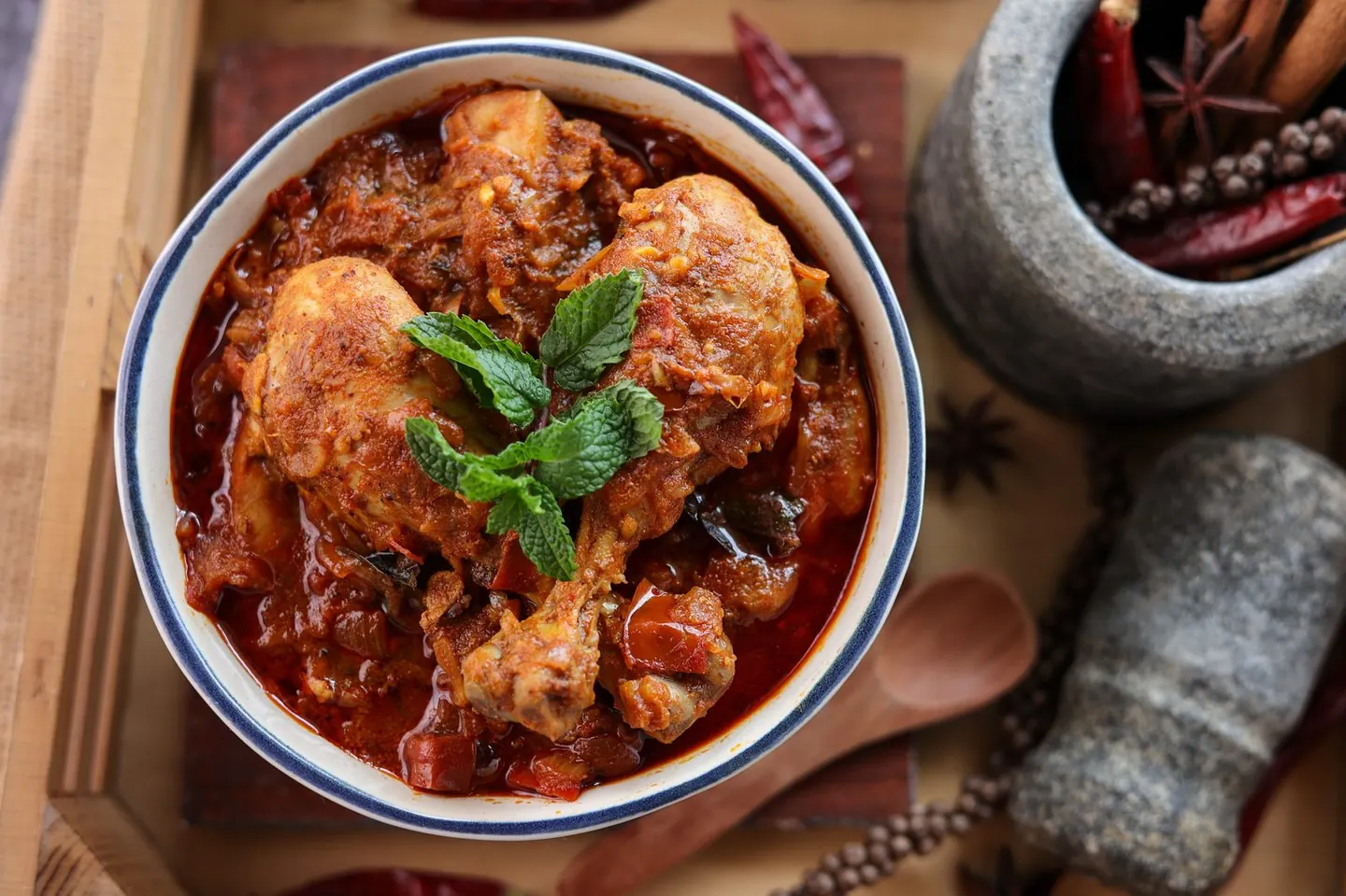
Chapter 19 — Chicken, Egg and Meat
Kerala is an omnivorous state with vegetarian occasions, not the reverse. Outside specific communities the ordinary household eats fish most days, chicken often, egg constantly, and beef, mutton and duck without hesitation — across religious lines, in a way that has no close parallel in India. Three traditions did the technical work. The Syrian Christian kitchens of central Kerala made beef and duck their signature and gave us duck mappas, beef ularthiyathu and the stew that arrives with appam on Easter morning. The Mappila kitchens of Malabar, with their unbroken mother-to-daughter transmission inside one tharavaad, built the most elaborate meat repertoire in the state. And the toddy shop cooked what nobody else wanted — offal, fish heads, duck, the tough cuts — better than the restaurants that have since copied it.
This book will not pretend beef ularthiyathu is health food. In the traditional version set out in R048 it carries about 51 g of fat and 32 g of saturated fat in a 200 g portion, and nothing in the evidence turns that into something else. What the evidence does support is precise, and belongs in numbers rather than adjectives. The WHO's 2023 guideline recommends adults reduce saturated fatty acid intake to 10% of total energy and replace it with polyunsaturated fat. Mensink's meta-analysis of 60 controlled trials gives the exchange rate: replacing 1% of energy from saturated fat lowers LDL cholesterol by 1.8 mg/dL with polyunsaturated fat and 1.3 mg/dL with monounsaturated, and the total-to-HDL ratio improves only with those unsaturated swaps, not with carbohydrate. Hooper's Cochrane review of 15 randomised trials in 56,675 people found that reducing saturated fat cut combined cardiovascular events by 17% (RR 0.83, 95% CI 0.70–0.98), with larger reductions giving larger benefit. That is the whole position. It is a dose relationship, not a prohibition.
So this chapter does three things instead of moralising.
It measures the oil. Every recipe states the fat in grams, and in most the traditional quantity is cut by half to two-thirds. Where coconut oil is the flavour it stays, in teaspoons; where it was only a frying medium, sesame or groundnut oil takes over at 16–19% saturated fat against coconut oil's 91%. The panels hold the chapter's most useful surprise: in the coconut-milk dishes the largest source of saturated fat is not the meat. Removing 100 ml of first extraction from a stew for four takes out more than trimming the mutton does.
It raises the vegetable and the pulse around the meat, so the meat portion falls without the meal feeling smaller. The mutton stew carries 600 g of goat and 400 g of potato and carrot for four; the rebuilt beef takes 250 g of shallots. That is the arithmetic of the Kerala Plate, and it means a 100–130 g portion arrives on a full plate rather than a bare one.
And it puts frequency at the centre rather than substitution. There is no low-fat beef ularthiyathu here, because there is no such dish. There is the real one, given properly, beside a rebuilt version, and the plain observation that a dish eaten monthly contributes a quarter of what the same dish eaten weekly does. Substitution asks you to accept a worse version of something you love; frequency asks you to eat the real thing less often. The second request is easier to keep, and adherence is the variable that decides outcomes.
Protein is the other half of the argument. The target here is 1.2–1.6 g per kilogram of body weight a day, with 25–30 g at each meal (Leidy et al., 2015), and a rice-and-coconut plate reaches that only deliberately. Chicken at 20 g of protein per 100 g of skinless meat, egg at 13 g, goat at 21 g and liver at 20 g are the most efficient routes to it after fish. Nine of the thirteen recipes below deliver 25 g or more per serving.
On the numbers in this chapter. Panels are computed from the per-100 g values in this book's nutrition tables (ICMR-NIN IFCT 2017; USDA FoodData Central SR Legacy for items IFCT does not tabulate), summed and divided by the stated servings, with energy calculated as 4 kcal per gram of net carbohydrate and of protein and 9 kcal per gram of fat. Net carbohydrate is total carbohydrate minus fibre. Sodium is rounded to the nearest 10 mg, macronutrients to the nearest gram. Every panel is an estimate and is labelled so.
On the 70:30 salt. Every recipe in this chapter is seasoned with M07, the 70% sodium chloride / 30% potassium chloride blend, and the sodium figures in the panels assume it. Potassium-enriched salt is not for everyone: do not use M07, or any potassium-based salt substitute, without your doctor's approval if you have chronic kidney disease, or if you take a RAAS inhibitor (an ACE inhibitor, names ending -pril, or an angiotensin receptor blocker, names ending -sartan), a potassium-sparing diuretic (spironolactone, eplerenone, amiloride), or a potassium supplement. Read the safety box at M07 in full before you make the jar. Where M07 is not suitable, use ordinary salt at the same weight and add about 125 mg of sodium for every gram of M07 the recipe lists, or work with M06 and the acid-and-aroma techniques of Chapter 10 instead. This book does not tell anyone to change or stop a medicine.
— this book's nutrition tables tabulate chicken and egg (IFCT N002, N003, M001) but no red meat, poultry other than chicken, or organ meat. Values used here are USDA FoodData Central SR Legacy generics: stewing beef (chuck, semi-trimmed, raw) 19.5 g protein and 12.5 g fat per 100 g; lean beef (round, trimmed, raw) 21.5 g and 5.0 g; goat, raw, 20.6 g and 2.3 g; duck, meat only without skin, raw, 18.3 g and 5.95 g; beef liver, raw, 20.4 g protein, 3.63 g fat, 3.89 g carbohydrate. Check each against ICMR-NIN IFCT 2017 Table 1 before print.
— shallot, onion, tomato, ginger, garlic, green chilli, potato, carrot, coriander seed, chilli powder, turmeric, pepper, fennel, cumin, fenugreek, mustard seed, sesame oil and ghee are not in this book's nutrition tables. Values are USDA SR Legacy, with paprika standing in for ground dried red chilli as the closest documented food. Fresh curry leaves and kudampuli are counted as nil, being both untabulated and negligible at the quantities used.
On the tags. [HIGH PROTEIN] means 25 g or more per serving. [HIGH FIBRE] means 6 g or more. [LOW SODIUM] and the L icon mean under 300 mg. [LOW SAT FAT] means 5 g or less. [UNDER 250 KCAL] is literal. [LOW GL] is used only where net carbohydrate per serving is under 15 g, so that the estimated glycaemic load cannot exceed about 11 even at a high glycaemic index, or where the carbohydrate comes predominantly from pulses (category mean GI 34; Atkinson et al., 2021).
R040 · Nadan Kozhi Curry [LOW GL] [HIGH PROTEIN]
The everyday country chicken curry
ICONS: P · B · F
THE RE-ENGINEERING: Coconut oil down from about 60 g to 15 g, and thick coconut milk from 250 ml to 60 ml. The body now comes from 200 g of shallots cooked down slowly and from M04's fennel-and-pepper aroma, which reads across the pot as richness.
Nadan means "of the country" — the everyday register, not the feast one. This is the curry a Kottayam or Thrissur household makes on a Tuesday, and the thing that makes it recognisably Kerala rather than generically Indian is the fennel, the black pepper and the shallots. It is also the dish where oil creep is most invisible: nobody measures the oil in a weeknight chicken curry, and three tablespoons go in because three tablespoons always went in. Four teaspoons do the job if the shallots are given their twenty minutes.
Serves 4 · about 280 g per portion Active 30 minutes · Total 50 minutes (plus 20 minutes resting — recommended, the curry tightens and deepens) Difficulty: Easy
EQUIPMENT: Heavy 26 cm pan or uruli with a lid. Substitute: any wide pan with a well-fitting lid; a narrow deep pot steams the shallots instead of reducing them and you will taste the difference.
BEFORE YOU START: Slice the 200 g of shallots before you light the flame — it takes eight minutes and the pan will not wait. Have the coconut milk in two separate jugs, thick and thin, and keep the thick one away from the hob so you cannot tip it in by reflex.
INGREDIENTS
- 15 g (1 tbsp) coconut oil
- 200 g (about 20) shallots, thinly sliced
- 30 g (2 tbsp) ginger-garlic-green chilli paste (M16)
- 15 g (about 3) green chillies, slit
- 10 fresh curry leaves
- 21 g (3 tbsp) nadan chicken masala (M04)
- 3 g (½ tsp) ground turmeric
- 3 g (½ tsp) coarsely crushed black pepper
- 100 g (1 medium) tomato, chopped
- 700 g bone-in chicken, skin removed, cut into 10–12 pieces (about 500 g edible meat)
- 4 g (⅔ tsp) 70:30 salt (M07)
- 150 ml water
- 200 ml second-extraction coconut milk (M08)
- 60 ml first-extraction coconut milk (M08)
- 4 g (¾ tsp) Kerala garam masala (M01)
- 10 more curry leaves, to finish
SOURCING NOTE: Ask the butcher for a curry cut with the skin off and the bone in — the bone is what gives a nadan curry its body, and the skin is where most of the fat you are trying to leave out lives. Outside India, chicken thighs and drumsticks bone-in, skinned at home, are the closest thing to Kerala's nadan kozhi; whole chicken breast alone will go dry over 25 minutes of simmering. If shallots are expensive, use 150 g shallots plus 100 g red onion rather than going all-onion, which is noticeably flatter.
ALLERGENS: None of the major allergens as the recipe is written. Sesame or peanuts — whichever of the two oils you use (it reaches the dish through M16).
METHOD
- Heat the oil in the pan over medium heat and swirl it to a film. Add the shallots all at once with a pinch of the salt and the lid on.
- Sweat the shallots, covered, stirring every 3–4 minutes, until they have collapsed, released their water and turned the colour of weak tea, 12–15 minutes. Then uncover and cook 4–5 minutes more, until the mass is jammy and one shade darker. This is the whole flavour argument of the dish; do not shorten it with a higher flame.
- Add the M16 paste, the slit chillies and the first 10 curry leaves. Cook until the raw garlic smell has lifted and the mixture smells sweet, 2–3 minutes.
- Add the M04, turmeric and crushed pepper. Stir constantly until the powders darken by a shade and the dusty raw smell is gone, 60–90 seconds. Add a tablespoon of water if anything catches.
- Add the tomato and cook until it breaks down completely and a thin rim of oil shows at the edge of the mass, 5–7 minutes. That rim is the cue that the water has gone.
- Add the chicken and the rest of the salt. Turn the pieces in the masala until every surface is coated and the meat has stiffened and gone opaque at the edges, 3–4 minutes.
- Pour in the water and the second-extraction milk, bring to a bare simmer, cover, and cook until the meat pulls easily from the bone and a knife meets no resistance at the thickest part of a thigh, 18–22 minutes. Bone-in pieces of very different sizes will not finish together; take out the small ones as they are done.
- Take the pan off the heat. Add the first-extraction milk and the M01, swirl the pan rather than stirring it, and let it stand covered for 5 minutes. The thick milk must not boil — see M08 for why.
- Finish with the last curry leaves, torn, and check the seasoning. Rest 20 minutes if you can spare it.
WHY THIS WORKS
Slowly sweated shallots lose their water gradually, so their sugars concentrate and caramelise instead of the surface browning while the inside steams — and their cell walls break down into a purée that thickens the gravy as a suspension rather than as an emulsion. That is body from vegetable rather than from fat. The coconut milk added off the heat keeps its emulsion intact, so 60 ml tastes like more.
PER SERVING (estimated)
| kcal | kJ | Carb | Fibre | Net carb | Sugars | Protein | Fat | Sat fat | Sodium |
|---|---|---|---|---|---|---|---|---|---|
| 410 | 1,714 | 18 g | 5 g | 13 g | 6 g | 29 g | 27 g | 14 g | 370 mg |
IF YOU ARE WATCHING… Blood sugar: at 13 g of net carbohydrate this dish contributes almost nothing to the meal's glycaemic load. What sits beside it decides everything — 150 g of cooked matta rice (R015) rather than 300 g, and a pulse on the plate (R053 or R059). Blood pressure: 370 mg of sodium against a 2,000 mg daily target. Made with plain salt instead of M07 it would be about 490 mg. Dropping the salt to 3 g takes it to about 320 mg, and the pepper and fennel cover the difference. Cholesterol: 14 g of saturated fat, of which roughly 9 g is the coconut — milk and oil together — and about 5 g the chicken. Halving the first-extraction milk to 30 ml removes about 2.5 g per serving and costs the curry a little silkiness, not its character.
SWAP IT
- No M04 → 15 g ground coriander, 6 g chilli powder, 3 g fennel and 2 g extra pepper. Close, and about 100 mg more sodium per serving is avoided compared with a packet masala, which is salted.
- Coconut milk → 30 g roasted coconut paste (M09) stirred in at step 7. Deeper, smokier, thicker, and it brings 4 g of fibre; saturated fat lands in much the same place.
- Chicken breast only → reduce the simmer to 10–12 minutes. Leaner by about 3 g of fat per serving, and noticeably drier if you overshoot.
- No coconut at all → 40 g cashews blended with 150 ml water. Less saturated fat, more monounsaturated, and a sweeter, rounder curry that is not quite nadan any more. (Allergen: this swap introduces tree nuts (cashew).)
SCALE IT
| Serves | Chicken (bone-in) | Shallots | Oil | M04 | Second milk | First milk | Water | M07 |
|---|---|---|---|---|---|---|---|---|
| 2 | 350 g | 100 g | 8 g | 11 g | 100 ml | 30 ml | 80 ml | 2 g |
| 4 | 700 g | 200 g | 15 g | 21 g | 200 ml | 60 ml | 150 ml | 4 g |
| 8 | 1.4 kg | 380 g | 26 g | 40 g | 380 ml | 120 ml | 280 ml | 7 g |
MAKE AHEAD · STORE · FREEZE Better on day two, like most Kerala meat curries. Fridge 3 days in a covered non-metal container. Freeze 2 months, but freeze it before the thick milk goes in and add that on reheating — frozen-and-thawed coconut emulsion is grainy. Reheat at a bare tremble, never a rolling boil.
LEFTOVERS Strip the meat off the bones, reduce the gravy hard for 4–5 minutes and you have the filling for a pathiri or a wrap. Or thin it with second-extraction milk and pour it over R020 kanji.
SERVE WITH R015 Matta Rice · R001 Appam · R053 Vanpayar Thoran · R063 Cabbage Thoran
TROUBLESHOOTING Gravy split, with oil on top: the thick milk boiled. Add it off the heat and swirl rather than stir. Thin, watery gravy: the shallots were rushed at step 2, or the tomato went in before the water had gone. Reduce uncovered for 5–6 minutes; it will not fully recover. Chicken tough and stringy: breast pieces left in for the full simmer. Add them 8 minutes from the end.
NOTES
R041 · Kerala Chicken Stew [HIGH PROTEIN]
Ishtu — white pepper, coconut milk, and the appam's partner
ICONS: V · B
THE RE-ENGINEERING: Thick coconut milk cut from about 250 ml to 120 ml, with the volume made up in second extraction, and the vegetable weight raised to 350 g against 600 g of chicken. Nothing is added to compensate, because a stew is not supposed to taste of compensation.
Note first that in central Kerala the Syrian Christian stew was traditionally made with beef or lamb; chicken stew is a late and comparatively rare variant, and the version most diaspora readers grew up on is the newest thing on the Easter breakfast table. What has not changed is the discipline. This is the least spiced dish in the chapter — white pepper, ginger, green chilli, whole cinnamon and clove, and nothing else — which means there is no masala to hide a broken emulsion behind. Get the thick milk right and this is the best argument in the book for restraint.
Serves 4 · about 330 g per portion Active 25 minutes · Total 45 minutes Difficulty: Easy, with one unforgiving step
EQUIPMENT: Heavy 26 cm pan with a lid. Substitute: a clay pot is traditional and holds heat too well for this dish — the residual heat keeps the thick milk at a simmer after you take it off the flame. If you use one, add the first milk after the pot has stood off the heat for two minutes.
BEFORE YOU START: This dish moves fast at the end and cannot be paused. Have the first-extraction milk measured, the extra white pepper ground, and the curry leaves picked before the chicken goes in.
INGREDIENTS
- 10 g (2 tsp) coconut oil
- 5 cm Ceylon cinnamon quill, 4 cloves, 3 green cardamom pods, lightly bruised
- 80 g (about 8) shallots, sliced
- 15 g (a 3 cm piece) ginger, julienned
- 10 g (about 3 cloves) garlic, sliced
- 20 g (about 4) green chillies, slit lengthways
- 15 fresh curry leaves
- 3 g (½ tsp) ground white pepper
- 600 g bone-in chicken, skin removed, cut into 8–10 pieces (about 430 g edible meat)
- 250 g (2 medium) potatoes, in 3 cm chunks
- 100 g (1 medium) carrot, in 2 cm rounds
- 4 g (⅔ tsp) 70:30 salt (M07)
- 300 ml second-extraction coconut milk (M08)
- 100 ml water
- 120 ml first-extraction coconut milk (M08)
- 2 g (⅓ tsp) ground white pepper, to finish
- 3 g (½ tsp) Kerala garam masala (M01) — optional, and not traditional in Travancore
SOURCING NOTE: White pepper is the point of this dish and is not the same as black; it is the same berry, hulled, and it gives heat without the black pepper's woody top note or its colour, which matters in a stew that is meant to be ivory. Any Asian grocer has it. If you only have black, use two-thirds as much and accept a stew with freckles. Tinned coconut milk works here better than in most dishes: use it undiluted as the first extraction and 1:1.5 with water as the second.
ALLERGENS: None of the major allergens.
METHOD
- Heat the oil over medium-low, add the whole spices and wait until the cinnamon curls slightly and the kitchen smells sweet, 45–60 seconds.
- Add the shallots, ginger, garlic, green chilli and curry leaves. Cook, stirring, until the shallots are translucent and soft but have taken no colour at all, 5–7 minutes. Browning here turns the stew beige and it never recovers. Lower the flame rather than hurry.
- Stir in the 3 g of white pepper for 30 seconds.
- Add the chicken and turn it in the aromatics until the surfaces have gone opaque, 2–3 minutes, still without browning.
- Add the potato, carrot, salt, second-extraction milk and water. Bring to a bare simmer — the surface should shiver, not bubble — cover, and cook until a knife slides into a potato chunk with no resistance and the chicken comes away from the bone, 18–22 minutes.
- Take the pan off the heat and let it stand for 1 minute. Pour in the first-extraction milk around the edge, add the finishing white pepper and the M01 if using, and swirl the pan — do not stir. Return to the barest heat for 60–90 seconds only, until warmed through, and stop.
- Rest covered for 5 minutes before serving. The stew thickens slightly as it stands.
WHY THIS WORKS
Coconut milk is an oil-in-water emulsion stabilised by a film of coconut globulins around each fat droplet. Sustained boiling denatures those proteins, the droplets coalesce, and you get clear oil above grainy curds — irreversibly. Second and third extractions survive heat because there is far less fat to separate, which is why the cooking is done in them and the first extraction is a finish, not an ingredient.
PER SERVING (estimated)
| kcal | kJ | Carb | Fibre | Net carb | Sugars | Protein | Fat | Sat fat | Sodium |
|---|---|---|---|---|---|---|---|---|---|
| 431 | 1,805 | 23 g | 5 g | 18 g | 5 g | 25 g | 28 g | 17 g | 380 mg |
IF YOU ARE WATCHING… Blood sugar: the potato carries most of the 18 g of net carbohydrate. Eaten with appam (R001) this is a two-starch meal; halve the potato to 125 g and add 125 g of green plantain instead, or eat the stew with a smaller quantity of appam and more of the stew. Blood pressure: 380 mg. This dish takes salt reduction unusually well because the white pepper and ginger carry it — try 3 g of M07 and taste before adding more. Cholesterol: 17 g of saturated fat, and about 13 g of that is the coconut milk. This is the clearest case in the chapter of the fat not being the meat. Dropping the first extraction to 80 ml removes about 2 g per serving; going below that and you have a soup, not an ishtu.
SWAP IT
- Beef or lamb, as it was originally → 500 g of stewing beef in 3 cm cubes, pressure-cooked 20 minutes before step 5, or simmered 70–90 minutes. Richer, and about 4 g more fat per serving.
- Mutton → see R050, which is the same dish built properly around goat.
- Potato → green plantain or elephant foot yam, weight for weight. Both land within 17.5–17.9 g of available carbohydrate per 100 g, so the arithmetic barely moves; chena brings 2.5 g of protein against potato's 2.
- Tinned coconut milk → as in the sourcing note. Flavour is flatter and faintly cooked.
SCALE IT
| Serves | Chicken (bone-in) | Potato | Carrot | Second milk | First milk | Oil | M07 |
|---|---|---|---|---|---|---|---|
| 2 | 300 g | 125 g | 50 g | 150 ml | 60 ml | 5 g | 2 g |
| 4 | 600 g | 250 g | 100 g | 300 ml | 120 ml | 10 g | 4 g |
| 8 | 1.2 kg | 500 g | 200 g | 580 ml | 230 ml | 18 g | 7 g |
MAKE AHEAD · STORE · FREEZE Make to step 5 up to a day ahead and finish with the thick milk on the day. Fridge 2 days — shorter than the fish curries, because the emulsion degrades. Freeze 1 month at step 5 only, never after the first milk goes in. Reheat below a simmer, and if it has separated a little, take it off the heat and swirl in 20 ml of fresh thick milk to bring it back.
LEFTOVERS Cold stew, chopped small and reduced, fills a pathiri or an omelette. The gravy alone, thinned with second milk, is a fine base for R080 mixed vegetable stew the next day.
SERVE WITH R001 Appam · R007 Thattu Dosa · R062 Sprouted Moong Salad · R107 Sambharam
TROUBLESHOOTING Stew is beige, not ivory: the shallots browned at step 2. Lower flame, longer, next time. Oily film and grainy texture: the first milk boiled. Off the heat, swirl, 90 seconds maximum. Watery: too much water for the size of pan, or the lid let steam escape. Lift out the solids and reduce the liquid 4–5 minutes before adding the thick milk.
NOTES
R042 · Pepper Chicken [LOW GL] [HIGH PROTEIN] [LOW SODIUM]
Kurumulaku kozhi — the dry black-pepper roast
ICONS: P · B · L
THE RE-ENGINEERING: Almost nothing needed changing. This dish was always built on pepper rather than on fat, and at 12 g of oil and no coconut it is the lowest-fat route to a big flavour in the whole chapter — 18 g of fat and 7 g of saturated fat per serving, against 27 g and 14 g for the same weight of chicken in a coconut-milk curry.
Kerala's pepper is the reason ships came. It is also, for a cook, the most useful ingredient in a low-fat kitchen, because piperine's heat is a trigeminal sensation rather than a taste — it raises the perceived intensity of everything else in the pan, which means less salt and less fat register as more flavour. This is a dry roast: the gravy reduces onto the meat until the pieces glisten and the pepper crusts. Sixteen grams of pepper for four people sounds like a mistake. It is not.
Serves 4 · about 140 g per portion Active 30 minutes · Total 40 minutes (plus 30 minutes marinating — recommended) Difficulty: Easy
EQUIPMENT: Heavy 26 cm pan or cheena chatti; mortar or spice grinder for the pepper. Substitute: pre-ground pepper works and loses perhaps a third of the aroma — pepper's volatiles go within days of grinding. If that is what you have, use 20 g rather than 16 g.
BEFORE YOU START: Crush the pepper coarsely, not to powder — you want grit that sits on the surface of the meat. Open a window before step 5; 16 g of pepper hitting a hot pan will find your throat.
INGREDIENTS
- 700 g bone-in chicken, skin removed, cut into 10–12 pieces (about 500 g edible meat)
- 25 g (1½ tbsp) ginger-garlic-green chilli paste (M16)
- 3 g (½ tsp) ground turmeric
- 2.5 g (½ tsp) 70:30 salt (M07)
- 8 g (1½ tbsp) coarsely crushed black pepper, for the marinade
- 12 g (1 tbsp) coconut oil
- 150 g (about 15) shallots, sliced
- 10 g (2) green chillies, slit
- 20 fresh curry leaves
- 6 g (1 tbsp) ground coriander
- 120 ml water
- 8 g (1½ tbsp) coarsely crushed black pepper, to finish
- 4 g (¾ tsp) Kerala garam masala (M01)
SOURCING NOTE: Buy whole peppercorns and grind them yourself; the difference here is not marginal, because pepper is the dish. Malabar pepper is GI-registered and worth the premium if you can get it — larger berries, more resinous. Tellicherry is the export grade of the same pepper, graded for size. Wherever you are, buy small quantities often rather than a large tin once.
ALLERGENS: None of the major allergens as the recipe is written. Sesame or peanuts — whichever of the two oils you use (it reaches the dish through M16).
METHOD
- Rub the chicken with the M16, turmeric, salt and the first 8 g of pepper. Leave 30 minutes at room temperature, or up to 8 hours refrigerated.
- Heat the oil in the pan over medium heat. Add the shallots, green chilli and half the curry leaves, and cook until the shallots are soft and light gold at the edges, 7–9 minutes.
- Add the ground coriander and stir for 45–60 seconds, until it smells toasted rather than dusty.
- Add the marinated chicken and raise the heat. Turn the pieces until every surface has taken a light colour and the pan smells of roasting rather than steaming, 5–6 minutes.
- Pour in the water, scrape the base, cover and cook on a low flame until the chicken is done through and the liquid has reduced to a thick coating, 15–18 minutes. Stir twice; add 2 tablespoons more water if it dries before the meat is cooked.
- Uncover and raise the heat. Cook, turning constantly, until the gravy has gone entirely and the pieces are dark, dry and glossy with a visible pepper crust, 4–6 minutes. The sound changes from a wet bubble to a dry sizzle; that is your cue.
- Take off the heat. Add the second 8 g of pepper, the M01 and the remaining curry leaves, and toss hard for 30 seconds in the residual heat. Adding the finishing pepper off the flame keeps its aroma; adding it earlier cooks it out.
WHY THIS WORKS
Piperine binds the same TRPV1 receptors that respond to heat, so pepper registers as warmth rather than as taste — and that trigeminal signal amplifies the perceived intensity of salt and savouriness in the same mouthful. That is the mechanism behind this dish needing 2.5 g of salt where a mild version would need 5 g. Half the pepper goes in off the heat because its aroma compounds are volatile and boil away.
PER SERVING (estimated)
| kcal | kJ | Carb | Fibre | Net carb | Sugars | Protein | Fat | Sat fat | Sodium |
|---|---|---|---|---|---|---|---|---|---|
| 311 | 1,302 | 13 g | 4 g | 9 g | 3 g | 27 g | 18 g | 7 g | 260 mg |
IF YOU ARE WATCHING… Blood sugar: 9 g of net carbohydrate. This is a free dish glycaemically; the meal is decided by the rice beside it. Blood pressure: 260 mg per serving, the lowest of any meat dish in this chapter, and the reason is the pepper. If you are working down from a high-salt habit, this is the recipe to start with. Cholesterol: 7 g of saturated fat, and there is no coconut in it at all — about 5 g comes from the chicken itself and 1 g from the tablespoon of coconut oil. Swap that tablespoon for sesame oil and saturated fat falls by about 0.2 g per serving while the dish tastes marginally nuttier.
SWAP IT
- Sesame or groundnut oil for the coconut oil → 16–19% saturated fat instead of 91%, and a cleaner, less sweet finish. Genuinely better here, where coconut is not the flavour.
- Boneless thigh → 500 g, and cut the covered cooking to 10–12 minutes. Easier to eat, and the gravy has less body without the bone.
- Add 60 g of coconut slivers at step 6 → this becomes something closer to R045, with about 5 g more fat and 4.5 g more saturated fat per serving.
- Less heat → 10 g of pepper total, and add 4 g of chilli powder at step 3. Different heat, similar intensity, and you will need more salt.
SCALE IT
| Serves | Chicken (bone-in) | Shallots | Pepper (total) | Oil | Water | M07 |
|---|---|---|---|---|---|---|
| 2 | 350 g | 75 g | 8 g | 6 g | 60 ml | 1.5 g |
| 4 | 700 g | 150 g | 16 g | 12 g | 120 ml | 2.5 g |
| 8 | 1.4 kg | 300 g | 30 g | 22 g | 240 ml | 5 g |
MAKE AHEAD · STORE · FREEZE Marinate up to 8 hours ahead. Fridge 3 days; it stays good because there is no emulsion to break. Freeze 2 months — the best freezer dish in the chapter. Reheat in a dry pan over medium heat with a tablespoon of water, 3–4 minutes, until it sizzles again.
LEFTOVERS Shred it cold into R089 Kerala salad, or fold it through R047 egg thoran for a substantial breakfast. It is also the best filling in this book for a rice-flour pathiri.
SERVE WITH R015 Matta Rice · R004 Puttu · R059 Sambar · R079 Cabbage-Carrot Upperi
TROUBLESHOOTING Bitter, harsh finish: all the pepper went in early and scorched. Half at the start, half off the heat. Chicken cooked but pale and wet: you skipped step 6, or the pan was crowded. Cook in two batches if your pan is under 26 cm. Too hot to eat: the pepper was ground fine rather than crushed coarse. Fine pepper distributes into every mouthful; coarse pepper sits in patches you can eat around.
NOTES
R043 · Kozhi Porichathu, Rebuilt [HIGH PROTEIN] [LOW SODIUM]
Fried chicken, taken out of the oil and put in the oven
ICONS: P · B · F · L
THE RE-ENGINEERING: Deep-frying replaced by a hot oven or air fryer, with 15 g of sesame oil brushed on instead of the 60–80 g a deep-fried batch absorbs. The marinade is thickened with yoghurt and a little rice flour so that something still crisps.
Here is the honest account of what you lose. Deep-frying does three things at once: it dehydrates the surface violently, it browns it through Maillard reactions at 170–180°C (340–355°F), and it deposits a thin layer of fat that carries aroma and gives the shattering texture nobody has ever fully reproduced. An oven does the first two and not the third. This version is very good and it is not fried chicken. If you want fried chicken, fry it, eat it, and note that a 130 g portion deep-fried carries roughly 12–15 g more fat than this one.
Serves 4 · about 130 g per portion Active 20 minutes · Total 50 minutes (plus 2 hours marinating — required; overnight is better) Difficulty: Easy
EQUIPMENT: Oven with a wire rack set over a tray, or an air fryer. Substitute: a grill pan on the hob gets you two browned faces and pale sides; turn the pieces four times and accept less crust.
BEFORE YOU START: Dry the chicken thoroughly with kitchen paper before it goes into the marinade, and again as it comes out. Surface water is the single reason oven-cooked chicken steams instead of browning.
INGREDIENTS
- 700 g bone-in chicken thighs and drumsticks, skin removed, slashed twice to the bone (about 500 g edible meat)
- 60 g (4 tbsp) thick plain yoghurt
- 25 g (1½ tbsp) ginger-garlic-green chilli paste (M16)
- 15 g (1 tbsp) lime juice
- 5 g (1 tsp) Kashmiri chilli powder
- 3 g (½ tsp) ground turmeric
- 4 g (¾ tsp) coarsely crushed black pepper
- 6 g (1 tsp) fennel seed, coarsely crushed
- 3 g (½ tsp) Kerala garam masala (M01)
- 2.5 g (½ tsp) 70:30 salt (M07)
- 20 g (2½ tbsp) rice flour
- 10 g (1 tbsp) corn flour
- 15 g (1 tbsp) sesame or groundnut oil, for brushing
- 15 fresh curry leaves and 2 slit green chillies, for the final 5 minutes
SOURCING NOTE: Bone-in thighs and drumsticks are essential — breast has neither the fat nor the connective tissue to survive 30 minutes of dry heat. Rice flour is what gives Kerala fried chicken its particular sandy crust; the fine white flour sold for puttu and idiyappam is exactly right. Corn flour is optional and adds brittleness rather than flavour.
ALLERGENS: Milk. Sesame or peanuts — whichever of the two oils you use.
METHOD
- Whisk the yoghurt, M16, lime juice, chilli powder, turmeric, pepper, fennel, M01 and salt to a thick paste. It should coat a spoon; if it runs, the crust will not form.
- Slash the chicken twice to the bone on each piece, then turn it in the marinade until every cut is filled. Refrigerate 2 hours minimum, overnight ideally.
- Heat the oven to 220°C (425°F) with the rack and tray already inside. A cold tray is a soggy tray.
- Sprinkle the rice flour and corn flour over the marinated chicken and turn to coat. The surface should look dry and dusty in patches, not pasty. Brush or spray each piece with the oil.
- Roast on the hot rack for 20 minutes, then turn each piece and roast a further 12–18 minutes, until the crust is deep brown at the ridges, the slashes have opened and pulled back from the bone, and juices from the thickest part run clear. In an air fryer, 200°C (390°F) for 12 minutes, turn, then 8–12 minutes.
- Scatter the curry leaves and green chillies over the tray for the final 5 minutes. They blister and crisp, and they are half the aroma of the dish.
- Rest 5 minutes on the rack, never on a plate. Steam trapped underneath undoes the crust in a minute.
WHY THIS WORKS
Yoghurt's lactic acid loosens the protein structure at the meat's surface, and its calcium activates the muscle's own proteases — so a yoghurt marinade tenderises where an acid-only one would just firm the outside. The rice flour then gelatinises in the surface moisture and dries into a rigid, low-moisture shell. That shell, not oil, is what browning and crispness require.
PER SERVING (estimated)
| kcal | kJ | Carb | Fibre | Net carb | Sugars | Protein | Fat | Sat fat | Sodium |
|---|---|---|---|---|---|---|---|---|---|
| 325 | 1,361 | 12 g | 2 g | 10 g | 1 g | 27 g | 20 g | 5 g | 270 mg |
IF YOU ARE WATCHING… Blood sugar: 10 g of net carbohydrate, most of it the flour coating. Negligible in the context of the meal. Blood pressure: 270 mg. Fried chicken from a thattukada is a different order of magnitude, largely from the salt in the marinade and the salt added at the counter. Cholesterol: 5 g of saturated fat, the lowest of the chicken dishes, because there is no coconut and the added fat is sesame at about 15% saturated. This is the single clearest illustration in the chapter of the oil decision tree from Chapter 8: coconut oil where it is the flavour, seed oil where it is only a medium.
SWAP IT
- Deep-fried, honestly → 500 ml of groundnut or rice bran oil at 170°C (340°F), 8–10 minutes a batch. Expect about 12–15 g more fat per serving and do not reuse the oil; ICMR-NIN's 2024 guidance advises against reheating and reusing frying oil.
- No yoghurt → 60 g of thick coconut milk plus 5 g extra lime juice. Works, browns less, and adds about 3 g of saturated fat per serving.
- Boneless → 500 g of thigh fillet, 12 minutes at 220°C (425°F), turning once. Faster, drier, and it loses the bone's contribution to flavour.
- No rice flour → 25 g of gram flour (besan). Nuttier, darker, and it browns faster, so drop the oven to 210°C (410°F).
SCALE IT
| Serves | Chicken (bone-in) | Yoghurt | Rice flour | Oil | M07 | Oven time |
|---|---|---|---|---|---|---|
| 2 | 350 g | 30 g | 10 g | 8 g | 1.5 g | 20 + 10–14 min |
| 4 | 700 g | 60 g | 20 g | 15 g | 2.5 g | 20 + 12–18 min |
| 8 | 1.4 kg | 120 g | 40 g | 28 g | 5 g | two trays, 20 + 15–20 min |
MAKE AHEAD · STORE · FREEZE Marinate up to 24 hours ahead — this is a dish that rewards the wait. Fridge 3 days cooked. Freeze 2 months cooked; the crust softens and comes back in a hot oven. Reheat at 200°C (390°F) for 6–8 minutes on a rack, never in a microwave, which turns the shell to paste.
LEFTOVERS Pull the meat and use it in R089 Kerala salad, or chop it into R061 chana masala for a substantial one-bowl meal. Cold, it is better than most fried chicken is cold.
SERVE WITH R107 Sambharam · R089 Kerala-Idiom Salad · R098 Inji Puli · R015 Matta Rice
TROUBLESHOOTING Pale and steamed rather than roasted: the tray was cold, the pieces were touching, or the chicken went in wet. All three are fixable and all three matter. Crust fell off in sheets: too much flour, or the marinade was thin. Dust lightly and let the excess fall away. Dry inside: breast meat, or 10 minutes too long. Take it out when the juices run clear, not later.
NOTES
R044 · Chicken Mappas [LOW GL] [HIGH PROTEIN]
The Syrian Christian coconut-milk curry, pale and pepper-warm
ICONS: B
THE RE-ENGINEERING: First-extraction coconut milk down from about 300 ml to 100 ml, cooking oil down to 12 g, and the sourness carried by 10 ml of coconut vinegar rather than by more fat. Mappas is a thenga chertha dish — coconut added as milk — so the reduction has to be done in the extraction grades rather than by leaving coconut out.
Mappas sits between a stew and a curry: paler and gentler than a nadan curry, more spiced and more sour than an ishtu. It belongs to the Kottayam and Alappuzha Christian kitchens, and its distinguishing move is the vinegar, which comes from the coconut-vinegar preserving tradition of the same households. The vinegar is not incidental. It cuts the coconut fat on the palate, and there is reasonable trial evidence that vinegar with a meal attenuates the glucose and insulin response — pooled reductions in glucose area under the curve of −0.60 standardised mean difference across clinical trials (Shishehbor et al., 2017).
Serves 4 · about 270 g per portion Active 25 minutes · Total 45 minutes Difficulty: Easy
EQUIPMENT: Heavy 26 cm pan with a lid, or a clay manchatti of 24 cm. Substitute: clay is genuinely better here because it is inert to the vinegar and simmers gently, but any non-reactive pan works; avoid bare iron or aluminium with this much acid.
BEFORE YOU START: Have the thick milk measured and the pan lid within reach. The last two minutes of this dish are the only two that can ruin it.
INGREDIENTS
- 12 g (2½ tsp) coconut oil
- 5 cm Ceylon cinnamon quill, 4 cloves, 3 green cardamom pods
- 150 g (about 15) shallots, sliced
- 20 g (a 4 cm piece) ginger, julienned
- 12 g (about 4 cloves) garlic, sliced
- 20 g (about 4) green chillies, slit
- 20 fresh curry leaves
- 5 g (1 tbsp) ground coriander
- 3 g (½ tsp) coarsely crushed black pepper
- 3 g (½ tsp) fennel seed, crushed
- 2 g (⅓ tsp) ground turmeric
- 700 g bone-in chicken, skin removed, cut into 10–12 pieces (about 500 g edible meat)
- 4 g (⅔ tsp) 70:30 salt (M07)
- 250 ml second-extraction coconut milk (M08)
- 100 ml water
- 100 ml first-extraction coconut milk (M08)
- 10 ml (2 tsp) coconut vinegar
- 2 g (⅓ tsp) Kerala garam masala (M01)
SOURCING NOTE: Coconut vinegar — cloudy, mild, faintly sweet — is sold by Kerala grocers and online as kaadi. Cider vinegar at the same volume is the closest substitute and is a little sharper. Do not use malt or distilled white vinegar, which are both too aggressive for the amount of coconut here.
ALLERGENS: None of the major allergens.
METHOD
- Heat the oil over medium-low. Add the whole spices and wait 45–60 seconds, until the cardamom smells sweet and the cinnamon curls.
- Add the shallots, ginger, garlic, green chilli and curry leaves. Cook until the shallots are soft and just beginning to gild at the edges, 8–10 minutes. A mappas wants a little colour where an ishtu wants none.
- Add the coriander, pepper, fennel and turmeric. Stir 45–60 seconds until the raw dusty smell lifts.
- Add the chicken and salt, and turn until every piece is coated and opaque at the surface, 3–4 minutes.
- Pour in the second-extraction milk and the water. Bring to a bare simmer, cover, and cook until the meat releases from the bone, 18–22 minutes.
- Uncover and reduce for 3–4 minutes if the gravy is thin — it should coat the back of a spoon before the thick milk goes in.
- Take off the heat. Add the first-extraction milk and the vinegar, swirl the pan, and return to the barest heat for 60–90 seconds. Do not stir and do not let it bubble.
- Finish with the M01 and rest 5 minutes covered.
WHY THIS WORKS
Acid and fat work on each other in the mouth: acetic acid cuts the perception of fat's coating heaviness, which is why 100 ml of thick coconut milk with vinegar tastes richer and cleaner than 200 ml without. Adding the vinegar off the heat keeps its volatile sharpness, and adding it after the milk rather than before avoids acid-shocking the emulsion while it is still hot enough to curdle.
PER SERVING (estimated)
| kcal | kJ | Carb | Fibre | Net carb | Sugars | Protein | Fat | Sat fat | Sodium |
|---|---|---|---|---|---|---|---|---|---|
| 413 | 1,726 | 14 g | 4 g | 10 g | 5 g | 28 g | 29 g | 16 g | 380 mg |
IF YOU ARE WATCHING… Blood sugar: 10 g of net carbohydrate, and the vinegar is on your side. Pair with 150 g of cooked matta rice or two appam rather than four. Blood pressure: 380 mg. The vinegar and pepper make this dish tolerant of less salt; 3 g of M07 brings it to about 320 mg with no real loss. Cholesterol: 16 g of saturated fat, of which about 11 g is coconut milk. If you make one change, make it here: 60 ml of first extraction instead of 100 ml removes about 2.5 g per serving.
SWAP IT
- Fish instead of chicken → 600 g of firm white fish, added at step 5 and simmered 8–10 minutes only. This is fish mappas, and it is lighter by about 12 g of fat per serving. (Allergen: this swap introduces fish.)
- Add 200 g of potato at step 5 → the Kuttanad habit. Adds about 10 g of net carbohydrate per serving and makes the dish stretch to five.
- No vinegar → 15 g of tamarind pulp added at step 5. Rounder, fruitier, and the dish loses its clean finish.
- Coconut milk → 40 g of roasted coconut paste (M09) plus 200 ml of second extraction. Deeper and darker, and no longer a mappas.
SCALE IT
| Serves | Chicken (bone-in) | Shallots | Second milk | First milk | Vinegar | Oil | M07 |
|---|---|---|---|---|---|---|---|
| 2 | 350 g | 75 g | 125 ml | 50 ml | 5 ml | 6 g | 2 g |
| 4 | 700 g | 150 g | 250 ml | 100 ml | 10 ml | 12 g | 4 g |
| 8 | 1.4 kg | 300 g | 480 ml | 190 ml | 20 ml | 22 g | 7 g |
MAKE AHEAD · STORE · FREEZE Cook to step 6 up to a day ahead. Fridge 2 days, covered, non-metal. Freeze 1 month at step 6 only. Reheat below a simmer and re-finish with 20 ml of fresh thick milk if it looks tired.
LEFTOVERS Reduce hard and use as a filling for chatti pathiri. Or add 200 g of cooked vanpayar (R053) and 100 ml of second milk to turn the remains into a full second meal.
SERVE WITH R001 Appam · R007 Thattu Dosa · R053 Vanpayar Thoran · R065 Cheera Thoran
TROUBLESHOOTING Curdled, with visible curds: the thick milk boiled, or the vinegar went in while the pan was still on the flame. Both, next time, off the heat. Flat and sweet: not enough vinegar or not enough pepper. A mappas that does not taste faintly sour is an ishtu with more spice in it. Gravy too thin: skipped step 6. Reduce before the thick milk, not after — after, you cannot.
NOTES
R045 · Chicken Ularthiyathu [LOW GL] [HIGH PROTEIN]
The dry roast, with coconut slivers
ICONS: P · B · F
THE RE-ENGINEERING: Coconut oil down from about 45 g to 14 g and coconut slivers from 150 g to 60 g. The dryness that traditionally comes from cooking meat in a lot of fat here comes from reducing the gravy completely and then roasting in the pan's residual heat — which is what ularthiyathu means in the first place.
Ularthiyathu — "dry-fried, roasted down" — is a technique, not a recipe, and it is the best one Kerala has for making a small quantity of meat taste like a lot. The pieces darken, the masala clings, and the coconut slivers toast to something between a nut and a crisp. Chicken takes to it as well as beef does and cooks in a quarter of the time, which makes this the weeknight version of the chapter's centrepiece.
Serves 4 · about 140 g per portion Active 35 minutes · Total 45 minutes Difficulty: Moderate — the last five minutes need your full attention
EQUIPMENT: Heavy 28 cm pan or cheena chatti; flat wooden turner (chattuvam). Substitute: a thin pan will scorch the coconut before the chicken dries. Cast iron is ideal.
BEFORE YOU START: Cut the coconut into thin slivers about 2 cm long — thenga kothu — rather than grating it. Grated coconut disappears into the masala; slivers stay as texture, which is the whole point.
INGREDIENTS
- 700 g bone-in chicken, skin removed, cut into 12 small pieces (about 500 g edible meat)
- 20 g (1 tbsp) ginger-garlic-green chilli paste (M16)
- 21 g (3 tbsp) nadan chicken masala (M04)
- 2 g (⅓ tsp) ground turmeric
- 3.5 g (⅔ tsp) 70:30 salt (M07)
- 150 ml water
- 14 g (1 tbsp) coconut oil
- 60 g (about ⅔ cup) fresh coconut, in thin slivers
- 120 g (about 12) shallots, sliced
- 25 fresh curry leaves
- 4 g (¾ tsp) coarsely crushed black pepper
- 4 g (¾ tsp) Kerala garam masala (M01)
SOURCING NOTE: Slivers need fresh coconut, or at least frozen grated coconut pressed into a block and sliced, which is a poor second. Desiccated coconut cannot be slivered and will burn. If no fresh coconut is available, use 40 g of coarsely chopped raw cashews instead: different, good, and about 2 g less saturated fat per serving.
ALLERGENS: None of the major allergens as the recipe is written. Sesame or peanuts — whichever of the two oils you use (it reaches the dish through M16).
METHOD
- Marinate the chicken with the M16, M04, turmeric and salt for 20 minutes at room temperature.
- Bring the marinated chicken and the water to a simmer in the pan, covered, and cook until the meat is just done and the liquid has reduced to a thick sludge around it, 14–18 minutes. Stir twice. There should be almost no free liquid left.
- Push the chicken to one side, add the oil to the cleared space, and let it heat for 30 seconds.
- Add the coconut slivers, shallots and curry leaves to the oil. Cook, stirring the coconut rather than the chicken, until the slivers turn from white to the colour of pale toast and the shallots soften, 5–7 minutes.
- Fold everything together and raise the heat. Now roast, turning with the flat turner every 30 seconds, until the masala has gone from paste to crust, the chicken is dark and dry, and the coconut is deep gold — 6–9 minutes. The pan will start to sound dry and the smell will turn from spice to toasted coconut. Take it off within a minute of that.
- Add the pepper and M01 off the heat, toss for 30 seconds, and serve hot. This dish does not improve by sitting.
WHY THIS WORKS
Two browning reactions run at once. The meat's surface proteins and the shallots' sugars undergo Maillard browning above about 140°C (285°F), which is only possible once all the free water has gone — hence step 2 before step 5. Meanwhile the coconut slivers render a little of their own fat as they toast, and that rendered fat carries the roasted aromas across everything else in the pan. The 14 g of added oil is a starter, not the cooking medium.
PER SERVING (estimated)
| kcal | kJ | Carb | Fibre | Net carb | Sugars | Protein | Fat | Sat fat | Sodium |
|---|---|---|---|---|---|---|---|---|---|
| 372 | 1,556 | 13 g | 5 g | 8 g | 4 g | 28 g | 25 g | 13 g | 330 mg |
IF YOU ARE WATCHING… Blood sugar: 8 g of net carbohydrate. A dry roast is glycaemically the safest way to eat meat, and its danger is entirely in what it makes you want to eat it with — parotta, usually. Matta rice at 150 g, or better, R004 puttu. Blood pressure: 330 mg. Down to 3 g of M07 gives about 295 mg and the pepper covers it. Cholesterol: 13 g of saturated fat, of which about 7 g is the 15 g of coconut each serving carries and about 1 g the oil. Cutting the slivers to 40 g takes about 2.5 g out per serving and costs the dish some of its texture. Halving the oil saves 0.6 g and costs you the browning; take it out of the coconut, not the oil.
SWAP IT
- Beef → see R048, which is this technique done properly with beef and 90 minutes.
- Cashews for coconut slivers → 40 g. Less saturated fat, more monounsaturated, and a sweeter roast. (Allergen: this swap introduces tree nuts (cashew).)
- Add 200 g of green plantain in 2 cm dice at step 4 → stretches to five servings, adds fibre, and is what a Travancore household does when the meat is short.
- Boneless thigh → 500 g, and step 2 drops to 10–12 minutes. Convenient, and the dish loses the gelatine from the bones that helps the masala cling.
SCALE IT
| Serves | Chicken (bone-in) | Coconut slivers | Shallots | Oil | M04 | Water | M07 |
|---|---|---|---|---|---|---|---|
| 2 | 350 g | 30 g | 60 g | 7 g | 11 g | 80 ml | 2 g |
| 4 | 700 g | 60 g | 120 g | 14 g | 21 g | 150 ml | 3.5 g |
| 8 | 1.4 kg | 120 g | 240 g | 26 g | 40 g | 280 ml | 6.5 g |
MAKE AHEAD · STORE · FREEZE Complete step 2 up to a day ahead and do the roast fresh — this is the best way to make it on a weeknight. Fridge 3 days. Freeze 2 months; texture survives well because there is no emulsion. Reheat in a dry pan, 3–4 minutes, until it sizzles.
LEFTOVERS Chop small, fold into an omelette, or stir through R061 chana masala. Cold, in a pathiri, with raw onion and lime, it is better than the first serving.
SERVE WITH R004 Puttu · R015 Matta Rice · R059 Sambar · R107 Sambharam
TROUBLESHOOTING Coconut burnt, chicken still wet: the slivers went in before the liquid had gone. Step 2 must finish before step 3 starts. Masala pasty rather than crusted: the flame was too low at step 5, or the pan was crowded. Roast in two batches. Chicken dry and shredding: 5 minutes too long at step 5. The cue is the sound, not the clock.
NOTES
R046 · Mutta Curry [LOW GL]
Egg curry in coconut milk
ICONS: B
THE RE-ENGINEERING: The eggs are not fried before they go in — a step that adds 15–20 g of oil to the pot for no flavour that survives the gravy — and the thick coconut milk is 60 ml rather than 200 ml. Two eggs a serving, not three, with the volume made up in shallots and tomato.
Egg is the most underrated protein in the Kerala kitchen: 13 g per 100 g at 135 kcal, available everywhere, and the one animal food that needs no cold chain to be bought fresh. Mutta curry is what a household makes when the fish did not arrive. This version keeps the gravy generous, because the gravy is what carries it over rice or idiyappam, and it takes the fat out of the two places where nobody misses it — the frying of the eggs and the last ladle of thick milk.
Serves 4 · about 255 g per portion Active 20 minutes · Total 35 minutes Difficulty: Easy
EQUIPMENT: 24 cm pan with a lid; small pan for the eggs. Substitute: boil the eggs in the same pan first, lift them out, and build the curry in it — one less thing to wash.
BEFORE YOU START: Boil and peel the eggs before you start the gravy. Peeling hot eggs while a masala catches is how this dish goes wrong.
INGREDIENTS
- 8 eggs (about 400 g shelled), hard-boiled 9 minutes, peeled and halved
- 10 g (2 tsp) coconut oil
- 150 g (about 15) shallots, sliced
- 20 g (1 tbsp) ginger-garlic-green chilli paste (M16)
- 15 fresh curry leaves
- 8 g (1½ tbsp) ground coriander
- 4 g (¾ tsp) Kashmiri chilli powder
- 2 g (⅓ tsp) ground turmeric
- 2 g (⅓ tsp) fennel seed, crushed
- 120 g (1 large) tomato, chopped
- 3 g (½ tsp) 70:30 salt (M07)
- 250 ml second-extraction coconut milk (M08)
- 100 ml water
- 60 ml first-extraction coconut milk (M08)
- 3 g (½ tsp) Kerala garam masala (M01)
SOURCING NOTE: Nine minutes at a bare simmer from refrigerator-cold gives a yolk that is fully set but still bright — beyond eleven minutes it goes chalky and grey at the edge, and no gravy hides that. Eggs one week old peel far more easily than eggs one day old, which is the one argument in favour of the older box.
ALLERGENS: Egg. Sesame or peanuts — whichever of the two oils you use (it reaches the dish through M16).
METHOD
- Boil the eggs 9 minutes at a bare simmer, cool them under running water for 2 minutes, and peel. Halve them lengthways and set aside.
- Heat the oil over medium heat, add the shallots, and cook until soft and pale gold, 8–10 minutes.
- Add the M16 and curry leaves and cook 2 minutes, until the raw garlic smell has gone.
- Add the coriander, chilli, turmeric and fennel. Stir 45–60 seconds, until they darken a shade.
- Add the tomato and salt and cook until the tomato collapses completely and the mass pulls away from the side of the pan, 5–7 minutes.
- Pour in the second-extraction milk and the water. Simmer uncovered until the gravy thickens enough to coat a spoon, 6–8 minutes.
- Slide in the egg halves, cut side up, and spoon gravy over them. Simmer 2 minutes only — long enough to warm through, short enough that the whites stay tender.
- Take off the heat, add the first-extraction milk and the M01, swirl the pan, and let it stand 3 minutes before serving.
WHY THIS WORKS
Frying a boiled egg before it enters a gravy is a habit inherited from dishes where the fried skin is the texture. In a coconut-milk curry the gravy rehydrates that skin within minutes, so the oil buys nothing and stays in the dish. Halving the eggs instead exposes the yolk, whose fat and lecithin emulsify into the gravy and thicken it — the same job the missing 140 ml of thick milk was doing.
PER SERVING (estimated)
| kcal | kJ | Carb | Fibre | Net carb | Sugars | Protein | Fat | Sat fat | Sodium |
|---|---|---|---|---|---|---|---|---|---|
| 292 | 1,220 | 13 g | 4 g | 9 g | 5 g | 16 g | 21 g | 13 g | 360 mg |
IF YOU ARE WATCHING… Blood sugar: 9 g of net carbohydrate. Egg's near-zero carbohydrate load is why this dish is such a useful partner for idiyappam or appam, both of which bring plenty of their own. Blood pressure: 360 mg per serving, and about 140 mg of that is the eggs themselves, which carry sodium naturally. The added salt is only 3 g across four servings. Cholesterol: 13 g of saturated fat, roughly 9 g from the coconut and 3 g from the eggs. The dietary-cholesterol content of egg is not the lever here; the coconut milk is. Drop the first extraction to 30 ml if you are working to a saturated-fat target.
SWAP IT
- Six eggs instead of eight → 12 g of protein and about 16 g of fat per serving, and the dish stretches better if there is a pulse alongside.
- Two whole eggs plus four whites per two servings → protein holds at about 14 g while fat falls to 13 g. Egg white boiled is 12.37 g of protein at 53 kcal per 100 g, against 148 kcal for the whole boiled egg.
- Coconut milk → 200 ml of thin buttermilk added off the heat, for a moru-inflected version. Lighter by 8 g of fat, sharper, and it must not boil either. (Allergen: this swap introduces milk.)
- Add 200 g of cooked vanpayar at step 6 → protein to about 21 g and fibre to 9 g per serving, and this becomes a complete plate on its own.
SCALE IT
| Serves | Eggs | Shallots | Tomato | Second milk | First milk | Oil | M07 |
|---|---|---|---|---|---|---|---|
| 2 | 4 | 75 g | 60 g | 125 ml | 30 ml | 5 g | 1.5 g |
| 4 | 8 | 150 g | 120 g | 250 ml | 60 ml | 10 g | 3 g |
| 8 | 16 | 300 g | 240 g | 480 ml | 120 ml | 18 g | 6 g |
MAKE AHEAD · STORE · FREEZE Make the gravy to step 6 up to two days ahead; boil the eggs on the day. Fridge 2 days complete — the whites toughen after that. Freeze: no. Boiled egg white goes rubbery and weeps on thawing, and this is one of the few dishes in the book that genuinely should not go in the freezer. Reheat gently, adding the eggs only in the last minute.
LEFTOVERS Chop the eggs into the gravy, reduce it hard, and it becomes a pathiri filling or an excellent topping for R020 kanji.
SERVE WITH R007 Thattu Dosa · R001 Appam · R004 Puttu · R055 Kadala Ularthiyathu
TROUBLESHOOTING Grey ring around the yolk: boiled too long. Nine minutes, then cold water. Whites rubbery: the eggs simmered in the gravy for more than 2–3 minutes. Gravy split: the thick milk boiled, or the tomato's acid met the thick milk over heat. Off the heat, always.
NOTES
R047 · Egg Thoran [LOW GL] [LOW SODIUM] [UNDER 250 KCAL]
Mutta thoran — scrambled with coconut and greens
ICONS: V · Q · L
THE RE-ENGINEERING: The traditional dish is egg and coconut. This one is 200 g of amaranth greens, 250 g of egg and 80 g of coconut — the vegetable raised until it is the larger part, which drops the energy density of the whole dish without removing anything.
A thoran is a grated-coconut stir-fry, and the grammar allows almost any solid ingredient to be treated this way. Egg thoran is what a Kerala kitchen makes for breakfast when there is no time to make anything, and adding greens to it costs three minutes and turns a side dish into a meal. Amaranth — cheera — carries 3.29 g of protein and 4.41 g of fibre per 100 g at 31 kcal, which is why it is the green this book reaches for first.
Serves 4 · about 130 g per portion Active 15 minutes · Total 25 minutes Difficulty: Easy
EQUIPMENT: 26 cm pan or cheena chatti; flat wooden turner. Substitute: any wide pan. A narrow one steams the greens and you will get a wet thoran.
BEFORE YOU START: A thoran is a two-minute dish once the pan is hot, and there is no pause in it. Have the greens washed and chopped, the coconut mixture ready in a bowl, and the eggs beaten before you light the flame.
INGREDIENTS
- 80 g (about ¾ cup) fresh grated coconut
- 60 g (about 6) shallots, roughly chopped
- 15 g (about 3) green chillies, chopped
- 2 g (⅓ tsp) ground turmeric
- 8 g (1½ tsp) coconut oil
- 3 g (½ tsp) mustard seed
- 15 fresh curry leaves
- 200 g (about 5 packed cups) amaranth leaves and tender stalks (cheera), washed and chopped
- 2.5 g (½ tsp) 70:30 salt (M07)
- 5 eggs (about 250 g shelled), beaten with a pinch of pepper
SOURCING NOTE: Any tender green works: amaranth, spinach, colocasia leaf (which must be well cooked), drumstick leaf, or the outer leaves of a cabbage finely shredded. Frozen chopped spinach is a legitimate substitute at 200 g, thawed and squeezed dry — an unsqueezed block will flood the pan. Frozen grated coconut is fine here and should be thawed but not dried.
ALLERGENS: Egg, mustard.
METHOD
- Crush the coconut, shallots, green chilli and turmeric together — with your fingers, a pestle or two pulses in a mixie. It should stay coarse and separate, not become a paste.
- Heat the oil in the pan over medium-high, add the mustard seed, and wait until it pops and the popping subsides, 30–45 seconds. Add the curry leaves and let them crackle for 10 seconds.
- Add the greens and the salt. Toss for 2–3 minutes, until they have wilted, gone glossy dark green and released their water.
- Raise the heat and cook 1–2 minutes more, until the water at the base of the pan has gone. Wet greens will make a wet thoran and nothing later fixes it.
- Add the coconut mixture and toss for 2 minutes, until the coconut smells warm and nutty and has taken on the turmeric's colour throughout.
- Pour in the beaten eggs. Now wait 20 seconds without touching them, then fold — do not stir — with the flat turner, lifting from the base every few seconds, until the egg is just set in soft curds and no wet egg remains, 90 seconds to 2 minutes. Take the pan off the heat while it still looks a shade underdone; it finishes in the residual heat.
WHY THIS WORKS
Egg proteins begin setting around 62°C (144°F) and toughen and express water above about 75°C (167°F). Folding rather than stirring, and stopping early, keeps the curds large and the water inside them — which is why this tastes creamy with no added fat. The coconut goes in before the egg because coconut needs 2 minutes of dry heat to smell of anything, and egg cannot spare 2 minutes.
PER SERVING (estimated)
| kcal | kJ | Carb | Fibre | Net carb | Sugars | Protein | Fat | Sat fat | Sodium |
|---|---|---|---|---|---|---|---|---|---|
| 215 | 901 | 10 g | 5 g | 5 g | 3 g | 11 g | 17 g | 11 g | 280 mg |
IF YOU ARE WATCHING… Blood sugar: 5 g of net carbohydrate per serving. As a breakfast with two puttu rather than four, this is one of the lowest-load Kerala breakfasts available. Blood pressure: 280 mg, and half of that is the eggs' own sodium. There is only 2.5 g of salt in the whole dish. Cholesterol: 11 g of saturated fat, and 7 g of it is the 20 g of coconut per serving. Cut the coconut to 50 g and you land at about 8 g, with a noticeably drier thoran. This is a real trade, not a free one.
SWAP IT
- Cabbage, beans, carrot or raw papaya for the greens → all work; increase step 3 to 5–7 minutes for the firmer ones, and add 2 tablespoons of water and a lid.
- Egg whites only → 8 whites for 5 whole eggs. Protein holds at about 11 g and fat falls to 9 g per serving. The texture is firmer and less rich.
- Add 150 g of cooked vanpayar at step 5 → fibre to 9 g, protein to 15 g, and the dish becomes a complete plate.
- No coconut → 30 g of roasted peanuts, crushed. A different dish, and not a thoran, but a good one. (Allergen: this swap introduces peanuts.)
SCALE IT
| Serves | Eggs | Greens | Coconut | Shallots | Oil | M07 |
|---|---|---|---|---|---|---|
| 2 | 3 | 100 g | 40 g | 30 g | 4 g | 1.5 g |
| 4 | 5 | 200 g | 80 g | 60 g | 8 g | 2.5 g |
| 8 | 10 | 400 g | 160 g | 120 g | 15 g | 5 g |
MAKE AHEAD · STORE · FREEZE Crush the coconut mixture up to a day ahead and keep it covered in the fridge; that is the only part worth doing in advance. Fridge 2 days. Freeze: no — scrambled egg thaws watery and the greens collapse. Reheat in a dry pan for 2 minutes, or eat it cold, which is better than reheating it.
LEFTOVERS Cold, between two pathiri, with a spoonful of R093 coconut chutney. Or stirred through leftover rice with a squeeze of lime as a five-minute lunch.
SERVE WITH R004 Puttu · R009 Oats and Matta Dosa · R012 Kanji with Vanpayar · R107 Sambharam
TROUBLESHOOTING Wet, soupy thoran: step 4 was skipped, or the greens were not drained. Cook the water off before the coconut goes in. Egg rubbery and weeping: cooked 60 seconds too long, or the heat was too high. Off the heat while it still looks wet. Tastes of raw coconut: the coconut needs its 2 minutes in the pan before the egg arrives.
NOTES
R048 · Beef Ularthiyathu, Traditional and Rebuilt [LOW GL] [HIGH PROTEIN]
Beef fry — the dry roast with coconut slivers, given twice
ICONS: P · B · F
THE RE-ENGINEERING: Both versions are here in full. The rebuilt one uses lean trimmed beef instead of fatty stewing cuts, 20 g of coconut oil instead of 60 g, 50 g of coconut slivers instead of 100 g, 250 g of shallots instead of 150 g, and the 70:30 salt instead of plain. Everything else — the technique, the masala, the roast — is identical. The tags above describe the rebuilt version.
This is the most argued-about plate in Kerala and the one dish in this book that gets two nutrition panels. Beef ularthiyathu belongs to the Syrian Christian kitchens of central Kerala and the highland settler households of Idukki and Wayanad, and in its restaurant form, beside a maida parotta, it is the default evening meal for a generation of young Malayali men. It is also the honesty test for a book like this one. So: the traditional recipe is given properly, without apology and without dilution. The rebuilt one follows. The numbers for both sit side by side, and the decision is yours.
Serves 4 · traditional about 205 g per portion; rebuilt about 195 g per portion Active 30 minutes · Total 1 hour 50 minutes in a pot, or 55 minutes in a pressure cooker Difficulty: Moderate — the last ten minutes decide it
EQUIPMENT: Pressure cooker, or heavy lidded pot; heavy 28 cm pan or cheena chatti for the roast; flat wooden turner. Substitute: one heavy pot does both jobs if you braise, drain and then roast in the same vessel — you lose a little browning to the residual moisture in the pot.
BEFORE YOU START: Read both ingredient lists before you shop, because the cut is the decision. Sliver the coconut, slice the shallots and crush the pepper before the braise finishes; once the meat is dry the roast takes seven minutes and offers no pauses.
INGREDIENTS — TRADITIONAL
- 800 g stewing beef (chuck or shoulder, with its fat), in 3 cm cubes
- 30 g (2 tbsp) ginger-garlic-green chilli paste (M16)
- 21 g (3 tbsp) nadan chicken masala (M04)
- 3 g (½ tsp) ground turmeric
- 8 g (1½ tbsp) coarsely crushed black pepper
- 6 g (1 tsp) fine salt
- 200 ml water
- 60 g (4 tbsp) coconut oil
- 100 g (1 cup) fresh coconut, in thin slivers
- 150 g (about 15) shallots, sliced
- 30 fresh curry leaves
- 5 g (1 tsp) Kerala garam masala (M01)
INGREDIENTS — REBUILT
- 600 g lean beef (round, topside or thick flank), trimmed of all visible fat, in 3 cm cubes
- 30 g (2 tbsp) ginger-garlic-green chilli paste (M16)
- 21 g (3 tbsp) nadan chicken masala (M04)
- 3 g (½ tsp) ground turmeric
- 10 g (2 tbsp) coarsely crushed black pepper
- 4 g (⅔ tsp) 70:30 salt (M07)
- 250 ml water
- 20 g (4 tsp) coconut oil
- 50 g (½ cup) fresh coconut, in thin slivers
- 250 g (about 25) shallots, sliced
- 30 fresh curry leaves
- 5 g (1 tsp) Kerala garam masala (M01)
SOURCING NOTE: In Kerala this is nadan beef, from an older animal, and the toughness is part of the identity — it wants long cooking and it rewards it. Outside India, ask for chuck, shoulder or blade for the traditional version and topside, round or thick flank for the rebuilt. Do not use a quick-cooking cut: sirloin or rump will be dry and grey long before the masala crusts. Buffalo meat (carabeef), which is what a good deal of Kerala "beef" actually is, works identically and is leaner still.
ALLERGENS: None of the major allergens as the recipe is written. Sesame or peanuts — whichever of the two oils you use (it reaches the dish through M16).
METHOD
- Rub the beef with the M16, M04, turmeric, pepper and salt and leave 20 minutes at room temperature, or overnight refrigerated.
- Braise with the water. In a pressure cooker: bring to full pressure and cook 25–30 minutes for the traditional cut, 20–25 minutes for the lean one, then release naturally. In a pot: bring to a bare simmer, cover, and cook 1 hour 30 minutes to 2 hours, until a cube crushes against the side of the pot under gentle pressure from a spoon but has not fallen apart. Lean cuts overcook faster; check the rebuilt version 15 minutes earlier than the traditional.
- Reduce the braising liquid, uncovered, over high heat until it is a thick dark sludge clinging to the meat and there is no free liquid in the pot, 6–10 minutes. Do not drain it away — that liquid is the masala.
- Heat the oil in the wide pan over medium heat. Add the coconut slivers and cook, stirring, until they turn the colour of pale toast, 3–5 minutes. Then add the shallots and curry leaves and cook until the shallots are soft and gilded, 6–8 minutes.
- Tip in the beef and all its reduced masala. Raise the heat to medium-high.
- Roast, turning with the flat turner every 30–40 seconds, until the pieces have darkened to near-black at the edges, the masala has become a dry crust rather than a paste, and the coconut slivers are deep brown — 8–12 minutes. Three cues arrive together: the sound goes from wet to a dry crackle, the pan starts to look oily rather than sticky, and the smell turns from spice to toasted coconut and roast meat.
- Add the M01 off the heat and toss for 30 seconds. Serve hot, and immediately.
WHY THIS WORKS
Collagen in a working cut begins converting to gelatine above about 70°C (160°F) and needs sustained wet heat to finish, which is why the braise cannot be skipped and why a tender cut is the wrong cut. Once the water is gone, the surface can pass 140°C (285°F) and Maillard browning starts on the meat, the shallot sugars and the coconut at the same time. The traditional version's extra 40 g of oil does not brown anything the coconut's own rendered fat cannot; what it does is fry rather than roast, which is a different and heavier mouthfeel.
PER SERVING — TRADITIONAL (estimated)
| kcal | kJ | Carb | Fibre | Net carb | Sugars | Protein | Fat | Sat fat | Sodium |
|---|---|---|---|---|---|---|---|---|---|
| 676 | 2,829 | 18 g | 7 g | 11 g | 5 g | 42 g | 51 g | 32 g | 740 mg |
PER SERVING — REBUILT (estimated)
| kcal | kJ | Carb | Fibre | Net carb | Sugars | Protein | Fat | Sat fat | Sodium |
|---|---|---|---|---|---|---|---|---|---|
| 368 | 1,541 | 21 g | 7 g | 14 g | 6 g | 36 g | 19 g | 12 g | 380 mg |
THE DIFFERENCE, STATED PLAINLY Per serving, the rebuilt version carries 308 kcal less, 32 g less fat, 20 g less saturated fat and 360 mg less sodium, and 6 g less protein. Three changes account for almost all of it: the cut (about 11 g of fat per serving), the oil (about 10 g), and the coconut (about 5 g of fat and 4.5 g of saturated). Twenty grams of saturated fat is a substantial part of a day's allowance — on a 2,000 kcal intake, the WHO's 10%-of-energy figure is about 22 g in total. Against Mensink's exchange rate, 20 g of saturated fat is about 9% of energy on that intake, and shifting it to unsaturated fat corresponds to roughly 16 mg/dL of LDL cholesterol. That arithmetic is for a single serving eaten daily, which nobody does, and it is why this book argues about frequency rather than about recipes. Eaten once a month, the traditional version is a rounding error in a year of eating. Eaten twice a week with parotta, it is not. Both of those statements are true and neither is a judgement.
IF YOU ARE WATCHING… Blood sugar: both versions are low in carbohydrate. The glycaemic problem with this dish has never been the dish; it is the two maida parottas beside it. Eat it with matta rice at a measured 150 g, or with kappa portioned as a starch, and add a pulse. Blood pressure: the traditional version's 740 mg is a third of a day's sodium in one serving, and most of it is the 6 g of plain salt. The rebuilt version's 380 mg comes from 4 g of M07. That swap alone — same recipe, different salt — takes about 190 mg out. Cholesterol: the rebuilt version is the one to cook if a lipid panel is the reason you bought this book. If you want the traditional one anyway, halve the portion, double the vegetable beside it, and put it on the calendar rather than in the weekly rotation.
SWAP IT
- Buffalo meat (carabeef) → leaner than beef by roughly a third in the traditional cut, and it is what much Kerala beef actually is. Same timings.
- Sesame or groundnut oil for the coconut oil → in the rebuilt version this takes saturated fat from 12 g to about 10.5 g per serving. It also changes the flavour, and here coconut oil genuinely is part of the taste, which is why the book keeps it in teaspoons rather than removing it.
- Add 300 g of green plantain or 200 g of cooked kadala at step 5 → six servings instead of four, about 250 kcal and 12 g of fat per serving in the rebuilt version, and a plate that looks fuller rather than emptier. This is the single most effective change in the recipe and it is not a compromise on the meat.
- Pressure cooker unavailable → the pot timings in step 2. Nothing is lost but ninety minutes.
SCALE IT
| Serves | Beef (rebuilt) | Coconut slivers | Shallots | Oil | Water | M07 | Pressure / pot |
|---|---|---|---|---|---|---|---|
| 2 | 300 g | 25 g | 125 g | 10 g | 150 ml | 2 g | 18–22 min / 75–90 min |
| 4 | 600 g | 50 g | 250 g | 20 g | 250 ml | 4 g | 20–25 min / 90–120 min |
| 8 | 1.2 kg | 100 g | 500 g | 38 g | 450 ml | 7 g | 25–30 min / 2–2½ hours |
MAKE AHEAD · STORE · FREEZE The braise is the make-ahead. Do steps 1–3 up to two days ahead and refrigerate the meat in its reduced masala; the roast then takes twelve minutes. Fridge 4 days cooked — the longest keeper in the chapter. Freeze 3 months, braised or fully roasted; the texture is unharmed. Reheat in a dry pan over medium heat, 4–6 minutes, until it crackles again.
LEFTOVERS This is the best leftover in Kerala. Kappa biryani, layered with mashed tapioca — a modern Kottayam invention and worth knowing as such. Chopped fine into a pathiri or a wrap with raw onion and lime. Or folded through R061 chana masala, where the pulse does the stretching.
SERVE WITH R015 Matta Rice · R055 Kadala Ularthiyathu · R065 Cheera Thoran · R089 Kerala-Idiom Salad
TROUBLESHOOTING Meat tough after the full braise: it was a lean cut given the traditional timing, or the pressure never came up. Give it 10 minutes more and check again; collagen only converts with time. Meat dry and stringy but tender: overcooked in the braise. Cut the roast to 6 minutes and accept less crust. Masala pasty, never crusting: free liquid remained after step 3. Reduce properly before the roast; you cannot reduce and brown at the same time. Burnt coconut, undercooked crust: the slivers went in with the shallots instead of before them, or the flame was too high at step 4.
NOTES
R049 · Beef Curry with Coconut Slivers [LOW GL] [LOW SODIUM]
Nadan beef curry — the wet cousin of the roast
ICONS: P · B · F · L
THE RE-ENGINEERING: Six hundred grams of beef for six people instead of four, with 350 g of shallots and tomato and 250 ml of second-extraction coconut milk carrying the volume. Coconut oil at 18 g, and no first-extraction milk at all — a nadan beef curry does not need it and is better without.
Where R048 drives all the liquid off, this keeps it. It is the everyday Kottayam beef curry: dark, loose enough to spoon over rice, with coconut slivers softened in the gravy rather than toasted crisp. It is also the demonstration of the chapter's second principle in its plainest form. One hundred grams of beef per person, in a generous gravy with a pulse and a thoran beside it, does not read as a small portion. It reads as dinner.
Serves 6 · about 225 g per portion Active 30 minutes · Total 1 hour 45 minutes in a pot, or 50 minutes in a pressure cooker Difficulty: Easy
EQUIPMENT: Pressure cooker or heavy lidded pot, 4 litre. Substitute: a slow cooker on high for 4–5 hours; you lose the browning at step 3, so brown the meat in the pan first.
BEFORE YOU START: Have the coconut slivered and the shallots sliced before the braise begins, because the two go in at different times and the pot will be ready before you are.
INGREDIENTS
- 18 g (1¼ tbsp) coconut oil
- 200 g (about 20) shallots, sliced
- 30 g (2 tbsp) ginger-garlic-green chilli paste (M16)
- 25 fresh curry leaves
- 20 g (3½ tbsp) ground coriander
- 8 g (1½ tsp) Kashmiri chilli powder
- 4 g (¾ tsp) coarsely crushed black pepper
- 4 g (¾ tsp) fennel seed, crushed
- 3 g (½ tsp) ground turmeric
- 150 g (1½) tomatoes, chopped
- 600 g stewing beef (chuck or shoulder), in 3 cm cubes
- 60 g (⅔ cup) fresh coconut, in thin slivers
- 4.5 g (¾ tsp) 70:30 salt (M07)
- 300 ml water
- 250 ml second-extraction coconut milk (M08)
- 5 g (1 tsp) Kerala garam masala (M01)
SOURCING NOTE: This is the recipe for the cheap cut. Chuck, shoulder, blade, shin, brisket point — anything with visible connective tissue — will be better here than an expensive steak cut, which has nothing to convert to gelatine and will simply toughen. Shin, if your butcher has it, gives the best gravy of all.
ALLERGENS: None of the major allergens as the recipe is written. Sesame or peanuts — whichever of the two oils you use (it reaches the dish through M16).
METHOD
- Heat the oil in the cooker or pot over medium heat, add the shallots, and cook until soft and the colour of weak tea, 10–12 minutes.
- Add the M16 and curry leaves; cook 2 minutes. Then the coriander, chilli, pepper, fennel and turmeric, stirring constantly for 60–90 seconds until they darken and smell toasted.
- Add the tomato and cook until it collapses and a rim of oil appears, 5–7 minutes. Add the beef and turn it in the masala over high heat until the outside has changed colour all over, 4–5 minutes.
- Add the coconut slivers, salt and water. Pressure-cook 25–30 minutes at full pressure and release naturally; or cover and simmer 1 hour 15 minutes to 1 hour 30 minutes, until a cube yields to gentle pressure from a spoon.
- Uncover and reduce over medium heat until the gravy has thickened and darkened and just coats the meat, 8–12 minutes. Taste now, before the milk goes in, and adjust salt here.
- Pour in the second-extraction milk and bring back to a bare simmer for 3–4 minutes. Second extraction tolerates this; first extraction would not, which is why there is none in the recipe.
- Finish with the M01 off the heat and rest 10 minutes. Better still, rest overnight.
WHY THIS WORKS
Coconut slivers cooked in liquid behave completely differently from slivers toasted in a pan: they hydrate, soften and release fat and soluble solids into the gravy, thickening it and giving it a sweetness that balances 20 g of coriander. That is why this dish needs no thick milk. The gelatine from the beef's connective tissue does the rest of the body — which is why the cheap cut makes the better curry.
PER SERVING (estimated)
| kcal | kJ | Carb | Fibre | Net carb | Sugars | Protein | Fat | Sat fat | Sodium |
|---|---|---|---|---|---|---|---|---|---|
| 343 | 1,436 | 15 g | 6 g | 9 g | 5 g | 22 g | 24 g | 14 g | 280 mg |
IF YOU ARE WATCHING… Blood sugar: 9 g of net carbohydrate. Pair it with 150 g of cooked matta rice and 100 g of cooked vanpayar and the whole plate lands at a moderate glycaemic load with 30 g of protein. Blood pressure: 280 mg, and this is a dish that carries almost no added salt — 4.5 g of M07 across six servings. The coriander, pepper and fennel are doing the work. Cholesterol: 14 g of saturated fat, split roughly 10 g from the beef and 4 g from the coconut. Using trimmed lean beef instead takes it to about 9 g and costs the gravy some richness; the coconut slivers are what make the dish, so take it out of the meat.
SWAP IT
- Lean trimmed beef → about 9 g of saturated fat and 250 kcal per serving. Braise 5 minutes less.
- Mutton or goat → 600 g, pressure-cooked 20–25 minutes. Leaner again, at about 6 g of saturated fat per serving.
- Add 300 g of cooked kadala at step 5 → eight servings, 8 g of fibre each, and it is a better plate than the original.
- No coconut milk → 40 g of roasted coconut paste (M09) at step 5. Darker, thicker, smokier, and about the same saturated fat.
SCALE IT
| Serves | Beef | Shallots | Coconut slivers | Second milk | Oil | Water | M07 |
|---|---|---|---|---|---|---|---|
| 3 | 300 g | 100 g | 30 g | 125 ml | 9 g | 150 ml | 2 g |
| 6 | 600 g | 200 g | 60 g | 250 ml | 18 g | 300 ml | 4.5 g |
| 12 | 1.2 kg | 400 g | 120 g | 500 ml | 34 g | 550 ml | 9 g |
MAKE AHEAD · STORE · FREEZE Genuinely better on day two, in the way the fish curries are. Fridge 4 days. Freeze 3 months — it freezes better than any coconut-milk dish in the book, because the milk is second extraction. Reheat at a bare simmer, 6–8 minutes, adding a splash of water if it has tightened.
LEFTOVERS Shred the meat, reduce the gravy hard, and you have the filling for kappa biryani or a pathiri. Or thin it with second milk and vegetables for a second night's stew.
SERVE WITH R015 Matta Rice · R004 Puttu · R053 Vanpayar Thoran · R069 Avial
TROUBLESHOOTING Meat tough: undercooked, not overcooked. Give it another 10 minutes under pressure. Gravy thin and pale: step 5 was skipped. Reduce before the milk goes in. Sweet and flat: not enough pepper, or the coriander was not toasted at step 2. A nadan beef curry should have a pepper finish.
NOTES
R050 · Mutton Stew [HIGH PROTEIN]
Attirachi ishtu — goat, white pepper and coconut milk
ICONS: V · B
THE RE-ENGINEERING: Thick coconut milk down from about 250 ml to 120 ml, and the vegetable weight raised to 400 g against 600 g of bone-in goat. Goat is the leanest red meat in the Kerala kitchen at about 2.3 g of fat per 100 g, so in this dish almost every gram of fat in the panel is coconut — which is where the reduction had to come from.
In central Kerala the Syrian Christian stew was made with beef or lamb before it was ever made with chicken, and mutton stew is the version that still turns up at Easter breakfast in Kottayam households. Kerala "mutton" is goat, not sheep, and that matters nutritionally: goat is leaner than lamb, leaner than beef and leaner than chicken thigh. If you have been avoiding red meat on a lipid panel and you miss it, this is the recipe to read twice.
Serves 4 · about 360 g per portion Active 30 minutes · Total 1 hour 20 minutes in a pot, or 50 minutes in a pressure cooker Difficulty: Easy
EQUIPMENT: Pressure cooker or heavy lidded pot, 4 litre. Substitute: a pot works and takes an extra half hour; goat is tougher than lamb and rewards the time either way.
BEFORE YOU START: Have the thick milk measured and standing away from the hob, and the finishing pepper ground. The last ninety seconds of a stew are the whole dish.
INGREDIENTS
- 10 g (2 tsp) coconut oil
- 5 cm Ceylon cinnamon quill, 4 cloves, 4 green cardamom pods
- 100 g (about 10) shallots, sliced
- 20 g (a 4 cm piece) ginger, julienned
- 12 g (about 4 cloves) garlic, sliced
- 20 g (about 4) green chillies, slit
- 20 fresh curry leaves
- 3 g (½ tsp) ground white pepper
- 600 g bone-in goat (mutton), in 4 cm pieces (about 420 g edible meat)
- 4 g (⅔ tsp) 70:30 salt (M07)
- 200 ml water
- 300 g (2 medium) potatoes, in 3 cm chunks
- 100 g (1 medium) carrot, in 2 cm rounds
- 350 ml second-extraction coconut milk (M08)
- 120 ml first-extraction coconut milk (M08)
- 2 g (⅓ tsp) ground white pepper, to finish
- 3 g (½ tsp) Kerala garam masala (M01)
SOURCING NOTE: Ask for shoulder and neck on the bone, which give the best stew, rather than leg, which is leaner but drier. Outside India, goat is sold at halal butchers, Caribbean and West African grocers and most South Asian shops; lamb shoulder is the nearest substitute and carries roughly three times the fat, so if you use it, trim hard and drop the coconut oil to 5 g.
ALLERGENS: None of the major allergens.
METHOD
- Heat the oil in the cooker over medium-low, add the whole spices, and wait 45–60 seconds until they smell sweet.
- Add the shallots, ginger, garlic, green chilli and curry leaves. Cook until the shallots are soft and translucent but have taken no colour, 6–8 minutes. As with R041, browning here turns the stew grey.
- Stir in the 3 g of white pepper for 30 seconds. Add the goat and salt and turn until the surfaces are opaque, 3–4 minutes.
- Add the water. Pressure-cook 20–25 minutes at full pressure and release naturally; or cover and simmer 55–70 minutes, until a piece pulls from the bone with a fork but still holds its shape.
- Add the potato, carrot and second-extraction milk. Simmer, uncovered or loosely covered, until the potato is completely tender and the liquid has thickened slightly, 12–15 minutes. Under pressure, 3 minutes is enough and the potato will be soft.
- Take off the heat and stand for 1 minute. Add the first-extraction milk around the edge, the finishing white pepper and the M01, swirl the pan, and return to the barest heat for 60–90 seconds only.
- Rest covered 5–10 minutes. Mutton stew improves visibly in that time as the gravy tightens.
WHY THIS WORKS
Goat's leanness is the reason this stew needs the bone. With little intramuscular fat to melt, body has to come from gelatine, and gelatine comes from the connective tissue around the bone and from the collagen in a working shoulder. That is also why the meat is cooked before the vegetables go in: potato held for 25 minutes under pressure disintegrates, and its starch would cloud the pale gravy this dish is prized for.
PER SERVING (estimated)
| kcal | kJ | Carb | Fibre | Net carb | Sugars | Protein | Fat | Sat fat | Sodium |
|---|---|---|---|---|---|---|---|---|---|
| 364 | 1,523 | 26 g | 5 g | 21 g | 6 g | 26 g | 19 g | 15 g | 400 mg |
IF YOU ARE WATCHING… Blood sugar: 21 g of net carbohydrate, nearly all of it potato. This is a stew with a starch already in it, so treat it as such: appam or rice in a smaller quantity than usual, or swap half the potato for ash gourd, which is 2.84 g of available carbohydrate per 100 g against potato's 15.4 g. Blood pressure: 400 mg, the highest of the coconut-milk dishes here, partly because goat itself carries about 82 mg of sodium per 100 g. Three grams of M07 brings it to about 345 mg. Cholesterol: 15 g of saturated fat, and about 13 g of that is coconut milk. The meat contributes roughly 0.7 g per serving. If you take one thing from this chapter, take this: in Kerala's coconut-milk dishes, the meat is rarely the saturated fat.
SWAP IT
- Lamb shoulder → trim hard, drop the oil to 5 g, and expect about 6 g more fat per serving.
- Beef → 600 g of chuck, pressure-cooked 25–30 minutes at step 4. About 5 g more fat per serving.
- Half the potato replaced with ash gourd or green plantain → net carbohydrate to about 14 g. Ash gourd is the bigger drop; plantain keeps more of the stew's body.
- No first-extraction milk at all → 300 kcal and 11 g of saturated fat per serving, and a thinner, cleaner stew that is still worth eating. This is the version to make if a lipid panel is the concern.
SCALE IT
| Serves | Goat (bone-in) | Potato | Carrot | Second milk | First milk | Oil | M07 | Pressure / pot |
|---|---|---|---|---|---|---|---|---|
| 2 | 300 g | 150 g | 50 g | 175 ml | 60 ml | 5 g | 2 g | 18–20 min / 50–60 min |
| 4 | 600 g | 300 g | 100 g | 350 ml | 120 ml | 10 g | 4 g | 20–25 min / 55–70 min |
| 8 | 1.2 kg | 600 g | 200 g | 680 ml | 230 ml | 18 g | 7 g | 25–30 min / 70–90 min |
MAKE AHEAD · STORE · FREEZE Cook to step 5 up to a day ahead and finish with the thick milk on the day; this is how a Kottayam kitchen gets stew onto the table at seven in the morning. Fridge 2 days. Freeze 1 month at step 4, before the potato and before the thick milk. Reheat below a simmer.
LEFTOVERS Pull the meat off the bones, mash the potato into the gravy, and it becomes a thick ishtu to eat with pathiri. Or thin it with second milk into a soup with more vegetables.
SERVE WITH R001 Appam · R007 Thattu Dosa · R062 Sprouted Moong Salad · R107 Sambharam
TROUBLESHOOTING Grey, cloudy gravy: the shallots browned, or the potato went in too early and broke up. Meat still tough after the full time: older goat needs longer. Another 10 minutes under pressure, and check again. Split gravy: the thick milk boiled, or the cooker was still under residual pressure when the milk went in. Release fully, stand a minute, then add.
NOTES
R051 · Duck Mappas [HIGH PROTEIN]
Tharavu mappas — the Kuttanad dish
ICONS: V · B
THE RE-ENGINEERING: The skin comes off before cooking, which removes roughly two-thirds of the fat in a duck, and the thick coconut milk is 100 ml rather than 250 ml. Potato and shallots take the volume. The whole-spice and pepper load stays exactly as it was, because duck needs it.
Kuttanad is one of the few places on earth where farming is done below sea level, and its cuisine is a cuisine of boats — duck, karimeen, toddy, kappa, rice. The ducks are herded across the paddy after harvest, eating what the reapers left, and duck mappas is the Syrian Christian dish that follows from that. It is richer and gamier than any of the chicken dishes here, it wants more pepper than seems reasonable, and it is worth the effort of finding duck.
Serves 4 · about 330 g per portion Active 30 minutes · Total 1 hour 15 minutes in a pot, or 45 minutes in a pressure cooker Difficulty: Moderate
EQUIPMENT: Pressure cooker or heavy lidded pot; clay manchatti if you have one for the final stage. Substitute: any heavy non-reactive pot. Duck's connective tissue needs sustained heat, so a thin pan will not do the braise.
BEFORE YOU START: Skin the duck and trim the visible fat pads at the tail and neck before you begin — this is five minutes with a sharp knife and it is the single largest change in the recipe. Keep the skin and render it separately if you want to cook something else in duck fat; do not put it back in this pot.
INGREDIENTS
- 700 g bone-in duck, skin and visible fat removed, in 8–10 pieces (about 455 g edible meat)
- 12 g (2½ tsp) coconut oil
- 5 cm Ceylon cinnamon quill, 5 cloves, 4 green cardamom pods, 1 star anise
- 180 g (about 18) shallots, sliced
- 25 g (a 5 cm piece) ginger, julienned
- 15 g (about 5 cloves) garlic, sliced
- 20 g (about 4) green chillies, slit
- 25 fresh curry leaves
- 6 g (1 tbsp) ground coriander
- 4 g (¾ tsp) coarsely crushed black pepper
- 3 g (½ tsp) fennel seed, crushed
- 2 g (⅓ tsp) ground turmeric
- 4 g (⅔ tsp) 70:30 salt (M07)
- 200 ml water
- 200 g (1 large) potato, in 3 cm chunks
- 300 ml second-extraction coconut milk (M08)
- 100 ml first-extraction coconut milk (M08)
- 10 ml (2 tsp) coconut vinegar
- 4 g (¾ tsp) Kerala garam masala (M01)
SOURCING NOTE: Kuttanad duck is a working bird — lean, dark, strongly flavoured. A supermarket Pekin duck is fattier and milder; skin it, trim it hard, and expect a gentler dish. Duck legs alone are the best-value option outside India and work better here than breast, which goes tough at braising temperatures. Frozen duck, thawed slowly in the fridge, is entirely acceptable.
ALLERGENS: None of the major allergens.
METHOD
- Heat the oil in the cooker over medium-low. Add the whole spices, including the star anise, and wait until the cinnamon curls and the anise perfumes the kitchen, 45–60 seconds. Star anise is not in a chicken mappas; in duck it belongs.
- Add the shallots, ginger, garlic, green chilli and curry leaves and cook until the shallots are soft and lightly gilded, 9–11 minutes.
- Add the coriander, pepper, fennel and turmeric and stir for 60–90 seconds until they smell toasted.
- Add the duck and the salt. Turn over medium-high heat until the pieces have taken colour on all sides and the pan smells of roasting, 5–7 minutes. Duck, unlike chicken, benefits from real browning here.
- Add the water. Pressure-cook 15–18 minutes at full pressure and release naturally; or cover and simmer 45–55 minutes, until the meat comes away from the bone easily.
- Add the potato and the second-extraction milk and simmer until the potato is tender and the gravy coats a spoon, 12–15 minutes.
- Take off the heat, stand a minute, then add the first-extraction milk and the vinegar. Swirl the pan and return to the barest heat for 60–90 seconds.
- Finish with the M01. Rest 10 minutes covered — duck mappas tightens and improves as it sits, and it is better still the next day.
WHY THIS WORKS
Duck's fat is almost all subcutaneous, sitting in a thick layer under the skin rather than marbled through the muscle, which is why removing the skin changes the dish's fat content so dramatically and its flavour so little. Star anise brings anethole, the same compound that dominates fennel, and it pairs with duck's stronger myoglobin-derived flavours in a way it would swamp in chicken. The vinegar at the end does what it does in every mappas: cuts the coconut on the palate.
PER SERVING (estimated)
| kcal | kJ | Carb | Fibre | Net carb | Sugars | Protein | Fat | Sat fat | Sodium |
|---|---|---|---|---|---|---|---|---|---|
| 379 | 1,585 | 25 g | 6 g | 19 g | 6 g | 25 g | 22 g | 16 g | 380 mg |
IF YOU ARE WATCHING… Blood sugar: 19 g of net carbohydrate, mostly potato. Halve the potato or replace it with green plantain if the meal also has rice. Blood pressure: 380 mg. The vinegar and the heavy pepper mean this dish will take 3 g of M07 without complaint, for about 325 mg. Cholesterol: 16 g of saturated fat, of which roughly 13 g is coconut milk and 2.6 g the duck. Cooked with the skin on, the duck's contribution would be nearer 15 g on its own, which is the whole reason for step zero.
SWAP IT
- Skin left on → about 15 g more fat and 5 g more saturated fat per serving. Stated so you can choose; the flavour gain is real but small once the gravy is built.
- Chicken → 700 g bone-in, braised 18–22 minutes at step 5, and leave the star anise out. This becomes R044.
- Add 200 g of green plantain with the potato → six servings instead of four and a better-balanced plate.
- No coconut vinegar → 15 g of tamarind pulp at step 6, or 20 ml of toddy if you have it, which is what a Kuttanad cook would have reached for.
SCALE IT
| Serves | Duck (bone-in) | Shallots | Potato | Second milk | First milk | Oil | M07 | Pressure / pot |
|---|---|---|---|---|---|---|---|---|
| 2 | 350 g | 90 g | 100 g | 150 ml | 50 ml | 6 g | 2 g | 13–15 min / 40–45 min |
| 4 | 700 g | 180 g | 200 g | 300 ml | 100 ml | 12 g | 4 g | 15–18 min / 45–55 min |
| 8 | 1.4 kg | 360 g | 400 g | 580 ml | 190 ml | 22 g | 7 g | 18–22 min / 55–70 min |
MAKE AHEAD · STORE · FREEZE Cook to step 6 a day ahead — this is a dish that genuinely wants the rest. Fridge 3 days. Freeze 2 months at step 5, before the potato and the thick milk. Reheat below a simmer, 8–10 minutes.
LEFTOVERS Shred the duck, reduce the gravy, and fill pathiri or appam with it. The bones make a good stock for R080.
SERVE WITH R001 Appam · R015 Matta Rice · R053 Vanpayar Thoran · R098 Inji Puli
TROUBLESHOOTING Greasy, with a fat layer on top: the skin or the fat pads were left in. Skim it off with a spoon and skin the bird next time. Duck tough: underdone. Duck legs need their full time; another 8 minutes under pressure. Gravy tastes flat against the meat: not enough pepper or not enough vinegar. Duck can absorb far more of both than chicken.
NOTES
R052 · Liver Fry [LOW SODIUM] [LOW SAT FAT] [UNDER 250 KCAL]
Kaleej varuthathu — pepper, shallots and lime
ICONS: P · L
THE RE-ENGINEERING: Coconut oil down from about 40 g to 12 g, and the cooking time cut deliberately short. Liver overcooks into something grainy and metallic, and the traditional remedy is more fat. The better remedy is less heat and a squeeze of lime.
Liver is the most nutrient-dense meat in the Kerala repertoire and the one this book has to write about carefully. Per 100 g raw it carries about 20 g of protein at 135 kcal with only 3.6 g of fat, and it is exceptionally rich in iron, vitamin B12 and preformed vitamin A — which matters in a country where B12 deficiency was found in 26.1% of 835 hospitalised adults in one eastern Indian series, and where anaemia is common (Priyadarshi et al., 2026). It is also, precisely because of the vitamin A, the one food in this chapter that carries a genuine upper-limit caution. Read the box before you cook it.
A caution about vitamin A, and it matters most in pregnancy. Liver is unusually concentrated in preformed vitamin A (retinol), and unlike the carotenoids in vegetables, preformed vitamin A has an upper intake level above which excess is a real concern. Two bodies have set that level independently and arrived at the same number. The European Food Safety Authority's 2024 opinion gives a tolerable upper intake level of 3,000 µg retinol equivalents a day for adults, applying to men, to women of child-bearing age, and to pregnant and lactating women, and states that "teratogenicity was selected as the critical effect on which to base the UL for preformed vitamin A". The US Food and Nutrition Board of the Institute of Medicine — now the National Academies — set the same figure, 3,000 µg RAE a day for adults aged 19 and over.
The everyday advisory is a different and lower number, and it is worth having both. The NHS states that "liver is a very rich source of vitamin A. Do not eat liver or liver products, such as pâté, more than once a week", and that "having an average of 1.5mg a day or less of vitamin A from diet and supplements combined is unlikely to cause any harm". That 1.5 mg — 1,500 µg — is a precautionary figure aimed at bone health rather than the toxicological ceiling: "women who have been through the menopause and older men, who are more at risk of osteoporosis, should avoid having more than 1.5mg of vitamin A a day from food and supplements." For reference, the NHS puts adult requirements at 700 µg a day for men and 600 µg for women.
In pregnancy the advice is not a limit but an exclusion. The NHS: "if you're pregnant you should avoid eating liver or liver products." The US National Institutes of Health note that intakes of preformed vitamin A above the upper level "can cause congenital birth defects", and that experts advise women who are or might be pregnant not to take more than 3,000 µg RAE daily from supplements.
This book's position, which follows those sources rather than departing from them: liver once a week or less, in a portion of about 100 g, for anyone who is not pregnant; and for anyone who is pregnant, planning a pregnancy, or taking a vitamin A or multivitamin supplement, ask your doctor or midwife before eating it at all. This book does not tell anyone to start or stop a supplement or a medicine.
Serves 4 · about 130 g per portion Active 20 minutes · Total 30 minutes (plus 20 minutes soaking — recommended) Difficulty: Moderate — the window between done and ruined is about ninety seconds
EQUIPMENT: Heavy 26 cm pan or cheena chatti; flat wooden turner. Substitute: a non-stick pan is genuinely useful here, because liver sticks and 12 g of oil is not much.
BEFORE YOU START: Everything must be within reach before the liver goes in. Have the pepper crushed, the lime cut and the curry leaves picked. This is a five-minute dish at the pan and there is no pausing in it.
INGREDIENTS
- 400 g beef or goat liver, membrane removed, in 2 cm cubes
- 20 g (1 tbsp) ginger-garlic-green chilli paste (M16)
- 2 g (⅓ tsp) ground turmeric
- 4 g (¾ tsp) coarsely crushed black pepper, for the marinade
- 3 g (½ tsp) 70:30 salt (M07)
- 12 g (2½ tsp) coconut oil
- 200 g (about 20) shallots, sliced
- 25 fresh curry leaves
- 5 g (1 tbsp) ground coriander
- 3 g (½ tsp) fennel seed, crushed
- 60 ml water
- 4 g (¾ tsp) coarsely crushed black pepper, to finish
- 3 g (½ tsp) Kerala garam masala (M01)
- 15 g (1 tbsp) lime juice
SOURCING NOTE: Buy liver the day you cook it and ask for it in a single piece rather than sliced, so you can see the colour — it should be glossy and deep red-brown, not grey or dull, and it should smell clean and faintly metallic, never sour. Goat liver is milder and more tender than beef liver; chicken liver is milder still and needs half the cooking time. Soaking the cubes in cold water or thin buttermilk for 20 minutes and patting them dry draws out some of the blood and softens the mineral edge that puts people off.
ALLERGENS: None of the major allergens as the recipe is written. Sesame or peanuts — whichever of the two oils you use (it reaches the dish through M16).
METHOD
- Soak the liver cubes in cold water for 20 minutes, drain, and pat thoroughly dry. Wet liver steams instead of browning.
- Toss the liver with the M16, turmeric, the first 4 g of pepper and the salt. Leave 10 minutes while you slice the shallots.
- Heat the oil over medium heat, add the shallots and half the curry leaves, and cook until soft and light gold, 8–10 minutes.
- Add the coriander and fennel and stir 45 seconds.
- Raise the heat to high. Add the liver in a single layer and leave it undisturbed for 60 seconds, then turn the pieces once and give them another 60 seconds. You want colour on two faces.
- Add the water, scrape the base, and cook 3–4 minutes, until the liquid has almost gone and the liver is firm outside but still faintly pink at the very centre of a cut cube. That is done. Ninety seconds more and it is grainy.
- Take off the heat. Add the finishing pepper, the M01, the remaining curry leaves and the lime juice, and toss hard for 30 seconds. Serve immediately; liver does not wait and does not reheat.
WHY THIS WORKS
Liver is unusually low in connective tissue and high in iron-bearing proteins, so it needs no tenderising and turns granular as soon as its proteins fully coagulate — there is no long-cooking phase where it improves. Short, hot cooking and an acid finish are the whole technique. The lime does double duty: it brightens the metallic note that comes from haem iron, and vitamin C in the same mouthful improves the absorption of non-haem iron from anything else on the plate.
PER SERVING (estimated)
| kcal | kJ | Carb | Fibre | Net carb | Sugars | Protein | Fat | Sat fat | Sodium |
|---|---|---|---|---|---|---|---|---|---|
| 211 | 881 | 17 g | 3 g | 14 g | 4 g | 22 g | 7 g | 4 g | 280 mg |
*Per 100 g raw, beef liver also carries roughly 4.9 mg of iron and a very high concentration of vitamin B12 and preformed vitamin A.
IF YOU ARE WATCHING… Blood sugar: 14 g of net carbohydrate, almost all of it from 200 g of shallots. Negligible in a meal. Blood pressure: 280 mg. There is 3 g of salt in the whole dish and the pepper carries it. Cholesterol: 4 g of saturated fat and 7 g of fat in total — the lowest of any meat dish here. Note honestly that liver is high in dietary cholesterol; the evidence base this book works from is about saturated fat and about dietary patterns, and it does not support a specific numeric limit on dietary cholesterol from a food eaten weekly. Iron and B12: this is the most efficient food in the chapter for both, which is the reason it is in the book. It is also the reason for the caution box above.
SWAP IT
- Chicken liver → 400 g, and halve the cooking at steps 5 and 6. Milder, softer, and it overcooks even faster.
- Add 150 g of sliced green pepper or onion at step 3 → stretches to five and adds volume, in the style of the thattukada version.
- No lime → coconut vinegar, 10 ml. Similar job, less bright.
- Sesame or groundnut oil for the coconut oil → saturated fat to about 3 g per serving. Worth doing; coconut is not the flavour here, pepper is.
SCALE IT
| Serves | Liver | Shallots | Pepper (total) | Oil | Water | M07 |
|---|---|---|---|---|---|---|
| 2 | 200 g | 100 g | 4 g | 6 g | 30 ml | 1.5 g |
| 4 | 400 g | 200 g | 8 g | 12 g | 60 ml | 3 g |
| 8 | 800 g | 400 g | 16 g | 22 g | 120 ml | 6 g |
MAKE AHEAD · STORE · FREEZE Soak, trim and marinate up to 4 hours ahead; that is all the make-ahead this dish permits. Fridge 1 day only, and it will not be as good. Freeze: no — cooked liver thaws grainy and dry. Reheat: no. Cook liver when you intend to eat it.
LEFTOVERS There should not be any, but if there are: chop them fine, fold them into R047 egg thoran, and eat that cold rather than reheating the liver on its own.
SERVE WITH R015 Matta Rice · R004 Puttu · R089 Kerala-Idiom Salad · R107 Sambharam
TROUBLESHOOTING Grainy, dry, metallic: overcooked. There is no recovery. Ninety seconds shorter next time. Liver stuck and tore: the pan was not hot enough at step 5, or the cubes were wet. Dry them and let the pan get properly hot. Bitter: a bile duct or gall residue was left in the trim. Cut away any green-tinged tissue before cooking.
NOTES
Thirteen dishes, and the honesty test. This is the chapter where the book had most to lose by flinching, and it has not. The beef roast is here twice, traditional and rebuilt, with both sets of numbers printed and the decision left with you. The fried chicken has moved into the oven and says what that costs. The liver fry carries its caution. Nine of these thirteen deliver 25 g of protein or more a serving, which is the real reason meat and egg belong in a book about metabolic health: satiety per calorie, and a plate that stays satisfying while the rice on it shrinks. What none of them is, is a daily dish. Cook them well, portion them at the weight the recipe gives, and let vegetables and pulses carry the other four nights. The next chapter is where those four nights come from.