Chapter 18 — Fish and Seafood
Kerala is 38,864 km² of ribbon: 580 to 590 km of coastline, nowhere more than 120 km wide, with 44 rivers running steeply off the Western Ghats into a chain of brackish backwaters. That geography handed the state a protein source most of India's interior never had. Where a Deccan or Gangetic household built its protein out of dal and, on good days, dairy, a Malayali household bought fish at the door most mornings of the year — and bought it from a coast productive enough that fish was the cheap food, not the expensive one. This is the single largest metabolic asset the traditional Kerala plate holds, and it is the reason this is the strongest chapter in the book.
The asset is concentrated in the fish nobody boasts about. Neymeen is the special-occasion steak fish and the best source of long-chain omega-3 fats in these waters, at roughly 1,048 mg of EPA plus DHA per 100 g. But mathi, ayala and kozhuva — sardine, mackerel and anchovy — are the ones sold by the kilo from a basket on a bicycle, and they carry 614, 332 and 247 mg respectively against a fraction of the price. Mathi alone, when the shoals are in, has fed coastal Kerala for as little as a tenth of what a karimeen costs. The book leans on these three harder than on anything else, and the reason is arithmetic rather than sentiment.
About the omega-3 evidence: the confident version you were sold in the 2000s has not survived. The two large supplement trials at 1 g a day in broad populations — VITAL in US adults and ASCEND in adults with diabetes — both came back null on major cardiovascular events (Manson et al., 2019; Bowman et al., 2018). The one clearly positive high-dose trial, REDUCE-IT, used a mineral-oil placebo, and the near-identical high-dose trial using a corn-oil placebo, STRENGTH, was null (Bhatt et al., 2019; Nicholls et al., 2020) — a discrepancy that has generated a whole literature about the comparator. A secondary analysis in STRENGTH found median EPA rose 443% from baseline with no relationship between events and achieved EPA or DHA levels. The Cochrane review is the conservative anchor (Abdelhamid et al., 2020). One effect is not in dispute: prescription omega-3 at 4 g a day lowers triglycerides by 30% or more, which the American Heart Association considers effective treatment for hypertriglyceridaemia (Skulas-Ray et al., 2019) — a pharmaceutical dose, not a food-level intake.
So this chapter promises nothing about your arteries. What it says instead is narrower and better founded: fish delivers 13 to 24 g of protein per 100 g at 58 to 112 kcal, which is the best satiety-per-calorie ratio in the Kerala repertoire; it displaces red meat and refined-carbohydrate meals; and it is a food, not a capsule.
What the main Kerala species actually carry, per 100 g
| Fish or shellfish | Malayalam | Protein g | Fat g | kcal | EPA + DHA mg |
|---|---|---|---|---|---|
| Tuna | choora | 24.50 | 1.44 | 112 | not extracted |
| Seer, kingfish | neymeen | 22.28 | 5.18 | 136 | ≈1,048 |
| Mackerel | ayala | 21.51 | 1.53 | 101 | ≈332 |
| Anchovy | kozhuva | 19.88 | 0.78 | 88 | ≈247 |
| Pearl spot | karimeen | 19.68 | 1.38 | 92 | ≈127 |
| Pomfret, white | avoli | 19.02 | 5.12 | 123 | not extracted |
| Sardine | mathi | 17.91 | 8.99 | 152 | ≈614 |
| Tiger prawn | chemmeen | 14.85 | 0.56 | 65 | low |
| Prawn, small | chemmeen | 13.07 | 0.78 | 71 | low |
| Green mussel | kallummakkaya | 12.14 | 0.98 | 58 | ≈189 |
ICMR-NIN Indian Food Composition Tables 2017, Tables 1 and 7. Read these with two caveats the tables themselves demand. Several entries rest on a single sample, and the sardine entry is internally inconsistent — Table 1 gives 8.99 g of fat while Table 7's fatty acids for the same sample sum to about 2.65 g, so treat the sardine omega-3 figure as indicative rather than precise. For a robust tinned equivalent, USDA gives Atlantic sardine canned in oil and drained, with bone, at 24.6 g protein, about 982 mg EPA plus DHA, 382 mg calcium and 307 mg sodium per 100 g. Atlantic mackerel is a much fattier species than Indian ayala; do not transfer its far higher omega-3 figure across.
The one change this chapter makes. Fish moves off the deep-fryer and onto the pan, into the oven and into the pot. That is the whole re-engineering, and it is worth being precise about why. The literature on fried versus baked or broiled fish and cardiac outcomes exists, but this book has not verified its effect sizes and will not cite it. What needs no citation is the arithmetic: deep-frying adds 20 to 40 g of fat to a dish whose entire value is high protein at low energy density, and ICMR-NIN's 2024 guidance advises against reheating and reusing frying oil. A 173-kcal baked ayala and a 235-kcal fried one are both good food. Knowing which one you are eating, and how often, is the whole of the method. R027 and R028 are the same fish cooked both ways, measured, side by side, and they are there so that this book never has to pretend.
Mercury, proportionately. US FDA and EPA advice (updated 5 March 2024) places sardines, anchovies, shrimp, canned light tuna and Atlantic mackerel among "Best Choices", albacore among "Good Choices", and king mackerel among "Choices to Avoid", recommending two to three servings a week from Best Choices in pregnancy and breastfeeding. King mackerel is a large Atlantic Scomberomorus — the same genus as neymeen — and large predatory fish of that genus are among the higher-mercury species, so the caution most plausibly extends to neymeen, particularly in pregnancy. This book prints no mercury figure for the Indian species because none has been verified, and does not stretch the FDA's classification to karimeen, kozhuva or mussels, which the advice does not name. For most adults, most of the time, the small oily fish this chapter is built on are the low-mercury end of the range as well as the cheap end.
How to buy fish. Buy whole where you can: a whole fish tells you things a fillet has been trimmed of. Eyes clear, domed and wet, not sunken and milky. Gills bright red rather than brown or slimy. Flesh that springs back when pressed and does not hold your fingerprint. Scales tight. And the smell — clean sea and cucumber, never ammonia, never sharp. Tired fish is not dangerous fish, but it will not fry, will not hold together in a curry, and will taste of the fridge.
Frozen is not a compromise everywhere. For prawns it is usually better than the "fresh" prawns beside it, which were frozen at sea and thawed for display. For mussels, squid and firm fillets going into a gravy, frozen is genuinely fine — the sauce carries the texture. Frozen is a real compromise for anything fried whole or wrapped in a leaf, because thawed flesh sheds water and will not crisp or char. Store fresh fish the same day, or up to 24 hours on ice in the coldest part of the fridge; frozen, three months for oily fish and six for lean, since it is the fat that goes rancid. Thaw in the fridge overnight, never in water.
On the salt. Every recipe here gives salt as M07, the 70:30 sodium–potassium blend, or plain salt, and the alternative is offered deliberately. Potassium-enriched salt is not for everyone: do not use M07 without your doctor's approval if you have chronic kidney disease, or if you take a RAAS inhibitor (an ACE inhibitor ending -pril, or an angiotensin receptor blocker ending -sartan), a potassium-sparing diuretic, or a potassium supplement. The full safety box is at M07. Where a recipe's sodium figure is computed on M07, using plain salt instead raises it by about 45% of the salt-derived fraction.
On the numbers in this chapter. Panels are computed from ICMR-NIN IFCT 2017 for fish, shellfish and coconut, and USDA FoodData Central SR Legacy for items IFCT does not tabulate. Energy is 4 kcal per gram of available carbohydrate and of protein and 9 kcal per gram of fat, with dietary fibre excluded — the ICMR-NIN convention. Sodium is to the nearest 10 mg, macros to the nearest 1 g.
— this book's nutrition tables do not carry IFCT Table 7's TSFA column, so the saturated fraction of fish fat is taken throughout this chapter as 30% of total fat. That is a deliberately conservative assumption drawn from USDA values for comparable species and it should be replaced with the IFCT figures before print.
— not tabulated in this book's nutrition tables. Values used: finfish 70–90 mg, prawns 120 mg, squid 44 mg, green mussel 286 mg per 100 g, after USDA analogues. Mussels are the reason R034 reads high, and it is the shellfish rather than the salt cellar.
— shallot, onion, tomato, ginger, garlic, green chilli, curry leaf, coriander leaf, ground chilli, turmeric, coriander seed, pepper, fenugreek, mustard, fennel and cumin are not tabulated in this book's nutrition tables. Values are USDA SR Legacy, with paprika standing in for ground red chilli. Check against IFCT 2017 before print.
— no published values were located. Kudampuli rind is modelled on tamarind, squid on IFCT S009 small prawns as the closest documented non-finfish. Both are flagged again at the recipes concerned.
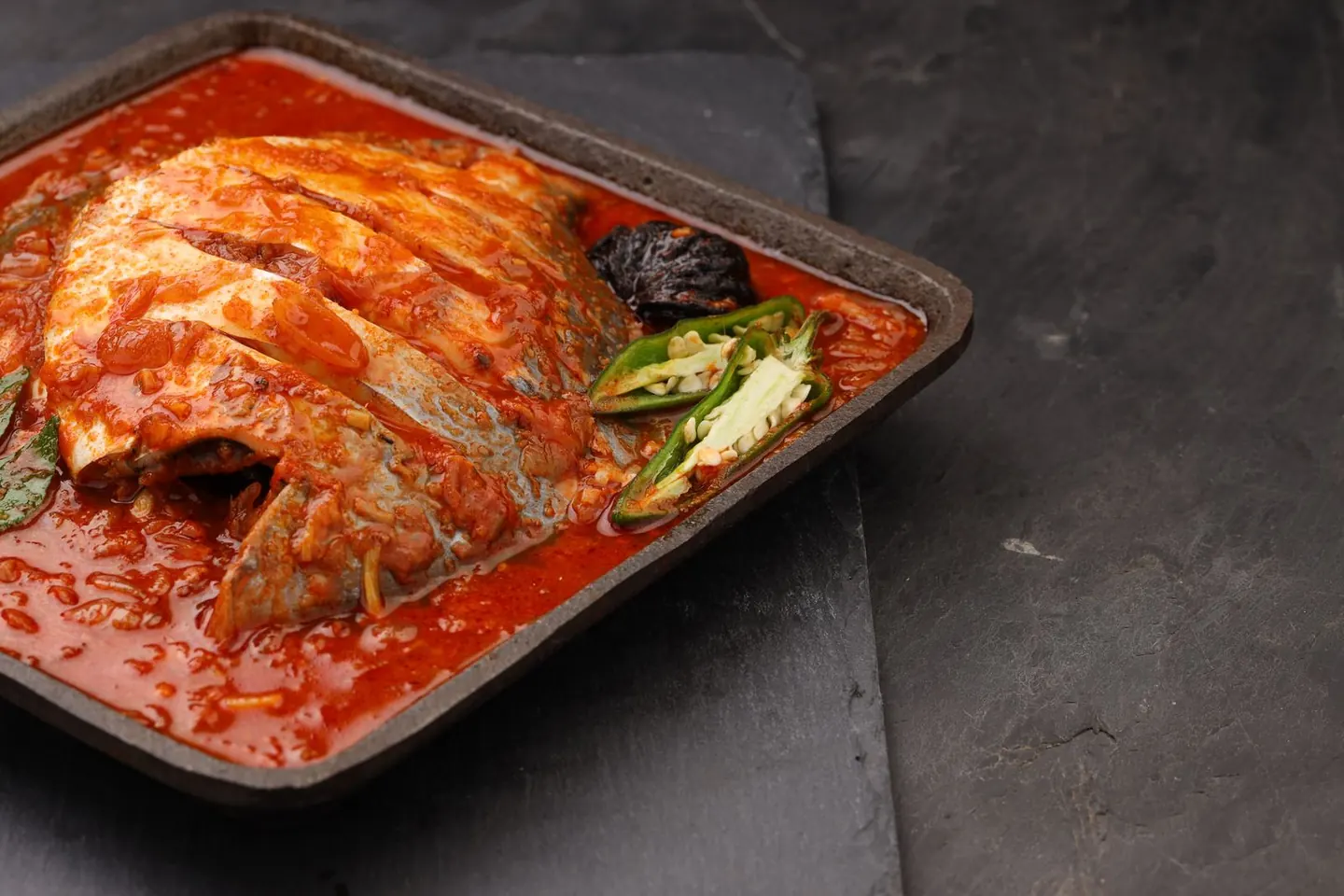
R024 · Meen Vevichathu [LOW GL] [HIGH PROTEIN] [UNDER 250 KCAL]
Kudampuli fish curry, the Kottayam Syrian Christian way
ICONS: P · B · F
THE RE-ENGINEERING: Coconut oil down from about 45 g to 10 g, half of it stirred in raw at the end where you can actually taste it; the body now comes from 120 g of shallots cooked right down and a full three pieces of kudampuli rather than from fat.
This is the archetype of the Kerala red fish curry and the flagship of this chapter: fiery, thin, brick-dark, soured with kudampuli and cooked in an unglazed clay pot. It is a Central Travancore dish, Kottayam-style, and the households that own it cook it in the evening to eat at noon the next day. That is not thrift. Kudampuli is the one souring agent in Kerala that makes a curry improve overnight rather than flatten, and the mechanism is worth knowing before you cook it.
Serves 4 · about 230 g per portion Active 25 minutes · Total 45 minutes (plus at least 4 hours resting, and overnight is better) Difficulty: Easy
EQUIPMENT: Unglazed clay pot (meen chatti), 20–22 cm. Substitute: any heavy non-reactive pan — stainless steel, enamelled cast iron, a kalchatti. You lose the microporous wall that returns a little of yesterday's curry to today's, and you lose about five minutes of residual cooking, so take the fish off the heat slightly later. Do not use bare iron or aluminium: kudampuli will pick up a metallic edge from both.
BEFORE YOU START: Soak the kudampuli first — it needs 15–20 minutes and everything else takes less. Slice the shallots before you light the flame; 120 g takes five minutes and the pot will not wait.
INGREDIENTS
- 3 pieces kudampuli (about 8 g), rinsed
- 60 ml warm water, for soaking
- 10 g (2 tsp) coconut oil, divided: 5 g and 5 g
- 120 g (about 12) shallots, thinly sliced
- 15 g (a 3 cm piece) ginger, julienned
- 10 g (about 3 cloves) garlic, sliced
- 2 green chillies (about 10 g), slit lengthways
- 14 g (2 tbsp) M05 fish masala
- 3 g (1 sprig) curry leaves
- 350 ml water
- 3 g (½ tsp) M07 salt, or plain salt
- 500 g (1 lb 2 oz) neymeen or kingfish, in 4 thick steaks about 2.5 cm deep
SOURCING NOTE: Kudampuli is sold as kodampuli, "Malabar tamarind" or "gambooge" in every Kerala-facing shop and online everywhere. Rinse it: the commercial product is often smoke-cured to speed drying, which is why one bag tastes of clean fruit acid and the next of a bonfire. In the US: kingfish steaks at Indian and Caribbean fishmongers, or Spanish mackerel, wahoo or mahi-mahi. In the UK: kingfish or coley at Asian counters; huss and monkfish tail both work and hold together beautifully. In the Gulf: ask for chanad — it is the same fish. In Australia: Spanish mackerel is the exact species, and school mackerel or blue-eye trevalla are good stand-ins. Any firm, thick, non-flaking fish will make this curry; a soft white fish will disintegrate.
ALLERGENS: Fish. Gluten (wheat) — only if your asafoetida is compounded with wheat flour, as most brands are (it arrives with M05).
METHOD
- Soak the kudampuli in the warm water. It is ready when it has gone from brittle to the texture of a dried apricot and the water has coloured to weak tea, 15–20 minutes. Keep the soaking water.
- Heat the clay pot slowly over a low flame for 2–3 minutes before anything goes in — clay cracks on thermal shock, not on heat. Add 5 g of the coconut oil.
- Fry the shallots, ginger, garlic and green chilli with a pinch of the salt until the shallots have collapsed and gone gold at the edges with no white left anywhere in the pan, 10–12 minutes on a low-medium flame. This is where the curry gets its body, and it is the step people rush.
- Add the M05 fish masala and curry leaves and stir constantly for 2–3 minutes, until the dusty raw note lifts off the pan and what replaces it is rounder and warmer. If it looks like catching, a tablespoon of water rather than more oil.
- Pour in the 350 ml water and the kudampuli with its soaking liquid, add the rest of the salt, and simmer uncovered until the gravy has darkened and thickened enough to coat the back of a spoon thinly, 10–12 minutes. Taste it now: it should be aggressively sour and slightly too salty, because the fish will absorb both.
- Slide in the fish steaks in a single layer, spooning gravy over them. Do not stir again — shake the pot instead.
- Simmer at a bare tremble, where a bubble breaks the surface every second or two, until the flesh has turned from translucent to opaque and gives slightly when pressed with the back of a spoon rather than squashing, 8–12 minutes. Take it off while the very centre still looks a shade underdone.
- Finish off the heat with the remaining 5 g of coconut oil poured over the surface, and leave the pot uncovered for 10 minutes before you touch it. The clay carries on cooking the fish for 8–12 minutes after the flame is out.
WHY THIS WORKS
Kudampuli's acids keep migrating into the fish for hours after cooking, firming its protein and softening connective tissue, while the gravy's soluble compounds and the fish's own trade places. Its acidity is smoky and rounded rather than sharp, so it integrates into the gravy instead of sitting on top of it — which is exactly why tamarind's brightness fades overnight and this deepens.
PER SERVING (estimated)
| kcal | kJ | Carb | Fibre | Net carb | Sugars | Protein | Fat | Sat fat | Sodium |
|---|---|---|---|---|---|---|---|---|---|
| 232 | 969 | 10 g | 3 g | 7 g | 3 g | 29 g | 10 g | 4 g | 300 mg |
Kudampuli is modelled on tamarind pulp.
IF YOU ARE WATCHING… Blood sugar: 7 g of net carbohydrate makes this one of the lowest-load main dishes in the book. What decides the meal is the rice: 150 g cooked matta (R015) adds about 45 g of net carbohydrate, and a 50 g serving of vanpayar (R053) alongside cuts the glycaemic response of that rice more than swapping the rice would. Blood pressure: 300 mg is 15% of a 2,000 mg day. To go lower, drop the added salt to 2 g and lean harder on the kudampuli — sour and hot together mask a missing gram of salt better than anything else in this cuisine. Cholesterol: 4 g of saturated fat, most of it from the 10 g of coconut oil. Sesame or groundnut oil takes it to about 2 g and the curry is still recognisably itself, though the raw finishing drizzle is where coconut oil earns its place.
SWAP IT
- No neymeen → ayala or mathi. Oilier, stronger, and better value; cut the coconut oil to 5 g in total because the fish brings its own. Omega-3 per serving goes up.
- No kudampuli → 15 g tamarind pulp. The curry becomes rounder and brighter and does not improve overnight, so eat it the day you make it.
- No M05 → 8 g Kashmiri chilli powder, 4 g ground coriander, 2 g turmeric and a pinch of fenugreek. Slightly flatter; you lose the pepper and the roasted depth. (The fenugreek here is under 1 g across four servings and nowhere near the 10–25 g a day at which fenugreek has real glycaemic effects — but anyone taking insulin or a sulfonylurea should read the caution at M05 and in Chapter 9.)
- No clay pot → see EQUIPMENT. The curry works; it will not archive.
SCALE IT
| Serves | Fish | Kudampuli | Shallots | Water | Oil | M05 | Salt |
|---|---|---|---|---|---|---|---|
| 2 | 250 g | 2 pieces | 60 g | 180 ml | 5 g | 7 g | 1.5 g |
| 4 | 500 g | 3 pieces | 120 g | 350 ml | 10 g | 14 g | 3 g |
| 8 | 1 kg | 6 pieces | 240 g | 650 ml | 18 g | 28 g | 6 g |
MAKE AHEAD · STORE · FREEZE Better on day two, and this is not a figure of speech. Fridge 3 days in a covered non-metal container. Freeze 2 months; the fish loses texture, the gravy does not, so freeze gravy alone if you can and poach fresh fish in it. Reheat to a bare tremble only, never a rolling boil.
LEFTOVERS Flake the fish off the bone into a thoran with 40 g grated coconut and a curry-leaf tempering. Or spoon the cold gravy — it will have set slightly — over hot kanji (R020), which is what a Kottayam household does with the last of the pot.
SERVE WITH R015 Matta Rice · R053 Vanpayar Thoran · R063 Cabbage Thoran · R107 Sambharam
TROUBLESHOOTING Curry tastes of raw chilli powder: step 4 was cut short. Simmer another 8–10 minutes; it will come round. Fish fell apart: it was stirred, it went in before the gravy had thickened, or the fish was tired. Shake the pot, never stir it. Thin and watery: not enough shallot reduction at step 3, or the gravy was not simmered down at step 5. Lift the fish out and reduce the gravy 4–5 minutes, then return it off the heat. Metallic, hard-edged sourness: an aluminium or bare-iron pan. This is the one dish where the vessel genuinely matters.
NOTES
R025 · Meen Moilee [LOW GL] [HIGH PROTEIN]
The pale coconut-milk fish curry, Cochin Latin Catholic and Anglo-Indian both
ICONS: P · Q
THE RE-ENGINEERING: Thick first milk cut from about 250 ml to 100 ml and moved to the very end of the cooking; 150 ml of M13 fish stock takes up the volume, so the curry has the same body on roughly half the saturated fat.
Moilee — also spelled molee, molly and moily depending on whose grandmother wrote it down — is the mild, pale, sour-sweet counterpart to the red kudampuli curry, and it comes out of the most Portuguese-inflected kitchens in Kerala. Turmeric and green chilli do the work of chilli powder; lime or vinegar does the work of kudampuli. It is the dish that teaches the coconut-milk rule, because there is nowhere for a broken emulsion to hide in a curry this pale.
Serves 4 · about 290 g per portion Active 25 minutes · Total 30 minutes Difficulty: Easy, with one unforgiving step
EQUIPMENT: Wide shallow pan, 26–28 cm, non-reactive. Substitute: a clay pot works and holds heat beautifully, but a wide pan lets you see the surface, which is how you catch the milk before it splits.
BEFORE YOU START: Have the first milk measured and standing away from the hob. The last 60 seconds of this recipe decide whether it is a moilee or a broken curry, and you will not have time to go looking for a jug.
INGREDIENTS
- 10 g (2 tsp) coconut oil
- 150 g (about 15) shallots, sliced into thin rings
- 15 g (a 3 cm piece) ginger, julienned
- 10 g (about 3 cloves) garlic, sliced
- 3 green chillies (about 15 g), slit
- 3 g (¾ tsp) ground turmeric
- 3 g (1 sprig) curry leaves
- 100 g (about 1) tomato, in thin wedges
- 150 ml M13 fish stock, or water
- 200 ml second coconut milk (M08)
- 3 g (½ tsp) M07 salt, or plain salt
- 500 g (1 lb 2 oz) white pomfret, karimeen or seer fish, in 4 portions
- 100 ml first coconut milk (M08)
- 15 ml (1 tbsp) lime juice
SOURCING NOTE: This curry wants a firm white fish that holds its shape. In the US: pompano is the same family as pomfret and is widely available in the South; otherwise red snapper, black sea bass or halibut cheeks. In the UK: pollack, gurnard, hake or a farmed sea bream. In the Gulf: hamour (grouper) or safi (rabbitfish) both work; zubaidi is pomfret. In Australia: snapper, barramundi or blue-eye trevalla. Tinned coconut milk is the honest fallback if you are not making M08 — use it undiluted as the first milk and at 1:1.5 with water as the second, and expect a slightly flatter, more cooked flavour.
ALLERGENS: Fish.
METHOD
- Heat the pan, then the oil, and cook the shallots, ginger, garlic and green chilli with a pinch of salt over a medium-low flame until translucent and just beginning to gold, 6–8 minutes. Moilee is not a browned curry; stop before colour builds.
- Add the turmeric and curry leaves and stir 45–60 seconds, until the turmeric smells warm and slightly earthy rather than dusty and the shallots have taken its colour.
- Add the tomato wedges and cook 2–3 minutes only, until the edges soften but the wedges still hold their shape. They are meant to be visible in the finished curry.
- Pour in the stock and the second coconut milk, add the rest of the salt, and simmer 5–6 minutes until the liquid has thickened very slightly and tastes of coconut rather than of raw milk.
- Slide in the fish in a single layer and simmer at a bare tremble until the flesh is opaque all the way to the bone and flakes along its natural lines when nudged with a spoon tip, 7–10 minutes depending on thickness. Take the pan off the heat.
- Add the first milk off the heat, swirling the pan rather than stirring it, until the curry warms through and turns a shade paler, 1–2 minutes. If you must return it to the flame, take it to the point where one bubble breaks every few seconds and no further.
- Finish with the lime juice, taste, and leave it covered for 5 minutes.
WHY THIS WORKS
Coconut milk is an oil-in-water emulsion held together by a film of coconut globulins around each fat droplet. Boil it and those proteins denature, stop sitting at the oil–water boundary, and the agitation lets the unprotected droplets coalesce: clear oil on top, grainy curds beneath, irreversibly. Second milk survives heat because there is far less fat to separate. First milk does not. That is the entire rule.
PER SERVING (estimated)
| kcal | kJ | Carb | Fibre | Net carb | Sugars | Protein | Fat | Sat fat | Sodium |
|---|---|---|---|---|---|---|---|---|---|
| 318 | 1,332 | 13 g | 3 g | 10 g | 6 g | 27 g | 19 g | 13 g | 340 mg |
Coconut milk from USDA FDC 170172 scaled by extraction, as in M08.
IF YOU ARE WATCHING… Blood sugar: 10 g of net carbohydrate, and the fat slows gastric emptying further. This is a low-load main dish; the rice portion is the whole decision. Blood pressure: 340 mg. Drop the added salt to 2 g and add a second slit chilli — 260 mg, and nobody notices. Cholesterol: 13 g of saturated fat is the highest figure in this chapter and all of it is coconut. Coconut oil raises LDL-C relative to unsaturated oils by about 10.5 mg/dL across 16 trials (Neelakantan et al., 2020), and thick coconut milk is the same fat in a whole-food matrix. Two levers: swap the 10 g of coconut oil for sesame, and take the first milk down to 60 ml with 40 ml more stock. That lands at about 9 g and the curry survives it.
SWAP IT
- No M08 → tinned coconut milk as in the sourcing note. Flatter, slightly cooked, and you lose the graded texture.
- No fish stock → water plus 100 ml third coconut milk. Thinner-bodied; add 2–3 minutes to step 4.
- Lime → 10 ml coconut vinegar, which is the older Latin Catholic choice. Sharper, more fermented, less floral.
- No coconut at all → 40 g cashews blended with 200 ml water in place of the second and first milk together. Comparable body, different flavour, roughly a third of the saturated fat, more monounsaturated. (Allergen: this swap introduces tree nuts (cashew).)
SCALE IT
| Serves | Fish | Shallots | Stock | Second milk | First milk | Oil | Salt |
|---|---|---|---|---|---|---|---|
| 2 | 250 g | 75 g | 75 ml | 100 ml | 50 ml | 5 g | 1.5 g |
| 4 | 500 g | 150 g | 150 ml | 200 ml | 100 ml | 10 g | 3 g |
| 8 | 1 kg | 300 g | 300 ml | 400 ml | 200 ml | 18 g | 6 g |
MAKE AHEAD · STORE · FREEZE Best within an hour of cooking, and this is the opposite of R024. Fridge 2 days. Do not freeze — the emulsion breaks on thawing and there is no repair. Reheat in a wide pan over the lowest possible flame, or better, over a pan of hot water.
LEFTOVERS Flake the fish into the gravy, thin it with stock and serve it over idiyappam (R005) as a breakfast. Or reduce the gravy to a spoonable thickness and use it as the sauce for R038.
SERVE WITH R001 Appam · R015 Matta Rice · R068 Kumbalanga Olan · R089 Kerala Salad
TROUBLESHOOTING Oil on the surface with grainy curds beneath: the first milk boiled. There is no repair. Next time, off the heat. Gravy split even off the heat: the pan was too hot when the milk went in, or the milk was stirred rather than swirled. Let the pan sit 60 seconds before adding it. Tastes flat and milky: not enough acid. Another 5 ml of lime, and check the salt after the acid, not before. Fish tough and dry: it cooked while the milk was going in. Add the milk with the pan already off the heat and the fish only just set.
NOTES
R026 · Mathi Curry [LOW GL]
Sardine curry with kudampuli — the cheapest good fish in Kerala
ICONS: P · B · F
THE RE-ENGINEERING: Almost nothing, and that is the point. A traditional mathi curry is already a low-oil dish; this version cuts the coconut oil from about 30 g to 12 g and gets the difference back from the sardine's own fat, which renders into the gravy.
Mathi is the fish this book would choose if it could only keep one. At 17.91 g of protein and roughly 614 mg of EPA plus DHA per 100 g, it out-delivers every prestige fish in Kerala on omega-3 per rupee by an order of magnitude, and when the shoals come in off Kollam and Alappuzha it is sold from baskets at a price that embarrasses the market. It is also strong, oily and unapologetic, which is why it needs kudampuli rather than coconut milk.
Serves 4 · about 210 g per portion Active 25 minutes · Total 45 minutes (plus 4 hours resting — strongly recommended) Difficulty: Easy
EQUIPMENT: Unglazed clay pot (meen chatti), 22 cm. Fish scissors or a small sharp knife for cleaning. Substitute: any heavy non-reactive pan — stainless steel, enamel, a kalchatti. You lose the seasoned wall and about five minutes of residual cooking, so take the pot off the heat slightly later. Never aluminium or bare iron with kudampuli.
BEFORE YOU START: Clean the sardines before anything else — heads off, gut removed, the black line inside the cavity scraped out with a thumbnail and rinsed. That black line is what makes a sardine curry bitter and nothing later removes it. Soak the kudampuli while you work.
INGREDIENTS
- 3 pieces kudampuli (about 8 g), rinsed and soaked in 60 ml warm water
- 500 g (1 lb 2 oz) cleaned sardines, from about 700 g whole — 8 to 10 medium fish
- 12 g (2½ tsp) coconut oil, divided: 7 g and 5 g
- 100 g (about 10) shallots, thinly sliced
- 15 g (a 3 cm piece) ginger, crushed
- 10 g (about 3 cloves) garlic, crushed
- 21 g (3 tbsp) M05 fish masala
- 4 g (1 large sprig) curry leaves
- 300 ml water
- 3 g (½ tsp) M07 salt, or plain salt
SOURCING NOTE: Fresh sardines are one of the few genuinely cheap fish in the West, and they are the same family as mathi. In the US: Pacific sardines on the West Coast, Spanish or Portuguese sardines frozen elsewhere; failing that, tinned sardines in water — see SWAP IT, because the method changes. In the UK: fresh Cornish sardines are excellent and seasonal from May to October, and pilchards are the same fish grown up. In the Gulf: oum is sardine and is everywhere. In Australia: Australian sardine, sold as pilchard in Victoria and South Australia. Buy them whole, and ask the fishmonger to gut them if you would rather not.
ALLERGENS: Fish. Gluten (wheat) — only if your asafoetida is compounded with wheat flour, as most brands are (it arrives with M05).
METHOD
- Rub the cleaned sardines with a pinch of the salt and set them aside while you build the gravy, 15–20 minutes. Salt draws a little surface moisture and firms the flesh so the fish holds together in the pot.
- Heat the clay pot slowly, 2–3 minutes, then add 7 g of the coconut oil.
- Cook the shallots, ginger and garlic over a low-medium flame until the shallots have gone soft and gold with no white showing, 8–10 minutes.
- Add the M05 and curry leaves and stir 2–3 minutes, until the raw dusty edge lifts and the paste darkens by one shade and no more. A tablespoon of water if it threatens to catch.
- Add the water, the kudampuli with its soaking liquid and the rest of the salt, and simmer 8–10 minutes until the gravy is glossy and thick enough to leave a brief trail when you draw a spoon through it.
- Lay the sardines in, in one layer, heads to tails so they interlock. Spoon gravy over them and shake the pot to settle them.
- Simmer at a bare tremble, without stirring, until the flesh has gone opaque and lifts cleanly from the backbone when you probe the thickest part, 8–10 minutes. Sardines cook faster than steaks and overcook into cotton wool, so err early.
- Finish off the heat with the remaining 5 g of coconut oil and a few fresh curry leaves torn over. Leave the pot alone for 15 minutes.
WHY THIS WORKS
Sardine fat sits under the skin and in the dark muscle along the flank, and at a tremble it renders into the gravy rather than staying in the fish — which is why this curry tastes rich on 12 g of oil. Kudampuli's acid then does two jobs: it firms the protein so the fillets hold, and its rounded sourness cuts fat as tamarind's brighter acid cannot.
PER SERVING (estimated)
| kcal | kJ | Carb | Fibre | Net carb | Sugars | Protein | Fat | Sat fat | Sodium |
|---|---|---|---|---|---|---|---|---|---|
| 257 | 1,077 | 10 g | 3 g | 7 g | 3 g | 24 g | 15 g | 6 g | 320 mg |
IFCT's sardine entry (P071, n=1) is internally inconsistent between its fat figure and its fatty-acid totals; the higher figure is used here, which makes this panel conservative on energy.
IF YOU ARE WATCHING… Blood sugar: 7 g of net carbohydrate. This is a low-load dish and 24 g of protein per serving; the meal is decided by the grain. Blood pressure: 320 mg. Sardine is naturally slightly higher in sodium than white fish. Two grams of added salt instead of three takes this to about 250 mg and the kudampuli carries it. Cholesterol: 6 g of saturated fat, and roughly two-thirds of it is the sardine's own rather than the added oil. Sardine fat is largely unsaturated, which is why 15 g of total fat here reads better than 15 g from coconut. Swapping the coconut oil for sesame takes saturated fat to about 4 g.
SWAP IT
- Tinned sardines in water → 2 × 120 g tins, drained. Add them at step 7 for 2–3 minutes only, off the heat if possible. Calcium goes up substantially because of the bones; sodium goes up to roughly 550 mg per serving, so use no added salt at all.
- No sardines → ayala (mackerel) cut into 3 cm rounds. Firmer, less oily, cooks in the same time.
- No kudampuli → 15 g tamarind pulp. Brighter, and the curry no longer improves overnight.
- Coconut oil → sesame oil throughout. Saturated fat falls by about 2 g per serving; you lose the finishing aroma, which is the one thing coconut oil does that nothing replaces. (Allergen: this swap introduces sesame.)
SCALE IT
| Serves | Sardines, cleaned | Kudampuli | Shallots | Water | Oil | M05 | Salt |
|---|---|---|---|---|---|---|---|
| 2 | 250 g | 2 pieces | 50 g | 160 ml | 6 g | 10 g | 1.5 g |
| 4 | 500 g | 3 pieces | 100 g | 300 ml | 12 g | 21 g | 3 g |
| 8 | 1 kg | 5 pieces | 200 g | 600 ml | 22 g | 40 g | 6 g |
MAKE AHEAD · STORE · FREEZE Better after 4 hours and better still overnight. Fridge 3 days covered, non-metal. Freeze 1 month only — sardine fat oxidises faster than white-fish fat and a frozen mathi curry starts tasting of old oil sooner than you would expect. Reheat at a tremble.
LEFTOVERS Lift the fillets off the bones, break them up, and fold into a cheera thoran (R065). Or mash them into the gravy with a fork and spread the result on toast, which is what a Kerala household in London does and does not admit to.
SERVE WITH R015 Matta Rice · R020 Kanji · R056 Muthira Thoran · R072 Pavakka Theeyal
TROUBLESHOOTING Bitter: the black line inside the cavity was not scraped out, or a gall bladder burst during gutting. Nothing fixes it. Fish broke up into the gravy: it was stirred, or it went in before the gravy thickened, or the sardines were more than a day old. A broken mathi curry is still a very good sauce. Overpoweringly fishy rather than rich: the sardines were not fresh. Sardine is the fish that punishes a bad buy hardest — clear eyes and red gills or do not buy. Not sour enough: one more piece of kudampuli, simmered 5 minutes in a ladleful of the gravy and stirred back in.
NOTES
R027 · Ayala Varuthathu, Baked [HIGH PROTEIN] [LOW SAT FAT] [UNDER 250 KCAL]
Mackerel with a chilli-masala rub, in a very hot oven
ICONS: P
THE RE-ENGINEERING: The frying oil is gone. What replaces it is 220°C (425°F), a wire rack, and 10 g of oil brushed on rather than poured in — 173 kcal a portion against 235 for the fried original, with 3 g of saturated fat instead of 9.
Read R028 immediately after this one. The two recipes are the same fish and the same rub, cooked two ways and measured both times, and they are printed side by side because a health cookbook that quietly deletes the fried version has told you a lie by omission. This one is genuinely good: the rub sets into a dark crust, the skin blisters and pulls back, and mackerel is oily enough that a hot oven treats it kindly. It is not a fried fish, and this recipe will not pretend it is.
Serves 4 · about 120 g of baked fish per portion Active 15 minutes · Total 45 minutes (including 20 minutes marinating — required) Difficulty: Easy
EQUIPMENT: Oven; wire rack set over a lined baking tray; silicone brush. Substitute: an air fryer at 200°C (390°F) for 10–12 minutes a side, which works very well and browns harder. A grill or broiler works too, 8–10 cm from the element, but watch it — the rub burns before the fish is done. No rack: score the tray with a bed of thin onion rings and sit the fish on that.
BEFORE YOU START: Get the oven fully to 220°C (425°F) with the tray and rack inside. A cold rack is how the skin sticks and tears.
INGREDIENTS
- 4 mackerel, about 200 g each cleaned (about 550 g edible flesh), heads on, scored 3 times a side to the bone
- 14 g (2 tbsp) M05 fish masala
- 8 g (a 1.5 cm piece) ginger, grated
- 5 g (1½ cloves) garlic, crushed
- 10 ml (2 tsp) lime juice
- 3 g (½ tsp) M07 salt, or plain salt
- 10 g (2 tsp) coconut oil, for brushing
SOURCING NOTE: Indian mackerel (Rastrelliger kanagurta) is a smaller, leaner fish than Atlantic mackerel and is the species behind the numbers in this chapter. In the US: Indian mackerel frozen whole in Asian groceries; Boston or Atlantic mackerel fresh, which is fattier and needs 2–3 minutes less. In the UK: Atlantic mackerel is on every fishmonger's slab and is one of the best-value fish in the country; Indian mackerel frozen in Sri Lankan and Kerala shops. In the Gulf: bathi is Indian mackerel and chanad is the larger seer. In Australia: blue mackerel or slimy mackerel, both cheap and both correct. Frozen mackerel is a real compromise here, because thawed flesh sheds water onto the tray and steams rather than roasts — if you must, thaw in the fridge, then pat dry hard and marinate for only 10 minutes.
ALLERGENS: Fish. Gluten (wheat) — only if your asafoetida is compounded with wheat flour, as most brands are (it arrives with M05).
METHOD
- Score each fish three times a side, cutting down to the bone at a 45-degree angle. This is not decoration: it is how the rub reaches the middle and how the thick part cooks in the same time as the thin.
- Mix the M05, ginger, garlic, lime juice and salt into a thick paste, adding water 5 ml at a time only if it will not spread — it should be the consistency of soft mud, not of sauce.
- Rub the paste over both sides and into every score and the belly cavity, working it in with your fingers. Rest 20–30 minutes at room temperature, or up to 2 hours in the fridge. Longer than that and the lime starts to make the surface mealy.
- Brush the fish with the coconut oil, 2–3 g per fish, on both sides. A brush puts oil on the surface; pouring puts most of it into the fish and the rest on the tray.
- Lay the fish on the hot rack, not touching, and roast 10–12 minutes.
- Turn once, carefully, with a fish slice and a hand, and roast a further 6–9 minutes. It is done when the rub has darkened to near-black at the edges of the scores, the skin has blistered and shrunk back, and the flesh at the thickest part lifts from the backbone in one piece and looks opaque right through. Total 18–21 minutes.
- Rest 3–4 minutes on the rack before moving it. Squeeze more lime over at the table, not before.
WHY THIS WORKS
At 220°C (425°F) the surface dehydrates fast enough for Maillard browning between the rub's spice sugars and amino acids and the fish's own surface protein, which is what produces the dark crust a fried fish gets from the oil. The rack matters: it lets the underside dry and brown instead of sitting in released liquid and steaming. What is genuinely lost is the crisp, oil-saturated shell that only frying produces.
PER SERVING (estimated)
| kcal | kJ | Carb | Fibre | Net carb | Sugars | Protein | Fat | Sat fat | Sodium |
|---|---|---|---|---|---|---|---|---|---|
| 173 | 723 | 3 g | 1 g | 2 g | 0 g | 30 g | 5 g | 3 g | 330 mg |
WHAT IS GAINED AND WHAT IS LOST, PRECISELY Against R028: 62 kcal less per serving, 7 g less fat, 6 g less saturated fat, no frying oil to dispose of, no oil to reuse or discard, and no pan to scour. What is lost is real and worth naming: the crackling, brittle, oil-set crust; the way a fried fish's skin shatters; and the smell of a fish frying in coconut oil, which is one of the load-bearing smells of a Kerala kitchen. The baked version has a drier, more roasted flavour and a chewier skin. It is a good dish. It is a different dish.
IF YOU ARE WATCHING… Blood sugar: 2 g of net carbohydrate. Nothing here moves glucose; 30 g of protein moves satiety a great deal. Blood pressure: 330 mg, most of it the added salt. Two grams instead of three lands at about 260 mg — do it, because the rub is intense enough to carry the loss. Cholesterol: 3 g of saturated fat per serving, of which about 2 g is the brushed coconut oil. Brush with sesame or groundnut instead and it falls below 2 g.
SWAP IT
- No mackerel → sardine, which is oilier and needs 4–5 minutes less; or pomfret, which is leaner and wants an extra 2 g of brushed oil.
- Fillets instead of whole fish → 130 g per person, skin side up, 9–12 minutes total, no turning. Faster and easier and considerably less good, because the bone and the belly fat are half of why this works.
- M05 → 8 g Kashmiri chilli powder, 3 g pepper, 2 g turmeric and a pinch of fenugreek. See the fenugreek note at R024 SWAP IT if you take insulin or a sulfonylurea.
- Coconut oil → sesame or groundnut. Saturated fat drops by about 1.5 g per serving; the aroma changes noticeably and it is still a good fish. (Allergen: this swap introduces peanuts, sesame.)
SCALE IT
| Serves | Mackerel, cleaned | M05 | Ginger | Garlic | Lime | Oil, brushed | Salt |
|---|---|---|---|---|---|---|---|
| 2 | 2 fish, about 400 g | 7 g | 4 g | 3 g | 5 ml | 5 g | 1.5 g |
| 4 | 4 fish, about 800 g | 14 g | 8 g | 5 g | 10 ml | 10 g | 3 g |
| 8 | 8 fish, about 1.6 kg | 28 g | 16 g | 10 g | 20 ml | 20 g | 6 g |
Eight fish need two trays and two racks, or two batches; a crowded oven steams rather than roasts.
MAKE AHEAD · STORE · FREEZE Rub the fish and hold it. Fridge 24 hours rubbed and uncooked, which improves it. Cooked: fridge 2 days. Freeze 1 month rubbed and raw, thawed overnight in the fridge; do not freeze it cooked, because reheating a baked oily fish is a poor experience. Reheat in a 200°C (390°F) oven for 5–6 minutes, never a microwave.
LEFTOVERS Flake it, bones out, into a peera with 40 g grated coconut (see R031 for the method), or into a cutlet mix (R039). Cold baked mackerel with lime and raw onion on matta rice is a better lunch than it sounds.
SERVE WITH R015 Matta Rice · R081 Moru Curry · R063 Cabbage Thoran · R053 Vanpayar Thoran
TROUBLESHOOTING Rub slid off in the oven: the paste was too wet, or the fish was not patted dry before rubbing. Thicker paste, drier fish. Skin stuck to the rack and tore: the rack was cold, or unoiled, or the fish was moved too early. Hot rack, brushed rack, and let it release itself. Dry and cottony: overcooked, which happens in the last three minutes. Pull it when the thickest part has just gone opaque. Pale and steamed rather than roasted: the oven was not fully up to temperature, the fish were touching, or they were still wet from thawing.
NOTES
R028 · Ayala Varuthathu, Fried and Measured [LOW GL] [HIGH PROTEIN] [UNDER 250 KCAL]
The real Kerala fish fry, with the oil weighed
ICONS: —
THE RE-ENGINEERING: None. This is the traditional dish, cooked traditionally, and the only thing this book has changed is that the oil is weighed before and after so you know exactly what you ate.
A proper Kerala fish fry cannot be made without oil. The oil is the cooking medium — it is what sets the rub into a shell, and no oven and no air fryer reproduces it. Books in this genre usually solve that problem by leaving the dish out, or by printing a "healthy fish fry" that is a baked fish wearing a false name. This book gives you both versions, measured, and lets you decide. The honest figure is 235 kcal and 12 g of fat a portion, which is not a disaster; it is a Thursday.
Serves 4 · about 120 g of fried fish per portion Active 25 minutes · Total 55 minutes (including 20 minutes marinating — required) Difficulty: Easy, but hot and messy
EQUIPMENT: Heavy shallow pan, 26–28 cm — a cheena chatti is traditional but its curved base needs more oil, so a flat frying pan is the better choice for a measured fry. A digital scale is not optional in this recipe. Substitute: a cast-iron skillet is ideal; non-stick works and needs slightly less oil.
BEFORE YOU START: Weigh the empty pan. Weigh the oil into it. Write both numbers down. At the end you will pour the oil back out and weigh it again, and the difference is what went into the fish. This is the whole reason the recipe exists, and skipping it turns it back into a guess.
INGREDIENTS
- 4 mackerel, about 200 g each cleaned (about 550 g edible flesh), scored 3 times a side to the bone
- 14 g (2 tbsp) M05 fish masala
- 8 g (a 1.5 cm piece) ginger, grated
- 5 g (1½ cloves) garlic, crushed
- 10 ml (2 tsp) lime juice
- 3 g (½ tsp) M07 salt, or plain salt
- 250 ml (about 230 g) coconut oil, for shallow frying — of which about 38 g ends up in the fish
SOURCING NOTE: As R027 for the fish. On the oil: coconut oil is used here because it is the flavour of a Kerala fish fry and nothing else tastes like it. If you would rather not, groundnut and rice bran oil both have the high smoke point this needs and run 19% and 24% saturated against coconut's 91% — the fry is excellent and it is no longer a Kerala fish fry. Whichever you choose, use it once. Do not top up old oil with fresh, and discard oil that has darkened, thickened, foams or smells acrid; ICMR-NIN's 2024 guidance advises against reheating and reusing frying oil.
ALLERGENS: Fish. Gluten (wheat) — only if your asafoetida is compounded with wheat flour, as most brands are (it arrives with M05).
METHOD
- Score, mix and rub exactly as R027 steps 1 to 3, and rest 20–30 minutes. Then pat the surface dry with kitchen paper — a wet fish spits violently and takes up more oil, not less.
- Weigh the pan empty. Add the oil and weigh again. Record both.
- Heat the oil over a medium-high flame until a fragment of curry leaf dropped in sizzles hard and rises immediately, 3–4 minutes. Test it: too cool and the fish absorbs oil instead of sealing, which is the single biggest driver of how much fat ends up on your plate.
- Lay two fish in, away from you, and leave them alone. Do not move them, do not poke them. Fry 4–5 minutes, until the edge of the rub visible above the oil has darkened and the fish releases from the pan when you tilt it.
- Turn once with a fish slice and fry a further 3–4 minutes, until the crust is dark reddish-brown, the skin is tight and crisp, and a skewer slid into the thickest part meets no resistance. Total 7–9 minutes per pair.
- Lift onto a wire rack, not onto paper. A rack lets the fish drain and stay crisp; paper traps steam under it and softens the crust you just paid 38 g of oil for.
- Repeat with the second pair, adding 2–3 minutes to bring the oil back to temperature first.
- Pour the oil back into a jug, let the pan cool, and weigh it again. Subtract. That number, divided by four, is your fat figure — and it will vary with how dry the fish was and how hot the oil ran.
WHY THIS WORKS
Hot oil drives water out of the rub as steam, and that outward flow is what keeps oil from moving inward. A properly hot pan therefore builds a crust and takes up relatively little oil; a cool pan gives a soggy fish that has drunk twice as much. The crust is a fused layer of dehydrated spice, gelatinised protein and set oil, and no oven can make it.
PER SERVING (estimated)
| kcal | kJ | Carb | Fibre | Net carb | Sugars | Protein | Fat | Sat fat | Sodium |
|---|---|---|---|---|---|---|---|---|---|
| 235 | 984 | 3 g | 1 g | 2 g | 0 g | 30 g | 12 g | 9 g | 330 mg |
Computed on 38 g of oil taken up across four fish, or 9.5 g each.
THE ARITHMETIC, AND WHERE THIS FITS IN A WEEK Against R027 this costs you 62 kcal, 7 g of fat and 6 g of saturated fat per serving. Put that in a week rather than in a moral category. Eaten once a week, this dish adds roughly 62 kcal and 6 g of saturated fat to seven days — which is, in the context of a 14,000 kcal week, approximately nothing. Eaten five times a week alongside a parotta, it is 310 kcal and 30 g of saturated fat, and it is part of the problem. The dish is not the variable. The frequency is. A reasonable pattern, and the one this book's 28-day plan uses, is R027 twice a week and R028 once, which delivers three fish fries and costs less than one traditional fry did.
IF YOU ARE WATCHING… Blood sugar: 2 g of net carbohydrate. Nothing here moves glucose. Blood pressure: 330 mg. As R027 — 2 g of salt instead of 3 lands at about 260 mg. Cholesterol: 9 g of saturated fat is the honest cost, and it is the highest single-item saturated-fat figure in this chapter after the coconut-milk curries. Frying in groundnut or rice bran oil instead takes it to about 3 g while keeping every calorie, which is the most useful single change available here if LDL-C is your concern. You lose the coconut aroma. That is the trade, stated plainly.
SWAP IT
- Groundnut or rice bran oil → saturated fat falls from 9 g to about 3 g per serving; total energy unchanged. Not a Kerala fish fry any more, and a very good fried fish. (Allergen: this swap introduces peanuts.)
- Shallow-fry in 20 g of oil in a wide non-stick pan → about 5 g of oil per serving and roughly 190 kcal. Genuinely between the two versions; the crust is patchy and the skin does not crisp evenly.
- Sardine instead of mackerel → oilier, cooks in 5–6 minutes total, takes up slightly less oil because there is less time in the pan.
- Rice-flour dredge before frying → the classic Malabar move. Crisper, and it takes up roughly 5 g more oil across the four fish, plus about 3 g of carbohydrate a serving.
SCALE IT
| Serves | Mackerel, cleaned | M05 | Oil in the pan | Oil taken up | Salt |
|---|---|---|---|---|---|
| 2 | 2 fish, about 400 g | 7 g | 200 ml | about 20 g | 1.5 g |
| 4 | 4 fish, about 800 g | 14 g | 250 ml | about 38 g | 3 g |
| 8 | 8 fish, about 1.6 kg | 28 g | 250 ml, four batches | about 80 g | 6 g |
Note what the middle column does and does not do: doubling the fish does not double the oil in the pan, because the pan needs a depth rather than a volume. It does roughly double the oil taken up, which is the number that reaches your plate. Weigh it every time.
MAKE AHEAD · STORE · FREEZE Fry to order. Fridge 2 days, and it will not be crisp again. Freeze 1 month rubbed and raw, never fried. Reheat on a rack in a 200°C (390°F) oven for 5–6 minutes, which recovers perhaps two-thirds of the crust.
LEFTOVERS Break the fried fish into a hot kudampuli gravy from R024 for ten minutes off the heat — a Kerala household trick that turns yesterday's fry into a curry, and better than either the fry or the curry alone.
SERVE WITH R015 Matta Rice · R020 Kanji · R081 Moru Curry · R053 Vanpayar Thoran
TROUBLESHOOTING Fish drank the oil and came out greasy: the pan was not hot enough, or the fish went in wet, or the pan was crowded and the temperature crashed. Two fish at a time, dry, and test the oil first. Crust came off in the pan: the fish was moved before it released, or the rub was too wet. Oil spat everywhere: water on the fish. Pat dry, and use a splatter screen rather than a lid, which traps steam and softens the crust. Burnt outside, raw at the bone: flame too high. Medium-high, and turn once.
NOTES
R029 · Karimeen Pollichathu [LOW GL] [HIGH PROTEIN] [UNDER 250 KCAL]
Pearl spot in a banana leaf — the toddy shop's most famous dish
ICONS: P
THE RE-ENGINEERING: Two stages of frying removed. The fish is no longer shallow-fried before wrapping, and the leaf parcel is no longer griddled in a slick of oil — 15 g of coconut oil goes into the masala instead of 50 g going into the pan, and the leaf does the rest.
Karimeen was declared Kerala's state fish in 2010, and 2011 was designated its year. It is a brackish-water cichlid of the backwaters, expensive because demand vastly outruns supply, and its signature dish is the single most recognisable Kerala preparation in the world. Pollichathu came out of the toddy shop rather than the palace — pollichathu means charred — and the char on the leaf is the flavour. Everything about the technique is designed to cook a delicate fish without touching it.
Serves 4 · one fish in its parcel, about 200 g Active 30 minutes · Total 55 minutes (including 20 minutes marinating) Difficulty: Moderate — the wrapping takes practice
EQUIPMENT: Heavy flat griddle or tawa, 26 cm or wider, with a lid; banana leaves; kitchen string or toothpicks. Substitute: baking parchment or foil in place of banana leaf, which loses the whole aromatic point and reduces the dish to a baked fish; a 200°C (390°F) oven for 18–22 minutes in place of the griddle, which works well and chars less.
BEFORE YOU START: Soften the banana leaves — hold each over a low flame or dip in boiling water for 10–15 seconds until it turns glossy and dark and goes pliable. A brittle leaf splits at the fold and the whole parcel leaks.
INGREDIENTS
- 4 karimeen or pearl spot, about 250 g each cleaned (about 550 g edible flesh), scored twice a side
- 3 g (½ tsp) M07 salt, or plain salt, divided
- 15 ml (1 tbsp) lime juice
- 15 g (1 tbsp) coconut oil, divided: 12 g and 3 g
- 120 g (about 12) shallots, very finely sliced
- 15 g (a 3 cm piece) ginger, finely chopped
- 10 g (about 3 cloves) garlic, finely chopped
- 3 green chillies (about 15 g), finely chopped
- 4 g (¾ tsp) black pepper, coarsely crushed
- 10 g (1½ tbsp) M05 fish masala
- 60 g (about ½) tomato, finely chopped
- 3 g (1 sprig) curry leaves
- 4 banana leaf pieces, about 30 × 30 cm
SOURCING NOTE: Karimeen has no true equivalent outside South Asia, and substituting it is a compromise you should make knowingly: it is a firm, sweet, faintly muddy fish with a lot of small bones. In the US: tilapia is the closest widely available cichlid and is the honest substitute, though blander; black crappie or freshwater drum are closer in flavour if you can get them. In the UK: sea bream or small sea bass, or tilapia from African and Caribbean fishmongers. In the Gulf: safi (rabbitfish) is the local answer and is very good this way. In Australia: silver perch, barramundi fillets or bream. Frozen banana leaf is sold in every Asian and Latin American freezer aisle and works perfectly — thaw and soften as above.
ALLERGENS: Fish. Gluten (wheat) — only if your asafoetida is compounded with wheat flour, as most brands are (it arrives with M05).
METHOD
- Rub the scored fish with 1 g of the salt and the lime juice and rest 20 minutes while you make the masala.
- Heat the griddle, then 12 g of the coconut oil, and cook the shallots, ginger, garlic and green chilli over a medium-low flame until the shallots are soft, gold and completely collapsed, 10–12 minutes. This masala is the whole dish; it must not be raw and it must not be pale.
- Add the pepper and M05 and stir 2 minutes, until the raw edge lifts.
- Add the tomato, curry leaves and the rest of the salt, and cook down until the mass is thick, glossy and holds its shape when you push it to one side of the pan, with a thin rim of oil at the edge, 5–7 minutes. Cool 5 minutes. Wipe the griddle.
- Spread a quarter of the masala on a softened leaf, sit a fish on it, and pack the rest of that quarter over the top and into the scores and the cavity. Fold the leaf over the fish, then fold the ends under, and tie or pin. Repeat.
- Brush the griddle with the remaining 3 g of oil and lay two parcels on it, folded side down. Cook covered over a medium-low flame 7–8 minutes, until the underside of the leaf has gone brown-black in patches and the kitchen smells of scorched leaf.
- Turn the parcels and cook a further 6–8 minutes covered. Done when the leaf is charred on both sides and a skewer pushed through the leaf into the thickest part of the fish meets no resistance and comes out hot to the wrist. Total 13–16 minutes.
- Rest the parcels 5 minutes off the heat before opening. Serve them closed and let each person open their own, because the burst of steam and leaf aroma when it opens is a third of the dish.
WHY THIS WORKS
The sealed leaf is a small steam oven: the fish cooks in its own moisture at just under 100°C (212°F), which is why a delicate fish stays whole and moist where a pan would dry it. Meanwhile the leaf's outer surface, against the griddle, pyrolyses — and its aromatic compounds, largely phenolic, migrate inward with the steam. That is the flavour foil cannot give you.
PER SERVING (estimated)
| kcal | kJ | Carb | Fibre | Net carb | Sugars | Protein | Fat | Sat fat | Sodium |
|---|---|---|---|---|---|---|---|---|---|
| 199 | 834 | 10 g | 2 g | 8 g | 3 g | 29 g | 6 g | 4 g | 300 mg |
IF YOU ARE WATCHING… Blood sugar: 7 g of net carbohydrate, most of it shallot. A very low-load main dish at 29 g of protein. Blood pressure: 300 mg. Two grams of salt instead of three gives about 230 mg, and the pepper and lime carry it easily. Cholesterol: 4 g of saturated fat, essentially all of it the 15 g of coconut oil in the masala. Sesame oil takes it to about 2 g; the masala tastes slightly nuttier and no worse.
SWAP IT
- No karimeen → see SOURCING NOTE. Any firm whole fish of 200–300 g works, and fillets work if you must, at 130 g each and 9–11 minutes total.
- No banana leaf → parchment. You lose the char and the aroma, which is most of the reason to make this. Do not use foil against an acidic masala.
- Griddle → 200°C (390°F) oven, 18–22 minutes, turning once. Reliable, slightly less charred, and much easier with four parcels.
- No M05 → 6 g Kashmiri chilli powder, 3 g coriander, 1 g turmeric.
SCALE IT
| Serves | Fish | Shallots | Tomato | M05 | Pepper | Oil | Salt | Leaves |
|---|---|---|---|---|---|---|---|---|
| 2 | 2 fish, about 500 g | 60 g | 30 g | 5 g | 2 g | 8 g | 1.5 g | 2 |
| 4 | 4 fish, about 1 kg | 120 g | 60 g | 10 g | 4 g | 15 g | 3 g | 4 |
| 8 | 8 fish, about 2 kg | 240 g | 120 g | 20 g | 8 g | 28 g | 6 g | 8 |
The masala scales cleanly; the griddle does not. Above four parcels, use the oven.
MAKE AHEAD · STORE · FREEZE The masala is the make-ahead. Fridge 3 days, or freeze 2 months in 100 g portions — one portion wraps one fish. Assembled parcels: fridge 12 hours before cooking. Cooked: fridge 2 days. Do not freeze cooked, because the leaf goes slimy on thawing. Reheat parcels in a 190°C (375°F) oven for 8–10 minutes.
LEFTOVERS Scrape the fish and masala together off the bones and fold through hot matta rice with a squeeze of lime — a pollichathu rice that is arguably better than the parent dish.
SERVE WITH R015 Matta Rice · R020 Kanji · R068 Kumbalanga Olan · R107 Sambharam
TROUBLESHOOTING Leaf split and masala leaked onto the griddle: the leaf was not softened enough, or was folded against the grain. Soften properly and fold along the ribs. Fish undercooked at the bone: the flame was too high, so the leaf charred before the inside cooked. Medium-low and covered is the whole technique. Leaf burnt through: too high, too long, or a dry griddle. It should brown and blister, not incinerate. Masala tastes raw: step 2 was rushed. Ten minutes of shallots is not negotiable in this dish.
NOTES
R030 · Neymeen Mango Curry [LOW GL] [HIGH PROTEIN]
Seer fish with raw mango and coconut milk, for the pre-monsoon glut
ICONS: P
THE RE-ENGINEERING: First milk cut to 80 ml and added off the heat; 100 ml of M13 fish stock and the mango's own body take up the difference. The mango is treated as the souring agent it is rather than as a garnish, which is what lets the coconut come down.
In the weeks before the southwest monsoon breaks, Kerala's mango trees drop more hard green fruit than any household can pickle, and coastal kitchens stop buying kudampuli. Raw mango is the seasonal acid: fresher and sharper than kudampuli, with fruit body behind it, and it goes into fish curries, kichadi, pachadi and manga curry for as long as the glut lasts. Pairing it with neymeen, the richest fish in these waters, is the best use of both.
Serves 4 · about 260 g per portion Active 25 minutes · Total 35 minutes Difficulty: Easy
EQUIPMENT: Clay pot or wide non-reactive pan, 24–26 cm. Substitute: as R024. Raw mango is acidic enough that aluminium and bare iron will both taint the curry.
BEFORE YOU START: Taste the mango. Green mangoes vary enormously in sourness, and this recipe is written for a properly sour one. A mild mango needs 5 ml of lime at the end; a ferociously sour one needs 20 ml less water and no lime at all.
INGREDIENTS
- 10 g (2 tsp) coconut oil
- 100 g (about 10) shallots, sliced
- 12 g (a 2.5 cm piece) ginger, julienned
- 3 green chillies (about 15 g), slit
- 14 g (2 tbsp) M05 fish masala
- 200 g raw green mango (about 1 small), peeled and cut into 2 cm wedges
- 100 ml M13 fish stock, or water
- 200 ml second coconut milk (M08)
- 3 g (½ tsp) M07 salt, or plain salt
- 500 g (1 lb 2 oz) neymeen or kingfish, in 4 steaks
- 80 ml first coconut milk (M08)
- 3 g (1 sprig) curry leaves
SOURCING NOTE: You want a hard, pale, aggressively sour green mango, not an underripe eating mango. In the US, UK and Australia: green mango is sold in every South Asian, Thai and Filipino grocery, often labelled "sour green mango" or kaeng mango; Thai green mangoes are ideal and sold year-round. In the Gulf: Indian green mango is seasonal from March and everywhere in season. If there is genuinely none: 2 pieces of kudampuli plus 60 g of tart green apple gives you acid plus fruit body, and it is a different but coherent curry. Do not use ripe mango; you will get a sweet fish curry and nothing will save it.
ALLERGENS: Fish. Gluten (wheat) — only if your asafoetida is compounded with wheat flour, as most brands are (it arrives with M05).
METHOD
- Heat the pot slowly, add the oil, and cook the shallots, ginger and green chilli with a pinch of salt over a medium-low flame until soft and just gold, 7–9 minutes.
- Add the M05 and stir 2 minutes, until the raw note lifts and the paste darkens a shade.
- Add the mango wedges, stock and the rest of the salt, and simmer covered until the mango is translucent at the edges and yields to a spoon tip but still holds its shape, 6–8 minutes. Under-ripe mango can take 10; taste one.
- Pour in the second coconut milk and simmer uncovered 4–5 minutes, until the gravy has thickened slightly and the mango's sourness has spread through it. Taste and adjust: it should be sharply sour, because the fish and the first milk will both soften it.
- Slide in the fish steaks in one layer and simmer at a bare tremble, without stirring, until the flesh is opaque and gives slightly under the back of a spoon, 8–11 minutes.
- Take the pot off the heat, add the first milk and the curry leaves, and swirl the pan — do not stir — until warmed through, 1–2 minutes.
- Rest 10 minutes uncovered before serving. The clay will finish the fish.
WHY THIS WORKS
Raw mango brings citric and malic acid plus pectin, and the pectin is the point: it dissolves into the gravy as the wedges soften and thickens it as a dried souring rind cannot. That is body from fruit rather than from fat, which is why this curry needs less thick coconut milk than a mappas of the same weight. The acid firms the fish protein too, so the steaks hold.
PER SERVING (estimated)
| kcal | kJ | Carb | Fibre | Net carb | Sugars | Protein | Fat | Sat fat | Sodium |
|---|---|---|---|---|---|---|---|---|---|
| 342 | 1,431 | 17 g | 4 g | 13 g | 9 g | 31 g | 18 g | 12 g | 310 mg |
Raw mango is computed from USDA's ripe mango (FDC 169910), which overstates the sugars — a hard green mango carries substantially less.
IF YOU ARE WATCHING… Blood sugar: 13 g of net carbohydrate is the highest of the fish curries here, and the mango is why. It is still a low-load dish, and the sugars figure above is an overestimate. Pair it with a smaller rice portion than you would give R024. Blood pressure: 310 mg. Two grams of salt gives about 240 mg; a sour curry hides a missing gram better than a mild one. Cholesterol: 12 g of saturated fat, almost all coconut. Take the first milk to 40 ml and add 40 ml more stock: about 9 g, and the curry is still rich because the mango is carrying the body.
SWAP IT
- No neymeen → pomfret, kingfish, or a firm white fish. Prawns work well too, added at step 5 for 3–4 minutes only. (Allergen: this swap introduces crustaceans.)
- No raw mango → 3 pieces kudampuli. Smokier, deeper, no fruit body, and no pectin, so add 20 g of M09 for thickness.
- Second and first milk → 40 g cashews blended with 250 ml water. Roughly a third of the saturated fat; a rounder, less coconut-forward curry. (Allergen: this swap introduces tree nuts (cashew).)
- No M13 stock → water. Thinner; simmer 2 minutes longer at step 4.
SCALE IT
| Serves | Fish | Mango | Shallots | Second milk | First milk | Oil | Salt |
|---|---|---|---|---|---|---|---|
| 2 | 250 g | 100 g | 50 g | 100 ml | 40 ml | 5 g | 1.5 g |
| 4 | 500 g | 200 g | 100 g | 200 ml | 80 ml | 10 g | 3 g |
| 8 | 1 kg | 400 g | 200 g | 400 ml | 160 ml | 18 g | 6 g |
MAKE AHEAD · STORE · FREEZE Fridge 2 days — the mango's acid keeps working and the curry gets sharper, not deeper. Do not freeze; the coconut emulsion breaks and the mango turns to mush. Reheat over the lowest flame, or over hot water.
LEFTOVERS Lift out the mango and fish, reduce the gravy hard for 5 minutes, and use it as a sauce for R038. Or chop everything together and fold into rice.
SERVE WITH R015 Matta Rice · R001 Appam · R053 Vanpayar Thoran · R065 Cheera Thoran
TROUBLESHOOTING Curry is sweet: the mango was not green enough. Add 15 ml lime juice and 2 more slit chillies; it will not be the same dish but it will be edible. Split, oily surface: the first milk went in over heat. Off the heat, always. Mango disintegrated: it was overcooked at step 3, or it was riper than it looked. Add it later next time, at step 4. Gravy thin: not enough reduction at step 4, or a low-pectin mango. Twenty grams of M09 stirred in fixes it immediately.
NOTES
R031 · Kozhuva Peera [LOW SODIUM]
Anchovies steamed dry with grated coconut
ICONS: P · Q · L
THE RE-ENGINEERING: Very little to reduce. The traditional dish uses 6 g of oil and a fistful of coconut; this version keeps both, weighs the coconut at 120 g, and cooks the whole thing in the fish's own water rather than adding any.
Peera — also peera pattichathu — is the driest and cleverest thing Kerala does with small fish. No gravy, no added water, no frying: the fish, grated coconut and aromatics go into a pot together and cook in the moisture the fish releases, until what comes out is a dry, savoury, faintly sour tumble you eat with rice and kanji. At 256 kcal for 24 g of protein it is close to the best protein-per-calorie dish in this book, and kozhuva at 19.88 g protein and 0.78 g fat per 100 g is why.
Serves 4 · about 140 g per portion Active 20 minutes · Total 30 minutes Difficulty: Easy
EQUIPMENT: Heavy pan or clay pot with a well-fitting lid, 22–24 cm. No substitute for the lid: the entire method depends on trapping the fish's own moisture. A plate weighted with a jar will do.
BEFORE YOU START: Kozhuva must be cleaned properly and it is fiddly. Pinch the head and pull — the gut usually comes with it. Do them all before you start cooking; there is no pause in this recipe once the lid goes on.
INGREDIENTS
- 450 g (1 lb) cleaned anchovies, from about 600 g whole
- 120 g (1½ cups) freshly grated coconut
- 80 g (about 8) shallots, roughly crushed
- 3 green chillies (about 15 g), crushed
- 12 g (a 2.5 cm piece) ginger, crushed
- 3 g (¾ tsp) ground turmeric
- 2 pieces kudampuli (about 5 g), rinsed and torn
- 2 g (⅓ tsp) M07 salt, or plain salt
- 6 g (1¼ tsp) coconut oil
- 4 g (1 large sprig) curry leaves
SOURCING NOTE: Fresh whole anchovies are the correct fish and they are not exotic. In the US: fresh anchovies on both coasts in season; smelt, or fresh sprats, are close enough. In the UK: sprats from October to February are the ideal substitute and are very cheap; whitebait works and needs no cleaning at all. In the Gulf: nehri is anchovy. In Australia: Australian anchovy or blue sprat. Do not use tinned or salted anchovies for this — they are a seasoning, not a fish, and the dish will be inedibly salty. Frozen cleaned kozhuva in Kerala shops is good and saves an hour of pinching heads.
ALLERGENS: Fish.
METHOD
- Crush the shallots, green chilli and ginger together — a rough pounding in a mortar, not a purée. You want texture; a smooth paste turns peera into a wet mush.
- Combine everything except the oil and curry leaves in the pan with your hands: fish, coconut, crushed aromatics, turmeric, kudampuli and salt. Turn it over gently until the coconut is evenly yellow. Add no water.
- Cover and cook over a low flame, undisturbed, 8–10 minutes. The fish will release liquid and the pan will start to sound like it is simmering rather than sizzling.
- Shake the pan — do not stir with a spoon or the anchovies will shred. Cook covered a further 4–6 minutes, until the fish is opaque and firm and the liquid has largely gone.
- Uncover and cook 3–5 minutes over a slightly higher flame, shaking every 30 seconds, until the mixture is dry to the point where the coconut looks like coconut again rather than a wet paste, and tilting the pan sends no water to the low side.
- Finish off the heat with the coconut oil and the curry leaves torn in, shaking to distribute. Rest 5 minutes covered.
WHY THIS WORKS
A small oily fish holds a great deal of water, and a sealed pan turns that water into the cooking medium: the fish poaches in its own juices at just under 100°C (212°F), gentle enough that the fillets stay intact. The grated coconut then absorbs that liquid and its dissolved flavour, so nothing is drained away — and it brings about 10 g of fibre per 100 g with it.
PER SERVING (estimated)
| kcal | kJ | Carb | Fibre | Net carb | Sugars | Protein | Fat | Sat fat | Sodium |
|---|---|---|---|---|---|---|---|---|---|
| 256 | 1,070 | 10 g | 4 g | 6 g | 4 g | 24 g | 15 g | 12 g | 250 mg |
IF YOU ARE WATCHING… Blood sugar: 6 g of net carbohydrate and 4 g of fibre. There is no lower-load protein dish in this chapter. Blood pressure: 250 mg per serving, which is why this carries the low-sodium tag. The kudampuli does most of the seasoning work; you could halve the salt again and lose very little. Cholesterol: 12 g of saturated fat, and unlike the coconut-milk curries it comes from 120 g of fresh grated coconut rather than from oil — so it arrives with 4 g of fibre and 4.6 g of protein attached. That is a genuinely different matrix from the same fat delivered as coconut oil, though it is not established that the difference changes LDL-C. To cut it: 80 g of coconut instead of 120 gives about 8 g of saturated fat, and the dish is drier and less generous.
SWAP IT
- No kozhuva → mathi (sardine) cut into 3 cm pieces, or sprats whole. Sardine peera is oilier and richer; drop the added oil entirely.
- Prawns → 400 g small peeled prawns makes chemmeen peera, which cooks in 6–8 minutes total and is sweeter. Protein per serving falls to about 16 g. (Allergen: this swap introduces crustaceans.)
- No kudampuli → 10 g tamarind pulp, or 20 ml lime juice added off the heat. The dish becomes brighter and slightly less savoury.
- Desiccated coconut → do not. It has been dried and defatted, it absorbs the fish liquid without giving anything back, and the result is chalky. Frozen grated coconut, thawed, is fine.
SCALE IT
| Serves | Anchovies | Coconut | Shallots | Kudampuli | Oil | Salt |
|---|---|---|---|---|---|---|
| 2 | 225 g | 60 g | 40 g | 1 piece | 3 g | 1 g |
| 4 | 450 g | 120 g | 80 g | 2 pieces | 6 g | 2 g |
| 8 | 900 g | 240 g | 160 g | 4 pieces | 12 g | 4 g |
MAKE AHEAD · STORE · FREEZE Fridge 2 days in a covered container; it dries further and is arguably better cold. Freeze 1 month — the coconut survives, the fish texture suffers. Reheat dry in a pan over a low flame for 3–4 minutes, or eat it cold, which is what Kerala does.
LEFTOVERS Peera is itself a leftovers format. Eat it cold with kanji (R020), which is the classic pairing, or fold it into an omelette, or press it into a rice ball for a lunchbox.
SERVE WITH R020 Kanji · R015 Matta Rice · R081 Moru Curry · R072 Pavakka Theeyal
TROUBLESHOOTING Wet and pasty: not enough time uncovered at step 5, or water was added. Keep going with the lid off. Fish shredded to nothing: it was stirred with a spoon. Shake the pan. Bitter: the fish were not gutted, or the turmeric burnt against the pan base at step 5. Lower flame, more shaking. Bland: under-salted, or not enough kudampuli, or the coconut was stale. Peera depends entirely on fresh coconut and there is no way round it.
NOTES
R032 · Chemmeen Theeyal [LOW SODIUM] [UNDER 250 KCAL]
Prawns in roasted coconut and tamarind
ICONS: P · Q · L
THE RE-ENGINEERING: The roasting and grinding are done in advance and frozen — 60 g of M09 replaces the fifteen minutes of continuous stirring and, more importantly, replaces about 250 ml of thick coconut milk. Half the saturated fat of a milk-based prawn curry, with 4 g of fibre the milk does not carry.
Theeyal means burnt, and it is the third coconut grammar: neither ground raw nor added as milk, but dry-roasted to deep brown before grinding. A theeyal is dark, slightly bitter, faintly smoky and completely unlike anything else in India, and it is the most stable coconut curry there is — it reheats without splitting, because the coconut thickens it as a suspension of solids rather than as an emulsion. Prawns are the version toddy shops make.
Serves 4 · about 240 g per portion Active 20 minutes · Total 30 minutes (assuming M09 is in the freezer) Difficulty: Easy
EQUIPMENT: Heavy pan or clay pot, 24 cm. Substitute: anything non-reactive — tamarind will pick up metal.
BEFORE YOU START: Take the M09 out of the freezer 20 minutes ahead, or thaw the cubes in 60 ml of warm water. Soak the tamarind in 100 ml of hot water for 10 minutes and squeeze it out through your fingers, discarding the fibres.
INGREDIENTS
- 20 g tamarind pulp, soaked in 100 ml hot water and strained
- 10 g (2 tsp) sesame oil
- 3 g (½ tsp) brown mustard seed
- 150 g (about 15) shallots, halved lengthways — left in pieces, not sliced
- 3 g (1 sprig) curry leaves
- 60 g M09 varutharacha thenga (2 frozen portions), thawed
- 150 ml M13 fish stock, or water
- 200 ml water
- 2 g (⅓ tsp) M07 salt, or plain salt
- 400 g (14 oz) raw prawns, peeled and deveined, tails on
SOURCING NOTE: Frozen prawns are usually better than the "fresh" ones next to them, which were frozen at sea and thawed for display. In the US: raw shell-on white or brown shrimp, 31/40 count. In the UK: raw king prawns, and note that most "prawns" sold cooked are useless here — buy raw and grey. In the Gulf: local robian is excellent and often still twitching. In Australia: raw banana or tiger prawns. Keep the heads and shells for M13; a stock made from prawn shells, dry-roasted 3–4 minutes first, is the single best liquid for this curry. Tamarind block is everywhere; if you can only get concentrate, use 8 g and taste before adding more.
ALLERGENS: Fish, crustaceans, sesame, mustard.
METHOD
- Heat the pan, then the oil, and pop the mustard seed — it should crackle within 20–30 seconds and be done in 45. If it does not pop, the oil is not hot enough; if it burns, the pan is too hot.
- Add the halved shallots and curry leaves and cook over a medium flame until the shallots are browned at the cut faces and softened but still in recognisable pieces, 6–8 minutes. In a theeyal the shallots stay whole; that texture is part of the dish.
- Add the M09 and stir 1–2 minutes, until it loosens into the pan and smells toasted rather than raw.
- Pour in the stock, the water and the strained tamarind, add the salt, and simmer uncovered until the gravy has darkened to a deep brown and thickened enough to coat a spoon, 8–10 minutes. Taste: sour, faintly bitter, savoury. Adjust the tamarind now, not later.
- Add the prawns and cook until they have turned from grey and translucent to pink and opaque and have curled into a loose C — not a tight O, which means overcooked — 3–4 minutes only. Take the pan off the heat immediately.
- Rest 10 minutes. The prawns will finish in the residual heat and the gravy will thicken as the coconut solids settle.
WHY THIS WORKS
Roasting the coconut before grinding runs Maillard reactions between its sugars and amino acids and ruptures the cell walls, so a little of the coconut's own fat renders out carrying the aroma with it. The resulting paste thickens the gravy as a suspension of insoluble particles rather than as an emulsion — which is exactly why a theeyal reheats and freezes without splitting where a coconut-milk curry cannot.
PER SERVING (estimated)
| kcal | kJ | Carb | Fibre | Net carb | Sugars | Protein | Fat | Sat fat | Sodium |
|---|---|---|---|---|---|---|---|---|---|
| 188 | 785 | 13 g | 4 g | 9 g | 7 g | 17 g | 9 g | 5 g | 270 mg |
IF YOU ARE WATCHING… Blood sugar: 10 g of net carbohydrate, of which about 7 g is sugars from the shallots and tamarind. Still a low-load dish, and 4 g of fibre alongside. Blood pressure: 270 mg, which earns the low-sodium tag. Prawns carry about 120 mg of sodium per 100 g of their own, so most of what is here is the prawn rather than the cellar; you cannot cut much further. Cholesterol: 5 g of saturated fat against roughly 16 g if the same curry were built on 250 ml of thick coconut milk. That is the theeyal argument in one number.
SWAP IT
- No M09 → 60 g grated coconut dry-roasted in the pan until deep brown, 10–14 minutes, then ground with 3 g coriander seed and 1 dried chilli. Same result, twenty-five more minutes.
- Prawns → 400 g diced firm white fish, added at step 5 for 5–7 minutes. Or 500 g mussel meat, 3–4 minutes. Or, without any seafood, 300 g cubed chena and 100 g cooked vanpayar for a vegetarian theeyal. (Allergen: this swap introduces molluscs.)
- Tamarind → 3 pieces kudampuli. Deeper and smokier, and closer to a Kottayam palate; theeyal is traditionally a tamarind dish.
- Sesame oil → coconut oil. More authentic to the tradition, about 2 g more saturated fat per serving.
SCALE IT
| Serves | Prawns | M09 | Shallots | Tamarind | Liquid | Oil | Salt |
|---|---|---|---|---|---|---|---|
| 2 | 200 g | 30 g | 75 g | 10 g | 175 ml | 5 g | 1 g |
| 4 | 400 g | 60 g | 150 g | 20 g | 350 ml | 10 g | 2 g |
| 8 | 800 g | 120 g | 300 g | 40 g | 700 ml | 18 g | 4 g |
MAKE AHEAD · STORE · FREEZE Make the gravy through step 4 and hold it. Fridge 3 days, gravy or finished dish. Freeze 2 months — this is the one coconut curry in the chapter that freezes properly, because there is no emulsion to break; freeze the gravy alone and add fresh prawns on reheating. Reheat freely, even at a simmer.
LEFTOVERS Reduce the gravy hard and use it as a thick relish with kappa, which is a toddy-shop combination. Or thin it with stock and poach eggs in it.
SERVE WITH R015 Matta Rice · R016 Chilled-and-Reheated Rice · R063 Cabbage Thoran · R055 Kadala Ularthiyathu
TROUBLESHOOTING Prawns tough and rubbery: more than 4 minutes at step 5. Prawns go from raw to overdone in about 90 seconds; watch the curl. Gravy gritty: the M09 was not ground fine enough, or a home mixie left it coarse. Grind longer next time with a splash of water; it is unfixable now. Too bitter: the coconut over-roasted when M09 was made. A teaspoon of jaggery rescues it, at about 4 kcal a serving. Thin and pale: not enough reduction at step 4, or only one portion of M09. Simmer 4 minutes more.
NOTES
R033 · Chemmeen Ularthiyathu [LOW GL] [UNDER 250 KCAL]
Dry prawn roast with coconut slivers
ICONS: P · Q
THE RE-ENGINEERING: Oil down from about 45 g to 12 g. The dish still ends up glossy and dark, because the browning comes from the prawns' own moisture cooking off against a hot pan and from the coconut slivers toasting in their own fat — not from added oil.
Ularthiyathu means dry-roasted down, and it is the technique behind Kerala's most famous meat dish. Applied to prawns it becomes a fifteen-minute pan dish: the gravy vanishes, the pieces darken, the coconut slivers go gold, and what is left clings to the prawns instead of pooling under them. It is a toddy-shop dish and it is meant to be eaten with your fingers off a banana leaf.
Serves 4 · about 145 g per portion Active 20 minutes · Total 25 minutes Difficulty: Easy, but it needs your full attention for the last 5 minutes
EQUIPMENT: Wide heavy pan or cheena chatti, 26–28 cm. Substitute: any wide pan. A narrow one steams the prawns instead of roasting them, which is the one way to fail at this.
BEFORE YOU START: This dish moves fast and there is no pause once the prawns go in. Have the coconut slivered, the aromatics chopped, the powders weighed, and the curry leaves stripped before you light the flame.
INGREDIENTS
- 500 g (1 lb 2 oz) raw prawns, peeled and deveined
- 10 g (1½ tbsp) M05 fish masala
- 3 g (½ tsp) black pepper, coarsely crushed
- 2 g (⅓ tsp) M07 salt, or plain salt
- 12 g (2½ tsp) coconut oil, divided: 9 g and 3 g
- 100 g (about 10) shallots, thinly sliced
- 15 g (a 3 cm piece) ginger, finely chopped
- 10 g (about 3 cloves) garlic, finely chopped
- 3 green chillies (about 15 g), slit
- 40 g (about ½ cup) fresh coconut, cut into thin slivers (thenga kothu)
- 3 g (1 sprig) curry leaves
SOURCING NOTE: As R032 for prawns. On the coconut slivers: these are cut from the kernel with a knife rather than grated, into pieces about the size of a matchstick, and they are structural — they toast, they crunch, and they are half the reason this dish is worth making. Abroad: if you have a whole coconut, cut them yourself; frozen coconut chunks in South Asian and Caribbean freezers can be slivered from frozen. Frozen grated coconut will not do it — it burns before it toasts. Dried coconut chips, unsweetened, are the honest fallback and want to go in 2 minutes later than the recipe says.
ALLERGENS: Crustaceans. Gluten (wheat) — only if your asafoetida is compounded with wheat flour, as most brands are (it arrives with M05).
METHOD
- Toss the prawns with the M05, pepper and salt and leave 10 minutes while you prepare everything else.
- Heat the pan properly, then add 9 g of the oil and the coconut slivers, and toast over a medium flame, stirring, until they turn from white to pale gold at the edges, 2–3 minutes. Lift them out and set aside; they will finish later and would burn otherwise.
- Add the shallots, ginger, garlic and green chilli to the same pan and cook over a medium flame until the shallots are soft and browning at the edges, 6–8 minutes.
- Add the marinated prawns in a single layer and leave them undisturbed 60–90 seconds to take colour before you move anything. Then stir and cook until they have gone pink and opaque and curled loosely, 3–4 minutes total.
- Raise the flame, return the coconut slivers, and roast everything together, stirring almost constantly, until the pan is dry, the masala clings to the prawns in a dark coating, and the slivers are deep gold, 3–5 minutes. If liquid runs when you tilt the pan, keep going.
- Finish off the heat with the remaining 3 g of oil and the curry leaves, which will crackle in the residual heat. Serve within a few minutes; this dish does not improve standing.
WHY THIS WORKS
The prawns release water as they set, and on a wide pan it evaporates faster than it accumulates, so the surface stays hot enough for the masala to brown against the prawn protein rather than simmer into a sauce. The coconut slivers are toasted separately and returned late for the reason a nut goes in at the end: their fat browns fast and would turn bitter.
PER SERVING (estimated)
| kcal | kJ | Carb | Fibre | Net carb | Sugars | Protein | Fat | Sat fat | Sodium |
|---|---|---|---|---|---|---|---|---|---|
| 182 | 760 | 10 g | 3 g | 7 g | 3 g | 20 g | 8 g | 6 g | 300 mg |
IF YOU ARE WATCHING… Blood sugar: 6 g of net carbohydrate. A dry roast like this is a good protein anchor for a plate where the rice is the variable. Blood pressure: 300 mg, and about half of it is the prawns themselves. With no added salt at all it lands near 210 mg, and the pepper and green chilli carry it. Cholesterol: 6 g of saturated fat, split roughly evenly between the 12 g of coconut oil and the 40 g of coconut slivers. Sesame oil takes it to about 4.5 g; halving the slivers to 20 g takes it to about 4 g and costs the dish its texture, which is a poor trade.
SWAP IT
- Prawns → 500 g squid rings, 4–5 minutes at step 4 (see R037 for the timing rule), or 500 g diced firm fish, handled gently. Or 400 g mussel meat. (Allergen: this swap introduces fish, molluscs.)
- No coconut slivers → 30 g desiccated coconut chips added at step 5. Less crunch, more even browning.
- Add 100 g diced tomato at step 3 → wetter, more of a roast than an ularthiyathu, and 5 more minutes to dry out. A common household version.
- Coconut oil → sesame or groundnut. Saturated fat falls about 1.5 g per serving; the finishing 3 g is where coconut oil is worth keeping. (Allergen: this swap introduces peanuts, sesame.)
SCALE IT
| Serves | Prawns | Shallots | Coconut slivers | M05 | Pepper | Oil | Salt |
|---|---|---|---|---|---|---|---|
| 2 | 250 g | 50 g | 20 g | 5 g | 1.5 g | 6 g | 1 g |
| 4 | 500 g | 100 g | 40 g | 10 g | 3 g | 12 g | 2 g |
| 8 | 1 kg | 200 g | 80 g | 20 g | 6 g | 22 g | 4 g |
Eight servings will not roast dry in one domestic pan. Cook in two batches and combine at step 5, or accept a wetter dish.
MAKE AHEAD · STORE · FREEZE Best within ten minutes of cooking. Fridge 2 days. Freeze 1 month, though the prawns become noticeably firmer. Reheat dry in a hot pan for 2–3 minutes; a microwave turns prawns to rubber.
LEFTOVERS Fold cold into a cabbage thoran, or into rice with a squeeze of lime, or roll into a wrap with raw onion and yoghurt. It is also excellent stirred through R020 kanji.
SERVE WITH R015 Matta Rice · R005 Idiyappam · R053 Vanpayar Thoran · R081 Moru Curry
TROUBLESHOOTING Prawns rubbery: overcooked, and it happens between step 4 and step 5. Take them out after step 4 and return them for the last 90 seconds if you are unsure. Watery and pale: pan too small, flame too low, or prawns still wet from thawing. Pat them dry and use a wider pan. Coconut slivers black and bitter: they stayed in through the whole cook, or the flame was too high at step 2. Out after 3 minutes, back in at the end. Masala tastes raw: the prawns went in before the shallots were properly cooked at step 3.
NOTES
R034 · Kallummakkaya Roast [UNDER 250 KCAL]
Green mussels roasted dry with pepper, fennel and coconut
ICONS: P
THE RE-ENGINEERING: No salt is added at all — the mussels bring roughly 286 mg of sodium per 100 g of their own, which is enough. Oil is down from about 40 g to 15 g, and the pan does the rest.
Kallummakkaya is a Malabar specialism, and Kozhikode and Kannur do more with the Asian green mussel than anywhere else in India: porichathu, ularthiyathu, and the extraordinary arikkadukka, stuffed with spiced rice batter and fried in the shell. This is the everyday one. Mussel meat is the leanest protein in this chapter at 12.14 g protein and 0.98 g fat per 100 g, and it takes pepper and fennel the way beef does.
Serves 4 · about 190 g per portion Active 30 minutes · Total 35 minutes Difficulty: Easy, once the mussels are out of their shells
EQUIPMENT: Wide heavy pan, 26–28 cm; a large pot with a lid for steaming the mussels open. Substitute: none needed, but a wide pan is essential to the roast.
BEFORE YOU START: If you are starting from mussels in the shell, you need about 2 kg for 600 g of meat. Scrub them, pull the beards off, and discard any that stay open when tapped. Steam them in a covered pot with 100 ml water over a high flame for 4–6 minutes, until the shells have opened; discard any that have not. Pick the meat out and strain the liquor — a tablespoon of it goes into the roast at step 4 and is worth more than any stock.
INGREDIENTS
- 600 g (1 lb 5 oz) green mussel meat, from about 2 kg mussels in the shell
- 15 g (1 tbsp) coconut oil, divided: 12 g and 3 g
- 150 g (about 15) shallots, sliced
- 20 g (a 4 cm piece) ginger, finely chopped
- 12 g (about 4 cloves) garlic, finely chopped
- 3 green chillies (about 15 g), slit
- 14 g (2 tbsp) M05 fish masala
- 4 g (¾ tsp) black pepper, coarsely crushed
- 3 g (¾ tsp) fennel seed, crushed
- 80 g (about ¾) tomato, finely chopped
- 40 g (about ½ cup) fresh coconut, in thin slivers
- 4 g (1 large sprig) curry leaves
- No added salt. Taste at step 6 and add a pinch only if you must.
SOURCING NOTE: Asian green mussel (Perna viridis) is the Kerala species and is sold frozen, shelled and cooked in most South and Southeast Asian groceries — which is convenient and works, though the meat is softer and needs 2 minutes less. In the US, UK and Australia: blue mussels (Mytilus edulis) are everywhere, cheap and excellent, and are the substitute this recipe expects; they are smaller, so allow 2.2 kg in the shell. New Zealand greenshell mussels are the closest relative and are widely sold frozen on the half-shell. In the Gulf: frozen green mussel from India and Thailand. Frozen shelled mussel meat is genuinely fine here because the roast rebuilds the texture; rinse it and pat it very dry, or it will steam.
ALLERGENS: Molluscs. Gluten (wheat) — only if your asafoetida is compounded with wheat flour, as most brands are (it arrives with M05).
METHOD
- Pat the mussel meat thoroughly dry on a cloth. Wet mussels steam and go tough, and this is the step that decides the dish.
- Heat the pan, add 12 g of the oil and the coconut slivers, and toast 2–3 minutes until pale gold. Lift out and reserve.
- Cook the shallots, ginger, garlic and green chilli in the same pan over a medium flame until the shallots are soft and browning, 7–9 minutes.
- Add the M05, pepper and fennel and stir 90 seconds, until the raw note lifts. Then add the tomato and a tablespoon of the reserved mussel liquor and cook down until the mass is thick and a thin rim of oil shows at the edge, 5–7 minutes.
- Add the mussel meat and stir to coat. Cook over a medium-high flame, stirring often, until the liquid the mussels release has cooked off and the masala clings to them, 5–7 minutes. Frozen pre-cooked meat needs 3–4.
- Return the coconut slivers, raise the flame, and roast 2–3 minutes more, until everything is dry and dark and the slivers are deep gold. Taste for salt now — most people will not need any.
- Finish off the heat with the remaining 3 g of oil and the curry leaves.
WHY THIS WORKS
Mussel meat is dense muscle with very little fat and a great deal of bound water, so it toughens the moment it is held at a simmer. A dry, hot pan drives that water off as steam instead, and the masala coats rather than dilutes. Fennel and pepper go in together because mussels carry a mineral, faintly iodine sweetness that needs one warm aromatic and one sharp.
PER SERVING (estimated)
| kcal | kJ | Carb | Fibre | Net carb | Sugars | Protein | Fat | Sat fat | Sodium |
|---|---|---|---|---|---|---|---|---|---|
| 212 | 887 | 14 g | 4 g | 10 g | 5 g | 21 g | 10 g | 7 g | 440 mg |
Green mussel from IFCT R001 (n=1). The sodium figure is the mussels' own, with nothing added.
IF YOU ARE WATCHING… Blood pressure: 440 mg is the highest figure in this chapter and none of it is added salt — it is the shellfish. That is worth knowing rather than hiding: mussels, oysters and clams are naturally saline foods. If you are working to a 2,000 mg day, this dish is 22% of it, and the answer is to pair it with genuinely low-sodium dishes rather than to try to season it down. Rinsing the picked meat in fresh water before step 1 removes a little, perhaps 40–60 mg a serving, at the cost of some flavour. Blood sugar: 10 g of net carbohydrate, mostly shallot and tomato. Cholesterol: 7 g of saturated fat, from the oil and the coconut slivers between them. Sesame oil for the 12 g takes it to about 5 g.
SWAP IT
- Blue mussels → as the sourcing note. Smaller, sweeter, slightly less mineral, and about 2 minutes faster.
- Clams (elambakka) → 600 g picked meat, 3–4 minutes at step 5. Sweeter and sandier; rinse hard.
- Prawns or squid → both work in this masala; see R033 and R037 for timings. (Allergen: this swap introduces crustaceans.)
- No coconut slivers → 30 g dried coconut chips at step 6. Less crunch.
SCALE IT
| Serves | Mussel meat | Shallots | Tomato | Coconut slivers | Oil | M05 |
|---|---|---|---|---|---|---|
| 2 | 300 g | 75 g | 40 g | 20 g | 8 g | 7 g |
| 4 | 600 g | 150 g | 80 g | 40 g | 15 g | 14 g |
| 8 | 1.2 kg | 300 g | 160 g | 80 g | 28 g | 28 g |
MAKE AHEAD · STORE · FREEZE Steam and pick the mussels ahead: fridge 24 hours in their strained liquor. Finished dish: fridge 2 days. Freeze 1 month; the meat firms up considerably. Reheat dry in a hot pan, 2–3 minutes only.
LEFTOVERS Chop and fold through rice, or into an appam batter as a savoury filling, or pile onto toast. Cold mussel roast in a pathiri with raw onion is a Malabar snack and a very good one.
SERVE WITH R015 Matta Rice · R001 Appam · R065 Cheera Thoran · R068 Kumbalanga Olan
TROUBLESHOOTING Tough and squeaky: the mussels were held at a simmer, or they were cooked twice — steamed open, then cooked again for 8 minutes. Dry pan, high flame, short time. Watery and grey: the meat went in wet. Pat it dry on a cloth, not on paper. Gritty: the mussels were not scrubbed, or the liquor was added unstrained. Strain through muslin. Too salty: you added salt. This recipe told you not to.
NOTES
R035 · Fish Mappas [LOW GL] [HIGH PROTEIN]
The mild coconut-milk fish stew, with pepper instead of chilli
ICONS: P
THE RE-ENGINEERING: First milk down from about 300 ml to 100 ml and added off the heat; 100 ml of M13 stock and 250 ml of second milk carry the volume. Oil down from about 30 g to 12 g. The pepper is raised, because a milder curry needs a sharper aromatic to stay interesting on less fat.
Mappas sits in the same grammar as ishtu and moilee — thenga chertha, coconut added as milk rather than ground — and it is the gentlest fish dish in the Kerala repertoire. Where meen vevichathu is chilli and acid, mappas is pepper, fennel and coconut, and its ancestry runs through Syrian Christian and Latin Catholic kitchens both. It is the fish curry to cook for someone who does not eat chilli, and the one to cook when the fish is good enough to taste.
Serves 4 · about 270 g per portion Active 25 minutes · Total 35 minutes Difficulty: Easy, with one unforgiving step
EQUIPMENT: Wide shallow non-reactive pan, 26–28 cm, or a clay pot. Substitute: as R025 — a wide pan lets you watch the surface for the moment the emulsion is at risk.
BEFORE YOU START: Measure the first milk and stand it away from the hob. Once the fish is in, this dish is four minutes from finished and you cannot leave it.
INGREDIENTS
- 12 g (2½ tsp) coconut oil
- 150 g (about 15) shallots, sliced into rings
- 15 g (a 3 cm piece) ginger, julienned
- 4 green chillies (about 20 g), slit
- 3 g (¾ tsp) ground turmeric
- 4 g (¾ tsp) black pepper, coarsely crushed
- 3 g (¾ tsp) fennel seed, crushed
- 100 ml M13 fish stock, or water
- 250 ml second coconut milk (M08)
- 3 g (½ tsp) M07 salt, or plain salt
- 500 g (1 lb 2 oz) seer fish, kingfish or pomfret, in 4 portions
- 100 ml first coconut milk (M08)
- 10 ml (2 tsp) coconut vinegar, or lime juice
- 3 g (1 sprig) curry leaves
SOURCING NOTE: Mappas wants a fish with enough character to be tasted through a mild gravy but firm enough to hold. In the US: kingfish, halibut, black cod or striped bass. In the UK: hake, monkfish, gurnard or coley. In the Gulf: hamour or chanad. In Australia: blue-eye trevalla, snapper or ling. Coconut vinegar is sold in Kerala and Sri Lankan shops and Filipino aisles and is the traditional acid here; cider vinegar at 8 ml is closer than lime if you have no coconut vinegar, because a vinegar's acid holds up in a coconut gravy where citrus can taste soapy.
ALLERGENS: Fish.
METHOD
- Heat the pan, then the oil, and cook the shallots, ginger and green chilli with a pinch of salt over a medium-low flame until soft and translucent with barely any colour, 7–9 minutes. Mappas is a pale curry; if the shallots brown you have made something else.
- Add the turmeric, pepper and fennel and stir 45–60 seconds, until the pepper smells hot and floral rather than dusty.
- Pour in the stock and second coconut milk, add the rest of the salt, and simmer 6–8 minutes, until the gravy has thickened enough to coat a spoon and no longer tastes of raw coconut. Taste for salt and pepper now.
- Slide in the fish in a single layer and simmer at a bare tremble, spooning gravy over the tops, until the flesh is opaque through and flakes at a nudge, 8–11 minutes. Take the pan off the heat.
- Add the first milk off the heat, swirling the pan and never stirring, until warmed through and the curry has gone a shade paler, 1–2 minutes.
- Finish with the vinegar and the curry leaves torn over. Cover and rest 5–10 minutes before serving; a mappas improves in the first ten minutes and declines after two hours.
WHY THIS WORKS
Same physics as R025, and it matters more here because there is nothing to hide behind. The emulsion's coconut globulins denature above about 80°C (176°F) and stop stabilising the fat droplets, which coalesce into visible oil. Adding the first milk off the flame keeps the mixture below that threshold while the pan's residual heat brings it to serving temperature. The vinegar goes in last because acid accelerates the same breakdown.
PER SERVING (estimated)
| kcal | kJ | Carb | Fibre | Net carb | Sugars | Protein | Fat | Sat fat | Sodium |
|---|---|---|---|---|---|---|---|---|---|
| 345 | 1,443 | 12 g | 3 g | 9 g | 5 g | 31 g | 21 g | 14 g | 310 mg |
IF YOU ARE WATCHING… Blood sugar: 9 g of net carbohydrate. The fat content slows the meal considerably, which is useful alongside rice and unhelpful if you are counting energy. Blood pressure: 310 mg. Two grams of salt gives about 240 mg; pepper at this level carries the loss better than chilli would. Cholesterol: 14 g of saturated fat is the highest in the chapter, and all of it is coconut. This is a dish to eat knowingly rather than weekly. Three levers, in order of effect: first milk to 60 ml with 40 ml more stock (about 11 g); coconut oil to sesame (about 12.5 g); and both together with 40 g of cashew paste replacing the first milk entirely (about 7 g). The last of these is no longer a mappas, and this book will say so rather than pretend.
SWAP IT
- Fish → 500 g prawns, added at step 4 for 3–4 minutes. Or 400 g mussel meat for 4–5 minutes. (Allergen: this swap introduces crustaceans, molluscs.)
- Add 200 g potato, diced and parboiled → the common household version, at about 20 g more net carbohydrate per serving. Add at step 3.
- Second and first milk → 40 g cashews blended with 300 ml water. Half the saturated fat, a rounder and slightly sweeter gravy, and not a mappas. (Allergen: this swap introduces tree nuts (cashew).)
- Coconut vinegar → cider vinegar at 8 ml, or lime at 15 ml. Lime is brighter and less integrated.
SCALE IT
| Serves | Fish | Shallots | Stock | Second milk | First milk | Oil | Salt |
|---|---|---|---|---|---|---|---|
| 2 | 250 g | 75 g | 50 ml | 125 ml | 50 ml | 6 g | 1.5 g |
| 4 | 500 g | 150 g | 100 ml | 250 ml | 100 ml | 12 g | 3 g |
| 8 | 1 kg | 300 g | 200 ml | 500 ml | 200 ml | 22 g | 6 g |
MAKE AHEAD · STORE · FREEZE Make the gravy through step 3 and hold it; that is the make-ahead. Fridge 2 days finished. Do not freeze — the emulsion breaks on thawing. Reheat over the lowest flame or over a pan of hot water, and accept that it will never be as good as it was at ten minutes old.
LEFTOVERS Thin with stock and serve over idiyappam (R005) or appam (R001), which is what Sunday lunch becomes on Monday morning in a Syrian Christian house. Flake the fish in first so it warms without cooking again.
SERVE WITH R001 Appam · R005 Idiyappam · R015 Matta Rice · R063 Cabbage Thoran
TROUBLESHOOTING Split with oil on top: the first milk was heated. No repair. Grey rather than white: the shallots browned at step 1, or the turmeric burnt at step 2. Bland: under-peppered rather than under-salted, nine times out of ten. Crush 2 g more pepper and stir it in at step 5. Fish tough: it cooked twice, once at step 4 and again while the milk went in. Pan off the heat first.
NOTES
R036 · Unakka Meen Thoran [HIGH FIBRE] [UNDER 250 KCAL]
Cheera with dried fish used as a seasoning, not as a portion
ICONS: V · P
THE RE-ENGINEERING: The dried fish drops from a handful — 150 g or more in a traditional unakka meen thoran — to 40 g, and it is soaked and rinsed before it goes in. It is now the salt and the umami in the dish rather than the bulk, and 400 g of cheera is the bulk instead. No salt is added at all.
Dried fish is one of the oldest flavour concentrates in this cuisine and one of its largest hidden sodium sources. Kerala's own state survey measured 6.7 g of salt a day against WHO's target of under 5 g, and unakka meen, achar and pappadam are where a great deal of it sits. The dish does not need to go. It needs to be re-proportioned, which is the whole of this recipe: a small quantity, finely broken, giving a whole panful of greens a savoury depth nothing else provides.
Serves 4 · about 100 g per portion Active 20 minutes · Total 45 minutes (including 20 minutes soaking the fish — required) Difficulty: Easy
EQUIPMENT: Wide heavy pan, 26 cm, with a lid; chattuvam or a flat wooden turner. Substitute: any wide pan with a lid. Use wood rather than metal: a metal spatula bruises the greens and turns a thoran to mush.
BEFORE YOU START — THE SOAK, AND WHY IT MATTERS Dried fish is preserved with salt applied at high and wildly variable levels, so no honest single sodium figure exists for it and this book prints none. What works instead is procedural. Break the fish into small pieces, cover with warm water, and soak 20 minutes. Drain, cover with fresh warm water, and soak a further 10 minutes. Drain and squeeze dry.
Three things the soak changes, and one of them is a safety matter. The FDA's Fish and Fishery Products Hazards and Controls Guidance explains what makes a dried salted fish stable on a shelf at all: controlling "water activity to 0.85 or below by drying, to prevent growth and toxin formation", or "the amount of salt in the product to 20% water phase salt (wps) or more, to prevent the growth of C. botulinum". Small uneviscerated fish of the kind Kerala dries — the FDA's own examples are "anchovies and herring sprats", under five inches — are covered by the same logic. What follows for a home cook is simple and this book states it as an inference rather than an FDA instruction: once you have soaked dried fish, you have deliberately removed the barrier that let it sit in a cupboard. Soaked fish is a perishable food. Cook it the same day, keep it refrigerated until you do, and do not soak more than you will use. Two changes of water remove a substantial fraction of the surface salt — the salt is largely on and near the surface rather than bound in the muscle — and a third change removes a little more at the cost of flavour. Then add no salt to the dish at all. That instruction is not a suggestion; it is what keeps this dish's sodium as low as it can honestly be brought. It does not make the dish low-sodium, and this recipe does not claim to be: the soak reduces an unknown quantity to a smaller unknown quantity.
INGREDIENTS
- 40 g dried fish (unakka kozhuva or unakka mathi), broken small
- warm water, for two soaks
- 8 g (1½ tsp) coconut oil
- 4 g (¾ tsp) brown mustard seed
- 3 g (1 sprig) curry leaves
- 60 g (about 6) shallots, sliced
- 3 green chillies (about 12 g), sliced
- 2 g (⅓ tsp) ground turmeric
- 400 g (about 2 large bunches, trimmed) cheera — green amaranth leaves and tender stems, chopped
- 60 g (¾ cup) freshly grated coconut
- No added salt
SOURCING NOTE: In the US, UK, Gulf and Australia: Kerala- and Sri Lanka-facing shops sell unakka kozhuva (dried anchovy) and unakka chemmeen (dried prawn) in packets. The Filipino aisle is an excellent alternative source — dilis is dried anchovy and tuyo is dried herring or sardine — and so is the Chinese and Thai dried-shrimp shelf. Italian salted anchovies work surprisingly well, rinsed hard under running water and then soaked once; use 25 g rather than 40 g, because they are wetter and saltier. Buy dried fish firm, dry and pale rather than dark, with no caked salt crust and no sharp smell of old oil, which means it has oxidised. Store it airtight in the freezer, 6 months — it is high in fat, will go rancid at room temperature, and will perfume an entire kitchen from inside a cupboard. Buy carefully rather than treat carelessly, and here is why. Mackerel, sardine and anchovy are all scombrotoxin-forming species, and the FDA's seafood guidance states that "histamine formation is possible during processes such as brining, salting, smoking, drying, fermenting, and pickling until the product is fully shelf-stable" — and, decisively for a cook, that "once histamine is produced, it cannot be eliminated by heat (including retorting) or freezing". No soak, no fry and no freezer rescues fish that was mishandled before it was dried. The FDA's guidance level is 50 ppm histamine in the edible portion. That is a supplier's number, not a kitchen one, which is exactly the point: the only control you hold is where you buy. For the greens: cheera is sold as amaranth, callaloo, bhaji or Chinese spinach; spinach, chard leaves or water spinach all substitute, with spinach releasing considerably more water.
ALLERGENS: Fish, mustard.
METHOD
- Soak the dried fish as described above — two changes of warm water, 20 minutes then 10 — then drain and squeeze it dry in your hands. It should be pliable and smell of fish rather than of brine.
- Heat the pan, add the oil, and pop the mustard seed, 20–30 seconds. Add the curry leaves and let them crackle, 10 seconds.
- Add the drained dried fish and fry over a medium flame until it has firmed up and smells toasted, 2–3 minutes. This step is what turns soaked fish back into a seasoning.
- Add the shallots and green chilli and cook until the shallots are soft and just gold, 4–6 minutes.
- Stir in the turmeric, then the cheera, in two or three additions as the pan allows. Cover and cook 5–7 minutes, until the leaves have collapsed to about a third of their volume and the stems bend without snapping.
- Uncover, add the grated coconut, and cook 3–5 minutes, stirring with the wooden turner, until the pan is dry — tilt it, and no water should run to the low side — and the coconut looks like coconut again rather than a wet paste.
- Taste. It will almost certainly need no salt. If it genuinely does, add 1 g and no more, and note that this puts about 100 mg of sodium a serving back.
WHY THIS WORKS
Salt on dried fish sits as a crust and in the outer millimetre of muscle, so successive warm soaks pull it out along a steep concentration gradient — while the glutamates and nucleotides that make dried fish savoury sit throughout the tissue and largely stay. You can therefore remove much of the salt and keep most of the umami. Frying afterwards drives off the water the soak put in.
PER SERVING (estimated)
| kcal | kJ | Carb | Fibre | Net carb | Sugars | Protein | Fat | Sat fat | Sodium |
|---|---|---|---|---|---|---|---|---|---|
| 151 | 633 | 13 g | 7 g | 6 g | 3 g | 11 g | 10 g | 7 g | high — see note |
On the sodium cell, and why this recipe is not tagged low-sodium. The sodium cell reads high — see note because no honest number can be put in it. Dried fish is salted by the producer rather than to a standard, and the quantity applied varies enormously from one drying yard to the next, so a plausible-looking figure here would be worse than none. The two-change warm soak specified above removes a substantial fraction of that salt — most of it sits on and near the surface rather than bound in the muscle — but it removes an unpredictable fraction of an unknown starting quantity, and that cannot be turned into a printed value either. What can be stated: no salt is added in this recipe, the non-fish ingredients contribute about 40 mg a serving, and the fish contributes the rest after two soaks. Because the total cannot be shown to fall under 300 mg, this recipe carries neither the L icon nor the [LOW SODIUM] tag. Protein and fat for the dried fish are modelled on IFCT anchovy (P003) concentrated threefold by water loss.
IF YOU ARE WATCHING… Blood pressure: this is the recipe in the chapter that exists for you, and it is also the one with an unverified sodium figure — which is itself the honest answer. Soak twice, add no salt, treat the fish as a condiment at 10 g a head, and serve it alongside dishes whose sodium you do know. If you are working to a strict sodium budget and want certainty rather than an estimate, make the same thoran without the dried fish and 15 g of M06 low-sodium podi instead. Blood sugar: 6 g of net carbohydrate and 7 g of fibre, which is the best fibre figure in this chapter. Cholesterol: 7 g of saturated fat, nearly all from the 60 g of grated coconut, arriving with about 6 g of fibre. Forty grams of coconut takes it to about 5 g.
SWAP IT
- Cheera → 400 g cabbage (drier, sweeter, 2 minutes longer), 400 g green beans (finely cut, 3 minutes longer), or 350 g spinach (much wetter, so uncover 3 minutes earlier). Any thoran vegetable works.
- Dried fish → 30 g dried prawn (unakka chemmeen), which is sweeter and stronger; soak it once only, for 10 minutes, because it is smaller and loses flavour fast. (Allergen: this swap introduces crustaceans.)
- Dried fish → omit entirely and use 15 g M06 podi. Sodium becomes a known quantity, the dish becomes vegetarian, and it loses the marine depth that is the point.
- Fresh fish → 100 g flaked cooked mackerel. A pleasant dish and a different one: no umami concentration, no sodium problem, and considerably more protein.
SCALE IT
| Serves | Dried fish | Cheera | Coconut | Shallots | Oil |
|---|---|---|---|---|---|
| 2 | 20 g | 200 g | 30 g | 30 g | 4 g |
| 4 | 40 g | 400 g | 60 g | 60 g | 8 g |
| 8 | 75 g | 800 g | 120 g | 120 g | 15 g |
MAKE AHEAD · STORE · FREEZE Soak and fry the dried fish ahead: fridge 3 days in a closed jar. Finished thoran: fridge 2 days. Freeze 1 month, though the greens go limp on thawing and it is better made fresh. Reheat dry in a pan for 2–3 minutes; do not microwave a thoran, which steams it.
LEFTOVERS Fold cold into rice, or into an omelette, or spread it on a dosa. It also makes a very good filling for a pathiri.
SERVE WITH R015 Matta Rice · R020 Kanji · R058 Parippu Curry · R081 Moru Curry
TROUBLESHOOTING Too salty: the fish was not soaked, or soaked once instead of twice, or salt was added. Stir in 100 g more cooked greens and a squeeze of lime to spread the load. Wet and khaki: the lid stayed on too long at step 5, or the greens were wet when they went in. Finish uncovered on a higher flame. Fishy in an unpleasant, oily way: the dried fish was rancid. Smell it before you buy it and keep it in the freezer. Greens turned brown: too much acid, too high a flame, or an iron pan. Cheera browns easily; medium heat and no lime until serving.
NOTES
R037 · Koonthal Roast [LOW SODIUM] [UNDER 250 KCAL]
Squid roasted dry with pepper and garam masala
ICONS: P · L
THE RE-ENGINEERING: Oil down from about 45 g to 12 g. What makes that possible is the two-stage cooking rule for squid: a fast sear, then a covered braise in its own water, then a dry roast. Squid gives up enough liquid to cook itself, and the traditional oil was mostly there to stop a pan from catching.
Koonthal roast is toddy-shop food, and it is on every shaap menu on the Kerala coast because squid is cheap, quick, and takes pepper and garam masala like meat. Squid also has a reputation for turning to rubber, and that reputation is deserved but avoidable: there are exactly two windows in which squid is tender, one under three minutes and one over twenty, and the whole method below is built around using both rather than getting stuck between them.
Serves 4 · about 160 g per portion Active 30 minutes · Total 40 minutes Difficulty: Moderate — the timing is the skill
EQUIPMENT: Wide heavy pan, 26–28 cm, with a lid. Substitute: any wide pan; a cheena chatti is traditional. The lid is not optional — the braise happens under it.
BEFORE YOU START: Cut and dry the squid before you light the flame. Rings 1 cm wide, tentacles left in bunches, hoods scored inside in a fine crosshatch if you want them to curl. Then pat everything very dry, because wet squid steams and the sear is the point.
INGREDIENTS
- 600 g (1 lb 5 oz) cleaned squid, in 1 cm rings with tentacles
- 12 g (2½ tsp) coconut oil, divided: 9 g and 3 g
- 120 g (about 12) shallots, sliced
- 15 g (a 3 cm piece) ginger, finely chopped
- 10 g (about 3 cloves) garlic, finely chopped
- 3 green chillies (about 15 g), slit
- 12 g (1¾ tbsp) M05 fish masala
- 4 g (¾ tsp) black pepper, coarsely crushed
- 80 g (about ¾) tomato, finely chopped
- 2 g (½ tsp) M07 salt, or plain salt
- 3 g (½ tsp) M01 Kerala garam masala
- 3 g (1 sprig) curry leaves
SOURCING NOTE: Squid is one of the few seafoods where frozen is genuinely as good as fresh, because freezing breaks down some of the connective tissue and the thawed flesh is often more tender. In the US, UK and Australia: cleaned squid tubes and rings are in every supermarket freezer, usually labelled calamari; ask for whole squid at a fish counter if you want the tentacles, which are the best part. In the Gulf: fresh local squid is superb and cheap. Baby squid needs 1 minute less at every stage. Cuttlefish is an excellent substitute and slightly sweeter; it needs 3–4 minutes more in the braise. Do not buy pre-battered calamari rings for this.
ALLERGENS: Molluscs. Gluten (wheat) — only if your asafoetida is compounded with wheat flour, as most brands are (it arrives with M05).
METHOD
- Pat the squid completely dry. Any surface water lowers the pan temperature and you lose the sear.
- Heat the pan until a drop of water skitters, add 9 g of the oil, and sear the squid in two batches over a high flame, 60–90 seconds a batch — just until the rings turn from translucent grey to opaque white and firm up. Lift them out immediately with their liquid. This is window one.
- Cook the shallots, ginger, garlic and green chilli in the same pan over a medium flame until soft and browning at the edges, 7–9 minutes.
- Add the M05 and pepper and stir 90 seconds, until the raw note lifts. Add the tomato and the salt and cook down until thick and glossy with a thin rim of oil at the edge, 5–7 minutes.
- Return the squid and all its released liquid, cover, and braise over a low flame 12–15 minutes. The squid will tighten and then relax again; taste a ring at 12 minutes and if it squeaks against your teeth, give it another 3. This is window two.
- Uncover, raise the flame, and roast, stirring, until the liquid has gone and the masala clings to the squid in a dark coating, 4–6 minutes. Tilt the pan: nothing should run.
- Finish off the heat with the M01, the remaining 3 g of oil and the curry leaves. The garam masala goes in last so its volatiles survive.
WHY THIS WORKS
Squid muscle is packed with collagen in crossed layers. Under about three minutes that collagen has not yet contracted and the flesh is tender. Between roughly three and fifteen minutes it contracts and squeezes water out, which is the rubber stage. Past fifteen to twenty it hydrolyses to gelatine and the flesh goes tender again, softly. This recipe uses both windows and never sits between them.
PER SERVING (estimated)
| kcal | kJ | Carb | Fibre | Net carb | Sugars | Protein | Fat | Sat fat | Sodium |
|---|---|---|---|---|---|---|---|---|---|
| 160 | 668 | 10 g | 3 g | 7 g | 3 g | 22 g | 5 g | 3 g | 280 mg |
Squid is not tabulated in the sources behind this book; IFCT S009 small prawns (13.07 g protein, 0.78 g fat) stands in as the closest documented non-finfish, which is likely to understate squid's protein slightly.
IF YOU ARE WATCHING… Blood sugar: 8 g of net carbohydrate, mostly shallot and tomato. A very low-load dish. Blood pressure: 280 mg, which earns the low-sodium tag, and squid is naturally one of the lowest-sodium seafoods there is. With no added salt it lands near 200 mg. Cholesterol: 3 g of saturated fat is the second-lowest figure in this chapter. Squid is often flagged for dietary cholesterol; dietary cholesterol has a modest effect on blood cholesterol in most people compared with saturated fat, and this book's position is that the saturated-fat figure is the one to watch. Sesame oil takes it to about 1.5 g.
SWAP IT
- Cuttlefish → sweeter, thicker-walled, 3–4 minutes longer in the braise.
- Baby squid, whole → 1 minute less at each stage; leave them whole and they look better than rings.
- Octopus → 600 g, and the timing changes completely: no sear, 40–50 minutes covered, then the roast. Excellent, and a different recipe.
- Prawns → do not use this method. Prawns have no second window; see R033.
SCALE IT
| Serves | Squid | Shallots | Tomato | Oil | M05 | Salt |
|---|---|---|---|---|---|---|
| 2 | 300 g | 60 g | 40 g | 6 g | 6 g | 1 g |
| 4 | 600 g | 120 g | 80 g | 12 g | 12 g | 2 g |
| 8 | 1.2 kg | 240 g | 160 g | 22 g | 24 g | 4 g |
MAKE AHEAD · STORE · FREEZE Cook through step 5 and hold; the braise is the slow part. Fridge 2 days, and it is arguably better on day two because the collagen has fully relaxed. Freeze 2 months — squid freezes better than any other seafood in this chapter. Reheat in a hot dry pan, 3–4 minutes.
LEFTOVERS Chop and fold through rice, or through a cabbage thoran, or into an appam. Cold koonthal roast with lime and raw onion is a proper snack.
SERVE WITH R015 Matta Rice · R001 Appam · R063 Cabbage Thoran · R053 Vanpayar Thoran
TROUBLESHOOTING Rubbery: the squid was cooked for 5–10 minutes total, which is exactly the wrong amount. Either under 3 minutes or over 15 — go back and braise it for another 10 and it will come back. Watery and grey: the squid was wet at step 1, or the pan was crowded at step 2. Two batches, dry squid, high flame. Pan liquid never cooked off: frozen squid holds more water. Give step 6 another 3–4 minutes with the flame up. Bitter: the M01 was added over heat and its whole spices scorched. Off the heat, at the end.
NOTES
R038 · Fish in Banana Leaf [LOW GL] [HIGH PROTEIN]
Steamed or baked parcels with a green coconut-coriander paste
ICONS: P · B
THE RE-ENGINEERING: This is pollichathu's method stripped to its structural minimum. There is no fried masala at all — the paste goes on raw, the parcel goes into a steamer or an oven, and total added fat is 5 g across four servings, brushed on the leaves so they do not stick.
The banana-leaf parcel is the oldest cooking vessel in Kerala and the most efficient piece of equipment in this book. It costs nothing, it needs no fat, it cooks a fish in its own moisture at just under boiling point so overcooking becomes difficult, and it perfumes the food with its own aromatics while it does so. This recipe is the one to give a reader who has never cooked fish and is afraid of ruining it. It is very hard to ruin.
Serves 4 · one parcel, about 175 g Active 20 minutes · Total 35 minutes Difficulty: Easy
EQUIPMENT: Steamer with a lid, or an oven; banana leaves; a mixie or small blender; string or toothpicks. Substitute: a colander over a pot of simmering water with a plate on top steams four parcels perfectly well. Baking parchment works in place of banana leaf and gives you a competent steamed fish with none of the aroma.
BEFORE YOU START: Soften the banana leaves over a flame or in boiling water, 10–15 seconds each, until glossy, dark and pliable. Cut them roughly 30 × 30 cm. A brittle leaf splits at the fold.
INGREDIENTS
- 30 g (a large handful) coriander leaves and tender stems
- 4 green chillies (about 20 g)
- 40 g (about 4) shallots
- 15 g (a 3 cm piece) ginger
- 20 g (¼ cup) freshly grated coconut
- 20 ml (4 tsp) lime juice
- 3 g (½ tsp) M07 salt, or plain salt
- 2 g (⅓ tsp) black pepper
- 600 g (1 lb 5 oz) firm fish, in 4 fillets or steaks of about 150 g
- 5 g (1 tsp) coconut oil, for brushing the leaves
- 4 banana leaf pieces, about 30 × 30 cm
SOURCING NOTE: Almost any fish works, which is the point of the method — the parcel is forgiving of species in a way frying is not. In the US: cod, halibut, mahi-mahi, snapper or salmon. In the UK: hake, pollack, sea bream, or salmon fillets. In the Gulf: hamour, safi or chanad. In Australia: barramundi, snapper, blue-eye or ocean trout. This is the one recipe in the chapter where frozen fillets are entirely acceptable, because there is no crust to compromise — thaw in the fridge and pat dry. Frozen banana leaf is in every Asian and Latin American freezer aisle. Grated coconut can be frozen; desiccated will not grind into a paste and will make the paste gritty.
ALLERGENS: Fish.
METHOD
- Grind the coriander, green chilli, shallots, ginger, coconut, lime juice, salt and pepper to a coarse green paste in short bursts, 20–30 seconds in total, adding 15 ml of water only if the blades will not catch. Stop while it still has texture — a smooth purée goes grey and tastes flat.
- Taste the paste. It should be sharply hot, distinctly sour and a little over-salted, because the fish will absorb all three and the parcel concentrates nothing.
- Coat each piece of fish with a quarter of the paste, top, bottom and sides, working it into any scores.
- Brush each softened leaf with about 1 g of coconut oil, sit the fish in the middle, fold the leaf over, fold the ends under, and tie or pin. The parcel should be snug: a loose parcel lets steam out and the fish poaches in escaped liquid.
- Steam over a rolling boil, covered, 12–15 minutes for a 2 cm fillet and 16–18 for a thick steak. Or bake at 200°C (390°F) for 18–22 minutes, which browns the leaf a little and tastes slightly more of it.
- Test by pushing a skewer through the leaf into the thickest part: it should meet no resistance and come out hot against your wrist. If in doubt, open one parcel and look — the flesh should be opaque and flake along its lines.
- Rest 5 minutes, and serve the parcels closed so each person opens their own.
WHY THIS WORKS
A sealed leaf is a sous-vide bag you can buy for nothing. The fish cooks in its own moisture at a temperature that cannot exceed 100°C (212°F), so the protein sets without the surface drying and the window between done and overdone widens from ninety seconds to about four minutes. The leaf's phenolic aromatics migrate inward with the steam, and the raw paste's volatiles are trapped rather than driven off.
PER SERVING (estimated)
| kcal | kJ | Carb | Fibre | Net carb | Sugars | Protein | Fat | Sat fat | Sodium |
|---|---|---|---|---|---|---|---|---|---|
| 251 | 1,050 | 5 g | 1 g | 4 g | 2 g | 34 g | 11 g | 5 g | 320 mg |
Computed on neymeen (IFCT P087) at 5.18 g fat per 100 g. A leaner fish — ayala, karimeen, cod — takes this to about 195 kcal and 4 g of fat; a fattier one — salmon, sardine — to about 300 kcal.
IF YOU ARE WATCHING… Blood sugar: 3 g of net carbohydrate and 34 g of protein, which is the highest protein figure in this chapter. This is the dish to build a plate around when the rice portion is generous. Blood pressure: 320 mg. Two grams of salt gives about 250 mg, and the lime and chilli in the paste carry the loss more easily than in any other recipe here. Cholesterol: 5 g of saturated fat, and about 3.5 g of that is the fish's own rather than added. With a lean white fish and the same paste it falls to about 2 g, which makes this the lowest-saturated-fat main dish in the chapter.
SWAP IT
- Steam → oven at 200°C (390°F), 18–22 minutes. Slightly drier, slightly more leaf flavour. Or a covered griddle as R029, 12–16 minutes, for char.
- Banana leaf → parchment. A competent steamed fish and no aroma. Do not use foil; the paste is acidic.
- Green paste → the fried masala from R029, which makes it a pollichathu with 15 g more oil. Or 60 g of M09 loosened with 20 ml of water and lime, for a roasted-coconut version.
- Add 100 g thinly sliced tomato or 80 g of sliced shallot under the fish → a small amount of liquid collects in the parcel and becomes a sauce. Adds about 2 g of net carbohydrate a serving.
- Prawns → 500 g, 8–10 minutes steamed. Mussel meat → 500 g, 6–8 minutes. (Allergen: this swap introduces crustaceans, molluscs.)
SCALE IT
| Serves | Fish | Coriander | Chilli | Shallots | Coconut | Lime | Salt |
|---|---|---|---|---|---|---|---|
| 2 | 300 g | 15 g | 2 | 20 g | 10 g | 10 ml | 1.5 g |
| 4 | 600 g | 30 g | 4 | 40 g | 20 g | 20 ml | 3 g |
| 8 | 1.2 kg | 60 g | 8 | 80 g | 40 g | 40 ml | 6 g |
MAKE AHEAD · STORE · FREEZE Assemble and hold — this is the best make-ahead fish dish in the chapter. Fridge 24 hours assembled and raw, which is a genuine advantage for entertaining. Freeze 1 month assembled and raw, cooked from frozen with 8–10 minutes added. Cooked: fridge 2 days, and it is good cold. Reheat by steaming the parcel again for 5–6 minutes.
LEFTOVERS Flake it cold into a salad with raw onion, tomato and more lime. Or warm it through in the gravy from R024 or R030, which turns a plain parcel into a curry in five minutes off the heat.
SERVE WITH R015 Matta Rice · R016 Chilled-and-Reheated Rice · R053 Vanpayar Thoran · R089 Kerala Salad
TROUBLESHOOTING Fish watery and the parcel full of liquid: the fish was frozen and not dried, or the parcel was loose. Pat dry, wrap snug. Paste turned grey: over-ground, or ground too long so it heated in the jar. Short bursts. Leaf split in the steamer: not softened enough. Ten to fifteen seconds over a flame changes the leaf completely. Bland: the paste was not seasoned aggressively enough before wrapping. There is no way to adjust a sealed parcel, so taste at step 2 without fail.
NOTES
R039 · Baked Sardine Cutlets
The Kerala fish cutlet, out of the fryer and onto a tray
ICONS: P · B · F
THE RE-ENGINEERING: Deep-frying replaced by 220°C (425°F), a rack and 10 g of brushed oil; breadcrumbs replaced by crushed aval, which crisps harder in dry heat than crumbs do; and the fish raised from a token amount to 400 g so the cutlet is a protein dish rather than a potato one. Twelve cutlets cost 10 g of oil in total instead of roughly 60 g absorbed.
The cutlet came into Kerala through Anglo-Indian and Cochin Jewish kitchens and was adopted wholesale by Syrian Christian ones, and it is the reason every Kerala bakery counter smells the way it does. The traditional version is a deep-fried potato patty with some fish in it. This one inverts that ratio and bakes it, which is a real change and not a disguised one — a baked cutlet does not shatter the way a fried one does, and it browns rather than blisters. What it does do is give you three cutlets for 298 kcal.
Makes 12 cutlets · Serves 4 · 3 cutlets, about 190 g per portion Active 40 minutes · Total 1 hour 15 minutes (including 20 minutes chilling — required) Difficulty: Moderate — the mixture must be dry enough to shape
EQUIPMENT: Wire rack over a lined baking tray; oven; potato masher; silicone brush. Substitute: an air fryer at 200°C (390°F), 8–10 minutes a side, which browns considerably better. Baking directly on a lined tray works if you turn them once, at the cost of a soggy underside.
BEFORE YOU START: The mixture must be genuinely dry or the cutlets will spread and fall apart on the tray. Boil the potato in its skin rather than peeled and diced, drain it thoroughly, and let the steam come off for 5 minutes before mashing. Cook the fish and let it cool and drain too. Twenty minutes in the fridge after shaping is not optional.
INGREDIENTS
- 250 g potato (about 1 large), boiled in its skin, peeled and mashed dry
- 400 g (14 oz) sardine flesh, from about 600 g whole fish — steamed 6–8 minutes, cooled, boned and flaked
- 10 g (2 tsp) coconut oil, divided: 4 g for the pan and 6 g for brushing
- 100 g (about 10) shallots, very finely chopped
- 15 g (a 3 cm piece) ginger, very finely chopped
- 3 green chillies (about 12 g), very finely chopped
- 3 g (1 sprig) curry leaves, finely shredded
- 8 g (1 tbsp) M05 fish masala
- 3 g (½ tsp) M07 salt, or plain salt
- 15 ml (1 tbsp) lime juice
- 1 egg (about 50 g), beaten
- 50 g (about 1 cup) aval (rice flakes), crushed to coarse crumbs
SOURCING NOTE: Tinned sardines are the honest shortcut and a good one: use 3 × 120 g tins in water, drained hard, which gives about 300 g of drained flesh — reduce the salt to 1 g because tinned sardines carry roughly 300 mg of sodium per 100 g, and note that the bones, mashed in, add substantial calcium. In the US, UK and Australia: fresh sardines or sprats as R026; tinned sardines everywhere. In the Gulf: fresh oum year-round. Aval, also sold as poha, beaten rice or flattened rice, is in every South Asian grocery — buy the thick variety and crush it in a bag with a rolling pin. Substitutes for aval: panko (crisper, more absorbent, about 4 g more carbohydrate a serving), crushed cornflakes, or semolina.
ALLERGENS: Fish, egg. Gluten (wheat) — only if your asafoetida is compounded with wheat flour, as most brands are (it arrives with M05).
METHOD
- Heat a wide pan, add 4 g of the coconut oil, and cook the shallots, ginger, green chilli and curry leaves over a medium flame until the shallots are soft and beginning to gold and the pan is dry, 7–9 minutes. Any residual moisture here becomes a soft cutlet later.
- Add the M05 and stir 90 seconds, until the raw note lifts. Take the pan off the heat.
- Combine the mashed potato, flaked sardine, cooked aromatics, salt and lime juice in a bowl, and work it with your hands rather than a spoon until it holds together when squeezed and shows no wet patches. Taste it. It should be a shade over-seasoned.
- Chill the mixture 20 minutes. Cold fat and cold starch both firm it up and this is the difference between twelve cutlets and one tray of mush.
- Divide into 12 and shape each into a flattened round about 6 cm across and 1.5 cm thick, or the traditional shallow heart. Uniform thickness matters more than shape.
- Heat the oven to 220°C (425°F) with the rack and tray inside.
- Dip each cutlet in the beaten egg, letting the excess run off, then press it into the crushed aval on both sides and on the rim. Press firmly — the coating must adhere or it will fall off on the rack.
- Brush each cutlet on both sides with the remaining 6 g of coconut oil, using about 0.5 g each. A brush is the whole method; poured oil pools and the tops stay pale.
- Bake on the hot rack 10–12 minutes, turn once carefully, and bake a further 8–10 minutes. Done when the coating is deep gold and dry, the edges have gone crisp and slightly darker, and a cutlet lifts off the rack cleanly and feels firm when pressed. Total 18–22 minutes.
- Rest 5 minutes on the rack. They firm up considerably as they cool and will break if moved hot.
WHY THIS WORKS
A fried cutlet crisps because oil at 180°C (355°F) dehydrates the coating almost instantly. In a dry oven that happens more slowly and only where air can reach, which is why the rack and the turn both matter — a cutlet sitting in its own steam never crisps. Crushed aval beats breadcrumbs because it is already a gelatinised dried starch flake with little water to lose.
PER SERVING, 3 CUTLETS (estimated)
| kcal | kJ | Carb | Fibre | Net carb | Sugars | Protein | Fat | Sat fat | Sodium |
|---|---|---|---|---|---|---|---|---|---|
| 298 | 1,247 | 26 g | 3 g | 23 g | 3 g | 23 g | 13 g | 5 g | 310 mg |
Per cutlet: about 99 kcal (415 kJ), 7.5 g net carbohydrate, 7.5 g protein, 4.4 g fat. Potato from USDA FDC 170026; aval from IFCT A011.
IF YOU ARE WATCHING… Blood sugar: 22 g of net carbohydrate per serving is the highest in this chapter, and it is potato and aval. Treat three cutlets as occupying part of the grain quarter of the plate, not just the protein quarter — with three cutlets, a 100 g portion of cooked rice rather than 150 g. Or make the swap below. Blood pressure: 310 mg. With tinned sardines and 1 g of salt it lands near 400 mg, which is the cost of the convenience. Cholesterol: 5 g of saturated fat, of which about 2.5 g is the sardine's own, 1.5 g the egg and 1 g the brushed oil. Brushing with sesame takes it to about 4 g.
SWAP IT
- Potato → 250 g chena (elephant foot yam), boiled and mashed. Nearly identical carbohydrate, and it brings 2.56 g of protein and 4.17 g of fibre per 100 g against potato's 2.05 g and 2.1 g. Slightly firmer and faintly earthy, and a better cutlet.
- Potato → 150 g potato plus 150 g cooked vanpayar, mashed. Net carbohydrate falls to about 18 g a serving and fibre rises to about 6 g. The cutlet is denser and holds together better.
- Sardine → mackerel, tuna, or any leftover cooked fish, including R027. Leaner fish makes a drier cutlet; add 10 ml more lime juice.
- Egg → 20 g of gram flour slaked with 40 ml water. The coating adheres slightly less well and the cutlet is vegan apart from the fish.
- Aval → panko, cornflakes or semolina, as the sourcing note. Panko crisps best of the three.
- Deep-fry them → about 175 kcal and 12 g of fat per cutlet, or roughly 525 kcal a serving. Shattering, glorious, and 227 kcal a serving more than this recipe. R028 makes the general argument.
SCALE IT
| Makes | Sardine | Potato | Shallots | Egg | Aval | Oil |
|---|---|---|---|---|---|---|
| 6 | 200 g | 125 g | 50 g | 1 small | 25 g | 5 g |
| 12 | 400 g | 250 g | 100 g | 1 | 50 g | 10 g |
| 24 | 800 g | 500 g | 200 g | 2 | 100 g | 20 g |
MAKE AHEAD · STORE · FREEZE This is the best batch dish in the chapter. Fridge 2 days shaped, coated and raw, or 3 days baked. Freeze 3 months shaped and coated raw, open-frozen on a tray then bagged, and baked from frozen at 200°C (390°F) for 26–30 minutes. Reheat on a rack at 200°C (390°F) for 6–8 minutes, which restores most of the crispness. Never microwave a cutlet.
LEFTOVERS Break them into a sandwich or a wrap with raw onion and lime. Crumble them over a salad. Or split one, warm it, and eat it with the gravy from R024, which is not traditional and is very good.
SERVE WITH R089 Kerala Salad · R095 Kanji Podi · R107 Sambharam · R020 Kanji
TROUBLESHOOTING Cutlets spread and flattened on the tray: mixture too wet, or not chilled. Drier potato, longer chill, and 10 g more crushed aval into the mixture itself. Coating fell off: not pressed on firmly enough, or the egg was too thick and slid. Press hard, and let the excess egg drip off. Pale and soft on the underside: baked on a tray rather than a rack, or not turned. Rack, and turn once. Fell apart when turned: turned too early. Give the first side its full 10–12 minutes and it will have set enough to move. Tastes of potato rather than fish: the ratio drifted. Four hundred grams of fish to 250 g of potato is the floor, not a suggestion.
NOTES
A closing note on this chapter. Sixteen recipes, and two of them are the same fish. R027 and R028 are printed together on purpose, because the honest position on a Kerala fish fry is not that you should stop eating it but that you should know what it costs and how often you are paying. Everything else in this chapter is built on the same principle applied more quietly: the oil is weighed, the coconut milk goes in off the heat, the dried fish is soaked, and the numbers are on the page whether they flatter the dish or not. Kerala's coast handed its cooks the best protein source in India. The only thing that needed changing was the frying pan.