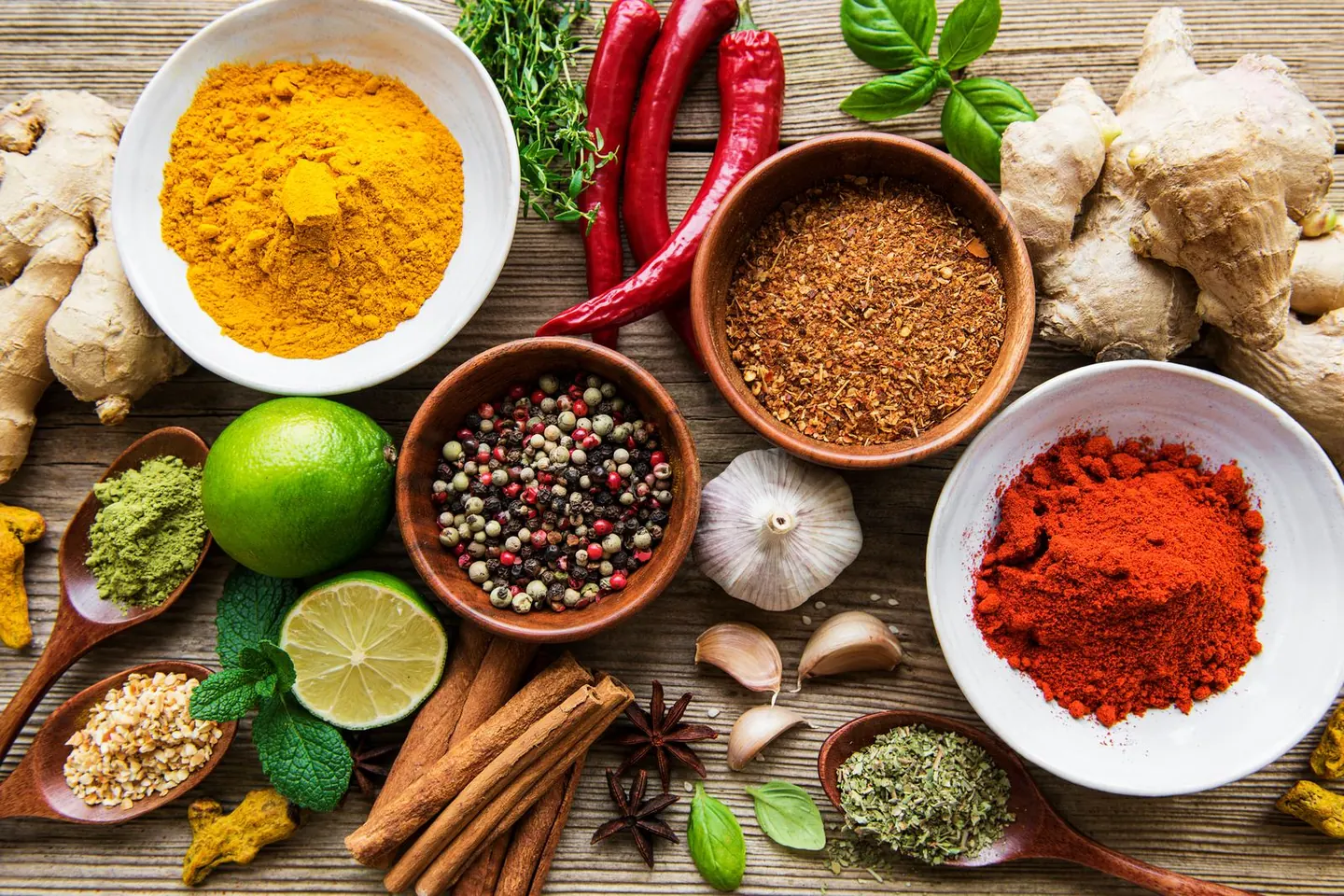
Chapter 15 — Mother Preparations
Sixteen things. Make them, keep them, and the other hundred and twenty recipes in this book stop being projects. That is not a convenience argument — it is the fat-loss argument. Hall's inpatient trial found people ate 508 kcal a day more on ultra-processed food than on unprocessed food at matched calories, macronutrients, sugar, sodium and fibre (Hall et al., 2019). Cooking from whole ingredients is itself the intervention. But nobody cooks from whole ingredients on a Wednesday unless the grinding, roasting and slow shallot reduction were done on a Sunday.
They divide into four families. Blends (M01–M07) are jars: twenty minutes to make, three months of use, and the place where this book takes most of its salt out. Coconut (M08–M09) is the two grammars of Chapter 14 made portionable. Batters (M10–M12) turn the fermented Kerala breakfast into a routine. Bases and stocks (M13–M16) are the weeknight engine.
On the numbers. Where the unit of use is a tablespoon or a single piece rather than a serving, the panel says so. Energy is computed as 4 kcal per gram of available carbohydrate and of protein and 9 kcal per gram of fat, with dietary fibre excluded — the ICMR-NIN convention. Because tablespoon quantities are small, values under 5 g are given to one decimal place; rounding whole grams at this scale would make the arithmetic meaningless. Sodium is to the nearest 10 mg.
— coriander, cumin, fennel, cinnamon, cardamom, clove, mace, nutmeg, star anise, pepper, turmeric, dried chilli, dried curry leaf, asafoetida, shallot, garlic, ginger, green chilli and tomato are not tabulated in this book's nutrition tables. Values here are USDA FoodData Central SR Legacy, with paprika standing in for dried red chilli and dried basil for dried curry leaf as the closest documented foods. Check each against ICMR-NIN IFCT 2017 before print.
M01 · Kerala Garam Masala
The southern register — aromatic, not earthy [LOW SODIUM] [VEGAN]
ICONS: B · L
THE RE-ENGINEERING: Nothing removed; something restored. Commercial garam masala is a salted, cumin-heavy northern blend that swamps a Kerala dish and brings sodium with it. This one is built to be added by the half-teaspoon at the end, where aroma does the work a further teaspoon of salt would be asked to do.
Kerala's garam masala is not North India's. There is no cumin in it and very little coriander, because both live in the podi jars instead. What is here is the montane spice trade in a bowl: cardamom from Idukki, pepper from the Malabar vines, cinnamon, clove, mace, fennel. It goes into chicken and mutton, into ishtu, into a Thalassery biryani — always late and always in small amounts. Make 75 g and you will use it for three months.
Makes about 75 g (about 150 ml, 11 tablespoons) Active 20 minutes · Total 25 minutes (plus 20 minutes cooling — required before grinding) Difficulty: Easy
EQUIPMENT: Heavy dry pan; spice grinder or mixie with a small jar. Substitute: a mortar works but will not take the mace fine; sieve and re-grind the coarse fraction.
BEFORE YOU START: Weigh everything into separate piles. The spices go in at different times and there is no pausing once the pan is hot.
INGREDIENTS
- 20 g (about six 8 cm quills) Ceylon cinnamon, broken
- 15 g (about 40 pods) green cardamom
- 15 g (2½ tbsp) fennel seed
- 10 g (about 60) cloves
- 10 g (1½ tbsp) black peppercorns
- 5 g (about 10 blades) mace
- 3 g (about ¼ nut) nutmeg, broken
- 2 g (1 whole star) star anise
SOURCING NOTE: Buy Ceylon cinnamon (Cinnamomum verum, sold as karuvapatta or "true cinnamon") rather than cassia — softer, more floral, and it grinds to powder rather than splinters. Supermarket cassia works at 15 g rather than 20 g, being more assertive. No mace: use 4 g extra nutmeg and accept a heavier blend.
ALLERGENS: None of the major allergens.
METHOD
- Heat the dry pan over medium-low for 1–2 minutes, until a fennel seed dropped in sizzles faintly rather than sitting inert.
- Roast the cinnamon, cloves, star anise and mace, stirring constantly, until the cinnamon curls tighter and the room smells sweet and woody, 2–3 minutes.
- Add the fennel and peppercorns. Roast until the fennel darkens one shade and the pepper smells hot rather than dusty, 2–3 minutes. Pepper that pops is done.
- Add the cardamom and nutmeg for the last 45–60 seconds only. Cardamom husks scorch fast and taste of ash when they do.
- Tip everything onto a cold plate at once and spread it out. Cool completely, 15–20 minutes; warm spices grind to a paste that cakes.
- Grind in short bursts to a fine powder, sieve, re-grind the coarse fraction, and store cold.
WHY THIS WORKS
The compounds you want — eugenol from clove, cinnamaldehyde from cinnamon, terpinyl acetate from cardamom — are volatile and fat-soluble, and dry roasting drives them to the surface without any oil at all. That is why this blend perfumes a dish added at the end, and why adding it early wastes it. Fragrant food reads as better seasoned.
PER TABLESPOON, about 7 g (estimated)
| kcal | kJ | Carb | Fibre | Net carb | Sugars | Protein | Fat | Sat fat | Sodium |
|---|---|---|---|---|---|---|---|---|---|
| 17 | 71 | 4.6 g | 2.5 g | 2.1 g | 0.2 g | 0.6 g | 0.7 g | 0.2 g | under 10 mg |
SWAP IT
- No star anise → omit. The blend loses a faint liquorice top note and nothing else.
- Cassia for Ceylon → three-quarters of the weight. Coarser, hotter, higher in coumarin, which matters only at supplement doses.
- Pre-ground spices → possible, about 40% less aromatic within a fortnight, and never roast them; they burn in seconds.
SCALE IT
| Makes | Cinnamon | Cardamom | Fennel | Clove | Pepper | Mace | Nutmeg | Star anise |
|---|---|---|---|---|---|---|---|---|
| 40 g | 10 g | 8 g | 8 g | 5 g | 5 g | 3 g | 2 g | 1 g |
| 75 g | 20 g | 15 g | 15 g | 10 g | 10 g | 5 g | 3 g | 2 g |
| 150 g | 40 g | 30 g | 30 g | 20 g | 20 g | 10 g | 6 g | 4 g |
MAKE AHEAD · STORE · FREEZE Cupboard 3 months in a sealed glass jar away from the hob. Fridge 6 months, worth it in a humid kitchen. Freeze 12 months; bring to room temperature before opening so condensation stays out.
LEFTOVERS A ground masala has no leftovers, only a jar that ages. The last third of the jar is always the weakest, so use it in the dishes with the most other aroma — a biryani or a roast rather than a stew — and increase the quantity by about a quarter. When the jar smells of dust rather than of clove, roast a fresh batch and throw the remainder into a marinade where nobody will miss it.
SERVE WITH R040 Nadan Kozhi Curry · R045 Chicken Ularthiyathu · R048 Beef Ularthiyathu, Traditional and Rebuilt · R018 Thalassery Chicken Biryani, Rebuilt · R014 Egg Roast, Rebuilt — and, more broadly, chicken and mutton curries, roasts, Kerala stews, neychoru and duck mappas.
TROUBLESHOOTING Bitter, ashy blend: the cardamom husks burned. Last minute only. Caked in the jar: ground warm, or moisture got in. Dry on a tray at 60°C (140°F) for 15–20 minutes, cool, re-grind.
NOTES
M02 · Sambar Podi
The everyday sour-lentil blend [LOW SODIUM] [VEGAN]
ICONS: P · B · L
THE RE-ENGINEERING: Commercial sambar powder is salted, and the salt is invisible to you. This contains none, which hands the sodium decision back to the pot — and the roasted dals carry enough savoury body that the pot needs less.
Sambar arrives in the sadya comparatively late, which is why the older four-curry scheme of erissery, kalan, olan and a sweet curry does not include it. It has since become the most-cooked gravy in South India. This blend is coriander-dominant with two roasted dals for body, and deliberately less chilli-forward than a Tamil Nadu podi, because Kerala sambar sits beside coconut dishes and should not shout them down.
Makes about 240 g (about 480 ml, 34 tablespoons) Active 25 minutes · Total 45 minutes (plus 20 minutes cooling — required) Difficulty: Easy
EQUIPMENT: Heavy dry pan; spice grinder. Substitute: a dry-grinder jar on any blender, in two batches.
BEFORE YOU START: Have a wide cold plate ready. Roasted dal keeps cooking in a hot pan and turns bitter within a minute.
INGREDIENTS
- 120 g (1½ cups) coriander seed
- 40 g (about 25) dried red chilli, stalks removed
- 30 g (2½ tbsp) toor dal
- 20 g (1½ tbsp) Bengal gram dal (chana dal)
- 10 g (2 tsp) fenugreek seed
- 8 g (1 tbsp) black peppercorns
- 8 g (1½ tsp) cumin seed
- 6 g (3 sprigs) curry leaves
- 10 g (1½ tbsp) ground turmeric
- 3 g (½ tsp) asafoetida
SOURCING NOTE: Use two chillies if you can — a mild bright one such as Kashmiri or Byadgi for colour and a hotter one such as Guntur for heat, roughly three to one. These quantities assume compounded asafoetida, the granular kind cut with rice flour; with pure resin use a third as much.
ALLERGENS: None of the major allergens as the recipe is written. Gluten (wheat) — only if your asafoetida is compounded with wheat flour, as most brands are.
METHOD
- Roast the coriander alone over medium-low heat, stirring constantly, until it darkens by a shade, turns brittle between the fingers and smells of orange peel rather than grass, 6–8 minutes. Tip out.
- Roast the two dals together until pale honey-coloured and one snaps cleanly under a spoon, 4–6 minutes. Tip out; they keep darkening on the plate.
- Roast the chillies until they blister and the smell catches at the back of the throat, 2–3 minutes, window open.
- Roast the fenugreek, pepper and cumin together 2–3 minutes, until the fenugreek turns reddish-brown. Past that it is irretrievably bitter.
- Roast the curry leaves 30–45 seconds, until they crumble between your fingers.
- Cool completely, 15–20 minutes, then grind fine with the turmeric and asafoetida, which are never roasted. Sieve and re-grind the coarse fraction.
WHY THIS WORKS
Roasting the dals gelatinises and then dries their starch, so the podi thickens a sambar slightly as it cooks — body from a spice blend rather than from fat. The coriander's oils, driven to the surface by roasting, then carry the chilli's capsaicin across the whole pot, and trigeminal heat raises perceived flavour intensity at lower salt.
PER TABLESPOON, about 7 g (estimated)
| kcal | kJ | Carb | Fibre | Net carb | Sugars | Protein | Fat | Sat fat | Sodium |
|---|---|---|---|---|---|---|---|---|---|
| 20 | 84 | 4.1 g | 2.3 g | 1.8 g | 0.3 g | 1.1 g | 0.9 g | 0.1 g | under 10 mg |
SWAP IT
- No toor dal → all chana dal. Nuttier, thickens marginally less.
- Pre-ground coriander → 100 g, added off the heat. Never roast it; it scorches in under a minute.
- More chilli → 60 g for Palakkad-style heat. The blend then carries the dish, so use a spoon less per pot.
SCALE IT
| Makes | Coriander | Chilli | Toor dal | Chana dal | Fenugreek | Pepper | Cumin | Turmeric | Curry leaf |
|---|---|---|---|---|---|---|---|---|---|
| 120 g | 60 g | 20 g | 15 g | 10 g | 5 g | 4 g | 4 g | 5 g | 3 g |
| 240 g | 120 g | 40 g | 30 g | 20 g | 10 g | 8 g | 8 g | 10 g | 6 g |
| 480 g | 240 g | 80 g | 60 g | 40 g | 20 g | 16 g | 16 g | 20 g | 12 g |
MAKE AHEAD · STORE · FREEZE Cupboard 3 months sealed. Fridge 6 months. Freeze 12 months. The dals are the limiting factor — a podi smelling faintly of old nuts should be replaced.
LEFTOVERS The dregs at the bottom of the jar are mostly ground dal and are the first part to go stale. Tip them into a dal or a vegetable stew rather than into a sambar, where the podi is the flavour and a tired one shows. If a jar has gone beyond use, dry-roast the last of it for a minute in a pan and use it as a dusting over boiled tubers.
SERVE WITH R059 Sambar · R118 Sadya Sambar · R060 Parippu with Cheera — and, more broadly, sambar of every kind, dal with greens, vegetable stews given a sour turn, and as a dry seasoning for roasted tubers.
TROUBLESHOOTING Bitter podi: the fenugreek or the dals went too far. No correction. Sambar tastes raw: the podi went in at the end. It needs 6–8 minutes of simmering, until the raw smell lifts.
NOTES
M03 · Rasam Podi
Pepper-and-cumin, for the closing liquid of a meal [LOW SODIUM] [VEGAN]
ICONS: P · B · L
THE RE-ENGINEERING: Nothing taken out. What changed is the pepper-to-chilli ratio: this leans on piperine rather than on chilli and salt, because rasam is drunk rather than eaten and a salty rasam is the easiest way to add 400 mg of sodium to a meal unnoticed.
Rasam — from Sanskrit rasa, juice or essence — is the third rice course of a sadya and often the last thing before buttermilk. Its job is explicitly digestive, its character sharp, thin and pungent. This is a pepper podi with cumin behind it, and a rasam made from it needs almost no salt because the tamarind and the pepper do the work between them.
Makes about 145 g (about 300 ml, 21 tablespoons) Active 20 minutes · Total 40 minutes (plus 20 minutes cooling — required) Difficulty: Easy
EQUIPMENT: Heavy dry pan; spice grinder.
INGREDIENTS
- 60 g (¾ cup) coriander seed
- 30 g (2½ tbsp) toor dal
- 25 g (3 tbsp) black peppercorns
- 20 g (3½ tbsp) cumin seed
- 10 g (about 6) dried red chilli
- 5 g (2 sprigs) curry leaves
- 5 g (2 tsp) ground turmeric
- 3 g (½ tsp) asafoetida
SOURCING NOTE: Pepper is the whole point, so buy it whole and buy it recently — Malabar pepper is GI-registered and worth the premium for this blend specifically. Pre-ground pepper has lost most of its aroma and kept only the burn.
ALLERGENS: None of the major allergens as the recipe is written. Gluten (wheat) — only if your asafoetida is compounded with wheat flour, as most brands are.
METHOD
- Roast the coriander over medium-low heat until brittle and fragrant, 6–8 minutes. Tip out.
- Roast the toor dal until pale honey-coloured, 4–5 minutes. Tip out.
- Roast the pepper and cumin together until the pepper begins to pop and the cumin darkens a shade and smells nutty, 2–3 minutes. Cumin goes from nutty to acrid in about thirty seconds, so watch it rather than the clock.
- Roast the chillies 1–2 minutes and the curry leaves 30–45 seconds, until they crumble.
- Cool completely, 15–20 minutes, then grind with the turmeric and asafoetida. Do not sieve; a slightly coarse rasam podi gives better mouthfeel in a thin liquid.
WHY THIS WORKS
Piperine stimulates the trigeminal nerve rather than the taste buds — a physical warmth rather than a taste — and that warmth raises the perceived intensity of everything else in the bowl, saltiness included. A properly peppery rasam tastes fully seasoned at half the usual salt, and cumin's aroma does the same job through the nose.
PER TABLESPOON, about 7 g (estimated)
| kcal | kJ | Carb | Fibre | Net carb | Sugars | Protein | Fat | Sat fat | Sodium |
|---|---|---|---|---|---|---|---|---|---|
| 22 | 92 | 4.1 g | 2.0 g | 2.1 g | 0.3 g | 1.1 g | 0.9 g | 0.1 g | under 10 mg |
SWAP IT
- No toor dal → omit; the rasam is very slightly thinner and no worse.
- Less pepper, more chilli → a milder, redder rasam that needs more salt to taste finished. Make the trade knowingly.
SCALE IT
| Makes | Coriander | Toor dal | Pepper | Cumin | Chilli | Turmeric |
|---|---|---|---|---|---|---|
| 75 g | 30 g | 15 g | 13 g | 10 g | 5 g | 3 g |
| 145 g | 60 g | 30 g | 25 g | 20 g | 10 g | 5 g |
| 290 g | 120 g | 60 g | 50 g | 40 g | 20 g | 10 g |
MAKE AHEAD · STORE · FREEZE Cupboard 2 months — shorter than the other podis, because pepper aroma fades fastest and it is the reason the blend exists. Fridge 4 months. Freeze 9 months.
LEFTOVERS Rasam podi loses its pepper first and its cumin last, so an old jar tastes flat rather than wrong. Use the remainder in a dal or over steamed vegetables, where the shortfall is not the point, and start a fresh jar for rasam itself. Two months is the honest limit at room temperature.
SERVE WITH R086 Rasam · R118 Sadya Sambar · R020 Kanji, Three Ways — and, more broadly, pepper-water for a cold, thin tomato broths, and a dusting over steamed vegetables.
TROUBLESHOOTING Rasam hot rather than fragrant: the podi is old, or went in at a rolling boil. Add at a bare simmer and take the pan off within 2–3 minutes. Sandy: grind longer. Coarse is intended; sandy is not.
NOTES
M04 · Nadan Chicken Masala
The country-style blend for birds and for beef [LOW SODIUM]
ICONS: B · L
THE RE-ENGINEERING: A packet chicken masala carries salt, often sugar and sometimes anti-caking agents. This carries none of the three, and it is fennel- and pepper-forward so that a nadan kozhi curry made with 20 g of oil rather than 60 g still tastes like one.
Nadan means "of the country" — the everyday register, not the feast one. This is what a Kottayam or Thrissur household keeps for chicken curry, chicken roast and ularthiyathu, and what makes those three recognisably Kerala rather than generically Indian: fennel and pepper high, cumin absent, a whisper of clove and cardamom, and enough coriander to build a gravy on.
Makes about 190 g (about 380 ml, 27 tablespoons) Active 25 minutes · Total 45 minutes (plus 20 minutes cooling — required) Difficulty: Easy
EQUIPMENT: Heavy dry pan; spice grinder.
INGREDIENTS
- 80 g (1 cup) coriander seed
- 35 g (about 22) dried red chilli, Kashmiri or Byadgi
- 20 g (2½ tbsp) black peppercorns
- 15 g (2½ tbsp) fennel seed
- 12 g (2 tbsp) ground turmeric
- 10 g (three 8 cm quills) Ceylon cinnamon, broken
- 8 g (about 22 pods) green cardamom
- 6 g (1 tsp) fenugreek seed
- 5 g (about 30) cloves
- 5 g (2 sprigs) curry leaves
SOURCING NOTE: The colour of a Kerala chicken curry comes from Kashmiri or Byadgi chilli, not from paprika or tomato. Where neither is available, substitute 25 g Spanish sweet paprika plus 8 g hot chilli powder, which gives the colour and roughly the right heat with a slightly sweeter finish.
ALLERGENS: None of the major allergens.
METHOD
- Roast the coriander over medium-low heat until brittle and fragrant, 6–8 minutes. Tip out.
- Roast the cinnamon and cloves 2 minutes, then add the fennel and pepper and roast 2–3 minutes more, until the fennel darkens by a shade.
- Roast the chillies until blistered, 2–3 minutes; then the fenugreek 1–2 minutes to reddish-brown; then the cardamom 45 seconds; then the curry leaves 30–45 seconds, until they crumble.
- Cool completely, 15–20 minutes.
- Grind fine with the turmeric, sieve, re-grind the coarse fraction, store cold.
WHY THIS WORKS
Fennel's anethole and coriander's linalool are both sweet-smelling and fat-soluble, so they distribute through the small quantity of oil in a rebuilt chicken curry and read across the whole dish. That is what lets you cut the oil from three tablespoons to four teaspoons: aroma does what a larger volume of fat used to do, and slow-cooked shallots supply the body.
PER TABLESPOON, about 7 g (estimated)
| kcal | kJ | Carb | Fibre | Net carb | Sugars | Protein | Fat | Sat fat | Sodium |
|---|---|---|---|---|---|---|---|---|---|
| 17 | 71 | 4.1 g | 2.6 g | 1.5 g | 0.3 g | 0.9 g | 0.9 g | 0.2 g | under 10 mg |
SWAP IT
- For beef or mutton → add 5 g star anise and 3 g mace at step 2. Both hold up to long cooking; in chicken they dominate.
- No fennel → omit rather than substitute, and label the jar honestly. Fennel is the marker of this blend, and a version without it is a generic curry powder.
SCALE IT
| Makes | Coriander | Chilli | Pepper | Fennel | Turmeric | Cinnamon | Cardamom | Fenugreek | Clove |
|---|---|---|---|---|---|---|---|---|---|
| 95 g | 40 g | 18 g | 10 g | 8 g | 6 g | 5 g | 4 g | 3 g | 3 g |
| 190 g | 80 g | 35 g | 20 g | 15 g | 12 g | 10 g | 8 g | 6 g | 5 g |
| 380 g | 160 g | 70 g | 40 g | 30 g | 24 g | 20 g | 16 g | 12 g | 10 g |
MAKE AHEAD · STORE · FREEZE Cupboard 3 months. Fridge 6 months. Freeze 12 months. Label with the date; a chicken masala past six months at room temperature is why some home curries taste dusty.
LEFTOVERS The last of the jar goes into a marinade rather than a gravy: rubbed into chicken with a little curd and lime it works hard even when the aroma has faded, because the salt and acid do part of the job. What you should not do is compensate for a stale jar by adding more of it, which makes a dish taste of dust rather than of masala.
SERVE WITH R040 Nadan Kozhi Curry · R045 Chicken Ularthiyathu · R044 Chicken Mappas · R048 Beef Ularthiyathu, Traditional and Rebuilt · R050 Mutton Stew — and, more broadly, beef curry with coconut slivers, liver fry and egg roast.
TROUBLESHOOTING Curry tastes harsh: the masala went in without enough cooking. Powders need 2–3 minutes in oil, until the raw smell lifts and the paste darkens by a shade. Dull brown rather than red: the chillies were old or roasted too dark. Kashmiri chilli loses colour long before it loses heat.
NOTES
M05 · Fish Masala
Chilli-forward, turmeric-heavy, built for a sour gravy [LOW SODIUM]
ICONS: B · L
THE RE-ENGINEERING: More turmeric and far less whole spice than a meat masala, because a fish curry's aromatics come from the tempering and the kudampuli, not from the powder. That division is what lets a meen vevichathu work on two teaspoons of oil.
Kerala's red fish curry is a chilli-and-acid dish and its masala is correspondingly plain: chilli, coriander, turmeric, a little fenugreek, a little pepper. No garam masala, no cinnamon, no clove — those belong to the meat side of the kitchen and they make fish taste of a restaurant.
Makes about 178 g (about 360 ml, 25 tablespoons) Active 20 minutes · Total 40 minutes (plus 20 minutes cooling — required) Difficulty: Easy
EQUIPMENT: Heavy dry pan; spice grinder.
INGREDIENTS
- 70 g (scant 1 cup) coriander seed
- 60 g (about 38) dried red chilli, two-thirds Kashmiri and one-third hot
- 20 g (3 tbsp) ground turmeric
- 12 g (1½ tbsp) black peppercorns
- 8 g (1½ tsp) fenugreek seed
- 6 g (1 tsp) cumin seed
- 6 g (3 sprigs) curry leaves
- 2 g (⅓ tsp) asafoetida
SOURCING NOTE: Fenugreek matters more here than anywhere else in this chapter — it is the bitter counterweight that makes a kudampuli gravy taste finished, so do not omit it. Readers taking insulin or a sulfonylurea should note that fenugreek at 10–25 g a day has genuine glycaemic effects and can compound those medicines; the 8 g spread across 25 tablespoons here is nowhere near that range, but the caution belongs with every fenugreek mention in this book and Chapter 9 gives it in full.
ALLERGENS: None of the major allergens as the recipe is written. Gluten (wheat) — only if your asafoetida is compounded with wheat flour, as most brands are.
METHOD
- Roast the coriander over medium-low heat until brittle and orange-scented, 6–8 minutes. Tip out.
- Roast the chillies until blistered and sharp-smelling, 2–3 minutes, in two batches if the pan is crowded.
- Roast the pepper, fenugreek and cumin together 2–3 minutes, stopping the moment the fenugreek turns reddish-brown.
- Roast the curry leaves 30–45 seconds, until they crumble between your fingers.
- Cool completely, 15–20 minutes, then grind fine with the turmeric and asafoetida.
WHY THIS WORKS
Turmeric and chilli bind readily to fish protein at the surface, so a wet rub of this masala forms a skin that holds during cooking and keeps the flesh from shredding. The fenugreek supplies a controlled bitterness, and bitterness is what stops a strongly soured gravy tasting one-dimensional.
PER TABLESPOON, about 7 g (estimated)
| kcal | kJ | Carb | Fibre | Net carb | Sugars | Protein | Fat | Sat fat | Sodium |
|---|---|---|---|---|---|---|---|---|---|
| 18 | 75 | 3.9 g | 2.4 g | 1.5 g | 0.3 g | 0.9 g | 0.9 g | 0.2 g | under 10 mg |
SWAP IT
- Milder → 60 g Kashmiri and no hot chilli. Colour holds, heat halves, and the gravy will want a squeeze of lime to compensate.
- No asafoetida → omit. You lose a savoury undertone, most missed in vegetarian uses of this blend.
SCALE IT
| Makes | Coriander | Chilli | Turmeric | Pepper | Fenugreek | Cumin | Curry leaf |
|---|---|---|---|---|---|---|---|
| 90 g | 35 g | 30 g | 10 g | 6 g | 4 g | 3 g | 3 g |
| 178 g | 70 g | 60 g | 20 g | 12 g | 8 g | 6 g | 6 g |
| 356 g | 140 g | 120 g | 40 g | 24 g | 16 g | 12 g | 12 g |
MAKE AHEAD · STORE · FREEZE Cupboard 3 months. Fridge 6 months. Freeze 12 months. Turmeric stains plastic permanently; use glass.
LEFTOVERS A fish masala with the aroma going is still an excellent wet rub. Mix the last of it with lime juice and a pinch of salt, rub it into fish and bake or shallow-fry, and the heat recovers most of what the jar has lost. Do not use a tired jar for a curry whose whole flavour is the masala.
SERVE WITH R024 Meen Vevichathu · R026 Mathi Curry · R027 Ayala Varuthathu, Baked · R033 Chemmeen Ularthiyathu · R039 Baked Sardine Cutlets — and, more broadly, the whole red fish curry family, fish mappas, prawn theeyal, mussel and squid roasts, and as a wet rub before shallow-frying or baking fish.
TROUBLESHOOTING Gravy tastes of raw chilli powder: the masala needs 3–4 minutes in the pan before liquid goes in, or 8–10 minutes simmering after. Bitter curry: too much fenugreek, or it over-roasted at step 3.
NOTES
M06 · The Low-Sodium All-Purpose Podi
The jar that lets you take the salt out [LOW SODIUM] [VEGAN]
ICONS: P · B · L
THE RE-ENGINEERING: This preparation does not exist in the tradition. It is built from traditional parts — roasted dal, dried chilli, curry leaf, asafoetida, pepper — for one purpose: to give a dish so much savoury density that you can cut its salt by a third and nobody at the table will find the missing gram.
Everything else in this chapter is a version of something a Kerala grandmother made. This one is an invention, and it is the most useful thing in the book. Salt-taste preference adapts over roughly eight to twelve weeks, so a 10–15% cut each month goes undetected where a single steep cut does not; and the levers that make a lower-salt dish taste finished are acid, umami, aroma, pungency and texture. This podi delivers four of the five at once. Keep it beside the hob and use it wherever your hand would reach for the salt cellar.
Makes about 185 g (about 370 ml, 26 tablespoons) Active 25 minutes · Total 45 minutes (plus 20 minutes cooling — required) Difficulty: Easy
EQUIPMENT: Heavy dry pan; spice grinder.
BEFORE YOU START: Strip the curry leaves from their stalks and check them for moisture. Damp leaves will not crisp and will make the podi cake.
INGREDIENTS
- 100 g (½ cup) Bengal gram dal (chana dal)
- 40 g (3 tbsp) black gram dal (urad dal)
- 25 g (about 16) dried red chilli
- 15 g (about 8 sprigs, stripped) curry leaves
- 8 g (1 tbsp) black peppercorns
- 5 g (1 tsp) cumin seed
- 3 g (½ tsp) asafoetida
- No salt. None at all. This is the point of the jar.
SOURCING NOTE: Curry leaves are the one ingredient with no substitute — dried jar leaves have almost no aroma and the coriander-leaf swap tastes of something else entirely. Fresh leaves freeze well on the stalk for six months, so buy a large bunch when you see one, or grow a Murraya koenigii on a windowsill and strip it twice a year.
ALLERGENS: None of the major allergens as the recipe is written. Gluten (wheat) — only if your asafoetida is compounded with wheat flour, as most brands are.
METHOD
- Roast the chana dal over medium-low heat, stirring constantly, until pale honey-brown and one grain snaps rather than bends, 6–8 minutes. Tip onto a cold plate.
- Roast the urad dal the same way, 4–5 minutes, until the colour of weak tea and smelling of biscuit. Urad goes from nutty to burnt faster than chana.
- Roast the chillies until they blister and darken slightly, 2–3 minutes.
- Roast the pepper and cumin together 2 minutes, until the pepper begins to pop.
- Roast the curry leaves last, on the lowest flame, until brittle enough to crumble to dust between finger and thumb, 1–2 minutes. They must be completely dry or the podi will not keep.
- Cool to room temperature, 15–20 minutes, then grind with the asafoetida to a coarse, sandy powder — coarser than a sambar podi, because texture is one of the five levers and a slightly gritty podi reads as more seasoned than a fine one.
WHY THIS WORKS
Roasting the dals generates Maillard products — pyrazines, furans, thiazoles — that the brain reads as savoury and cooked, the same class of compound that makes browned onion taste rich. Curry leaf adds terpene aroma, and fragrant food is perceived as better seasoned at identical sodium. Pepper adds trigeminal warmth. The dal also brings protein and fibre.
PER TABLESPOON, about 7 g (estimated)
| kcal | kJ | Carb | Fibre | Net carb | Sugars | Protein | Fat | Sat fat | Sodium |
|---|---|---|---|---|---|---|---|---|---|
| 22 | 92 | 4.4 g | 1.4 g | 3.0 g | 0.4 g | 1.5 g | 0.4 g | 0.1 g | under 10 mg |
*Black gram dal is not tabulated in this book's nutrition tables; green gram dal (IFCT B010) stands in as the closest documented pulse, and dried curry leaf from USDA dried basil.
IF YOU ARE WATCHING… Blood pressure: a tablespoon carries under 10 mg of sodium and replaces roughly a quarter-teaspoon of salt's worth of perceived seasoning — about 590 mg — in the dishes it suits. Against a 2,000 mg daily target, using it twice a day instead of the salt cellar closes a meaningful part of the gap. Blood sugar: the roasted dal contributes protein and fibre, and a pulse on the plate is the habit with the best evidence in this book.
SWAP IT
- No urad dal → all chana. Slightly less aroma, no other loss.
- Add 20 g roasted white sesame → richer and nuttier, better on idli and rice, worse on vegetables. Fat rises about 1 g per tablespoon. (Allergen: this swap introduces sesame.)
- Add 10 g dried prawn or 8 g powdered dried fish → a large jump in savoury depth. Stated honestly: dried fish is heavily salted, so the podi is no longer low-sodium and no further salt should go into the dish at all. (Allergen: this swap introduces fish, crustaceans.)
SCALE IT
| Makes | Chana dal | Urad dal | Chilli | Curry leaf | Pepper | Cumin | Asafoetida |
|---|---|---|---|---|---|---|---|
| 90 g | 50 g | 20 g | 12 g | 8 g | 4 g | 3 g | 1.5 g |
| 185 g | 100 g | 40 g | 25 g | 15 g | 8 g | 5 g | 3 g |
| 370 g | 200 g | 80 g | 50 g | 30 g | 16 g | 10 g | 6 g |
MAKE AHEAD · STORE · FREEZE Cupboard 6 weeks — shorter than the spice podis, because roasted dal fat oxidises and curry-leaf aroma goes first. Fridge 4 months. Freeze 9 months in a small jar, taking out a fortnight at a time so the main jar is never warmed and cooled.
LEFTOVERS This is the one jar in the chapter you want to finish quickly, because a salt-free podi has nothing preserving it and the roasted dals go stale in about six weeks. Sprinkle the remainder over anything at all — curd, boiled vegetables, kanji, a plate of rice — and treat the empty jar as the signal to make the next one. Do not stretch it to three months.
SERVE WITH R020 Kanji, Three Ways · R036 Unakka Meen Thoran · R105 Roasted Kadala Mix · R065 Cheera Thoran · R099 Carrot and Coconut Raita — and, more broadly, steamed and boiled vegetables, idli and dosa, dals, boiled tubers, and anywhere a recipe says "taste before you salt".
TROUBLESHOOTING Tastes of nothing: the curry leaves were damp or the dals under-roasted. Both faults are invisible until you taste. Caked solid: moisture, almost certainly from the leaves. Dry the jar at 60°C (140°F) for 15–20 minutes, cool, re-grind. Bitter: the urad dal burned at step 2.
NOTES
M07 · The 70:30 Salt
Seventy per cent sodium chloride, thirty per cent potassium chloride [VEGAN]
ICONS: Q · B
THE RE-ENGINEERING: Three-tenths of the sodium chloride in your salt cellar, replaced with potassium chloride. Nothing about how you cook changes. A level teaspoon carries about 1,650 mg of sodium instead of about 2,360 mg, and brings about 940 mg of potassium with it.
READ THIS BEFORE YOU MAKE IT
Potassium-enriched salt is not for everyone. Do not use this blend, or any potassium-based salt substitute, without your doctor's approval if you have chronic kidney disease, or if you take a RAAS inhibitor — an ACE inhibitor (names ending -pril, such as enalapril or ramipril) or an angiotensin receptor blocker (names ending -sartan, such as losartan or telmisartan) — or a potassium-sparing diuretic (spironolactone, eplerenone, amiloride), or a potassium supplement. All of these raise the risk of hyperkalaemia, a high blood potassium level, which can be dangerous. If you are not certain what your medicines are, ask the pharmacist who dispenses them before you make this jar. This book does not tell anyone to change or stop a medicine.
This is the most consequential single swap in the book, and the evidence is unusually direct. The Salt Substitute and Stroke Study randomised 20,995 participants in 600 Chinese villages — all with a previous stroke, or aged 60 and over with poorly controlled blood pressure — to a 70% sodium chloride / 30% potassium chloride substitute or to regular salt, and followed them for a mean of 4.7 years. Stroke fell 14%, major adverse cardiovascular events 13%, and all-cause mortality 12% (Neal et al., 2021). Hyperkalaemia events did not differ significantly between groups — in a population screened for normal renal function, which is exactly why the carve-out above exists.
Makes 200 g (about 35 level teaspoons) Active 5 minutes · Total 5 minutes Difficulty: Easy
EQUIPMENT: Digital scale reading to 1 g; dry glass jar with a tight lid. No substitute for the scale: eyeballing this blend is how you end up at 50:50 and taste it.
INGREDIENTS
- 140 g fine sea salt or table salt (sodium chloride)
- 60 g potassium chloride, food grade
- 5 g (2 tsp) raw rice, or a few dried curry leaves, as a desiccant in the jar
SOURCING NOTE: Food-grade potassium chloride is sold as "potassium salt" or "low-sodium salt substitute" in pharmacies, health-food shops and online, and as lo-salt style products in most Western supermarkets. Read the label: many commercial low-sodium salts are already a sodium–potassium blend, in which case you are buying this ready-made and should not add further sodium chloride. Never use potassium chloride sold for water softeners, de-icing or laboratory use.
ALLERGENS: None of the major allergens.
METHOD
- Weigh both salts separately into a dry bowl. Any moisture will cake the blend permanently, so dry the bowl and the spoon.
- Mix thoroughly with a dry spoon for 60–90 seconds, until the blend is a single uniform white with no visible difference in crystal size. Potassium chloride crystals are often coarser and will settle if you undermix, so the first spoonfuls come out mild and the last metallic.
- Transfer to the jar with the rice or curry leaves, and label it clearly. 70:30 — not for anyone on kidney or blood-pressure medicines is not an over-cautious label in a shared kitchen.
- Shake the jar before each use.
WHY THIS WORKS
Potassium chloride tastes salty because the potassium ion, like sodium, activates the tongue's salt channels — but less efficiently, and it additionally triggers bitter receptors, which is why the substitution has a ceiling. Meanwhile the two ions do opposite things to blood pressure: raised potassium gives about −3.5/−2.0 mmHg in hypertensive adults (Aburto et al., 2013). One swap moves both levers the right way.
THE TASTE THRESHOLD, AND HOW TO WORK AROUND IT Most people begin to detect potassium chloride as a faint metallic bitterness above about 30% of the blend, and almost everyone detects it by 50%. Thirty per cent is therefore not arbitrary; it is the practical ceiling, and it is the ratio the trial used. Three things push the threshold away. Use it in cooking rather than at the table, since bitterness is most noticeable where dry crystals meet the tongue undiluted. Use it in dishes with acid or fat — a kudampuli gravy, a coconut-milk curry, anything with lime or curd — because both mask bitterness well. And keep plain salt for finishing, where a few surface crystals deliver more perceived saltiness per gram than anything dissolved into the mass of a dish. Cook with M07, finish with a pinch of plain salt, and you will use less sodium than either alone.
PER LEVEL TEASPOON, about 6 g (estimated)
| kcal | kJ | Carb | Fibre | Net carb | Sugars | Protein | Fat | Sat fat | Sodium |
|---|---|---|---|---|---|---|---|---|---|
| 0 | 0 | 0 g | 0 g | 0 g | 0 g | 0 g | 0 g | 0 g | 1,650 mg |
Potassium: about 940 mg per level teaspoon. A level teaspoon of ordinary salt carries about 2,360 mg sodium and no potassium. Sodium chloride is 39.34% sodium by mass and potassium chloride 52.45% potassium; both are stoichiometric rather than measured.
IF YOU ARE WATCHING… Blood pressure: switching every gram of salt in your cooking to this blend cuts sodium 30% at no effort. A household using 8 g of salt a day drops from about 3,150 mg to about 2,200 mg of sodium without changing a recipe. That is additive with the DASH-style pattern this book is built on, and most of the gain from sodium reduction comes below 2,300 mg a day. Kidney disease or RAAS inhibitors: do not use this. Re-read the box above.
SWAP IT
- 80:20 → gentler on the palate, less benefit, and a sensible starting ratio for a household that objects to the taste. Move to 70:30 over a month.
- Commercial low-sodium salt → often already 66:34 or similar. Use it as bought; do not blend it with more table salt.
- Cannot use potassium salt at all → Chapter 10 and M06 are for you. Acid, aroma, pungency and gradual reduction get most of the way there.
SCALE IT
| Makes | Sodium chloride | Potassium chloride | Sodium per level tsp |
|---|---|---|---|
| 100 g | 70 g | 30 g | 1,650 mg |
| 200 g | 140 g | 60 g | 1,650 mg |
| 500 g | 350 g | 150 g | 1,650 mg |
MAKE AHEAD · STORE · FREEZE Cupboard indefinitely — salt does not spoil. Replace the desiccant every 3 months. Do not freeze; condensation on thawing will cake the jar solid.
LEFTOVERS There are no leftovers, only a jar that clumps in a humid kitchen. Break the clumps with the back of a spoon, add a few grains of dry rice to the jar, and keep it away from the steam of the hob. If it has hardened into a solid block, spread it on a tray in a low oven for 10 minutes, cool completely and re-jar.
SERVE WITH R015 Matta Rice, Properly Cooked · R063 Cabbage Thoran · R059 Sambar · R040 Nadan Kozhi Curry · R117 Sadya Parippu with Ghee — and, in fact, every savoury recipe in this book that calls for salt, unless the safety box above applies to you.
TROUBLESHOOTING Metallic aftertaste: the blend separated in the jar, or you are using it as a finishing salt. Shake it, and finish with plain salt. Caked: moisture. Dry on a tray at 100°C (210°F) for 20–25 minutes, cool completely, break up and re-jar.
NOTES
M08 · Coconut Milk, Three Extractions
Onnaam, randaam and moonnaam paal from one coconut [LOW SODIUM] [VEGAN]
ICONS: Q · L
THE RE-ENGINEERING: Nothing is reduced. What changes is where the milk goes: thick milk off the heat, thin milk in the pot. A curry finished properly with 120 ml of first milk tastes richer than one boiled with 200 ml, so the technique is itself the fat reduction.
One large coconut gives three liquids of three strengths, and Kerala cooking uses them for three different jobs. Tinned coconut milk is one liquid pretending to be all three, which is why tinned olan is either too rich or too thin and never right. Twenty minutes gives you nearly a litre of graded milk plus a bowl of thengaappu — the spent gratings, which still hold most of the coconut's fibre and belong in a thoran.
Makes about 940 ml in three grades: about 200 ml first milk, 320 ml second, 420 ml third, plus about 220 g spent gratings Active 20 minutes · Total 20 minutes Difficulty: Easy
EQUIPMENT: Coconut scraper (thenga chirava) or box grater; mixie; muslin or a fine nylon sieve. Substitute: a thin cotton tea towel, at a cost of about 20 ml lost to the cloth.
BEFORE YOU START: Warm the water to about 50°C (120°F) — hot to the finger, not scalding. Warm water extracts noticeably more fat than cold; boiling water starts cooking the proteins you need intact.
INGREDIENTS
- 400 g (about 4 cups) freshly grated coconut, from 1 large coconut
- 820 ml warm water, divided: 120 ml, 300 ml, 400 ml
SOURCING NOTE: Frozen grated coconut in 400 g bags works for all three extractions and is what most diaspora readers should use; thaw it fully. Desiccated coconut does not work — it has been dried and defatted and yields a thin, chalky liquid. A tin of full-fat coconut milk is the honest last resort: undiluted as first milk, 1:1.5 with water as second, 1:3 as third.
ALLERGENS: None of the major allergens.
METHOD
- Grind the coconut with 120 ml warm water in 10-second bursts, 30–45 seconds in total, stopping before the jar feels warm to the back of your hand. A warm jar means the fat has begun to separate.
- Press the mash hard, a handful at a time, through muslin over a bowl, twisting until the pulp gives nothing more: about 200 ml of first milk, thick and opaque, the colour of full cream. Set it aside away from the hob.
- Return the mash to the jar with 300 ml warm water. Grind 15–20 seconds and press again: about 320 ml of second milk, thinner and distinctly coconut-flavoured.
- Repeat with 400 ml water for about 420 ml of third milk, barely more than flavoured water.
- Cook with the third and second milk; vegetables, fish or meat may simmer freely in them.
- Finish with the first milk off the heat, or at the barest tremble where a bubble breaks the surface every few seconds and no more. Swirl the pan; do not stir. Done when the milk is warmed through, 1–2 minutes, and not a moment longer.
WHY THIS WORKS
Coconut milk is an oil-in-water emulsion held together by a film of coconut globulins at the surface of each fat droplet. Boiling denatures those proteins so they stop sitting at the oil–water boundary, while the agitation lets unprotected droplets coalesce: clear oil above, grainy curds below, irreversibly. Second and third milk survive heat because there is far less fat to separate.
PER 100 ml OF FIRST MILK (estimated)
| kcal | kJ | Carb | Fibre | Net carb | Sugars | Protein | Fat | Sat fat | Sodium |
|---|---|---|---|---|---|---|---|---|---|
| 230 | 962 | 5.5 g | 2.2 g | 3.3 g | 3.3 g | 2.3 g | 23.8 g | 21.1 g | 20 mg |
Second milk is about 80 kcal, 8.0 g fat and 0.9 g protein per 100 ml; third about 32 kcal, 3.0 g fat and 0.4 g protein. From USDA FoodData Central SR Legacy "Nuts, coconut milk, raw" (FDC 170172), scaled by extraction.
IF YOU ARE WATCHING… Cholesterol: first milk is 21 g of saturated fat per 100 ml and it is the largest saturated-fat source in Kerala home cooking. Two things follow. Use the graded extractions rather than tinned milk, so most of a curry's volume is second and third milk. And keep the whole coconut in your diet: fresh grated coconut carries about 10 g fibre and 3.8 g protein per 100 g, where coconut oil carries neither.
SWAP IT
- Tinned full-fat coconut milk → as in the sourcing note. Flavour is flatter and slightly cooked, and you lose the thengaappu.
- Coconut milk powder → convenient, keeps well, noticeably sweeter.
- No coconut at all → 40 g cashews blended with 200 ml water gives comparable body, a different flavour, less saturated fat and more monounsaturated. (Allergen: this swap introduces tree nuts (cashew).)
SCALE IT
| Grated coconut | Water: 1st / 2nd / 3rd | First milk | Second milk | Third milk |
|---|---|---|---|---|
| 200 g | 60 / 150 / 200 ml | about 100 ml | about 160 ml | about 210 ml |
| 400 g | 120 / 300 / 400 ml | about 200 ml | about 320 ml | about 420 ml |
| 800 g | 240 / 600 / 800 ml | about 400 ml | about 640 ml | about 840 ml |
MAKE AHEAD · STORE · FREEZE Fridge 2 days covered, in a non-metal container; the fat sets on top and stirs back in cold. Freeze 2 months — first milk in an ice-cube tray at about 30 ml a cube, thawed in the fridge rather than the microwave. Use within 4 hours if the kitchen is above 30°C (86°F); fresh coconut milk sours fast in Kerala heat.
LEFTOVERS Second and third extractions are the leftovers of this preparation and they are the most useful things in it. Keep them in separate jars, use the second in place of water in a sambar, a dal or a vegetable stew, and freeze the third in an ice tray for kanji. First milk left over from a curry goes into a payasam or into the next morning's appam batter. Coconut milk sours quickly, so smell it before every use.
SERVE WITH R068 Kumbalanga Olan · R041 Kerala Chicken Stew · R025 Meen Moilee · R001 Palappam · R113 Ada Pradhaman, with the Arithmetic Shown — and, more broadly, mappas and moilee, fish and prawn curries, vegetable kurma, kanji, and the payasam family.
TROUBLESHOOTING Split, oily curry with grainy curds: the first milk boiled. No repair. Next time, off the heat. Thin, watery first milk: the coconut was machine-chopped rather than scraped, or the water was cold. A grater shreds into long wet flakes that release milk; a processor chops into granules that keep it. Frozen milk thawed grainy: normal. Blend 10 seconds and it comes back.
NOTES
M09 · Varutharacha Thenga
Roasted coconut paste, in freezer portions [LOW SODIUM] [VEGAN]
ICONS: B · F · L
THE RE-ENGINEERING: This paste replaces coconut milk as the body of a curry. Thirty grams delivers more depth than 150 ml of thick milk, at roughly a third of the saturated fat and with 4 g of fibre attached — and because it is batched and frozen, it is available on a Wednesday.
Roasting coconut before grinding produces a third grammar, neither thenga aracha nor thenga chertha, and it is what makes a varutharacha meen curry taste like nothing else in India. The work is fifteen minutes of continuous stirring, which is exactly why nobody does it on a weeknight and exactly why it should be made eight portions at a time.
Makes about 240 g, portioned as 8 × 30 g (each portion bodies a curry for two) Active 35 minutes · Total 40 minutes Difficulty: Moderate — the roast is the only genuinely unforgiving step in this chapter
EQUIPMENT: Heavy dry pan, 24 cm or wider; flat wooden turner; mixie. A cast-iron pan is ideal; a thin pan will scorch the coconut before it dries.
BEFORE YOU START: Weigh the spices out first. Once the coconut reaches pale gold you have about four minutes of decisions and no time to measure.
INGREDIENTS
- 200 g (2 cups) freshly grated coconut
- 30 g (about 3) shallots, thinly sliced
- 15 g (2 tbsp) coriander seed
- 8 g (about 5) dried red chilli
- 3 g (½ tsp) fennel seed
- 2 g (⅓ tsp) ground turmeric
- 60 ml water, for grinding
SOURCING NOTE: Frozen grated coconut roasts well but must be thawed and patted dry, or the first five minutes go on boiling off water. Desiccated coconut can be used at 120 g plus 60 ml water to rehydrate, giving a paler, less complex paste.
ALLERGENS: None of the major allergens.
METHOD
- Heat the dry pan over medium-low for 1–2 minutes. Add the coconut and shallots together.
- Stir continuously with the flat turner through three stages: white to ivory, smelling faintly of hot milk, 4–6 minutes; pale gold, smelling of biscuit, 4–5 minutes; then the colour of dark toast, visibly releasing oil and smelling nutty with a distinct edge of smoke, a further 4–6 minutes. Stop at the third stage.
- Add the coriander, chilli and fennel for the last 2 minutes only, stirring hard. They burn while the coconut is still pale, which is why they go in late.
- Tip everything onto a cold plate the moment it is right. A hot pan takes it past the point in ninety seconds.
- Grind while still warm with the turmeric and the 60 ml water, in bursts, until no grit is left on your fingertip, 2–3 minutes. Warm coconut grinds smooth; cold roasted coconut grinds gritty.
- Portion into an ice-cube tray or small bags at 30 g each and freeze once cold.
WHY THIS WORKS
Roasting runs Maillard reactions between the kernel's sugars and amino acids, generating aroma compounds available no other way, and ruptures cell walls so a little of the coconut's own fat renders out and carries them. The paste then thickens a gravy as a suspension of insoluble particles rather than as an emulsion, which is why a varutharacha curry is stable, reheats without splitting, and brings its fibre with it.
PER 30 g PORTION (estimated)
| kcal | kJ | Carb | Fibre | Net carb | Sugars | Protein | Fat | Sat fat | Sodium |
|---|---|---|---|---|---|---|---|---|---|
| 115 | 481 | 6.8 g | 4.1 g | 2.7 g | 1.6 g | 1.5 g | 10.9 g | 9.2 g | 10 mg |
Coconut values from ICMR-NIN IFCT 2017 H007 (fresh kernel); the saturated fraction of coconut fat taken as 88.6% after USDA FDC 170169.
IF YOU ARE WATCHING… Cholesterol: a 30 g portion is 9 g of saturated fat, so this is not a free ingredient — but it replaces about 150 ml of thick coconut milk at roughly 32 g of saturated fat, and it brings 4 g of fibre the milk does not. One portion between two people is 4.6 g of saturated fat each across a whole curry.
SWAP IT
- No shallots → 40 g sliced onion. Slightly sweeter, slightly less complex.
- Add 10 g garlic at step 1 → rounder and more savoury, for meat curries. Garlic is the one aromatic in this book whose evidence overlaps cooking quantities; Chapter 9 has the figures.
- Half the coconut, made up with 40 g roasted chana dal → about 40% less fat and much the same thickening, at some cost in aroma. Genuinely useful if you are watching saturated fat closely.
SCALE IT
| Makes | Coconut | Shallots | Coriander | Chilli | Fennel | Water | Portions |
|---|---|---|---|---|---|---|---|
| 120 g | 100 g | 15 g | 8 g | 4 g | 1.5 g | 30 ml | 4 × 30 g |
| 240 g | 200 g | 30 g | 15 g | 8 g | 3 g | 60 ml | 8 × 30 g |
| 480 g | 400 g | 60 g | 30 g | 16 g | 6 g | 120 ml | 16 × 30 g |
Roast 400 g in two batches; one large batch steams rather than roasts and will not reach the third stage.
MAKE AHEAD · STORE · FREEZE Fridge 4 days sealed. Freeze 3 months in 30 g portions — the intended storage, and the paste loses very little. Use from frozen, dropped straight into a simmering gravy, where it disperses in 2–3 minutes.
LEFTOVERS Frozen 30 g portions are the point of making this in quantity, and a thawed portion that was not used should be cooked out the same day rather than refrozen. A spoonful left in the grinder loosened with warm water makes an instant chammanthi for rice. Do not keep the paste in the fridge beyond two days; roasted coconut oxidises and turns bitter faster than raw.
SERVE WITH R084 Ulli Theeyal · R032 Chemmeen Theeyal · R010 Kadala Curry · R057 Muthira Curry · R049 Beef Curry with Coconut Slivers — and, more broadly, varutharacha fish and prawn curries, erissery, and mixed-vegetable curries in the Kottayam manner.
TROUBLESHOOTING Bitter, ashy paste: the coconut went past dark toast into burnt. No jaggery or acid will bury it. Start again. Pale paste, curry tastes of raw coconut: the roast stopped at stage two. Return it to a dry pan for 4–5 minutes and you will recover some of it. Gritty: ground cold, or too briefly. Add 20 ml water and grind another 2 minutes.
NOTES
M10 · Appam and Palappam Batter
The lace-edged breakfast, started the night before [LOW SODIUM] [VEGAN]
ICONS: B · L
THE RE-ENGINEERING: Sugar cut to a working minimum — 8 g across fourteen appams, which is what the yeast needs and no more — and the pan brushed rather than oiled, so two appams carry under 5 g of fat. The batter itself is unchanged, because the batter was never the problem.
Appam is retreating from Kerala kitchens faster than any other traditional breakfast, for one reason: it has to be started the night before. That is a scheduling problem, not a cooking problem. A Sangam-era Tamil verse describes "delicate appams that are like honeycombs", still the best description anyone has managed — crisp lace at the rim, soft and spongy at the centre. Achaya notes that unlike dosa, the recipe has been essentially unchanged for centuries. Do not improve it. Start it at nine at night.
Makes about 1.25 litres of batter, enough for 14 appams of about 90 g of batter each Active 20 minutes · Total 10 hours (including 8–10 hours fermentation — required) Difficulty: Moderate — the swirl takes three attempts to learn
EQUIPMENT: Appachatti — a small deep lidded pan with curved sides, 18–20 cm. Substitute: a small deep non-stick wok with a domed lid; the edges are less lacy but the appam is still an appam. Blender or wet grinder.
BEFORE YOU START: Soak the rice in the morning if you plan to grind at night. Four hours is the minimum, eight is better.
INGREDIENTS
- 300 g (1½ cups) raw rice (pachari), soaked 4 hours at room temperature, or up to 8 hours in the refrigerator — the BC Centre for Disease Control's fermented-foods guideline caps room-temperature soaking at four hours
- 50 g (¼ cup) cooked rice, cold
- 75 g (¾ cup) freshly grated coconut
- 2 g (½ tsp) instant yeast
- 8 g (2 tsp) sugar
- 4 g (¾ tsp) M07 salt or plain salt
- about 500 ml water
SOURCING NOTE: Any short- or medium-grain raw rice works; long-grain basmati does not, lacking the starch to set a lace edge. Where no Kerala grocer is available, Thai jasmine or an Italian risotto rice both make a good appam. The traditional leaven was kallu — fresh toddy, and Cochin Jewish households fermented the batter with it; instant yeast is the modern stand-in and is what these quantities assume.
ALLERGENS: None of the major allergens.
METHOD
- Drain the soaked rice and grind it with the cooked rice, the coconut and about 250 ml water until completely smooth — rub a little between finger and thumb and feel for grit, 3–5 minutes in bursts.
- Dissolve the yeast and sugar in 60 ml water at 40°C (104°F) and stand 5–10 minutes, until the surface foams. If nothing foams the yeast is dead; stop.
- Combine by hand, adding water until the batter is the consistency of thin cream and pours in a smooth stream. It thickens overnight.
- Ferment loosely covered, 8–10 hours at 28–32°C (82–90°F) or 14–20 hours at 18–20°C (64–68°F). Ready when the volume has risen by half to double, the surface is domed and bubbled, and it smells clean and faintly yeasty. An oven with only the light on holds about 30°C (86°F) and solves most cold-kitchen problems.
- Stir in the salt gently — added earlier it would slow the yeast — and thin to a pouring cream if needed.
- Heat the appachatti over a medium flame until a drop of water skitters, 2–3 minutes. Brush with oil and wipe it almost dry.
- Pour a ladleful into the centre, lift the pan and swirl once in a single circular motion so the batter climbs the sides in a thin film, then set it down so the centre pools. Swirling twice gives a thick opaque rim.
- Cover and cook without turning, until the edges lift away golden and dry and the centre is set with no wet gloss, 2–3 minutes. Do not stack them hot or they steam each other soft.
WHY THIS WORKS
The yeast's carbon dioxide is trapped by gelatinising rice starch as the batter hits the hot pan, which gives the spongy centre. The lace rim is a separate mechanism: the thin film on the pan wall loses water fast, so its starch sets into an open network rather than a gel. The coconut's fat keeps that network from becoming brittle, which is why an appam made without coconut cracks.
PER APPAM, about 90 g of batter (estimated)
| kcal | kJ | Carb | Fibre | Net carb | Sugars | Protein | Fat | Sat fat | Sodium |
|---|---|---|---|---|---|---|---|---|---|
| 104 | 435 | 19.8 g | 1.2 g | 18.6 g | 1.0 g | 2.0 g | 2.3 g | 2.0 g | 110 mg |
Sodium assumes M07 salt; with plain salt it is about 170 mg per appam.
IF YOU ARE WATCHING… Blood sugar: three appams are three servings of rice, whatever the fermentation did overnight, and this book will not tell you that fermentation lowers glycaemic index by a specific amount, because the measurement does not exist. What works: two appams rather than four, and never eating them naked. A vegetable stew or a kadala curry alongside changes the meal's glycaemic load far more than the batter could.
SWAP IT
- Parboiled rice for raw → sturdier, less lacy, more fibre and thiamine. A real gain on composition and a real loss on texture; try it and decide.
- Toddy, or 60 ml coconut water plus a pinch of yeast → closer to the traditional article, slower, worth doing once.
- Baking soda instead of fermentation → something appam-shaped in twenty minutes, with no fermented flavour, no lace and none of the digestibility gains. Call it what it is.
SCALE IT
| Makes | Raw rice | Cooked rice | Coconut | Yeast | Sugar | Salt |
|---|---|---|---|---|---|---|
| 7 appams | 150 g | 25 g | 40 g | 1 g | 4 g | 2 g |
| 14 appams | 300 g | 50 g | 75 g | 2 g | 8 g | 4 g |
| 28 appams | 600 g | 100 g | 150 g | 3.5 g | 16 g | 8 g |
Yeast does not scale linearly; a double batch holds its own warmth.
MAKE AHEAD · STORE · FREEZE Fridge 3 days — the batter sours slowly and day-two appams are often the best. Freeze the cooked appams 1 month, interleaved with paper, reheated in a covered pan 2–3 minutes. Do not freeze the batter; the starch network never recovers. Refrigerate as soon as the ferment is done: the BC Centre for Disease Control's fermented-foods guideline gives a fermented rice batter about a day at room temperature and five to seven days refrigerated, and three days is comfortably inside that.
LEFTOVERS Batter left after a morning's appams thickens and sours as it stands, which is not spoilage until it smells sharp rather than pleasantly sour. Thin it with 2 tablespoons of water, use it within 24 hours, and expect flatter appams with a stronger flavour. Very old batter makes good kallappam and poor palappam.
SERVE WITH R001 Palappam · R010 Kadala Curry · R041 Kerala Chicken Stew · R025 Meen Moilee — and, more broadly, breakfast with vegetable or chicken stew, with egg roast, and as vellayappam and kallappam variants.
TROUBLESHOOTING No lace, thick opaque edge: batter too thick, or you swirled twice. Appam sticks: the pan was not hot enough before the oil went on. Sour, flat batter: over-fermented. Use it for dosa or vellayappam, where sourness is an asset. Centre wet after 3 minutes: the lid was off, or the ladle too generous for the pan.
NOTES
M11 · Idli and Dosa Batter
One batter, two breakfasts [LOW SODIUM] [VEGAN]
ICONS: P · B · L
THE RE-ENGINEERING: The dal fraction raised to a full 3:1 rather than the 4:1 many households use, which lifts the protein of two idlis from about 3.5 g to nearly 5 g and improves the fermentation at the same time. Nothing removed.
The rice-and-black-gram pairing is one of the oldest pieces of applied nutrition in India, and it works for a reason nobody knew when it was invented: rice is short on lysine and black gram on methionine, so together they make a better protein than either alone. Ferment it and you get lift, sourness, better digestibility, and — through the phytase activated by the falling pH — better access to the grain's iron and zinc.
Makes about 1.4 litres of batter, enough for 20 idlis of about 60 g each, or 12 dosas of about 110 g each Active 25 minutes · Total 14 hours (including 4 hours soaking and 8–10 hours fermentation — both required) Difficulty: Moderate
EQUIPMENT: Wet grinder or strong blender; idli steamer with plates, or a dosa kallu / heavy flat griddle. Substitute: a stacked steamer with small greased bowls makes perfectly good idlis.
BEFORE YOU START: Rice and dal soak separately and grind separately. Together they never reach the right textures. Keep the room-temperature soak to four hours — the BC Centre for Disease Control's guideline on fermented foods says to "limit soaking time to a maximum of 4 hours" at room temperature — and put the bowls in the refrigerator if you want longer.
INGREDIENTS
- 300 g (1½ cups) parboiled rice (idli rice or matta), soaked 4 hours at room temperature, or 4–6 hours in the refrigerator
- 100 g (½ cup) black gram dal (urad dal), skinned, soaked on the same schedule
- 5 g (1 tsp) fenugreek seed, soaked with the dal
- 6 g (1 tsp) M07 salt or plain salt
- about 450 ml water
SOURCING NOTE: Whole skinned urad dal gives more lift than split; with split, use 110 g. The fenugreek here is 5 g across twenty idlis and is present for aroma and fermentation; readers taking insulin or a sulfonylurea should note that fenugreek has genuine glycaemic effects at 10–25 g a day and can compound those medicines, and Chapter 9 gives that caution in full. For rice, less-polished parboiled rice is the better buy — glycaemic index in Indian parboiled rice rose from 57.6 unpolished to 73 at only 2.3% polish and 79.6 at 9.7% (Shobana et al., 2017), so polish, not variety, is the lever. Ask for unda kuthiya or under-milled parboiled rice.
ALLERGENS: None of the major allergens.
METHOD
- Grind the drained dal and fenugreek first with 150–200 ml cold water, in bursts, until the paste is white, glossy, aerated and holds a soft peak, 6–10 minutes. This is where the lift comes from and it cannot be hurried.
- Grind the rice with 200–250 ml water to a fine but very slightly grainy paste — rub it and feel the faintest sand, 5–8 minutes.
- Combine in a large bowl and mix with your hand for a full minute, lifting and folding rather than stirring. Warmth from your hand and air from the folding both start the fermentation. The batter should fall from a ladle in a ribbon.
- Ferment covered, 8–10 hours at 28–32°C (82–90°F) or 14–20 hours at 18–20°C (64–68°F). Ready when risen by half to double, showing a fine even honeycomb against the side of the bowl, smelling clean and faintly sour.
- Stir in the salt gently. For idli use it as it is; for dosa thin half of it with 60–100 ml water.
- Steam the idlis in greased plates over a rolling boil 10–12 minutes, until a skewer comes out clean and the surface is matt rather than glossy. Rest 2–3 minutes before unmoulding or they tear.
- Or griddle the dosas: heat until a flick of water skitters, wipe with an oiled cloth or half an onion dipped in oil, pour a ladleful and spread outward in a spiral. Cook until the edges lift and the underside is golden-brown, 1½–2 minutes.
WHY THIS WORKS
Urad dal carries a mucilaginous protein–polysaccharide complex that traps air mechanically during grinding, which is why the dal must be beaten to a peak: much of an idli's rise is physical, not biological. The fermentation adds carbon dioxide from Leuconostoc mesenteroides and drops the pH to about 4.2–5.9, which flavours the batter and activates phytases that improve iron and zinc bioaccessibility.
PER IDLI, about 60 g of batter (estimated)
| kcal | kJ | Carb | Fibre | Net carb | Sugars | Protein | Fat | Sat fat | Sodium |
|---|---|---|---|---|---|---|---|---|---|
| 68 | 285 | 15.4 g | 1.1 g | 14.3 g | 0.3 g | 2.4 g | 0.2 g | 0.1 g | 120 mg |
Per dosa, about 110 g of batter: 114 kcal (477 kJ), 25.6 g carbohydrate of which 1.8 g fibre, 23.8 g net carbs, 4.0 g protein, 0.3 g fat plus whatever the griddle takes, 200 mg sodium. Urad dal is not tabulated in this book's nutrition tables; green gram dal (IFCT B010) stands in as the closest documented pulse.
IF YOU ARE WATCHING… Blood sugar: four idlis are a large rice portion. Two idlis plus a bowl of sambar with real dal in it and a vegetable thoran is the same plate rebuilt, and it is the plate this book argues for. Blood pressure: made with M07 this is about 120 mg of sodium an idli; the chutney beside it will usually carry more, so that is where to look next.
SWAP IT
- 2.5:1 rice to dal → softer idlis, faster ferment, more protein. A good change.
- Add 40 g cooked rice or 30 g flattened rice at step 2 → softer idlis without more dal.
- Ragi or millet for a third of the rice → see M12, which is that idea done properly.
SCALE IT
| Makes | Parboiled rice | Urad dal | Fenugreek | Salt | Water |
|---|---|---|---|---|---|
| 10 idlis / 6 dosas | 150 g | 50 g | 2.5 g | 3 g | 225 ml |
| 20 idlis / 12 dosas | 300 g | 100 g | 5 g | 6 g | 450 ml |
| 40 idlis / 24 dosas | 600 g | 200 g | 10 g | 12 g | 900 ml |
MAKE AHEAD · STORE · FREEZE Fridge 4 days, improving for dosa as it sours and worsening for idli. Freeze the cooked idlis 1 month; re-steam 4–5 minutes from frozen. Refrigerate within 2 hours of the ferment finishing in a warm kitchen, or it overshoots. The BC Centre for Disease Control's guideline on fermented foods gives dosa and idli batter "approximately 1 day at room temperature" and "approximately 5-7 days" refrigerated, and names E. coli, Staphylococcus aureus and Bacillus cereus as the organisms to keep out; four days is inside that and is where this book leaves it. Discard a batter that smells sharply putrid rather than sour, that has gone pink, grey or fuzzy on the surface, or that has been left out overnight in a warm kitchen after it finished rising.
LEFTOVERS Day-three batter is more sour and rises less, which makes it better for dosa than for idli. Thin it slightly, and if the sourness is more than you want, stir in 20 g of rice flour and rest it for 30 minutes. Cooked idlis keep better than the batter does: steam the lot, refrigerate them and re-steam from cold.
SERVE WITH R006 Idli · R007 Thattu Dosa · R010 Kadala Curry · R093 Coconut Chutney, Rebuilt · R094 Tomato Chutney — and, more broadly, any breakfast built on a steamed or griddled fermented batter.
TROUBLESHOOTING Flat, dense idlis: the dal was under-ground, or the batter over-fermented and has collapsed. The same symptom from opposite causes. Batter did not rise: kitchen too cold. Oven light, warmer grinding water, longer wait, or a quarter-teaspoon of instant yeast. Dosa tears when spread: batter too thick, or griddle too hot. Idlis stick: plates not greased, or unmoulded hot. Rest 2–3 minutes.
NOTES
M12 · Ragi-Matta Dosa Batter
A higher-fibre hybrid, and a different animal to handle [LOW SODIUM] [VEGAN]
ICONS: P · B · L
THE RE-ENGINEERING: A third of the rice replaced with finger millet, taking the fibre of a dosa from about 1.8 g to about 2.3 g and adding calcium and iron. Stated honestly: that is a modest gain, and the reason to make it is that it tastes good, not that ragi is medicine.
Ragi is not a substitute for rice and this is not a substitute for M11. It is its own thing — darker, earthier, faintly cocoa-like, soft rather than crisp — and it behaves differently in every respect that matters at the griddle. Millets have a real but modest advantage over polished rice on glycaemic response, and the enthusiasm currently attached to them outruns the data.
Makes about 1.3 litres of batter, enough for 12 dosas of about 110 g each Active 25 minutes · Total 14 hours (including 4–6 hours soaking and 8–12 hours fermentation — both required) Difficulty: Moderate
EQUIPMENT: Wet grinder or blender; heavy flat griddle. A well-seasoned iron griddle matters more here than for M11 — ragi batter sticks to anything less.
BEFORE YOU START: Read the handling note in the swaps before you spread the first one. This batter does not behave like M11, and being surprised at the griddle is how the first three go in the bin.
INGREDIENTS
- 200 g (1 cup) parboiled rice, soaked 4 hours at room temperature, or 4–6 hours in the refrigerator
- 100 g (¾ cup) ragi flour (finger millet)
- 80 g (⅓ cup) black gram dal (urad dal), soaked on the same schedule
- 5 g (1 tsp) fenugreek seed, soaked with the dal
- 6 g (1 tsp) M07 salt or plain salt
- about 500 ml water
SOURCING NOTE: Ragi flour is stocked by every Indian grocer and most health-food shops as finger millet or nachni flour. Buy small quantities — it is high in fat for a flour and goes rancid within about three months, and rancid ragi tastes of old paint. Whole ragi grain works instead at 90 g, soaked 8–10 hours and ground with the rice, giving better flavour and a coarser dosa.
ALLERGENS: None of the major allergens.
METHOD
- Grind the drained dal and fenugreek first with 150 ml cold water until white, aerated and holding a peak, 6–10 minutes.
- Grind the drained rice with 200 ml water to a fine, faintly grainy paste, 5–8 minutes.
- Whisk the ragi flour separately into 150 ml water until there are no lumps at all. Ragi added dry to a wet batter forms lumps that never disperse and show as gritty flecks in the dosa.
- Combine all three by hand, folding for a full minute. The batter looks distinctly thinner than M11 at the same solids because ragi absorbs water slowly; do not add flour to correct it.
- Ferment covered, 8–12 hours at 28–32°C (82–90°F) or 16–24 hours at 18–20°C (64–68°F). It rises less than a plain rice-and-dal batter — half again rather than double — with smaller surface bubbles. Judge it by smell and by the honeycomb at the side of the bowl, not by height.
- Stir in the salt and stand 20–30 minutes before the first dosa: the ragi finishes absorbing water in that window and the batter thickens noticeably.
- Griddle on a medium flame, lower than for M11. Wipe with an oiled cloth, pour, and spread in a spiral working quickly — this batter sets faster and tears if you go back over it. Cook until the edges lift and the underside is deep brown, 2–2½ minutes. Ragi browns sooner than rice, so read the edge rather than the middle.
WHY THIS WORKS
Ragi carries about 11 g of fibre per 100 g against parboiled rice's 3.7 g, and its starch sits in a denser protein matrix, which is why the batter is thirstier, the dosa softer and the browning faster. The urad dal is still doing all the structural work — it is the only ingredient here that traps air — which is why its fraction is held at nearly a quarter of the solids rather than reduced.
PER DOSA, about 110 g of batter (estimated)
| kcal | kJ | Carb | Fibre | Net carb | Sugars | Protein | Fat | Sat fat | Sodium |
|---|---|---|---|---|---|---|---|---|---|
| 106 | 444 | 24.4 g | 2.3 g | 22.1 g | 0.4 g | 3.6 g | 0.4 g | 0.1 g | 200 mg |
Parboiled milled rice (IFCT A014) is used for the rice fraction, as IFCT 2017 has no matta entry.
IF YOU ARE WATCHING… Blood sugar: a fair account is that this dosa is somewhat better than a white-rice dosa and that the difference is small. The larger lever is what sits beside it — a kadala curry or a sambar with real dal will do more for the meal's glycaemic load than the flour swap did. Iron and calcium: ragi is a useful source of both and the fermentation improves access to them. That is a compositional statement, not a claim about any condition.
SWAP IT
- Whole ragi grain for flour → better flavour, coarser texture, 8 hours soaking.
- Jowar or bajra for the ragi → both work; bajra is stronger and slightly bitter, jowar milder and paler.
- Handling note, plainly: if you want a crisp dosa, this is the wrong batter. Ragi's fibre and slow water uptake give a soft, pliable dosa with a chewy edge. For crispness drop the ragi to 60 g and add 20 g rice flour, and accept that you have made something closer to M11.
SCALE IT
| Makes | Parboiled rice | Ragi flour | Urad dal | Fenugreek | Salt | Water |
|---|---|---|---|---|---|---|
| 6 dosas | 100 g | 50 g | 40 g | 2.5 g | 3 g | 250 ml |
| 12 dosas | 200 g | 100 g | 80 g | 5 g | 6 g | 500 ml |
| 24 dosas | 400 g | 200 g | 160 g | 10 g | 12 g | 1,000 ml |
MAKE AHEAD · STORE · FREEZE Fridge 3 days — a day less than M11, because ragi sours faster and turns claggy. Freeze the cooked dosas 1 month, interleaved with paper. Use within 24 hours of the ferment finishing for the best texture. Refrigerate as soon as it has risen, and apply the same discard rules as M11: sharply putrid rather than sour, pink or grey or fuzzy on the surface, or left out overnight in a warm kitchen after the ferment finished.
LEFTOVERS Ragi batter is best on the day it is ground and acceptable on the next. Left longer it goes noticeably sour and the ragi turns claggy, so cook the remainder off as thicker, smaller dosas rather than saving it again. Cooked dosas freeze between sheets of parchment and reheat dry on a hot tawa.
SERVE WITH R008 Ragi Dosa · R009 Oats and Matta Dosa · R011 Cherupayar Curry · R093 Coconut Chutney, Rebuilt — and, more broadly, any dosa where the point is a higher-fibre grain rather than a whiter one.
TROUBLESHOOTING Gritty flecks: the ragi went in dry. Whisk it into water separately. Sticks and tears: griddle not hot enough, or not enough seasoning on the iron. Ragi is unforgiving here. Barely rose: normal for this blend. Judge by smell and bubbles. Bitter, paint-like taste: the ragi flour is rancid. Nothing will fix it.
NOTES
M13 · Fish Stock from Heads and Frames
The free ingredient in every fishmonger's bin [LOW SODIUM]
ICONS: B · F · L
THE RE-ENGINEERING: A lever no traditional Kerala recipe uses and every Kerala recipe benefits from. A fish curry built on stock rather than water carries body and savour that would otherwise have come from oil and coconut milk, at effectively no calories. Ask for the frames; they are usually free.
Kerala cooks the whole fish and always has — meen thala curry, fish head in the toddy shop, small backwater fish eaten bones and all. What Kerala does not traditionally do is extract those heads and frames into a stock and cook with it, and it is the cheapest upgrade in this book. Twenty-five minutes, no salt, and a litre of liquid that makes the next three curries taste as though they were simmered for an hour.
Makes about 1.1 litres (four 275 ml portions) Active 10 minutes · Total 40 minutes Difficulty: Easy
EQUIPMENT: Wide heavy 4-litre pan; fine sieve. Do not use an unglazed clay pot: the fish flavour will move into the wall and into every curry you cook in it afterwards.
BEFORE YOU START: Rinse the frames under cold running water until no blood comes away, 2–3 minutes. Blood is what makes fish stock bitter and cloudy, and nothing later removes it.
INGREDIENTS
- 800 g fish heads and frames from white fish — seer, kingfish, pearl spot, snapper, bream
- 1.5 litres cold water
- 60 g (about 6) shallots, halved
- 20 g (a 4 cm piece) ginger, sliced
- 1 green chilli, slit
- 2 sprigs curry leaves
- 4 g (½ tbsp) black peppercorns, lightly crushed
- No salt. The stock may be reduced later, and salting now removes that choice.
SOURCING NOTE: White-fleshed fish only. Oily fish — mackerel, sardine, tuna — make a stock that is strong, grey and fishy in the wrong way, and their fat oxidises within a day. Any fishmonger will usually give frames and heads away, and a supermarket counter will fillet a whole fish and hand back the bones if you ask. Gills must come out: they hold blood and grit.
ALLERGENS: Fish.
METHOD
- Rinse the frames thoroughly and pull out the gills and any dark viscera.
- Cover with the cold water and bring to a bare simmer over a medium flame, 8–10 minutes. Cold water and slow heating are what keep a stock clear.
- Skim the grey foam for the first 3–4 minutes, until what rises is clean.
- Add the shallots, ginger, chilli, curry leaves and pepper. Simmer, never boiling, with a bubble breaking every second or two, 20–25 minutes. Past 30 minutes the bones give up bitterness and the collagen turns glue-like.
- Strain through a fine sieve without pressing the solids — pressing clouds it — and cool uncovered 20 minutes before refrigerating.
WHY THIS WORKS
Fish frames are rich in collagen, which hydrolyses to gelatine at around 60–70°C (140–160°F) and gives the stock a body you can feel on the lips. That body is what a low-oil curry is usually missing, and it costs nothing. The short simmer is not laziness: fish bone is thin, gives up its flavour fast, then keeps going and gives up what you do not want.
PER 275 ml PORTION (estimated)
| kcal | kJ | Carb | Fibre | Net carb | Sugars | Protein | Fat | Sat fat | Sodium |
|---|---|---|---|---|---|---|---|---|---|
| 18 | 75 | 0.5 g | 0 g | 0.5 g | 0.3 g | 2.3 g | 0.7 g | 0.2 g | 40 mg |
IF YOU ARE WATCHING… Blood pressure: an unsalted stock is the best way to build savour without sodium, which is why this sits in the low-sodium half of the chapter. Commercial fish or seafood stock cubes commonly carry 300–700 mg of sodium each, which defeats the purpose entirely.
SWAP IT
- Prawn heads and shells for fish frames → sweeter, pinker, more assertive; roast them dry 3–4 minutes first. Excellent for theeyal. (Allergen: this swap introduces crustaceans.)
- No frames available → M14 plus 10 g powdered dried prawn at step 4 for a marine note. Dried prawn is salted, so drop any salt later in the dish. (Allergen: this swap introduces crustaceans.)
- Third coconut milk from M08 in place of 400 ml of the water → richer, for moilee and mappas, and it keeps two days rather than three.
SCALE IT
| Makes | Frames | Water | Shallots | Ginger | Pepper | Simmer |
|---|---|---|---|---|---|---|
| 550 ml | 400 g | 750 ml | 30 g | 10 g | 2 g | 15–20 min |
| 1.1 litres | 800 g | 1.5 litres | 60 g | 20 g | 4 g | 20–25 min |
| 2.2 litres | 1.6 kg | 3 litres | 120 g | 40 g | 8 g | 25–30 min |
MAKE AHEAD · STORE · FREEZE Fridge 3 days covered. Freeze 3 months, in 250 ml portions or as an ice-cube tray of concentrate. Reduce by half and freeze if space is short: 550 ml of concentrate is as useful as 1.1 litres of stock.
LEFTOVERS Fish stock is itself a leftover — heads and frames that were going in the bin — so what matters is what happens to the stock. Reduce whatever is left by half, freeze it in an ice tray, and two cubes will lift any fish curry. It keeps 24 hours in the fridge and no longer; fish stock spoils faster than meat stock and its smell tells you plainly.
SERVE WITH R025 Meen Moilee · R030 Neymeen Mango Curry · R032 Chemmeen Theeyal · R035 Fish Mappas — and, more broadly, mussel and clam preparations, seafood kanji, and as the cooking liquid for rice served with fish.
TROUBLESHOOTING Cloudy: it boiled, or the solids were pressed. It still tastes fine. Bitter: the gills stayed in, the frames were not rinsed, or it simmered past 30 minutes. Strongly fishy rather than sweet: oily fish, or frames that were not fresh. This is a same-day preparation from same-day fish.
NOTES
M14 · Vegetable Stock, Kerala Aromatics
Shallot, ginger, curry leaf, pepper — not celery and thyme [LOW SODIUM] [VEGAN]
ICONS: V · B · F · L
THE RE-ENGINEERING: A stock built from the aromatics Kerala actually cooks with, so that it disappears into a Kerala dish instead of announcing a European one. Unsalted, so the salt decision stays in the pot, and made largely from trimmings you were going to throw away.
Western vegetable stock tastes of celery, carrot, bay and thyme, and it fights every Kerala dish it goes into. This one tastes of shallot, ginger, curry leaf and pepper, and it vanishes. It also turns the peel-and-stalk problem into an asset: ash gourd trimmings, drumstick ends, coriander stalks, spring onion tops, the outer leaves of a cabbage.
Makes about 1.2 litres (four 300 ml portions) Active 15 minutes · Total 55 minutes Difficulty: Easy
EQUIPMENT: Wide heavy 4-litre pan; fine sieve.
INGREDIENTS
- 120 g (about 12) shallots, halved, skins on for colour
- 100 g ash gourd or bottle gourd, with peel, roughly chopped
- 60 g carrot, roughly chopped
- 30 g (a 6 cm piece) ginger, sliced
- 4 sprigs curry leaves
- 20 g coriander stalks, roughly chopped
- 6 g (¾ tbsp) black peppercorns, lightly crushed
- 2 dried red chillies
- 1.6 litres cold water
- No salt.
SOURCING NOTE: Everything here can be trimmings — keep a freezer bag for shallot skins, ginger peel, coriander stalks, gourd peel and drumstick ends, and make stock when it is full. Avoid brassica cores, which turn sulphurous over a long simmer, and bitter gourd trimmings, which make the stock genuinely bitter.
ALLERGENS: None of the major allergens.
METHOD
- Dry-roast the shallots cut side down in the empty pan over a medium flame until the cut faces are browned and blistered, 4–6 minutes. This is the step that separates a stock with body from hot vegetable water.
- Add the ginger, pepper and chillies and stir 1 minute, until fragrant.
- Add the remaining vegetables and the cold water and bring to a bare simmer, 8–10 minutes.
- Simmer uncovered, a bubble breaking every second or so, 35–40 minutes, until the liquid is light amber and tastes distinctly sweet and savoury rather than watery. Add the curry leaves for the last 5 minutes only, so their aroma survives.
- Strain without pressing and cool uncovered 20 minutes before refrigerating.
WHY THIS WORKS
Browning the shallots first runs Maillard reactions that a raw-simmered stock never develops — the same chemistry as technique 8 in the previous chapter, done in five minutes instead of twenty-five. The gourd contributes soluble pectin for a faint viscosity, and the skins contribute colour. Curry leaf goes in last because forty minutes of simmering removes its aroma entirely.
PER 300 ml PORTION (estimated)
| kcal | kJ | Carb | Fibre | Net carb | Sugars | Protein | Fat | Sat fat | Sodium |
|---|---|---|---|---|---|---|---|---|---|
| 14 | 59 | 2.9 g | 0.2 g | 2.7 g | 1.8 g | 0.5 g | 0.1 g | 0 g | 20 mg |
IF YOU ARE WATCHING… Blood pressure: unsalted stock plus M06 podi is the two-part answer to a commercial stock cube, which typically carries 300–700 mg of sodium. Blood sugar: negligible carbohydrate at these dilutions, and it replaces water rather than adding anything to a meal.
SWAP IT
- Add 15 g dried shiitake or 10 g dried porcini → a large jump in savoury depth from glutamate and guanylate. Not traditional; genuinely useful.
- Add a 4 cm piece of kudampuli at step 3 → a smoky, faintly sour stock for fish and theeyal. Use half as much acid later in the dish.
- Simmer everything raw without roasting → 15 minutes faster and about half as good.
SCALE IT
| Makes | Shallots | Gourd | Carrot | Ginger | Pepper | Water | Simmer |
|---|---|---|---|---|---|---|---|
| 600 ml | 60 g | 50 g | 30 g | 15 g | 3 g | 800 ml | 25–30 min |
| 1.2 litres | 120 g | 100 g | 60 g | 30 g | 6 g | 1.6 litres | 35–40 min |
| 2.4 litres | 240 g | 200 g | 120 g | 60 g | 12 g | 3.2 litres | 45–50 min |
MAKE AHEAD · STORE · FREEZE Fridge 5 days covered. Freeze 6 months, in 250 ml portions or as ice cubes. Reduce to a quarter and freeze as concentrate for 6 months; two cubes plus 250 ml water rebuilds a portion.
LEFTOVERS Reduce what is left by half and freeze it in an ice tray; two cubes in place of water is the whole point of keeping it. The strained vegetable solids are not worth eating, but they are worth composting. In the fridge the stock is good for three days and begins to taste tired on the fourth.
SERVE WITH R080 Mixed Vegetable Stew · R059 Sambar · R086 Rasam · R068 Kumbalanga Olan · R020 Kanji, Three Ways — and, more broadly, vegetable kurma, dals, and any recipe whose method says "water or M14".
TROUBLESHOOTING Tastes of nothing: the shallots were not browned, or the simmer was too short. Reduce by a third and taste again. Sulphurous or cabbagey: brassica went in. Discard and start again. Bitter: bitter gourd trimmings, or the shallot skins scorched black rather than browning.
NOTES
M15 · Base Shallot Masala to Freeze
The weeknight engine of this book [LOW SODIUM] [VEGAN]
ICONS: V · B · F · L
THE RE-ENGINEERING: Technique 8 from the previous chapter, made once and portioned fourteen ways. Twenty grams of coconut oil across the whole batch — about 1.4 g a cube — replaces the 40–60 g a household would use building this base separately for four curries, and the body comes from twenty-five minutes of slow shallot reduction instead.
Almost every Kerala curry starts the same way: shallots cooked down, ginger and garlic, green chilli, powdered spice, tomato if the household uses it. That is twenty-five minutes of the forty a weeknight curry takes, and it is why people buy jars of sauce. Make it on a Sunday, freeze it in an ice-cube tray, and a fish curry becomes a fifteen-minute dish. There is no salt in it, so every downstream recipe still controls its own sodium.
Makes about 700 g, portioned as 14 cubes of 50 g Active 45 minutes · Total 55 minutes (plus 30 minutes cooling before freezing) Difficulty: Easy, but it needs a low flame and your attention four or five times
EQUIPMENT: Wide heavy-bottomed 28 cm pan with a lid; silicone ice-cube tray with 50 ml wells, or a muffin tray. Substitute: freeze in a flat bag and score it into fourteen squares before it sets hard.
BEFORE YOU START: Slice all the shallots before you light the flame. Six hundred grams takes fifteen minutes to slice and the pan will not wait.
INGREDIENTS
- 600 g (about 60) shallots, thinly sliced
- 200 g (about 2) tomatoes, chopped
- 40 g (an 8 cm piece) ginger, finely chopped
- 30 g (about 8 cloves) garlic, finely chopped
- 20 g (about 4) green chillies, slit
- 20 g (4 tsp) coconut oil
- 20 g (3 tbsp) ground coriander
- 12 g (2 tbsp) Kashmiri chilli powder
- 8 g (1½ tsp) ground turmeric
- No salt.
SOURCING NOTE: Shallots — cheriya ulli — are not interchangeable with onions here. They are sweeter, lower in water and higher in the sulphur compounds that build depth, and an onion base is noticeably flatter. Where shallots are expensive use 450 g shallots and 250 g red onion rather than going all-onion. Frozen pre-peeled shallots are a legitimate shortcut and save half the active time.
ALLERGENS: None of the major allergens.
METHOD
- Heat the pan, add the coconut oil and swirl it to a film across the base. Add the shallots all at once with the lid on.
- Sweat on a low flame, covered, stirring every 4–5 minutes, until the shallots have collapsed, released their water and turned the colour of weak tea, 18–25 minutes. Do not rush this with a higher flame: you want them to melt, not to fry.
- Uncover and continue on a low flame, stirring more often, until the water has gone and the mass is jammy, glossy and one shade darker, 8–10 minutes.
- Add the ginger, garlic and green chilli. Cook until the raw garlic smell has lifted and the mixture smells sweet, 3–4 minutes.
- Add the coriander, chilli powder and turmeric. Cook, stirring constantly, until the powders darken by a shade and the raw dusty smell is gone, 2–3 minutes. Add a splash of water if anything catches.
- Add the tomatoes and cook until they break down completely and a thin rim of oil appears at the edge of the mass, 8–10 minutes. That rim is the cue: the water has gone and the base is done.
- Cool completely, 20–30 minutes, then spoon 50 g into each well and freeze. Turn out into a bag once solid and label with the date and the cube weight.
WHY THIS WORKS
Slowly reduced shallots do two things a quickly fried onion cannot. Their water leaves gradually, so the sugars concentrate and caramelise rather than the surface browning while the inside steams; and their cell walls break down completely, leaving a purée that thickens a gravy as a suspension. Frying the powders at step 5 hydrates them and drives their fat-soluble aromatics into the oil, which is why a curry on this base tastes cooked from the first minute.
PER 50 g CUBE (estimated)
| kcal | kJ | Carb | Fibre | Net carb | Sugars | Protein | Fat | Sat fat | Sodium |
|---|---|---|---|---|---|---|---|---|---|
| 56 | 234 | 10.7 g | 2.7 g | 8.0 g | 4.4 g | 1.8 g | 1.9 g | 1.2 g | 10 mg |
HOW MANY CUBES EACH DISH NEEDS
| Downstream dish | Serves | Cubes | Note |
|---|---|---|---|
| Fish curry, kudampuli-soured | 4 | 3 | Kudampuli and M05 go in separately |
| Fish mappas or moilee | 4 | 2 | Coconut milk supplies the rest of the body |
| Prawn or shallot theeyal | 4 | 2 | Plus one portion of M09 |
| Nadan chicken curry | 4 | 4 | The base carries this dish; add M04 with it |
| Chicken or beef roast, ularthiyathu | 4 | 3 | Reduce hard after adding; a roast wants no free liquid |
| Egg roast | 2 | 3 | Egg roast is almost entirely this base |
| Kadala or vanpayar curry | 4 | 3 | Plus a portion of M09 if you want it dark |
| Parippu or dal curry | 4 | 1 | Stirred in at the end; more will dominate |
| Vegetable kurma or stew | 4 | 2 | Before the coconut milk, never after |
| Mixed-vegetable mezhukkupuratti | 4 | 1 | A glaze, not a gravy |
SWAP IT
- No tomato → omit and add 15 g tamarind pulp at step 6. This is the older Kerala base and suits sadya-register dishes better; tomato in a "traditional" Kerala recipe is a reliable dating marker.
- Groundnut or sesame oil for the coconut oil → saturated fat per cube drops from about 1.2 g to about 0.3 g, with a slight loss of Kerala character where the base is prominent. (Allergen: this swap introduces peanuts, sesame.)
- Add 25 g of M04 or M05 at step 5 → a base pre-committed to chicken or fish. Convenient, less flexible, and label it.
SCALE IT
| Makes | Shallots | Tomato | Ginger | Garlic | Chilli | Oil | Coriander | Chilli powder | Turmeric | Cubes |
|---|---|---|---|---|---|---|---|---|---|---|
| 350 g | 300 g | 100 g | 20 g | 15 g | 10 g | 10 g | 10 g | 6 g | 4 g | 7 |
| 700 g | 600 g | 200 g | 40 g | 30 g | 20 g | 20 g | 20 g | 12 g | 8 g | 14 |
| 1.4 kg | 1.2 kg | 400 g | 80 g | 60 g | 40 g | 35 g | 40 g | 24 g | 16 g | 28 |
At 1.2 kg of shallots use two pans, or add 10 minutes to steps 2 and 3. Oil does not scale linearly; a wider pan needs proportionally less.
MAKE AHEAD · STORE · FREEZE Fridge 5 days sealed, with a film of oil on the surface. Freeze 3 months as 50 g cubes — the intended storage. Use from frozen, dropped into a hot pan with a splash of water, where the cubes break down in 3–4 minutes.
LEFTOVERS This preparation exists to be a leftover. Freeze it in 60 g portions, and a portion straight from the freezer into a hot pan is the ten-minute start to a weeknight curry. A thawed portion should be cooked the same day. If a batch has been in the freezer beyond three months, use it in a dish with a strong masala rather than in a stew, where the shallots' sweetness is the flavour.
SERVE WITH R010 Kadala Curry · R014 Egg Roast, Rebuilt · R040 Nadan Kozhi Curry · R055 Kadala Ularthiyathu · R080 Mixed Vegetable Stew — and, more broadly, fish and prawn curries, beef curries and roasts, pulse curries and dal.
TROUBLESHOOTING Sharp and oniony: step 2 was rushed on too high a flame. Nothing fixes it afterwards but longer cooking. Burnt, bitter edge: the powders caught at step 5. Add a splash of water with them next time. Cubes will not release: freeze 30 minutes longer, then dip the tray base in warm water for 10–15 seconds. Tastes flat in the finished curry: it has no salt in it, by design. Season the dish, not the base.
NOTES
M16 · Ginger-Garlic-Green Chilli Paste
Three aromatics, one jar, honest limits [LOW SODIUM] [VEGAN]
ICONS: Q · B · F · L
THE RE-ENGINEERING: No salt, no vinegar, no preservative, and therefore short storage — which is the honest trade. Commercial pastes keep for months because of what is in them; this keeps a week in the fridge and three months in the freezer, and tastes of the three things it contains.
Every second Kerala recipe begins with ginger, garlic and green chilli, and grinding them fresh each time is the small friction that pushes people towards a jar of something else. The green chilli, rather than the two-ingredient northern paste, is what makes this Kerala's version: the chilli goes in from the start and its heat becomes part of the base rather than a later decision.
Makes about 340 g (about 22 tablespoons) Active 15 minutes · Total 15 minutes Difficulty: Easy
EQUIPMENT: Mixie or small blender jar; ammikkallu if you have one. A stone-ground paste is coarser, glossier and does not warm in the jar; with a mixie, grind in short bursts and stop before the jar feels warm.
INGREDIENTS
- 150 g ginger, peeled and roughly chopped
- 150 g (about 40 cloves) garlic, peeled
- 50 g (about 10) green chillies, stalks removed
- 15 g (1 tbsp) sesame or groundnut oil
- 2–3 tbsp water, only if the machine needs it
SOURCING NOTE: Young ginger with thin skin grinds smoother and tastes less fibrous than old ginger, whose woody core should be cut out. Peeled garlic in tubs is a reasonable shortcut and about 20% less pungent. Use the chilli your household tolerates: Kerala's pacha mulaku is moderate, a Thai bird chilli four or five times hotter, a jalapeño about half as hot.
ALLERGENS: None of the major allergens as the recipe is written. Sesame or peanuts — whichever of the two oils you use.
METHOD
- Grind the ginger first, alone, in short bursts until it is a fine paste with no fibrous strands, 45–60 seconds. Ginger ground with garlic stays stringy.
- Add the garlic and green chilli and grind in bursts until uniform and no white flecks of garlic remain, 45–60 seconds, scraping down twice. If the jar feels warm to the back of your hand, stop and let it cool — a warm paste turns bitter and the garlic goes stale within a day.
- Add the oil and pulse 5 seconds. The oil coats the paste, slows oxidation and keeps the colour bright.
- Pack into a clean dry jar, level the surface and pour a thin film of oil over the top — or portion into an ice-cube tray at 15 g a well and freeze.
WHY THIS WORKS
Crushing garlic converts alliin to allicin via alliinase, which is why crushed garlic tastes of something raw garlic does not — and why allicin degrades over hours into sulphur compounds that make an old paste taste stale rather than pungent. Ginger's gingerols are more stable but its long fibres resist a blade, which is why it is ground first and alone. The oil film slows both processes.
PER TABLESPOON, about 15 g (estimated)
| kcal | kJ | Carb | Fibre | Net carb | Sugars | Protein | Fat | Sat fat | Sodium |
|---|---|---|---|---|---|---|---|---|---|
| 22 | 92 | 3.6 g | 0.3 g | 3.3 g | 0.4 g | 0.6 g | 0.7 g | 0.1 g | under 10 mg |
IF YOU ARE WATCHING… Blood pressure and cholesterol: garlic is the one aromatic in this book whose effective dose overlaps ordinary cooking. Pooled across 108 trials and 7,137 participants, garlic gave −3.7/−2.0 mmHg on blood pressure, LDL cholesterol −5.9 mg/dL and total cholesterol −10.2 mg/dL (Behrouz et al., 2026). A tablespoon of this paste carries about 6.5 g of garlic, and two tablespoons a day across a household's cooking is a plausible route to the lower end of trial intakes. Chapter 9 sets out exactly what that evidence does and does not support. Anticoagulants: garlic and ginger in quantity can add to the effect of warfarin and similar medicines. If you take one, mention to your doctor that you cook with garlic regularly. Do not change any medicine.
SWAP IT
- Add 6 g salt → keeps about twice as long in the fridge and adds roughly 100 mg of sodium per tablespoon. In a book about blood pressure, freeze it instead.
- Add 15 ml coconut vinegar → keeps 2–3 weeks refrigerated, at the cost of a sour edge that shows in delicate dishes.
- Garlic only → for dishes where ginger's brightness is wrong, as in some Mappila preparations; keeps rather less well. Ginger only → for temple-register and formal sadya cooking, where onion and garlic are excluded.
SCALE IT
| Makes | Ginger | Garlic | Green chilli | Oil |
|---|---|---|---|---|
| 170 g | 75 g | 75 g | 25 g | 8 g |
| 340 g | 150 g | 150 g | 50 g | 15 g |
| 680 g | 300 g | 300 g | 100 g | 30 g |
Grind 300 g batches in two goes; a full jar heats before it grinds smooth.
MAKE AHEAD · STORE · FREEZE Fridge 7 days with an oil film on the surface — a real limit, not a cautious one; by day ten an unsalted paste tastes stale. Freeze 3 months in 15 g portions. Use from frozen, straight into the pan.
LEFTOVERS Freeze in a flat sheet and snap off what you need; a paste that has been thawed should not go back. In the fridge, a jar with a film of oil on the surface keeps a fortnight and a jar without one keeps a week. If the paste has gone grey and smells of sulphur rather than of garlic, discard it — that is the garlic breaking down, and no amount of cooking recovers it.
SERVE WITH R040 Nadan Kozhi Curry · R043 Kozhi Porichathu, Rebuilt · R048 Beef Ularthiyathu, Traditional and Rebuilt · R061 Kerala Chana Masala · R052 Liver Fry — and, more broadly, fish marinades, biryani and neychoru, egg preparations, and the base of M15 if you would rather not chop.
TROUBLESHOOTING Bitter: the jar warmed during grinding. Grind in bursts and let it cool between. Stringy: the ginger was ground with the garlic, or was old and woody. Turned bluish-green: a harmless reaction between garlic's sulphur compounds and trace acids and metals. Safe to eat, though it usually means the paste is past its best. Sharp and stale: it is over a week old. Freeze the next batch.
NOTES
M17 · Thaliched Moru, Tempered Curd
Curd loosened with water and finished with a mustard tempering, ready in the fridge [LOW GL] [VEGETARIAN] [UNDER 250 KCAL]
ICONS: B · L
THE RE-ENGINEERING: Nothing is reduced here, because there was nothing to reduce. What changes is that this stops being something you improvise at the end of a meal and becomes something already in the fridge, made once for the week, so that a bowl of rice and a vegetable becomes a complete plate without another pan going on.
Every Kerala household has a jar of this and almost nobody writes it down. Curd is loosened with water to the consistency of thin cream, salted lightly, and a mustard tempering is poured over it and left to sit. It is not moru curry, which is cooked; it is not sambharam, which is a drink. It is the cold, tempered curd that goes over the last course of rice, into a pachadi as its base, or beside anything fried. Made in a batch it keeps four days and improves for the first two.
Makes about 730 g (about seven 100 g servings) Active 10 minutes · Total 10 minutes (plus 2 hours in the fridge — recommended, not required) Difficulty: Easy
EQUIPMENT: A whisk or a fork, a bowl, and a small tempering pan (cheena chatti or the smallest frying pan you own). Substitute: a ladle held over the flame will temper 8 g of oil perfectly well and saves washing a pan — it is how most Kerala kitchens actually do it.
BEFORE YOU START: Everything for the tempering must be beside the pan before the oil goes on. Mustard seed goes from unpopped to burnt in about eight seconds, and once the curry leaf is in you have no time to look for the asafoetida.
INGREDIENTS
- 500 g (2 cups) thick plain curd, whisked smooth
- 200 ml water, cold
- 2 g (⅓ tsp) M07 salt, or plain salt
- 8 g (1½ tsp) coconut oil
- 4 g (¾ tsp) brown mustard seed
- 2 dried red chillies (about 1 g), broken in half
- 10 g (about 1) shallot, thinly sliced
- 5 g (about 1 clove) garlic, thinly sliced
- a pinch of asafoetida
- 3 g (1 sprig) curry leaves
SOURCING NOTE: Use a plain, unsweetened, full-fat set curd with live cultures and no starch or stabiliser; Indian and Middle Eastern shops sell it as dahi or simply curd, soured closer to the Kerala register than Western plain yoghurt. Greek yoghurt works if you thin it — start at 400 g yoghurt to 300 ml water. A slightly sour curd is better here than a fresh one, and a curd that has gone sharply sour is better still in R081 or R087, where heat rounds it off. Sweetened, flavoured and low-fat set yoghurts all split or taste wrong.
ALLERGENS: Milk, mustard. Gluten (wheat) — only if your asafoetida is compounded with wheat flour, as most brands are.
METHOD
- Whisk the curd alone until it is completely smooth and no lumps remain, 30–45 seconds. Lumps at this stage never come out later.
- Add the water in three additions, whisking between, until the mixture pours like thin cream off the back of a spoon. Stir in the salt.
- Heat the coconut oil in the small pan on a medium flame until a single mustard seed dropped in cracks within two seconds.
- Add the mustard seed and cover for 10–15 seconds, until the popping has slowed from a rattle to the odd single crack. Listen rather than look.
- Add the dried chilli, shallot and garlic and fry until the shallot is gold at the edges and the garlic has stopped smelling raw, 60–90 seconds on a lower flame. Do not brown the garlic — bitter garlic will carry through the whole jar.
- Add the asafoetida and curry leaves, stand back from the spitting, and count three seconds. The leaves should go translucent and crisp, not dark.
- Pour the tempering, oil and all, straight into the curd and stir once — once only, so the pattern of oil and mustard sits on the surface where you can see it.
- Chill at least two hours if you have them. The garlic and asafoetida need that long to move out of the oil and into the curd.
WHY THIS WORKS
Mustard seed's pungency is locked up until the seed is broken and wetted, and dry heat both cracks the seed and drives off the harshest of it, which is why a popped seed is nutty rather than sharp. Pouring the tempering hot into cold curd fixes the aroma compounds in fat that is already in contact with water and protein, so they disperse instead of evaporating. And because nothing is heated after the curd goes in, the casein never coagulates: this is the one curd preparation in the book that cannot split.
PER 100 g (estimated)
| kcal | kJ | Carb | Fibre | Net carb | Sugars | Protein | Fat | Sat fat | Sodium |
|---|---|---|---|---|---|---|---|---|---|
| 56 | 234 | 3.9 g | 0.1 g | 3.8 g | 3.2 g | 2.5 g | 3.5 g | 2.3 g | 110 mg |
Computed from USDA SR Legacy plain whole-milk yogurt (61 kcal, 3.47 g protein, 3.25 g fat of which 2.1 g saturated, 4.66 g carbohydrate, 46 mg sodium per 100 g), since ICMR-NIN IFCT 2017 carries no curd entry, and from IFCT coconut oil. Salt is computed on M07 at 400 mg sodium per gram of the sodium-chloride fraction; with plain salt the figure rises to about 140 mg per 100 g.
IF YOU ARE WATCHING… Blood sugar: 3.8 g of net carbohydrate per 100 g, all of it lactose, and no added sugar of any kind. As the last course over rice it is the cheapest way in this book to slow the end of a meal. Blood pressure: 110 mg of sodium per 100 g on M07, about 140 mg on plain salt. Cultured dairy carries sodium before you add any — around 46 mg per 100 g in the curd itself — which is worth knowing before you reach for the shaker at the table. Cholesterol: 2.3 g of saturated fat per 100 g, roughly two-thirds from the curd and one-third from the tempering oil. Made with a low-fat curd it falls to about 0.9 g, and the tempering is what you actually taste.
SWAP IT
- No curd → 400 g thick coconut yoghurt plus 300 ml water makes a dairy-free version that tempers identically and tastes markedly sweeter. (Allergen: this removes milk; check the yoghurt's own label for tree nut or soya bases.)
- Coconut oil → gingelly (sesame) oil. Darker, nuttier, and a Tamil-inflected register rather than a Kerala one. (Allergen: this swap introduces sesame.)
- No garlic → leave it out for temple-register and formal sadya cooking, where garlic is excluded. Add 5 g of finely chopped ginger instead and the jar keeps a day longer.
- No shallot → 20 g of red onion, sliced as thinly as you can. Sweeter, wetter, and it browns faster, so drop the flame.
SCALE IT
| Makes | Curd | Water | Salt | Oil | Mustard seed |
|---|---|---|---|---|---|
| 365 g | 250 g | 100 ml | 1 g | 4 g | 2 g |
| 730 g | 500 g | 200 ml | 2 g | 8 g | 4 g |
| 1.45 kg | 1 kg | 400 ml | 4 g | 15 g | 8 g |
Temper in one pan at any of these scales; the oil does not need to scale linearly and 15 g is enough for a kilogram of curd.
MAKE AHEAD · STORE · FREEZE Fridge 4 days in a covered non-metal container, souring a little each day, which is an improvement until about day three. Do not freeze — curd separates on thawing and no amount of whisking brings it back. Do not heat. If you want it warm, you want R087 Moru Kachiyathu, which is a different preparation with a different technique.
LEFTOVERS Day four's jar, gone sharp, is exactly what R081 Moru Curry and R087 Moru Kachiyathu want. It also thins into a marinade for chicken or fish with nothing added, and it is the base a pachadi is built on: fold 150 g of it into grated cucumber or beetroot with a spoon of ground coconut.
SERVE WITH R015 Matta Rice — the last course of any rice meal · R073 Chena Mezhukkupuratti · R074 Vendakka Mezhukkupuratti · R028 Ayala Varuthathu, Fried and Measured · R105 Roasted Kadala Mix
TROUBLESHOOTING Lumpy: the curd was not whisked alone before the water went in. Pass it through a sieve; next time, whisk first. Bitter: the garlic browned, or the mustard seed went past popping into scorching. Both are unrecoverable. Watery and separated after a day: the curd was low-fat or stabilised, or the batch was over-thinned. Use full-fat set curd and start with less water. Tastes of nothing: it was eaten straight away. Give it the two hours in the fridge.
NOTES
Seventeen jars, and what they were for. Everything in this chapter exists so that the rest of the book can be cooked on a weeknight. A spice blend ground once a month, a bag of frozen coconut milk, a tray of shallot masala cubes and a jar of tempered curd are not a project; they are the difference between deciding to cook Kerala food and actually doing it at seven o'clock on a Tuesday. Nothing here is a shortcut in the sense of a compromise. Ground fresh and stored properly, these are better than anything sold in a packet, and they carry no salt you did not put there and no oil you did not measure. Make four of them on a Sunday, not seventeen, and let the freezer carry the rest. The chapter that follows spends them: breakfast is where a Kerala kitchen does its best work, and half of what it needs is already in your fridge.